

ASTM D3802-23
(Test Method)Standard Test Method for Ball-Pan Hardness of Activated Carbon
General Information
- Abstract
SIGNIFICANCE AND USE
5.1 Several methods have been employed in the past for determining the resistance of activated carbons to particle size degradation under service conditions, including the ball-pan method, the stirring bar method, and the dust elutriation method. None of these have proven completely satisfactory for all applications, and all have been questioned by ASTM Committee D28 on Activated Carbon as tests for establishing degradation resistance. However, the ball-pan method has been used widely in the past and has a broad history in the activated carbon industry for measuring the property loosely described as “hardness.” In this context the test is useful in establishing a measurable characteristic of a carbon. Conceding the fact that the test does not actually measure in-service resistance to degradation, it can be used to establish the comparability of lots ostensibly of the same grade of carbon.
SCOPE
1.1 This test method covers a procedure for determining the ball-pan hardness number of granular activated carbons. For the purpose of this test, granular activated carbons are those having particles 90 % of which are larger than 80 mesh (180 μm) as determined by Test Method D2862.
1.2 The values stated in SI units are to be regarded as standard. No other units of measurement are included in this standard.
1.3 This standard does not purport to address all of the safety concerns, if any, associated with its use. It is the responsibility of the user of this standard to establish appropriate safety, health, and environmental practices and determine the applicability of regulatory limitations prior to use.
1.4 This international standard was developed in accordance with internationally recognized principles on standardization established in the Decision on Principles for the Development of International Standards, Guides and Recommendations issued by the World Trade Organization Technical Barriers to Trade (TBT) Committee.
- Status
- Published
- Publication Date
- 31-May-2023
- Technical Committee
- D28 - Activated Carbon
- Drafting Committee
- D28.04 - Gas Phase Evaluation Tests

Overview
ASTM D3802-23 provides the industry-standard procedure for determining the ball-pan hardness of granular activated carbon. Developed by ASTM International, this test method assesses the mechanical robustness of granular activated carbon products-an essential characteristic for their reliable performance in demanding environments. While not a direct measure of in-service degradation resistance, the ball-pan hardness test is widely recognized for enabling comparability between lots of the same grade and providing a quantifiable attribute often referred to as "hardness." The method is applicable to granular activated carbons with at least 90% of the particles exceeding 80 mesh (180 μm) in size.
Key Topics
Procedure: The test evaluates how well granular activated carbon resists size degradation by subjecting a measured sample to mechanical stresses in a controlled device with steel balls and a brass pan. After a defined period of tapping and rotation, the quantity of material retained on a specific sieve is weighed to calculate the ball-pan hardness number.
Applicability: This method is suitable for any granular activated carbon, regardless of raw material (e.g., coconut shell, bituminous coal, wood) provided the particle size requirements are met.
Precision and Repeatability: The method includes guidelines for ensuring precision in results through repeatability and reproducibility, with recommendations for calibration and verification across different laboratories and equipment.
Equipment: The procedure utilizes a mechanical sieve shaker, standardized sieves, a calibrated hardness test pan, stainless steel balls, and precision weighing devices, all conforming to referenced ASTM specifications.
Reporting Requirements: Results must include supplier and grade information, nominal particle size, moisture content, the calculated hardness number, technician identity, and lot and test identification to ensure traceability.
Applications
Quality Control: Ball-pan hardness assessment is a vital quality control measure for manufacturers and users of activated carbon, helping ensure the durability and integrity of products designed for liquid and gas filtration, purification, and environmental remediation.
Product Comparability: The method allows for comparison among lots of the same grade of granular activated carbon, making it valuable for procurement, consistency verification, and specification compliance.
Material Selection: Industries such as water treatment, air filtration, food and beverage processing, and chemical manufacturing rely on this test to select suitable activated carbon products based on their mechanical strength.
Research and Development: R&D teams use ball-pan hardness values to evaluate the effects of raw material choice, processing methods, and treatment protocols on the durability of activated carbons.
Related Standards
- ASTM D2862 - Test Method for Particle Size Distribution of Granular Activated Carbon (referenced for particle size determination)
- ASTM D2854 - Test Method for Apparent Density of Activated Carbon
- ASTM D2867 - Test Methods for Moisture in Activated Carbon
- ASTM E11 - Specification for Woven Wire Test Sieve Cloth and Test Sieves
- ASTM E300 - Practice for Sampling Industrial Chemicals
Other complementary standards include ASTM B19 and B150/B150M for brass and aluminum bronze components used in test apparatus, and ASTM D2652 for relevant terminology.
ASTM D3802-23 ensures consistency in evaluating the mechanical strength of granular activated carbon, supporting the quality and reliability of filtration and purification systems across industries. For the most current official version and detailed technical requirements, users should consult the ASTM website or authorized distributors.
Relations
- Effective Date
- 01-Apr-2020
- Effective Date
- 01-Apr-2019
- Effective Date
- 01-Apr-2017
- Effective Date
- 01-May-2015
- Effective Date
- 01-Jul-2014
- Effective Date
- 01-Oct-2013
- Effective Date
- 01-Oct-2012
- Effective Date
- 15-Jun-2011
- Effective Date
- 01-Oct-2010
- Effective Date
- 01-Nov-2009
- Effective Date
- 01-Sep-2009
- Effective Date
- 01-Sep-2009
- Effective Date
- 01-May-2009
- Effective Date
- 01-Apr-2009
- Effective Date
- 15-Apr-2008
Get Certified
Connect with accredited certification bodies for this standard

Element Materials Technology
Materials testing and product certification.

ABS Group Brazil
ABS Group certification services in Brazil.

ABS Quality Evaluations Inc.
American Bureau of Shipping quality certification.
Sponsored listings
Frequently Asked Questions
ASTM D3802-23 is a standard published by ASTM International. Its full title is "Standard Test Method for Ball-Pan Hardness of Activated Carbon". This standard covers: SIGNIFICANCE AND USE 5.1 Several methods have been employed in the past for determining the resistance of activated carbons to particle size degradation under service conditions, including the ball-pan method, the stirring bar method, and the dust elutriation method. None of these have proven completely satisfactory for all applications, and all have been questioned by ASTM Committee D28 on Activated Carbon as tests for establishing degradation resistance. However, the ball-pan method has been used widely in the past and has a broad history in the activated carbon industry for measuring the property loosely described as “hardness.” In this context the test is useful in establishing a measurable characteristic of a carbon. Conceding the fact that the test does not actually measure in-service resistance to degradation, it can be used to establish the comparability of lots ostensibly of the same grade of carbon. SCOPE 1.1 This test method covers a procedure for determining the ball-pan hardness number of granular activated carbons. For the purpose of this test, granular activated carbons are those having particles 90 % of which are larger than 80 mesh (180 μm) as determined by Test Method D2862. 1.2 The values stated in SI units are to be regarded as standard. No other units of measurement are included in this standard. 1.3 This standard does not purport to address all of the safety concerns, if any, associated with its use. It is the responsibility of the user of this standard to establish appropriate safety, health, and environmental practices and determine the applicability of regulatory limitations prior to use. 1.4 This international standard was developed in accordance with internationally recognized principles on standardization established in the Decision on Principles for the Development of International Standards, Guides and Recommendations issued by the World Trade Organization Technical Barriers to Trade (TBT) Committee.
SIGNIFICANCE AND USE 5.1 Several methods have been employed in the past for determining the resistance of activated carbons to particle size degradation under service conditions, including the ball-pan method, the stirring bar method, and the dust elutriation method. None of these have proven completely satisfactory for all applications, and all have been questioned by ASTM Committee D28 on Activated Carbon as tests for establishing degradation resistance. However, the ball-pan method has been used widely in the past and has a broad history in the activated carbon industry for measuring the property loosely described as “hardness.” In this context the test is useful in establishing a measurable characteristic of a carbon. Conceding the fact that the test does not actually measure in-service resistance to degradation, it can be used to establish the comparability of lots ostensibly of the same grade of carbon. SCOPE 1.1 This test method covers a procedure for determining the ball-pan hardness number of granular activated carbons. For the purpose of this test, granular activated carbons are those having particles 90 % of which are larger than 80 mesh (180 μm) as determined by Test Method D2862. 1.2 The values stated in SI units are to be regarded as standard. No other units of measurement are included in this standard. 1.3 This standard does not purport to address all of the safety concerns, if any, associated with its use. It is the responsibility of the user of this standard to establish appropriate safety, health, and environmental practices and determine the applicability of regulatory limitations prior to use. 1.4 This international standard was developed in accordance with internationally recognized principles on standardization established in the Decision on Principles for the Development of International Standards, Guides and Recommendations issued by the World Trade Organization Technical Barriers to Trade (TBT) Committee.
ASTM D3802-23 is classified under the following ICS (International Classification for Standards) categories: 75.160.10 - Solid fuels. The ICS classification helps identify the subject area and facilitates finding related standards.
ASTM D3802-23 has the following relationships with other standards: It is inter standard links to ASTM B19-20, ASTM B150/B150M-19, ASTM B150/B150M-12(2017), ASTM B19-15, ASTM D2854-09(2014), ASTM E11-13, ASTM B150/B150M-12, ASTM D2652-11, ASTM B19-10, ASTM D2867-09, ASTM D2862-97(2009)e1, ASTM D2862-97(2009), ASTM E11-09e1, ASTM D2854-09, ASTM B150/B150M-08. Understanding these relationships helps ensure you are using the most current and applicable version of the standard.
ASTM D3802-23 is available in PDF format for immediate download after purchase. The document can be added to your cart and obtained through the secure checkout process. Digital delivery ensures instant access to the complete standard document.
Standards Content (Sample)
This international standard was developed in accordance with internationally recognized principles on standardization established in the Decision on Principles for the
Development of International Standards, Guides and Recommendations issued by the World Trade Organization Technical Barriers to Trade (TBT) Committee.
Designation: D3802 − 23
Standard Test Method for
Ball-Pan Hardness of Activated Carbon
This standard is issued under the fixed designation D3802; the number immediately following the designation indicates the year of
original adoption or, in the case of revision, the year of last revision. A number in parentheses indicates the year of last reapproval. A
superscript epsilon (´) indicates an editorial change since the last revision or reapproval.
1. Scope E11 Specification for Woven Wire Test Sieve Cloth and Test
Sieves
1.1 This test method covers a procedure for determining the
E300 Practice for Sampling Industrial Chemicals
ball-pan hardness number of granular activated carbons. For
the purpose of this test, granular activated carbons are those
3. Terminology
having particles 90 % of which are larger than 80 mesh
3.1 General—Terms applicable to this standard are defined
(180 μm) as determined by Test Method D2862.
in Terminology D2652.
1.2 The values stated in SI units are to be regarded as
3.2 Definitions of Terms Specific to This Standard:
standard. No other units of measurement are included in this
3.2.1 nominal particle size: natural, granular, and irregu-
standard.
larly shaped particle carbons, n—that particle size range,
1.3 This standard does not purport to address all of the
expressed in terms of Specification E11 sieve sizes, whose
safety concerns, if any, associated with its use. It is the
small end excludes not more than 5 % of the particle size
responsibility of the user of this standard to establish appro-
distribution, and whose large end excludes not more than 5 %
priate safety, health, and environmental practices and deter-
of the distribution, on a weight basis.
mine the applicability of regulatory limitations prior to use.
3.2.2 nominal particle size: pelleted carbons, n—that par-
1.4 This international standard was developed in accor-
ticle size range, expressed in terms of Specification E11 sieve
dance with internationally recognized principles on standard-
sizes, whose small end excludes not more than 10 % of the
ization established in the Decision on Principles for the
particle size distribution, and whose large end excludes not
Development of International Standards, Guides and Recom-
more than 5 % of the distribution, on a weight basis.
mendations issued by the World Trade Organization Technical
Barriers to Trade (TBT) Committee.
3.2.3 small end nominal particle size, n—that particle size,
expressed by its equivalent Specification E11 sieve, which
2. Referenced Documents
defines the excluded portion of the particle size distribution at
its small particle size end in accordance with 3.2.1 or 3.2.2.
2.1 ASTM Standards:
B19 Specification for Cartridge Brass Sheet, Strip, Plate,
4. Summary of Test Method
Bar, and Disks
4.1 A screened and weighed sample of the carbon is placed
B150/B150M Specification for Aluminum Bronze Rod, Bar,
in a brass hardness pan with a specified number of stainless
and Shapes
steel balls, then subjected to a combined rotating and tapping
D2652 Terminology Relating to Activated Carbon
D2854 Test Method for Apparent Density of Activated action for 30 min. At the end of this period, the amount of
particle size degradation is determined by measuring the
Carbon
D2862 Test Method for Particle Size Distribution of Granu- quantity of carbon, by weight, which is retained on a sieve
whose openings are closest to one half the openings of the
lar Activated Carbon
D2867 Test Methods for Moisture in Activated Carbon sieve that defines the minimum nominal particle size of the
original sample.
5. Significance and Use
This test method is under the jurisdiction of ASTM Committee D28 on
Activated Carbon and is the direct responsibility of Subcommittee D28.04 on Gas
5.1 Several methods have been employed in the past for
Phase Evaluation Tests.
determining the resistance of activated carbons to particle size
Current edition approved June 1, 2023. Published July 2023. Originally approved
degradation under service conditions, including the ball-pan
in 1979. Last previous edition approved in 2016 as D3802 – 16. DOI: 10.1520/
D3802-23.
method, the stirring bar method, and the dust elutriation
For referenced ASTM standards, visit the ASTM website, www.astm.org, or
method. None of these have proven completely satisfactory for
contact ASTM Customer Service at service@astm.org. For Annual Book of ASTM
all applications, and all have been questioned by ASTM
Standards volume information, refer to the standard’s Document Summary page on
the ASTM website. Committee D28 on Activated Carbon as tests for establishing
Copyright © ASTM International, 100 Barr Harbor Drive, PO Box C700, West Conshohocken, PA 19428-2959. United States
D3802 − 23
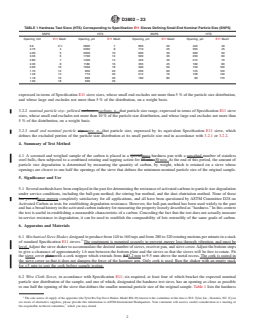
TABLE 1 Hardness Test Sieve (HTS) Corresponding to Specification E11 Sieves Defining Small-End Nominal Particle Size (SNPS)
SNPS HTS SNPS HTS
Opening, mm E11 Mesh Opening, μm E11 Mesh Opening, μm E11 Mesh Opening, μm E11 Mesh
5.6 3 ⁄2 2800 7 850 20 425 40
4.75 4 2360 8 710 25 355 45
4.00 5 2000 10 600 30 300 50
3.35 6 1700 12 500 35 250 60
2.80 7 1400 14 425 40 212 70
2.36 8 1180 16 355 45 180 80
2.00 10 1000 18 300 50 150 100
1.70 12 850 20 250 60 125 120
1.40 14 710 25 212 70 106 140
1.18 16 600 30 180 80 90 170
1.00 18 500 35
degradation resistance. However, the ball-pan method has been a combined rotating and tapping action for at least 24 h.
used widely in the past and has a broad history in the activated Consistent surface roughness may also be verified by internal
carbon industry for measuring the property loosely described reference material conformance.
as “hardness.” In this context the test is useful in establishing
6.5 Adjustable Interval Timer, with a precision of at least
a measurable characteristic of a carbon. Conceding the fact that
65 s, duration at least 600 s (10 min).
the test does not actually measure in-service resistance to
6.6 Sample Splitter, single-stage riffle type, in accordance
degradation, it can be used to establish the comparability of
with 30.5.2 of Practice E300.
lots ostensibly of the same grade of carbon.
6.7 Balance, with sensitivity and accuracy of at least 0.1 g.
6. Apparatus and Materials
6.8 Soft Brass-Wire Brush.
6.1 Mechanical Sieve Shaker, designed to produce from 140
6.9 Steel Balls (Preferably Type 316 Stainless), fifteen solid
to 160 taps and from 280 to 320 rotating motions per minute in
3 12.7 mm 6 0.1 mm in diameter and fifteen solid 9.5 mm 6
a stack of standard Specification E11 sieves. The equipment is
0.1 mm in diameter.
mounted securely to prevent energy loss through vibration, and
must be level. Adjust the sieve shaker to accommodate the
7. Sampling
desired number of sieves, receiver pan, and sieve cover. Adjust
7.1 Guidance in sampling granular activated carbon is given
the bottom stops to give a clearance of approximately 1.6 mm
in Practice E300.
between the bottom plate and the sieves so that the sieves will
be free to rotate. Fit the sieve cover with a cork stopper which
8. Calibration
extends from 3.2 mm to 9.5 mm above the metal recess. The
cork is seated in the sieve cover so that it does not dampen the 8.1 Calibration of balances shall be maintained by standard
force of the hammer arm. Only cork is used. Run the shaker laboratory methods. Sieves shall be calibrated at reasonable
with an empty stack for >3 min to seat the cork before sample intervals in accordance with the procedure described in Speci-
testing. fication E11.
6.2 Wire Cloth Sieves, in accordance with Specification E11;
9. Verification
six required, at least four of which bracket the expected
9.1 Verification of mechanical sieve shaker equipment shall
nominal particle size distribution of the sample, and one of
occur regularly, proportional to use. The height of the lift rod
which, designated the hardness test sieve, has an opening as
has a significant impact on the grinding force of the shaker and
close as possible to one half the opening of the sieve that
is verified relative to the equipment manufacturer’s specifica-
defines the smaller nominal particle size of the original sample.
tions.
Table 1 lists the hardness test sieve corresponding to each
minimum nominal sieve.
10. Procedure
6.3
...
This document is not an ASTM standard and is intended only to provide the user of an ASTM standard an indication of what changes have been made to the previous version. Because
it may not be technically possible to adequately depict all changes accurately, ASTM recommends that users consult prior editions as appropriate. In all cases only the current version
of the standard as published by ASTM is to be considered the official document.
Designation: D3802 − 16 D3802 − 23
Standard Test Method for
Ball-Pan Hardness of Activated Carbon
This standard is issued under the fixed designation D3802; the number immediately following the designation indicates the year of
original adoption or, in the case of revision, the year of last revision. A number in parentheses indicates the year of last reapproval. A
superscript epsilon (´) indicates an editorial change since the last revision or reapproval.
1. Scope
1.1 This test method covers a procedure for determining the ball-pan hardness number of granular activated carbons. For the
purpose of this test, granular activated carbons are those having particles 90 % of which are larger than 80 mesh (180 μm) (180 μm)
as determined by Test Method D2862.
1.2 The values stated in SI units are to be regarded as standard. No other units of measurement are included in this standard.
1.3 This standard does not purport to address all of the safety concerns, if any, associated with its use. It is the responsibility
of the user of this standard to establish appropriate safety and healthsafety, health, and environmental practices and determine
the applicability of regulatory limitations prior to use.
1.4 This international standard was developed in accordance with internationally recognized principles on standardization
established in the Decision on Principles for the Development of International Standards, Guides and Recommendations issued
by the World Trade Organization Technical Barriers to Trade (TBT) Committee.
2. Referenced Documents
2.1 ASTM Standards:
B19 Specification for Cartridge Brass Sheet, Strip, Plate, Bar, and Disks
B150/B150M Specification for Aluminum Bronze Rod, Bar, and Shapes
D2652 Terminology Relating to Activated Carbon
D2854 Test Method for Apparent Density of Activated Carbon
D2862 Test Method for Particle Size Distribution of Granular Activated Carbon
D2867 Test Methods for Moisture in Activated Carbon
E11 Specification for Woven Wire Test Sieve Cloth and Test Sieves
E300 Practice for Sampling Industrial Chemicals
3. Terminology
3.1 General—Terms applicable to this standard are defined in Terminology D2652.
3.2 Definitions of Terms Specific to This Standard:
3.2.1 nominal particle size: natural, granular, and irregularly shaped particle carbons—carbons, n—that particle size range,
This test method is under the jurisdiction of ASTM Committee D28 on Activated Carbon and is the direct responsibility of Subcommittee D28.04 on Gas Phase
Evaluation Tests.
Current edition approved June 1, 2016June 1, 2023. Published July 2016July 2023. Originally approved in 1979. Last previous edition approved in 20102016 as
D3802 – 10.D3802 – 16. DOI: 10.1520/D3802-16.10.1520/D3802-23.
For referenced ASTM standards, visit the ASTM website, www.astm.org, or contact ASTM Customer Service at service@astm.org. For Annual Book of ASTM Standards
volume information, refer to the standard’s Document Summary page on the ASTM website.
Copyright © ASTM International, 100 Barr Harbor Drive, PO Box C700, West Conshohocken, PA 19428-2959. United States
D3802 − 23
TABLE 1 Hardness Test Sieve (HTS) Corresponding to Specification E11 Sieves Defining Small-End Nominal Particle Size (SNPS)
SNPS HTS SNPS HTS
Opening, mm E11 Mesh Opening, μm E11 Mesh Opening, μm E11 Mesh Opening, μm E11 Mesh
5.6 3 ⁄2 2800 7 850 20 425 40
4.75 4 2360 8 710 25 355 45
4.00 5 2000 10 600 30 300 50
3.35 6 1700 12 500 35 250 60
2.80 7 1400 14 425 40 212 70
2.36 8 1180 16 355 45 180 80
2.00 10 1000 18 300 50 150 100
1.70 12 850 20 250 60 125 120
1.40 14 710 25 212 70 106 140
1.18 16 600 30 180 80 90 170
1.00 18 500 35
expressed in terms of Specification E11 sieve sizes, whose small end excludes not more than 5 % of the particle size distribution,
and whose large end excludes not more than 5 % of the distribution, on a weight basis.
3.2.2 nominal particle size: pelleted carbons—carbons, n—that particle size range, expressed in terms of Specification E11 sieve
sizes, whose small end excludes not more than 10 % of the particle size distribution, and whose large end excludes not more than
5 % of the distribution, on a weight basis.
3.2.3 small end nominal particle size—size, n—that particle size, expressed by its equivalent Specification E11 sieve, which
defines the excluded portion of the particle size distribution at its small particle size end in accordance with 3.2.1 or 3.2.2.
4. Summary of Test Method
4.1 A screened and weighed sample of the carbon is placed in a specialbrass hardness pan with a specified number of stainless
steel balls, then subjected to a combined rotating and tapping action for 30 min. 30 min. At the end of this period, the amount of
particle size degradation is determined by measuring the quantity of carbon, by weight, which is retained on a sieve whose
openings are closest to one half the openings of the sieve that defines the minimum nominal particle size of the original sample.
5. Significance and Use
5.1 Several methods have been employed in the past for determining the resistance of activated carbons to particle size degradation
under service conditions, including the ball-pan method, the stirring bar method, and the dust elutriation method. None of these
has provedhave proven completely satisfactory for all applications, and all have been questioned by ASTM Committee D28 on
Activated Carbon as tests for establishing degradation resistance. However, the ball-pan method has been used widely in the past
and has a broad history in the activated carbon industry for measuring the property loosely described as “hardness.” In this context
the test is useful in establishing a measurable characteristic of a carbon. Conceding the fact that the test does not actually measure
in-service resistance to degradation, it can be used to establish the comparability of lots ostensibly of the same grade of carbon.
6. Apparatus and Materials
6.1 Mechanical Sieve Shaker, designed to produce from 140 to 160 taps and from 280 to 320 rotating motions per minute in a stack
of standard Specification E11 sieves. The equipment is mounted securely to prevent energy loss through vibration, and must be
level. Adjust the sieve shaker to accommodate the desired number of sieves, receiver pan, and sieve cover. Adjust the bottom stops
to give a clearance of approximately 1.6 mm between the bottom plate and the sieves so that the sieves will be free to rotate. Fit
the sieve cover plate with a cork stopper which extends from 3.23.2 mm to 9.5 mm above the metal recess. The cork is seated in
the sieve cover so that it does not dampen the force of the hammer arm. Only cork is used. Run the shaker with an empty stack
for >3 min to seat the cork before sample testing.
6.2 Wire Cloth Sieves, in accordance with Specification E11; six required, at least four of which bracket the expected nominal
particle size distribution of the sample, and one of which, designated the hardness test sieve, has an opening as close as possible
to one half the opening of the sieve that defines the smaller nominal particle size of the original sample. Table 1 lists the hardness
The sole source of supply of the apparatus (the Tyler Ro-Tap Sieve Shaker, Model RX-29) known to the committee at this time is W.S. Tyler, Inc., Gastonia, NC. If you
are aware of alternative suppliers, please provide this information to ASTM International Headquarters. Your comments will receive careful consideration at a meeting of
the responsible technical committee, which you may attend.
D3802 − 23
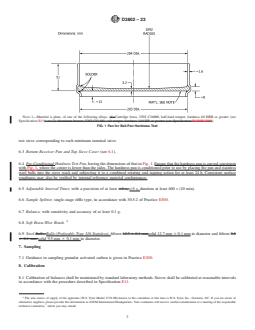
NOTE 1—Material is plate, of one of the following alloys: (1) Cartridge brass, UNS C26000, half-hard temper, hardness 60 HRB or greater (see
Specification B19); or (2) Aluminum bronze, UNS C61400, soft temper, hardness 140 HB or greater (see Specification B150/B150M).
FIG. 1 Pan for Ball-Pan Hardness Test
test sieve corresponding to each minimum nominal sieve.
6.3 Bottom Receiver Pan and Top Sieve Cover (see 6.1).
6.4 Pre-Conditioned Hardness Test Pan, having the dimensions of that in Fig. 1. Ensure that the hardness pan is curved consistent
with Fig. 1, where the center is lower than the sides. The hardness pan is conditioned prior to use by placing the pan and stainless
steel balls into the sieve stack and subjecting it to a combined rotating and tapping action for at least 24 h. Consistent surface
roughness may also be verified by internal reference material conformance.
6.5 Adjustable Interval Timer, with a
...