

ASTM E953-23
(Test Method)Standard Test Method for Fusibility of Refuse-Derived Fuel (RDF) Ash
General Information
- Abstract
SIGNIFICANCE AND USE
4.1 This standard is for determining the fusibility of ash produced from RDF.
4.2 Limitations of Ash Fusibility Data—Ash fusibility data are often over-interpreted. In practice, types of burning equipment, rate of burning, temperature and thickness of fire bed or ball, distribution of ash forming mineral matter in the RDF, and viscosity of the molten ash may influence ash behavior more than the ash fusibility characteristics determined by the laboratory test. Also, conditions existing during applied combustion of RDF are so complex that they are impossible to duplicate completely in a small-scale laboratory test. Therefore, the analysis should be considered an empirical one and the data only qualitative.
SCOPE
1.1 This test method covers the observation of the temperatures at which triangular pyramids (cones) prepared from RDF ash attain and pass through certain stages of fusing and flow when heated at a specific rate in controlled, mildly reducing, and oxidizing atmospheres.
1.2 The test method is empirical, and strict observance of the requirements and conditions is necessary to obtain reproducible temperatures and enable different laboratories to obtain comparable results.
1.3 The values stated in SI units are to be regarded as standard. The values given in parentheses are for information only.
1.4 This standard does not purport to address all of the safety concerns, if any, associated with its use. It is the responsibility of the user of this standard to establish appropriate safety, health, and environmental practices and determine the applicability of regulatory limitations prior to use.
1.5 This international standard was developed in accordance with internationally recognized principles on standardization established in the Decision on Principles for the Development of International Standards, Guides and Recommendations issued by the World Trade Organization Technical Barriers to Trade (TBT) Committee.
- Status
- Published
- Publication Date
- 31-Oct-2023
- Technical Committee
- D34 - Waste Management
- Drafting Committee
- D34.03 - Treatment, Recovery and Reuse
Overview
ASTM E953-23 is the internationally recognized standard test method for determining the fusibility of ash generated from refuse-derived fuel (RDF). Developed by ASTM International, this standard establishes systematic laboratory procedures to observe and record the temperatures at which RDF ash transitions through various stages of fusion and flow under regulated atmospheres. The data gained from this empirical method are qualitative and support the assessment, classification, and comparison of RDF fuels intended for waste-to-energy and other thermal processing applications.
Key Topics
Empirical Fusibility Testing: The standard describes a procedure in which cones, formed from RDF ash, are systematically heated in controlled mildly reducing or oxidizing atmospheres. Observations are made at specific temperature points where the cones deform, soften, become hemispherical, or fluidize.
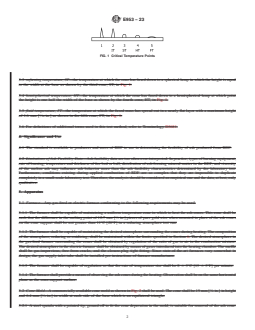
Critical Temperature Points: Key indicators recorded in the test are
- Initial Deformation Temperature (IT): First signs of apex rounding.
- Softening Temperature (ST): Cone fuses down to a sphere where height equals base width.
- Hemispherical Temperature (HT): Height is half the base width.
- Fluid Temperature (FT): Ash spreads to a nearly flat shape with minimal height.
Controlled Atmospheres: The procedure mandates controlled use of either gas-fired or electric furnaces, maintaining strictly defined oxidizing or reducing environments to replicate, as closely as possible, intended industrial conditions.
Significance and Limitations: Results provide practical, comparative insight into the fusibility of RDF ash. However, actual ash behavior in thermal equipment is influenced by many complex variables-such as burning equipment type, firebed thickness, and ash viscosity-which cannot be fully simulated in laboratory settings. Therefore, test data are qualitative and supplemental.
Applications
The ASTM E953-23 standard is widely used in waste management, energy production, and environmental compliance. Its practical uses include:
- Waste-to-Energy Plant Design: Engineers and operators utilize ash fusibility data to select or design combustion equipment less prone to slagging and fouling.
- Process Optimization: Operators use qualitative fusibility information to anticipate operational challenges in RDF-fired boilers or incinerators, aiding in maintenance planning and process efficiency.
- Quality Control for RDF Fuels: Producers and buyers of RDF can compare the fusibility characteristics of different fuel batches, supporting procurement decisions and contractual specifications.
- Compliance and Reporting: Regulatory bodies or facility managers may reference this test for environmental reporting, emissions monitoring, or adherence to legislation pertaining to the combustion of waste-derived materials.
Related Standards
Several related standards complement ASTM E953-23 in the field of RDF analysis and waste management:
- ASTM E829 - Practice for Preparing Refuse-Derived Fuel (RDF) Laboratory Samples for Analysis: Outlines protocols for specimen preparation to ensure representativeness.
- ASTM D5681 - Terminology for Waste and Waste Management: Provides definitions and clarifications of terms used in waste characterization, processing, and analytics.
Summary
ASTM E953-23 offers a consistent, comparative, and practical approach to evaluating the fusibility of RDF ash, enabling informed decision-making in waste-fueled combustion and energy recovery projects. It supports the optimization of operational processes, assists in equipment design, and ensures better resource management while recognizing the limitations inherent in empirical, laboratory-derived data. For professionals working in waste management, energy recovery from refuse, and environmental compliance, adherence to ASTM E953-23 helps promote standardization and reliability in RDF fuel assessment.
Relations
- Effective Date
- 01-Nov-2023
- Effective Date
- 01-Nov-2023
- Effective Date
- 01-May-2022
Get Certified
Connect with accredited certification bodies for this standard

Element Materials Technology
Materials testing and product certification.

ABS Group Brazil
ABS Group certification services in Brazil.

ABS Quality Evaluations Inc.
American Bureau of Shipping quality certification.
Sponsored listings
Frequently Asked Questions
ASTM E953-23 is a standard published by ASTM International. Its full title is "Standard Test Method for Fusibility of Refuse-Derived Fuel (RDF) Ash". This standard covers: SIGNIFICANCE AND USE 4.1 This standard is for determining the fusibility of ash produced from RDF. 4.2 Limitations of Ash Fusibility Data—Ash fusibility data are often over-interpreted. In practice, types of burning equipment, rate of burning, temperature and thickness of fire bed or ball, distribution of ash forming mineral matter in the RDF, and viscosity of the molten ash may influence ash behavior more than the ash fusibility characteristics determined by the laboratory test. Also, conditions existing during applied combustion of RDF are so complex that they are impossible to duplicate completely in a small-scale laboratory test. Therefore, the analysis should be considered an empirical one and the data only qualitative. SCOPE 1.1 This test method covers the observation of the temperatures at which triangular pyramids (cones) prepared from RDF ash attain and pass through certain stages of fusing and flow when heated at a specific rate in controlled, mildly reducing, and oxidizing atmospheres. 1.2 The test method is empirical, and strict observance of the requirements and conditions is necessary to obtain reproducible temperatures and enable different laboratories to obtain comparable results. 1.3 The values stated in SI units are to be regarded as standard. The values given in parentheses are for information only. 1.4 This standard does not purport to address all of the safety concerns, if any, associated with its use. It is the responsibility of the user of this standard to establish appropriate safety, health, and environmental practices and determine the applicability of regulatory limitations prior to use. 1.5 This international standard was developed in accordance with internationally recognized principles on standardization established in the Decision on Principles for the Development of International Standards, Guides and Recommendations issued by the World Trade Organization Technical Barriers to Trade (TBT) Committee.
SIGNIFICANCE AND USE 4.1 This standard is for determining the fusibility of ash produced from RDF. 4.2 Limitations of Ash Fusibility Data—Ash fusibility data are often over-interpreted. In practice, types of burning equipment, rate of burning, temperature and thickness of fire bed or ball, distribution of ash forming mineral matter in the RDF, and viscosity of the molten ash may influence ash behavior more than the ash fusibility characteristics determined by the laboratory test. Also, conditions existing during applied combustion of RDF are so complex that they are impossible to duplicate completely in a small-scale laboratory test. Therefore, the analysis should be considered an empirical one and the data only qualitative. SCOPE 1.1 This test method covers the observation of the temperatures at which triangular pyramids (cones) prepared from RDF ash attain and pass through certain stages of fusing and flow when heated at a specific rate in controlled, mildly reducing, and oxidizing atmospheres. 1.2 The test method is empirical, and strict observance of the requirements and conditions is necessary to obtain reproducible temperatures and enable different laboratories to obtain comparable results. 1.3 The values stated in SI units are to be regarded as standard. The values given in parentheses are for information only. 1.4 This standard does not purport to address all of the safety concerns, if any, associated with its use. It is the responsibility of the user of this standard to establish appropriate safety, health, and environmental practices and determine the applicability of regulatory limitations prior to use. 1.5 This international standard was developed in accordance with internationally recognized principles on standardization established in the Decision on Principles for the Development of International Standards, Guides and Recommendations issued by the World Trade Organization Technical Barriers to Trade (TBT) Committee.
ASTM E953-23 is classified under the following ICS (International Classification for Standards) categories: 75.160.10 - Solid fuels. The ICS classification helps identify the subject area and facilitates finding related standards.
ASTM E953-23 has the following relationships with other standards: It is inter standard links to ASTM E953/E953M-16, ASTM D5681-23, ASTM D5681-22e1. Understanding these relationships helps ensure you are using the most current and applicable version of the standard.
ASTM E953-23 is available in PDF format for immediate download after purchase. The document can be added to your cart and obtained through the secure checkout process. Digital delivery ensures instant access to the complete standard document.
Standards Content (Sample)
This international standard was developed in accordance with internationally recognized principles on standardization established in the Decision on Principles for the
Development of International Standards, Guides and Recommendations issued by the World Trade Organization Technical Barriers to Trade (TBT) Committee.
Designation: E953 − 23
Standard Test Method for
Fusibility of Refuse-Derived Fuel (RDF) Ash
This standard is issued under the fixed designation E953; the number immediately following the designation indicates the year of
original adoption or, in the case of revision, the year of last revision. A number in parentheses indicates the year of last reapproval. A
superscript epsilon (´) indicates an editorial change since the last revision or reapproval.
1. Scope 3.1.1 The critical temperature points to be observed are as
follows, denoting the atmosphere used:
1.1 This test method covers the observation of the tempera-
3.1.2 fluid temperature, FT—the temperature at which the
tures at which triangular pyramids (cones) prepared from RDF
fused mass has spread out in a nearly flat layer with a
ash attain and pass through certain stages of fusing and flow
maximum height of 1.6 mm ( ⁄16 in.) as shown in the fifth cone,
when heated at a specific rate in controlled, mildly reducing,
FT, in Fig. 1.
and oxidizing atmospheres.
3.1.3 hemispherical temperature, HT—the temperature at
1.2 The test method is empirical, and strict observance of
which the cone has fused down to a hemispherical lump at
the requirements and conditions is necessary to obtain repro-
which point the height is one half the width of the base as
ducible temperatures and enable different laboratories to obtain
shown by the fourth cone, HT, in Fig. 1.
comparable results.
3.1.4 initial deformation temperature, IT—the temperature
1.3 The values stated in SI units are to be regarded as
at which the first rounding of the apex of the cone occurs.
standard. The values given in parentheses are for information
Shrinking or warping of the cone is ignored if the tip remains
only.
sharp. In Fig. 1, the first cone shown is an unheated one; the
1.4 This standard does not purport to address all of the
second cone, IT, is a typical cone at the initial deformation
safety concerns, if any, associated with its use. It is the
stage.
responsibility of the user of this standard to establish appro-
3.1.5 softening temperature, ST—the temperature at which
priate safety, health, and environmental practices and deter-
the cone has fused down to a spherical lump in which the
mine the applicability of regulatory limitations prior to use.
height is equal to the width at the base as shown by the third
1.5 This international standard was developed in accor-
cone, ST, in Fig. 1.
dance with internationally recognized principles on standard-
3.2 For definitions of additional terms used in this test
ization established in the Decision on Principles for the
method, refer to Terminology D5681.
Development of International Standards, Guides and Recom-
mendations issued by the World Trade Organization Technical
4. Significance and Use
Barriers to Trade (TBT) Committee.
4.1 This standard is for determining the fusibility of ash
produced from RDF.
2. Referenced Documents
2.1 ASTM Standards: 4.2 Limitations of Ash Fusibility Data—Ash fusibility data
are often over-interpreted. In practice, types of burning
D5681 Terminology for Waste and Waste Management
E829 Practice for Preparing Refuse-Derived Fuel (RDF) equipment, rate of burning, temperature and thickness of fire
Laboratory Samples for Analysis bed or ball, distribution of ash forming mineral matter in the
RDF, and viscosity of the molten ash may influence ash
3. Terminology
behavior more than the ash fusibility characteristics determined
by the laboratory test. Also, conditions existing during applied
3.1 Definitions:
combustion of RDF are so complex that they are impossible to
duplicate completely in a small-scale laboratory test.
This test method is under the jurisdiction of ASTM Committee D34 on Waste
Therefore, the analysis should be considered an empirical one
Management and is the direct responsibility of Subcommittee D34.03 on Treatment,
and the data only qualitative.
Recovery and Reuse.
Current edition approved Nov. 1, 2023. Published November 2023. Originally
5. Apparatus
approved in 1983. Last previous edition approved in 2016 as E953/E953M – 16.
DOI: 10.1520/E0953-23.
5.1 Furnace—Any gas-fired or electric furnace conforming
For referenced ASTM standards, visit the ASTM website, www.astm.org, or
to the following requirements may be used.
contact ASTM Customer Service at service@astm.org. For Annual Book of ASTM
5.1.1 The furnace shall be capable of maintaining a uniform
Standards volume information, refer to the standard’s Document Summary page on
the ASTM website. temperature zone in which to heat the ash cones. This zone
Copyright © ASTM International, 100 Barr Harbor Drive, PO Box C700, West Conshohocken, PA 19428-2959. United States
E953 − 23
5.2.1 A steel spatula with a pointed tip, ground off to fit the
cone depression in the mold, is suitable for removal of the ash
cone.
5.3 Optical Pyrometer or Thermocouple, for temperature
measurements, conforming to the following requirements:
5.3.1 Optical Pyrometer—An optical pyrometer of the dis-
FIG. 1 Critical Temperature Points
appearing filament type shall be used. The instrument shall
have been calibrated to be accurate within 11 °C (20 °F) up to
1400 °C (2550 °F) and within 16 °C (30 °F) from 1400 to
shall be such that the difference in the melting point of
1600 °C (2550 °F to 2910 °F) (Note 1). The pyrometer fila-
12.7 mm ( ⁄2 in.) pieces of pure gold wire when mounted in
ment shall be sighted on the cones until the softening point
place of the ash cones on the cone support shall be not greater
temperature (Fig. 1) has been passed, and then sighted on the
than 11 °C (20 °F) in a reducing atmosphere test run.
cone support. The pyrometer shall have readable graduations
5.1.2 The furnace shall be capable of maintaining the
not larger than 5.5 °C (10 °F).
desired atmosphere surrounding the cones during heating. The
NOTE 1—The pyrometer equipment shall be calibrated periodically by
composition of the atmosphere, reducing or oxidizing, shall be
a suitably equipped standardizing laboratory such as that of the National
maintained within the limits specified in Section 6. The desired
Institute of Standards and Technology (NIST), or verified periodically
atmosphere in the gas-fired furnace shall be obtained by
against equipment certified by NIST.
regulation of the ratio of gas to air in the combustion mixture.
5.3.2 Thermocouple—A thermocouple of platinum and
The electric furnace desired atmosphere shall be obtained by
platinum-rhodium, protected from the furnace gases by a
means of gases introduced into the heating chamber. The
glazed porcelain sheath, shall be used with a high-resistance
muffle shall be gas impervious, free from cracks, and the
millivoltmeter or potentiometer accurate and readable to within
closure plug tight fitting. Since state-of-the-art furnaces vary in
5.5 °C (10 °F). The sheath shall be attached to the furnace wall
design, the gas supply inlet tube shall be installed per instruc-
by alundum cement. The hot junction of the thermocouple shall
tions of the furnace manufacturer.
touch the end of the sheath and shall be placed in the center of
5.1.3 The furnace shall be capable of temperature regulation
the muffle furnace and immediately to the rear of the cones.
where the rise shall be 8 6 3 °C (15 6 5 °F) per minute.
The thermocouple protective sheath shall be checked periodi-
5.1.4 The furnace shall provide a means of observing the
cally for cracks. The thermocouple and its meter shall meet the
ash cones during the heating. Observation shall be on the same
requirements of Section 9. The potentiometer or millivoltmeter
horizontal plane as the cone-support surface.
shall be located and shielded adequately to prevent radiant or
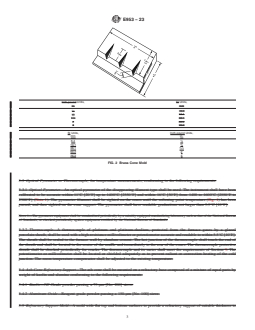
5.2 Cone Mold—A commercially available cone mold as
convection heating of the cold junction. The room temperature
shown in Fig. 2 shall be used. The cone shall be 19 mm ( ⁄4 in.)
compensator shall be adjusted to the existing temperature.
in height and 6.4 mm ( ⁄4 in.) in width at each side of the base.
5.4 Ash-Cone Refractory Support—The ash cone shall be
mounted on a refractory base composed of a mixture of equal
parts by weight of kaolin and alumina conforming to the
following requirements:
5.4.1 Kaolin—NF grade powder passing a 75 μm (No. 200)
sieve.
5.4.2 Aluminum Oxide—Reagent grade powder passing a
150 μm (No. 100) sieve.
5.5 Refractory Support Mold—A mold with flat top and
bottom surfaces to provide a refractory support of suitable
thickness to minimize warping shall be used. A side mold not
over 6.4 mm ( ⁄4 in.) high of any convenient shape, placed on
an iron plate so that the top surface of the refractory mix can
be struck off flat and parallel to the base by means of a
straightedge, is satisfactory. For electric furnace use, legs not
over 3 mm ( ⁄8 in.) long may be provided on the corners of the
cone support by suitable holes bored in the iron base plate of
the mold.
SI Units, Inch-pound Units,
mm in.
5.6 Gold Wire, twenty-four gage or larger round wire of
6.4 ⁄4
99.98 % purity, but drawn from metal of 99.99 % purity, and
19.1 ⁄4
having a melting point of 1063 °C (1945 °F).
38.1 1 ⁄2
50.2 2
5.7 Nickel Wire, twenty-four gage or larger round wire of
76.2 3
CP nickel 99.98 % pure, fully annealed, and having a melting
FIG. 2 Brass Cone Mold point of 1452 °C (2645 °F).
E953 − 23
NOTE 2—A mechanical agate mortar grinder will save time where many
6. Test Atmosphere
determinations are made. An iron mortar or pestle is not recommended
6.1 Gas-Fired Furnace:
because of metallic contamination.
6.1.1 Reducing Atmosphere Test—In the gas-fired furnace, a
7.2 Spread the ash in a thin layer in a fireclay, silica, or
mildly reducing atmosphere surrounding the cones shall be
porcelain dish and ignite it in a stream of oxygen for 1 ⁄2 h at
maintained during the test. Hydrogen, hydrocarbons, and
800 to 850 °C (1470 to 1560 °F) to ensure complete and
carbon monoxide are defined as reducing gases; oxygen,
uniform oxidation of the ash. Any tube or muffle-type furnace
carbon dioxide, and water vapor are defined as oxidizing gases.
which, when supplied with an oxygen flow of not less than one
Nitrogen is inert. The ratio by volume of reducing gases to
furnace volume in 5 min will maintain a highly oxidizing
oxidizing gases in the atmosphere shall be between the limits
atmosphere, is suitable.
of 20 to 80 %, that is, on a nitrogen-free basis, the total amount
of reducing gases present shall be between the limits of 20 and
NOTE 3—It has been found that in most samples, the initial ignition
outlined in 7.1 is sufficient to convert the RDF to ash and the reignition
80 volume %. A flame 150 to 200 mm (6 to 8 in.) in height and
step in 7.2 is unnecessary. Reignition of the ash should be made only if an
tinged with yellow above the furnace outlet has been found to
observable amount of noncombustible matter or carbon is pr
...
This document is not an ASTM standard and is intended only to provide the user of an ASTM standard an indication of what changes have been made to the previous version. Because
it may not be technically possible to adequately depict all changes accurately, ASTM recommends that users consult prior editions as appropriate. In all cases only the current version
of the standard as published by ASTM is to be considered the official document.
Designation: E953/E953M − 16 E953 − 23
Standard Practice Test Method for
Fusibility of Refuse-Derived Fuel (RDF) Ash
This standard is issued under the fixed designation E953/E953M;E953; the number immediately following the designation indicates the
year of original adoption or, in the case of revision, the year of last revision. A number in parentheses indicates the year of last
reapproval. A superscript epsilon (´) indicates an editorial change since the last revision or reapproval.
1. Scope
1.1 This practice covers the observation of the temperatures at which triangular pyramids (cones) prepared from RDF ash attain
and pass through certain stages of fusing and flow when heated at a specific rate in controlled, mildly-reducing, and oxidizing
atmospheres.
1.2 The test method is empirical, and strict observance of the requirements and conditions is necessary to obtain reproducible
temperatures and enable different laboratories to obtain concordant results.
1.3 The values stated in either SI units or inch-pound units are to be regarded separately as standard. The values stated in each
system may not be exact equivalents; therefore, each system shall be used independently of the other. Combining values from the
two systems may result in non-conformance with the standard.
1.4 This standard does not purport to address all of the safety problems, if any, associated with its use. It is the responsibility
of the user of this standard to establish appropriate safety and health practices and determine the applicability of regulatory
limitations prior to use.
1.5 This international standard was developed in accordance with internationally recognized principles on standardization
established in the Decision on Principles for the Development of International Standards, Guides and Recommendations issued
by the World Trade Organization Technical Barriers to Trade (TBT) Committee.
2. Referenced Documents
2.1 ASTM Standards:
D5681 Terminology for Waste and Waste Management
E829 Practice for Preparing Refuse-Derived Fuel (RDF) Laboratory Samples for Analysis
3. Terminology
3.1 Definitions and Symbols—The critical temperature points to be observed are as follows, denoting the atmosphere used:
3.2 initial deformation temperature, IT—the temperature at which the first rounding of the apex of the cone occurs. Shrinking or
warping of the cone is ignored if the tip remains sharp. In Fig. 1, the first cone shown is an unheated one; the second cone, IT,
is a typical cone at the initial deformation stage.
This practice test method is under the jurisdiction of ASTM Committee D34 on Waste Management and is the direct responsibility of Subcommittee D34.03 on Treatment,
Recovery and Reuse.
Current edition approved Nov. 15, 2016Nov. 1, 2023. Published November 2016November 2023. Originally approved in 1983. Last previous edition approved in 20082016
as E953/E953M – 08.E953/E953M – 16. DOI: 10.1520/E0953_E0953M-16.10.1520/E0953-23.
For referenced ASTM standards, visit the ASTM website, www.astm.org, or contact ASTM Customer Service at service@astm.org. For Annual Book of ASTM Standards
volume information, refer to the standard’s Document Summary page on the ASTM website.
Copyright © ASTM International, 100 Barr Harbor Drive, PO Box C700, West Conshohocken, PA 19428-2959. United States
E953 − 23
FIG. 1 Critical Temperature Points
3.3 softening temperature, ST—the temperature at which the cone has fused down to a spherical lump in which the height is equal
to the width at the base as shown by the third cone, ST, in Fig. 1.
3.4 hemispherical temperature, HT—the temperature at which the cone has fused down to a hemispherical lump at which point
the height is one half the width of the base as shown by the fourth cone, HT, in Fig. 1.
3.5 fluid temperature, FT—the temperature at which the fused mass has spread out in a nearly flat layer with a maximum height
of 1.6 mm [ ⁄16 in.] as shown in the fifth cone, FT, in Fig. 1.
3.6 For definitions of additional terms used in this test method, refer to Terminology D5681.
4. Significance and Use
4.1 The standard is available to producers and users of RDF to use in determining the fusibility of ash produced from RDF.
4.2 Limitations of Ash Fusibility Data—Ash fusibility data are too often over-interpreted. In practice, types of burning equipment,
rate of burning, temperature and thickness of fire bed or ball, distribution of ash forming mineral matter in the RDF, and viscosity
of the molten ash may influence ash behavior more than the ash fusibility characteristics determined by the laboratory test.
Furthermore, conditions existing during applied combustion of RDF are so complex that they are impossible to duplicate
completely in a small-scale laboratory test. Therefore, the analysis should be considered an empirical one and the data, at best, only
qualitative.
5. Apparatus
5.1 Furnace—Any gas-fired or electric furnace conforming to the following requirements may be used.
5.1.1 The furnace shall be capable of maintaining a uniform temperature zone in which to heat the ash cones. This zone shall be
such that the difference in the melting point of 12.7 mm [ ⁄2 in.] pieces of pure gold wire when mounted in place of the ash cones
on the cone support shall be not greater than 11°C [20°F] in a reducing atmosphere test run.
5.1.2 The furnace shall be capable of maintaining the desired atmosphere surrounding the cones during heating. The composition
of the atmosphere, reducing or oxidizing, shall be maintained within the limits specified in Section 6. The desired atmosphere in
the gas-fired furnace surrounding the cones shall be obtained by regulation of the ratio of gas to air in the combustion mixture.
The desired atmosphere in the electric furnace shall be obtained by means of gases introduced into the heating chamber. The muffle
shall be gas-impervious, free from cracks, and the closure-plug tight fitting. Since state-of-the-art furnaces vary somewhat in
design, the gas supply inlet tube shall be installed per instructions of furnace manufacturer.
5.1.3 The furnace shall be capable of regulation so that the rate of temperature rise shall be 8 6 3°C [15 6 5°F] per minute.
5.1.4 The furnace shall provide a means of observing the ash cones during the heating. Observation shall be on the same horizontal
plane as the cone-support surface.
5.2 Cone Mold—A commercially available cone mold as shown in Fig. 2 shall be used. The cone shall be 19 mm [ ⁄4 in.] in height
and 6.4 mm [ ⁄4 in.] in width at each side of the base which is an equilateral triangle.
5.2.1 A steel spatula with a pointed tip, ground off to fit the cone depression in the mold, is suitable for removal of the ash cone.
E953 − 23
Inch-pound Units, SI Units,
in. mm
⁄4 6.4
⁄4 19.1
1 ⁄2 38.1
2 50.2
3 76.2
SI Units, Inch-pound Units,
mm in.
6.4 ⁄4
19.1 ⁄4
38.1 1 ⁄2
50.2 2
76.2 3
FIG. 2 Brass Cone Mold
5.3 Optical Pyrometer or Thermocouple, for temperature measurements, conforming to the following requirements:
5.3.1 Optical Pyrometer—An optical pyrometer of the disappearing filament type shall be used. The instrument shall have been
calibrated to be accurate within 11°C [20°F] up to 1400°C [2550°F] and within 16°C [30°F] from 1400 to 1600°C [2550°F to
2900°F] (Note 1). The pyrometer filament shall be sighted on the cones until the softening point temperature (Fig. 1) has been
passed, and then sighted on the cone support. The pyrometer shall have readable graduations not larger than 5.5°C [10°F].
NOTE 1—The pyrometer equipment shall be standardized periodically by a suitably equipped standardizing laboratory such as that of the National Bureau
of Standards, or checked periodically against equipment certified by the National Bureau of Standards.
5.3.2 Thermocouple—A thermocouple of platinum and platinum-rhodium, protected from the furnace gases by a glazed
porcelain sheath, shall be used with a high-resistance millivoltmeter or potentiometer accurate and readable to within 5.5°C [10°F].
The sheath shall be sealed to the furnace wall by alundum cement. The hot junction of the thermocouple shall touch the end of
the sheath and shall be located in the center of the muffle and immediately to the rear of the cones. The thermocouple protective
sheath shall be checked periodically for cracks. The thermocouple and its meter shall meet the requirements of Section 9. The
potentiometer or millivoltmeter shall be located or shielded adequately as to prevent radiant or convection heating of the cold
junction. The room temperature compensator shall be adjusted to the existing temperature.
5.4 Ash-Cone Refractory Support—The ash cone shall be mounted on a refractory base composed of a mixture of equal parts by
weight of kaolin and alumina conforming to the following requirements:
5.4.1 Kaolin—NF-Grade powder passing a 75-μm [No. 200] sieve.
5.4.2 Aluminum Oxide—Reagent grade powder passing a 150-μm [No. 100] sieve.
5.5 Refractory Support Mold—A mold with flat top and bottom surfaces to provide a refractory support of suitable thickness to
E953 − 23
minimize warping shall be used. A side mold not over 6.4 mm [ ⁄4 in.] high of any convenient shape, placed on an iron plate so
that the top surface of the refractory mix can be struck off flat and parallel to the base by means of a straightedge, is satisfactory.
For electric furnace use, legs not over 3 mm [ ⁄8 in.] long may be provided on the corners of the cone support by suitable holes
bored in the iron base plate of the mold.
5.6 Gold Wire, twenty-four gage or larger round wire of 99.98 % purity, but drawn from metal of 99.99 % purity, and having
a melting point of 1063°C [1945°F].
5.7 Nickel Wire, twenty-four gage or larger round wire of CP nickel 99.98 % pure, fully annealed, and having a melting point
of 1452°C [2645°F].
6. Test Atmosphere
6.1 Gas Fired Furnace:
6.1.1 Reducing Atmosphere Test—A mildly reducing atmosphere surrounding the cones shall be maintained during the test in the
gas-fired furnace. Hydrogen, hydrocarbons, and carbon monoxide shall be considered as reducing gases; oxygen, carbon dioxide,
and water vapor shall be considered as oxidizing gases. Nitrogen is inert. The ratio by volume of reducing gases to oxidizing gases
in the atmosphere shall be between the limits of 20 to 80 %, that is, on a nitrogen-free basis, the total amount of reducing gases
present shall be between the limits of 20 and 80 volume %. A flame 150 to 200 mm [6 to 8 in.] in height and tinged with yellow
above the furnace outlet has been found to provide an atmosphere within the specified limits.
6.1.2 Oxidizing Atmosphere Test—An atmosphere containing a minimum amount of reducing gases shall be maintained
surrounding the cones during the test in the gas-fired furnace. On a nitrogen-free basis, the volume of the reducing gases present
in the atmosphere will not exceed 10 volume %. Combustion with the maximum possible quantity of air with preservation of the
specified rate of temperature increase has been found to provide an atmosphere within the specified limits. A completely blue flame,
not over 50 mm [2 in.] in height above the outlet at the beginning of the test, provides the desired atmosphere; and, by regulation
of the combustion gas-air ratio, the specified atmosphere and temperature rise can be maintained.
6.2 Electric Furnace:
6.2.1 Reducing Atmosphere Test—A regulated flow of gas of the nominal composition, 60 % carbon monoxide and 40 6 5
volume % carbon dioxide, shall be maintained in the heating chamber throughout the test in the electric furnace. The gas stream
shall be regulated by any convenient means to provide a measured flow of 1.3 to 1.5 furnace volumes per minute.
6.2.2 Oxidizing Atmosphere Test—A regulated stream of air shall be maintained throughout the test in the electric furnace. The gas
stream shall be regulated by any convenient means to provide a measured flow of 1.3 to 1.5 furnace volumes per minute.
7. Preparation of Ash
7.1 Use RDF milled to passing a 0.5-mm [0.02-in.] sieve prepared in accordance with Practice E829 to obtain the ash by
incineration in a well-ventilated muffle furnace. The quantity of RDF required will vary with the ash content; usually 3 to 5 g of
ash will suffice for cones for several check determinations. Spread out the analysis sample of RDF in a layer approximately 6.4
mm [ ⁄4 in.] in depth in a fireclay or porcelain roasting dish. Place the dish in the muffle at a low temperature, and gradually heat
to redness at such a rate as to avoid mechanical loss from too rapid expulsion of volatile matter. The rate of temperature rise of
500°C [932°F] in 1 h was found to be satisfactory. Complete the conversion to ash at a temperature of 800 to 900°C [1470 to
1650°F]. Transfer the ash to an agate mortar (Note 2), and grind so it will pass a No. 200 [0.074 mm] sieve.
NOTE 2—A mechanical agate mortar grinder will save time where many determinations are made. An iron mortar or pestle is not recommended because
of metallic contamination.
7.2 Spread the ash in a thin layer in a fireclay, silica, or porcelain dish and ignite it in a stream of oxygen for 1 ⁄2 h at 800 to 850°C
[1470 to 1560°F] to ensure complete and uniform oxidation of the ash. Any tube or muffle-type furnace which, when supplied with
an oxygen flow of not less than one furnace volume in 5 min will maintain a highly oxidizing atmosphere, is suitable.
For information concerning the effect of various atmospheres, see U.S. Bureau of Mines Bulletin 129, 1918.
E953 − 23
NOTE 3—It has been found that in most samples, the initial ignition outlined in 7.1 is sufficient to convert the RDF to ash and the reignition step in 7.2
is not necessary. Reignition of the ash should be made only if an observable amount of noncombustible matter or carbon is present.
8. Preparation of Cones
8.1 Thoroughly mix the ignited ash in a mechanical mixer or on a sheet of glazed paper or oil cloth by raising first one corner
to roll the ash over, and then raising each of the other corners in rotation in the same manner until each corner has been raised
five times or more.
8.2 Take sufficient ash for the number of cones desired from various parts of the bulk ash. Moisten the ash with a few drops of
a clear, filtered (if necessary) 10 % solution of dextrin containing 0:1 % salicylic acid as a preservative, and work it into a stiff
plastic mass with a spatula. Press the plastic material firmly with a spatula into the cone mold to form the triangular pyramids.
Strike off the exposed surfaces of the material smooth and remove the cones from the mold by applying pressure at the base with
a suitably pointed spatula. Previous coating of the mold with a thin layer of petroleum jelly, thinned with kerosine (if necessary),
aids in preventing adherence of the cones to the mold and in providing the sharp point and edges desired in the cone.
8.3 Place the cones in a suitable location to dry sufficiently to permit handling without deformation. Mount the dried cone
vertically on a freshly prepared refractory base. Moisten a portion of the well-mixed kaolin-alumina mixture with a minimum
amount of water to make a workable, but stiff, plastic mass and firmly press it into the support mold. Strike off the surface of the
mass flat and smooth with a steel spatula, moistening with one or two drops of water is necessary to obtain a smooth surface. A
number of cones may be mounted on one base. Make shallow triangular depressions, not over 0.8 mm [ ⁄32 in.] in depth, with a
triangular file ground to the correct size to produce a depression to fit the base of the cone, and locate the cones sufficiently distant
from adjacent cones so that no merging of the fusing material of the cones shall occur during the test. Mount the cones vertically
in the depressions while the base is still wet without the use of ash or refractory as mounting aid.
NOTE 4—The intent of the triangular depression is to enable the cones to be mounted in a sufficiently stable manner to permit handling of the prepared
support with cones.
NOTE 5—Gold wires can be mounted on each cone support beside the ash cones, and the gold melting point observed concurrently with the ash cones
in both oxidizing and reducing atmospheres.
8.4 For the calibration check run of Section 9, mount 12.7 mm [ ⁄2 in.] lengths of gold and nickel wire as described in 5.6 and
5.7 vertically on a support similar to those prepared as described in 8.3, but on which no ash cones are mounted. Insert the pieces
of wire into the support before drying. Two or more pieces of each kind of wire should be mounted on this support in locations
which correspond to ash cone positions. Dry the support as described in 8.5 but do not ignite. At least one such support with
mounted pieces of gold and nickel wire shall be prepared for each week of observation of ash fusibility.
8.5 Dry the mounted cones at 110°C [230°F], and ignite at 750°C [1382°F] to remove all carbonaceous material.
9. Calibration
9.1 At least once during each week of operation, check the optical pyrometer or the thermocouple and its meter for calibration
in place under routine test conditions with the reducing atmosphere by observing the melting point of gold. At the same time, check
the adequacy of the furnace atmosphere by observing the melting point of nickel.
9.1.1 Insert a support with mounted pieces of gold and nickel wire into the test furnace. Locate at the position used for tests of
ash cones.
9.1.2 Establish the reducing gas atmosphere, and heat the furnace chamber in accordance with 10.1.
9.1.3 Observe the temperatures shown on the meter when the pieces of wire melt.
9.1.4 The indicated melting points should be within 5.5°C [10°F] of the following:
Gold 1063°C [1945°F]
Nickel 1452°C [2645°F]
E953 − 23
9.1.5 If the indicated melting point of gold wire frequently falls outside of the desired range, readjust or calibrate the meter so that
the average temperature from several observations of the gold melting point is within the specified range.
9.1.6 If the indicated melting point for nickel wire frequently falls outside the desired range after applying the corrections in 9.1.5,
the consistency of indicated temperatures and the subsequent appearance of the specimen should be examined closely. Erratic
readings of failures to obtain melting at 1452°C [2645°F] can be due to nickel oxidation caused by an insufficient reducing
atmosphere. If a consistent error of more than 14°C [25°F] is found, the furnace atmosphere and the temperature measurement
equipment should be suspected of having faults; necessary corrections should be made.
10. Procedure
10.1 Reducing Atmosphere Test:
10.1.1 Place the mounted test cones in the furnace at a temperature of not over 800°C [1470°F] for the gas-fired furnace and not
over 400°C [750°F] for the electric furnace in order to provide sufficient time to purge the air from the uniform temperature zone
and establish the desired atmosphere.
10.1.2 If the furnace temperature is below the respective temperature specified in 10.1.1, raise it rapidly to the specified
temperature; then control the rate of heating to give a rate of temperature increase of 8 6 3°C [15 6 5°F] per minute. Maintain
this rate throughout the test.
10.1.3 Establish the mildly reducing atmosphere surrounding the cones, as specified in 6.1.1 and 6.2.1, at the temperature specified
in 10.1.1 for the respective furnace type. Maintain this atmosphere throughout the test.
NOTE 6—At temperatures of the order of 1370 to 1430°C [2500 to 2600°F] and above in the gas-fired furnace, it may not be possible to maintain the
reducing gases above the 20-volume % limit specified while also preserving the specified rate of temperature increase. At such temperatures, the effect
of the atmosphere is not so critical as the maintenance of the specified heating rate. Make every effort to maintain the reducing gases as near the 20-
volume % level as possible at such temperature.
10.2 Oxidizing Atmosphere Test:
10.2.1 Place the mounted test cones in the furnace at a temperature of not over 800°C [1470°F] for the gas-fired furnace, and not
over 400°C [750°F] for the electric furnace. If the furnace temperature is below the respective temperature specified, raise it rapidly
to the specified temperature, then control the rate of heating to give a rate of temperature increase of 8 6 3°C [15 6 5°F] per
minute. Maintain this rate throughout the test.
10.2.2 Establish the oxidizing atmosphere surrounding the cones, as specified in 6.1.2 and 6.2.2 at the temperature specified in
10.2.1 for the respective furnace type. Maintain this atmosphere throughout the test.
11. Report
11.1 Report the following information:
11.1.1 Type of atmosphere,
11.1.2 Initial deformation temperature, IT,
11.1.3 Softening temperature, ST,
11.1.4 Hemispherical temperature, HT, and
11.1.5 Fluid temperature, FT.
12. Precision and Bias
12.1 Due to the lack of any known RDF ash standard, generation of a precision and bias statement for this practice is not feasible.
E953 − 23
13. Keywords
13.1 ash; fusibility; RDF
ASTM International takes no position respecting the validity of any patent rights asserted in connection with any item mentioned
in this standard. Users of this standard are expressly advised that determination of the validity of any such patent rights, and the risk
of infringement of such rights, are entirely their own responsibility.
This standard is subject to revision at any time by the responsible technical committee and must be reviewed every five years and
if not
...