

ASTM D4827-03(2022)
(Test Method)Standard Test Method for Determining the Unreacted Monomer Content of Latexes Using Capillary Column Gas Chromatography
General Information
- Abstract
SIGNIFICANCE AND USE
4.1 Excessive amounts of unreacted monomer may cause concerns relating to toxicity and odor. This test method is designed to measure the unreacted monomer content of latexes. The results may be used to monitor the extent of polymerization during manufacture, as well as to establish maximum unreacted monomer content for regulatory purposes.
SCOPE
1.1 This test method is for the determination of the unreacted monomer content of acrylic latexes. Monomers that have been successfully determined by this procedure include n-butyl methacrylate, n-butyl acrylate, styrene, and methyl methacrylate. The determination of other monomers has not been evaluated, but this test method is believed to be applicable. The established working range of this test method is from 100 μg/g to 000 μg/g, but there is no reason to believe it will not work outside of this range, provided that appropriate dilutions and adjustments in specimen size are made.
1.2 The unreacted monomer in acrylic latexes is expected to change with time and environmental factors. This time dependence of the determination may be seen as an artificially large deviation of results, making the test method mostly applicable for in-house quality control, where sampling and analysis conditions can be better controlled.
1.3 The values stated in SI units are to be regarded as standard. No other units of measurement are included in this standard.
1.4 This standard does not purport to address all of the safety concerns, if any, associated with its use. It is the responsibility of the user of this standard to establish appropriate safety, health, and environmental practices and determine the applicability of regulatory limitations prior to use. For specific hazard statements, see Section 7.
1.5 This international standard was developed in accordance with internationally recognized principles on standardization established in the Decision on Principles for the Development of International Standards, Guides and Recommendations issued by the World Trade Organization Technical Barriers to Trade (TBT) Committee.
- Status
- Published
- Publication Date
- 30-Nov-2022
- Technical Committee
- D01 - Paint and Related Coatings, Materials, and Applications
- Drafting Committee
- D01.21 - Chemical Analysis of Paints and Paint Materials

Overview
ASTM D4827-03(2022) establishes a standardized test method for determining the unreacted monomer content of acrylic latexes using capillary column gas chromatography. Excessive unreacted monomer levels in latex products can lead to issues concerning toxicity and odor, making precise measurement essential for regulatory compliance and product quality. This standard is designed to support manufacturing quality control processes and help organizations ensure their latexes meet environmental, health, and safety requirements.
Key Topics
- Scope of Method: This standard is applicable to the determination of unreacted monomers such as n-butyl methacrylate, n-butyl acrylate, styrene, and methyl methacrylate in acrylic latexes. While these monomers have been validated, the method can potentially be extended to other monomers with suitable calibration and evaluation.
- Measurement Range: The method is effective for unreacted monomer concentrations from 100 μg/g upward, with flexibility for appropriate specimen size and dilution adjustments.
- Time Sensitivity: The content of unreacted monomer in latexes may shift over time and under varying environmental conditions, which underscores the importance of controlled, in-house quality control settings for consistent results.
- Significance of Testing: Monitoring unreacted monomer levels is crucial for evaluating polymerization efficiency during manufacturing and for setting limits that align with health and safety regulations.
Applications
ASTM D4827-03(2022) is widely used in various industrial and laboratory settings, particularly in the production and quality control of latex-based products. Key applications include:
- Manufacturing Quality Control: Detecting and quantifying unreacted monomers ensures the effectiveness of polymerization processes and helps manufacturers maintain consistent product quality.
- Regulatory Compliance: Results from this test method assist companies in demonstrating compliance with governmental or industry regulations governing acceptable monomer concentrations.
- Health and Safety Assurance: By controlling levels of potentially toxic or odorous unreacted monomers, manufacturers can reduce risks related to product safety and environmental impact.
- R&D and Product Development: Research laboratories utilize this method to optimize formulations and processing conditions to achieve low residual monomer content in new latex-based materials.
This method is especially valuable for organizations operating under frameworks that prioritize consumer safety and regulatory standards.
Related Standards
For comprehensive testing and quality assurance, the following ASTM standards are commonly referenced alongside ASTM D4827-03(2022):
- ASTM D1193 - Specification for Reagent Water, detailing requirements for water purity in analytical laboratory testing.
- Other Related Methods: Standards focusing on chemical analysis of paints, coatings, and latex vehicles, and requirements for reagent purity.
- General Test Methods: Procedures related to gas chromatography and quality control in paint and coatings industries.
Keywords: ASTM D4827, unreacted monomer content, latexes, capillary column gas chromatography, quality control, acrylic latex, regulatory compliance, monomer analysis, paint standards, residual monomer testing, latex vehicles, health and safety standards.
By following ASTM D4827-03(2022), organizations in the latex and coatings industries can improve product safety, meet regulatory requirements, and achieve high-quality end products.
Relations
- Effective Date
- 23-Dec-2019
- Effective Date
- 01-Mar-2006
- Effective Date
- 10-Feb-1999
- Effective Date
- 10-Feb-1999
Get Certified
Connect with accredited certification bodies for this standard

DIN CERTCO
DIN Group product certification.

Smithers Quality Assessments
US management systems and product certification.
Sponsored listings
Frequently Asked Questions
ASTM D4827-03(2022) is a standard published by ASTM International. Its full title is "Standard Test Method for Determining the Unreacted Monomer Content of Latexes Using Capillary Column Gas Chromatography". This standard covers: SIGNIFICANCE AND USE 4.1 Excessive amounts of unreacted monomer may cause concerns relating to toxicity and odor. This test method is designed to measure the unreacted monomer content of latexes. The results may be used to monitor the extent of polymerization during manufacture, as well as to establish maximum unreacted monomer content for regulatory purposes. SCOPE 1.1 This test method is for the determination of the unreacted monomer content of acrylic latexes. Monomers that have been successfully determined by this procedure include n-butyl methacrylate, n-butyl acrylate, styrene, and methyl methacrylate. The determination of other monomers has not been evaluated, but this test method is believed to be applicable. The established working range of this test method is from 100 μg/g to 000 μg/g, but there is no reason to believe it will not work outside of this range, provided that appropriate dilutions and adjustments in specimen size are made. 1.2 The unreacted monomer in acrylic latexes is expected to change with time and environmental factors. This time dependence of the determination may be seen as an artificially large deviation of results, making the test method mostly applicable for in-house quality control, where sampling and analysis conditions can be better controlled. 1.3 The values stated in SI units are to be regarded as standard. No other units of measurement are included in this standard. 1.4 This standard does not purport to address all of the safety concerns, if any, associated with its use. It is the responsibility of the user of this standard to establish appropriate safety, health, and environmental practices and determine the applicability of regulatory limitations prior to use. For specific hazard statements, see Section 7. 1.5 This international standard was developed in accordance with internationally recognized principles on standardization established in the Decision on Principles for the Development of International Standards, Guides and Recommendations issued by the World Trade Organization Technical Barriers to Trade (TBT) Committee.
SIGNIFICANCE AND USE 4.1 Excessive amounts of unreacted monomer may cause concerns relating to toxicity and odor. This test method is designed to measure the unreacted monomer content of latexes. The results may be used to monitor the extent of polymerization during manufacture, as well as to establish maximum unreacted monomer content for regulatory purposes. SCOPE 1.1 This test method is for the determination of the unreacted monomer content of acrylic latexes. Monomers that have been successfully determined by this procedure include n-butyl methacrylate, n-butyl acrylate, styrene, and methyl methacrylate. The determination of other monomers has not been evaluated, but this test method is believed to be applicable. The established working range of this test method is from 100 μg/g to 000 μg/g, but there is no reason to believe it will not work outside of this range, provided that appropriate dilutions and adjustments in specimen size are made. 1.2 The unreacted monomer in acrylic latexes is expected to change with time and environmental factors. This time dependence of the determination may be seen as an artificially large deviation of results, making the test method mostly applicable for in-house quality control, where sampling and analysis conditions can be better controlled. 1.3 The values stated in SI units are to be regarded as standard. No other units of measurement are included in this standard. 1.4 This standard does not purport to address all of the safety concerns, if any, associated with its use. It is the responsibility of the user of this standard to establish appropriate safety, health, and environmental practices and determine the applicability of regulatory limitations prior to use. For specific hazard statements, see Section 7. 1.5 This international standard was developed in accordance with internationally recognized principles on standardization established in the Decision on Principles for the Development of International Standards, Guides and Recommendations issued by the World Trade Organization Technical Barriers to Trade (TBT) Committee.
ASTM D4827-03(2022) is classified under the following ICS (International Classification for Standards) categories: 83.040.10 - Latex and raw rubber. The ICS classification helps identify the subject area and facilitates finding related standards.
ASTM D4827-03(2022) has the following relationships with other standards: It is inter standard links to ASTM D4747-02(2014), ASTM D1193-06, ASTM D1193-99e1, ASTM D1193-99. Understanding these relationships helps ensure you are using the most current and applicable version of the standard.
ASTM D4827-03(2022) is available in PDF format for immediate download after purchase. The document can be added to your cart and obtained through the secure checkout process. Digital delivery ensures instant access to the complete standard document.
Standards Content (Sample)
This international standard was developed in accordance with internationally recognized principles on standardization established in the Decision on Principles for the
Development of International Standards, Guides and Recommendations issued by the World Trade Organization Technical Barriers to Trade (TBT) Committee.
Designation: D4827 − 03 (Reapproved 2022)
Standard Test Method for
Determining the Unreacted Monomer Content of Latexes
Using Capillary Column Gas Chromatography
This standard is issued under the fixed designation D4827; the number immediately following the designation indicates the year of
original adoption or, in the case of revision, the year of last revision. A number in parentheses indicates the year of last reapproval. A
superscript epsilon (´) indicates an editorial change since the last revision or reapproval.
1. Scope 2. Referenced Documents
2.1 ASTM Standards:
1.1 This test method is for the determination of the unre-
D1193 Specification for Reagent Water
acted monomer content of acrylic latexes. Monomers that have
beensuccessfullydeterminedbythisprocedureinclude n-butyl
3. Summary of Test Method
methacrylate, n-butyl acrylate, styrene, and methyl methacry-
3.1 A suitable aliquot of the latex is internally standardized
late. The determination of other monomers has not been
with isobutyl acrylate, diluted with water, and then injected
evaluated,butthistestmethodisbelievedtobeapplicable.The
onto a capillary gas chromatographic column containing a
established working range of this test method is from 100 µg⁄g
stationary phase that separates the internal standard and mono-
to 000 µg/g, but there is no reason to believe it will not work
mers in question from each other and from other volatile
outside of this range, provided that appropriate dilutions and
compounds.
adjustments in specimen size are made.
4. Significance and Use
1.2 The unreacted monomer in acrylic latexes is expected to
4.1 Excessive amounts of unreacted monomer may cause
change with time and environmental factors. This time depen-
concerns relating to toxicity and odor. This test method is
dence of the determination may be seen as an artificially large
designedtomeasuretheunreactedmonomercontentoflatexes.
deviation of results, making the test method mostly applicable
The results may be used to monitor the extent of polymeriza-
for in-house quality control, where sampling and analysis
tion during manufacture, as well as to establish maximum
conditions can be better controlled.
unreacted monomer content for regulatory purposes.
1.3 The values stated in SI units are to be regarded as
5. Apparatus
standard. No other units of measurement are included in this
standard. 5.1 Gas Chromatograph—Any gas-liquid chromatographic
instrument having a flame ionization detector and linear
1.4 This standard does not purport to address all of the
temperature programming and a capillary column inlet capable
safety concerns, if any, associated with its use. It is the
of split operation.The split liner should be constructed of glass
responsibility of the user of this standard to establish appro-
andbereplacedorcleanedasneeded.On-columninjectioninto
priate safety, health, and environmental practices and deter-
a wide bore capillary column was not evaluated but is expected
mine the applicability of regulatory limitations prior to use.
to also be satisfactory for this procedure.
For specific hazard statements, see Section 7.
5.2 Column—30 m by 0.25 mm inside diameter fused silica
1.5 This international standard was developed in accor-
coated witha1µm thick film of a phenyl methyl silicone
dance with internationally recognized principles on standard-
polymer. A bonded phase is preferred. Other columns having
ization established in the Decision on Principles for the
equivalent or superior performance may also be used.
Development of International Standards, Guides and Recom-
5.3 Recorder—A recording potentiometer with a full-scale
mendations issued by the World Trade Organization Technical
deflection of 10 mV, a full-scale response time of 2 s or less,
Barriers to Trade (TBT) Committee.
and a maximum noise level of 60.03 % of full scale. The use
of a recording integrator or other data-handling device is
preferred.
This test method is under the jurisdiction of ASTM Committee D01 on Paint
and Related Coatings, Materials, andApplications and is the direct responsibility of
Subcommittee D01.21 on Chemical Analysis of Paints and Paint Materials. For referenced ASTM standards, visit the ASTM website, www.astm.org, or
Current edition approved Dec. 1, 2022. Published December 2022. Originally contact ASTM Customer Service at service@astm.org. For Annual Book of ASTM
approved in 1988. Last previous edition approved in 2015 as D4827 – 03 (2015). Standards volume information, refer to the standard’s Document Summary page on
DOI: 10.1520/D4827-03R22. the ASTM website.
Copyright © ASTM International, 100 Barr Harbor Drive, PO Box C700, West Conshohocken, PA 19428-2959. United States
D4827 − 03 (2022)
TABLE 1 Instrument Conditions
5.4 Liquid Charging Devices—A microsyringe, 1.0-µL
capacity, or an automatic liquid sampling device using a Detector flame ionization
A
Airflow, mL/min 240
suitable syringe and appropriate change in split ratio.
Hydrogen flow, mL/min 30
Makeup gas 30
5.5 Dropper Pipettes, glass, disposable.
Helium
B
5.6 Vials,approximately7mLcapacity,withcaps.Opentop Column:
Length, m 30
screw-cap vials fitted with PTFE/silicone septa are preferred.
Inside diameter, mm 0.25
Film thickness, µm 1
5.7 Autosampler Vials, 2 mL capacity (optional).
Carrier gas helium
5.8 Analytical Balance, accurate to 0.1 mg. Flow rate 0.5 mL/min
Temperatures:
Injection port, °C 220
6. Reagents
Detector block, °C 250
6.1 Purity of Reagents—Reagent grade chemicals shall be
Column:
Initial, °C 60
used in all tests. Unless otherwise indicated, it is intended that
Hold time, min 4
all reagents shall conform to the specifications of the Commit-
Program rate, °C/min 8
tee onAnalytical Reagents of theAmerican Chemical Society, Final, °C 200 (or higher as needed)
Final hold, min 10 (or longer)
where such specifications are available. Other grades may be
Injection volume, µL 0.5
used, provided it is first ascertained that the reagent is of
Split ratio 20:1
sufficiently high purity to permit its use without lessening the
A
Set at recommended flow according to the instrument manufacturer.
B
accuracy of the determination.
Cross-linked 50 % phenyl 50 % methyl silicone.Acolumn of equivalent or better
performance may also be used.
6.2 Purity of Water—Unless otherwise indicated, references
to water shall be understood to mean reagent water as defined
by Type II of Specification D1193.
6.3 Carrier Gas—Helium of 99.995 % or higher purity.
High purity nitrogen may also be used.
6.4 Acetone.
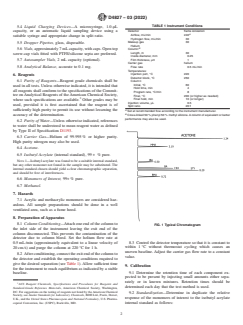
6.5 Isobutyl Acrylate (internal standard), 99 + % pure.
NOTE 1—Isobutyl acrylate was found to be a suitable internal standard,
but any other monomer not found in the sample may be substituted. The
internal standard chosen should yield a clear chromatographic separation,
and should be free of interferences.
6.6 Monomers of Interest, 99+ % pure.
6.7 Methanol.
7. Hazards
7.1 Acrylic and methacrylic monomers are considered haz-
ardous. All sample preparations should be done in a well
ventilated area, such as a fume hood.
8. Preparation of Apparatus
8.1 Column Conditioning—Attach one end of the column to
FIG. 1 Typical Chromatogram
the inlet side of the instrument leaving the exit end of the
column disconnected. This prevents the contamination of the
detector due to column bleed. Set the helium flow rate at
8.3 Control the detector temperature so that it is constant to
0.5 mL⁄min (approximately equivalent to a linear velocity of
within 1 °C without thermostat cycling which causes an
20 cm⁄s) and purge the column at 220 °C for 1 h.
uneven baseline. Adjust the carrier gas flow rate to a constant
8.2 Afterconditioning,connecttheexitendofthecolumnto
value.
the detector and establish the operating conditions required to
give the desired separation (see Table 1).Allow sufficient time
9. Calibration
for the instrument to reach equilibrium as indicated by a stable
9.1 Determine the retention time of each component
...