

ASTM D5796-20
(Test Method)Standard Test Method for Measurement of Dry Film Thickness of Thin-Film Coil-Coated Systems by Destructive Means Using a Boring Device
General Information
- Abstract
SIGNIFICANCE AND USE
3.1 Measurement of dry film thickness of organic coatings by physically cutting through the film and optically observing and measuring the thickness offers the advantage of direct measurement as compared with nondestructive means.
3.2 Constituent coating layers of an overall thickness of a coating system can usually be measured individually by this test method, provide adhesion between each layer is sufficient. (However, this can be difficult in cases where the primer, topcoat, or multiple coating layers have the same, or very similar, appearance.)
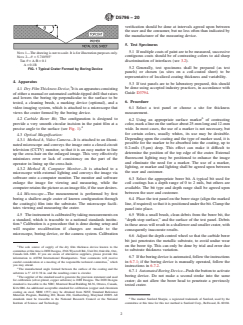
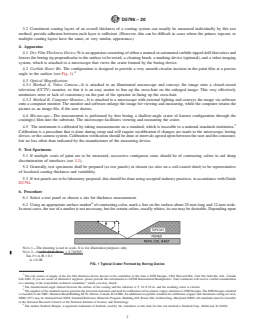
FIG. 1 Typical Crater Formed by Boring Device
Note 1: The drawing is not to scale. It is for illustration purposes only.
Note 2: θ = 5.710593°
Tan θ = A/B = 0.1
A = 0.1B
SCOPE
1.1 This test method covers the measurement of dry film thickness (DFT) of coating films by microscopic observation of a precision-cut, shallow-angle crater bored into the coating film. This crater reveals cross sectional layers appearing as rings, whose width is proportional to the depth of the coating layer(s) and allows for direct calculation of dry film thickness.
1.1.1 The Apparatus, Procedure, and Precision and Bias discussions include Method A and Method B. Method A involves the use of an optical measurement apparatus which is no longer commercially available, but remains a valid method of dry film measurement. Method B is a software driven measurement procedure that supersedes Method A.
1.2 The substrate may be any rigid, metallic material, such as cold-rolled steel, hot-dipped galvanized steel, aluminum, etc. The substrate must be planar with the exception of substrates exhibiting “coil set,” which may be held level by the use of the clamping tool on the drilling device.
Note 1: Variations in the surface profile of the substrate may result in misrepresentative organic coating thickness readings. This condition may exist over substrates such as hot-dipped, coated steel sheet. This is true of all “precision cut” methods that are used to determine dry film thickness of organic coatings. This is why several measurements across the strip may be useful if substrate surface profile is suspect.
1.3 The range of thickness measurement is 0 to 3.5 mils (0 to 89 μm).
Note 2: For DFT measurements of films greater than 3.5 mils (89μm), but less than 63 mils (1600 μm), a 45° borer may be used in accordance with this test method, with the exception of 6.8, where the micrometer reading would provide a direct read-out, and division by ten would be unnecessary per 4.3.1 Method A.
1.4 Measurements may be made on coil-coated sheet, certain formed products, or on test panels.
1.5 The values stated in SI units are to be regarded as the standard. The values given in parentheses are for information only.
1.6 This standard does not purport to address all of the safety concerns, if any, associated with its use. It is the responsibility of the user of this standard to establish appropriate safety, health, and environmental practices and determine the applicability of regulatory limitations prior to use.
1.7 This international standard was developed in accordance with internationally recognized principles on standardization established in the Decision on Principles for the Development of International Standards, Guides and Recommendations issued by the World Trade Organization Technical Barriers to Trade (TBT) Committee.
- Status
- Published
- Publication Date
- 30-Jun-2020
- Technical Committee
- D01 - Paint and Related Coatings, Materials, and Applications
- Drafting Committee
- D01.53 - Coil Coated Metal
Buy Documents
ASTM D5796-20 - Standard Test Method for Measurement of Dry Film Thickness of Thin-Film Coil-Coated Systems by Destructive Means Using a Boring Device
REDLINE ASTM D5796-20 - Standard Test Method for Measurement of Dry Film Thickness of Thin-Film Coil-Coated Systems by Destructive Means Using a Boring Device
Overview
ASTM D5796-20 is a standard test method established by ASTM International for the measurement of dry film thickness (DFT) of thin-film coil-coated systems using destructive means, specifically with a boring device. Unlike nondestructive approaches, this method physically cuts through the film to expose its cross-section, allowing for a direct and highly accurate measurement of individual coating layer thicknesses. Primarily, it applies to organic coatings applied on rigid metallic substrates such as cold-rolled steel, galvanized steel, and aluminum.
The standard covers both manual and automated processes for boring and measuring the film, utilizing either optical measurement apparatus (Method A) or software-driven procedures (Method B), with Method B now preferred due to technological advancements.
Key Topics
- Direct Thickness Measurement: Provides direct, reliable readings of total and individual coating layer thicknesses by examining the rings exposed in a precision-cut crater.
- Applicability: Suitable for rigid, metallic, and planar substrates typically used in coil-coated sheet production and formed metallic products.
- Crater Method: Involves boring a shallow-angle crater in the coated surface, revealing multilayer systems as visible rings, each proportional in width to the corresponding layer’s thickness.
- Measurement Range: Standard procedure covers DFT in the range of 0 to 3.5 mils (0 to 89 μm). Adaptations with a steeper angle borer permit measurement of thicker films up to 63 mils (1600 μm).
- Measurement Equipment: Requires specialized boring devices (manual or automated), appropriate carbide borer bits, optical microscopes, and in modern setups, software for image capture and thickness calculation.
- Calibration and Precision: Instruments must be calibrated with standards traceable to national bodies (e.g., NIST). The method provides precise repeatability and reproducibility within specified tolerances.
- Layer Differentiation: Most effective where coating layers are visually distinct; challenges may arise with layers of nearly identical appearance.
Applications
- Quality Control in Coil Coating: Ensures coil-coated metals meet factory and regulatory thickness requirements by enabling accurate, layer-specific DFT measurements.
- Product Development: Used in the laboratory and during production trials to confirm new coating formulations or process modifications achieve targeted film builds.
- Failure Analysis: Assists in identifying issues related to coating thickness non-uniformity, which can affect corrosion resistance, aesthetics, or mechanical properties.
- Inspection of Formed Products: Applicable not only to flat coil-coated sheets but also to certain finished or semi-finished formed products and standardized test panels.
This test method is essential when nondestructive thickness measurement methods cannot distinguish between constituent layers or do not provide sufficient accuracy for quality-critical applications.
Related Standards
- ASTM D3794: Guide for Testing Coil Coatings – provides additional context and best practices for sampling and testing coil-coated materials.
- Other Precision Cut Methods: ASTM D5796-20 is complementary to other DFT measurement standards, especially when direct measurement is required for multilayered coatings.
- International Standardization: Developed according to WTO Technical Barriers to Trade (TBT) Committee principles, promoting global harmonization.
Practical Value
Implementing ASTM D5796-20 offers:
- Direct, verifiable coating thickness data, essential for product certification, process control, and regulatory compliance.
- Enhanced problem-solving in cases of coating system failures or disputes over coating integrity.
- Consistent calibration and measurement practices, improving comparability of results between laboratories and production sites.
In summary, ASTM D5796-20 provides an authoritative framework for the destructive measurement of dry film thickness, ensuring the performance and quality of coil-coated metallic products in manufacturing and research settings.
Relations
- Effective Date
- 01-Feb-2017
- Effective Date
- 01-Jul-2016
- Effective Date
- 15-Mar-2013
- Effective Date
- 10-Jun-2000
Buy Documents
ASTM D5796-20 - Standard Test Method for Measurement of Dry Film Thickness of Thin-Film Coil-Coated Systems by Destructive Means Using a Boring Device
REDLINE ASTM D5796-20 - Standard Test Method for Measurement of Dry Film Thickness of Thin-Film Coil-Coated Systems by Destructive Means Using a Boring Device
Get Certified
Connect with accredited certification bodies for this standard

BSMI (Bureau of Standards, Metrology and Inspection)
Taiwan's standards and inspection authority.
Sponsored listings
Frequently Asked Questions
ASTM D5796-20 is a standard published by ASTM International. Its full title is "Standard Test Method for Measurement of Dry Film Thickness of Thin-Film Coil-Coated Systems by Destructive Means Using a Boring Device". This standard covers: SIGNIFICANCE AND USE 3.1 Measurement of dry film thickness of organic coatings by physically cutting through the film and optically observing and measuring the thickness offers the advantage of direct measurement as compared with nondestructive means. 3.2 Constituent coating layers of an overall thickness of a coating system can usually be measured individually by this test method, provide adhesion between each layer is sufficient. (However, this can be difficult in cases where the primer, topcoat, or multiple coating layers have the same, or very similar, appearance.) FIG. 1 Typical Crater Formed by Boring Device Note 1: The drawing is not to scale. It is for illustration purposes only. Note 2: θ = 5.710593° Tan θ = A/B = 0.1 A = 0.1B SCOPE 1.1 This test method covers the measurement of dry film thickness (DFT) of coating films by microscopic observation of a precision-cut, shallow-angle crater bored into the coating film. This crater reveals cross sectional layers appearing as rings, whose width is proportional to the depth of the coating layer(s) and allows for direct calculation of dry film thickness. 1.1.1 The Apparatus, Procedure, and Precision and Bias discussions include Method A and Method B. Method A involves the use of an optical measurement apparatus which is no longer commercially available, but remains a valid method of dry film measurement. Method B is a software driven measurement procedure that supersedes Method A. 1.2 The substrate may be any rigid, metallic material, such as cold-rolled steel, hot-dipped galvanized steel, aluminum, etc. The substrate must be planar with the exception of substrates exhibiting “coil set,” which may be held level by the use of the clamping tool on the drilling device. Note 1: Variations in the surface profile of the substrate may result in misrepresentative organic coating thickness readings. This condition may exist over substrates such as hot-dipped, coated steel sheet. This is true of all “precision cut” methods that are used to determine dry film thickness of organic coatings. This is why several measurements across the strip may be useful if substrate surface profile is suspect. 1.3 The range of thickness measurement is 0 to 3.5 mils (0 to 89 μm). Note 2: For DFT measurements of films greater than 3.5 mils (89μm), but less than 63 mils (1600 μm), a 45° borer may be used in accordance with this test method, with the exception of 6.8, where the micrometer reading would provide a direct read-out, and division by ten would be unnecessary per 4.3.1 Method A. 1.4 Measurements may be made on coil-coated sheet, certain formed products, or on test panels. 1.5 The values stated in SI units are to be regarded as the standard. The values given in parentheses are for information only. 1.6 This standard does not purport to address all of the safety concerns, if any, associated with its use. It is the responsibility of the user of this standard to establish appropriate safety, health, and environmental practices and determine the applicability of regulatory limitations prior to use. 1.7 This international standard was developed in accordance with internationally recognized principles on standardization established in the Decision on Principles for the Development of International Standards, Guides and Recommendations issued by the World Trade Organization Technical Barriers to Trade (TBT) Committee.
SIGNIFICANCE AND USE 3.1 Measurement of dry film thickness of organic coatings by physically cutting through the film and optically observing and measuring the thickness offers the advantage of direct measurement as compared with nondestructive means. 3.2 Constituent coating layers of an overall thickness of a coating system can usually be measured individually by this test method, provide adhesion between each layer is sufficient. (However, this can be difficult in cases where the primer, topcoat, or multiple coating layers have the same, or very similar, appearance.) FIG. 1 Typical Crater Formed by Boring Device Note 1: The drawing is not to scale. It is for illustration purposes only. Note 2: θ = 5.710593° Tan θ = A/B = 0.1 A = 0.1B SCOPE 1.1 This test method covers the measurement of dry film thickness (DFT) of coating films by microscopic observation of a precision-cut, shallow-angle crater bored into the coating film. This crater reveals cross sectional layers appearing as rings, whose width is proportional to the depth of the coating layer(s) and allows for direct calculation of dry film thickness. 1.1.1 The Apparatus, Procedure, and Precision and Bias discussions include Method A and Method B. Method A involves the use of an optical measurement apparatus which is no longer commercially available, but remains a valid method of dry film measurement. Method B is a software driven measurement procedure that supersedes Method A. 1.2 The substrate may be any rigid, metallic material, such as cold-rolled steel, hot-dipped galvanized steel, aluminum, etc. The substrate must be planar with the exception of substrates exhibiting “coil set,” which may be held level by the use of the clamping tool on the drilling device. Note 1: Variations in the surface profile of the substrate may result in misrepresentative organic coating thickness readings. This condition may exist over substrates such as hot-dipped, coated steel sheet. This is true of all “precision cut” methods that are used to determine dry film thickness of organic coatings. This is why several measurements across the strip may be useful if substrate surface profile is suspect. 1.3 The range of thickness measurement is 0 to 3.5 mils (0 to 89 μm). Note 2: For DFT measurements of films greater than 3.5 mils (89μm), but less than 63 mils (1600 μm), a 45° borer may be used in accordance with this test method, with the exception of 6.8, where the micrometer reading would provide a direct read-out, and division by ten would be unnecessary per 4.3.1 Method A. 1.4 Measurements may be made on coil-coated sheet, certain formed products, or on test panels. 1.5 The values stated in SI units are to be regarded as the standard. The values given in parentheses are for information only. 1.6 This standard does not purport to address all of the safety concerns, if any, associated with its use. It is the responsibility of the user of this standard to establish appropriate safety, health, and environmental practices and determine the applicability of regulatory limitations prior to use. 1.7 This international standard was developed in accordance with internationally recognized principles on standardization established in the Decision on Principles for the Development of International Standards, Guides and Recommendations issued by the World Trade Organization Technical Barriers to Trade (TBT) Committee.
ASTM D5796-20 is classified under the following ICS (International Classification for Standards) categories: 17.040.20 - Properties of surfaces. The ICS classification helps identify the subject area and facilitates finding related standards.
ASTM D5796-20 has the following relationships with other standards: It is inter standard links to ASTM D3794-17, ASTM D3794-16, ASTM D3794-13, ASTM D3794-00. Understanding these relationships helps ensure you are using the most current and applicable version of the standard.
ASTM D5796-20 is available in PDF format for immediate download after purchase. The document can be added to your cart and obtained through the secure checkout process. Digital delivery ensures instant access to the complete standard document.
Standards Content (Sample)
This international standard was developed in accordance with internationally recognized principles on standardization established in the Decision on Principles for the
Development of International Standards, Guides and Recommendations issued by the World Trade Organization Technical Barriers to Trade (TBT) Committee.
Designation: D5796 − 20
Standard Test Method for
Measurement of Dry Film Thickness of Thin-Film Coil-
Coated Systems by Destructive Means Using a Boring
Device
This standard is issued under the fixed designation D5796; the number immediately following the designation indicates the year of
original adoption or, in the case of revision, the year of last revision. A number in parentheses indicates the year of last reapproval. A
superscript epsilon (´) indicates an editorial change since the last revision or reapproval.
1. Scope 1.4 Measurements may be made on coil-coated sheet, cer-
tain formed products, or on test panels.
1.1 This test method covers the measurement of dry film
thickness(DFT)ofcoatingfilmsbymicroscopicobservationof 1.5 The values stated in SI units are to be regarded as the
a precision-cut, shallow-angle crater bored into the coating standard. The values given in parentheses are for information
film. This crater reveals cross sectional layers appearing as only.
rings, whose width is proportional to the depth of the coating
1.6 This standard does not purport to address all of the
layer(s) and allows for direct calculation of dry film thickness.
safety concerns, if any, associated with its use. It is the
1.1.1 The Apparatus, Procedure, and Precision and Bias
responsibility of the user of this standard to establish appro-
discussions include Method A and Method B. Method A
priate safety, health, and environmental practices and deter-
involves the use of an optical measurement apparatus which is
mine the applicability of regulatory limitations prior to use.
no longer commercially available, but remains a valid method
1.7 This international standard was developed in accor-
of dry film measurement. Method B is a software driven
dance with internationally recognized principles on standard-
measurement procedure that supersedes Method A.
ization established in the Decision on Principles for the
Development of International Standards, Guides and Recom-
1.2 The substrate may be any rigid, metallic material, such
mendations issued by the World Trade Organization Technical
as cold-rolled steel, hot-dipped galvanized steel, aluminum,
Barriers to Trade (TBT) Committee.
etc. The substrate must be planar with the exception of
substrates exhibiting “coil set,” which may be held level by the
2. Referenced Documents
use of the clamping tool on the drilling device.
2.1 ASTM Standards:
NOTE 1—Variations in the surface profile of the substrate may result in
D3794 Guide for Testing Coil Coatings
misrepresentative organic coating thickness readings. This condition may
exist over substrates such as hot-dipped, coated steel sheet. This is true of
3. Significance and Use
all “precision cut” methods that are used to determine dry film thickness
of organic coatings. This is why several measurements across the strip
3.1 Measurement of dry film thickness of organic coatings
may be useful if substrate surface profile is suspect.
by physically cutting through the film and optically observing
1.3 The range of thickness measurement is 0 to 3.5 mils (0
and measuring the thickness offers the advantage of direct
to 89 µm).
measurement as compared with nondestructive means.
NOTE 2—For DFTmeasurements of films greater than 3.5 mils (89µm), 3.2 Constituent coating layers of an overall thickness of a
but less than 63 mils (1600 µm), a 45° borer may be used in accordance
coating system can usually be measured individually by this
with this test method, with the exception of 6.8, where the micrometer
test method, provide adhesion between each layer is sufficient.
reading would provide a direct read-out, and division by ten would be
(However, this can be difficult in cases where the primer,
unnecessary per 4.3.1 Method A.
topcoat, or multiple coating layers have the same, or very
similar, appearance.)
This test method is under the jurisdiction of ASTM Committee D01 on Paint
and Related Coatings, Materials, andApplications and is the direct responsibility of
Subcommittee D01.53 on Coil Coated Metal. For referenced ASTM standards, visit the ASTM website, www.astm.org, or
Current edition approved July 1, 2020. Published July 2020. Originally approved contact ASTM Customer Service at service@astm.org. For Annual Book of ASTM
in 1995. Last previous edition approved in 2015 as D5796 – 10 (2015). DOI: Standards volume information, refer to the standard’s Document Summary page on
10.1520/D5796-20. the ASTM website.
Copyright © ASTM International, 100 Barr Harbor Drive, PO Box C700, West Conshohocken, PA 19428-2959. United States
D5796 − 20
verification should be done at intervals agreed upon between
the user and the consumer, but no less often than indicated by
the manufacturer of the measuring device.
5. Test Specimens
5.1 If multiple coats of paint are to be measured, successive
NOTE 1—The drawing is not to scale. It is for illustration purposes only.
contiguous coats should be of contrasting colors to aid sharp
NOTE 2—θ = 5.710593°
Tan θ=A⁄B=0.1 discrimination of interfaces (see 3.2).
A = 0.1B
5.2 Generally, test specimens shall be prepared (as test
FIG. 1 Typical Crater Formed by Boring Device
panels) or chosen (as sites on a coil-coated sheet) to be
representative of localized coating thickness and variability.
4. Apparatus
5.3 If test panels are to be laboratory prepared, this should
be done using accepted industry practices, in accordance with
4.1 Dry Film Thickness Device, Itisanapparatusconsisting
Guide D3794.
of either a manual or automated carbide-tipped drill that raises
and lowers the boring tip perpendicular to the surface to be
6. Procedure
tested, a cleaning brush, a marking device (optional), and a
video imaging system, which is attached to a microscope that
6.1 Select a test panel or choose a site for thickness
views the crater formed by the boring device.
measurement.
4.2 Carbide Borer Bit, The configuration is designed to
6.2 Using an appropriate surface marker of contrasting
provide a very smooth circular incision in the paint film at a
color,markalineonthesurfaceabout25-mmlongand12-mm
precise angle to the surface (see Fig. 1).
wide. In most cases, the use of a marker is not necessary, but
for certain colors, usually whites, its use may be desirable.
4.3 Optical Magnification:
Depending upon the coating and the type of marker used, it is
4.3.1 Method A, Video Camera—It is attached to an illumi-
possible for the marker to be absorbed into the coating, up to
nated microscope and conveys the image onto a closed-circuit
0.2-mils (5-µm) deep. This effect can make it difficult to
television (CCTV) monitor, so that it is an easy matter to line
determine the position of the top edge of the crater. External
up the cross-hair on the enlarged image. This very effectively
fluorescent lighting may be positioned to enhance the image
minimizes error or lack of consistency on the part of the
and eliminate the need for a marker. The use of a marker,
operator in lining up the cross-hair.
lighting, or marker and lighting shall be agreed upon between
4.3.2 Method B, Computer Monitor—It is attached to a
the user and customer.
microscope with external lighting and conveys the image via
software onto a computer monitor. The monitor and software
6.3 Select the appropriate borer bit. A typical bit used for
enlarge the image for viewing and measuring, while the
coil coatings has a depth range of 0 to 2 mils, but others are
computerretainsthepictureasanimagefile,iftheuserdesires.
available. The bit type and depth range shall be agreed upon
between the user and customer.
4.4 Microscope—The measurement is performed by first
boring a shallow-angle crater of known configuration through
6.4 Place the test panel on the borer stage (align the marked
the coating(s) film into the substrate. The microscope facili-
line,ifrequired)sothatitispositionedunderthebit.Clampthe
tates viewing and measuring the crater.
panel into place.
4.5 Theinstrumentiscalibratedbytakingmeasurementson
6.5 With a small brush, clean debris from the borer bit, the
a standard, which is traceable to a national standards institu-
“depth stop surface,” and the surface of the test panel. Debris
tion. Calibration is a procedure that is done during setup and
in these areas will result in a shallower and smaller crater, with
will require recalibration if changes are made to the
consequently inaccurate results.
microscope, boring device, or the camera system. Calibration
6.6 Adjust the depth control wheel so that the carbide borer
bit just penetrates the metallic substrate, to avoid undue wear
on the borer tip. This can only be done by trial and error due
The sole source of supply of the dry film thickness device known to the
committee at this time is DJH Designs, 2366Wyecroft Rd., Unit D4, Oakville, Ont., to substrate thickness variation.
Canada L6L 6M1. If you are aware of alternative suppliers, please provide this
6.7 Iftheboringdeviceisautomated,followtheinstructions
information to ASTM International Headquarters. Your comments will receive
careful consideration at a meeting of the responsible technical committee, which in 6.7.1; if the boring device is manually operated, follow the
you may attend.
instructions in 6.7.2.
The manufactured angle formed between the surface of the coating and the
6.7.1 Automated Boring Device—Pushthebuttontoactivate
substrate is 5° 42 ft 38 in. and the resulting crater is circular.
5 boring device. Do not make a second stroke into the same
The supplier of the standard used to generate the precision statement and used
for calibration (silver-plated, copper substrate) is DJH Designs. The DJH Designs
crater; do not allow the borer head to penetrate a previously
standard is traceable to the NRC, Montreal Road Building M-36, Ottawa, Canada,
tested crater.
K1A 0R6. An additional acceptable standard for calibration (copper and chromium
coating on steel, SRM 1357) may be obtained from NIST, Standard Reference
Materials Program, Buildin
...
This document is not an ASTM standard and is intended only to provide the user of an ASTM standard an indication of what changes have been made to the previous version. Because
it may not be technically possible to adequately depict all changes accurately, ASTM recommends that users consult prior editions as appropriate. In all cases only the current version
of the standard as published by ASTM is to be considered the official document.
Designation: D5796 − 10 (Reapproved 2015) D5796 − 20
Standard Test Method for
Measurement of Dry Film Thickness of Thin-Film Coil-
Coated Systems by Destructive Means Using a Boring
Device
This standard is issued under the fixed designation D5796; the number immediately following the designation indicates the year of
original adoption or, in the case of revision, the year of last revision. A number in parentheses indicates the year of last reapproval. A
superscript epsilon (´) indicates an editorial change since the last revision or reapproval.
1. Scope
1.1 This test method covers the measurement of dry film thickness (DFT) of coating films by microscopic observation of a
precision-cut, shallow-angle crater bored into the coating film. This crater reveals cross sectional layers appearing as rings, whose
width is proportional to the depth of the coating layer(s) and allows for direct calculation of dry film thickness.
1.1.1 The Apparatus, Procedure, and Precision and Bias discussions include Method A and Method B. Method A involves the
use of an optical measurement apparatus which is no longer commercially available, but remains a valid method of dry film
measurement. Method B is a software driven measurement procedure that supersedes Method A.
1.2 The substrate may be any rigid, metallic material, such as cold-rolled steel, hot-dipped galvanized steel, aluminum, etc. The
substrate must be planar with the exception of substrates exhibiting “coil set,” which may be held level by the use of the clamping
tool on the drilling device.
NOTE 1—Variations in the surface profile of the substrate may result in misrepresentative organic coating thickness readings. This condition may exist
over substrates such as hot-dipped, coated steel sheet. This is true of all “precision cut” methods that are used to determine dry film thickness of organic
coatings. This is why several measurements across the strip may be useful if substrate surface profile is suspect.
1.3 The range of thickness measurement is 0 to 3.5 mils (0 to 89 μm).
NOTE 2—For DFT measurements of films greater than 3.5 mils (89μm), but less than 63 mils (1600 μm), a 45° borer may be used in accordance with
this test method, with the exception of 6.8, where the micrometer reading would provide a direct read-out, and division by ten would be unnecessary per
4.3.1 Method A.
1.4 Measurements may be made on coil-coated sheet, certain formed products, or on test panels.
1.5 The values stated in SI units are to be regarded as the standard. The values given in parentheses are for information only.
1.6 This standard does not purport to address all of the safety concerns, if any, associated with its use. It is the responsibility
of the user of this standard to establish appropriate safety safety, health, and healthenvironmental practices and determine the
applicability of regulatory limitations prior to use.
1.7 This international standard was developed in accordance with internationally recognized principles on standardization
established in the Decision on Principles for the Development of International Standards, Guides and Recommendations issued
by the World Trade Organization Technical Barriers to Trade (TBT) Committee.
2. Referenced Documents
2.1 ASTM Standards:
D3794 Guide for Testing Coil Coatings
3. Significance and Use
3.1 Measurement of dry film thickness of organic coatings by physically cutting through the film and optically observing and
measuring the thickness offers the advantage of direct measurement as compared with nondestructive means.
This test method is under the jurisdiction of ASTM Committee D01 on Paint and Related Coatings, Materials, and Applications and is the direct responsibility of
Subcommittee D01.53 on Coil Coated Metal.
Current edition approved June 1, 2015July 1, 2020. Published June 2015July 2020. Originally approved in 1995. Last previous edition approved in 20102015 as
D5796 – 10.D5796 – 10 (2015). DOI: 10.1520/D5796-10R15.10.1520/D5796-20.
For referenced ASTM standards, visit the ASTM website, www.astm.org, or contact ASTM Customer Service at service@astm.org. For Annual Book of ASTM Standards
volume information, refer to the standard’s Document Summary page on the ASTM website.
Copyright © ASTM International, 100 Barr Harbor Drive, PO Box C700, West Conshohocken, PA 19428-2959. United States
D5796 − 20
3.2 Constituent coating layers of an overall thickness of a coating system can usually be measured individually by this test
method, provide adhesion between each layer is sufficient. (However, this can be difficult in cases where the primer, topcoat, or
multiple coating layers have the same, or very similar, appearance.)
4. Apparatus
4.1 Dry Film Thickness Device, It is an apparatus consisting of either a manual or automated carbide-tipped drill that raises and
lowers the boring tip perpendicular to the surface to be tested, a cleaning brush, a marking device (optional), and a video imaging
system, which is attached to a microscope that views the crater formed by the boring device.
4.2 Carbide Borer Bit, The configuration is designed to provide a very smooth circular incision in the paint film at a precise
angle to the surface (see Fig. 1).
4.3 Optical Magnification:
4.3.1 Method A, Video Camera—It is attached to an illuminated microscope and conveys the image onto a closed-circuit
television (CCTV) monitor, so that it is an easy matter to line up the cross-hair on the enlarged image. This very effectively
minimizes error or lack of consistency on the part of the operator in lining up the cross-hair.
4.3.2 Method B, Computer Monitor—It is attached to a microscope with external lighting and conveys the image via software
onto a computer monitor. The monitor and software enlarge the image for viewing and measuring, while the computer retains the
picture as an image file, if the user desires.
4.4 Microscope—The measurement is performed by first boring a shallow-angle crater of known configuration through the
coating(s) film into the substrate. The microscope facilitates viewing and measuring the crater.
4.5 The instrument is calibrated by taking measurements on a standard, which is traceable to a national standards institution.
Calibration is a procedure that is done during setup and will require recalibration if changes are made to the microscope, boring
device, or the camera system. Calibration verification should be done at intervals agreed upon between the user and the consumer,
but no less often than indicated by the manufacturer of the measuring device.
5. Test Specimens
5.1 If multiple coats of paint are to be measured, successive contiguous coats should be of contrasting colors to aid sharp
discrimination of interfaces (see 3.2).
5.2 Generally, test specimens shall be prepared (as test panels) or chosen (as sites on a coil-coated sheet) to be representative
of localized coating thickness and variability.
5.3 If test panels are to be laboratory prepared, this should be done using accepted industry practices, in accordance with Guide
D3794.
6. Procedure
6.1 Select a test panel or choose a site for thickness measurement.
6.2 Using an appropriate surface marker of contrasting color, mark a line on the surface about 25-mm long and 12-mm wide.
In most cases, the use of a marker is not necessary, but for certain colors, usually whites, its use may be desirable. Depending upon
NOTE 1—The drawing is not to scale. It is for illustration purposes only.
NOTE 2—θ = 5° 42 ft 38 in. = 5.710593°
Tan θ = A ⁄B = 0.1
A = 0.1B
FIG. 1 Typical Crater Formed by Boring Device
The sole source of supply of the dry film thickness device known to the committee at this time is DJH Designs, 2366 Wyecroft Rd., Unit D4, Oakville, Ont., Canada
L6L 6M1. If you are aware of alternative suppliers, please provide this information to ASTM International Headquarters. Your comments will receive careful consideration
at a meeting of the responsible technical committee, which you may attend.
The manufactured angle formed between the surface of the coating and the substrate is 5° 42 ft 38 in. and the resulting crater is circular.
The supplier of the standard used to generate the precision statement and used for calibration (silver-plated, copper substrate) is DJH Designs. The DJH Designs standard
is traceable to the NRC, Montreal Road Building M-36, Ottawa, Canada, K1A 0R6. An additional acceptable standard for calibration (copper and chromium coating on steel,
SRM 1357) may be obtained from NIST, Standard Reference Materials Program, Building 202, Room 204, Gaithersburg, Maryland 20899. All standards must be traceable
to the National Research Council or the National Institute of Science and Technology.
The marker Sanford Sharpie, a registered trademark of Sanford, used by the committee at this time for this test method is Sanford Corp., Bellwood, IL 60104.
D5796 − 20
the coating and the type of marker used, it is possible for the marker to be absorbed into the coating, up to 0.2-mils (5-μm) deep.
This effect can make it difficult to determine the position of the top edge of the crater. External fluorescent lighting may be
positioned to enhance the image and eliminate the need for a marker. The use of a marker, lighting, or marker and lighting shall
be agreed upon between the user and customer.
6.3 Select the appropriate borer bit. A typical bit used for coil coatings has a depth range of 0 to 2 mils, but others are available.
The bit type and depth range shall be agreed upon between the user and customer.
6.4 Place the test panel on the borer stage (align the marked line, if required) so that it is positioned under the bit. Clamp the
panel into place.
6.5 With a small brush, clean debris from the borer bit, the “depth stop surface,” and the surface of the test panel. Debris in these
areas will result in a shallower and smaller crater, with consequently inaccurate results.
6.6 Adjust the depth control wheel so that the carbide borer bit just penetrates the metallic substrate, to avoid undue wear on
the borer
...