

ASTM G98-23
(Test Method)Standard Test Method for Galling Resistance of Materials
General Information
- Abstract
SIGNIFICANCE AND USE
5.1 This test method is designed to rank material couples in their resistance to the failure mode caused by galling and not merely to classify the surface appearance of sliding surfaces.
5.2 This test method should be considered when damaged (galled) surfaces render components non-serviceable. Experience has shown that galling is most prevalent in sliding systems that are slow moving and operate intermittently. The galling and seizure of threaded components is a classic example which this test method most closely simulates.
5.3 Other galling-prone examples include: sealing surfaces of value trim which may leak excessively due to galling; and pump wear rings that may function ineffectively due to galling.
5.4 If the equipment continues to operate satisfactorily and loses dimension gradually, then mechanical wear should be evaluated by a different test such as the crossed cylinder Test Method (see Test Method G83). Chain belt pins and bushings are examples of this type of problem.
5.5 This test method should not be used for quantitative or final design purposes since many environmental factors influence the galling performance of materials in service. Lubrication, alignment, stiffness and geometry are only some of the factors that can affect how materials perform. This test method has proven valuable in screening materials for prototypical testing that more closely simulates actual service conditions.
SCOPE
1.1 This test method covers a laboratory test which ranks the galling resistance of material couples. Most galling studies have been conducted on bare metals and alloys; however, non-metallics, coatings, and surface modified alloys may also be evaluated by this test method.
1.2 This test method is not designed for evaluating the galling resistance of material couples sliding under lubricated conditions because galling usually will not occur under lubricated sliding conditions using this test method.
1.3 This standard does not purport to address all of the safety concerns, if any, associated with its use. It is the responsibility of the user of this standard to establish appropriate safety, health, and environmental practices and determine the applicability of regulatory limitations prior to use.
1.4 This international standard was developed in accordance with internationally recognized principles on standardization established in the Decision on Principles for the Development of International Standards, Guides and Recommendations issued by the World Trade Organization Technical Barriers to Trade (TBT) Committee.
- Status
- Published
- Publication Date
- 31-Oct-2023
- Technical Committee
- G02 - Wear and Erosion
- Drafting Committee
- G02.40 - Non-Abrasive Wear

Overview
ASTM G98-23: Standard Test Method for Galling Resistance of Materials provides a laboratory procedure for ranking material couples based on their resistance to galling-a common and damaging wear phenomenon in sliding metal components. Developed by ASTM International, this standard aims to simulate conditions under which galling is likely to occur, especially in slow-moving, intermittently operated systems. The method is essential for industries seeking to identify materials or coatings that minimize galling risk and maintain component performance and reliability.
Key Topics
- Galling Definition: Galling is a form of severe surface damage and material transfer that occurs between sliding solids, resulting in roughening, protrusions, or even seizure of the components.
- Test Scope: The method is primarily intended for bare metals and alloys, but can also evaluate non-metallics, coatings, and surface-modified materials.
- Test Limitations:
- Not suitable for lubricated sliding systems, as galling is unlikely under such conditions in this procedure.
- Not recommended for final quantitative design calculations since in-service performance is influenced by lubrication, geometry, alignment, and other factors.
- Test Procedure:
- Standardized flat-on-flat specimen geometry (button-on-block).
- Incremental load application with specimen rotation to induce galling.
- Threshold galling stress is determined by gradually increasing load until visible galling is observed.
- At least three repeat determinations are averaged for accuracy.
- Reporting Requirements: Test reports should include specimen composition, hardness, thermal history, threshold galling stress, surface finish, test environment details, and any unusual occurrences.
Applications
ASTM G98-23 is widely used in quality control, materials selection, R&D, and failure analysis within industries where galling can compromise safety, functionality, or lifespan of components. Key applications include:
- Threaded Fasteners: Prevents seizure in nuts and bolts by selecting galling-resistant combinations.
- Valve Trim and Seals: Assures leak-free operation by minimizing surface damage in slow-moving, high-contact pressure systems.
- Pump Wear Rings: Maintains efficiency by reducing galling-related malfunctions.
- Prototypical Testing: Screens candidate materials before more complex, application-specific evaluations.
- Comparative Ranking: Provides a comparative, rather than absolute, ranking of material couples under defined laboratory conditions.
Related Standards
When evaluating galling and wear resistance, the following standards and resources are also relevant:
- ASTM G40: Terminology Relating to Wear and Erosion-Essential for understanding galling and other wear processes.
- ASTM G83: Test Method for Wear Testing with a Crossed-Cylinder Apparatus-Useful for scenarios dominated by gradual mechanical wear rather than discrete galling failure.
- ASTM E177 / E691: Standards for precision, bias, and interlaboratory study practices in test methods.
Practical Value
By following ASTM G98-23, manufacturers, engineers, and researchers can:
- Identify material combinations that will minimize galling in real-world applications.
- Streamline material selection processes for improved service life and reduced maintenance costs.
- Reduce the risk of unexpected component seizure, leaks, or failures in critical systems.
- Support quality assurance and compliance with international best practices in wear testing.
Keywords
Galling resistance, ASTM G98, galling test, wear testing, surface damage, sliding materials, threshold galling stress, material ranking, metals, alloys, failure prevention, laboratory test method.
Relations
- Effective Date
- 01-Nov-2023
- Effective Date
- 01-Nov-2023
Get Certified
Connect with accredited certification bodies for this standard

BSMI (Bureau of Standards, Metrology and Inspection)
Taiwan's standards and inspection authority.
Sponsored listings
Frequently Asked Questions
ASTM G98-23 is a standard published by ASTM International. Its full title is "Standard Test Method for Galling Resistance of Materials". This standard covers: SIGNIFICANCE AND USE 5.1 This test method is designed to rank material couples in their resistance to the failure mode caused by galling and not merely to classify the surface appearance of sliding surfaces. 5.2 This test method should be considered when damaged (galled) surfaces render components non-serviceable. Experience has shown that galling is most prevalent in sliding systems that are slow moving and operate intermittently. The galling and seizure of threaded components is a classic example which this test method most closely simulates. 5.3 Other galling-prone examples include: sealing surfaces of value trim which may leak excessively due to galling; and pump wear rings that may function ineffectively due to galling. 5.4 If the equipment continues to operate satisfactorily and loses dimension gradually, then mechanical wear should be evaluated by a different test such as the crossed cylinder Test Method (see Test Method G83). Chain belt pins and bushings are examples of this type of problem. 5.5 This test method should not be used for quantitative or final design purposes since many environmental factors influence the galling performance of materials in service. Lubrication, alignment, stiffness and geometry are only some of the factors that can affect how materials perform. This test method has proven valuable in screening materials for prototypical testing that more closely simulates actual service conditions. SCOPE 1.1 This test method covers a laboratory test which ranks the galling resistance of material couples. Most galling studies have been conducted on bare metals and alloys; however, non-metallics, coatings, and surface modified alloys may also be evaluated by this test method. 1.2 This test method is not designed for evaluating the galling resistance of material couples sliding under lubricated conditions because galling usually will not occur under lubricated sliding conditions using this test method. 1.3 This standard does not purport to address all of the safety concerns, if any, associated with its use. It is the responsibility of the user of this standard to establish appropriate safety, health, and environmental practices and determine the applicability of regulatory limitations prior to use. 1.4 This international standard was developed in accordance with internationally recognized principles on standardization established in the Decision on Principles for the Development of International Standards, Guides and Recommendations issued by the World Trade Organization Technical Barriers to Trade (TBT) Committee.
SIGNIFICANCE AND USE 5.1 This test method is designed to rank material couples in their resistance to the failure mode caused by galling and not merely to classify the surface appearance of sliding surfaces. 5.2 This test method should be considered when damaged (galled) surfaces render components non-serviceable. Experience has shown that galling is most prevalent in sliding systems that are slow moving and operate intermittently. The galling and seizure of threaded components is a classic example which this test method most closely simulates. 5.3 Other galling-prone examples include: sealing surfaces of value trim which may leak excessively due to galling; and pump wear rings that may function ineffectively due to galling. 5.4 If the equipment continues to operate satisfactorily and loses dimension gradually, then mechanical wear should be evaluated by a different test such as the crossed cylinder Test Method (see Test Method G83). Chain belt pins and bushings are examples of this type of problem. 5.5 This test method should not be used for quantitative or final design purposes since many environmental factors influence the galling performance of materials in service. Lubrication, alignment, stiffness and geometry are only some of the factors that can affect how materials perform. This test method has proven valuable in screening materials for prototypical testing that more closely simulates actual service conditions. SCOPE 1.1 This test method covers a laboratory test which ranks the galling resistance of material couples. Most galling studies have been conducted on bare metals and alloys; however, non-metallics, coatings, and surface modified alloys may also be evaluated by this test method. 1.2 This test method is not designed for evaluating the galling resistance of material couples sliding under lubricated conditions because galling usually will not occur under lubricated sliding conditions using this test method. 1.3 This standard does not purport to address all of the safety concerns, if any, associated with its use. It is the responsibility of the user of this standard to establish appropriate safety, health, and environmental practices and determine the applicability of regulatory limitations prior to use. 1.4 This international standard was developed in accordance with internationally recognized principles on standardization established in the Decision on Principles for the Development of International Standards, Guides and Recommendations issued by the World Trade Organization Technical Barriers to Trade (TBT) Committee.
ASTM G98-23 is classified under the following ICS (International Classification for Standards) categories: 17.040.20 - Properties of surfaces. The ICS classification helps identify the subject area and facilitates finding related standards.
ASTM G98-23 has the following relationships with other standards: It is inter standard links to ASTM G98-17(2022), ASTM G196-08(2021). Understanding these relationships helps ensure you are using the most current and applicable version of the standard.
ASTM G98-23 is available in PDF format for immediate download after purchase. The document can be added to your cart and obtained through the secure checkout process. Digital delivery ensures instant access to the complete standard document.
Standards Content (Sample)
This international standard was developed in accordance with internationally recognized principles on standardization established in the Decision on Principles for the
Development of International Standards, Guides and Recommendations issued by the World Trade Organization Technical Barriers to Trade (TBT) Committee.
Designation: G98 − 23
Standard Test Method for
Galling Resistance of Materials
This standard is issued under the fixed designation G98; the number immediately following the designation indicates the year of original
adoption or, in the case of revision, the year of last revision. A number in parentheses indicates the year of last reapproval. A superscript
epsilon (´) indicates an editorial change since the last revision or reapproval.
1. Scope 3. Terminology
1.1 This test method covers a laboratory test which ranks 3.1 Definitions: Terminology Relating to Wear and Erosion
the galling resistance of material couples. Most galling studies G40:
have been conducted on bare metals and alloys; however, 3.1.1 galling—a form of surface damage arising between
non-metallics, coatings, and surface modified alloys may also sliding solids, distinguished by macroscopic, usually localized,
be evaluated by this test method. roughening and creation of protrusions above the original
surface; it often includes plastic flow or material transfer, or
1.2 This test method is not designed for evaluating the
both.
galling resistance of material couples sliding under lubricated
conditions because galling usually will not occur under lubri- 3.2 Definitions of Terms Specific to This Standard:
cated sliding conditions using this test method. 3.2.1 threshold galling stress—the stress midway between
the highest non-galled stress and the lowest galled stress as
1.3 This standard does not purport to address all of the
determined by this test method.
safety concerns, if any, associated with its use. It is the
responsibility of the user of this standard to establish appro-
4. Summary of Test Method
priate safety, health, and environmental practices and deter-
4.1 This test method uses available laboratory equipment
mine the applicability of regulatory limitations prior to use.
capable of maintaining a constant, compressive load between
1.4 This international standard was developed in accor-
two flat specimens, such as hydraulic or screw feed compres-
dance with internationally recognized principles on standard-
sion testing machines. One specimen is slowly rotated one
ization established in the Decision on Principles for the
revolution 360° relative to the other specimen. The surfaces are
Development of International Standards, Guides and Recom-
examined for galling after sliding. The criterion for whether
mendations issued by the World Trade Organization Technical
galling occurs is the appearance of the specimens based on
Barriers to Trade (TBT) Committee.
unassisted visual examination. If the specimens have not
galled, a new set of specimens is tested at increased load. This
2. Referenced Documents
process is continued until galling occurs.
2.1 ASTM Standards:
4.2 Appropriate load intervals are chosen to determine the
E177 Practice for Use of the Terms Precision and Bias in
threshold galling stress within an acceptable range.
ASTM Test Methods
E691 Practice for Conducting an Interlaboratory Study to
4.3 The higher the threshold galling stressing, the more
Determine the Precision of a Test Method
galling resistant is the test couple.
G40 Terminology Relating to Wear and Erosion
5. Significance and Use
G83 Test Method for Wear Testing with a Crossed-Cylinder
Apparatus (Withdrawn 2005)
5.1 This test method is designed to rank material couples in
their resistance to the failure mode caused by galling and not
merely to classify the surface appearance of sliding surfaces.
This test method is under the jurisdiction of ASTM Committee G02 on Wear
5.2 This test method should be considered when damaged
and Erosion and is the direct responsibility of Subcommittee G02.40 on Non-
(galled) surfaces render components non-serviceable. Experi-
Abrasive Wear.
ence has shown that galling is most prevalent in sliding
Current edition approved Nov. 1, 2023. Published November 2023. Originally
approved in 1989. Last previous edition approved in 2022 as G98 – 17 (2022). DOI:
systems that are slow moving and operate intermittently. The
10.1520/G0098-23.
galling and seizure of threaded components is a classic
For referenced ASTM standards, visit the ASTM website, www.astm.org, or
example which this test method most closely simulates.
contact ASTM Customer Service at service@astm.org. For Annual Book of ASTM
Standards volume information, refer to the standard’s Document Summary page on
5.3 Other galling-prone examples include: sealing surfaces
the ASTM website.
of value trim which may leak excessively due to galling; and
The last approved version of this historical standard is referenced on
www.astm.org. pump wear rings that may function ineffectively due to galling.
Copyright © ASTM International, 100 Barr Harbor Drive, PO Box C700, West Conshohocken, PA 19428-2959. United States
G98 − 23
5.4 If the equipment continues to operate satisfactorily and 7.5 Maintain block flatness at 0.33 mm/m (0.004 in./ft).
loses dimension gradually, then mechanical wear should be
7.6 The arithmetic average surface finish of both test sur-
evaluated by a different test such as the crossed cylinder Test
faces should be between 0.25 μm and 1.1 μm (10 μin. and
Method (see Test Method G83). Chain belt pins and bushings
45 μin.). Leave specimens as-ground or polished with abrasive
are examples of this type of problem.
paper to achieve the finish.
5.5 This test method should not be used for quantitative or
8. Procedure
final design purposes since many environmental factors influ-
ence the galling performance of materials in service.
8.1 An overall view of the galling test set-up is shown in
Lubrication, alignment, stiffness and geometry are only some
Fig. 2.
of the factors that can affect how materials perform. This test
8.2 Cleaning—Immediately prior to testing, clean the test
method has proven valuable in screening materials for proto-
surfaces of the specimens using a procedure that will remove
typical testing that more closely simulates actual service
any scale, oil film, or foreign matter. The following cleaning
conditions.
technique is suggested for metallic specimens: clean the button
and block in trichloroethane, ultrasonically, if possible; a
6. Apparatus
methanol rinse may be used to remove any traces of trichlo-
6.1 Commonly available laboratory equipment has been
roethane residue (see Note 1). Materials with open grains
used to conduct galling tests. Both Brinell hardness testers and
(some powder metals) must be dried to remove all traces of the
servo-hydraulic testing machines have proven to be satisfac-
cleaning solvent which may be entrapped in the material.
tory as loading devices. Any apparatus that can apply and
Demagnetize steel specimens having residual magnetism.
maintain a constant compressive load should be acceptable.
NOTE 1—This cleaning procedure is not appropriate for polymers. If a
polymer is being tested, a cleaning procedure that does not alter the
7. Test Specimens
chemistry or surface should be determined.
7.1 This test method uses a cylindrical flat-on-flat geometry.
8.3 Mount specimens in the loading device and degrease
One specimen is called the button (or pin) and is generally (but
again if possible. Lightly load the specimens. Twist the button
not necessarily) rotated about its axis on the flat specimen
by hand to make sure it is seated flat on the block.
called the block.
8.4 Apply the selected load. If there is no estimate of the
7.2 Some typical button geometries are shown in Fig. 1.
galling resistance of the test couple, it is advisable to start with
7.3 The only critical dimension is diameter “B’’ of the
890 N (200 lb) and increase the stress in subsequent tests as
contact area. The 6.4 mm (0.25 in.) diameter hole accommo-
desired. This will minimize damage to the specimens so that
dates a ball bearing for alignment purposes during the test. All
they may be remachined and used for further testing.
other dimensions may be varied to the user’s convenience.
8.5 Immediately rotate one specimen (usually the button,
7.4 The block specimen must have sufficient area to accom-
but not necessarily) one revolution. Use an open-end wrench,
modate at least one test; however, most users have found that
adjustable wrench, or some other special tool in order to grip
blocks of length 76 mm (3 in.) to 152 mm (6 in.) are ideal for
the specimen for rotating by hand. A mechanized system may
multiple tests. A reasonable width is 19 mm (0.75 in.).
also be used to rotate one specimen relative to the other. This
Thickness is not critical. Tests have been successfully run on
may allow torque measurement during testing which may
blocks with thickne
...
This document is not an ASTM standard and is intended only to provide the user of an ASTM standard an indication of what changes have been made to the previous version. Because
it may not be technically possible to adequately depict all changes accurately, ASTM recommends that users consult prior editions as appropriate. In all cases only the current version
of the standard as published by ASTM is to be considered the official document.
Designation: G98 − 17 (Reapproved 2022) G98 − 23
Standard Test Method for
Galling Resistance of Materials
This standard is issued under the fixed designation G98; the number immediately following the designation indicates the year of original
adoption or, in the case of revision, the year of last revision. A number in parentheses indicates the year of last reapproval. A superscript
epsilon (´) indicates an editorial change since the last revision or reapproval.
1. Scope
1.1 This test method covers a laboratory test which ranks the galling resistance of material couples. Most galling studies have been
conducted on bare metals and alloys; however, non-metallics, coatings, and surface modified alloys may also be evaluated by this
test method.
1.2 This test method is not designed for evaluating the galling resistance of material couples sliding under lubricated conditions
because galling usually will not occur under lubricated sliding conditions using this test method.
1.3 This standard does not purport to address all of the safety concerns, if any, associated with its use. It is the responsibility
of the user of this standard to establish appropriate safety, health, and environmental practices and determine the applicability of
regulatory limitations prior to use.
1.4 This international standard was developed in accordance with internationally recognized principles on standardization
established in the Decision on Principles for the Development of International Standards, Guides and Recommendations issued
by the World Trade Organization Technical Barriers to Trade (TBT) Committee.
2. Referenced Documents
2.1 ASTM Standards:
E177 Practice for Use of the Terms Precision and Bias in ASTM Test Methods
E691 Practice for Conducting an Interlaboratory Study to Determine the Precision of a Test Method
G40 Terminology Relating to Wear and Erosion
G83 Test Method for Wear Testing with a Crossed-Cylinder Apparatus (Withdrawn 2005)
3. Terminology
3.1 Definitions: Terminology Relating to Wear and Erosion G40:
3.1.1 galling—a form of surface damage arising between sliding solids, distinguished by macroscopic, usually localized,
roughening and creation of protrusions above the original surface; it often includes plastic flow or material transfer, or both.
3.1.1.1 Discussion—
The onset of galling usually requires that the contact pressure exceeds some threshold value. Galling can be a precursor to seizing
or loss of function. The identification of galling is somewhat subjective, and complete agreement does not exist, even among
experts.
3.2 Definitions of Terms Specific to This Standard:
This test method is under the jurisdiction of ASTM Committee G02 on Wear and Erosion and is the direct responsibility of Subcommittee G02.40 on Non-Abrasive Wear.
Current edition approved Nov. 1, 2022Nov. 1, 2023. Published November 2022November 2023. Originally approved in 1989. Last previous edition approved in 20172022
as G98 – 17.G98 – 17 (2022). DOI: 10.1520/G0098-17R22.10.1520/G0098-23.
For referenced ASTM standards, visit the ASTM website, www.astm.org, or contact ASTM Customer Service at service@astm.org. For Annual Book of ASTM Standards
volume information, refer to the standard’s Document Summary page on the ASTM website.
The last approved version of this historical standard is referenced on www.astm.org.
Copyright © ASTM International, 100 Barr Harbor Drive, PO Box C700, West Conshohocken, PA 19428-2959. United States
G98 − 23
3.2.1 threshold galling stress—the stress midway between the highest non-galled stress and the lowest galled stress as determined
by this test method.
4. Summary of Test Method
4.1 This test method uses available laboratory equipment capable of maintaining a constant, compressive load between two flat
specimens, such as hydraulic or screw feed compression testing machines. One specimen is slowly rotated one revolution 360°
relative to the other specimen. The surfaces are examined for galling after sliding. The criterion for whether galling occurs is the
appearance of the specimens based on unassisted visual examination. If the specimens have not galled, a new set of specimens is
tested at increased load. This process is continued until galling occurs.
4.2 Appropriate load intervals are chosen to determine the threshold galling stress within an acceptable range.
4.3 The higher the threshold galling stressing, the more galling resistant is the test couple.
5. Significance and Use
5.1 This test method is designed to rank material couples in their resistance to the failure mode caused by galling and not merely
to classify the surface appearance of sliding surfaces.
5.2 This test method should be considered when damaged (galled) surfaces render components non-serviceable. Experience has
shown that galling is most prevalent in sliding systems that are slow moving and operate intermittently. The galling and seizure
of threaded components is a classic example which this test method most closely simulates.
5.3 Other galling-prone examples include: sealing surfaces of value trim which may leak excessively due to galling; and pump
wear rings that may function ineffectively due to galling.
5.4 If the equipment continues to operate satisfactorily and loses dimension gradually, then mechanical wear should be evaluated
by a different test such as the crossed cylinder Test Method (see Test Method G83). Chain belt pins and bushings are examples
of this type of problem.
5.5 This test method should not be used for quantitative or final design purposes since many environmental factors influence the
galling performance of materials in service. Lubrication, alignment, stiffness and geometry are only some of the factors that can
affect how materials perform. This test method has proven valuable in screening materials for prototypical testing that more closely
simulates actual service conditions.
6. Apparatus
6.1 Commonly available laboratory equipment has been used to conduct galling tests. Both Brinell hardness testers and
servo-hydraulic testing machines have proven to be satisfactory as loading devices. Any apparatus that can apply and maintain a
constant compressive load should be acceptable.
7. Test Specimens
7.1 This test method uses a cylindrical flat-on-flat geometry. One specimen is called the button (or pin) and is generally (but not
necessarily) rotated about its axis on the flat specimen called the block.
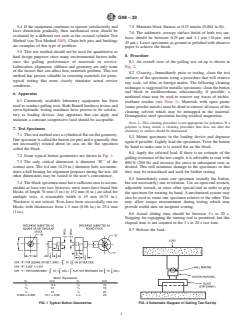
7.2 Some typical button geometries are shown in Fig. 1.
7.3 The only critical dimension is diameter “B’’ of the contact area. The 6.4 mm (0.25 in.) diameter hole accommodates a ball
bearing for alignment purposes during the test. All other dimensions may be varied to the user’s convenience.
7.4 The block specimen must have sufficient area to accommodate at least one test; however, most users have found that blocks
of length 76 mm (3 in.) to 152 mm (6 in.) are ideal for multiple tests. A reasonable width is 19 mm (0.75 in.). Thickness is not
critical. Tests have been successfully run on blocks with thicknesses from 1.5 mm (0.06 in.) to 25.4 mm (1 in.).
G98 − 23
Metric Equivalents
in. mm in. mm
1 5
⁄4 6.4 ⁄8 16
3 3
⁄8 10 ⁄4 19
1 7
⁄2 13 ⁄8 22
0.500 ± 0.003 12.7 ± 0.08 1 ⁄8 29
FIG. 1 Typical Button Geometries
7.5 Maintain block flatness at 0.33 mm/m (0.004 in./ft).
7.6 The arithmetic average surface finish of both test surfaces should be between 0.25 μm and 1.1 μm (10 μin. and 45 μin.). Leave
specimens as-ground or polished with abrasive paper to achieve the finish.
8. Procedure
8.1 An overall view of the galling test set-up is shown in Fig. 2.
8.2 Cleaning—Immediately prior to testing, clean the test surfaces of the specimens using a procedure that will remove any scale,
oil film, or foreign matter. The following cleaning technique is suggested for metallic specimens: clean the button and block in
trichloroethane, ultrasonically, if possible; a methanol rinse may be used to remove any traces of trichloroethane residue (see Note
1). Materials with open grains (some powder metals) must be dried to remove all traces of the cleaning solvent which may be
entrapped in the material. Demagnetize steel specimens having residual magnetism.
NOTE 1—This cleaning procedure is not appropriate for polymers. If a polymer is being tested, a cleaning procedure that does not alter the chemistry or
surface should be determined.
8.3 Mount specimens in the loading device and degrease again if possible. Lightly load the specimens. Twist the button by hand
to make sure it is seated flat on the block.
FIG. 2 Schematic Diagram of Galling Test Set-Up
G98 − 23
8.4 Apply the selected load. If there is no estimate of the galling resistance of the test couple, it is advisable to start with 890 N
(200 lb) and increase the stress
...