

ASTM G75-15(2021)
(Test Method)Standard Test Method for Determination of Slurry Abrasivity (Miller Number) and Slurry Abrasion Response of Materials (SAR Number)
General Information
- Abstract
SIGNIFICANCE AND USE
5.1 The Miller Number5 is an index of the relative abrasivity of slurries. Its primary purpose is to rank the abrasivity of slurries in terms of the wear of a standard reference material. The wear damage on the standard wear block is worse as the Miller Number gets higher.
5.2 The SAR Number is an index of the relative abrasion response of materials as tested in any particular slurry of interest. The SAR Number is a generalized form of the Miller Number applicable to materials other than the reference material used for the Miller Number determination. A major purpose is to rank construction materials for use in a system for pumping and fluid handling equipment for a particular slurry. It can also be used to rank the abrasivity of various slurries against any selected construction material other than the reference material specified for a Miller Number determination. The slurry damage on the specimen of material being tested is worse as the SAR Number gets higher.
5.3 Experience has shown that slurries with a Miller Number or a SAR Number of approximately 50 or lower can be pumped with minor abrasive damage to the system. Above a number of 50, precautions must be observed and greater damage from abrasion is to be expected. Accordingly, the Miller Number and the SAR Number provide information about the slurry or the material that may be useful in the selection of pumps and other equipment and to predict the life expectancy of liquid-end parts of the pumps involved.
5.4 The SAR Number can be used to determine the most suitable materials for certain slurry systems.
SCOPE
1.1 This test method covers a single laboratory procedure that can be used to develop data from which either the relative abrasivity of any slurry (Miller Number) or the response of different materials to the abrasivity of different slurries (SAR Number), can be determined.
1.2 The test data obtained by this procedure is used to calculate either a number related to the rate of mass loss of duplicate standard-shaped 27 % chromium iron wear blocks when run for a period of time in the slurry of interest (Miller Number), or to calculate a number related to the rate of mass loss (converted to volume loss) of duplicate standard-shaped wear specimens of any material of interest when run for a period of time in any slurry of interest (SAR Number).
1.3 The requirement for a finished flat wearing surface on the test specimen for a SAR Number test may preclude application of the procedure where thin (0.051 mm to 0.127 mm), hard, wear-resistant coatings will not allow for surface finishing. The 6 h total duration of the SAR Number Test may not allow establishment of a consistent rate-of-mass-loss of the unfinished surface.
1.4 This standard does not purport to address all of the safety concerns, if any, associated with its use. It is the responsibility of the user of this standard to establish appropriate safety, health, and environmental practices and determine the applicability of regulatory limitations prior to use.
1.5 This international standard was developed in accordance with internationally recognized principles on standardization established in the Decision on Principles for the Development of International Standards, Guides and Recommendations issued by the World Trade Organization Technical Barriers to Trade (TBT) Committee.
- Status
- Published
- Publication Date
- 31-Oct-2021
- Technical Committee
- G02 - Wear and Erosion
- Drafting Committee
- G02.30 - Abrasive Wear
Overview
ASTM G75-15(2021), issued by ASTM International, outlines the Standard Test Method for Determination of Slurry Abrasivity (Miller Number) and Slurry Abrasion Response of Materials (SAR Number). This internationally recognized standard provides a laboratory test procedure to quantitatively evaluate the relative abrasivity of slurries and the abrasion resistance of materials exposed to those slurries. Widely used in industries such as mining, mineral processing, wastewater treatment, and pump manufacturing, ASTM G75 delivers crucial data to help users select construction and pump materials and to predict equipment life where abrasive slurries are handled.
The Miller Number serves as an index to rank slurries’ abrasivity by measuring wear on a standardized reference material, while the SAR Number offers a broad assessment of how different materials fare in any given slurry. These metrics support safer, more economical equipment choices and reduce unplanned downtime caused by abrasion wear.
Key Topics
Slurry Abrasivity (Miller Number):
- Ranks slurries according to their potential to wear a standard reference material
- Higher Miller Numbers correspond to increased abrasion and wear risk
- Helps identify slurries that require special precautions or equipment
Slurry Abrasion Response (SAR Number):
- Assesses the wear resistance of various materials in a selected slurry
- Allows comparison and ranking of material performance for specific applications
- SAR Numbers above 50 indicate potential for more severe abrasive damage
Testing Procedures:
- Relies on controlled laboratory simulating real-world slurry wear
- Measures mass loss from duplicate test specimens after specified exposure
- Supports repeatable, comparable data for material and slurry selection
Practical Guidance:
- Informs choices for pumps, pipelines, and other fluid handling components
- Predicts service life and maintenance intervals for equipment exposed to slurries
- Provides data for materials scientists, engineers, and plant operators
Applications
ASTM G75 is essential for organizations dealing with abrasive slurries, such as:
Selecting Pump Materials:
- Use Miller and SAR Numbers to choose wear-resistant components or coatings
- Avoids premature failure of pump wet-end parts and associated costs
Piping and Fluid Handling Design:
- Engineers can select optimal pipe linings and joint materials for slurry transport
- Reduces risk of unplanned shutdowns due to excessive wear
Material Development and Comparison:
- Material scientists use the SAR Number to benchmark new alloys or composites
- Laboratories compare material candidates for use with a range of abrasive slurries
Quality Assurance and Product Validation:
- Manufacturers and buyers verify abrasion resistance claims using standardized testing
- Assures consistency and reliability in material sourcing for abrasive service
Predictive Maintenance Planning:
- Reliable wear data helps forecast equipment replacement intervals
- Enables cost-effective maintenance and extended asset life
Related Standards
- ASTM G40: Terminology Relating to Wear and Erosion
- MIL-R-6855C: Rubber, Synthetic, Sheets, Strips, Molded or Extruded Shapes
- ASTM G117: Guidelines for evaluating the precision and reproducibility in wear test methods
Adherence to ASTM G75 enhances compatibility with international standardization principles and supports compliance with technical requirements set by organizations like the World Trade Organization (WTO).
Keywords: ASTM G75, slurry abrasivity, Miller Number, SAR Number, abrasion resistance, material wear, pump material selection, slurry handling, wear testing standard, equipment life prediction
Relations
- Effective Date
- 01-Nov-2015
- Effective Date
- 01-Jun-2013
- Effective Date
- 01-May-2012
- Effective Date
- 01-Dec-2010
- Effective Date
- 01-Jul-2010
- Effective Date
- 01-Jan-2010
- Effective Date
- 15-Nov-2009
- Effective Date
- 01-May-2005
- Effective Date
- 01-Dec-2004
- Effective Date
- 10-Oct-2002
- Effective Date
- 10-Jun-2001
- Effective Date
- 10-Jun-2001
Get Certified
Connect with accredited certification bodies for this standard

BSMI (Bureau of Standards, Metrology and Inspection)
Taiwan's standards and inspection authority.
Sponsored listings
Frequently Asked Questions
ASTM G75-15(2021) is a standard published by ASTM International. Its full title is "Standard Test Method for Determination of Slurry Abrasivity (Miller Number) and Slurry Abrasion Response of Materials (SAR Number)". This standard covers: SIGNIFICANCE AND USE 5.1 The Miller Number5 is an index of the relative abrasivity of slurries. Its primary purpose is to rank the abrasivity of slurries in terms of the wear of a standard reference material. The wear damage on the standard wear block is worse as the Miller Number gets higher. 5.2 The SAR Number is an index of the relative abrasion response of materials as tested in any particular slurry of interest. The SAR Number is a generalized form of the Miller Number applicable to materials other than the reference material used for the Miller Number determination. A major purpose is to rank construction materials for use in a system for pumping and fluid handling equipment for a particular slurry. It can also be used to rank the abrasivity of various slurries against any selected construction material other than the reference material specified for a Miller Number determination. The slurry damage on the specimen of material being tested is worse as the SAR Number gets higher. 5.3 Experience has shown that slurries with a Miller Number or a SAR Number of approximately 50 or lower can be pumped with minor abrasive damage to the system. Above a number of 50, precautions must be observed and greater damage from abrasion is to be expected. Accordingly, the Miller Number and the SAR Number provide information about the slurry or the material that may be useful in the selection of pumps and other equipment and to predict the life expectancy of liquid-end parts of the pumps involved. 5.4 The SAR Number can be used to determine the most suitable materials for certain slurry systems. SCOPE 1.1 This test method covers a single laboratory procedure that can be used to develop data from which either the relative abrasivity of any slurry (Miller Number) or the response of different materials to the abrasivity of different slurries (SAR Number), can be determined. 1.2 The test data obtained by this procedure is used to calculate either a number related to the rate of mass loss of duplicate standard-shaped 27 % chromium iron wear blocks when run for a period of time in the slurry of interest (Miller Number), or to calculate a number related to the rate of mass loss (converted to volume loss) of duplicate standard-shaped wear specimens of any material of interest when run for a period of time in any slurry of interest (SAR Number). 1.3 The requirement for a finished flat wearing surface on the test specimen for a SAR Number test may preclude application of the procedure where thin (0.051 mm to 0.127 mm), hard, wear-resistant coatings will not allow for surface finishing. The 6 h total duration of the SAR Number Test may not allow establishment of a consistent rate-of-mass-loss of the unfinished surface. 1.4 This standard does not purport to address all of the safety concerns, if any, associated with its use. It is the responsibility of the user of this standard to establish appropriate safety, health, and environmental practices and determine the applicability of regulatory limitations prior to use. 1.5 This international standard was developed in accordance with internationally recognized principles on standardization established in the Decision on Principles for the Development of International Standards, Guides and Recommendations issued by the World Trade Organization Technical Barriers to Trade (TBT) Committee.
SIGNIFICANCE AND USE 5.1 The Miller Number5 is an index of the relative abrasivity of slurries. Its primary purpose is to rank the abrasivity of slurries in terms of the wear of a standard reference material. The wear damage on the standard wear block is worse as the Miller Number gets higher. 5.2 The SAR Number is an index of the relative abrasion response of materials as tested in any particular slurry of interest. The SAR Number is a generalized form of the Miller Number applicable to materials other than the reference material used for the Miller Number determination. A major purpose is to rank construction materials for use in a system for pumping and fluid handling equipment for a particular slurry. It can also be used to rank the abrasivity of various slurries against any selected construction material other than the reference material specified for a Miller Number determination. The slurry damage on the specimen of material being tested is worse as the SAR Number gets higher. 5.3 Experience has shown that slurries with a Miller Number or a SAR Number of approximately 50 or lower can be pumped with minor abrasive damage to the system. Above a number of 50, precautions must be observed and greater damage from abrasion is to be expected. Accordingly, the Miller Number and the SAR Number provide information about the slurry or the material that may be useful in the selection of pumps and other equipment and to predict the life expectancy of liquid-end parts of the pumps involved. 5.4 The SAR Number can be used to determine the most suitable materials for certain slurry systems. SCOPE 1.1 This test method covers a single laboratory procedure that can be used to develop data from which either the relative abrasivity of any slurry (Miller Number) or the response of different materials to the abrasivity of different slurries (SAR Number), can be determined. 1.2 The test data obtained by this procedure is used to calculate either a number related to the rate of mass loss of duplicate standard-shaped 27 % chromium iron wear blocks when run for a period of time in the slurry of interest (Miller Number), or to calculate a number related to the rate of mass loss (converted to volume loss) of duplicate standard-shaped wear specimens of any material of interest when run for a period of time in any slurry of interest (SAR Number). 1.3 The requirement for a finished flat wearing surface on the test specimen for a SAR Number test may preclude application of the procedure where thin (0.051 mm to 0.127 mm), hard, wear-resistant coatings will not allow for surface finishing. The 6 h total duration of the SAR Number Test may not allow establishment of a consistent rate-of-mass-loss of the unfinished surface. 1.4 This standard does not purport to address all of the safety concerns, if any, associated with its use. It is the responsibility of the user of this standard to establish appropriate safety, health, and environmental practices and determine the applicability of regulatory limitations prior to use. 1.5 This international standard was developed in accordance with internationally recognized principles on standardization established in the Decision on Principles for the Development of International Standards, Guides and Recommendations issued by the World Trade Organization Technical Barriers to Trade (TBT) Committee.
ASTM G75-15(2021) is classified under the following ICS (International Classification for Standards) categories: 17.040.20 - Properties of surfaces. The ICS classification helps identify the subject area and facilitates finding related standards.
ASTM G75-15(2021) has the following relationships with other standards: It is inter standard links to ASTM G40-15, ASTM G40-13, ASTM G40-12, ASTM G40-10b, ASTM G40-10a, ASTM G40-10, ASTM G40-09, ASTM G40-05, ASTM G40-04, ASTM G40-02, ASTM G40-01, ASTM G40-99. Understanding these relationships helps ensure you are using the most current and applicable version of the standard.
ASTM G75-15(2021) is available in PDF format for immediate download after purchase. The document can be added to your cart and obtained through the secure checkout process. Digital delivery ensures instant access to the complete standard document.
Standards Content (Sample)
This international standard was developed in accordance with internationally recognized principles on standardization established in the Decision on Principles for the
Development of International Standards, Guides and Recommendations issued by the World Trade Organization Technical Barriers to Trade (TBT) Committee.
Designation: G75 − 15 (Reapproved 2021)
Standard Test Method for
Determination of Slurry Abrasivity (Miller Number) and
Slurry Abrasion Response of Materials (SAR Number)
ThisstandardisissuedunderthefixeddesignationG75;thenumberimmediatelyfollowingthedesignationindicatestheyearoforiginal
adoptionor,inthecaseofrevision,theyearoflastrevision.Anumberinparenthesesindicatestheyearoflastreapproval.Asuperscript
epsilon (´) indicates an editorial change since the last revision or reapproval.
1. Scope 2. Referenced Documents
2.1 ASTM Standard:
1.1 This test method covers a single laboratory procedure
G40Terminology Relating to Wear and Erosion
that can be used to develop data from which either the relative
2.2 Military Standard:
abrasivity of any slurry (Miller Number) or the response of
MIL-R-6855CRubber, Synthetic, Sheets, Strips, Molded or
different materials to the abrasivity of different slurries (SAR
Extruded Shapes
Number), can be determined.
3. Terminology
1.2 The test data obtained by this procedure is used to
3.1 Definitions:
calculate either a number related to the rate of mass loss of
3.1.1 Definitions used in this test method are in accordance
duplicate standard-shaped 27% chromium iron wear blocks
with Terminology G40 as follows:
when run for a period of time in the slurry of interest (Miller
3.1.2 abrasive wear—wear due to hard particles or hard
Number), or to calculate a number related to the rate of mass
protuberancesforcedagainstandmovingalongasolidsurface.
loss (converted to volume loss) of duplicate standard-shaped
3.1.3 corrosive wear—wear in which chemical or electro-
wear specimens of any material of interest when run for a
chemical reaction with the environment is significant.
period of time in any slurry of interest (SAR Number).
3.1.4 abrasion-corrosion—a synergistic process involving
1.3 The requirement for a finished flat wearing surface on
both abrasive wear and corrosion in which each of these
the test specimen for a SAR Number test may preclude
processes is affected by the simultaneous action of the other
application of the procedure where thin (0.051 mm to
and, in many cases is thereby accelerated.
0.127mm), hard, wear-resistant coatings will not allow for
3.1.5 cumulative erosion-time curve—a plot of cumulative
surface finishing. The 6h total duration of the SAR Number
erosion versus cumulative exposure duration, usually deter-
Test may not allow establishment of a consistent rate-of-mass-
mined by periodic interruption of the test and weighing of the
loss of the unfinished surface.
specimen. This is the primary record of an erosion test. Most
1.4 This standard does not purport to address all of the other characteristics, such as the incubation period, maximum
safety concerns, if any, associated with its use. It is the erosionrate,terminalerosionrate,anderosionrate-timecurve,
are derived from it.
responsibility of the user of this standard to establish appro-
priate safety, health, and environmental practices and deter-
3.1.6 erosion—progressive loss of original material from a
mine the applicability of regulatory limitations prior to use.
solid surface due to mechanical interaction between that
surface and a fluid, a multi-component fluid, or impinging
1.5 This international standard was developed in accor-
liquid or solid particles.
dance with internationally recognized principles on standard-
ization established in the Decision on Principles for the
3.1.7 erosion-corrosion—a conjoint action involving corro-
Development of International Standards, Guides and Recom-
sion and erosion in the presence of a corrosive substance.
mendations issued by the World Trade Organization Technical
3.1.8 instantaneous erosion rate—the slope of a tangent to
Barriers to Trade (TBT) Committee.
the cumulative erosion-time curve at a specified point on that
curve.
1 2
This test method is under the jurisdiction of ASTM Committee G02 on Wear For referenced ASTM standards, visit the ASTM website, www.astm.org, or
and Erosion and is the direct responsibility of Subcommittee G02.30 on Abrasive contact ASTM Customer Service at service@astm.org. For Annual Book of ASTM
Wear. Standards volume information, refer to the standard’s Document Summary page on
Current edition approved Nov. 1, 2021. Published December 2021. Originally the ASTM website.
approved in 1982. Last previous edition approved in 2015 as G75–15. DOI: Available from DLA Document Services, Building 4/D, 700 Robbins Ave.,
10.1520/G0075-15R21. Philadelphia, PA 19111-5094, http://quicksearch.dla.mil.
Copyright © ASTM International, 100 Barr Harbor Drive, PO Box C700, West Conshohocken, PA 19428-2959. United States
G75 − 15 (2021)
3.2 Definitions of Terms Specific to This Standard:
3.2.1 mass concentration—the mass of solid particles per
unit mass of mixture, expressed in percent.
3.2.2 Miller Number—a measure of slurry abrasivity as
related to the instantaneous rate of mass loss of a standard
metalwearblockataspecifictimeonthecumulativeabrasion-
corrosion time curve.
3.2.3 SAR Number—a measure of the relative abrasion
response of any material in any slurry, as related to the
instantaneousrateofmass-lossofaspecimenataspecifictime
on the cumulative abrasion-corrosion time curve, converted to
volume or thickness loss rate.
3.2.4 slurry—amixtureofsolidparticlesinliquid,ofsucha
FIG. 1 Miller Number Machine
consistency as to be capable of being pumped like a liquid.
5. Significance and Use
3.2.5 slurry abrasivity—therelativetendencyofaparticular
moving slurry to produce abrasive and corrosive wear com-
5.1 The Miller Number is an index of the relative abrasiv-
pared with other slurries.
ity of slurries. Its primary purpose is to rank the abrasivity of
slurries in terms of the wear of a standard reference material.
4. Summary of Test Method
The wear damage on the standard wear block is worse as the
4.1 The relative effect of slurry abrasivity in both the Miller
Miller Number gets higher.
Number and the SAR Number is determined by using the
5.2 The SAR Number is an index of the relative abrasion
measured mass loss of a standard-shaped 27% chrome iron
response of materials as tested in any particular slurry of
metal wear block (Miller Number); or a metal, ceramic,
interest. The SAR Number is a generalized form of the Miller
composite, plastic, or elastomer wear specimen (SAR
Number applicable to materials other than the reference
Number), driven in a reciprocating motion by a rotating crank,
material used for the Miller Number determination. A major
riding in the bottom of a trough containing the slurry.Adirect
purposeistorankconstructionmaterialsforuseinasystemfor
load is applied to the wear block or wear specimen. For each
pumpingandfluidhandlingequipmentforaparticularslurry.It
test, the bottom of the trough is equipped with a new piece of
can also be used to rank the abrasivity of various slurries
a sheet of Neoprene to act as a lap. The interior of the trough
against any selected construction material other than the
hasaflat-bottomedortruncated“V”shapetroughthatconfines
reference material specified for a Miller Number determina-
the slurry particles to the path taken by the wear block or wear
tion. The slurry damage on the specimen of material being
specimen. At one end of each stroke, the wear block wear
tested is worse as the SAR Number gets higher.
specimenisliftedoffthelapbyacamactionforsufficienttime
5.3 Experience has shown that slurries with a Miller Num-
to allow fresh slurry material to flow under the wear block or
ber or a SAR Number of approximately 50 or lower can be
wear specimen.The wear block/wear specimen holder is made
pumped with minor abrasive damage to the system. Above a
of plastic, as are the troughs, so that electrolysis inherent in
number of 50, precautions must be observed and greater
certain slurries is minimized.
damage from abrasion is to be expected. Accordingly, the
4.2 The test consists of measuring the mass loss of a part
Miller Number and the SAR Number provide information
that is referred to either a wear block or wear specimen to be
about the slurry or the material that may be useful in the
consistent with Section G34 of Form and Style for ASTM
selection of pumps and other equipment and to predict the life
Standards.Standardwearblocksof27%chromeironareused
expectancy of liquid-end parts of the pumps involved.
fortheMillerNumbertestwheretheslurryisthespecimenand
5.4 The SAR Number can be used to determine the most
the results are the relative abrasivity of the slurry. Wear
suitable materials for certain slurry systems.
specimens are used in the SAR Number test where the test
resultsaretherelativewearrateofdifferentwearspecimensin
6. Apparatus
a given slurry.
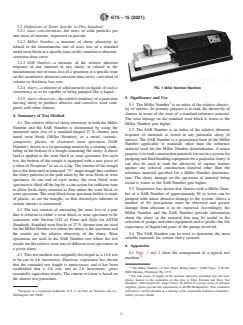
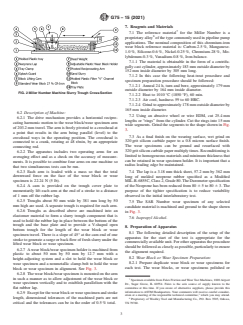
6.1 Figs. 1 and 2 show the arrangement of a typical test
4.3 This test method was originally developed as a 16h test
machine.
to be run in 4h increments. However, experience has shown
that the extended test length is unnecessary and it has been
“The Miller Number—A New Slurry Rating Index,” AIME Paper 73-B-300,
established that a 6h test, run in 2h increments, gives
SME Meeting, Pittsburgh, PA, 1973.
essentially equivalent results. The current revision is based on
The sole source of supply of the machine and parts, including laps and wear
the shorter test procedure.
blocks, known to the committee at this time is Falex Friction and Wear Test
Machines, 1020 Airport Dr., Sugar Grove, IL 60554. If you are aware of alternate
suppliers, please provide this information to ASTM Headquarters. Your comments
4 1
Neoprene is a registered trademark of E. I. du Pont de Nemours and Co., will receive careful attention at a meeting of the responsible technical committee,
Wilmington, DE 19898. which you may attend.
G75 − 15 (2021)
7. Reagents and Materials
7.1 The reference material for the Miller Number is a
proprietaryalloy ofthetypecommonlyusedinpipelinepump
applications. The nominal composition of this chromium-iron
wear block reference material is: Carbon-2.5%, Manganese-
1.0%, Silicone-0.6%, Nickel-0.25%, Chromium-28%, Mo-
lybdenum-0.3%, Vanadium-0.8%, Iron-balance.
7.1.1 The material is obtainable in the form of a centrifu-
gallycastcylinder,approximately183mmoutsidediameterby
152mm inside diameter by 305 mm long.
7.1.2 In this case the following heat-treat procedure and
specimen preparation procedure should be followed:
7.1.2.1 Anneal 24 h, turn and bore, approximately 179mm
outside diameter by 164mm inside diameter.
FIG. 2 Miller Number Machine Slurry Trough Cross-Section
7.1.2.2 Heat to 1010°C (1850°F), 60 min.
7.1.2.3 Air cool, hardness 59 to 60 HRC.
7.1.2.4 Grindtoapproximately178mmoutsidediameterby
165mm inside diameter.
6.2 Description of Machine:
7.2 Using an abrasive wheel or wire EDM, cut 25.4mm
6.2.1 The drive mechanism provides a horizontal recipro-
lengths or “rings” from the cylinder. Cut the rings into 15mm
cating harmonic motion to the wear block/wear specimen arm
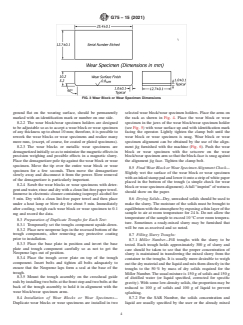
wide segments. Grind the segments to the shape shown in Fig.
of203.2mmtravel.Thearmisfreelypivotedtoacrossheadat
3.
a point that results in the arm being parallel (level) to the
7.3 As a final finish on the wearing surface, wet grind on
crosshead ways in the operating position. The crosshead is
320grit silicon carbide paper to a 0.8 micron surface finish.
connected to a crank, rotating at 48 r/min, by an appropriate
The wear specimens can be ground and resurfaced with
connecting rod.
320gritsiliconcarbidepapermultiplytimes.Reconditioningis
6.2.2 The apparatus includes two operating arms for an
limitedtohomogeneousmaterialsandminimumthicknessthat
averaging effect and as a check on the accuracy of measure-
can be retained in wear specimen holder. It is important that a
ments. It is possible to combine four arms on one machine so
radius leading edge be maintained.
that two simultaneous tests can be run.
6.2.3 Each arm is loaded with a mass so that the total 7.4 The lap is a 3.18mm thick sheet, 57.2 mm by 362 mm
downward force on the face of the wear block or wear
long of molded neoprene rubber specified as a Modified
specimen is 22.24 N (5 lb). MIL-R-6855C,Class2,Grade80.TheDurometerspecification
of the Neoprene has been reduced from 80 65to80 6 3.The
6.2.4 A cam is provided on the trough cover plate to
purpose of the tighter specification is to reduce variability
momentarily lift each arm at the end of a stroke to a distance
observed in the initial interlaboratory test.
of 1 mm off the rubber lap.
6.2.5 Troughs about 50 mm wide by 381 mm long by 50
7.5 The SAR Number wear specimen of any selected
mm high are used.Aseparate trough is required for each arm.
candidate material is machined and ground to the shape shown
6.2.6 Troughs as described above are machined into an
in Fig. 3.
elastomer material to form a slurry trough component that is
7.6 Isopropyl Alcohol.
used to hold the rubber lap in place between the bottom of the
trough and the base plate and to provide a V-shaped open
8. Preparation of Apparatus
bottom trough for the length of the wear block or wear
8.1 The following detailed description of the setup of the
specimen travel. There is a slope of 45° at the cam end of one
apparatus for the start of the test is appropriate for the
stroketogenerateasurgeorbackflowoffreshslurryunderthe
commerciallyavailableunit.Forotherapparatustheprocedure
lifted wear block or wear specimen.
shouldbefollowedascloselyaspossible,particularlytoensure
6.2.7 Awear block/wear specimen holder is machined from
the alignment required.
plastic to about 50 mm by 50 mm by 12.7 mm with a
8.2 Wear Block or Wear Specimen Preparation:
height-adjusting system and a slot to hold the wear block or
8.2.1 Prepare duplicate wear block or wear specimens for
wear specimen and a nonmetallic clamp-bolt to hold the wear
each test. The wear blocks, or wear specimens polished or
block or wear specimen in alignment. See Fig. 3.
6.2.8 The wear block/wear specimen is mounted on the arm
in such a manner as to allow adjustment of the wear block or
Specimen available from Falex Friction andWearTest Machines, 1020Airport
wear specimen vertically and to establish parallelism with the
Dr., Sugar Grove, IL 60554. Falex is the sole source of supply known to the
committee at this time. If you aware of alternative suppliers, please provide this
flat rubber lap.
information to ASTM Headquarters. Your comments will receive careful consider-
6.2.9 Exceptforthewearblockorwearspecimenandstroke
ation at a meeting of the responsible technical committee, which you may attend.
length, dimensional tolerances of the machined parts are not
Proprietary of Woolley Tool and Manufacturing Co., P.O. Box 3505, Odessa,
critical and the tolerances can be in the order of 0.5% total. TX79760.
G75 − 15 (2021)
FIG. 3 Wear Block or Wear Specimen Dimensions
ground flat on the wearing surface, should be permanently selected wear block/wear specimen holders. Place the arms on
marked with an identification mark or number on one side. the rack as shown in Fig. 4. Place the wear block or wear
8.2.2 The wear block/wear specimen holders are designed specimen in the jaws of the wear block/wear specimen holder
to be adjustable so as to accept a wear block or wear specimen (see Fig. 5) with wear surface up and with identification mark
of any thickness up to about 10 mm; therefore, it is possible to facing the operator. Lightly tighten the clamp bolt until the
rework the wear blocks or wear specimens and realize many wear block or wear specimen is snug. Wear block or wear
more runs, (except, of course, for coated or plated specimens). specimen alignment can be obtained by the use of the align-
8.2.3 The wear blocks or metallic wear specimens are ment jig furnished with the machine (Fig. 6). Push the wear
demagnetizedinitiallysoastominimizethemagneticeffectsin block or wear specimen with the setscrew on the wear
precision weighing and possible effects in a magnetic slurry. block/wearspecimenarmsothattheblock-faceissnugagainst
Place the demagnetizer pole tip against the wear block or wear the alignment jig face. Tighten the clamp bolt.
specimen. Move the tip over the entire wear block or wear
8.5 Final Wear Block or Wear Specimen Alignment Check—
specimen for a few seconds. Then move the demagnetizer
Slightly wet the surface of the wear block or wear specimen
slowly away and disconnect it from the power. Slow removal
withaninkedstamppadandloweritontoastripofwhitepaper
of the demagnetizer is particularly important.
placed in the bottom of the trough (a simple check for wear
8.2.4 Scrub the wear blocks or wear specimens with deter-
blockorwearspecimenalignment).Afull“imprint”ofwetness
gentandwater,rinseanddrywithacleanlint-freepapertowel.
should show on the paper.
Immerse in electronic cleaner containing isopropyl alcohol for
5 min. Dry with a clean lint-free paper towel and then place 8.6 Drying Solids—Dry, unwashed solids should be used to
make the slurry. The moisture of the solids must be brought to
under a heat lamp or blow dry for about 5 min. Immediately
after cooling, weigh each wear block or wear specimen to 0.1 equilibriumwiththeatmospherebyexposingathinlayerofthe
sample to air at room temperature for 24 h. Do not allow the
mg and record the data.
temperatureofthesampletoexceed10°Coverroomtempera-
8.3 Preparation of Duplicate Troughs for Each Test:
ture. Sometimes a ready-mixed slurry may be furnished that
8.3.1 Temporarily set the troughs component upside-down.
will be run as-received and so noted.
8.3.2 Place new neoprene laps in the recessed bottom of the
trough components, after removing any protective coating
8.7 Filling Slurry Troughs:
prior to installation.
8.7.1 Miller Number—Fill troughs with the slurry to be
8.3.3 Place the base plate in position and invert the base
tested. Each trough holds approximately 300 g of slurry and
plate and trough component carefully so as not to get the
care should be taken to see that the proper concentration of
Neoprene laps out of position.
slurry is maintained in transferring the mixed slurry from the
8.3.4 Place the trough cover plate on top of the trough
container to the troughs. It is usually more desirable to weigh
component. Insert bolts and tighten all bolts adequately to
outthedrymaterialandtheliquidandmixthemdirectlyinthe
ensure that the Neoprene laps form a seal at the base of the
troughs to the 50% by mass of dry solids required for the
trough.
Miller Number.The usual mixture is 150 g of solids and 150 g
8.3.5 Mount the trough assembly on the crosshead guide
of distilled water (or liquid specified, corrected for specific
rodsbyinstallingtwoboltsatthefrontstopandtwoboltsatthe
gravity). With some low-density solids, the proportion may be
back of the trough assembly to hold it in alignment with the
reduced to 100 g of solids and 100 g of liquid to prevent
wear block/wear specimen arms.
splashing.
8.4 Installation of Wear Blocks or Wear Specimens— 8.7.2 For the SAR Number, the solids concentration and
Duplicate wear blocks or wear specimens are installed in two liquid are usually specified by the user or the already mixed
G75 − 15 (2021)
10.1.1 The wear block or wear specimen mass loss, is
recorded as the average of two runs in a typical slurry. For
example, see Table 1. The basic mathematical equation for a
curve-fit of the data is:
B
M,mg 5 At (1)
where:
M = cumulative mass loss,
A = first curve fit coefficient,
B = second curve fit coefficient,
t = time, h, and
MN = Miller number.
10.1.2 Using the least squares method, the values of A and
B are calculated for the curve closely matching the test data
curve. In this example, the following values are determined:
A=4.732 and B =0.906. The Miller Number and the SAR
FIG. 4 Arms in Racked Position
Number are described as indexes related to the rate at which
the wear block or specimen loses mass at 2 h into the test,
which can be calculated by using the first derivative of (Eq 1)
slurry may be furnished. If a dry material sample is supplied,
at 2 h and is designated as M. This become
...