

ASTM D6311-98(2022)
(Guide)Standard Guide for Generation of Environmental Data Related to Waste Management Activities: Selection and Optimization of Sampling Design
General Information
- Abstract
SIGNIFICANCE AND USE
4.1 The intended use of this guide is to provide practical assistance in the development of an optimized sampling design. This standard describes or discusses:
4.1.1 Sampling design selection criteria,
4.1.2 Factors impacting the choice of a sampling design,
4.1.3 Selection of a sampling design,
4.1.4 Techniques for optimizing candidate designs, and
4.1.5 The criteria for evaluating an optimized sampling design.
4.2 Within a formal USEPA data generation activity, the planning process or data quality objectives (DQOs) development is the first step. The second and third are the implementation of the sampling and analysis design and the data quality assessment. Within the DQO planning process, the selection and optimization of the sampling design is the last step, and therefore, the culmination of the DQO process. The preceding steps in the DQO planning process address:
4.2.1 The problem that needs to be addressed,
4.2.2 The possible decisions,
4.2.3 The data input and associated activities,
4.2.4 The boundaries of the study,
4.2.5 The development of decision rules, and
4.2.6 The specified the limits on decision error.
4.3 This guide is not intended to address the aspects of the planning process for development of the project objectives. However, the project objectives must be outlined and communicated to the design team, prior to the selection and optimization of the sample design.
4.4 This guide references statistical aspects of the planning and implementation process and includes an appendix for the statistical calculation of the optimum number of samples for a given sampling design.
4.5 This guide is intended for those who are responsible for making decisions about environmental waste management activities.
SCOPE
1.1 This document provides practical guidance on the selection and optimization of sample designs in waste management sampling activities, within the context of the requirements established by the data quality objectives or other planning process.
1.2 This document (1) provides guidance for selection of sampling designs; (2) outlines techniques to optimize candidate designs; and (3) describes the variables that need to be balanced in choosing the final optimized design.
1.3 The contents of this guide are arranged by section as follows:
1.
Scope
2.
Referenced Documents
3.
Terminology
4.
Significance and Use
5.
Summary of Guide
6.
Factors Affecting Sampling Design Selection
6.1
Sampling Design Performance Characteristics
6.2
Regulatory Considerations
6.3
Project Objectives
6.4
Knowledge of the Site
6.5
Physical Sample Issues
6.6
Communication with the Laboratory
6.7
Analytical Turn Around Time
6.8
Analytical Method Constraints
6.9
Health and Safety
6.10
Budget/Cost Considerations
6.11
Representativeness
7.
Initial Design Selection
8.
Optimization Criteria
9.
Optimization Process
9.2
Practical Evaluation of Design Alternatives
9.3
Statistical and Cost Evaluation
10.
Final Selection
Annex A1
Types of Sampling Designs
A1.1
Commonly Used Sampling Designs
A1.2
Sampling Design Tools
A1.3
Combination Sample Designs
Appendix X1. Additional References
Appendix X2. Choosing Analytical Method Based on Variance and Cost
Appendix X3. Calculating the Number of Samples: A Statistical Treatment
1.4 This standard does not purport to address all of the safety concerns, if any, associated with its use. It is the responsibility of the user of this standa...
- Status
- Published
- Publication Date
- 28-Feb-2022
- Technical Committee
- D34 - Waste Management
- Drafting Committee
- D34.01.01 - Planning for Sampling
Overview
ASTM D6311-98(2022) is a widely recognized standard guide developed by ASTM International to assist in the generation of high-quality environmental data for waste management activities. This document focuses on the practical selection and optimization of sampling design for environmental data collection, particularly within the requirements established by Data Quality Objectives (DQOs) or similar planning processes. It is intended for professionals responsible for making key decisions about waste management, site investigation, and regulatory compliance.
Key Topics
- Sampling Design Selection Criteria: The guide explores various criteria to consider when selecting a sampling design, such as project objectives, regulatory requirements, site characteristics, and data quality needs.
- Optimization of Sampling Design: Techniques and methods are outlined to refine sampling designs, aiming to achieve balance among cost, practicality, statistical robustness, and regulatory compliance.
- Factors Influencing Design Choice: Considerations include site knowledge, physical characteristics of samples, access and logistics, analytical constraints, turnaround time, health and safety, representativeness, and cost.
- Statistical Methods: The standard references approaches to calculate the optimum number of samples, using statistical parameters relevant to waste management projects.
- Iterative Evaluation Process: The document stresses an iterative approach to select, evaluate, and optimize sampling designs to ensure they meet project objectives within practical constraints.
- Communication and Planning: Coordination with laboratories and project teams is emphasized to ensure chosen designs can be implemented effectively and provide reliable data.
Applications
ASTM D6311-98(2022) is particularly valuable for organizations involved in:
- Environmental Site Assessments: Ensuring that sampling plans are statistically defensible and tailored to specific contaminants and site conditions.
- Waste Management Programs: Facilitating reliable data collection for the classification, monitoring, and treatment of waste streams.
- Regulatory Compliance: Meeting the requirements of environmental authorities such as the USEPA, by designing sampling protocols that support decision-making and minimize risk of enforcement actions.
- Optimization of Resources: Enabling project managers to maximize data quality within budget, time, and resource limitations.
- Data Quality Planning: Guiding the selection of sampling designs as the final step of the DQO process, ensuring that all planning and decision rules are addressed.
- Complex Site Investigations: Addressing multiple site areas and integrating diverse sampling designs for comprehensive environmental characterization.
Related Standards
Those implementing ASTM D6311-98(2022) may also find these related ASTM and USEPA documents useful:
- ASTM D5956: Guide for Sampling Strategies for Heterogeneous Wastes
- ASTM D6044: Guide for Representative Sampling for Management of Waste and Contaminated Media Data
- ASTM D6051: Guide for Composite Sampling and Field Subsampling for Environmental Waste Management Activities
- ASTM D6232: Guide for Selection of Sampling Equipment for Waste and Contaminated Media Data Collection Activities
- USEPA QA/G-4: Guidance for the Data Quality Objectives Process
- USEPA Environmental Investigations Branch SOP and QA Manual
Practical Value
Using ASTM D6311-98(2022) strengthens the scientific and regulatory foundation of environmental data collection in waste management. By guiding project teams through the selection and optimization of sampling design, this standard helps ensure that sampling programs yield reliable, representative data-minimizing risks, supporting compliance, and facilitating efficient allocation of resources. Its focus on statistical rigor, practical constraints, and iterative improvement makes it a critical tool for environmental professionals striving for data quality and operational excellence.
Relations
- Effective Date
- 01-Jan-2020
- Effective Date
- 15-May-2019
- Effective Date
- 15-May-2016
- Effective Date
- 01-Jul-2015
- Effective Date
- 15-May-2015
- Effective Date
- 15-Aug-2014
- Effective Date
- 01-Apr-2014
- Effective Date
- 15-Feb-2014
- Effective Date
- 01-Dec-2013
- Effective Date
- 15-Sep-2011
- Effective Date
- 15-Jun-2011
- Effective Date
- 15-Jan-2011
- Effective Date
- 01-Jul-2010
- Effective Date
- 15-Jan-2010
- Effective Date
- 15-Jan-2010
Get Certified
Connect with accredited certification bodies for this standard

CIS Institut d.o.o.
Personal Protective Equipment (PPE) certification body. Notified Body NB-2890 for EU Regulation 2016/425 PPE.

Kiwa BDA Testing
Building and construction product certification.
Kmetijski inštitut Slovenije
Agricultural Institute of Slovenia. Soil testing, plant health, agricultural product analysis.
Sponsored listings
Frequently Asked Questions
ASTM D6311-98(2022) is a guide published by ASTM International. Its full title is "Standard Guide for Generation of Environmental Data Related to Waste Management Activities: Selection and Optimization of Sampling Design". This standard covers: SIGNIFICANCE AND USE 4.1 The intended use of this guide is to provide practical assistance in the development of an optimized sampling design. This standard describes or discusses: 4.1.1 Sampling design selection criteria, 4.1.2 Factors impacting the choice of a sampling design, 4.1.3 Selection of a sampling design, 4.1.4 Techniques for optimizing candidate designs, and 4.1.5 The criteria for evaluating an optimized sampling design. 4.2 Within a formal USEPA data generation activity, the planning process or data quality objectives (DQOs) development is the first step. The second and third are the implementation of the sampling and analysis design and the data quality assessment. Within the DQO planning process, the selection and optimization of the sampling design is the last step, and therefore, the culmination of the DQO process. The preceding steps in the DQO planning process address: 4.2.1 The problem that needs to be addressed, 4.2.2 The possible decisions, 4.2.3 The data input and associated activities, 4.2.4 The boundaries of the study, 4.2.5 The development of decision rules, and 4.2.6 The specified the limits on decision error. 4.3 This guide is not intended to address the aspects of the planning process for development of the project objectives. However, the project objectives must be outlined and communicated to the design team, prior to the selection and optimization of the sample design. 4.4 This guide references statistical aspects of the planning and implementation process and includes an appendix for the statistical calculation of the optimum number of samples for a given sampling design. 4.5 This guide is intended for those who are responsible for making decisions about environmental waste management activities. SCOPE 1.1 This document provides practical guidance on the selection and optimization of sample designs in waste management sampling activities, within the context of the requirements established by the data quality objectives or other planning process. 1.2 This document (1) provides guidance for selection of sampling designs; (2) outlines techniques to optimize candidate designs; and (3) describes the variables that need to be balanced in choosing the final optimized design. 1.3 The contents of this guide are arranged by section as follows: 1. Scope 2. Referenced Documents 3. Terminology 4. Significance and Use 5. Summary of Guide 6. Factors Affecting Sampling Design Selection 6.1 Sampling Design Performance Characteristics 6.2 Regulatory Considerations 6.3 Project Objectives 6.4 Knowledge of the Site 6.5 Physical Sample Issues 6.6 Communication with the Laboratory 6.7 Analytical Turn Around Time 6.8 Analytical Method Constraints 6.9 Health and Safety 6.10 Budget/Cost Considerations 6.11 Representativeness 7. Initial Design Selection 8. Optimization Criteria 9. Optimization Process 9.2 Practical Evaluation of Design Alternatives 9.3 Statistical and Cost Evaluation 10. Final Selection Annex A1 Types of Sampling Designs A1.1 Commonly Used Sampling Designs A1.2 Sampling Design Tools A1.3 Combination Sample Designs Appendix X1. Additional References Appendix X2. Choosing Analytical Method Based on Variance and Cost Appendix X3. Calculating the Number of Samples: A Statistical Treatment 1.4 This standard does not purport to address all of the safety concerns, if any, associated with its use. It is the responsibility of the user of this standa...
SIGNIFICANCE AND USE 4.1 The intended use of this guide is to provide practical assistance in the development of an optimized sampling design. This standard describes or discusses: 4.1.1 Sampling design selection criteria, 4.1.2 Factors impacting the choice of a sampling design, 4.1.3 Selection of a sampling design, 4.1.4 Techniques for optimizing candidate designs, and 4.1.5 The criteria for evaluating an optimized sampling design. 4.2 Within a formal USEPA data generation activity, the planning process or data quality objectives (DQOs) development is the first step. The second and third are the implementation of the sampling and analysis design and the data quality assessment. Within the DQO planning process, the selection and optimization of the sampling design is the last step, and therefore, the culmination of the DQO process. The preceding steps in the DQO planning process address: 4.2.1 The problem that needs to be addressed, 4.2.2 The possible decisions, 4.2.3 The data input and associated activities, 4.2.4 The boundaries of the study, 4.2.5 The development of decision rules, and 4.2.6 The specified the limits on decision error. 4.3 This guide is not intended to address the aspects of the planning process for development of the project objectives. However, the project objectives must be outlined and communicated to the design team, prior to the selection and optimization of the sample design. 4.4 This guide references statistical aspects of the planning and implementation process and includes an appendix for the statistical calculation of the optimum number of samples for a given sampling design. 4.5 This guide is intended for those who are responsible for making decisions about environmental waste management activities. SCOPE 1.1 This document provides practical guidance on the selection and optimization of sample designs in waste management sampling activities, within the context of the requirements established by the data quality objectives or other planning process. 1.2 This document (1) provides guidance for selection of sampling designs; (2) outlines techniques to optimize candidate designs; and (3) describes the variables that need to be balanced in choosing the final optimized design. 1.3 The contents of this guide are arranged by section as follows: 1. Scope 2. Referenced Documents 3. Terminology 4. Significance and Use 5. Summary of Guide 6. Factors Affecting Sampling Design Selection 6.1 Sampling Design Performance Characteristics 6.2 Regulatory Considerations 6.3 Project Objectives 6.4 Knowledge of the Site 6.5 Physical Sample Issues 6.6 Communication with the Laboratory 6.7 Analytical Turn Around Time 6.8 Analytical Method Constraints 6.9 Health and Safety 6.10 Budget/Cost Considerations 6.11 Representativeness 7. Initial Design Selection 8. Optimization Criteria 9. Optimization Process 9.2 Practical Evaluation of Design Alternatives 9.3 Statistical and Cost Evaluation 10. Final Selection Annex A1 Types of Sampling Designs A1.1 Commonly Used Sampling Designs A1.2 Sampling Design Tools A1.3 Combination Sample Designs Appendix X1. Additional References Appendix X2. Choosing Analytical Method Based on Variance and Cost Appendix X3. Calculating the Number of Samples: A Statistical Treatment 1.4 This standard does not purport to address all of the safety concerns, if any, associated with its use. It is the responsibility of the user of this standa...
ASTM D6311-98(2022) is classified under the following ICS (International Classification for Standards) categories: 13.030.01 - Wastes in general. The ICS classification helps identify the subject area and facilitates finding related standards.
ASTM D6311-98(2022) has the following relationships with other standards: It is inter standard links to ASTM E135-20, ASTM E135-19, ASTM E135-16, ASTM E135-15a, ASTM E135-15, ASTM E135-14b, ASTM E135-14a, ASTM E135-14, ASTM E135-13a, ASTM E135-11b, ASTM E135-11a, ASTM E135-11, ASTM E135-10b, ASTM E135-10, ASTM E135-10a. Understanding these relationships helps ensure you are using the most current and applicable version of the standard.
ASTM D6311-98(2022) is available in PDF format for immediate download after purchase. The document can be added to your cart and obtained through the secure checkout process. Digital delivery ensures instant access to the complete standard document.
Standards Content (Sample)
This international standard was developed in accordance with internationally recognized principles on standardization established in the Decision on Principles for the
Development of International Standards, Guides and Recommendations issued by the World Trade Organization Technical Barriers to Trade (TBT) Committee.
Designation: D6311 − 98 (Reapproved 2022)
Standard Guide for
Generation of Environmental Data Related to Waste
Management Activities: Selection and Optimization of
Sampling Design
This standard is issued under the fixed designation D6311; the number immediately following the designation indicates the year of
original adoption or, in the case of revision, the year of last revision. A number in parentheses indicates the year of last reapproval. A
superscript epsilon (´) indicates an editorial change since the last revision or reapproval.
1. Scope
10. Final Selection
1.1 This document provides practical guidance on the se-
lection and optimization of sample designs in waste manage- Annex A1 Types of Sampling Designs
A1.1 Commonly Used Sampling Designs
ment sampling activities, within the context of the require-
A1.2 Sampling Design Tools
ments established by the data quality objectives or other
A1.3 Combination Sample Designs
planning process.
Appendix X1. Additional References
1.2 This document (1) provides guidance for selection of
Appendix X2. Choosing Analytical Method Based on Variance and Cost
samplingdesigns;(2)outlinestechniquestooptimizecandidate
designs; and (3) describes the variables that need to be
Appendix X3. Calculating the Number of Samples: A Statistical Treatment
balanced in choosing the final optimized design.
1.4 This standard does not purport to address all of the
1.3 The contents of this guide are arranged by section as
safety concerns, if any, associated with its use. It is the
follows:
responsibility of the user of this standard to establish appro-
priate safety, health, and environmental practices and deter-
1. Scope
mine the applicability of regulatory limitations prior to use.
2. Referenced Documents
1.5 This international standard was developed in accor-
dance with internationally recognized principles on standard-
3. Terminology
ization established in the Decision on Principles for the
4. Significance and Use
Development of International Standards, Guides and Recom-
5. Summary of Guide mendations issued by the World Trade Organization Technical
Barriers to Trade (TBT) Committee.
6. Factors Affecting Sampling Design Selection
6.1 Sampling Design Performance Characteristics
2. Referenced Documents
6.2 Regulatory Considerations
6.3 Project Objectives
2.1 ASTM Standards:
6.4 Knowledge of the Site
D5956 Guide for Sampling Strategies for Heterogeneous
6.5 Physical Sample Issues
6.6 Communication with the Laboratory
Wastes
6.7 Analytical Turn Around Time
D6044 Guide for Representative Sampling for Management
6.8 Analytical Method Constraints
6.9 Health and Safety of Waste and Contaminated Media
6.10 Budget/Cost Considerations
D6051 Guide for Composite Sampling and Field Subsam-
6.11 Representativeness
pling for Environmental Waste Management Activities
D6232 Guide for Selection of Sampling Equipment for
7. Initial Design Selection
8. Optimization Criteria
WasteandContaminatedMediaDataCollectionActivities
9. Optimization Process
E135 Terminology Relating to Analytical Chemistry for
9.2 Practical Evaluation of Design Alternatives
9.3 Statistical and Cost Evaluation Metals, Ores, and Related Materials
E943 Terminology Relating to Biological Effects and Envi-
ronmental Fate
This guide is under the jurisdiction of ASTM Committee D34 on Waste
Management and is the direct responsibility of Subcommittee D34.01.01 on
Planning for Sampling. For referenced ASTM standards, visit the ASTM website, www.astm.org, or
Current edition approved March 1, 2022. Published March 2022. Originally contact ASTM Customer Service at service@astm.org. For Annual Book of ASTM
approved in 1998. Last previous edition approved in 2014 as D6311 – 98 (2014). Standards volume information, refer to the standard’s Document Summary page on
DOI: 10.1520/D6311-98R22. the ASTM website.
Copyright © ASTM International, 100 Barr Harbor Drive, PO Box C700, West Conshohocken, PA 19428-2959. United States
D6311 − 98 (2022)
2.2 USEPA Documents: will be compared to the decision point or action level, (2)
USEPA Guidance for the Data Quality Objectives Process, whichdecisionwillbemadeasaresultofthatcomparison,and
EPA QA/G-4, Quality Assurance Management Staff, (3) what subsequent action will be taken based on the deci-
Washington, DC, March 1995 sions.
USEPA Data Quality Objectives Process for Superfund—
3.10 false negative error, n—an error which occurs when
Workbook, EPA 540/R-93/078 (OSWER 9355.9-01A),
(environmental) data misleads the decision maker(s) into not
Office of Emergency and Remedial Response,
taking action when action should be taken.
Washington, DC, September 1993
3.11 false positive error, n—an error which occurs when
USEPA Environmental Investigations Branch Standard Op-
environmental data misleads the decision maker(s) into taking
erating Procedures and Quality Assurance Manual
action when action should not be taken.
(EISOPQAM), Region 4—Science and Ecosystem Sup-
3.12 heterogeneity, n—theconditionofthepopulationunder
port Division, Athens, GA, May 1996
which items of the population are not identical with respect to
2.3 There are numerous useful references available from
the characteristic of interest. (D5956)
ASTM, USEPA, and private sector publishers. Appendix X1
contains a list, which is by no means comprehensive, of 3.13 homogeneity, n—the condition of the population under
additional commonly used references.
which all items of the population are identical with respect to
the characteristic of interest. (D5956)
3. Terminology
3.14 representative sample, n—a sample collected such that
3.1 accuracy, n—closeness of a measured value to the true
it reflects one or more characteristics of interest (as defined by
or an accepted reference or standard value. (E135)
the project objectives) of a population from which it was
3.2 attribute, n—a quality of samples or a population.
collected. (D5956)
(D5956)
3.15 risk, n—the probability or likelihood that an adverse
3.3 characteristic, n—a property of items in a sample or
effect will occur. (E943)
population that can be measured, counted, or otherwise
3.16 sample, n—a portion of material which is collected for
observed. (D5956)
testing or for record purposes. (D5956)
3.3.1 Discussion—A characteristic of interest may be the
3.16.1 Discussion—Sample is a term with numerous mean-
cadmium concentration or ignitability of a population.
ings. The project team member collecting physical samples
3.4 composite sample, n—a combination of two or more
(forexample,fromalandfill,drum,orwastepipe)oranalyzing
samples.
samples considers a sample to be that unit of the population
3.5 confidence interval, n—a numerical range used to bound collected and placed in a container. In statistics, a sample is
considered to be a subset of the population and this subset may
the value of a population parameter with a specified degree of
confidence (that the interval would include the true parameter consist of one or more physical samples. To minimize
confusion, the term “physical sample” is a reference to the
value).
sample held in a sample container or that portion of the
3.5.1 Discussion—When providing a confidence interval,
population which is subjected to measurement.
the number of observations on which the interval is based
should be identified.
3.17 sampling design, n—(1) the sampling schemes speci-
fying the point(s) for sample collection; (2) the sampling
3.6 confidence level, n—the probability, usually expressed
schemes and associated components for implementation of a
as a percent, that a confidence interval will contain the
sampling event.
parameter of interest.
3.17.1 Discussion—Both of the above definitions are com-
3.7 data quality objectives (DQOs), n—qualitative and
monly used within the environmental community. Therefore,
quantitative statements derived from the DQO process describ-
both are used within this document.
ing the decision rules and the uncertainties of the decision(s)
within the context of the problem(s). (D5956)
4. Significance and Use
3.8 data quality objective process, n—aqualitymanagement
4.1 The intended use of this guide is to provide practical
tool based on the scientific method and developed by the U.S.
assistance in the development of an optimized sampling
Environmental Protection Agency to facilitate the planning of
design. This standard describes or discusses:
environmental data collection activities. (D5956)
4.1.1 Sampling design selection criteria,
3.8.1 Discussion—The DQO process enables planners to
4.1.2 Factors impacting the choice of a sampling design,
focus their planning efforts by specifying the use of the data
4.1.3 Selection of a sampling design,
(the decision), the decision criteria (action level), and the
4.1.4 Techniques for optimizing candidate designs, and
decision maker’s acceptable decision error rates. The products
4.1.5 The criteria for evaluating an optimized sampling
of the DQO process are the DQOs.
design.
3.9 decision rule, n—a set of directions in the form of
4.2 Within a formal USEPA data generation activity, the
conditional statements that specifies: (1) how the sample data
planning process or data quality objectives (DQOs) develop-
ment is the first step. The second and third are the implemen-
Available from the Superintendent of Documents, U.S. Government Printing
Office, Washington, DC 20402. tation of the sampling and analysis design and the data quality
D6311 − 98 (2022)
assessment. Within the DQO planning process, the selection nicated to the design team, prior to the selection and optimi-
and optimization of the sampling design is the last step, and zation of the sample design.
therefore, the culmination of the DQO process. The preceding
4.4 This guide references statistical aspects of the planning
steps in the DQO planning process address:
and implementation process and includes an appendix for the
4.2.1 The problem that needs to be addressed,
statistical calculation of the optimum number of samples for a
4.2.2 The possible decisions,
given sampling design.
4.2.3 The data input and associated activities,
4.5 This guide is intended for those who are responsible for
4.2.4 The boundaries of the study,
making decisions about environmental waste management
4.2.5 The development of decision rules, and
activities.
4.2.6 The specified the limits on decision error.
5. Summary of Guide
4.3 This guide is not intended to address the aspects of the
planning process for development of the project objectives. 5.1 The selection and optimization process is an iterative
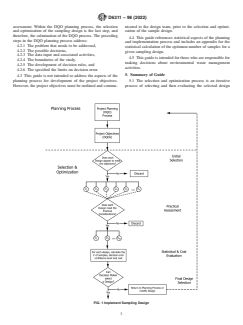
However, the project objectives must be outlined and commu- process of selecting and then evaluating the selected design
FIG. 1 Implement Sampling Design
D6311 − 98 (2022)
alternativesanddeterminingthemostresource-effectivedesign initial investigation and planning or DQO process. The deci-
which satisfies the project objectives or DQOs. Fig. 1 illus- sion makers should have identified the population boundaries,
trates this approach. characteristicsofinterest,acceptabilityofanaverageanalytical
value, the need to locate areas of contamination or “hot spots,”
5.2 An appropriate sampling design may be implemented
the statistical needs (for example, acceptable decision errors,
without a formal optimization, however, the following steps
levels of uncertainty), and the quality control acceptance
are recommended. Each evaluation step typically results in
criteria, as well as any other pertinent information.
fewer design alternatives.
5.2.1 Evaluation of the designs against the project’s practi-
6.4 Knowledge of the Site—The site knowledge (for
cal considerations (for example, time, personnel, and material
example, geography/topography, utilities, past site use) used to
resources), determine project objectives will also provide for a more
5.2.2 Calculation of the design cost and statistical
resource-efficient sampling design, for example, divide a site
uncertainty, and intoseparatedesignareasforsamplingorexcludeanareafrom
5.2.3 Choice of the sample design decision by the decision
sampling.
makers.
6.5 Physical Sample Issues—The physical material to be
5.3 The process steps for the evaluation can be followed in
sampled and its location on or within the site will usually
any order. And for a small project, the entire selection and
impact the sampling design and limit the choices of equipment
optimization process may be conducted at the same time. If
and methods.
ultimately, a design meeting the project constraints, for
6.5.1 Number of Samples:
example, schedule and budget, cannot be identified among the
6.5.1.1 The project objectives should specify the confidence
candidate sampling designs, it may be necessary to modify the
levels for decision making. Using this level of decision error,
closest candidate design or reevaluate and revise the project
the proximity to a threshold or action limit and the anticipated
objectives.
population variance, the number of samples can be calculated.
The statistical parameter of interest, for example, mean or 95
6. Factors Affecting Sampling Design Selection
percentile, and type of frequency of distribution, for example,
normal or log normal, will determine which equation is used to
6.1 Sampling Design Performance Characteristics:
calculate the appropriate number of samples. Eq X3.5 from
6.1.1 The sampling design provides the structure and detail
Appendix X3 can be used to calculate the number of samples
for the sampling activity and should be chosen in light of the
whentheobjectiveistomeasurethemeanforapopulationthat
project objectives. Prior to this point, the planning process
has a normal distribution for the characteristic of interest.
shouldhaveaddressedanddefinedtheprojectneedsforeachof
the sampling design characteristics, including the characteris- 6.5.1.2 Appendix X3 contains statistical approaches to cal-
tics of interest, population boundaries, decision rule, accept- culatingthenumberofsamplesneededforestimatingthemean
able decision errors, and budgets. In considering all aspects of concentration, for simple random, statistical random, multi-
theproject,theselecteddesignshouldaccommodatethespatial stage sampling, and search sampling (where the objective is to
detect hot spots).
and temporal distribution of contaminants at the site, be
practical,costeffective,andgeneratedatathatallowtheproject
6.5.2 Sample Mass or Volume:
objectives to be met.
6.5.2.1 The sample mass or volume is determined by the
6.1.2 Whenever possible, technical guidelines for measure-
size of the items that constitute the population, the heteroge-
ment of the sources of variability and levels of uncertainty
neity of the population, the characteristics of available sam-
should be established prior to developing sampling design
pling equipment (for example, dimensions) and the mass or
alternatives, to ensure that it is possible to establish that the
volume needed for analysis.
program objectives are met.
6.5.2.2 It is important that the sample mass be large enough
6.1.3 Annex A1 presents an overview of some of the more
to accommodate all item sizes or parts of all items. If items
commonly used sampling designs and design tools and sum-
such as fine granular sand or large discarded automobile parts
marizes their advantages and disadvantages. Because numer-
constitutethepopulation,thesamplemayneedtoincludethose
ous sampling strategies exist, this is limited to the more
items or wipes of those items.
common. If the more common sampling strategies are not
6.5.3 Sample Access and Logistics—Site access and logis-
cost-effective or applicable to the population of interest, a
tics such as the following can alter the sampling design:
statistician should be consulted to identify other strategies
6.5.3.1 Whether equipment can maneuver on site to obtain
which may be more appropriate.
the desired samples,
6.2 Regulatory Considerations—The selection of sampling
6.5.3.2 Availability of power and water,
design, the sampling techniques, and analytical methods may
6.5.3.3 Presence of buried, suspended, or surficial utilities,
be dictated by current regulation, permits, or consent
for example, power lines, water lines, etc.,
agreements, applicable to the site.These should be reviewed to
6.5.3.4 Terrain including slope, stability of site (subsidence
determine their impact on the selection process.
considerations), presence of brush or trees, and soil condition
(hard pack versus mud), and
6.3 Project Objectives—Projectobjectivesareusuallydeter-
mined by the decision makers (for example, regulatory body, 6.5.3.5 Noise of equipment which could constitute a nui-
consent agreement group, company management) during the sance.
D6311 − 98 (2022)
6.5.3.6 For further information, see Guides D6232 and The manner of reporting these multiple analyses need to be
D5956. agreed upon with the laboratory prior to analysis.
6.5.4 Sample Matrix:
6.8.1.3 Action Levels—Detection levels need to be lower
6.5.4.1 The physical properties of the matrix to be sampled than the decision points or regulatory levels. If the detection
will determine the suitability of some sampling devices. Some
limit is at the action or regulatory level, the increased levels of
devices work best with cohesive material, such as moist soils,
imprecision will increase the uncertainty in the decision. Low
while other work best with dry materials. Equipment used to
detection limit requirements may require special method de-
dig, core, and sample abrasive materials needs to be strong
velopment. The validation and ruggedization of new methods
enoughtomaintainitsintegrityduringsampling.Thesampling
can be costly and impact schedules.
program should not be compromised by incompatibilities
6.8.2 Moisture Content of Samples—Reporting analytical
between the sampling device and the waste.
results on a dry weight basis may increase the sample mass
6.5.4.2 Heterogeneity will impact both the sampling design
requirements. Dry weight reporting may be accomplished in
and the physical means of collecting the samples. Nonuniform
one of two ways.
distributionofthecontaminant(s)ofinterestorvaryingparticle
6.8.2.1 Dry the sample aliquot prior to analysis on the same
size of the material, or both, for example, soil, concrete,
sample aliquot. This approach usually yields the lower detec-
building material, vegetation, will require different sampling
tion limit. However, drying may change the sample. For
equipment and sampling strategies. For further information,
example, it may affect the results of an analytical extraction,
see Guides D6232 and D5956.
such as oxidizing a constituent, for example, hexavalent
6.6 Communication with the Laboratory—Advanced plan-
chromium.
ning with the laboratory should address the sampling schedule,
6.8.2.2 Employ two sample aliquots. One aliquot is used to
sample preparation techniques, any subsampling instructions,
determine the moisture content, which is then used to calculate
analytical procedures, analytes of interest, matrices to be
a dry weight analytical result, based on an analysis of the
analyzed, data report format, data to be reported, and any
second aliquot. This second approach can result is raised
specific requirements for accuracy, precision, quality control,
detection limits, but it is required for the analysis of volatile
calibration, and needed turnaround time.
analytes, which would be lost during drying.
6.7 Analytical Turnaround Time—Turnaround time is usu- 6.8.3 Holding Times—The holding time is usually the time
ally the time from sample receipt in the laboratory to analytical from sample collection to sample extraction or analysis. Most
data delivery. This usually depends on the analytical consider- regulatory agencies will not accept or will limit the use of data
ations and the laboratory capabilities. from a sample analyzed outside the specified holding time.
Holding times differ depending on the media, analyte, and
6.8 Analytical Method Constraints—Theanalyticalmethods
regulation.
need to be chosen prior to or in conjunction with the optimi-
6.8.3.1 Analyses such as pH, hexavalent chromium, semi-
zation of the sampling design. The selection of appropriate
volatileandvolatileorganicshaveshortholdingtimesandmay
methods needs to take into account at least the following areas.
necessitate special planning. Samples with very short holding
6.8.1 Analytical Method Sensitivity—The analytical method
times will need to be shipped as soon as possible to allow
sensitivity, usually expressed as the method detection limit or
sufficient processing time or will need on-site analysis.
detection limit, may dictate the mass or volume of sample
6.8.4 Screening Measurements:
needed, the selection of the analytical methods, and the
accuracy and precision of the data. Analytical method sensi-
6.8.4.1 Screening—Screening methods can be implemented
tivity is influenced by a number of factors, including sample
in the field or the laboratory and can provide either qualitative
preparation, sample volume, percent moisture, dilutions, and
or semi-quantitative analyses. Screening methods are faster
analytical method used. and generally less costly than traditional laboratory methods,
6.8.1.1 Analytical Aliquot Mass or Volume—In general, for but may be less sensitive and employ less quality control than
a given method, the larger the analytical aliquot (up to the traditional methods. However, they allow field personnel to
maximum accommodated by the analytical method), the lower defineproblematicareasquicklyandtoguidethesamplingand
the detection limit and the more representative the data. verification analyses, using traditional methods, for final com-
However, typical aliquots used by most methods range from a pliance determination.
few millilitres to 1 L or 100 g. The laboratory instrumentation
6.8.4.2 Field and In-Situ Analyses—When hold or turn-
may not be physically capable of managing a much larger
around times cannot be met by traditional laboratory analyses
aliquot.
ortosavetime,reducecost,orincreasethenumberofsamples,
6.8.1.2 Dilutions—Any analytical dilution will decrease
analytical testing may be performed at the sampling site. Field
sensitivity and increase the detection limit, as a multiplier of
analytical methods include chemical-specific kits and portable
the dilution factor. When the sample has parameters in high
instrumentation for various organic and inorganic compounds.
concentrations, the lab may dilute the sample to allow the
Care should be taken that the needed detection limits, regula-
parameter to fall within the analytical instruments’ calibration
tory requirements, and quality control are achievable and that
range.
accuracy and precision criteria, trained staff, and data manage-
(1) Samples containing parameters of varied concentrations mentpracticesareinplacetoproducedatatomeettheplanning
may need to be prepared and analyzed at different dilutions. objectives or DQOs.
D6311 − 98 (2022)
6.9 Health and Safety—Personnel safety must be consid- 7.2 Meeting Project Objectives—Priortotheselectionofthe
ered. Of particular concern are any potential exposure of field initial set of sampling designs, those responsible for the project
personnel to hazardous materials and any possibility for
planning or DQO process need to establish and communicate
explosion or fire which might be triggered by sampling theprojectobjectives.Fig.2providesaguidetosomecommon
equipment. Additionally, intrusive sampling, such as drilling,
sampling designs as they could potentially satisfy some basic
can result in the release of hazardous materials to the environ-
projectobjectives.Fig.3givesaguidetosomeoftheattributes
ment and potentially impact off-site personnel.
of the same designs.
7.2.1 Estimating Population Parameters—Waste
6.10 Budget/Cost Considerations—Budgets are almost al-
ways a significant factor. The challenge is to design a cost- classification, evaluation of waste treatability, or determining
compatibilityofwastesaretypesofprojectswhereinformation
effective sampling plan, while still achieving the specified
project objectives. The sample design cost estimate compari- of the population parameters, such as the mean and variance,
sons need to include: may be required. Estimation of these parameters generally
6.10.1 Personnel costs including travel and per diem, relies on a statistical sampling design and classical inferential
6.10.2 Sampling equipment, including purchases/rentals, statistics.
6.10.3 Mobilization and demobilization costs,
7.2.2 Monitoring for Routine Purposes—Monitoring, such
6.10.4 Decontamination of equipment,
as ground water or monitoring changes in waste streams over
6.10.5 Waste collection and disposal,
time may be useful in determining for example whether a
6.10.6 Sample analyses or field screening, or both,
characteristic of a waste stream has exceeded a prespecified
6.10.7 QA or QC samples, or both,
quality control or permit limit.
6.10.8 Consumables, and
7.2.3 Describing Spatial or Temporal Distribution, or
6.10.9 Health and safety.
Both—Information for corrective action purposes may be used
6.11 Representativeness—Representativeness is the degree
to define spatially or temporally those portions of a waste
to which samples collected reflect the characteristics of the
stream that are to be managed in different ways (for example,
population.The sampling design must be chosen such that bias
disposal versus treatment, etc.). Information may also be used
is minimized and the other project objectives achieved. For
forlocatingadditionalsamplingunitsforincreasedprecisionin
further guidance, see Guide D6044.
definingboundariesseparatingwastestobemanagedifferently.
7.2.4 Noncompliance Monitoring—Identifyinghotspotsisa
7. Initial Design Selection
common noncompliance monitoring objective. Search sam-
7.1 Sampling design options need to be selected consistent
plingisusedtolocateordetectconstituentsofinterest,objects,
with the project objectives. Prior to selecting designs, the
“hot spots” in the area to be sampled. Authoritative sampling
parameter(s) of interest (target compounds), population
based on site knowledge is frequently used to identify the
boundaries, decision rule, the spatial and temporal distribution
possibility of the “worst case” scenario noncompliance.
of contaminants at the site (if known), the acceptable decision
errors, and budgets should have been considered in the 7.3 Sampling Designs for Complex Sites—Many sites for
planning process. In addition, the final design should be environmental sampling are complex and require the selection
practical and cost-effective. See Annex A1 for a listing of of multiple sampling designs to address the various suspected
commonly used sampling designs. problems. For these sites, optimization of several sample
FIG. 2 Project Objectives and Sampling Designs Guidance
D6311 − 98 (2022)
FIG. 3 Relationships Between Sampling Designs and Some Attributes Guidance
designs is needed. Once the specific areas are defined, the 7.3.1.3 What are the levels of the potential contaminants in
process is similar to any other optimization. The following is
the soil immediately adjacent to and beneath the lagoon?
an example.
7.3.1.4 Hasthecontaminationreachedthegroundwaterand
7.3.1 Example—Fig. 4 illustrates a complex site, one where
to what extent?
a multi-design program is appropriate. It represents a source of
7.3.2 Assuming the planning team is familiar with the
potential contamination such as a waste lagoon that is leaking
process waste and the spatial heterogeneity of the lagoon, the
contaminated liquids to the subsurface and the ground water.
first question can be answered by an authoritative sampling.
To determine the extent of the problem, it is necessary to
Thesecondquestioncanbeansweredbyasystematicsampling
collect samples from separate areas of the site and answer the
of the areas adjacent to the site. The answer to the third
following:
question can be found by a systematic sampling design around
7.3.1.1 What are the potential contaminants present in the
and beneath the lagoon. The fourth question can be answered
lagoon?
byasystematicsamplingofthegroundwateralongalinefrom
7.3.1.2 What are the background levels of contaminants?
thepointoforigin(thelagoon)inthedirectionofgroundwater
flow.
7.3.3 The final integrated plan for the entire site should
consider all the information needs, integrate multiple sampling
designs (per area), and stage the field sampling to collect
samplesinsuchamannerthatitwillsatisfymorethanonearea
or question. For example, samples from the lagoon can be
scheduled first and the results used to determine the analyte list
for the soils and ground water. The soil borings used to
determine the contamination around and beneath the lagoon
and the ground water samples from the ground water beneath
thesitewillprovideinformationabouttheextentofanyplume.
This type of integrated planning occurs after the selection of
the designs to answer the individual questions. Many times,
considerable cost savings can be realized by this type of
FIG. 4 Complex Site selection and optimization.
D6311 − 98 (2022)
may be introduced by a random choice of origin. Systematic
Area of Site and Description Candidate Design
A. Lagoon (source of the contamination) Authoritative Sampling
grid sampling usually provides a more accurate estimate of the
B. Undisturbed soil area (presumed uncontami- Systematic Sampling
mean.
nated)
C. Soil directly under the spill (known to be con- Systematic Sampling
8. Optimization Criteria
taminated, need to map extent of contamina-
tion)
8.1 Optimization involves choosing between the initially
D. Ground water (need to know the extent of Grid Sampling
selectedsampledesignswhichmayormaynotmeettheproject
contamination of ground water plume)
objectives. The optimum sample design will minimize project
7.4 Statistical versus Non-Statistical Designs:
variables such as cost, time, and risk, the objective being to
7.4.1 Non-Statistical Designs—Sampling designs can be
achieve a balance between the costs of acquiring environmen-
classified as statistical or non-statistical sampling designs.
tal data and the costs or consequences of incorrect waste
Non-statistical sampling designs are sometimes referred to as
management decisions.
non-probability or authoritative (biased or judgmental) sam-
8.2 In general, the criteria for an optimized sampling design
pling. These strategies rely upon a person’s judgment or a
are that the design:
pre-arranged decision rule to decide which portions of a
8.2.1 Be resource and cost effective,
population will be sampled. Non-statistical sampling designs
8.2.2 Provide data of known quality,
can be the optimum strategy for certain populations or times in
8.2.3 Meet or not exceed the acceptable level of decision
a sampling program. Non-statistical sampling may be appro-
errors,
priate under circumstances such as the following: (1) pilot
8.2.4 Be practical or at least possible to implement
studies (preliminary information is needed to facilitate plan-
appropriately,
ning); (2) spills: a spill of an unknown chemical has been
8.2.5 Comply with regulatory requirements,
encountered; (3) limited access to portions of the population;
8.2.6 Be implementable within the project schedule,
(4) field screening to select a limited number of samples for
8.2.7 Have high reliability, and
laboratory analysis; (5) historical site knowledge is available;
8.2.8 Meet any other project specific objectives.
and (6) noncompliance determinations.
7.4.1.1 While non-statistical sampling can generate useful
8.3 In the optimization process the above criteria will be
data, because of its subjective nature, the logic used to choose
used to choose the optimum design from the candidate sam-
the sampling location must be explained and defensible.
pling designs.
7.4.1.2 It is very important not to confuse non-statistical
9. Optimization Process
sampling with the use of historical information during sam-
pling design. For example, if one area of a site is known to be
9.1 The optimization process is an iterative process of
heavily contaminated while another area is believed not to be evaluating the initially selected design alternatives and deter-
contaminated,thisinformationcanbeusedtodefensiblydivide
mining the most resource-effective design which satisfies the
the site into strata or de-select an area from sampling. Use of project objectives or DQOs. An appropriate sampling design
historical information in conjunction with statistical sampling
may be implemented without a formal optimization; however,
strategies should generate unbiased, representative, and defen- the following steps are recommended: (1) evaluation of the
sible data.
designs against the project’s practical considerations (for
7.4.2 Statistical Designs—Statistical sampling designs are example, time, personnel, and material resources); (2) calcu-
also referred to as probability, non-biased, or non-judgmental lation of the design cost and statistical uncertainty; and (3)
designsandrelyuponarandomselectionofsamplinglocations choice of the sample design decision by the decision makers.
tominimizeanybiasinthesampleselectionprocess.Statistical Fig. 1 and Section 5 illustrate this approach.
sampling strategies allow for large populations to be charac- 9.1.1 Theprocessstepsfortheevaluationcanbefollowedin
terized with a measured degree of confidence. In addition to any order. For a small project, the entire selection and
considering all the other information, the following may apply: optimization process may be conducted simultaneously. Typi-
7.4.2.1 Usually, the greater the number of samples, the cally as the evaluation continues each evaluation step will
result in fewer design alternatives. If ultimately, a design
narrower or tighter the confidence interval for the parameter of
interest. meeting the project constraints, for example, schedule and
budget, cannot be identified among the candidate sampling
7.4.2.2 Composite samples are useful for locating the hot
designs, it may be necessary to modify the closest candidate
spot areas, although they may not identify a specific point
design or return to the planning stage and reevaluate and revise
source contaminant location.
the project objectives.
7.4.2.3 For containerized waste, the sampling error for both
the within (an individual) container and between multiple
9.2 Practical Evaluation of Design Alternatives—Each de-
containers need to be considered.
signcandidateshouldbeevaluatedwithrespecttotheproject’s
7.4.2.4 Because sampling errors are usually larger and may
practical considerations. These aspects should have been taken
be more difficult to quantify than analytical errors, field QC
into account initially and some may overlap. However, the
samples need to be included to help determine the potential
purpose here is to go into more depth and then to compare the
errors.
design candidates. After reviewing, eliminate any designs
7.4.2.5 Systematic grid sampling is preferred when spatial which do not meet the site’s practical needs.
structure (correlation) is suspected or known.Arandom factor 9.2.1 Define the Population or Area(s) to be Sampled:
D6311 − 98 (2022)
9.2.1.1 Review the site history and assumptions that were n 5 Z CV /P (1)
$ ~ ! %
α
usedtodefinethepopulationboundaries.Thisinformationmay
where:
allow for stratification of the site, identification of specific
n = number of samples to collect,
areas of interest, and an estimate of heterogeneity. Determine
Z = statistical factor for the desired confidence level,
α
which sampling design best accommodates the spatial and
CV = coefficient of variation, and
temporal boundaries of the population.
p = margin of error.
9.2.1.2 Subdivision of the site may involve spatial bound-
In a case where no previous sampling data is available, the
aries such as drums, tanks, an area within a grid, a boring
values used in the above discussion can be used as a starting
location on a grid, a depth interval in a boring, distance along
point.
a conveyor belt, or any other appropriate defined physical unit
2 2
from which material can be obtained. For example, a defined
~1.65! ~0.65!
n 5 (2)
search area may be the answer to locate an 8-ft diameter area
0.20
~ !
of PCB contamination from a 55-gal drum PCB spill.
n 5 29 samples (3)
9.2.2 Determine Optimum Number of Samples:
If a two-sided inference is desired (for example the mean is
9.2.2.1 Budgets and the acceptable levels of uncertainty as
equal to 10 ppm), the Z-value of 1.96 is used in the formula,
defined by the DQO or project objective planning process are
instead of 1.65. The result is an n = 40.
competing factors that affect the number of samples. Statistical
(5) Upon completion of the calculation the number of
techniques for balancing these competing factors are discussed
samples and the margin of error is reviewed to determine that
in a number of places in the literature and Appendix X1.
each is acceptable. If the value of n number of samples is too
9.2.2.2 The following illustrates a calculation for the com-
great, then an adjustment to the margin of error should be
monly used systematic grid sampling and the iterations which
considered, or the sampling design may be modified.
may be necessary, if the calculated number of samples should
Alternately, if the population is stratified by concentration, the
prove, for practical reasons, to be too large to implement.
number of samples required may be reduced by selecting a
9.2.2.3 Example Calculation—The number of samples to be
sampling design for each of the strata. The inter-strata vari-
collected can be calculated based on variance information
ability would then be removed from the calculation of the
derived from previous sampling data or estimated based on
needed number of samples.
professional judgment. Usually the contaminants of concern
(6) Table 1 illustrates the number of samples required at a
(COCs) are parameters which are closest to or in excess of an
95 % confidence level (Z-table factor of 1.65) with varying
action level. Their presence is normally the driving force
margins of error (p) and coefficients of variation (CV).
behind the need to determine the extent and levels of contami-
(7) Note that as the CV increases at a set margin of error,
nation. The statistic of interest here is the mean and it assumes
thenumberofsamplesrequiredincreases.Whenthevariability
a normal distribution.
islow(asmeasuredbythestandarddeviationorthesquareroot
(1) Select a margin of error (p) acceptable for the subse-
of the variance) relative to the mean of the data, then the CV
quent use of the data. For soil studies, a margin of error of 0.20
is low. However, as the variability in the population begins to
is not unusual. The margin of error may be calculated by
increase relative to the mean of the data, then the CVincreases
dividing the needed precision, in units of concentration, for
and the number of samples required increases if characteriza-
example, = 10 ppm, by the known or anticipated mean
tion of the site at a 95 % confidence level and a set margin of
concentration of the COCs. Note, that if the actual precision or
error is desired.
mean concentration for the COC differs from those estimated
(8) A similar relationship is observed for the margin of
during the planning process, a reevaluation of the assumed
error. When the precision required (say 610 ppm lead) is high
margin of error may be necessary.
relative to the mean of the data (say 100 ppm lead), then the
(2) Acoefficient of variation (CV), which is defined as the
standard deviation of a COC divided by the mean of the COC, margin of error is low (in this case 0.1). In this case 115
is either obtained using previous sampling data or estimated samples would be required with a CV of 0.65. If the investi-
basedonanticipatedvariability.IfaCVabove0.65isobtained,
gators could accept a higher margin of error (for example,
a large number of samples will usually be needed to make a 620 %), and the mean concentration of the data is still 100
decision with the selected margin of error.
(3) Aconfidencelevel100(1–α)%needstobeestablished.
For work involving hazardous wastes, a confidence level of
95 % is frequently used. For a 95 % confidence level, using a
TABLE 1 Number of Samples (n) for given Coefficient of Variation
standard Z statistical table, this corresponds to a one-sided and Margin of Error
statistical factor of Z = 1.645.
Coefficient of Variation (CV)
α
0.1 0.5 0.65 1.0 2.0
(4) If a one-sided inference about the population is desired
Margin of Error (p)
(for example, comparing a mean concentration to a regulatory
0.1 3 68 115 272 1089
threshold), the required number of samples is calculated using
0.2 1 17 29 68 272
0.3 - 8 13 30 121
the following formula:
0.5 - 3 5 11 44
1.0 - 1 1 3 11
Gilbert, R. O., Statistical Methods for Environmental Pollution Monitoring, 2.0 --- 1 3
Van Nostrand Reinhold Co., New York, 1987.
D6311 − 98 (2022)
ppm lead, then the resulting margin of error (0.2) would result Typically, this involves changing specific parameters within
in a lower number of required samples. Note that 29 samples some reasonable range and establishing how each of these
would be required at the same CV of 0.65 and a one-sided changes influences the expected decision error rates. A statis-
inference. tical power curve is a useful statistical tool used to evaluate
(9) If the confidence level is decreased to 80 %, then the
whether a sampling design has the ability to meet the project
required number of samples reflected in this figure would be objectives.
lower for each margin of error and CV combination. However,
9.3.1.2 Hypothesis Test:
the confidence level may fixed. One alternative to analyzing
(1) Each statistical sampling design should include a sta-
the larger number of samples may be to use compositing.
tistical hypothesis test.Astatistical model should be developed
which describes the relationship of the measured value to the
9.2.2.4 Site/Event Considerations—The site and physical
“true” value. This mathematical formulation clarifies how data
sampling event(s) constitute the majority of the practical
generated from a design is to be interpreted and processed in
aspects to be evaluated. Each design should be evaluated
testing the hypothesis. A tentative analytic form for analyzing
againstallpracticalaspectstodeterminewhetherornotagiven
the resulting data (for example, a student’s t-test or a tolerance
design will be practical to implement. This evaluation is
interval) should be specified in the project objectives. This
subject to professional judgment as to whether or not a
informationcanbeusedtodeterminetheminimumsamplesize
practical aspect, for example, the level of personnel training
which satisfies the project objective’s limits on decision error.
needed, is practical or acceptable, or both. If it is not, then the
(2) The objectives of a statistical design are to limit the
design needs to be modified or eliminated. These aspects
total error, which is a combination of sampling and measure-
include, but are not limited to the following:
menterror,toacceptablelevels.Traditionallaboratorymethods
(1) Site Access and Conditions—Site considerations: cross
tend to minimize measurement error, but can be so expensive
contamination potential; limits on access to sampling locations
that only a limited number of samples can be analyzed within
(for example, buildings, refusals).
budget.Theadvantagetousinglessprecisemethods,whichare
(2) Equipment and Personnel—Equipment limitations; ex-
relatively less expensive, is that it allows a significantly larger
perience of the field sampling team; experience of the analysts;
number of samples to be collected and analyzed. This may
field and laboratory resources.
trade off an increase in measurement error for a decrease in
(3) Sampling Event—Special site concerns (for example,
sampling error. If so, given the natural variability in many
unexploded ordnance); special analytical needs (for example,
environmental studies, this approach may reduce overall costs
low level analyses, dioxin); special analytical concerns (for
whilelimitingthetotaldecisionerrorratestoacceptablelevels.
example, interferences, multiple pha
...