

ASTM D6051-15(2023)
(Guide)Standard Guide for Composite Sampling and Field Subsampling for Environmental Waste Management Activities
General Information
- Abstract
SIGNIFICANCE AND USE
5.1 This guide provides guidance to persons managing or responsible for designing sampling and analytical plans for determining whether sample compositing may assist in more efficiently meeting study objectives. Samples must be composited properly, or useful information on contamination distribution and sample variance may be lost.
5.2 The procedures described for mixing samples and obtaining a representative subsample are broadly applicable to waste sampling where it is desired to transport a reduced amount of material to the laboratory. The mixing and subsampling sections provide guidance to persons preparing sampling and analytical plans and field personnel.
5.3 While this guide generally focuses on solid materials, the attributes and limitations of composite sampling apply equally to static liquid samples.
SCOPE
1.1 Compositing and subsampling are key links in the chain of sampling and analytical events that must be performed in compliance with project objectives and instructions to ensure that the resulting data are representative. This guide discusses the advantages and appropriate use of composite sampling, field procedures and techniques to mix the composite sample, and procedures to collect an unbiased and precise subsample(s) from a larger sample. It discusses the advantages and limitations of using composite samples in designing sampling plans for characterization of wastes (mainly solid) and potentially contaminated media. This guide assumes that an appropriate sampling device is selected to collect an unbiased sample.
1.2 The guide does not address: where samples should be collected (depends on the objectives) (see Guide D6044), selection of sampling equipment, bias introduced by selection of inappropriate sampling equipment, sample collection procedures or collection of a representative specimen from a sample, or statistical interpretation of resultant data and devices designed to dynamically sample process waste streams. It also does not provide sufficient information to statistically design an optimized sampling plan, or determine the number of samples to collect or calculate the optimum number of samples to composite to achieve specified data quality objectives (see Practice D5792). Standard procedures for planning waste sampling activities are addressed in Guide D4687.
1.3 The sample mixing and subsampling procedures described in this guide are considered inappropriate for samples to be analyzed for volatile organic compounds. Volatile organics are typically lost through volatilization during sample collection, handling, shipping, and laboratory sample preparation unless specialized procedures are used. The enhanced mixing described in this guide is expected to cause significant losses of volatile constituents. Specialized procedures should be used for compositing samples for determination of volatiles such as combining directly into methanol (see Guide D4547).
1.4 This standard does not purport to address all of the safety concerns, if any, associated with its use. It is the responsibility of the user of this standard to establish appropriate safety, health, and environmental practices and determine the applicability of regulatory limitations prior to use.
1.5 This international standard was developed in accordance with internationally recognized principles on standardization established in the Decision on Principles for the Development of International Standards, Guides and Recommendations issued by the World Trade Organization Technical Barriers to Trade (TBT) Committee.
- Status
- Published
- Publication Date
- 31-Mar-2023
- Technical Committee
- D34 - Waste Management
- Drafting Committee
- D34.01.01 - Planning for Sampling
Overview
ASTM D6051-15(2023), Standard Guide for Composite Sampling and Field Subsampling for Environmental Waste Management Activities, sets out best practices and recommendations for composite sampling and field subsampling as part of environmental waste management activities. The standard is applicable to professionals responsible for developing sampling and analytical plans, with a focus on ensuring that data from waste samples are representative of the larger population from which they are taken. It primarily addresses the efficient and appropriate use of composite sampling-blending multiple individual samples into one-and provides guidance on mixing and subsampling to optimize data quality and reduce costs without sacrificing accuracy. While the guide is mostly centered on solid material sampling, the principles extend to static liquid samples.
Key Topics
- Composite Sampling: Combining two or more individual samples to produce a single, representative sample for analysis.
- Field Subsampling Techniques: Methods to obtain unbiased and precise subsamples from larger composite samples before laboratory analysis.
- Cost Efficiency and Data Quality: Guidance on how compositing can reduce analytical costs, increase sampling efficiency, and improve precision if properly applied.
- Advantages and Limitations of Compositing:
- Reduces variance in mean concentration estimates.
- Efficient in identifying contaminant “hot spots” or demonstrating their absence.
- Helps in situations where analytical costs are high relative to sampling costs.
- Limitations include possible loss of information on distribution, dilution of concentrated samples, and inapplicability for volatile organic compounds.
- Mixing Methods:
- Pan mixing/quartering to homogenize samples.
- Kneading, sieving, and particle size reduction as appropriate for material type.
- Recommendations for Handling and Segregation: Includes how to handle particles of varying sizes and the importance of adequate mixing before field subsampling.
- Representative Subsampling:
- Procedures such as use of rectangular or alternate scoops.
- Special consideration for cohesive or heterogeneous materials.
- Special Notes: The standard is not suitable for the preparation of samples for volatile organic compound (VOC) analysis due to the risk of volatilization during mixing.
Applications
ASTM D6051-15(2023) provides practical value across various waste management and environmental monitoring scenarios:
- Waste Characterization: Ensures that composite samples accurately reflect the average contaminant concentrations in solid and certain liquid waste materials.
- Remediation Projects: Guides environmental professionals in efficiently identifying contamination patterns and hot spots for site assessment and cleanup planning.
- Laboratory Sample Preparation: Offers methods for reducing the volume of material transported for analysis, thus lowering logistics and analysis costs.
- Regulatory Compliance: Supports meeting requirements for representativeness in environmental data collection, strengthening compliance with regulatory frameworks.
- Sampling Plan Development: Assists project managers and field personnel in designing effective sampling strategies that balance cost, efficiency, and data quality.
Note: The standard does not address statistical design, selection of sampling locations, or detailed analytical methodologies; nor is it intended for dynamic sampling of process waste streams or for VOC analysis using standard procedures.
Related Standards
For comprehensive waste sampling programs or plan development, ASTM D6051-15(2023) should be used in conjunction with several related ASTM standards:
- ASTM D6044: Guide for Representative Sampling for Management of Waste and Contaminated Media
- ASTM D4687: Guide for General Planning of Waste Sampling
- ASTM D5792: Practice for Generation of Environmental Data Related to Waste Management Activities: Development of Data Quality Objectives
- ASTM D4547: Guide for Sampling Waste and Soils for Volatile Organic Compounds (for specialized VOC procedures)
- ASTM D5088: Practice for Decontamination of Field Equipment Used at Waste Sites
- ASTM C702/C702M: Practice for Reducing Samples of Aggregate to Testing Size (methods for mixing and reducing aggregate samples)
By integrating ASTM D6051-15(2023) with these companion standards, users can develop robust, cost-effective, and compliant environmental waste sampling and analysis programs based on internationally recognized best practices.
Relations
- Effective Date
- 01-Feb-2024
- Effective Date
- 01-Nov-2023
- Effective Date
- 01-May-2020
- Effective Date
- 01-May-2020
- Effective Date
- 15-Apr-2018
- Effective Date
- 01-Aug-2017
- Effective Date
- 01-Sep-2015
- Effective Date
- 01-Sep-2015
- Effective Date
- 01-Sep-2015
- Effective Date
- 01-Aug-2015
- Effective Date
- 01-Jul-2015
- Effective Date
- 15-Jan-2015
- Effective Date
- 01-Mar-2014
- Effective Date
- 01-Oct-2011
- Effective Date
- 01-Aug-2011
Get Certified
Connect with accredited certification bodies for this standard

CIS Institut d.o.o.
Personal Protective Equipment (PPE) certification body. Notified Body NB-2890 for EU Regulation 2016/425 PPE.

Kiwa BDA Testing
Building and construction product certification.
Kmetijski inštitut Slovenije
Agricultural Institute of Slovenia. Soil testing, plant health, agricultural product analysis.
Sponsored listings
Frequently Asked Questions
ASTM D6051-15(2023) is a guide published by ASTM International. Its full title is "Standard Guide for Composite Sampling and Field Subsampling for Environmental Waste Management Activities". This standard covers: SIGNIFICANCE AND USE 5.1 This guide provides guidance to persons managing or responsible for designing sampling and analytical plans for determining whether sample compositing may assist in more efficiently meeting study objectives. Samples must be composited properly, or useful information on contamination distribution and sample variance may be lost. 5.2 The procedures described for mixing samples and obtaining a representative subsample are broadly applicable to waste sampling where it is desired to transport a reduced amount of material to the laboratory. The mixing and subsampling sections provide guidance to persons preparing sampling and analytical plans and field personnel. 5.3 While this guide generally focuses on solid materials, the attributes and limitations of composite sampling apply equally to static liquid samples. SCOPE 1.1 Compositing and subsampling are key links in the chain of sampling and analytical events that must be performed in compliance with project objectives and instructions to ensure that the resulting data are representative. This guide discusses the advantages and appropriate use of composite sampling, field procedures and techniques to mix the composite sample, and procedures to collect an unbiased and precise subsample(s) from a larger sample. It discusses the advantages and limitations of using composite samples in designing sampling plans for characterization of wastes (mainly solid) and potentially contaminated media. This guide assumes that an appropriate sampling device is selected to collect an unbiased sample. 1.2 The guide does not address: where samples should be collected (depends on the objectives) (see Guide D6044), selection of sampling equipment, bias introduced by selection of inappropriate sampling equipment, sample collection procedures or collection of a representative specimen from a sample, or statistical interpretation of resultant data and devices designed to dynamically sample process waste streams. It also does not provide sufficient information to statistically design an optimized sampling plan, or determine the number of samples to collect or calculate the optimum number of samples to composite to achieve specified data quality objectives (see Practice D5792). Standard procedures for planning waste sampling activities are addressed in Guide D4687. 1.3 The sample mixing and subsampling procedures described in this guide are considered inappropriate for samples to be analyzed for volatile organic compounds. Volatile organics are typically lost through volatilization during sample collection, handling, shipping, and laboratory sample preparation unless specialized procedures are used. The enhanced mixing described in this guide is expected to cause significant losses of volatile constituents. Specialized procedures should be used for compositing samples for determination of volatiles such as combining directly into methanol (see Guide D4547). 1.4 This standard does not purport to address all of the safety concerns, if any, associated with its use. It is the responsibility of the user of this standard to establish appropriate safety, health, and environmental practices and determine the applicability of regulatory limitations prior to use. 1.5 This international standard was developed in accordance with internationally recognized principles on standardization established in the Decision on Principles for the Development of International Standards, Guides and Recommendations issued by the World Trade Organization Technical Barriers to Trade (TBT) Committee.
SIGNIFICANCE AND USE 5.1 This guide provides guidance to persons managing or responsible for designing sampling and analytical plans for determining whether sample compositing may assist in more efficiently meeting study objectives. Samples must be composited properly, or useful information on contamination distribution and sample variance may be lost. 5.2 The procedures described for mixing samples and obtaining a representative subsample are broadly applicable to waste sampling where it is desired to transport a reduced amount of material to the laboratory. The mixing and subsampling sections provide guidance to persons preparing sampling and analytical plans and field personnel. 5.3 While this guide generally focuses on solid materials, the attributes and limitations of composite sampling apply equally to static liquid samples. SCOPE 1.1 Compositing and subsampling are key links in the chain of sampling and analytical events that must be performed in compliance with project objectives and instructions to ensure that the resulting data are representative. This guide discusses the advantages and appropriate use of composite sampling, field procedures and techniques to mix the composite sample, and procedures to collect an unbiased and precise subsample(s) from a larger sample. It discusses the advantages and limitations of using composite samples in designing sampling plans for characterization of wastes (mainly solid) and potentially contaminated media. This guide assumes that an appropriate sampling device is selected to collect an unbiased sample. 1.2 The guide does not address: where samples should be collected (depends on the objectives) (see Guide D6044), selection of sampling equipment, bias introduced by selection of inappropriate sampling equipment, sample collection procedures or collection of a representative specimen from a sample, or statistical interpretation of resultant data and devices designed to dynamically sample process waste streams. It also does not provide sufficient information to statistically design an optimized sampling plan, or determine the number of samples to collect or calculate the optimum number of samples to composite to achieve specified data quality objectives (see Practice D5792). Standard procedures for planning waste sampling activities are addressed in Guide D4687. 1.3 The sample mixing and subsampling procedures described in this guide are considered inappropriate for samples to be analyzed for volatile organic compounds. Volatile organics are typically lost through volatilization during sample collection, handling, shipping, and laboratory sample preparation unless specialized procedures are used. The enhanced mixing described in this guide is expected to cause significant losses of volatile constituents. Specialized procedures should be used for compositing samples for determination of volatiles such as combining directly into methanol (see Guide D4547). 1.4 This standard does not purport to address all of the safety concerns, if any, associated with its use. It is the responsibility of the user of this standard to establish appropriate safety, health, and environmental practices and determine the applicability of regulatory limitations prior to use. 1.5 This international standard was developed in accordance with internationally recognized principles on standardization established in the Decision on Principles for the Development of International Standards, Guides and Recommendations issued by the World Trade Organization Technical Barriers to Trade (TBT) Committee.
ASTM D6051-15(2023) is classified under the following ICS (International Classification for Standards) categories: 13.030.01 - Wastes in general. The ICS classification helps identify the subject area and facilitates finding related standards.
ASTM D6051-15(2023) has the following relationships with other standards: It is inter standard links to ASTM D4439-24, ASTM D5792-10(2023), ASTM D5088-20, ASTM D1129-13(2020)e2, ASTM D4439-18, ASTM D4439-17, ASTM D5792-10(2015), ASTM D4439-15a, ASTM D4547-15, ASTM D5088-15a, ASTM D4439-15, ASTM D5088-15, ASTM D4439-14, ASTM D4439-11, ASTM C702/C702M-11. Understanding these relationships helps ensure you are using the most current and applicable version of the standard.
ASTM D6051-15(2023) is available in PDF format for immediate download after purchase. The document can be added to your cart and obtained through the secure checkout process. Digital delivery ensures instant access to the complete standard document.
Standards Content (Sample)
This international standard was developed in accordance with internationally recognized principles on standardization established in the Decision on Principles for the
Development of International Standards, Guides and Recommendations issued by the World Trade Organization Technical Barriers to Trade (TBT) Committee.
Designation: D6051 − 15 (Reapproved 2023)
Standard Guide for
Composite Sampling and Field Subsampling for
Environmental Waste Management Activities
This standard is issued under the fixed designation D6051; the number immediately following the designation indicates the year of
original adoption or, in the case of revision, the year of last revision. A number in parentheses indicates the year of last reapproval. A
superscript epsilon (´) indicates an editorial change since the last revision or reapproval.
1. Scope 1.4 This standard does not purport to address all of the
safety concerns, if any, associated with its use. It is the
1.1 Compositing and subsampling are key links in the chain
responsibility of the user of this standard to establish appro-
of sampling and analytical events that must be performed in
priate safety, health, and environmental practices and deter-
compliance with project objectives and instructions to ensure
mine the applicability of regulatory limitations prior to use.
that the resulting data are representative. This guide discusses
1.5 This international standard was developed in accor-
the advantages and appropriate use of composite sampling,
dance with internationally recognized principles on standard-
field procedures and techniques to mix the composite sample,
ization established in the Decision on Principles for the
and procedures to collect an unbiased and precise subsample(s)
Development of International Standards, Guides and Recom-
from a larger sample. It discusses the advantages and limita-
mendations issued by the World Trade Organization Technical
tions of using composite samples in designing sampling plans
Barriers to Trade (TBT) Committee.
for characterization of wastes (mainly solid) and potentially
contaminated media. This guide assumes that an appropriate
2. Referenced Documents
sampling device is selected to collect an unbiased sample.
2.1 ASTM Standards:
1.2 The guide does not address: where samples should be
C702/C702M Practice for Reducing Samples of Aggregate
collected (depends on the objectives) (see Guide D6044),
to Testing Size
selection of sampling equipment, bias introduced by selection
D1129 Terminology Relating to Water
of inappropriate sampling equipment, sample collection proce-
D4439 Terminology for Geosynthetics
dures or collection of a representative specimen from a sample,
D4547 Guide for Sampling Waste and Soils for Volatile
or statistical interpretation of resultant data and devices de-
Organic Compounds
signed to dynamically sample process waste streams. It also
D4687 Guide for General Planning of Waste Sampling
does not provide sufficient information to statistically design an
D5088 Practice for Decontamination of Field Equipment
optimized sampling plan, or determine the number of samples
Used at Waste Sites
to collect or calculate the optimum number of samples to
D5792 Practice for Generation of Environmental Data Re-
composite to achieve specified data quality objectives (see
lated to Waste Management Activities: Development of
Practice D5792). Standard procedures for planning waste
Data Quality Objectives
sampling activities are addressed in Guide D4687.
D6044 Guide for Representative Sampling for Management
1.3 The sample mixing and subsampling procedures de-
of Waste and Contaminated Media
scribed in this guide are considered inappropriate for samples
E856 Definitions of Terms and Abbreviations Relating to
to be analyzed for volatile organic compounds. Volatile organ-
Physical and Chemical Characteristics of Refuse Derived
ics are typically lost through volatilization during sample
Fuel (Withdrawn 2011)
collection, handling, shipping, and laboratory sample prepara-
3. Terminology
tion unless specialized procedures are used. The enhanced
mixing described in this guide is expected to cause significant
3.1 Definitions:
losses of volatile constituents. Specialized procedures should
3.1.1 composite sample, n—a combination of two or more
be used for compositing samples for determination of volatiles
samples. D1129
such as combining directly into methanol (see Guide D4547).
1 2
This guide is under the jurisdiction of ASTM Committee D34 on Waste For referenced ASTM standards, visit the ASTM website, www.astm.org, or
Management and is the direct responsibility of Subcommittee D34.01.01 on contact ASTM Customer Service at service@astm.org. For Annual Book of ASTM
Planning for Sampling. Standards volume information, refer to the standard’s Document Summary page on
Current edition approved April 1, 2023. Published April 2023. Originally the ASTM website.
approved in 1996. Last previous edition approved in 2015 as D6051 – 15. DOI: The last approved version of this historical standard is referenced on
10.1520/D6051-15R23. www.astm.org.
Copyright © ASTM International, 100 Barr Harbor Drive, PO Box C700, West Conshohocken, PA 19428-2959. United States
D6051 − 15 (2023)
3.1.2 sample, n—a portion of material taken from a larger 6.2 The principal advantages of sample compositing in-
quantity for the purpose of estimating properties or composi- clude: reduction in the variance of an estimated average
tion of the larger quantity. E856 concentration (1), increasing the efficiency of locating/
identifying hot spots (2), and reduction of sampling and
3.1.3 specimen, n—a specific portion of a material or
analytical costs (3). These main advantages are discussed in the
laboratory sample upon which a test is performed or which is
following paragraphs. However, a principle assumption needed
taken for that purpose. D4439
to justify compositing is that analytical costs are high relative
3.1.4 subsample, n—a portion of a sample taken for the
to sampling costs. In general, appropriate use of sample
purpose of estimating properties or composition of the whole
compositing can:
sample.
6.2.1 Reduce inter-sample variance, that is, improve the
3.1.4.1 Discussion—a subsample, by definition, is also a
precision of the mean estimation while reducing the probability
sample.
of making an incorrect decision;
6.2.2 Reduce costs for estimating a total or mean value,
4. Summary of Guide
especially where analytical costs greatly exceed sampling costs
(also may be effective when analytical capacity is a limitation);
4.1 This guide describes how the collection of composite
6.2.3 Efficiently determine the absence or possible presence
samples, as opposed to individual samples, may be used to:
of hot spots or hot containers and, when combined with
more precisely estimate the mean concentration of a waste
retesting schemes, identify hot spots, as long as the probability
analyte in contaminated media, reduce costs, efficiently deter-
of hitting a hot spot is low;
mine the absence or possible presence of a hot spot (a highly
6.2.4 Be especially useful for situations, where the nature of
contaminated local area), and, when coupled with retesting
contaminant distribution tends to be contiguous and non-
schemes, efficiently locate hot spots. Specific procedures for
random and the majority of analyses are “non-detects” for the
mixing a sample(s) and collecting subsamples for transport to
contaminant(s) of interest; and
a laboratory are provided.
6.2.5 Provide a degree of anonymity where population,
rather than individual statistics, are needed.
5. Significance and Use
6.3 Improvement in Sampling Precision—Samples are al-
5.1 This guide provides guidance to persons managing or
ways taken to make inferences to a larger volume of material,
responsible for designing sampling and analytical plans for
and a set of composite samples from a heterogeneous popula-
determining whether sample compositing may assist in more
tion provides a more precise estimate of the mean than a
efficiently meeting study objectives. Samples must be compos-
comparable number of discrete samples. This occurs because
ited properly, or useful information on contamination distribu-
compositing is a “physical process of averaging.” Averages of
tion and sample variance may be lost.
samples have greater precision than the individual samples.
5.2 The procedures described for mixing samples and ob-
Likewise, a set of composite samples is always more precise
taining a representative subsample are broadly applicable to
than an equal number of individual samples. Decisions based
waste sampling where it is desired to transport a reduced
on a set of composite samples will, for practical purposes,
amount of material to the laboratory. The mixing and subsam-
always provide greater statistical confidence than for a com-
pling sections provide guidance to persons preparing sampling
parable set of individual samples.
and analytical plans and field personnel.
6.3.1 If an estimated precision of a mean is desired, then
more than one composite sample is needed; a standard devia-
5.3 While this guide generally focuses on solid materials,
the attributes and limitations of composite sampling apply tion cannot be calculated from one composite sample.
However, the precision of a single composite sample may be
equally to static liquid samples.
estimated when there are data to show the relationship between
the precision of the individual samples that comprise the
6. Attributes of Composite Sampling for Waste
composite sample and that of the composite sample. The
Characterization
precision (standard deviation) of the composite sample is
6.1 In general, the individual samples to be composited
approximately the precision of the individual samples divided
should be of the same mass; however, proportional sampling
by the square root of the number of individual samples in the
may be appropriate in some cases depending upon the objec-
composite.
tive. For example, if the objective is to determine the average
6.4 Example 1—An example of how a single composite
drum concentration of a contaminant, compositing equal vol-
sample can be used for decision-making purposes is given
umes of waste from each drum would be appropriate. If the
here. Assume a regulatory limit of 1 mg/kg and a standard
objective is to determine average contaminant concentration of
deviation of 0.5 mg/kg for the individual samples. If the
the waste contained in a group of drums, the volume of each
concentration of a site is estimated to be around 0.6 mg/kg,
sample to be composited should be proportional to the amount
how many individual samples should be composited to have
of waste in each drum. Another example of proportional
relatively high confidence that the true concentration does not
sampling is estimating the contaminant concentration of soil
overlying an impermeable zone. Soil cores should be collected
from the surface to the impermeable layer, regardless of core
The boldface numbers in parentheses refer to a list of references at the end of
length. this guide.
D6051 − 15 (2023)
exceed the regulatory limit when only one composite sample is
used? Assuming the composite is well mixed, then the preci-
sion of a composite is a function of the number of samples as
follows:
Number of Individual Precision (standard deviation ÷ n)
œ
Samples in Composite
of One Composite Sample
2 0.35
3 0.29
4 0.25
5 0.22
FIG. 2 Example of Within-Cell Compositing
6 0.20
Thus, if six samples are included in a composite, the
1 is similar to sample random sampling, except they are now
composite concentration of 0.6 mg/kg is two standard devia-
composite samples. Each composite sample in this case is a
tions below the regulatory limit. Therefore, if the composite
representative sample of the entire site, eliminates cell-to-cell
concentration is actually observed to be in the neighborhood of
variability, and leads to increased precision in estimating the
0.6 mg/kg, we can be reasonably confident (approximately
mean concentration of the site. If there is a need to estimate the
95 %) that the concentration of the site is below the regulatory
cell-to-cell variability, then the approach in Fig. 2 is suitable. In
limit, using only one composite sample.
addition, if the precision of estimating the mean concentration
6.5 Example 2—Another example is when the standard
of the cell is needed, multiple composite samples should be
deviation of the individual samples in the previous example is
collected from that cell.
relatively small, say 0.1 mg/kg. Then the standard deviation of
6.6 Effect on Cost Reduction—Because the composite
a composite of six individual samples is 0.04 mg/kg (0.1 mg/kg
samples yield a more precise mean estimate than the same
divided by the square root of 6 = 0.04 mg ⁄kg), a very small
number of individual samples, there is the potential for
number relative to the regulatory limit of 1 mg/kg. In this case,
substantial cost saving. Given the higher precision associated
simple comparison of the composite concentration to the
with composite samples, the number of composite samples
regulatory limit is often quite adequate for decision-making
required to achieve a specified precision is smaller than that
purposes.
required for individual samples. This cost saving opportunity is
6.5.1 The effectiveness of compositing depends on the
especially pronounced when the cost of sample analysis is high
relative magnitude of sampling and analytical error. When
relative to the cost of sampling, compositing, and analyzing.
sampling uncertainty is high relative to analytical error (as is
6.7 Hot Container/Hot Spot Identification and Retesting
usually assumed to be the case), compositing is very effective
Schemes—Samples can be combined to determine whether an
in improving precision. If analytical errors are high relative to
individual sample exceeds a specified limit as long as the
field errors, sample compositing is much less effective.
action limit is relatively high compared with the actual
6.5.2 Because compositing is a physical averaging process,
detection limit and the average sample concentration. Depend-
composite samples tend to be more normally distributed than
ing on the difficulty and probability of having to resample, it
the individual samples. The normalizing effect is frequently an
may be desirable to retain a split of the discrete samples for
advantage since calculation of means, standard deviations, and
possible analysis depending on the analytical results from the
confidence intervals generally assume the data are normally
composite sample.
distributed. Although environmental residue data are com-
monly non-normally distributed, compositing often leads to
6.8 Example 3—One hundred drums are to be examined to
approximate normality and avoids the need to transform the
determine whether the concentration of PCBs exceeds
data.
50 mg ⁄kg. Assume the detection limit is 5 mg/kg and most
6.5.3 The spatial design of the compositing scheme can be
drums have non-detectable levels. Compositing samples from
important. Depending upon the locations from which the
ten drums for analysis would permit determining that none of
individual samples are collected and composited, composites
the drums in the composite exceeds 50 mg/kg as long as the
can be used to determine spatial variability or improve the
concentration of the composite is <5 mg/kg. If the detected
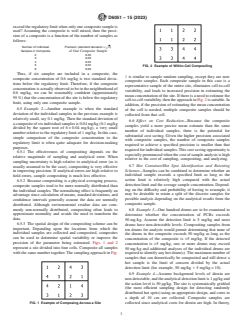
precision of the parameter being estimated. Figs. 1 and 2
concentration is >5 mg/kg, one or more drums may exceed
represent a site divided into four cells. Composite all samples
50 mg ⁄kg and additional analyses of the individual drums are
with the same number together. The sampling approach in Fig.
required to identify any hot drum(s). The maximum number of
samples that can theoretically be composited and still detect a
hot sample is the limit of concern divided by the actual
detection limit (for example, 50 mg/kg ÷ 5 mg/kg = 10).
6.9 Example 4—Assume background levels of dioxin are
non-detectable, and the analytical detection limit is 1 μg/kg and
the action level is 50 μg/kg. The site is systematically gridded
(the most efficient sampling design for detecting randomly
distributed hot spots) using an appropriate design, and cores to
a depth of 10 cm are collected. Composite samples are
FIG. 1 Example of Composing Across a Site collected since analytical costs for dioxin are high. In the
...