

ASTM E133-92(2022)
(Specification)Standard Specification for Distillation Equipment
General Information
- Abstract
ABSTRACT
This specification covers distillation equipment. The equipment shall consist of the following: distillation flasks, condenser, cooling bath, metal shield or enclosure for flask (type 1 or type 2), heat source (gas burner or electric heater), flask support (type 1 or type 2), graduated cylinders, and thermometers.
SCOPE
1.1 This specification covers distillation equipment used in the following ASTM test methods: D86, D850, and (for approved alternative requirements only) Test Method D1078.
1.2 Some items of equipment included in this specification are common to all methods; other items are not. Therefore, those portions of this specification pertinent to the need must be selected.
1.3 The values stated in inch-pound units are to be regarded as standard. The values given in parentheses are mathematical conversions to SI units that are provided for information only and are not considered standard.
1.4 This international standard was developed in accordance with internationally recognized principles on standardization established in the Decision on Principles for the Development of International Standards, Guides and Recommendations issued by the World Trade Organization Technical Barriers to Trade (TBT) Committee.
- Status
- Published
- Publication Date
- 31-Dec-2021
- Technical Committee
- E41 - Laboratory Apparatus
- Drafting Committee
- E41.01 - Laboratory Ware and Supplies

Overview
ASTM E133-92(2022): Standard Specification for Distillation Equipment provides a comprehensive framework for the essential laboratory apparatus used in standardized distillation procedures. Developed and maintained by ASTM International, this standard ensures that distillation glassware and supporting components meet rigorous quality and design requirements. It is widely referenced in petroleum, chemical, and research laboratories to enable accurate and reliable distillation measurements.
This specification covers all main components required for distillation, including flasks, condensers, cooling baths, shields/enclosures, heat sources, flask supports, graduated cylinders, and thermometers. It is specifically applicable to ASTM test methods D86, D850, and (for alternative requirements) D1078.
Key Topics
Scope of Application
- Distillation equipment covered under this standard is intended for use in ASTM D86, D850, and D1078 test methods.
- The standard recognizes that some equipment items are common across methods while others are method-specific, allowing for flexibility and adaptability to testing needs.
Required Equipment Components
- Distillation Flasks: Heat-resistant glass flasks that comply with ASTM E1405, available in different types and sizes.
- Condensers and Cooling Baths: Brass tube condensers and cooling baths with minimum capacity specifications, suitable for efficient condensation and temperature control.
- Metal Shields/Enclosures: Type 1 and Type 2 shields designed for safe operations with gas burners or electric heaters.
- Heat Source: Options for gas burners and electric heaters, facilitating controlled heating as per the test requirements.
- Flask Supports: Adjustable ring or board supports to securely hold distillation flasks during operations.
- Graduated Cylinders: Compliant with ASTM E1272 for accurate measurement of distillate volumes.
- Thermometers: Must comply with ASTM E1, ensuring precise temperature monitoring.
Standardized Units
- The specification uses inch-pound units as standard, with SI conversions for reference only.
International Alignment
- Developed in accordance with WTO TBT Committee principles, facilitating interoperability and global acceptance.
Applications
ASTM E133-92(2022) is critical for laboratories performing distillation tests in compliance with ASTM standards, particularly:
- Petroleum and Fuel Testing: Ensures consistent setup for ASTM D86, which is the core method for determining distillation characteristics of petroleum products and liquid fuels.
- Chemical Testing: Supports procedures in D850 (distillation of industrial aromatic hydrocarbons) and D1078 (distillation range of volatile organic liquids), guaranteeing accuracy and repeatability.
- Quality Control: Laboratories use this specification to validate and standardize their equipment, reducing variance and ensuring compliance with industry regulations.
- Research and Development: Ensures new product formulations and experimental methods are based on trusted, widely recognized apparatus compliance.
Related Standards
For complete compliance and integration of laboratory apparatus, ASTM E133-92(2022) references and is used alongside several key standards:
- ASTM D86: Test Method for Distillation of Petroleum Products and Liquid Fuels at Atmospheric Pressure
- ASTM D850: Test Method for Distillation of Industrial Aromatic Hydrocarbons and Related Materials
- ASTM D1078: Test Method for Distillation Range of Volatile Organic Liquids
- ASTM E1: Specification for ASTM Liquid-in-Glass Thermometers
- ASTM E1272: Specification for Laboratory Glass Graduated Cylinders
- ASTM E1405: Specification for Laboratory Glass Distillation Flasks
Utilizing ASTM E133-92(2022) helps laboratories ensure their distillation equipment is robust, standardized, and fully compatible with leading international test methods, supporting both regulatory compliance and results integrity.
Relations
- Effective Date
- 01-Dec-2023
- Effective Date
- 01-Dec-2023
- Effective Date
- 01-Jan-2019
- Effective Date
- 01-Jul-2016
- Effective Date
- 01-May-2013
- Effective Date
- 01-Nov-2012
- Refers
ASTM D86-11b - Standard Test Method for Distillation of Petroleum Products at Atmospheric Pressure - Effective Date
- 01-Dec-2011
- Effective Date
- 15-Nov-2011
- Effective Date
- 15-May-2010
- Refers
ASTM D86-09 - Standard Test Method for Distillation of Petroleum Products at Atmospheric Pressure - Effective Date
- 15-Apr-2009
- Refers
ASTM D86-08a - Standard Test Method for Distillation of Petroleum Products at Atmospheric Pressure - Effective Date
- 15-Dec-2008
- Refers
ASTM D86-08 - Standard Test Method for Distillation of Petroleum Products at Atmospheric Pressure - Effective Date
- 15-Nov-2008
- Effective Date
- 01-Jun-2008
- Refers
ASTM D86-07b - Standard Test Method for Distillation of Petroleum Products at Atmospheric Pressure - Effective Date
- 15-Nov-2007
- Effective Date
- 01-Nov-2007
Get Certified
Connect with accredited certification bodies for this standard

ECOCERT
Organic and sustainability certification.

Eurofins Food Testing Global
Global leader in food, environment, and pharmaceutical product testing.

Intertek Bangladesh
Intertek certification and testing services in Bangladesh.
Sponsored listings
Frequently Asked Questions
ASTM E133-92(2022) is a technical specification published by ASTM International. Its full title is "Standard Specification for Distillation Equipment". This standard covers: ABSTRACT This specification covers distillation equipment. The equipment shall consist of the following: distillation flasks, condenser, cooling bath, metal shield or enclosure for flask (type 1 or type 2), heat source (gas burner or electric heater), flask support (type 1 or type 2), graduated cylinders, and thermometers. SCOPE 1.1 This specification covers distillation equipment used in the following ASTM test methods: D86, D850, and (for approved alternative requirements only) Test Method D1078. 1.2 Some items of equipment included in this specification are common to all methods; other items are not. Therefore, those portions of this specification pertinent to the need must be selected. 1.3 The values stated in inch-pound units are to be regarded as standard. The values given in parentheses are mathematical conversions to SI units that are provided for information only and are not considered standard. 1.4 This international standard was developed in accordance with internationally recognized principles on standardization established in the Decision on Principles for the Development of International Standards, Guides and Recommendations issued by the World Trade Organization Technical Barriers to Trade (TBT) Committee.
ABSTRACT This specification covers distillation equipment. The equipment shall consist of the following: distillation flasks, condenser, cooling bath, metal shield or enclosure for flask (type 1 or type 2), heat source (gas burner or electric heater), flask support (type 1 or type 2), graduated cylinders, and thermometers. SCOPE 1.1 This specification covers distillation equipment used in the following ASTM test methods: D86, D850, and (for approved alternative requirements only) Test Method D1078. 1.2 Some items of equipment included in this specification are common to all methods; other items are not. Therefore, those portions of this specification pertinent to the need must be selected. 1.3 The values stated in inch-pound units are to be regarded as standard. The values given in parentheses are mathematical conversions to SI units that are provided for information only and are not considered standard. 1.4 This international standard was developed in accordance with internationally recognized principles on standardization established in the Decision on Principles for the Development of International Standards, Guides and Recommendations issued by the World Trade Organization Technical Barriers to Trade (TBT) Committee.
ASTM E133-92(2022) is classified under the following ICS (International Classification for Standards) categories: 71.040.10 - Chemical laboratories. Laboratory equipment. The ICS classification helps identify the subject area and facilitates finding related standards.
ASTM E133-92(2022) has the following relationships with other standards: It is inter standard links to ASTM D86-23a, ASTM D86-23ae1, ASTM E1272-02(2019), ASTM D86-16, ASTM E1-13, ASTM E1272-02(2012), ASTM D86-11b, ASTM D1078-11, ASTM E1405-98(2010), ASTM D86-09, ASTM D86-08a, ASTM D86-08, ASTM D850-03(2008)e1, ASTM D86-07b, ASTM E1-07. Understanding these relationships helps ensure you are using the most current and applicable version of the standard.
ASTM E133-92(2022) is available in PDF format for immediate download after purchase. The document can be added to your cart and obtained through the secure checkout process. Digital delivery ensures instant access to the complete standard document.
Standards Content (Sample)
This international standard was developed in accordance with internationally recognized principles on standardization established in the Decision on Principles for the
Development of International Standards, Guides and Recommendations issued by the World Trade Organization Technical Barriers to Trade (TBT) Committee.
Designation:E133 −92 (Reapproved 2022)
Standard Specification for
Distillation Equipment
This standard is issued under the fixed designation E133; the number immediately following the designation indicates the year of
original adoption or, in the case of revision, the year of last revision. A number in parentheses indicates the year of last reapproval. A
superscript epsilon (´) indicates an editorial change since the last revision or reapproval.
This standard has been approved for use by agencies of the U.S. Department of Defense.
1. Scope 3. Apparatus Assembly
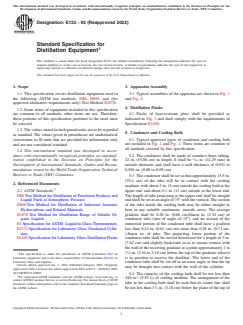
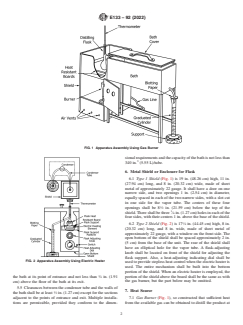
1.1 This specification covers distillation equipment used in 3.1 Typical assemblies of the apparatus are shown in Fig. 1
the following ASTM test methods: D86, D850, and (for and Fig. 2.
approved alternative requirements only) Test Method D1078.
4. Distillation Flasks
1.2 Some items of equipment included in this specification
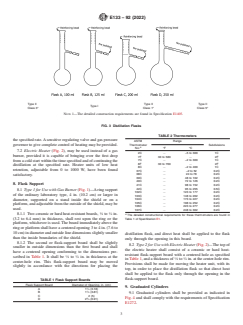
are common to all methods; other items are not. Therefore, 4.1 Flasks of heat-resistant glass shall be provided as
indicated in Fig. 3 and shall comply with the requirements of
those portions of this specification pertinent to the need must
be selected. Specification E1405.
1.3 The values stated in inch-pound units are to be regarded
5. Condenser and Cooling Bath
as standard. The values given in parentheses are mathematical
5.1 Typical approved types of condenser and cooling bath
conversions to SI units that are provided for information only
are included in Fig. 1 and Fig. 2. These items are common to
and are not considered standard.
all methods covered by this specification.
1.4 This international standard was developed in accor-
dance with internationally recognized principles on standard- 5.2 The condenser shall be made of seamless brass tubing,
ization established in the Decision on Principles for the 22 in. (55.88 cm) in length. It shall be ⁄16 in. (14.29 mm) in
Development of International Standards, Guides and Recom- outside diameter, and shall have a wall thickness of 0.031 to
mendations issued by the World Trade Organization Technical 0.036 in. (0.08 to 0.09 cm).
Barriers to Trade (TBT) Committee.
5.3 Thecondensershallbesetsothatapproximately15.5in.
(39.4 cm) of the tube will be in contact with the cooling
2. Referenced Documents
medium, with about 2 in. (5 cm) outside the cooling bath at the
2.1 ASTM Standards: upper end, and about 4 ⁄2 in. (11 cm) outside at the lower end.
D86 Test Method for Distillation of Petroleum Products and The length of tube projecting at the upper end shall be straight
Liquid Fuels at Atmospheric Pressure and shall be set at an angle of 75° with the vertical.The section
D850 Test Method for Distillation of Industrial Aromatic of the tube inside the cooling bath may be either straight or
Hydrocarbons and Related Materials bent in any suitable continuous, smooth curve. The average
D1078 Test Method for Distillation Range of Volatile Or- gradient shall be 0.26 in. (0.66 cm)/linear in. (2.54 cm) of
ganic Liquids condenser tube (sine of angle of 15°), and no section of the
E1 Specification for ASTM Liquid-in-Glass Thermometers immersed portion of the condenser tube shall have a gradient
E1272 Specification for Laboratory Glass Graduated Cylin- less than 0.24 in. (0.61 cm) nor more than 0.28 in. (0.71 cm-
ders )⁄linear in. of tube. The projecting lower portion of the
E1405 Specification for Laboratory Glass Distillation Flasks condenser tube shall be curved downward for a length of 3 in.
(7.62 cm) and slightly backward so as to ensure contact with
the wall of the receiving graduate at a point approximately 1 to
1 ⁄4 in. (2.54 to 3.18 cm) below the top of the graduate when it
This specification is under the jurisdiction of ASTM Committee E41 on
is in position to receive the distillate. The lower end of the
Laboratory Apparatus and is the direct responsibility of Subcommittee E41.01 on
Laboratory Ware and Supplies.
condenser tube shall be cut off at an acute angle so that the tip
Current edition approved Jan. 1, 2022. Published February 2022. Originally
may be brought into contact with the wall of the cylinder.
approvedin1958.Lastpreviouseditionapprovedin2016asE133 – 92(2016).DOI:
10.1520/E0133-92R22.
5.4 The capacity of the cooling bath shall be not less than
For referenced ASTM standards, visit the ASTM website, www.astm.org, or 3
340 in. (5.55 L) of cooling medium. The arrangement of the
contact ASTM Customer Service at service@astm.org. For Annual Book of ASTM
tube in the cooling bath shall be such that its center line shall
Standards volume information, refer to the standard’s Document Summary page on
the ASTM website. be not less than 1 ⁄4 in. (3.18 cm) below the plane of the top of
Copyright © ASTM International, 100 Barr Harbor Drive, PO Box C700, West Conshohocken, PA 19428-2959. United States
E133−92 (2022)
FIG. 1 Apparatus Assembly Using Gas Burner
sional requirements and the capacity of the bath is not less than
340 in. (5.55 L)/tube.
6. Metal Shield or Enclosure for Flask
6.1 Type 1 Shield (Fig. 1) is 19 in. (48.26 cm) high, 11 in.
(27.94 cm) long, and 8 in. (20.32 cm) wide, made of sheet
metal of approximately 22 gauge. It shall have a door on one
narrow side, and two openings 1 in. (2.54 cm) in diameter,
equally spaced in each of the two narrow sides, with a slot cut
in one side for the vapor tube. The centers of these four
openings shall be 8 ⁄2 in. (21.59 cm) below the top of the
shield.There shall be three ⁄4-in. (1.27 cm) holes in each of the
four sides, with their centers 1 in. above the base of the shield.
6.2 Type 2 Shield (Fig. 2)is17 ⁄4 in. (44.45 cm) high, 8 in.
(20.32 cm) long, and 8 in. wide, made of sheet metal of
approximately 22 gauge, with a window on the front sid
...