

ASTM E2335-22
(Guide)Standard Guide for Laboratory Monitors
General Information
- Abstract
SIGNIFICANCE AND USE
4.1 These guidelines are intended to enable a laboratory monitor to perform onsite assessments of laboratory facilities. Accepted facilities will then participate in an interlaboratory test protocol to establish precision and bias for a particular ASTM standard.
4.2 This assessment is intended to determine that all of the participants have the necessary equipment, an understanding of the test method, and the minimum level of skill necessary to gather data that are to be used to establish precision and bias for the particular standard.
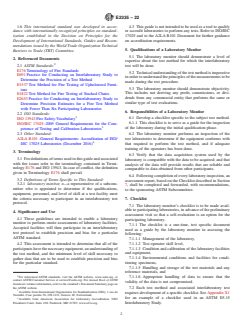
4.3 This guide is not intended to be used as a tool to qualify or accredit laboratories to perform any tests. Refer to ISO/IEC 17025 and to the A2LA R101 Document for further guidance on accreditation requirements.
SCOPE
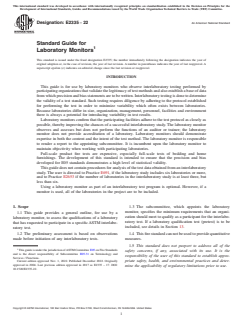
1.1 This guide provides a general outline, for use by a laboratory monitor, to assess the qualifications of a laboratory that has requested to participate in a specific ASTM interlaboratory test.
1.2 The preliminary assessment is based on observations made before initiation of any interlaboratory tests.
1.3 The subcommittee, which appoints the laboratory monitor, specifies the minimum requirements that an organization should meet to qualify as a participant for the interlaboratory test. If a laboratory qualification test (pretest) is to be included, see details in Section 13.
1.4 This fire standard can not be used to provide quantitative measures.
1.5 This standard does not purport to address all of the safety concerns, if any, associated with its use. It is the responsibility of the user of this standard to establish appropriate safety, health, and environmental practices and determine the applicability of regulatory limitations prior to use.
1.6 This international standard was developed in accordance with internationally recognized principles on standardization established in the Decision on Principles for the Development of International Standards, Guides and Recommendations issued by the World Trade Organization Technical Barriers to Trade (TBT) Committee.
- Status
- Published
- Publication Date
- 31-Oct-2022
- Technical Committee
- E05 - Fire Standards
- Drafting Committee
- E05.31 - Terminology and Services / Functions
Overview
ASTM E2335-22:Standard Guide for Laboratory Monitors provides a structured approach for laboratory monitors to assess the qualifications of laboratories seeking to participate in ASTM interlaboratory studies. This guide clarifies the necessary processes and minimum requirements for onsite evaluations, ensuring that each participating laboratory has the essential equipment, understands the relevant test methods, and possesses the technical skills to consistently gather data for the determination of precision and bias in accordance with specific ASTM standards.
This document is especially significant in interlaboratory testing, where minimizing variability and ensuring adherence to standardized protocols are crucial for generating reliable, comparable results.
Key Topics
- Role of Laboratory Monitors: Laboratory monitors are responsible for performing objective onsite assessments of laboratory facilities, ensuring that participating organizations meet the methodological requirements before starting any interlaboratory test.
- Assessment Criteria: Evaluations focus on the laboratory's equipment, personnel skill levels, test method understanding, data handling procedures, and environmental control measures.
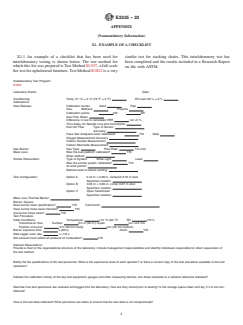
- Checklist Development: Monitors utilize custom checklists tailored to the specific test method. These checklists are shared with laboratories prior to assessment for self-evaluation.
- Report Generation: After each assessment, laboratory monitors submit detailed reports with recommendations to the corresponding ASTM subcommittee.
- Scope Limitations: This standard does not qualify or accredit laboratories for testing. For accreditation, ISO/IEC 17025 and A2LA R101 should be consulted.
- Objectivity and Expertise: Laboratory monitors must demonstrate thorough knowledge of the test method and remain impartial, with no financial interests in participating entities.
Applications
The practical applications of ASTM E2335-22 are primarily in ensuring the integrity and comparability of interlaboratory studies, especially when developing and validating new or revised ASTM test methods. Key applications include:
- Fire Testing Laboratories: Assisting in pre-assessment for laboratories participating in full-scale fire testing and related interlaboratory studies (e.g., ASTM E1537 for upholstered furniture).
- Precision and Bias Evaluation: Ensuring that data collected across participating laboratories is robust, statistically valid, and suitable for use in determining the precision and bias of a standard.
- Test Method Validation: Confirming that all participants can consistently execute the procedures required for the interlaboratory protocol, reducing variability and supporting method legitimacy.
- Laboratory Quality Assurance: Fostering best practices for laboratory management, operator training, equipment calibration, environmental monitoring, and specimen handling.
- Pretest Observation: Overseeing qualification pretests where required, documenting compliance with specimen preparation, and verifying adherence to test protocols.
Related Standards
ASTM E2335-22 references and works in conjunction with several prominent standards:
- ASTM E691: Practice for Conducting an Interlaboratory Study to Determine the Precision of a Test Method.
- ASTM E1537: Test Method for Fire Testing of Upholstered Furniture.
- ASTM E1822: Test Method for Fire Testing of Stacked Chairs.
- ASTM E2653: Practice for Conducting an Interlaboratory Study for Fewer Than Six Laboratories.
- ASTM E176: Terminology of Fire Standards.
- ISO/IEC 17025: General Requirements for the Competence of Testing and Calibration Laboratories.
- A2LA R101: Accreditation Requirements for ISO/IEC 17025 Laboratories.
- ISO 13943: Fire Safety Vocabulary.
Practical Value
Implementing ASTM E2335-22 boosts the reliability of interlaboratory studies by supporting strictly standardized assessments. It helps ensure that participating laboratories are fully prepared, promoting credible, statistically representative data for the development and validation of ASTM standards. Moreover, it enhances quality assurance, traceability, and transparency in laboratory operations, fostering greater confidence among stakeholders in the precision and bias findings reported for ASTM tests. This guide is an essential tool for laboratory oversight, fire testing standardization, and interlaboratory technical collaboration.
Relations
- Effective Date
- 01-Jan-2024
- Effective Date
- 15-Dec-2018
- Effective Date
- 01-Mar-2018
- Effective Date
- 01-Nov-2015
- Effective Date
- 01-Aug-2015
- Effective Date
- 01-Aug-2015
- Effective Date
- 01-Feb-2015
- Effective Date
- 01-Dec-2014
- Effective Date
- 01-Oct-2014
- Effective Date
- 15-Aug-2014
- Effective Date
- 01-Aug-2014
- Effective Date
- 01-Jul-2014
- Effective Date
- 01-May-2013
- Effective Date
- 01-Apr-2013
- Effective Date
- 01-Apr-2013
Get Certified
Connect with accredited certification bodies for this standard

ECOCERT
Organic and sustainability certification.

Eurofins Food Testing Global
Global leader in food, environment, and pharmaceutical product testing.

Intertek Bangladesh
Intertek certification and testing services in Bangladesh.
Sponsored listings
Frequently Asked Questions
ASTM E2335-22 is a guide published by ASTM International. Its full title is "Standard Guide for Laboratory Monitors". This standard covers: SIGNIFICANCE AND USE 4.1 These guidelines are intended to enable a laboratory monitor to perform onsite assessments of laboratory facilities. Accepted facilities will then participate in an interlaboratory test protocol to establish precision and bias for a particular ASTM standard. 4.2 This assessment is intended to determine that all of the participants have the necessary equipment, an understanding of the test method, and the minimum level of skill necessary to gather data that are to be used to establish precision and bias for the particular standard. 4.3 This guide is not intended to be used as a tool to qualify or accredit laboratories to perform any tests. Refer to ISO/IEC 17025 and to the A2LA R101 Document for further guidance on accreditation requirements. SCOPE 1.1 This guide provides a general outline, for use by a laboratory monitor, to assess the qualifications of a laboratory that has requested to participate in a specific ASTM interlaboratory test. 1.2 The preliminary assessment is based on observations made before initiation of any interlaboratory tests. 1.3 The subcommittee, which appoints the laboratory monitor, specifies the minimum requirements that an organization should meet to qualify as a participant for the interlaboratory test. If a laboratory qualification test (pretest) is to be included, see details in Section 13. 1.4 This fire standard can not be used to provide quantitative measures. 1.5 This standard does not purport to address all of the safety concerns, if any, associated with its use. It is the responsibility of the user of this standard to establish appropriate safety, health, and environmental practices and determine the applicability of regulatory limitations prior to use. 1.6 This international standard was developed in accordance with internationally recognized principles on standardization established in the Decision on Principles for the Development of International Standards, Guides and Recommendations issued by the World Trade Organization Technical Barriers to Trade (TBT) Committee.
SIGNIFICANCE AND USE 4.1 These guidelines are intended to enable a laboratory monitor to perform onsite assessments of laboratory facilities. Accepted facilities will then participate in an interlaboratory test protocol to establish precision and bias for a particular ASTM standard. 4.2 This assessment is intended to determine that all of the participants have the necessary equipment, an understanding of the test method, and the minimum level of skill necessary to gather data that are to be used to establish precision and bias for the particular standard. 4.3 This guide is not intended to be used as a tool to qualify or accredit laboratories to perform any tests. Refer to ISO/IEC 17025 and to the A2LA R101 Document for further guidance on accreditation requirements. SCOPE 1.1 This guide provides a general outline, for use by a laboratory monitor, to assess the qualifications of a laboratory that has requested to participate in a specific ASTM interlaboratory test. 1.2 The preliminary assessment is based on observations made before initiation of any interlaboratory tests. 1.3 The subcommittee, which appoints the laboratory monitor, specifies the minimum requirements that an organization should meet to qualify as a participant for the interlaboratory test. If a laboratory qualification test (pretest) is to be included, see details in Section 13. 1.4 This fire standard can not be used to provide quantitative measures. 1.5 This standard does not purport to address all of the safety concerns, if any, associated with its use. It is the responsibility of the user of this standard to establish appropriate safety, health, and environmental practices and determine the applicability of regulatory limitations prior to use. 1.6 This international standard was developed in accordance with internationally recognized principles on standardization established in the Decision on Principles for the Development of International Standards, Guides and Recommendations issued by the World Trade Organization Technical Barriers to Trade (TBT) Committee.
ASTM E2335-22 is classified under the following ICS (International Classification for Standards) categories: 71.040.10 - Chemical laboratories. Laboratory equipment. The ICS classification helps identify the subject area and facilitates finding related standards.
ASTM E2335-22 has the following relationships with other standards: It is inter standard links to ASTM E176-24, ASTM E176-18a, ASTM E176-18, ASTM E1537-15, ASTM E176-15a, ASTM E176-15ae1, ASTM E176-15, ASTM E2653-14, ASTM E176-14c, ASTM E176-14b, ASTM E176-14a, ASTM E176-14, ASTM E691-13, ASTM E1822-13, ASTM E176-13. Understanding these relationships helps ensure you are using the most current and applicable version of the standard.
ASTM E2335-22 is available in PDF format for immediate download after purchase. The document can be added to your cart and obtained through the secure checkout process. Digital delivery ensures instant access to the complete standard document.
Standards Content (Sample)
This international standard was developed in accordance with internationally recognized principles on standardization established in the Decision on Principles for the
Development of International Standards, Guides and Recommendations issued by the World Trade Organization Technical Barriers to Trade (TBT) Committee.
Designation: E2335 − 22 An American National Standard
Standard Guide for
Laboratory Monitors
This standard is issued under the fixed designation E2335; the number immediately following the designation indicates the year of
original adoption or, in the case of revision, the year of last revision. A number in parentheses indicates the year of last reapproval. A
superscript epsilon (´) indicates an editorial change since the last revision or reapproval.
INTRODUCTION
This guide is for use by laboratory monitors who observe interlaboratory testing performed by
participatingorganizationsthatvalidatethelegitimacyoftestmethodsandalsoestablishabaseofdata
fromwhichprecisionandbiasstatementsaretobewritten.Interlaboratorytestingisdonetodetermine
the validity of a test standard. Such testing requires diligence by adhering to the protocol established
for performing the test in order to minimize variability which often exists between laboratories.
Because laboratories differ in size, organization, management, personnel, facilities and environment
there is always a potential for introducing variability in test results.
Laboratory monitors confirm that the participating facilities adhere to the test protocol as closely as
possible, thereby improving the chances of a successful interlaboratory study. The laboratory monitor
observes and assesses but does not perform the functions of an auditor or trainer; the laboratory
monitor does not provide accreditation of a laboratory. Laboratory monitors should demonstrate
expertise in both the content and the intent of the test method. The laboratory monitor is responsible
to render a report to the appointing subcommittee. It is incumbent upon the laboratory monitor to
maintain objectivity when working with participating laboratories.
Full-scale product fire tests are expensive, especially full-scale tests of bedding and home
furnishings. The development of this standard is intended to ensure that the precision and bias
developed for E05 standards demonstrates a high level of statistical validity.
This guide does not contain procedures for analysis of the test data obtained from an interlaboratory
study. The user is directed to Practice E691, if the laboratory study includes six laboratories or more,
and to Practice E2653 if the number of laboratories in the interlaboratory study is at least three, but
less than six.
Using a laboratory monitor as part of an interlaboratory test program is optional. However, if a
monitor is used, all of the laboratories in the project are to be included.
1. Scope 1.3 The subcommittee, which appoints the laboratory
monitor, specifies the minimum requirements that an organi-
1.1 This guide provides a general outline, for use by a
zation should meet to qualify as a participant for the interlabo-
laboratory monitor, to assess the qualifications of a laboratory
ratory test. If a laboratory qualification test (pretest) is to be
that has requested to participate in a specific ASTM interlabo-
included, see details in Section 13.
ratory test.
1.2 The preliminary assessment is based on observations 1.4 Thisfirestandardcannotbeusedtoprovidequantitative
made before initiation of any interlaboratory tests.
measures.
1.5 This standard does not purport to address all of the
This guide is under the jurisdiction ofASTM Committee E05 on Fire Standards
safety concerns, if any, associated with its use. It is the
and is the direct responsibility of Subcommittee E05.31 on Terminology and
responsibility of the user of this standard to establish appro-
Services / Functions.
Current edition approved Nov. 1, 2022. Published December 2022. Originally priate safety, health, and environmental practices and deter-
approved in 2004. Last previous edition approved in 2017 as E2335 – 17. DOI:
mine the applicability of regulatory limitations prior to use.
10.1520/E2335-22.
Copyright © ASTM International, 100 Barr Harbor Drive, PO Box C700, West Conshohocken, PA 19428-2959. United States
E2335 − 22
1.6 This international standard was developed in accor- 4.3 This guide is not intended to be used as a tool to qualify
dance with internationally recognized principles on standard- or accredit laboratories to perform any tests. Refer to ISO/IEC
ization established in the Decision on Principles for the 17025 and to the A2LA R101 Document for further guidance
Development of International Standards, Guides and Recom- on accreditation requirements.
mendations issued by the World Trade Organization Technical
5. Qualifications of a Laboratory Monitor
Barriers to Trade (TBT) Committee.
5.1 The laboratory monitor should demonstrate a level of
2. Referenced Documents
expertise about the test method for which the interlaboratory
2.1 ASTM Standards:
test will be done.
E176 Terminology of Fire Standards
5.2 Technicalunderstandingofthetestmethodisimperative
E691 Practice for Conducting an Interlaboratory Study to
in order to understand the principles of the measurements to be
Determine the Precision of a Test Method
made during the test procedure.
E1537 Test Method for Fire Testing of Upholstered Furni-
5.3 The laboratory monitor should demonstrate objectivity.
ture
This includes not deriving any profit, commissions, or divi-
E1822 Test Method for Fire Testing of Stacked Chairs
dends from any commercial entity that performs the same or
E2653 Practice for Conducting an Interlaboratory Study to
similar type of test evaluations.
Determine Precision Estimates for a Fire Test Method
with Fewer Than Six Participating Laboratories
6. Responsibilities of a Laboratory Monitor
2.2 ISO Standards:
6.1 Develop a checklist specific to the subject test method.
ISO 13943 Fire Safety-Vocabulary
6.1.1 This checklist is to serve as a guide for the inspection
ISO/IEC 17025 :2005 General Requirements for the Com-
of the laboratory during the initial qualification phase.
petence of Testing and Calibration Laboratories
2.3 Other Standard:
6.2 The laboratory monitor performs an inspection of the
A2LA R101 -General Requirements: Accreditation of ISO/
test laboratories to determine if the equipment conforms with
IEC 17025 Laboratories (December 2016)
that required to perform the test method, and if adequate
training of the operators has been done.
3. Terminology
6.3 Verify that the data acquisition system used by the
3.1 Fordefinitionsoftermsusedinthisguideandassociated
laboratory is compatible with the data to be acquired; and that
with fire issues refer to the terminology contained in Termi-
analysis of the data will provide results that are reliable and
nology E176 and ISO 13943. In case of conflict, the definition
comparable to data obtained from other participants.
given in Terminology E176 shall prevail.
6.4 Following completion of every laboratory inspection, an
3.2 Definitions of Terms Specific to This Standard:
assessment report, based on the Checklist described in Section
3.2.1 laboratory monitor, n—a representative of a subcom-
7, shall be completed and forwarded, with recommendations,
mittee who is appointed to determine if the qualifications,
to the sponsoring ASTM Subcommittee.
equipment, personnel, and level of skill at a test facility meet
the criteria necessary to participate in an interlaboratory test
7. Checklist
protocol.
7.1 The laboratory monitor’s checklist is to be made avail-
able to participating laboratories, in advance of the preliminary
4. Significance and Use
assessment visit so that a self-evaluation is an option for the
4.1 These guidelines are intended to enable a laboratory
participating laboratory.
monitor to perform onsite assessments of laboratory facilities.
7.1.1 The checklist is a one-time, test specific document
Accepted facilities will then participate in an interlaboratory
used as a guide by the laboratory monitor in assessing the
test protocol to establish precision and bias for a particular
following:
ASTM standard.
7.1.1.1 Management of the laboratory,
7.1.1.2 Test operator skill level,
4.2 This assessment is intended to determine that all of the
7.1.1.3 Condition and calibration of the laboratory facilities
participantshavethenecessaryequipment,anunderstandingof
and equipment,
the test method, and the minimum level of skill necessary to
7.1.1.4 Environmental conditions and facilities for condi-
gather data that are to be used to establish precision and bias
tioning specimens,
for the particular standard.
7.1.1.5 Handling and storage of the test materials and any
reference materials, and
For referenced ASTM standards, visit the ASTM website, www.astm.org, or
7.1.1.6 Appropriate handling of data to ensure that the
contact ASTM Customer Service at service@astm.org. For Annual Book of ASTM
validity of the data is not compromised.
Standards volume information, ref
...
This document is not an ASTM standard and is intended only to provide the user of an ASTM standard an indication of what changes have been made to the previous version. Because
it may not be technically possible to adequately depict all changes accurately, ASTM recommends that users consult prior editions as appropriate. In all cases only the current version
of the standard as published by ASTM is to be considered the official document.
Designation: E2335 − 17 E2335 − 22 An American National Standard
Standard Guide for
Laboratory Monitors
This standard is issued under the fixed designation E2335; the number immediately following the designation indicates the year of
original adoption or, in the case of revision, the year of last revision. A number in parentheses indicates the year of last reapproval. A
superscript epsilon (´) indicates an editorial change since the last revision or reapproval.
INTRODUCTION
This guide is for use by laboratory monitors who observe interlaboratory testing performed by
participating organizations that validate the legitimacy of test methods and also establish a base of data
from which precision and bias statements are to be written. Interlaboratory testing is done to determine
the validity of a test standard. Such testing requires diligence by adhering to the protocol established
for performing the test in order to minimize variability which often exists between laboratories.
Because laboratories differ in size, organization, management, personnel, facilities and environment
there is always a potential for introducing variability in test results.
Laboratory monitors confirm that the participating facilities adhere to the test protocol as closely as
possible, thereby improving the chances of a successful interlaboratory study. The laboratory monitor
observes and assesses but does not perform the functions of an auditor or trainer; the laboratory
monitor does not provide accreditation of a laboratory. Laboratory monitors should demonstrate
expertise in both the content and the intent of the test method. The laboratory monitor is responsible
to render a report to the appointing subcommittee. It is incumbent upon the laboratory monitor to
maintain objectivity when working with participating laboratories.
Full-scale product fire tests are expensive, especially full-scale tests of bedding and home
furnishings. The development of this standard is intended to ensure that the precision and bias
developed for E05 standards demonstrates a high level of statistical validity.
This guide does not contain procedures for analysis of the test data obtained from an interlaboratory
study. The user is directed to Practice E691, if the laboratory study includes six laboratories or more,
and to Practice E2653 if the number of laboratories in the interlaboratory study is at least three, but
less than six.
Using a laboratory monitor as part of an interlaboratory test program is optional. However, if a
monitor is used, all of the laboratories in the project are to be included.
1. Scope
1.1 This guide provides a general outline, for use by a laboratory monitor, to assess the qualifications of a laboratory that has
requested to participate in a specific ASTM interlaboratory test.
1.2 The preliminary assessment is based on observations made before initiation of any interlaboratory tests.
This guide is under the jurisdiction of ASTM Committee E05 on Fire Standards and is the direct responsibility of Subcommittee E05.31 on Terminology and Services
/ Functions.
Current edition approved July 1, 2017Nov. 1, 2022. Published July 2017December 2022. Originally approved in 2004. Last previous edition approved in 20122017 as
E2335-12. DOI: 10.1520/E2335-17. – 17. DOI: 10.1520/E2335-22.
Copyright © ASTM International, 100 Barr Harbor Drive, PO Box C700, West Conshohocken, PA 19428-2959. United States
E2335 − 22
1.3 The subcommittee, which appoints the laboratory monitor, specifies the minimum requirements that an organization should
meet to qualify as a participant for the interlaboratory test. If a laboratory qualification test (pretest) is to be included, see details
in Section 13.
1.4 This fire standard can not be used to provide quantitative measures.
1.5 This standard does not purport to address all of the safety concerns, if any, associated with its use. It is the responsibility
of the user of this standard to establish appropriate safety safety, health, and healthenvironmental practices and determine the
applicability of regulatory requirementslimitations prior to use.
1.6 This international standard was developed in accordance with internationally recognized principles on standardization
established in the Decision on Principles for the Development of International Standards, Guides and Recommendations issued
by the World Trade Organization Technical Barriers to Trade (TBT) Committee.
2. Referenced Documents
2.1 ASTM Standards:
E176 Terminology of Fire Standards
E691 Practice for Conducting an Interlaboratory Study to Determine the Precision of a Test Method
E1537 Test Method for Fire Testing of Upholstered Furniture
E1822 Test Method for Fire Testing of Stacked Chairs
E2653 Practice for Conducting an Interlaboratory Study to Determine Precision Estimates for a Fire Test Method with Fewer
Than Six Participating Laboratories
2.2 ISO Standards:
ISO 13943 Fire Safety-Vocabulary
ISO/IEC 17025 :2005 General Requirements for the Competence of Testing and Calibration Laboratories
2.3 Other Standard:
A2LA R101 -General Requirements: Accreditation of ISO/IEC 17025 Laboratories (December 2016)
3. Terminology
3.1 For definitions of terms used in this guide and associated with fire issues refer to the terminology contained in Terminology
E176 and ISO 13943. In case of conflict, the definition given in Terminology E176 shall prevail.
3.2 Definitions of Terms Specific to This Standard:
3.2.1 laboratory monitor, n—a representative of a subcommittee who is appointed to determine if the qualifications, equipment,
personnel, and level of skill at a test facility meet the criteria necessary to participate in an interlaboratory test protocol.
4. Significance and Use
4.1 These guidelines are intended to enable a laboratory monitor to perform onsite assessments of laboratory facilities. Accepted
facilities will then participate in an interlaboratory test protocol to establish precision and bias for a particular ASTM standard.
4.2 This assessment is intended to determine that all of the participants have the necessary equipment, an understanding of the
test method, and the minimum level of skill necessary to gather data that are to be used to establish precision and bias for the
particular standard.
4.3 This guide is not intended to be used as a tool to qualify or accredit laboratories to perform any tests. Refer to ISO/IEC 17025
and to the A2LA R101 Document for further guidance on accreditation requirements.
5. Qualifications of a Laboratory Monitor
5.1 The laboratory monitor should demonstrate a level of expertise about the test method for which the interlaboratory test will
be done.
For referenced ASTM standards, visit the ASTM website, www.astm.org, or contact ASTM Customer Service at service@astm.org. For Annual Book of ASTM Standards
volume information, refer to the standard’s Document Summary page on the ASTM website.
Available from International Organization for Standardization (ISO), 1 rue de Varembé, Case postale 56, CH-1211, Geneva 20, Switzerland.
Available from American Association for Laboratory Accreditation, 5202 Presidents Court, Suite 220, Frederick, MD 21703; www.a21a.org.
E2335 − 22
5.2 Technical understanding of the test method is imperative in order to understand the principles of the measurements to be made
during the test procedure.
5.3 The laboratory monitor should demonstrate objectivity. This includes not deriving any profit, commissions, or dividends from
any commercial entity that performs the same or similar type of test evaluations.
6. Responsibilities of a Laboratory Monitor
6.1 Develop a checklist specific to the subject test method.
6.1.1 This checklist is to serve as a guide for the inspection of the laboratory during the initial qualification phase.
6.2 The laboratory monitor performs an inspection of the test laboratories to determine if the equipment conforms with that
required to perform the test method, and if adequate training of the operators has been done.
6.3 Verify that the data acquisition system used by the laboratory is compatible with the data to be acquired; and that analysis of
the data will provide results that are reliable and comparable to data obtained from other participants.
6.4 Following completion of every laboratory inspection, an assessment report, based on the Checklist described in Section 7, shall
be completed and forwarded, with recommendations, to the sponsoring ASTM Subcommittee.
7. Checklist
7.1 The laboratory monitor’s checklist is to be made available to participating laboratories, in advance of the preliminary
assessment visit so that a self-evaluation is an option for the participating laboratory.
7.1.1 The checklist is a one-time, test specific document used as a guide by the laboratory monitor in assessing the following:
7.1.1.1 Ma
...