

ASTM D5423-23
(Specification)Standard Specification for Forced-Convection Laboratory Ovens for Evaluation of Electrical Insulation
General Information
- Abstract
ABSTRACT
This specification covers forced-convection ventilated electrically-heated ovens and used for thermal endurance evaluation of electrical insulating materials. The ovens shall be classified according to ventilations: Type I and Type II. Rate of ventilation, set temperature, temperature variation, and thermal log time properties shall be determined using specified test methods.
SCOPE
1.1 This specification covers forced-convection ventilated electrically-heated ovens, operating over all or part of the temperature range from 20 °C above the ambient temperature to 500 °C, and used for thermal endurance evaluation of electrical insulating materials.
1.2 The specification requirements for Type I ovens are based on IEC Publication 60216-4-1, and are technically identical to it. The requirements for Type II ovens are essentially identical to the requirements of Specification D2436. This specification and an associated test method, D5374, have replaced Specification D2436.
1.3 While the ovens covered by this specification are intended primarily for thermal endurance evaluation, their characteristics make them suitable for other applications as applicable.
1.4 The values stated in SI units are to be regarded as standard. No other units of measurement are included in this standard.
1.5 This standard does not purport to address all of the safety concerns, if any, associated with its use. It is the responsibility of the user of this standard to establish appropriate safety, health, and environmental practices and determine the applicability of regulatory limitations prior to use.
1.6 This international standard was developed in accordance with internationally recognized principles on standardization established in the Decision on Principles for the Development of International Standards, Guides and Recommendations issued by the World Trade Organization Technical Barriers to Trade (TBT) Committee.
- Status
- Published
- Publication Date
- 31-Jan-2023
- Technical Committee
- D09 - Electrical and Electronic Insulating Materials
- Drafting Committee
- D09.17 - Fire and Thermal Properties
Buy Documents


ASTM D5423-23 - Standard Specification for Forced-Convection Laboratory Ovens for Evaluation of Electrical Insulation
REDLINE ASTM D5423-23 - Standard Specification for Forced-Convection Laboratory Ovens for Evaluation of Electrical Insulation
Overview
ASTM D5423-23 is the standard specification developed by ASTM International for forced-convection laboratory ovens used in the thermal endurance evaluation of electrical insulating materials. These ovens are ventilated and electrically heated, designed to operate within a temperature range from 20°C above ambient up to 500°C. The specification defines performance requirements, classifications, and test methods to ensure ovens provide consistent and reliable conditions necessary for accelerated aging and assessment of insulation materials in electrical and electronic applications.
This specification ensures that ovens deliver precise temperature control, ventilation rates, and reproducibility, which are critical for reliable material evaluation. The requirements are harmonized with international standards, specifically aligning Type I ovens with IEC 60216-4-1, and describing Type II ovens based on previous ASTM standards.
Key Topics
Types of Ovens
- Type I: 5 to 20 air changes per hour, harmonized with IEC 60216-4-1
- Type II: 100 to 200 air changes per hour, building on previous ASTM standards
Performance Requirements
- Rate of ventilation at specific temperatures
- Set temperature stability over defined test periods
- Temperature variation and fluctuation within the oven chamber
- Maximum allowable thermal lag time
Construction and Safety
- Use of corrosion-resistant materials
- Leak-proof, easy-to-clean interiors
- Reliable seals and safety features such as automatic heater shutoff
- Adjustable vents for precise control of ventilation and air flow
Certification and Marking
- Certification of compliance for each oven model based on standard test methods (e.g., ASTM D5374)
- Clear labeling of manufacturer, model, power specifications, and key physical dimensions
Applications
ASTM D5423-23 finds primary use in testing the thermal endurance of electrical insulating materials. This includes:
- Accelerated aging tests: Simulating long-term thermal stress on insulation used in electrical wires, cables, transformers, and other components.
- Quality control in manufacturing: Verifying that insulating materials or finished products meet regulatory and performance requirements under defined heat exposure.
- Research and development: Studying the behavior and durability of new insulation materials under high-temperature, forced-convection conditions.
- General laboratory heating: Due to their robust construction and precise temperature and airflow characteristics, these ovens are suitable for other high-temperature laboratory applications when uniform, controlled heating is required.
Best practices include regular in-service monitoring and periodic testing of ovens to ensure ongoing compliance, particularly before conducting new aging tests at different temperatures. Proper specimen placement within turbulent airflow regions of the chamber further enhances result reproducibility.
Related Standards
- ASTM D5374: Test Methods for Forced-Convection Laboratory Ovens for Evaluation of Electrical Insulation
- IEC 60216-4-1: Electrical Insulating Materials - Thermal Endurance Properties - Aging Ovens - Single-Chamber Ovens
- ASTM D1711: Terminology Relating to Electrical Insulation
These documents provide the test procedures, technical language, and international harmonization necessary for laboratories and manufacturers to ensure their equipment and test results meet global and industry-specific requirements. Adherence to ASTM D5423-23 supports quality assurance, regulatory compliance, and facilitates global trade of electrical insulating materials and products.
Keywords
Forced-convection oven, laboratory oven, electrical insulation evaluation, thermal endurance, ventilation rate, set temperature, temperature fluctuation, temperature gradient, ASTM D5423-23, IEC 60216-4-1, accelerated aging, insulating materials testing.
Relations
- Effective Date
- 01-Mar-2024
- Effective Date
- 01-Nov-2015
- Effective Date
- 01-Nov-2014
- Effective Date
- 01-May-2014
- Effective Date
- 01-Nov-2013
- Effective Date
- 01-Aug-2011
- Effective Date
- 01-May-2008
- Effective Date
- 01-Sep-2005
- Effective Date
- 10-Mar-2002
- Effective Date
- 10-Oct-1999
- Effective Date
- 10-Mar-1999
Buy Documents
ASTM D5423-23 - Standard Specification for Forced-Convection Laboratory Ovens for Evaluation of Electrical Insulation
REDLINE ASTM D5423-23 - Standard Specification for Forced-Convection Laboratory Ovens for Evaluation of Electrical Insulation
Get Certified
Connect with accredited certification bodies for this standard

ECOCERT
Organic and sustainability certification.

Eurofins Food Testing Global
Global leader in food, environment, and pharmaceutical product testing.

Intertek Bangladesh
Intertek certification and testing services in Bangladesh.
Sponsored listings
Frequently Asked Questions
ASTM D5423-23 is a technical specification published by ASTM International. Its full title is "Standard Specification for Forced-Convection Laboratory Ovens for Evaluation of Electrical Insulation". This standard covers: ABSTRACT This specification covers forced-convection ventilated electrically-heated ovens and used for thermal endurance evaluation of electrical insulating materials. The ovens shall be classified according to ventilations: Type I and Type II. Rate of ventilation, set temperature, temperature variation, and thermal log time properties shall be determined using specified test methods. SCOPE 1.1 This specification covers forced-convection ventilated electrically-heated ovens, operating over all or part of the temperature range from 20 °C above the ambient temperature to 500 °C, and used for thermal endurance evaluation of electrical insulating materials. 1.2 The specification requirements for Type I ovens are based on IEC Publication 60216-4-1, and are technically identical to it. The requirements for Type II ovens are essentially identical to the requirements of Specification D2436. This specification and an associated test method, D5374, have replaced Specification D2436. 1.3 While the ovens covered by this specification are intended primarily for thermal endurance evaluation, their characteristics make them suitable for other applications as applicable. 1.4 The values stated in SI units are to be regarded as standard. No other units of measurement are included in this standard. 1.5 This standard does not purport to address all of the safety concerns, if any, associated with its use. It is the responsibility of the user of this standard to establish appropriate safety, health, and environmental practices and determine the applicability of regulatory limitations prior to use. 1.6 This international standard was developed in accordance with internationally recognized principles on standardization established in the Decision on Principles for the Development of International Standards, Guides and Recommendations issued by the World Trade Organization Technical Barriers to Trade (TBT) Committee.
ABSTRACT This specification covers forced-convection ventilated electrically-heated ovens and used for thermal endurance evaluation of electrical insulating materials. The ovens shall be classified according to ventilations: Type I and Type II. Rate of ventilation, set temperature, temperature variation, and thermal log time properties shall be determined using specified test methods. SCOPE 1.1 This specification covers forced-convection ventilated electrically-heated ovens, operating over all or part of the temperature range from 20 °C above the ambient temperature to 500 °C, and used for thermal endurance evaluation of electrical insulating materials. 1.2 The specification requirements for Type I ovens are based on IEC Publication 60216-4-1, and are technically identical to it. The requirements for Type II ovens are essentially identical to the requirements of Specification D2436. This specification and an associated test method, D5374, have replaced Specification D2436. 1.3 While the ovens covered by this specification are intended primarily for thermal endurance evaluation, their characteristics make them suitable for other applications as applicable. 1.4 The values stated in SI units are to be regarded as standard. No other units of measurement are included in this standard. 1.5 This standard does not purport to address all of the safety concerns, if any, associated with its use. It is the responsibility of the user of this standard to establish appropriate safety, health, and environmental practices and determine the applicability of regulatory limitations prior to use. 1.6 This international standard was developed in accordance with internationally recognized principles on standardization established in the Decision on Principles for the Development of International Standards, Guides and Recommendations issued by the World Trade Organization Technical Barriers to Trade (TBT) Committee.
ASTM D5423-23 is classified under the following ICS (International Classification for Standards) categories: 71.040.10 - Chemical laboratories. Laboratory equipment. The ICS classification helps identify the subject area and facilitates finding related standards.
ASTM D5423-23 has the following relationships with other standards: It is inter standard links to ASTM D1711-24, ASTM D1711-15, ASTM D1711-14a, ASTM D1711-14, ASTM D1711-13, ASTM D1711-11a, ASTM D1711-08, ASTM D5374-93(2005), ASTM D1711-02, ASTM D1711-99, ASTM D5374-93(1999). Understanding these relationships helps ensure you are using the most current and applicable version of the standard.
ASTM D5423-23 is available in PDF format for immediate download after purchase. The document can be added to your cart and obtained through the secure checkout process. Digital delivery ensures instant access to the complete standard document.
Standards Content (Sample)
This international standard was developed in accordance with internationally recognized principles on standardization established in the Decision on Principles for the
Development of International Standards, Guides and Recommendations issued by the World Trade Organization Technical Barriers to Trade (TBT) Committee.
Designation: D5423 − 23
Standard Specification for
Forced-Convection Laboratory Ovens for Evaluation of
Electrical Insulation
This standard is issued under the fixed designation D5423; the number immediately following the designation indicates the year of
original adoption or, in the case of revision, the year of last revision. A number in parentheses indicates the year of last reapproval. A
superscript epsilon (´) indicates an editorial change since the last revision or reapproval.
1. Scope 2. Referenced Documents
2.1 ASTM Standards:
1.1 This specification covers forced-convection ventilated
D1711 Terminology Relating to Electrical Insulation
electrically-heated ovens, operating over all or part of the
D2436 Specification for Forced-Convection Laboratory Ov-
temperature range from 20 °C above the ambient temperature
ens for Electrical Insulation (Withdrawn 1994)
to 500 °C, and used for thermal endurance evaluation of
D5374 Test Methods for Forced-Convection Laboratory Ov-
electrical insulating materials.
ens for Evaluation of Electrical Insulation
1.2 The specification requirements for Type I ovens are
2.2 Other Document:
based on IEC Publication 60216-4-1, and are technically
IEC Publication 60216-4-1 Electrical Insulating Materials—
identical to it. The requirements for Type II ovens are essen-
Thermal Endurance Properties—Part 4-1: Ageing
tially identical to the requirements of Specification D2436.
Ovens—Single-Chamber Ovens
This specification and an associated test method, D5374, have
replaced Specification D2436.
3. Terminology
1.3 While the ovens covered by this specification are
3.1 For terms related to electrical and electronic insulating
intended primarily for thermal endurance evaluation, their
materials issues refer to Terminology D1711.
characteristics make them suitable for other applications as
3.2 Definitions of Terms Specific to This Standard:
applicable.
3.2.1 rate of ventilation, n—the number of air changes per
1.4 The values stated in SI units are to be regarded as
hour in the oven chamber.
standard. No other units of measurement are included in this
3.2.2 set temperature, n—the average of all of the measured
standard.
temperatures within the oven, averaged over the period of any
1.5 This standard does not purport to address all of the
cyclic temperature variation that occurs.
safety concerns, if any, associated with its use. It is the
3.2.2.1 Discussion—This is the actual operating temperature
responsibility of the user of this standard to establish appro-
of the oven. In IEC 60216-4-1, this term is called the exposure
priate safety, health, and environmental practices and deter-
temperature.
mine the applicability of regulatory limitations prior to use.
3.2.3 temperature fluctuation, n—maximum change in tem-
1.6 This international standard was developed in accor-
perature at one point in the oven over a period of time.
dance with internationally recognized principles on standard-
3.2.3.1 Discussion—This property depends upon the sensi-
ization established in the Decision on Principles for the
tivity and type (on/off or proportional) of control used and the
Development of International Standards, Guides and Recom-
heater mass in relation to surface area.
mendations issued by the World Trade Organization Technical
Barriers to Trade (TBT) Committee.
For referenced ASTM standards, visit the ASTM website, www.astm.org, or
contact ASTM Customer Service at service@astm.org. For Annual Book of ASTM
This specification is under the jurisdiction of ASTM Committee D09 on Standards volume information, refer to the standard’s Document Summary page on
Electrical and Electronic Insulating Materials and is the direct responsibility of the ASTM website.
Subcommittee D09.17 on Fire and Thermal Properties. The last approved version of this historical standard is referenced on www.ast-
Current edition approved Feb. 1, 2023. Published February 2023. Originally m.org.
approved in 1993. Last previous edition approved in 2022 as D5423 – 22. DOI: Available from American National Standards Institute (ANSI), 25 W. 43rd St.,
10.1520/D5423-23. 4th Floor, New York, NY 10036.
Copyright © ASTM International, 100 Barr Harbor Drive, PO Box C700, West Conshohocken, PA 19428-2959. United States
D5423 − 23
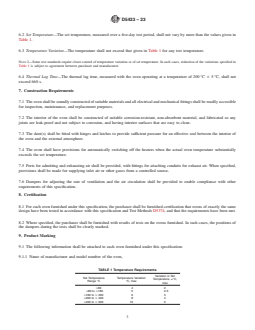
3.2.4 temperature gradient, n—the maximum temperature 6.4 Thermal Lag Time—The thermal lag time, measured
difference at one time between any two points in the oven with the oven operating at a temperature of 200 °C 6 5 °C,
chamber. shall not exceed 660 s.
3.2.4.1 Discussion—This property depends on such factors
as uniformity of heater temperature, heater distribution about
7. Construction Requirements
the oven, and air flow patterns within the oven. In IEC
7.1 The oven shall be soundly constructed of suitable
60216-4-1, this term is called the temperature difference.
materials and all electrical and mechanical fittings shall be
3.2.5 temperature variation, n—maximum change in tem-
readily accessible for inspection, maintenance, and replace-
perature with time and location due to the combination of
ment purposes.
temperature gradient and temperature fluctuation.
7.2 The interior of the oven shall be constructed of suitable
3.2.6 thermal lag time, n—the time required for a defined
corrosion-resistant, non-absorbent material, and fabricated so
specimen to reach a specified temperature (or range of tem-
any joints are leak-proof and not subject to corrosion, and
perature).
having interior surfaces that are easy to clean.
3.2.6.1 Discussion—This property is largely dependent
7.3 The door(s) shall be fitted with hinges and latches to
upon the rate of air circulation within the oven. In IEC
provide sufficient pressure for an effective seal between the
60216-4-1, this term is called the “time constant.”
interior of the oven and the external atmosphere.
4. Classification
7.4 The oven shall have provisions for automatically
switching off the heaters when the actual oven temperature
4.1 Type I—Ovens with rate of ventilation of 5 to 20 air
substantially exceeds the set temperature.
changes per hour.
7.5 Ports for admitting and exhausting air shall be provided,
4.2 Type II—Ovens with rate of ventilation of 100 to 200 air
with fittings for attaching conduits for exhaust air. When
changes per hour.
specified, provisions shall be
...
This document is not an ASTM standard and is intended only to provide the user of an ASTM standard an indication of what changes have been made to the previous version. Because
it may not be technically possible to adequately depict all changes accurately, ASTM recommends that users consult prior editions as appropriate. In all cases only the current version
of the standard as published by ASTM is to be considered the official document.
Designation: D5423 − 22 D5423 − 23
Standard Specification for
Forced-Convection Laboratory Ovens for Evaluation of
Electrical Insulation
This standard is issued under the fixed designation D5423; the number immediately following the designation indicates the year of
original adoption or, in the case of revision, the year of last revision. A number in parentheses indicates the year of last reapproval. A
superscript epsilon (´) indicates an editorial change since the last revision or reapproval.
1. Scope
1.1 This specification covers forced-convection ventilated electrically-heated ovens, operating over all or part of the temperature
range from 20 °C above the ambient temperature to 500 °C, and used for thermal endurance evaluation of electrical insulating
materials.
1.2 The specification requirements for Type I ovens are based on IEC Publication 60216-4-1, and are technically identical to it.
The requirements for Type II ovens are essentially identical to the requirements of Specification D2436. This specification and an
associated test method, D5374, have replaced Specification D2436.
1.3 While the ovens covered by this specification are intended primarily for thermal endurance evaluation, their characteristics
make them suitable for other applications as applicable.
1.4 The values stated in SI units are to be regarded as standard. No other units of measurement are included in this standard.
1.5 This standard does not purport to address all of the safety concerns, if any, associated with its use. It is the responsibility
of the user of this standard to establish appropriate safety, health, and environmental practices and determine the applicability of
regulatory limitations prior to use.
1.6 This international standard was developed in accordance with internationally recognized principles on standardization
established in the Decision on Principles for the Development of International Standards, Guides and Recommendations issued
by the World Trade Organization Technical Barriers to Trade (TBT) Committee.
2. Referenced Documents
2.1 ASTM Standards:
D1711 Terminology Relating to Electrical Insulation
D2436 Specification for Forced-Convection Laboratory Ovens for Electrical Insulation (Withdrawn 1994)
D5374 Test Methods for Forced-Convection Laboratory Ovens for Evaluation of Electrical Insulation
This specification is under the jurisdiction of ASTM Committee D09 on Electrical and Electronic Insulating Materials and is the direct responsibility of Subcommittee
D09.17 on Fire and Thermal Properties.
Current edition approved May 1, 2022Feb. 1, 2023. Published May 2022February 2023. Originally approved in 1993. Last previous edition approved in 20142022 as
D5423 – 14.D5423 – 22. DOI: 10.1520/D5423-22.10.1520/D5423-23.
For referenced ASTM standards, visit the ASTM website, www.astm.org, or contact ASTM Customer Service at service@astm.org. For Annual Book of ASTM Standards
volume information, refer to the standard’s Document Summary page on the ASTM website.
The last approved version of this historical standard is referenced on www.astm.org.
Copyright © ASTM International, 100 Barr Harbor Drive, PO Box C700, West Conshohocken, PA 19428-2959. United States
D5423 − 23
2.2 Other Document:
IEC Publication 60216-4-1 Electrical Insulating Materials—Thermal Endurance Properties—Part 4-1: Ageing Ovens—Single-
Chamber Ovens
3. Terminology
3.1 For terms related to electrical and electronic insulating materials issues refer to Terminology D1711.
3.2 Definitions of Terms Specific to This Standard:
3.2.1 rate of ventilation, n—the number of air changes per hour in the oven chamber.
3.2.2 set temperature, n—the average of all of the measured temperatures within the oven, averaged over the period of any cyclic
temperature variation that occurs.
3.2.2.1 Discussion—
This is the actual operating temperature of the oven. In IEC 60216-4-1, this term is called the exposure temperature.
3.2.3 temperature fluctuation, n—maximum change in temperature at one point in the oven over a period of time.
3.2.3.1 Discussion—
This property depends upon the sensitivity and type (on/off or proportional) of control used and the heater mass in relation to
surface area.
3.2.4 temperature gradient, n—the maximum temperature difference at one time between any two points in the oven chamber.
3.2.4.1 Discussion—
This property depends on such factors as uniformity of heater temperature, heater distribution about the oven, and air flow patterns
within the oven. In IEC 60216-4-1, this term is called the temperature difference.
3.2.5 temperature variation, n—maximum change in temperature with time and location due to the combination of temperature
gradient and temperature fluctuation.
3.2.6 thermal lag time, n—the time required for a defined specimen to reach a specified temperature (or range of temperature).
3.2.6.1 Discussion—
This property is largely dependent upon the rate of air circulation within the oven. In IEC 60216-4-1, this term is called the “time
constant.”
4. Classification
4.1 Type I—Ovens with rate of ventilation of 5 to 20 air changes per hour.
4.2 Type II—Ovens with rate of ventilation of 100 to 200 air changes per hour.
5. Test Methods
5.1 Determine the properties specified in Section 6 using Test Methods D5374.
6. Performance Requirements
6.1 Rate of Ventilation—The rate of ventilation at 100 °C and at the maximum temperature at which the oven is used shall be:
6.1.1 For Type I ovens, 5 to 20 air changes per hour,
6.1.2 For Type II ovens, 100 to 200 air changes per hour.
NOTE 1—Past experience in the United States has been to specify 100 to 200 air changes per hour, as required for Type II ovens. However, current
international practice is to prefer the lower rate of ventilation specified for Type I ovens.
Available from American National Standards Institute (ANSI), 25 W. 43rd St., 4th Floor, New York, NY 10036.
D5423 − 23
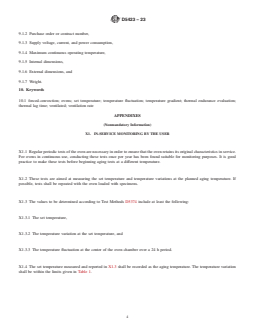
6.2 Set Temperature—The set temperature, measured over a five-day test period, shall not vary by more than the values given in
Table 1.
6.3 Temperature Variation—The temperature shall not exceed that given in Table 1 for any test temperature.
NOTE 2—Some test standards require closer control of temperature variation or of set temperature. In such cases, reduction of the variatio
...