

ASTM E1537-22
(Test Method)Standard Test Method for Fire Testing of Upholstered Furniture
General Information
- Abstract
SIGNIFICANCE AND USE
5.1 This test method provides a means to measure a variety of fire-test-response characteristics resulting from burning a specimen of upholstered furniture. The upholstered furniture specimen is allowed to burn freely under well-ventilated conditions after ignition using a propane gas burner. The most important fire-test-response characteristic measured is the rate of heat release, which quantifies the intensity of the fire generated.
5.2 The rate of heat release is measured by the principle of oxygen consumption. The assumptions and limitations of oxygen depletion calorimetry are discussed in Annex A4, and in particular in A4.1.2.
5.3 Other fire-test-response characteristics are measured, namely smoke obscuration and combustion gas release, as they are also important in making decisions on fire safety.
5.4 The most important gaseous components of smoke are the carbon oxides, present in all fires. They are indicators of the toxicity of the atmosphere and of the completeness of combustion. Measurement of concentrations of carbon oxides are useful for two purposes: as part of fire hazard assessment calculations and to improve the accuracy of heat release measurements. Other toxic combustion gases, which are specific to certain materials, are less crucial for determining combustion completeness and are optional measures, but fire hazard assessment often requires their measurement.
5.5 The type of ignition chosen (a flaming source) is common in both accidental and intentional fires in public occupancies. This test method is thus applicable to upholstered furniture in public occupancies. Such facilities include, but are not limited to, jails, prisons, nursing care homes, health care facilities, public auditoriums, hotels, and motels.
5.6 It has been shown that if the gas burner is used at a flow rate of 13 L/min for 80 s (equivalent to 19.3 kW), as is the case in California Technical Bulletin (CA TB) 133, it approximates the ignition propensity of five cru...
SCOPE
1.1 This is a fire-test-response standard.
1.2 The purpose of this test method is to determine the burning behavior of upholstered furniture used in public occupancies by measuring specific fire-test responses when the specimen of furniture is subjected to a specified flaming ignition source under well-ventilated conditions.
1.3 Data are obtained describing the burning behavior from a specific ignition source until all burning has ceased, a period of 1 h has elapsed, or flashover appears inevitable.
1.4 This test method does not provide information on the fire performance of upholstered furniture in fire conditions other than those conditions specified. In particular, this test method does not apply to smoldering ignition by cigarettes. See X1.6 for further information.
1.5 The rate of heat release of the burning specimen is measured by an oxygen consumption method. See X1.6.4 for further information.
1.6 The production of light obscuring smoke is measured and the concentrations of certain toxic gas species in the combustion gases are determined. See X1.6.5 for further information.
1.7 The burning behavior is visually documented by photographic or video recordings, whenever possible.
1.8 The system of units to be used in referee decisions is the SI system of units, see IEEE/ASTM SI-10 only. The units given in parentheses are for information only.
1.9 This standard is used to measure and describe the response of materials, products, or assemblies to heat and flame under controlled conditions, but does not by itself incorporate all factors required for fire hazard or fire risk assessment of the materials, products or assemblies under actual fire conditions.
1.10 Fire testing is inherently hazardous. Adequate safeguards for personnel and property shall be employed in conducting these tests.
1.11 This standard does not purport to address all of the safety concerns, if any, associated with its us...
- Status
- Published
- Publication Date
- 31-Mar-2022
- Technical Committee
- E05 - Fire Standards
- Drafting Committee
- E05.15 - Furnishings and Contents
Overview
ASTM E1537-22, Standard Test Method for Fire Testing of Upholstered Furniture, establishes a comprehensive procedure for evaluating the fire-test-response characteristics of upholstered furniture when exposed to a specified flaming ignition source under well-ventilated conditions. Developed by ASTM International, this standard is essential for assessing the burning behavior, rate of heat release, smoke production, and emission of combustion gases from furniture intended for use in public occupancies. By providing controlled and repeatable fire testing methods, ASTM E1537-22 helps manufacturers, regulators, and safety professionals make informed decisions about fire safety in public settings.
Key Topics
Fire-Test-Response Characteristics
The primary focus is on measuring how upholstered furniture responds to direct flame exposure. Significant test-response metrics include:- Rate of heat release (intensity of fire)
- Production of smoke (obscuration levels)
- Release of combustion gases, primarily carbon monoxide and carbon dioxide
Oxygen Consumption Calorimetry
Heat release rate is determined using oxygen consumption, a method that quantifies the energy output during combustion and is a key parameter in fire hazard assessments.Test Conditions
Testing is performed under well-ventilated conditions using a propane gas burner as an ignition source, closely simulating potential fires in public environments.Applicability to Public Occupancies
The methods and fire scenarios addressed in ASTM E1537-22 are directly relevant to facilities such as jails, prisons, nursing homes, healthcare facilities, auditoriums, hotels, and motels.Other Measurements and Documentation
The standard includes optional procedures for measuring the concentration of other toxic gases, visual documentation via photography or video, and requirements for precise calibration and reporting.Limitations
This standard is not applicable to smoldering ignition sources (such as cigarettes) and is intended only to assess performance under the specified flaming ignition conditions.
Applications
ASTM E1537-22 holds significant value for stakeholders needing reliable fire safety data for upholstered furniture, especially where public occupancy risk is high. Typical applications include:
Product Development and Quality Assurance
Manufacturers use this method to evaluate new designs or materials and to ensure ongoing compliance with fire safety requirements for seating products.Risk Assessment and Regulatory Compliance
Regulatory authorities and fire safety engineers employ data generated under this standard to inform building codes, fire risk analyses, and safety regulations specific to furniture in public spaces.Fire Incident Investigation
Data on heat release and smoke generation inform forensic analyses and help improve future fire safety measures.Procurement and Public Safety Standards
Facility managers and procurement officers reference ASTM E1537-22 results to specify furniture that meets required fire performance criteria for public settings.Cross-Referenced Testing
This method complements broader room fire tests and other material-specific tests when a full assessment of fire performance is required.
Related Standards
ASTM E1537-22 is part of a suite of international fire safety standards. Key related documents include:
- ASTM E84 - Test Method for Surface Burning Characteristics of Building Materials
- ASTM E1354 - Test Method for Heat and Visible Smoke Release Rates for Materials and Products Using an Oxygen Consumption Calorimeter
- ASTM E2067 - Practice for Full-Scale Oxygen Consumption Calorimetry Fire Tests
- CA Technical Bulletin 133 - Flammability Test Procedure for Seating Furniture for Use in Public Occupancies (withdrawn but referenced for methodology)
- BS 5852 - Fire Tests for Furniture: Ignitability of Upholstered Composites
- UL 1056 - Fire Test of Upholstered Furniture (withdrawn)
- ISO 9705 - Fire Tests – Full-Scale Room Test for Surface Products
- NFPA 265 & NFPA 286 - Fire Tests for Evaluating Room Fire Growth Contribution of Wall and Ceiling Materials
By utilizing ASTM E1537-22 for fire testing of upholstered furniture, organizations can enhance the safety of public environments, support regulatory compliance, and advance best practices in fire hazard assessment.
Relations
- Effective Date
- 01-Jan-2024
- Effective Date
- 01-Dec-2023
- Effective Date
- 01-Nov-2023
- Effective Date
- 01-Sep-2023
- Effective Date
- 01-Jul-2020
- Effective Date
- 01-Jul-2019
- Effective Date
- 15-Apr-2019
- Effective Date
- 01-Mar-2019
- Effective Date
- 15-Dec-2018
- Effective Date
- 01-Oct-2018
- Effective Date
- 01-Jul-2018
- Effective Date
- 01-Mar-2018
- Effective Date
- 01-Mar-2018
- Effective Date
- 01-Nov-2017
- Effective Date
- 01-Aug-2017
Get Certified
Connect with accredited certification bodies for this standard

CIS Institut d.o.o.
Personal Protective Equipment (PPE) certification body. Notified Body NB-2890 for EU Regulation 2016/425 PPE.

Kiwa BDA Testing
Building and construction product certification.
Kmetijski inštitut Slovenije
Agricultural Institute of Slovenia. Soil testing, plant health, agricultural product analysis.
Sponsored listings
Frequently Asked Questions
ASTM E1537-22 is a standard published by ASTM International. Its full title is "Standard Test Method for Fire Testing of Upholstered Furniture". This standard covers: SIGNIFICANCE AND USE 5.1 This test method provides a means to measure a variety of fire-test-response characteristics resulting from burning a specimen of upholstered furniture. The upholstered furniture specimen is allowed to burn freely under well-ventilated conditions after ignition using a propane gas burner. The most important fire-test-response characteristic measured is the rate of heat release, which quantifies the intensity of the fire generated. 5.2 The rate of heat release is measured by the principle of oxygen consumption. The assumptions and limitations of oxygen depletion calorimetry are discussed in Annex A4, and in particular in A4.1.2. 5.3 Other fire-test-response characteristics are measured, namely smoke obscuration and combustion gas release, as they are also important in making decisions on fire safety. 5.4 The most important gaseous components of smoke are the carbon oxides, present in all fires. They are indicators of the toxicity of the atmosphere and of the completeness of combustion. Measurement of concentrations of carbon oxides are useful for two purposes: as part of fire hazard assessment calculations and to improve the accuracy of heat release measurements. Other toxic combustion gases, which are specific to certain materials, are less crucial for determining combustion completeness and are optional measures, but fire hazard assessment often requires their measurement. 5.5 The type of ignition chosen (a flaming source) is common in both accidental and intentional fires in public occupancies. This test method is thus applicable to upholstered furniture in public occupancies. Such facilities include, but are not limited to, jails, prisons, nursing care homes, health care facilities, public auditoriums, hotels, and motels. 5.6 It has been shown that if the gas burner is used at a flow rate of 13 L/min for 80 s (equivalent to 19.3 kW), as is the case in California Technical Bulletin (CA TB) 133, it approximates the ignition propensity of five cru... SCOPE 1.1 This is a fire-test-response standard. 1.2 The purpose of this test method is to determine the burning behavior of upholstered furniture used in public occupancies by measuring specific fire-test responses when the specimen of furniture is subjected to a specified flaming ignition source under well-ventilated conditions. 1.3 Data are obtained describing the burning behavior from a specific ignition source until all burning has ceased, a period of 1 h has elapsed, or flashover appears inevitable. 1.4 This test method does not provide information on the fire performance of upholstered furniture in fire conditions other than those conditions specified. In particular, this test method does not apply to smoldering ignition by cigarettes. See X1.6 for further information. 1.5 The rate of heat release of the burning specimen is measured by an oxygen consumption method. See X1.6.4 for further information. 1.6 The production of light obscuring smoke is measured and the concentrations of certain toxic gas species in the combustion gases are determined. See X1.6.5 for further information. 1.7 The burning behavior is visually documented by photographic or video recordings, whenever possible. 1.8 The system of units to be used in referee decisions is the SI system of units, see IEEE/ASTM SI-10 only. The units given in parentheses are for information only. 1.9 This standard is used to measure and describe the response of materials, products, or assemblies to heat and flame under controlled conditions, but does not by itself incorporate all factors required for fire hazard or fire risk assessment of the materials, products or assemblies under actual fire conditions. 1.10 Fire testing is inherently hazardous. Adequate safeguards for personnel and property shall be employed in conducting these tests. 1.11 This standard does not purport to address all of the safety concerns, if any, associated with its us...
SIGNIFICANCE AND USE 5.1 This test method provides a means to measure a variety of fire-test-response characteristics resulting from burning a specimen of upholstered furniture. The upholstered furniture specimen is allowed to burn freely under well-ventilated conditions after ignition using a propane gas burner. The most important fire-test-response characteristic measured is the rate of heat release, which quantifies the intensity of the fire generated. 5.2 The rate of heat release is measured by the principle of oxygen consumption. The assumptions and limitations of oxygen depletion calorimetry are discussed in Annex A4, and in particular in A4.1.2. 5.3 Other fire-test-response characteristics are measured, namely smoke obscuration and combustion gas release, as they are also important in making decisions on fire safety. 5.4 The most important gaseous components of smoke are the carbon oxides, present in all fires. They are indicators of the toxicity of the atmosphere and of the completeness of combustion. Measurement of concentrations of carbon oxides are useful for two purposes: as part of fire hazard assessment calculations and to improve the accuracy of heat release measurements. Other toxic combustion gases, which are specific to certain materials, are less crucial for determining combustion completeness and are optional measures, but fire hazard assessment often requires their measurement. 5.5 The type of ignition chosen (a flaming source) is common in both accidental and intentional fires in public occupancies. This test method is thus applicable to upholstered furniture in public occupancies. Such facilities include, but are not limited to, jails, prisons, nursing care homes, health care facilities, public auditoriums, hotels, and motels. 5.6 It has been shown that if the gas burner is used at a flow rate of 13 L/min for 80 s (equivalent to 19.3 kW), as is the case in California Technical Bulletin (CA TB) 133, it approximates the ignition propensity of five cru... SCOPE 1.1 This is a fire-test-response standard. 1.2 The purpose of this test method is to determine the burning behavior of upholstered furniture used in public occupancies by measuring specific fire-test responses when the specimen of furniture is subjected to a specified flaming ignition source under well-ventilated conditions. 1.3 Data are obtained describing the burning behavior from a specific ignition source until all burning has ceased, a period of 1 h has elapsed, or flashover appears inevitable. 1.4 This test method does not provide information on the fire performance of upholstered furniture in fire conditions other than those conditions specified. In particular, this test method does not apply to smoldering ignition by cigarettes. See X1.6 for further information. 1.5 The rate of heat release of the burning specimen is measured by an oxygen consumption method. See X1.6.4 for further information. 1.6 The production of light obscuring smoke is measured and the concentrations of certain toxic gas species in the combustion gases are determined. See X1.6.5 for further information. 1.7 The burning behavior is visually documented by photographic or video recordings, whenever possible. 1.8 The system of units to be used in referee decisions is the SI system of units, see IEEE/ASTM SI-10 only. The units given in parentheses are for information only. 1.9 This standard is used to measure and describe the response of materials, products, or assemblies to heat and flame under controlled conditions, but does not by itself incorporate all factors required for fire hazard or fire risk assessment of the materials, products or assemblies under actual fire conditions. 1.10 Fire testing is inherently hazardous. Adequate safeguards for personnel and property shall be employed in conducting these tests. 1.11 This standard does not purport to address all of the safety concerns, if any, associated with its us...
ASTM E1537-22 is classified under the following ICS (International Classification for Standards) categories: 13.220.40 - Ignitability and burning behaviour of materials and products; 97.140 - Furniture. The ICS classification helps identify the subject area and facilitates finding related standards.
ASTM E1537-22 has the following relationships with other standards: It is inter standard links to ASTM E176-24, ASTM E84-23d, ASTM E2067-23, ASTM E84-23c, ASTM E800-20, ASTM E84-19b, ASTM E84-19a, ASTM E84-19, ASTM E176-18a, ASTM E84-18b, ASTM E84-18a, ASTM E84-18, ASTM E176-18, ASTM E84-17a, ASTM E84-17. Understanding these relationships helps ensure you are using the most current and applicable version of the standard.
ASTM E1537-22 is available in PDF format for immediate download after purchase. The document can be added to your cart and obtained through the secure checkout process. Digital delivery ensures instant access to the complete standard document.
Standards Content (Sample)
This international standard was developed in accordance with internationally recognized principles on standardization established in the Decision on Principles for the
Development of International Standards, Guides and Recommendations issued by the World Trade Organization Technical Barriers to Trade (TBT) Committee.
Designation: E1537 − 22 An American National Standard
Standard Test Method for
Fire Testing of Upholstered Furniture
This standard is issued under the fixed designation E1537; the number immediately following the designation indicates the year of
original adoption or, in the case of revision, the year of last revision.Anumber in parentheses indicates the year of last reapproval.A
superscript epsilon (´) indicates an editorial change since the last revision or reapproval.
1. Scope* 1.10 Fire testing is inherently hazardous. Adequate safe-
guards for personnel and property shall be employed in
1.1 This is a fire-test-response standard.
conducting these tests.
1.2 The purpose of this test method is to determine the
1.11 This standard does not purport to address all of the
burning behavior of upholstered furniture used in public
safety concerns, if any, associated with its use. It is the
occupanciesbymeasuringspecificfire-testresponseswhenthe
responsibility of the user of this standard to establish appro-
specimen of furniture is subjected to a specified flaming
priate safety, health, and environmental practices and deter-
ignition source under well-ventilated conditions.
mine the applicability of regulatory limitations prior to use.
1.12 This international standard was developed in accor-
1.3 Data are obtained describing the burning behavior from
dance with internationally recognized principles on standard-
a specific ignition source until all burning has ceased, a period
ization established in the Decision on Principles for the
of 1 h has elapsed, or flashover appears inevitable.
Development of International Standards, Guides and Recom-
1.4 This test method does not provide information on the
mendations issued by the World Trade Organization Technical
fire performance of upholstered furniture in fire conditions
Barriers to Trade (TBT) Committee.
other than those conditions specified. In particular, this test
method does not apply to smoldering ignition by cigarettes.
2. Referenced Documents
See X1.6 for further information.
2.1 ASTM Standards:
1.5 The rate of heat release of the burning specimen is D123Terminology Relating to Textiles
measured by an oxygen consumption method. See X1.6.4 for E84Test Method for Surface Burning Characteristics of
further information. Building Materials
E176Terminology of Fire Standards
1.6 The production of light obscuring smoke is measured
E603Guide for Room Fire Experiments
and the concentrations of certain toxic gas species in the
E800GuideforMeasurementofGasesPresentorGenerated
combustion gases are determined. See X1.6.5 for further
During Fires
information.
E1354Test Method for Heat and Visible Smoke Release
1.7 The burning behavior is visually documented by photo-
Rates for Materials and Products Using an Oxygen Con-
graphic or video recordings, whenever possible. sumption Calorimeter
E2067Practice for Full-Scale Oxygen Consumption Calo-
1.8 Thesystemofunitstobeusedinrefereedecisionsisthe
rimetry Fire Tests
SI system of units, see IEEE/ASTMSI-10 only. The units
E2257Test Method for Room Fire Test of Wall and Ceiling
given in parentheses are for information only.
Materials and Assemblies
1.9 This standard is used to measure and describe the
IEEE/ASTMSI-10International System of Units (SI): The
response of materials, products, or assemblies to heat and
Modern Metric System
flame under controlled conditions, but does not by itself
2.2 ISO Standards:
incorporate all factors required for fire hazard or fire risk
ISO 4880 Burning Behaviour of Textiles and Textile
assessment of the materials, products or assemblies under
Products—Vocabulary
actual fire conditions.
ISO 9705Fire Tests—Full Scale Room Test for Surface
Products
1 2
This test method is under the jurisdiction of ASTM Committee E05 on Fire For referenced ASTM standards, visit the ASTM website, www.astm.org, or
Standards and is the direct responsibility of Subcommittee E05.15 on Furnishings contact ASTM Customer Service at service@astm.org. For Annual Book of ASTM
and Contents. Standards volume information, refer to the standard’s Document Summary page on
Current edition approved April 1, 2022. Published May 2022. Originally the ASTM website.
approved in 1993. Last previous edition approved in 2016 as E1537–16. DOI: Available fromAmerican National Standards Institute (ANSI), 25 W. 43rd St.,
10.1520/E1537-22. 4th Floor, New York, NY 10036, http://www.ansi.org.
*A Summary of Changes section appears at the end of this standard
Copyright © ASTM International, 100 Barr Harbor Drive, PO Box C700, West Conshohocken, PA 19428-2959. United States
E1537 − 22
ISO 13943Fire Safety—Vocabulary material, (2) contains upholstery material, and (3) is intended
or promoted for sitting upon.
2.3 UL Standard:
UL 1056Fire Test of Upholstered Furniture (withdrawn)
3.2.5 upholstery cover material, n—the outermost layer of
2.4 CA Standard:
fabric or related materials used to enclose the main support
CA Technical Bulletin 133 FlammabilityTest Procedure for
system, or upholstery materials, or both, used in the furniture
Seating Furniture for Use in Public Occupancies (with-
unit.
drawn)
3.2.6 upholsterymaterial,n—thepadding,stuffing,orfilling
2.5 BSI Standard:
material used in a furniture unit, which may be either loose or
BS 5852Fire Tests for Furniture. Methods of Test for the
attached, enclosed by an upholstery cover material, or located
Ignitability of Upholstered Composites for Seating by
between the upholstery cover material and support system, if
Flame Sources
present.
2.6 Nordtest Standard:
3.2.6.1 Discussion—This includes, but is not limited to,
Nordtest Method NT Fire 032Upholstered Furniture: Burn-
material, such as foams, cotton batting, polyester fiberfill,
ing Behavior—Full Scale Test
bonded cellulose, or down.
2.7 NFPA Standards:
NFPA 265Standard Methods of Fire Tests for Evaluating
4. Summary of Test Method
Room Fire Growth Contribution of Textile Coverings on
4.1 This test method determines a number of fire-test-
Full Height Panels and Walls
response characteristics from a full-scale specimen of uphol-
NFPA 286Standard Methods of Fire Tests for Evaluating
stered furniture ignited with a propane gas burner. Measure-
Contribution of Wall and Ceiling Interior Finish to Room
ments to be made include rate of heat and smoke release, total
Fire Growth
amount of heat and smoke released, rate and concentration of
3. Terminology carbon oxides released, and rate and amount of mass of
specimenlost.Otheroptionalmeasurementsarealsodescribed.
3.1 Definitions:
3.1.1 For definitions of terms used in this test method and 4.2 Three options are provided, in all of which the uphol-
associated with fire issues, refer to the terminology contained stered furniture specimen to be tested is placed on a weighing
in Terminology E176 and in ISO 13943. The definitions given platformandmeasurementsofheatrelease,smokerelease,and
in Terminology E176 shall prevail in case of conflict. For combustion gas release are made in an exhaust duct.
definitions of terms used in this test method and associated
4.3 In Options A and B the duct is located outside the
with textile issues, refer to Terminology D123 and ISO 4880.
doorwayofatestroom.InOptionCtheductislocateddirectly
The definitions given in Terminology D123 shall prevail in
over the specimen.
case of conflict.
4.4 Additional (optional) instrumentation placed in the test
3.1.2 For definitions of terms used in this test method and
room is also described.
associatedwithtextileissuesrefertotheterminologycontained
in Terminology D123.
5. Significance and Use
3.2 Definitions of Terms Specific to This Standard:
3.2.1 product, n—the upholstered furniture for which infor-
5.1 This test method provides a means to measure a variety
mation is required.
of fire-test-response characteristics resulting from burning a
specimen of upholstered furniture. The upholstered furniture
3.2.2 specimen, n—manufactured item of the product, rep-
resentative prototype of the product, or mock-up of the specimen is allowed to burn freely under well-ventilated
conditions after ignition using a propane gas burner. The most
product.
3.2.2.1 Discussion—The mock-up shall be constructed as important fire-test-response characteristic measured is the rate
of heat release, which quantifies the intensity of the fire
described in Annex A1.
generated.
3.2.3 upholstered, adj—covered with material (as fabric or
padding) to provide a soft surface.
5.2 The rate of heat release is measured by the principle of
oxygen consumption. The assumptions and limitations of
3.2.4 upholstered seating furniture, n—a unit of interior
oxygen depletion calorimetry are discussed in Annex A4, and
furnishing that (1) contains any surface that is covered, in
in particular in A4.1.2.
whole or in part, with a fabric or other upholstery cover
5.3 Other fire-test-response characteristics are measured,
namelysmokeobscurationandcombustiongasrelease,asthey
Available from Underwriters Laboratories (UL), 333 Pfingsten Rd.,
are also important in making decisions on fire safety.
Northbrook, IL 60062-2096, http://www.ul.com.
Available from Bureau of Household Goods and Service (BHGS), State of
5.4 The most important gaseous components of smoke are
California, Dept. of ConsumerAffairs, 3485 Orange GroveAve., North Highlands,
thecarbonoxides,presentinallfires.Theyareindicatorsofthe
CA 95660-5595, http://www.bhgs.dca.ca.gov/industry/tb133.
Available from British Standards Institution (BSI), 389 Chiswick High Rd.,
toxicityoftheatmosphereandofthecompletenessofcombus-
London W4 4AL, U.K., http://www.bsigroup.com.
tion. Measurement of concentrations of carbon oxides are
Available from Nordtest, PO Box 22, SF-00341, Helsingfors, Finland.
useful for two purposes: as part of fire hazard assessment
Available from National Fire Protection Association (NFPA), 1 Batterymarch
Park, Quincy, MA 02169-7471, http://www.nfpa.org. calculations and to improve the accuracy of heat release
E1537 − 22
measurements. Other toxic combustion gases, which are spe- 25 mm by 2.44 m 6 25 mm high (8 by 12 by 8 ft high). The
cific to certain materials, are less crucial for determining room shall have no openings other than a doorway opening
combustion completeness and are optional measures, but fire 0.76 m 6 6.4 mm by 2.03 m 6 6.4 mm (30 by 80 in.), located
hazard assessment often requires their measurement. asindicatedinFig.1,andothersmallopenings,asnecessaryto
maketestmeasurements.Constructthetestroomofwoodenor
5.5 The type of ignition chosen (a flaming source) is
metal studs, and line it with fire rated gypsum wallboard or
common in both accidental and intentional fires in public
calcium silicate wallboard. Position a hood, as described in
occupancies.Thistestmethodisthusapplicabletoupholstered
AnnexA2,outsideoftheroomdoorway,suchthatitcollectsall
furniture in public occupancies. Such facilities include, but are
the combustion gases. There shall be no obstructions to the air
not limited to, jails, prisons, nursing care homes, health care
supply to the test setup.
facilities, public auditoriums, hotels, and motels.
NOTE 1—Both Type X gypsum wallboard and calcium silicate wall-
5.6 Ithasbeenshownthatifthegasburnerisusedataflow
board with a thickness of at least 13 mm (0.5 in.) have been found
rateof13L/minfor80s(equivalentto19.3kW),asisthecase
acceptable. If the thickness of the wallboard is larger, it will not affect the
in California Technical Bulletin (CATB) 133, it approximates
results of this test.
the ignition propensity of five crumpled sheets of newspaper
7.2 Test Room Layout (Test Configuration B)—The test
located on the seating cushion.
room shall have dimensions of 3.05 m 6 25 mm by 3.66 m 6
5.7 This test method specifies both a particular flow rate of
25 mm by 2.44 m 6 25 mm high (10 by 12 by 8 ft high). The
propane gas and a period of gas flow. If the ignition conditions
room shall have no openings other than a doorway opening
are changed, the results would then deviate from the model
0.97 m 6 6.4 mm by 2.06 m 6 6.4 mm (38 by 81 in.), located
selected for this test.
as indicated in Fig. 2, and other small openings, as necessary,
tomaketestmeasurements.Constructthetestroomofwooden
5.8 This test method is not applicable to ignition of uphol-
or metal studs, and line it with fire-rated gypsum wallboard or
stered furniture by cigarettes.
calcium silicate wallboard. Position a hood, as described in
5.9 One of the following three test configurations is to be
AnnexA2,outsideoftheroomdoorway,suchthatitcollectsall
used in this test method:
5.9.1 A—A test room with the following dimensions: 3.66
by 2.44 by 2.44 m high.
5.9.2 B—A test room with the following dimensions: 3.66
by 3.05 by 2.44 m high.
5.9.3 C—An open calorimeter (or furniture calorimeter).
5.10 Measurements in the three test configurations listed in
5.9 have been shown to give similar results for heat release in
the duct, for heat release rates lower than 600 kW (see X1.4)
(1).
5.11 Measurementsoftemperatures,gasconcentrations,and
smoke obscuration in the room, which are optional in this test
method, are dependent on room size.
5.12 This test method has been designed to give details for
the means to build and operate equipment capable of running
tests as required by CATB 133. This test method is, however,
more general than that technical bulletin.
6. Test Specimen
6.1 The test specimen consists of a full-size manufactured
item of upholstered furniture, a representative prototype of the
upholstered furniture, or a mock-up of the upholstered
furniture, constructed in accordance with Annex A1.
6.2 When a full-scale upholstered furniture mock-up is
used, the mock-up shall in all possible respects reflect the
construction of the actual furniture that it is intended to
represent.
7. Room Layout and Instrumentation
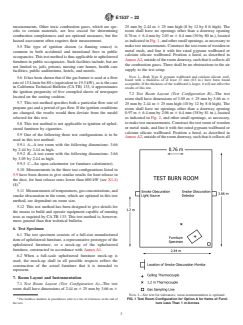
7.1 Test Room Layout (Test Configuration A)—The test
room shall have dimensions of 2.44 m 6 25 mm by 3.66 m 6
NOTE 1—See text for tolerances; room instrumentation is optional.
The boldface numbers in parentheses refer to a list of references at the end of FIG. 1 Test Room Configuration for Option A for Items of Furni-
the text. ture Less Than 1 m Across
E1537 − 22
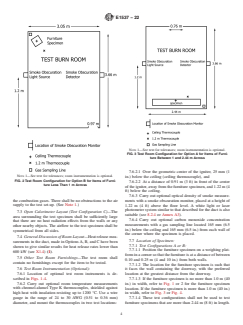
NOTE 1—See text for tolerances; room instrumentation is optional.
FIG. 3 Test Room Configuration for Option A for Items of Furni-
ture Between 1 and 2.44 m Across
7.6.2.1 Over the geometric center of the igniter, 25 mm (1
NOTE 1—See text for tolerances; room instrumentation is optional.
in.) below the ceiling (ceiling thermocouple), and
FIG. 2 Test Room Configuration for Option B for Items of Furni-
7.6.2.2 At a distance of 0.91 m (3 ft) in front of the center
ture Less Than 1 m Across
oftheigniter,awayfromthefurniturespecimen,and1.22m(4
ft) below the ceiling.
7.6.3 Carry out optional optical density of smoke measure-
the combustion gases. There shall be no obstructions to the air ments with a smoke obscuration monitor, placed at a height of
supply to the test set-up. (See Note 1.)
1.22 m (4 ft) above the floor level. A white light or laser
photometersystemsimilartothatdescribedfortheductisalso
7.3 Open Calorimeter Layout (Test Configuration C)—The
suitable (see 8.2.4 or Annex A3).
area surrounding the test specimen shall be sufficiently large
7.6.4 Carry out optional carbon monoxide concentration
that there are no heat radiation effects from the walls or any
measurements with a gas sampling line located 165 mm (6.5
other nearby objects. The airflow to the test specimen shall be
in.) below the ceiling and 165 mm (6.5 in.) from each wall of
symmetrical from all sides.
the corner where the specimen is placed.
7.4 GeneralDiscussionofRoomLayout—Heatreleasemea-
7.7 Location of Specimen:
surements in the duct, made in OptionsA, B, and C have been
7.7.1 Test Configurations A or B:
shown to give similar results for heat release rates lower than
7.7.1.1 Position the furniture specimen on a weighing plat-
600 kW (see X1.4) (1).
forminacornersothatthefurnitureisatadistanceofbetween
7.5 Other Test Room Furnishings—The test room shall
0.10 and 0.25 m (4 and 10 in.) from both walls.
contain no furnishings except for the item to be tested.
7.7.1.2 The location for the furniture specimen is such that
7.6 Test Room Instrumentation (Optional): it faces the wall containing the doorway, with the preferred
7.6.1 Location of optional test room instruments is de- location at the greatest distance from the doorway.
scribed in Figs. 1-4. 7.7.1.3 If the furniture specimen is no more than 1.0 m (40
7.6.2 Carry out optional room temperature measurements in.) in width, refer to Fig. 1 or 2 for the furniture specimen
with chromel-alumel Type K thermocouples, shielded against location. If the furniture specimen is more than 1.0 m (40 in.)
high heat with insulation resisting up to 1200 °C. Use a wire in width, refer to Fig. 3 or Fig. 4.
gauge in the range of 24 to 30 AWG (0.51 to 0.36 mm) 7.7.1.4 These test configurations shall not be used to test
diameter, and mount the thermocouples in two test locations: furniture specimens that are more than 2.44 m (8 ft) in length.
E1537 − 22
NOTE 1—See text for tolerances; room instrumentation is optional.
FIG. 4 Test Room Configuration for Option B for Items of Furni-
ture Between 1 and 2.44 m Across
NOTE 1—All tubing 13 mm outside diameter, stainless steel, 0.89 mm
wall thickness.
NOTE 2—All holes 1 mm in diameter.
7.7.2 Test Configuration C:
NOTE 3—All units are mm unless otherwise noted.
7.7.2.1 Position the furniture specimen on a weighing plat-
NOTE 4—See text for tolerances.
form underneath the hood.
FIG. 5 Plan View of Square Gas Burner
7.7.2.2 Thistestmethod,inTestConfigurationC,issuitable
for furniture specimens more than 2.44 m (8 ft) in length only
if the hood is large enough to collect all the smoke generated.
7.8 Ignition Source:
7.8.1 Use a square gas burner, as described in Figs. 5 and 6,
and Fig. 7.
7.8.2 Construct the 250 6 10 by 250 6 10 mm (approxi-
mately 10 by 10 in.) square burner of 13 6 1 mm (0.5 in.)
outside diameter stainless steel tubing, with 0.89 6 0.05 mm
(0.035in.)wallthickness(seeFig.5).Thefrontsideshallhave
14 holes pointing straight out and spaced 13 6 1 mm (0.5 in.)
apart and nine holes pointing straight down and spaced 13 6 1
mm (0.5 in.) apart.The right and left sides shall have six holes
pointing straight out and spaced 13 6 1 mm (0.5 in.) apart and
four holes pointing inward at a 45° angle and spaced 50 6 2
FIG. 6 Side View of Square Gas Burner
mm(2in.)apart.Allholesshallbeof1 60.05mm(0.039in.)
diameter(seeFig.5,Fig.6,andFig.7).Thestraightarmofthe
burner shall be 1.07 6 0.05 m (42 in.) long and welded on to
thoroughly, if required. Take care not to enlarge the holes when cleaning
the rear of the front side (see Fig. 5) at a 30° angle. Mount the them.
burneronanadjustableheightpoleataheightof460 613mm
7.8.3 The burner is described in detail in Ref. (2).
(18 6 0.5 in.) and balance it by a counterweight or other
7.8.4 Usepropanegas,withaknownnetheatofcombustion
appropriate mechanism (see Fig. 8).
of 2050 6 50 kJ/mol, as a fuel for this ignition source. Meter
the flow rate of propane and keep it constant throughout the
NOTE 2—Caution: It is common for the burner holes to become
cloggedupfollowingatest.Inspectburnerholesaftereachtest,andclean test.
E1537 − 22
7.10.3 The barrier shall consist of a galvanized steel pan
withgypsumboardliningplacedunderthefurniturespecimen.
The pan shall be constructed of nominally 1.6–mm ( ⁄16 in.)
thick steel, and have dimensions of no less than 1.0 by 1.0 m
(which corresponds to approximately 39 by 39 in.), with a
uniform raised lip of the same material, 100 6 10 mm
(approximately 4 in.) high, on each side, to catch falling
FIG. 7 Cross-sectional View of Each Side of Square Gas Burner
material. The bottom of the pan shall be covered by a tight
fitting section of standard gypsum board (finish side up), of
nominally 13 mm (0.5 in.) thickness. The gypsum board shall
be clean before the start of a test; the board shall be replaced
for each test. Pans with dimensions of 1.2 6 0.1 by 2.1 6 0.1
m(4ft 64in.by8ft 64in.)havebeenfoundsatisfactoryfor
testing large furniture specimens.
7.10.4 Measure the specimen mass continuously with a
device capable of an accuracy of no less than 6150 g, up to at
least 90 kg. Install it in such a way that neither the heat from
theburningspecimennoranyeccentricityoftheloadaffectthe
accuracy. Do not make any range shifts during measurements.
Install all parts of the mass measuring device below the top
level of the thermal barrier.
7.10.5 The distance from the upper surface of the thermal
barrier to floor level shall not exceed 0.5 m (20 in.). The area
betweenthethermalbarrierandthefloorlevelshallbeshielded
inordertoavoidliftingforces,duetofireinducedairflow,that
NOTE 1—See text for tolerances.
influence the measurement.
FIG. 8 Positioning of Square Gas Burner on a Chair
8. Exhaust Collection System
7.8.5 Use the gas burner at a flow rate of 13 6 0.25 L/min
8.1 General:
for a total of 80 s. Measure the gas flow rate at a pressure of
8.1.1 The exhaust collection system shall consist of a
101 6 5 kPa (standard atmospheric pressure, measured at the
blower, steel hood, duct, bidirectional probe, thermocouple(s),
flow gauge) and a temperature of 20 6 5 °C.The approximate
oxygen measurement system, smoke obscuration measuring
ratio of heat release rate output to gas flow rate is 1.485 kW
system (white light photocell lamp/detector or laser), and
min/L, under standard conditions.
combustion gas sampling and analysis system. It shall be
7.9 Location of Gas Burner:
constructed as shown in Fig. A2.1 and as explained in Annex
7.9.1 If the furniture specimen is less than 1.0 m wide
A2.
(overall), place the gas burner at the center of the furniture
8.1.2 The system for collecting the combustion products
seating surface, 50 65mm(2 6 0.2 in.) away from the
shall have a capacity and be designed in such a way that all of
furniture back and 2565mm(1 6 0.2 in.) above the seating
the combustion products leaving the burning specimen are
surface.
collected.Designthecapacityoftheevacuationsystemsoasto
7.9.2 Test any specimen over 1.0 m wide with the gas
exhaust all combustion gases leaving the furniture specimen
burner located at 125 6 10 mm (5 6 0.4 in.) from the side of
(see A2.1.4).
the piece of furniture, 50 65mm(2 6 0.2 in.) away from the
8.1.3 Place probes for sampling of combustion gas and for
furniture back and 25 65mm(1 6 0.2 in.) above the seating
measurement of flow rate in accordance with 8.2.
surface.
8.1.4 Measure all combustion product (smoke obscuration
7.9.3 In order to facilitate repeatability and reproducibility,
and gas concentrations) at a position in the exhaust duct where
it has been found useful to determine the exact location of the
the exhaust is uniformly mixed and there is a nearly uniform
gas burner on the furniture by using a back line marker gauge.
velocity across the duct section. A distance of 10 to 30 duct
7.10 Mass Loss Measurements:
diameters is satisfactory for this purpose.
7.10.1 Useaweighingplatformtocontinuouslymeasurethe
8.2 Details of Instrumentation in Exhaust Duct:
mass of the burning specimen. Construct a weighing platform,
8.2.1 The following specifications are minimum require-
consisting of a horizontal thermal barrier, as described in
mentsforexhaustductinstrumentation.Additionalinformation
7.10.2 and 7.10.3, and placed on top of a mass measuring
is found in Annex A3.
device.
7.10.2 Construct a thermal barrier large enough to prevent 8.2.2 Flow Rate—Measure the flow rate in the exhaust duct
melting or falling material from the tested furniture specimen by means of a bidirectional probe located at the center line of
fromfallingoffthethermalbarrier.Thebarriershallbeusedto the duct (see A3.1 for further details). Measure the flow rate in
protect the load cell. the exhaust duct with an accuracy of at least 66%. The
E1537 − 22
response time to a stepwise change of the duct flow rate shall
be a maximum of5sto reach 90% of the final value.
8.2.3 Combustion Gas Analysis:
8.2.3.1 Sampling Line—Make the sampling line tubes of a
material not influencing the concentration of the combustion
gas species to be analyzed. The recommended sequence of the
gas train is: sampling probe, soot filter, cold trap, gas path
pump, vent valve, plastic drying column and carbon dioxide
removal columns (if used), flow controller and oxygen ana-
FIG. 10 Optical System, Using a White Light
lyzer (see Fig. 9 and A3.2 for further details). The gas train
shall also include appropriate spanning and zeroing facilities.
8.2.3.2 OxygenMeasurement—Measuretheoxygenconcen-
9. Calibration
trationwithanaccuracyofatleast 60.04%offullscaleinthe
9.1 Calibrateallinstrumentscarefullywithstandardsources
outputrangeof0to21vol%oxygen,or 60.01vol%oxygen,
afterinitialinstallation.Amongtheinstrumentstobecalibrated
inordertohaveadequatemeasurementsofrateofheatrelease.
are load cells or weighing platforms, smoke meters, flow or
Take the combustion gas sample from the end of the sampling
velocity transducers, and gas analyzers. Perform recalibration
line. Calculate the time delay, including the time constant of
tests on the entire system, for example, using standard output
the instrument, from the test room; it is a function of the
burners.
exhaust duct flow rate. It shall be a maximum of 30 s. (See
9.2 Heat Release:
A3.3 for further details.) A discussion of the calculations for
9.2.1 Perform the calibration of the heat release instrumen-
rate of heat release is given in Annex A4.
tation in the exhaust duct by burning propane or methane gas
8.2.3.3 Carbon Monoxide and Carbon Dioxide
and comparing the heat release rates calculated from the
Measurement—Measure the combustion gas species with an
metered gas input and those calculated from the measured
instrument having an accuracy of at least 60.1 vol % for
oxygen consumption. The value of net heat of combustion for
carbon dioxide and 60.02 vol % for carbon monoxide. A
methane is 50.0 MJ/kg and that for propane is 46.5 MJ/kg.
suitable output range is 0 to 1 vol % for carbon monoxide and
Position the burner in the same location where the upholstered
0 to 6 vol % for carbon dioxide. Take the combustion gas
furniture specimen is to be placed during the test. Measure the
sample from the end of the sampling line. Calculate the time
gas flow rate at a pressure of 10 1 6 5 kPa (standard
delay, including the time constant of the instrument, from the
atmospheric pressure, measured at the flow gauge) and a
test room; it is a function of the exhaust duct flow rate. It shall
temperature of 20 6 5 °C.
be a maximum of 30 s. (See A3.3 for further details.)
9.2.2 Asuitablecalibrationburnerisasanddiffusionburner
8.2.4 Smoke Obscuration Measurement—Install an optical
with a 0.3 by 0.3-m (12 by 12-in.) top surface and a 0.15-m
system for measurement of light obscuration across the cen-
(6-in.) depth. Construct such a gas burner with a 25 mm (1 in.)
terlineoftheexhaustduct.Determinetheopticaldensityofthe
thick plenum. Alternatively, use a minimum 100 mm (4 in.)
smoke by measuring the light transmitted with a photometer
layer of Ottawa sand to provide the horizontal surface through
system consisting of a lamp, plano convex lenses, an aperture,
which the gas is supplied.This type of burner is shown in Fig.
a photocell, and an appropriate power supply. See Fig. 10 and
12. The gas supply to the burner shall be propane, of the same
A3.4 for further details. Construct the system so that soot
qualityasthatusedfortheignitionburner,ormethane.Thegas
deposits on the optics during a test do not reduce the light
for the burner flame shall not be premixed with air. Meter the
transmission by more than 5%.Alternatively, instrumentation
flow rate of gas and keep it constant throughout the calibration
usingalaserbeamsystem,withan0.5to2.0mWhelium-neon
test.
laser, instead of white light system is also acceptable. See Fig.
9.2.3 Another suitable calibration burner is a pipe, with an
11 and A3.4 for further details. It has been shown that white
innerdiameterof100 61.5mm(4in.),suppliedwithgasfrom
light and laser systems will give similar results (see Refs
beneath (see ISO 9705).The gas for the burner flame shall not
(3-6)).
be premixed with air.
9.2.4 Obtain a minimum of two calibration points. Obtain a
lower heat release rate value of 40 kW and then a higher heat
release rate value of 160 kW.Approximate propane flow rates
for any required heat release rate value are estimated using the
following constant: 1.485 kW min/L, determined at a pressure
of 101 6 5 kPa (standard atmospheric pressure, measured at
theflowgauge)andatemperatureof20 65°C.Accurateflow
ratesofpropanegasarecalculatedusingthemassflowrate(Eq
A5.1 or Eq A5.2).
9.2.5 Take measurements at least once every 6 s and start 1
min prior to ignition of the burner. Determine the average rate
of heat release over a period of at least 1 min by the oxygen
FIG. 9 Schematic of Gas Train consumption method and calculating the heat release rate from
E1537 − 22
FIG. 11 Laser Extinction Beam
9.2.6 Perform a calibration test according to 9.5 prior to
each continuous test series. Perform a full basic calibration on
a new system or when modifications are introduced.
9.2.7 When calibrating a new system, or when modifica-
tions are introduced, it is recommended to check the response
time of the measuring system by the following test sequence:
Time, min Burner Output, kW
0to5 0
5to10 40
10 to 15 160
15 to 20 0
Take measurements at least once every 6 s. The response of
the system to a stepwise change of the heat output from the
burner shall be a maximum of 12 s to 90% of final value.
9.2.8 Checktheprecisionofthesystematvariousflowrates
byincreasingtheflowintheexhaustductinfoursteps,starting
3 −1
from 0.25 m s (at 0.1 MPa and 25 °C) up to maximum. The
recommended heat output from the burner is 160 kW. The
change in measured rate of heat release, comparing time
average values over 1 min, shall not be more than 10% of the
actual heat output from the burner.
9.2.9 Theuseofahigherrateofheatreleaseforcalibration,
for example 500 kW, will generally lead to higher accuracy in
test results.
9.3 Mass Loss—Perform calibration of the mass measuring
device by loading the weighing platform with known masses
correspondingtothemeasuringrangeofinterest,toensurethat
the requirements of accuracy in 7.10.3 are fulfilled. Carry out
this calibration daily, prior to testing.
9.4 SmokeObscuration—Calibratethesmokemeterinitially
to read correctly for two neutral density filters of significantly
different values and also at 100% transmission. Once this
NOTE 1—See text for tolerances.
calibration is set, only the zero value of extinction coefficient
FIG. 12 Calibration Gas Burner
(100% transmission) needs to be verified each day, prior to
testing. Investigate any excessive departure from the zero line
the gas mass flow rate and the net heat of combustion. The
at the end of a test, and correct it.
difference between the two values shall not exceed 5%. Make
9.5 Gas Analysis—Calibrate gas analyzers daily, prior to
this comparison only after steady state conditions have been
reached. testing (see Guide E800 for further guidance).
E1537 − 22
10. Conditioning 12.2 Calculate smoke release data using the equations
presented in A5.2.
10.1 Prior to testing, condition the specimen for at least 48
h in an atmosphere at a temperature of 21 63°C(70 6 5 °F) 12.3 Calculate gas yield data using the equations presented
and a relative humidity of less than 55 6 5%. Test specimens in A5.3.
within 10 min of removal from such conditions if test room
13. Test Report
conditions differ from the above.
13.1 Report the following information:
11. Procedure
13.1.1 Descriptive Information:
13.1.1.1 Name and address of the testing laboratory,
11.1 Initial Conditions:
13.1.1.2 Date and identification number of the report,
11.1.1 The ambient temperature shall be above 15 °C (60
13.1.1.3 Name and address of the test requester,
°F) and the relative humidity shall be less than 75%.
13.1.1.4 Test option used: A, B or C,
11.1.2 The horizontal air flow, measured at the surface and
13.1.1.5 Name of product manufacturer or supplier, if
at a horizontal distance of 0.5 m (20 in.) from the edge of the
−1
known,
weighing platform, shall not exceed 0.5 ms .
13.1.1.6 Name or other identification marks and description
11.1.3 Position the specimen to be tested centrally on the
of the product,
weighing platform.
13.1.1.7 Density, or mass per unit surface area, total mass,
11.1.4 Have available means for extinguishing a fully de-
thicknessofthemaincomponentsinthespecimen,andmassof
veloped fire.
combustible portion of specimen, if known,
11.2 Test Procedure:
13.1.1.8 Description of the specimen, if different from the
11.2.1 Placethesquaregasburnerabovetheseatcushion,as
product,
specified in 7.9.
13.1.1.9 Conditioning of the specimens,
11.2.2 Start all recording and measuring devices 2 min
13.1.1.10 Date of test, and
before starting the ignition burner.
13.1.1.11 Test number and any special remarks.
11.2.3 Light the ignition burner.
13.2 Test Results (see also Annex A1):
11.2.4 Expose the specimen to the gas burner flames for 80
13.2.1 Table of Numerical Results Containing:
s, at a flow rate of 13 L/min, determine at a pressure of 101 6
13.2.1.1 Peak rate of heat release (in kW) and the time at
5 kPa (standard atmospheric pressure, measured at the flow
which it occurred,
gauge) and a temperature of 20 6 5 °C.
13.2.1.2 Total heat released (in MJ),
11.2.5 After the specified burning period extinguish the gas
2 −1
13.2.1.3 Peak rate of smoke release (in m s ) and the time
flame and remove the burner.
at which it occurred,
11.2.6 Perform a photographic or a video recording before
13.2.1.4 Total smoke released (in m ),
and during each test. A clock shall appear in all photographic
13.2.1.5 Total mass loss (in kg),
records, giving time to the nearest 1 s.
13.2.1.6 Total percentage of mass loss (in %),
11.2.7 During the test record the following events and the
13.2.1.7 Peak concentration of carbon monoxide (in ppm),
timewhentheyoccur,withrespecttothetimeofignitionofthe
13.2.1.8 Peak temperatures (in °C),
burner:
13.2.1.9 Equations used to calculate rate of heat release,
11.2.7.1 Ignition of the specimen,
13.2.1.10 Peak optical density of smoke (optional),
11.2.7.2 Position of flame front,
13.2.1.11 Averageopticaldensityofsmoke,overthe10min
11.2.7.3 Melting and dripping,
period including the peak (optional),
11.2.7.4 Formation of flaming droplets,
13.2.1.12 Total percentage of combustible mass loss (in %)
11.2.7.5 Occurrence of pool fire under the specimen,
(optional),
11.2.7.6 General description of the burning behavior, and
13.2.1.13 Average yield of carbon monoxide (in g CO/g
11.2.7.7 Any other event of special interest.
fuel) (optional),
11.2.8 Terminate the test after the first of:
13.2.1.14 Average yield of carbon dioxide (in g CO /g fuel)
11.2.8.1 Burning has ceased,
(optional),
11.2.8.2 One hour of testing has elapsed, or
13.2.1.15 Carbon monoxide/carbon dioxide molar yield ra-
11.2.8.3 Flashover appears inevitable.
tio (optional),
11.2.9 Note,fromvisualinspectionofthespecimenafterthe
13.2.1.16 Average yield of any other measured combustion
test, the approximate percentage of each surface that was
gas (in g combustion gas/g fuel) (optional), and
burned or charred, and the approximate depth of fire damage.
13.2.1.17 Report smoke obscuration, carbon monoxide, and
temperature measurements in the room in the same fashion, if
12. Calculation
they have been made (optional).
12.1 Considerations for heat release measurements are pre- 13.2.2 Graphical Results (Optional):
sented in Annex A4. Calculate heat release data, using the 13.2.2.1 Plot of rate of heat release versus time,
equations presented in A5.1. The testing laboratory shall 13.2.2.2 Plot of rate of smoke release versus time,
choose one of the equations in Annex A5 to calculate heat 13.2.2.3 Plot of optical density versus time,
release. 13.2.2.4 Plot of mass loss versus time,
E1537 − 22
13.2.2.5 Plot of concentration of carbon monoxide versus conduct an analysis of the data that excludes all incorrect data
time, butdoesnotexcludeoutliers,butthatwasnotdone.Aresearch
13.2.2.6 Plot of concentration of carbon dioxide versus report has been submitted to ASTM that includes all the
time, information required for a full understanding of results. The
13.2.2.7 Plots of concentration of any other measured com-
userisencouragedtoconsultthisresearchreportentitled,“Test
bustion gas versus time, MethodsE1537andE1822InterlaboratoryStudy,Preparedby:
13.2.2.8 Plot of mass flow rate in the exhaust duct versus
ASTM E05.15” (2001).The abbreviations used are as follows:
time, peak rate of heat release (Pk RHR), total heat released (THR),
13.2.2.9 Plot of duct temperature versus time, and
mass loss at 10 min (Mass Loss @ 10), peak rate of smoke
13.2.2.10 Report smoke obscuration, carbon monoxide, and release (Pk RSR), total smoke released (RSR), standard devia-
temperature measurements in the room in the same fashion, if
tion for repeatibility and reproducibility (STD repeat and STD
they have been made.
Repro), relative standard deviation for repeatibility and repro-
13.2.3 Descriptive Results:
ducibility (RSD repeat and RSD Repro), repeatability (r) and
13.2.3.1 Photographs or videotape of the fire development,
reproducibility (R).
and
14.2 Bias:
13.2.3.2 All available information requested in 11.2.7.
14.2.1 No information is presented on the bias of the
14. Precision and Bias
procedure in this test method because correct values of
fire-test-response characteristics of upholstered furniture can
14.1 Precision—The precision of this test method has not
only be defined in terms of a test method. Within this
been determined. Table 1 and Table 2 show the precision
limitation, this test method has no known bias and can be
obtained in an interlaboratory round-robin evaluation con-
accepted as a reference method.
ducted with four laboratories, using four sets of upholstered
chairs(labeledU1toU4),suppliedbydifferentmanufacturers, 14.2.2 For solid specimens of unknown chemical
and all commercially available. Two of the laboratories con- composition, as used in building materials, furnishings, and
ducted the tests using the “ASTM room,” and the other two common occupant fuel load, it has been documented that the
used the “California room.” The data obtained from all four use of the oxygen consumption standard value of 13.1 MJ/kg
laboratories were analyzed. In Table 2, outliers and “obviously oxygen for the net amount of heat released per unit of oxygen
incorrect data” were excluded, using standard statistical con- consumed for complete consumption, results in an expected
siderationsandinformationfromthetestlabreportssubmitted. error band of 65% compared to the true value. For homoge-
It should be noted that some tests in some laboratories were neous materials with only a single pyrolysis mechanism, this
incorrectly terminated before the mandated end point, after uncertainty is reduced by determining the net heat of combus-
tion from oxygen bomb measurements and the stoichiometric
some guidelines were exceeded. The complete set of major
data was also analyzed, without eliminating any data point, oxygen/fuel mass ratio from ultimate elemental analysis. For
testing relevant to this standard, this is not practical, since
withthestatisticalanalysisincludedasTable3.Itispossibleto
TABLE 1 Intralaboratory and Interlaboratory Precision Results of Round Robin Evaluation Excluding Outliers and Incorrect Data
Chair Property/Units Average STD repeat STD Repro R R RSD repeat RSD Repro
U1 Pk RHR/kW 25.2 3.9 4.1 11.0 11.6 15.5 16.5
U2 Pk RHR/kW 799.7 364.3 364.3 1020.0 1020.0 57.5 57.5
U3 Pk RHR/kW 21.7 7.7 7.7 21.4 21.4 35.3 35.3
U4 Pk RHR/kW 37.8 18.9 18.9 52.8 52.8 50.0 50.0
U1 THR @ 10/MJ 2.5 1.2 1.3 3.5 3.5 48.6 49.6
U2 THR @ 10/MJ 76.6 26.3 28.3 73.6 79.4 34.4 37.0
U3 THR @ 10/MJ 1.7 1.3 1.3 3.5 3.5 68.6 68.6
U4 THR @ 10/MJ 3.1 1.5 1.5 4.2 4.2 48.6 48.6
U1 time to Pk RHR/s 141.6 17.0 52.3 47.7 146.3 12.0 36.9
U2 time to Pk RHR/s 229.3 40.6 78.7 113.5 220.3 17.7 34.3
U3 time to Pk RHR/s 108.4 29.6 54.2 82.8 151.6 27.3 49.9
U4 time to Pk RHR/s 112.2 28.1 58.8 78.6 164.6 25.0 52.4
U1 Mass Loss @ 10/kg 0.1 0.02 0.03 0.05 0.09 18.7 31.7
U2 Mass Loss @ 10/kg 2.8 2.0 2.0 5.5 5.5 71.1 71.1
U3 Mass Loss @ 10/kg 0.1 0.1 0.1 0.2 0.2 61.8 61.8
U4 Mass Loss @ 10/kg 0.4 0.07 0.2 0.2 0.7 18.6 64.6
U1 Pk RSR, m /s 2.0 0.2 1.3 0.4 3.6 7.8 64.6
U2 Pk RSR, m /s 6.1 1.7 3.4 4.8 9.5 28.2 55.6
U3 Pk RSR, m /s 1.4 0.9 1.0 2.4 2.7 63.9 71.9
U4 Pk RSR, m /s 1.7 2.5 2.5 7.0 7.0 143.3 143.3
U1 TSR, m 238.8 180.2 243.8 504.5 682.5 75.5 102.1
U2 TSR, m 862.8 393.6 571.9 1102.1 1601.3 45.6 66.3
U3 TSR, m 160.1 35.8 93.0 100.1 260.3 22.3 58.1
U4 TSR, m 543.3 546.9 622.7 1531.4 1743.7 100.7 114.6
U1 time to Pk RSR/s 80.2 19.2 19.2 53.6 53.6 23.9 23.9
U2 time to Pk RSR/s 207.3 18.0 23.6 50.5 66.0 8.7 11.4
U3 time to Pk RSR/s 85.3 6.9 6.9 19.3 19.3 8.1 8.1
U4 time to Pk RSR/s 96.8 9.4 11.8 26.3 32.9 9.7 12.2
E1537 − 22
TABLE 2 Intralaboratory and Interlaboratory Precision Results of Round Robin Evaluation
Chair # of labs Average STD repeat STD Repro r R RSD repeat RSD Repro
Peak RHR/kW
U1 3 32.2 21.2 23.6 59.4 66.1 65.8 73.3
U2 4 632.7 182.3 467.8 510.4 1309.8 28.8 73.9
U3 4 21.7 3.9 4.0 10.8 11.3 17.7 18.6
U4 4 152.7 233.1 233.1 652.7 652.7 152.7 152.7
Total Heat Released @ 10 min/MJ
U1 3 2.54 0.89 1.5 2.5 4.2 35.0 59.1
U2 4 60.25 13.29 44.18 37.2 123.7 22.1 73.3
U3 4 1.83 0.63 0.89 1.8 2.5 34.4 48.6
U4 4 3.1 0.79 1.23 2.2 3.4 25.5 39.7
time to peak RHR/s
U1 3 210.1 205.9 205.9 576.5 576.5 98.0 98.0
U2 4 230.1 22.2 124.6 62.2 348.9 9.6 54.2
U3 4 108.4 15.2 84.9 42.6 237.7 14.0 78.3
U4 4 418.8 648.2 648.2 1815.0 1815.0 154.8 154.8
Mass Loss @ 10 min/kg
U1 3 0.14 0.11 0.13 0.3 0.4 78.6 92.9
U2 4 2.73 1.01 1.55 2.8 4.3 37.0 56.8
U3 4 0.11 0.04 0.05 0.1 0.1 36.4 45.5
U4 4 0.74 0.91 1.06 2.5 3.0 123.0 143.2
Peak RSR/m /s
U1 3 2.01 0.12 2.23 0.3 6.2 6.0 110.9
U2 3 1.78 1.54 5.67 4.3 15.9 86.5 318.5
U3 4 1.47 0.23 1.38 0.6 3.9 15.6 93.9
U4 4 1.74 2.23 2.38 6.2 6.7 128.2 136.8
Total Smoke Released @ 10 min/m
U1 3 238 180 368 504.0 1030.4 75.6 154.6
U2 3 689 731 888 2046.8 2486.4 106.1 128.9
U3 4 159.8 18.2 154 51.0 431.2 11.4 96.4
U4 4 286.2 115.1 354 322.3 991.2 40.2 123.7
Total Smoke Released entire test/m
U1 3 239 180 367 504.0 1027.6 75.3 153.6
U2 3 929 381 983 1066.8 2752.4 41.0 105.8
U3 4 160.2 18.3 154 51.2 431.2 11.4 96.1
U4 4 529 496 865 1388.8 2422.0 93.8 163.5
time to peak RSR/s
U1 3 136.8 170 171.4 476.0 479.9 124.3 125.3
U2 3 208.4 14 33 39.2 92.4 6.7 15.8
U3 4 85.3 4.26 4.38 11.9 12.3 5.0 5.1
U4 4 240.3 336.8 336.8 943.0 943.0 140.2 140.2
specimens are finished products, some of which are nonhomo- 15. Keywords
geneous and capable of exhibiting degradation reactions.
15.1 calorimetry; carbon dioxide; carbon monoxide; fire;
Therefore, for unknown specimens, a 65% accuracy limit is
fire-test-response; heat release; ignition; mock-up; oxygen
seen. For reference materials, however, careful determination
consumption; smoke obscuration; toxic combustion gases;
ofthenetheatreleasedperunitofoxygenconsumedcanmake
upholstered furniture
this source of uncertainty substantially less.
E1537 − 22
ANNEXES
(Mandatory Information)
A1. DESIGN OF MOCK-UP
A1.1 Inlieuoftestingfinishedproducts,full-scalemock-up
testing is performed on mock-ups constructed according to the
following specimen construction directives:
A1.1.1 The test specimen shall consist of component cush-
ions that duplicate the thickness, construction, and design
features of a product suitable for use.
A1.1.2 A metal test frame (see Fig. A1.1 and Fig. A1.2)
shall be used to support seat and back cushions and, if
necessary, arm cushions. The test frame shall be of steel
construction. The back wall shall be constructed so that it is
adjustable to a maximum angle of 135° from the horizontal
plane. The test frame shall be adjustable to accommodate test
cushions of
...
This document is not an ASTM standard and is intended only to provide the user of an ASTM standard an indication of what changes have been made to the previous version. Because
it may not be technically possible to adequately depict all changes accurately, ASTM recommends that users consult prior editions as appropriate. In all cases only the current version
of the standard as published by ASTM is to be considered the official document.
Designation: E1537 − 16 E1537 − 22 An American National Standard
Standard Test Method for
Fire Testing of Upholstered Furniture
This standard is issued under the fixed designation E1537; the number immediately following the designation indicates the year of
original adoption or, in the case of revision, the year of last revision. A number in parentheses indicates the year of last reapproval. A
superscript epsilon (´) indicates an editorial change since the last revision or reapproval.
1. Scope*
1.1 This is a fire-test-response standard.
1.2 The purpose of this test method is to determine the burning behavior of upholstered furniture used in public occupancies by
measuring specific fire-test responses when the specimen of furniture is subjected to a specified flaming ignition source under
well-ventilated conditions.
1.3 Data are obtained describing the burning behavior from a specific ignition source until all burning has ceased, a period of 1
h has elapsed, or flashover appears inevitable.
1.4 This test method does not provide information on the fire performance of upholstered furniture in fire conditions other than
those conditions specified. In particular, this test method does not apply to smoldering ignition by cigarettes. See X1.6 for further
information.
1.5 The rate of heat release of the burning specimen is measured by an oxygen consumption method. See X1.6.4 for further
information.
1.6 The production of light obscuring smoke is measured and the concentrations of certain toxic gas species in the combustion
gases are determined. See X1.6.5 for further information.
1.7 The burning behavior is visually documented by photographic or video recordings, whenever possible.
1.8 The system of units to be used in referee decisions is the SI system of units, see IEEE/ASTM SI-10 only. The units given in
parentheses are for information only.
1.9 This standard is used to measure and describe the response of materials, products, or assemblies to heat and flame under
controlled conditions, but does not by itself incorporate all factors required for fire hazard or fire risk assessment of the materials,
products or assemblies under actual fire conditions.
1.10 Fire testing is inherently hazardous. Adequate safeguards for personnel and property shall be employed in conducting these
tests.
This test method is under the jurisdiction of ASTM Committee E05 on Fire Standards and is the direct responsibility of Subcommittee E05.15 on Furnishings and
Contents.
Current edition approved Dec. 15, 2016April 1, 2022. Published January 2017May 2022. Originally approved in 1993. Last previous edition approved in 20152016 as
E1537 – 15.E1537 – 16. DOI: 10.1520/E1537-16.10.1520/E1537-22.
*A Summary of Changes section appears at the end of this standard
Copyright © ASTM International, 100 Barr Harbor Drive, PO Box C700, West Conshohocken, PA 19428-2959. United States
E1537 − 22
1.11 This standard does not purport to address all of the safety concerns, if any, associated with its use. It is the responsibility
of the user of this standard to establish appropriate safety safety, health, and healthenvironmental practices and determine the
applicability of regulatory limitations prior to use.
1.12 This international standard was developed in accordance with internationally recognized principles on standardization
established in the Decision on Principles for the Development of International Standards, Guides and Recommendations issued
by the World Trade Organization Technical Barriers to Trade (TBT) Committee.
2. Referenced Documents
2.1 ASTM Standards:
D123 Terminology Relating to Textiles
E84 Test Method for Surface Burning Characteristics of Building Materials
E176 Terminology of Fire Standards
E603 Guide for Room Fire Experiments
E800 Guide for Measurement of Gases Present or Generated During Fires
E1354 Test Method for Heat and Visible Smoke Release Rates for Materials and Products Using an Oxygen Consumption
Calorimeter
E2067 Practice for Full-Scale Oxygen Consumption Calorimetry Fire Tests
E2257 Test Method for Room Fire Test of Wall and Ceiling Materials and Assemblies
IEEE/ASTM SI-10 International System of Units (SI): The Modern Metric System
2.2 ISO Standards:
ISO 4880 Burning Behaviour of Textiles and Textile Products—Vocabulary
ISO 9705 Fire Tests—Full Scale Room Test for Surface Products
ISO 13943 Fire Safety—Vocabulary
2.3 UL Standard:
UL 1056 Fire Test of Upholstered Furniture (withdrawn)
2.4 CA Standard:
CA Technical Bulletin 133 Flammability Test Procedure for Seating Furniture for Use in Public Occupancies (withdrawn)
2.5 BSI Standard:
BS 5852 Fire Tests for Furniture. Methods of Test for the Ignitability of Upholstered Composites for Seating by Flame Sources
2.6 Nordtest Standard:
Nordtest Method NT Fire 032 Upholstered Furniture: Burning Behavior—Full Scale Test
2.7 NFPA Standards:
NFPA 265 Standard Methods of Fire Tests for Evaluating Room Fire Growth Contribution of Textile Coverings on Full Height
Panels and Walls
NFPA 286 Standard Methods of Fire Tests for Evaluating Contribution of Wall and Ceiling Interior Finish to Room Fire Growth
3. Terminology
3.1 Definitions:
3.1.1 For definitions of terms used in this test method and associated with fire issues, refer to the terminology contained in
Terminology E176 and in ISO 13943. The definitions given in Terminology E176 shall prevail in case of conflict. For definitions
of terms used in this test method and associated with textile issues, refer to Terminology D123 and ISO 4880. The definitions given
in Terminology D123 shall prevail in case of conflict.
3.1.2 For definitions of terms used in this test method and associated with textile issues refer to the terminology contained in
Terminology D123.
3.2 Definitions of Terms Specific to This Standard:
3.2.1 product, n—the upholstered furniture for which information is required.
For referenced ASTM standards, visit the ASTM website, www.astm.org, or contact ASTM Customer Service at service@astm.org. For Annual Book of ASTM Standards
volume information, refer to the standard’s Document Summary page on the ASTM website.
Available from American National Standards Institute (ANSI), 25 W. 43rd St., 4th Floor, New York, NY 10036, http://www.ansi.org.
Available from Underwriters Laboratories (UL), 333 Pfingsten Rd., Northbrook, IL 60062-2096, http://www.ul.com.
Available from Bureau of Electronic and Appliance Repair, Home Furnishings and Thermal Insulation, Household Goods and Service (BHGS), State of California, Dept.
of Consumer Affairs, 3485 Orange Grove Ave., North Highlands, CA 95660-5595, www.bhfti.ca.gov.http://www.bhgs.dca.ca.gov/industry/tb133.
Available from British Standards Institution (BSI), 389 Chiswick High Rd., London W4 4AL, U.K., http://www.bsigroup.com.
Available from Nordtest, PO Box 22, SF-00341, Helsingfors, Finland.
Available from National Fire Protection Association (NFPA), 1 Batterymarch Park, Quincy, MA 02169-7471, http://www.nfpa.org.
E1537 − 22
3.2.2 specimen, n—manufactured item of the product, representative prototype of the product, or mock-up of the product.
3.2.2.1 Discussion—
The mock-up shall be constructed as described in Annex A1.
3.2.3 upholstered, adj—covered with material (as fabric or padding) to provide a soft surface.
3.2.4 upholstered seating furniture, n—a unit of interior furnishing that (1) contains any surface that is covered, in whole or in part,
with a fabric or other upholstery cover material, (2) contains upholstery material, and (3) is intended or promoted for sitting upon.
3.2.5 upholstery cover material, n—the outermost layer of fabric or related materials used to enclose the main support system, or
upholstery materials, or both, used in the furniture unit.
3.2.6 upholstery material, n—the padding, stuffing, or filling material used in a furniture unit, which may be either loose or
attached, enclosed by an upholstery cover material, or located between the upholstery cover material and support system, if present.
3.2.6.1 Discussion—
This includes, but is not limited to, material, such as foams, cotton batting, polyester fiberfill, bonded cellulose, or down.
4. Summary of Test Method
4.1 This test method determines a number of fire-test-response characteristics from a full-scale specimen of upholstered furniture
ignited with a propane gas burner. Measurements to be made include rate of heat and smoke release, total amount of heat and
smoke released, rate and concentration of carbon oxides released, and rate and amount of mass of specimen lost. Other optional
measurements are also described.
4.2 Three options are provided, in all of which the upholstered furniture specimen to be tested is placed on a weighing platform
and measurements of heat release, smoke release, and combustion gas release are made in an exhaust duct.
4.3 In Options A and B the duct is located outside the doorway of a test room. In Option C the duct is located directly over the
specimen.
4.4 Additional (optional) instrumentation placed in the test room is also described.
5. Significance and Use
5.1 This test method provides a means to measure a variety of fire-test-response characteristics resulting from burning a specimen
of upholstered furniture. The upholstered furniture specimen is allowed to burn freely under well-ventilated conditions after
ignition using a propane gas burner. The most important fire-test-response characteristic measured is the rate of heat release, which
quantifies the intensity of the fire generated.
5.2 The rate of heat release is measured by the principle of oxygen consumption. The assumptions and limitations of oxygen
depletion calorimetry are discussed in Annex A4, and in particular in A4.1.2.
5.3 Other fire-test-response characteristics are measured, namely smoke obscuration and combustion gas release, as they are also
important in making decisions on fire safety.
5.4 The most important gaseous components of smoke are the carbon oxides, present in all fires. They are indicators of the toxicity
of the atmosphere and of the completeness of combustion. Measurement of concentrations of carbon oxides are useful for two
purposes: as part of fire hazard assessment calculations and to improve the accuracy of heat release measurements. Other toxic
combustion gases, which are specific to certain materials, are less crucial for determining combustion completeness and are
optional measures, but fire hazard assessment often requires their measurement.
5.5 The type of ignition chosen (a flaming source) is common in both accidental and intentional fires in public occupancies. This
test method is thus applicable to upholstered furniture in public occupancies. Such facilities include, but are not limited to, jails,
prisons, nursing care homes, health care facilities, public auditoriums, hotels, and motels.
E1537 − 22
5.6 It has been shown that if the gas burner is used at a flow rate of 13 L/min for 80 s (equivalent to 19.3 kW), as is the case in
California Technical Bulletin (CA TB) 133, it approximates the ignition propensity of five crumpled sheets of newspaper located
on the seating cushion.
5.7 This test method specifies both a particular flow rate of propane gas and a period of gas flow. If the ignition conditions are
changed, the results would then deviate from the model selected for this test.
5.8 This test method is not applicable to ignition of upholstered furniture by cigarettes.
5.9 One of the following three test configurations is to be used in this test method:
5.9.1 A—A test room with the following dimensions: 3.66 by 2.44 by 2.44 m high.
5.9.2 B—A test room with the following dimensions: 3.66 by 3.05 by 2.44 m high.
5.9.3 C—An open calorimeter (or furniture calorimeter).
5.10 Measurements in the three test configurations listed in 5.9 have been shown to give similar results for heat release in the duct,
for heat release rates lower than 600 kW (see X1.4) (1).
5.11 Measurements of temperatures, gas concentrations, and smoke obscuration in the room, which are optional in this test
method, are dependent on room size.
5.12 This test method has been designed to give details for the means to build and operate equipment capable of running tests as
required by CA TB 133. This test method is, however, more general than that technical bulletin.
6. Test Specimen
6.1 The test specimen consists of a full-size manufactured item of upholstered furniture, a representative prototype of the
upholstered furniture, or a mock-up of the upholstered furniture, constructed in accordance with Annex A1.
6.2 When a full-scale upholstered furniture mock-up is used, the mock-up shall in all possible respects reflect the construction of
the actual furniture that it is intended to represent.
7. Room Layout and Instrumentation
7.1 Test Room Layout (Test Configuration A)—The test room shall have dimensions of 2.44 m 6 25 mm by 3.66 m 6 25 mm by
2.44 m 6 25 mm high (8 by 12 by 8 ft high). The room shall have no openings other than a doorway opening 0.76 m6 m 6 6.4
mm by 2.03 m 6 6.4 mm (30 by 80 in.), located as indicated in Fig. 1, and other small openings, as necessary to make test
measurements. Construct the test room of wooden or metal studs, and line it with fire rated gypsum wallboard or calcium silicate
wallboard. Position a hood, as described in Annex A2, outside of the room doorway, such that it collects all the combustion gases.
There shall be no obstructions to the air supply to the test setup.
NOTE 1—Both Type X gypsum wallboard and calcium silicate wallboard with a thickness of at least 13 mm (0.5 in.) have been found acceptable. If the
thickness of the wallboard is larger, it will not affect the results of this test.
7.2 Test Room Layout (Test Configuration B)—The test room shall have dimensions of 3.05 m 6 25 mm by 3.66 m 6 25 mm by
2.44 m 6 25 mm high (10 by 12 by 8 ft high). The room shall have no openings other than a doorway opening 0.97 m6 m 6
6.4 mm by 2.06 m 6 6.4 mm (38 by 81 in.), located as indicated in Fig. 2, and other small openings, as necessary, to make test
measurements. Construct the test room of wooden or metal studs, and line it with fire-rated gypsum wallboard or calcium silicate
wallboard. Position a hood, as described in Annex A2, outside of the room doorway, such that it collects all the combustion gases.
There shall be no obstructions to the air supply to the test set-up. (See Note 1.)
The boldface numbers in parentheses refer to a list of references at the end of the text.
E1537 − 22
NOTE 1—See text for tolerances; room instrumentation is optional.
FIG. 1 Test Room Configuration for Option A for Items of Furniture Less Than 1 m Across
7.3 Open Calorimeter Layout (Test Configuration C)—The area surrounding the test specimen shall be sufficiently large that there
are no heat radiation effects from the walls or any other nearby objects. The airflow to the test specimen shall be symmetrical from
all sides.
7.4 General Discussion of Room Layout—Heat release measurements in the duct, made in Options A, B, and C have been shown
to give similar results for heat release rates lower than 600 kW (see X1.4) (1).
7.5 Other Test Room Furnishings—The test room shall contain no furnishings except for the item to be tested.
7.6 Test Room Instrumentation (Optional):
7.6.1 Location of optional test room instruments is described in Figs. 1-4.
7.6.2 Carry out optional room temperature measurements with chromel-alumel Type K thermocouples, shielded against high heat
with insulation resisting up to 1200°C. 1200 °C. Use a wire gagegauge in the range of 24 to 30 AWG (0.51 to 0.36 mm) diameter,
and mount the thermocouples in two test locations:
7.6.2.1 Over the geometric center of the igniter, 25 mm (1 in.) below the ceiling (ceiling thermocouple), and
7.6.2.2 At a distance of 0.91 m (3 ft) in front of the center of the igniter, away from the furniture specimen, and 1.22 m (4 ft) below
the ceiling.
E1537 − 22
NOTE 1—See text for tolerances; room instrumentation is optional.
FIG. 2 Test Room Configuration for Option B for Items of Furniture Less Than 1 m Across
7.6.3 Carry out optional optical density of smoke measurements with a smoke obscuration monitor, placed at a height of 1.22 m
(4 ft) above the floor level. A white light or laser photometer system similar to that described for the duct is also suitable (see 8.2.4
or Annex A3).
7.6.4 Carry out optional carbon monoxide concentration measurements with a gas sampling line located 165 mm (6.5 in.) below
the ceiling and 165 mm (6.5 in.) from each wall of the corner where the specimen is placed.
7.7 Location of Specimen:
7.7.1 Test Configurations A or B:
7.7.1.1 Position the furniture specimen on a weighing platform in a corner so that the furniture is at a distance of between 0.10
and 0.25 m (4 and 10 in.) from both walls.
7.7.1.2 The location for the furniture specimen is such that it faces the wall containing the doorway, with the preferred location
at the greatest distance from the doorway.
7.7.1.3 If the furniture specimen is no more than 1.0 m (40 in.) in width, refer to Fig. 1 or 2 for the furniture specimen location.
If the furniture specimen is more than 1.0 m (40 in.) in width, refer to Fig. 3 or Fig. 4.
7.7.1.4 These test configurations shall not be used to test furniture specimens that are more than 2.44 m (8 ft) in length.
7.7.2 Test Configuration C:
E1537 − 22
NOTE 1—See text for tolerances; room instrumentation is optional.
FIG. 3 Test Room Configuration for Option A for Items of Furniture Between 1 and 2.44 m Across
NOTE 1—See text for tolerances; room instrumentation is optional.
FIG. 4 Test Room Configuration for Option B for Items of Furniture Between 1 and 2.44 m Across
E1537 − 22
7.7.2.1 Position the furniture specimen on a weighing platform underneath the hood.
7.7.2.2 This test method, in Test Configuration C, is suitable for furniture specimens more than 2.44 m (8 ft) in length only if the
hood is large enough to collect all the smoke generated.
7.8 Ignition Source:
7.8.1 Use a square gas burner, as described in Figs. 5 and 6, and Fig. 7.
7.8.2 Construct the 250 6 10 by 250 6 10 mm (approximately 10 by 10 in.) square burner of 13 6 1 mm (0.5 in.) outside diameter
stainless steel tubing, with 0.89 6 0.05 mm (0.035 in.) wall thickness (see Fig. 5). The front side shall have 14 holes pointing
straight out and spaced 13 6 1 mm (0.5 in.) apart and nine holes pointing straight down and spaced 13 6 1 mm (0.5 in.) apart.
The right and left sides shall have six holes pointing straight out and spaced 13 6 1 mm (0.5 in.) apart and four holes pointing
inward at a 45° angle and spaced 50 6 2 mm (2 in.) apart. All holes shall be of 1 6 0.05 mm (0.039 in.) diameter (see Fig. 5,
Fig. 6, and Fig. 7). The straight arm of the burner shall be 1.07 6 0.05 m (42 in.) long and welded on to the rear of the front side
(see Fig. 5) at a 30° angle. Mount the burner on an adjustable height pole at a height of 460 6 13 mm (18 6 0.5 in.) and balance
it by a counterweight or other appropriate mechanism (see Fig. 8).
NOTE 2—Caution: It is common for the burner holes to become clogged up following a test. Inspect burner holes after each test, and clean thoroughly,
if required. Take care not to enlarge the holes when cleaning them.
7.8.3 The burner is described in detail in Ref. (2).
NOTE 1—All tubing 13 mm outside diameter, stainless steel, 0.89 mm wall thickness.
NOTE 2—All holes 1 mm in diameter.
NOTE 3—All units are mm unless otherwise noted.
NOTE 4—See text for tolerances.
FIG. 5 Plan View of Square Gas Burner
E1537 − 22
FIG. 6 Side View of Square Gas Burner
FIG. 7 Cross-sectional View of Each Side of Square Gas Burner
NOTE 1—See text for tolerances.
FIG. 8 Positioning of Square Gas Burner on a Chair
7.8.4 Use propane gas, with a known net heat of combustion of 2050 6 50 kJ/mol, as a fuel for this ignition source. Meter the
flow rate of propane and keep it constant throughout the test.
7.8.5 Use the gas burner at a flow rate of 13 6 0.25 L/min for a total of 80 s. Measure the gas flow rate at a pressure of 101 6
5 kPa (standard atmospheric pressure, measured at the flow gage)gauge) and a temperature of 20 6 5°C. 5 °C. The approximate
ratio of heat release rate output to gas flow rate is 1.485 kW min/L, under standard conditions.
7.9 Location of Gas Burner:
7.9.1 If the furniture specimen is less than 1.0 m wide (overall), place the gas burner at the center of the furniture seating surface,
50 6 5 mm (2 6 0.2 in.) away from the furniture back and 256 5 mm (1 6 0.2 in.) above the seating surface.
7.9.2 Test any specimen over 1.0 m wide with the gas burner located at 125 6 10 mm (5 6 0.4 in.) from the side of the piece
of furniture, 50 6 5 mm (2 6 0.2 in.) away from the furniture back and 25 6 5 mm (1 6 0.2 in.) above the seating surface.
E1537 − 22
7.9.3 In order to facilitate repeatability and reproducibility, it has been found useful to determine the exact location of the gas
burner on the furniture by using a back line marker gage.gauge.
7.10 Mass Loss Measurements:
7.10.1 Use a weighing platform to continuously measure the mass of the burning specimen. Construct a weighing platform,
consisting of a horizontal thermal barrier, as described in 7.10.2 and 7.10.3, and placed on top of a mass measuring device.
7.10.2 Construct a thermal barrier large enough to prevent melting or falling material from the tested furniture specimen from
falling off the thermal barrier. The barrier shall be used to protect the load cell.
7.10.3 The barrier shall consist of a galvanized steel pan with gypsum board lining placed under the furniture specimen. The pan
shall be constructed of nominally 1.6–mm ( ⁄16 in.) thick steel, and have dimensions of no less than 1.0 by 1.0 m (which
corresponds to approximately 39 by 39 in.), with a uniform raised lip of the same material, 100 6 10 mm (approximately 4 in.)
high, on each side, to catch falling material. The bottom of the pan shall be covered by a tight fitting section of standard gypsum
board (finish side up), of nominally 13 mm (0.5 in.) thickness. The gypsum board shall be clean before the start of a test; the board
shall be replaced for each test. Pans with dimensions of 1.2 6 0.1 by 2.1 6 0.1 m (4 ft 6 4 in. by 8 ft 6 4 in.) have been found
satisfactory for testing large furniture specimens.
7.10.4 Measure the specimen mass continuously with a device capable of an accuracy of no less than 6150 g, up to at least 90
kg. Install it in such a way that neither the heat from the burning specimen nor any eccentricity of the load affect the accuracy.
Do not make any range shifts during measurements. Install all parts of the mass measuring device below the top level of the thermal
barrier.
7.10.5 The distance from the upper surface of the thermal barrier to floor level shall not exceed 0.5 m (20 in.). The area between
the thermal barrier and the floor level shall be shielded in order to avoid lifting forces, due to fire induced air flow, that influence
the measurement.
8. Exhaust Collection System
8.1 General:
8.1.1 The exhaust collection system shall consist of a blower, steel hood, duct, bidirectional probe, thermocouple(s), oxygen
measurement system, smoke obscuration measuring system (white light photocell lamp/detector or laser), and combustion gas
sampling and analysis system. It shall be constructed as shown in Fig. A2.1 and as explained in Annex A2.
8.1.2 The system for collecting the combustion products shall have a capacity and be designed in such a way that all of the
combustion products leaving the burning specimen are collected. Design the capacity of the evacuation system so as to exhaust
all combustion gases leaving the furniture specimen (see A2.1.4).
8.1.3 Place probes for sampling of combustion gas and for measurement of flow rate in accordance with 8.2.
8.1.4 Measure all combustion product (smoke obscuration and gas concentrations) at a position in the exhaust duct where the
exhaust is uniformly mixed and there is a nearly uniform velocity across the duct section. A distance of 10 to 30 duct diameters
is satisfactory for this purpose.
8.2 Details of Instrumentation in Exhaust Duct:
8.2.1 The following specifications are minimum requirements for exhaust duct instrumentation. Additional information is found
in Annex A3.
8.2.2 Flow Rate—Measure the flow rate in the exhaust duct by means of a bidirectional probe located at the center line of the duct
(see A3.1 for further details). Measure the flow rate in the exhaust duct with an accuracy of at least 66 %. The response time to
a stepwise change of the duct flow rate shall be a maximum of 5 s to reach 90 % of the final value.
8.2.3 Combustion Gas Analysis:
E1537 − 22
8.2.3.1 Sampling Line—Make the sampling line tubes of a material not influencing the concentration of the combustion gas species
to be analyzed. The recommended sequence of the gas train is: sampling probe, soot filter, cold trap, gas path pump, vent valve,
plastic drying column and carbon dioxide removal columns (if used), flow controller and oxygen analyzer (see Fig. 9 and A3.2
for further details). The gas train shall also include appropriate spanning and zeroing facilities.
8.2.3.2 Oxygen Measurement—Measure the oxygen concentration with an accuracy of at least 60.04 % of full scale in the output
range of 0 to 21 vol % oxygen, or 60.01 vol % oxygen, in order to have adequate measurements of rate of heat release. Take the
combustion gas sample from the end of the sampling line. Calculate the time delay, including the time constant of the instrument,
from the test room; it is a function of the exhaust duct flow rate. It shall be a maximum of 30 s. (See A3.3 for further details.) A
discussion of the calculations for rate of heat release is given in Annex A4.
8.2.3.3 Carbon Monoxide and Carbon Dioxide Measurement—Measure the combustion gas species with an instrument having an
accuracy of at least 60.1 vol % for carbon dioxide and 60.02 vol % for carbon monoxide. A suitable output range is 0 to 1 vol
% for carbon monoxide and 0 to 6 vol % for carbon dioxide. Take the combustion gas sample from the end of the sampling line.
Calculate the time delay, including the time constant of the instrument, from the test room; it is a function of the exhaust duct flow
rate. It shall be a maximum of 30 s. (See A3.3 for further details.)
8.2.4 Smoke Obscuration Measurement—Install an optical system for measurement of light obscuration across the centerline of
the exhaust duct. Determine the optical density of the smoke by measuring the light transmitted with a photometer system
consisting of a lamp, plano convex lenses, an aperture, a photocell, and an appropriate power supply. See Fig. 10 and A3.4 for
further details. Construct the system so that soot deposits on the optics during a test do not reduce the light transmission by more
than 5 %. Alternatively, instrumentation using a laser beam system, with an 0.5 to 2.0 mW helium-neon laser, instead of white light
system is also acceptable. See Fig. 11 and A3.4 for further details. It has been shown that white light and laser systems will give
similar results (see Refs (3-6)).
9. Calibration
9.1 Calibrate all instruments carefully with standard sources after initial installation. Among the instruments to be calibrated are
load cells or weighing platforms, smoke meters, flow or velocity transducers, and gas analyzers. Perform recalibration tests on the
entire system, for example, using standard output burners.
9.2 Heat Release:
9.2.1 Perform the calibration of the heat release instrumentation in the exhaust duct by burning propane or methane gas and
comparing the heat release rates calculated from the metered gas input and those calculated from the measured oxygen
consumption. The value of net heat of combustion for methane is 50.0 MJ/kg and that for propane is 46.5 MJ/kg. Position the
burner in the same location where the upholstered furniture specimen is to be placed during the test. Measure the gas flow rate
at a pressure of 10 1 6 5 kPa (standard atmospheric pressure, measured at the flow gage)gauge) and a temperature of 20 6 5°C.5
°C.
9.2.2 A suitable calibration burner is a sand diffusion burner with a 0.3 by 0.3-m (12 by 12-in.) top surface and a 0.15-m (6-in.)
depth. Construct such a gas burner with a 25 mm (1 in.) thick plenum. Alternatively, use a minimum 100 mm (4 in.) layer of Ottawa
sand to provide the horizontal surface through which the gas is supplied. This type of burner is shown in Fig. 12. The gas supply
to the burner shall be propane, of the same quality as that used for the ignition burner, or methane. The gas for the burner flame
shall not be premixed with air. Meter the flow rate of gas and keep it constant throughout the calibration test.
FIG. 9 Schematic of Gas Train
E1537 − 22
FIG. 10 Optical System, Using a White Light
9.2.3 Another suitable calibration burner is a pipe, with an inner diameter of 100 6 1.5 mm (4 in.), supplied with gas from beneath
(see ISO 9705). The gas for the burner flame shall not be premixed with air.
9.2.4 Obtain a minimum of two calibration points. Obtain a lower heat release rate value of 40 kW and then a higher heat release
rate value of 160 kW. Approximate propane flow rates for any required heat release rate value are estimated using the following
constant: 1.485 kW min/L, determined at a pressure of 101 6 5 kPa (standard atmospheric pressure, measured at the flow
gage)gauge) and a temperature of 20 6 5°C. 5 °C. Accurate flow rates of propane gas are calculated using the mass flow rate (Eq
A5.1 or Eq A5.2).
9.2.5 Take measurements at least once every 6 s and start 1 min prior to ignition of the burner. Determine the average rate of heat
release over a period of at least 1 min by the oxygen consumption method and calculating the heat release rate from the gas mass
flow rate and the net heat of combustion. The difference between the two values shall not exceed 5 %. Make this comparison only
after steady state conditions have been reached.
9.2.6 Perform a calibration test according to 9.5 prior to each continuous test series. Perform a full basic calibration on a new
system or when modifications are introduced.
9.2.7 When calibrating a new system, or when modifications are introduced, it is recommended to check the response time of the
measuring system by the following test sequence:
Time, min Burner Output, kW
0 to 5 0
5 to 10 40
10 to 15 160
15 to 20 0
Take measurements at least once every 6 s. The response of the system to a stepwise change of the heat output from the burner
shall be a maximum of 12 s to 90 % of final value.
9.2.8 Check the precision of the system at various flow rates by increasing the flow in the exhaust duct in four steps, starting from
3 −1
0.25 m s (at 0.1 MPa and 25°C) 25 °C) up to maximum. The recommended heat output from the burner is 160 kW. The change
in measured rate of heat release, comparing time average values over 1 min, shall not be more than 10 % of the actual heat output
from the burner.
9.2.9 The use of a higher rate of heat release for calibration, for example 500 kW, will generally lead to higher accuracy in test
results.
9.3 Mass Loss—Perform calibration of the mass measuring device by loading the weighing platform with known masses
corresponding to the measuring range of interest, to ensure that the requirements of accuracy in 7.10.3 are fulfilled. Carry out this
calibration daily, prior to testing.
9.4 Smoke Obscuration—Calibrate the smoke meter initially to read correctly for two neutral density filters of significantly
different values and also at 100 % transmission. Once this calibration is set, only the zero value of extinction coefficient (100 %
transmission) needs to be verified each day, prior to testing. Investigate any excessive departure from the zero line at the end of
a test, and correct it.
9.5 Gas Analysis—Calibrate gas analyzers daily, prior to testing (see Guide E800 for further guidance).
E1537 − 22
FIG. 11 Laser Extinction Beam
NOTE 1—See text for tolerances.
FIG. 12 Calibration Gas Burner
E1537 − 22
10. Conditioning
10.1 Prior to testing, condition the specimen for at least 48 h in an atmosphere at a temperature of 21 6 3°C 3 °C (70 6 5°F)
5 °F) and a relative humidity of less than 55 6 5 %. Test specimens within 10 min of removal from such conditions if test room
conditions differ from the above.
11. Procedure
11.1 Initial Conditions:
11.1.1 The ambient temperature shall be above 15°C (60°F) 15 °C (60 °F) and the relative humidity shall be less than 75 %.
11.1.2 The horizontal air flow, measured at the surface and at a horizontal distance of 0.5 m (20 in.) from the edge of the weighing
−1
platform, shall not exceed 0.5 ms .
11.1.3 Position the specimen to be tested centrally on the weighing platform.
11.1.4 Have available means for extinguishing a fully developed fire.
11.2 Test Procedure:
11.2.1 Place the square gas burner above the seat cushion, as specified in 7.9.
11.2.2 Start all recording and measuring devices 2 min before starting the ignition burner.
11.2.3 Light the ignition burner.
11.2.4 Expose the specimen to the gas burner flames for 80 s, at a flow rate of 13 L/min, determine at a pressure of 101 6 5 kPa
(standard atmospheric pressure, measured at the flow gage)gauge) and a temperature of 20 6 5°C.5 °C.
11.2.5 After the specified burning period extinguish the gas flame and remove the burner.
11.2.6 Perform a photographic or a video recording before and during each test. A clock shall appear in all photographic records,
giving time to the nearest 1 s.
11.2.7 During the test record the following events and the time when they occur, with respect to the time of ignition of the burner:
11.2.7.1 Ignition of the specimen,
11.2.7.2 Position of flame front,
11.2.7.3 Melting and dripping,
11.2.7.4 Formation of flaming droplets,
11.2.7.5 Occurrence of pool fire under the specimen,
11.2.7.6 General description of the burning behavior, and
11.2.7.7 Any other event of special interest.
11.2.8 Terminate the test after the first of:
11.2.8.1 Burning has ceased,
11.2.8.2 One hour of testing has elapsed, or
11.2.8.3 Flashover appears inevitable.
E1537 − 22
11.2.9 Note, from visual inspection of the specimen after the test, the approximate percentage of each surface that was burned or
charred, and the approximate depth of fire damage.
12. Calculation
12.1 Considerations for heat release measurements are presented in Annex A4. Calculate heat release data, using the equations
presented in A5.1. The testing laboratory shall choose one of the equations in Annex A5 to calculate heat release.
12.2 Calculate smoke release data using the equations presented in A5.2.
12.3 Calculate gas yield data using the equations presented in A5.3.
13. Test Report
13.1 Report the following information:
13.1.1 Descriptive Information:
13.1.1.1 Name and address of the testing laboratory,
13.1.1.2 Date and identification number of the report,
13.1.1.3 Name and address of the test requester,
13.1.1.4 Test option used: A, B or C,
13.1.1.5 Name of product manufacturer or supplier, if known,
13.1.1.6 Name or other identification marks and description of the product,
13.1.1.7 Density, or mass per unit surface area, total mass, thickness of the main components in the specimen, and mass of
combustible portion of specimen, if known,
13.1.1.8 Description of the specimen, if different from the product,
13.1.1.9 Conditioning of the specimens,
13.1.1.10 Date of test, and
13.1.1.11 Test number and any special remarks.
13.2 Test Results (see also Annex A1):
13.2.1 Table of Numerical Results Containing:
13.2.1.1 Peak rate of heat release (in kW) and the time at which it occurred,
13.2.1.2 Total heat released (in MJ),
2 −1
13.2.1.3 Peak rate of smoke release (in m s ) and the time at which it occurred,
13.2.1.4 Total smoke released (in m ),
13.2.1.5 Total mass loss (in kg),
13.2.1.6 Total percentage of mass loss (in %),
E1537 − 22
13.2.1.7 Peak concentration of carbon monoxide (in ppm),
13.2.1.8 Peak temperatures (in °C),
13.2.1.9 Equations used to calculate rate of heat release,
13.2.1.10 Peak optical density of smoke (optional),
13.2.1.11 Average optical density of smoke, over the 10 min period including the peak (optional),
13.2.1.12 Total percentage of combustible mass loss (in %) (optional),
13.2.1.13 Average yield of carbon monoxide (in g CO/g fuel) (optional),
13.2.1.14 Average yield of carbon dioxide (in g CO /g fuel) (optional),
13.2.1.15 Carbon monoxide/carbon dioxide molar yield ratio (optional),
13.2.1.16 Average yield of any other measured combustion gas (in g combustion gas/g fuel) (optional), and
13.2.1.17 Report smoke obscuration, carbon monoxide, and temperature measurements in the room in the same fashion, if they
have been made (optional).
13.2.2 Graphical Results (Optional):
13.2.2.1 Plot of rate of heat release versus time,
13.2.2.2 Plot of rate of smoke release versus time,
13.2.2.3 Plot of optical density versus time,
13.2.2.4 Plot of mass loss versus time,
13.2.2.5 Plot of concentration of carbon monoxide versus time,
13.2.2.6 Plot of concentration of carbon dioxide versus time,
13.2.2.7 Plots of concentration of any other measured combustion gas versus time,
13.2.2.8 Plot of mass flow rate in the exhaust duct versus time,
13.2.2.9 Plot of duct temperature versus time, and
13.2.2.10 Report smoke obscuration, carbon monoxide, and temperature measurements in the room in the same fashion, if they
have been made.
13.2.3 Descriptive Results:
13.2.3.1 Photographs or videotape of the fire development, and
13.2.3.2 All available information requested in 11.2.7.
14. Precision and Bias
14.1 Precision—The precision of this test method has not been determined. Table 1 and Table 2 show the precision obtained in
an interlaboratory round-robin evaluation conducted with four laboratories, using four sets of upholstered chairs (labeled U1 to
U4), supplied by different manufacturers, and all commercially available. Two of the laboratories conducted the tests using the
E1537 − 22
TABLE 1 Intralaboratory and Interlaboratory Precision Results of Round Robin Evaluation Excluding Outliers and Incorrect Data
Chair Property/Units Average STD repeat STD Repro R R RSD repeat RSD Repro
U1 Pk RHR/kW 25.2 3.9 4.1 11.0 11.6 15.5 16.5
U2 Pk RHR/kW 799.7 364.3 364.3 1020.0 1020.0 57.5 57.5
U3 Pk RHR/kW 21.7 7.7 7.7 21.4 21.4 35.3 35.3
U4 Pk RHR/kW 37.8 18.9 18.9 52.8 52.8 50.0 50.0
U1 THR @ 10/MJ 2.5 1.2 1.3 3.5 3.5 48.6 49.6
U2 THR @ 10/MJ 76.6 26.3 28.3 73.6 79.4 34.4 37.0
U3 THR @ 10/MJ 1.7 1.3 1.3 3.5 3.5 68.6 68.6
U4 THR @ 10/MJ 3.1 1.5 1.5 4.2 4.2 48.6 48.6
U1 time to Pk RHR/s 141.6 17.0 52.3 47.7 146.3 12.0 36.9
U2 time to Pk RHR/s 229.3 40.6 78.7 113.5 220.3 17.7 34.3
U3 time to Pk RHR/s 108.4 29.6 54.2 82.8 151.6 27.3 49.9
U4 time to Pk RHR/s 112.2 28.1 58.8 78.6 164.6 25.0 52.4
U1 Mass Loss @ 10/kg 0.1 0.02 0.03 0.05 0.09 18.7 31.7
U2 Mass Loss @ 10/kg 2.8 2.0 2.0 5.5 5.5 71.1 71.1
U3 Mass Loss @ 10/kg 0.1 0.1 0.1 0.2 0.2 61.8 61.8
U4 Mass Loss @ 10/kg 0.4 0.07 0.2 0.2 0.7 18.6 64.6
U1 Pk RSR, m /s 2.0 0.2 1.3 0.4 3.6 7.8 64.6
U2 Pk RSR, m /s 6.1 1.7 3.4 4.8 9.5 28.2 55.6
U3 Pk RSR, m /s 1.4 0.9 1.0 2.4 2.7 63.9 71.9
U4 Pk RSR, m /s 1.7 2.5 2.5 7.0 7.0 143.3 143.3
U1 TSR, m 238.8 180.2 243.8 504.5 682.5 75.5 102.1
U2 TSR, m 862.8 393.6 571.9 1102.1 1601.3 45.6 66.3
U3 TSR, m 160.1 35.8 93.0 100.1 260.3 22.3 58.1
U4 TSR, m 543.3 546.9 622.7 1531.4 1743.7 100.7 114.6
U1 time to Pk RSR/s 80.2 19.2 19.2 53.6 53.6 23.9 23.9
U2 time to Pk RSR/s 207.3 18.0 23.6 50.5 66.0 8.7 11.4
U3 time to Pk RSR/s 85.3 6.9 6.9 19.3 19.3 8.1 8.1
U4 time to Pk RSR/s 96.8 9.4 11.8 26.3 32.9 9.7 12.2
“ASTM room,” and the other two used the “California room.” The data obtained from all four laboratories were analyzed. In Table
2, outliers and “obviously incorrect data” were excluded, using standard statistical considerations and information from the test
lab reports submitted. It should be noted that some tests in some laboratories were incorrectly terminated before the mandated end
point, after some guidelines were exceeded. The complete set of major data was also analyzed, without eliminating any data point,
with the statistical analysis included as Table 3. It is possible to conduct an analysis of the data that excludes all incorrect data but
does not exclude outliers, but that was not done. A research report has been submitted to ASTM that includes all the information
required for a full understanding of results. The user is encouraged to consult this research report entitled, “Test Methods E1537
and E1822 Interlaboratory Study, Prepared by: ASTM E05.15” (2001). The abbreviations used are as follows: peak rate of heat
release (Pk RHR), total heat released (THR), mass loss at 10 min (Mass Loss @ 10), peak rate of smoke release (Pk RSR), total
smoke released (RSR), standard deviation for repeatibility and reproducibility (STD repeat and STD Repro), relative standard
deviation for repeatibility and reproducibility (RSD repeat and RSD Repro), repeatability (r) and reproducibility (R).
14.2 Bias:
14.2.1 No information is presented on the bias of the procedure in this test method because correct values of fire-test-response
characteristics of upholstered furniture can only be defined in terms of a test method. Within this limitation, this test method has
no known bias and can be accepted as a reference method.
14.2.2 For solid specimens of unknown chemical composition, as used in building materials, furnishings, and common occupant
fuel load, it has been documented that the use of the oxygen consumption standard value of 13.1 MJ/kg oxygen for the net amount
of heat released per unit of oxygen consumed for complete consumption, results in an expected error band of 65 % compared to
the true value. For homogeneous materials with only a single pyrolysis mechanism, this uncertainty is reduced by determining the
net heat of combustion from oxygen bomb measurements and the stoichiometric oxygen/fuel mass ratio from ultimate elemental
analysis. For testing relevant to this standard, this is not practical, since specimens are finished products, some of which are
nonhomogeneous and capable of exhibiting degradation reactions. Therefore, for unknown specimens, a 65 % accuracy limit is
seen. For reference materials, however, careful determination of the net heat released per unit of oxygen consumed can make this
source of uncertainty substantially less.
15. Keywords
15.1 calorimetry; carbon dioxide; carbon monoxide; fire; fire-test-response; heat release; ignition; mock-up; oxygen consumption;
smoke obscuration; toxic combustion gases; upholstered furniture
E1537 − 22
TABLE 2 Intralaboratory and Interlaboratory Precision Results of Round Robin Evaluation
Chair # of labs Average STD repeat STD Repro r R RSD repeat RSD Repro
Peak RHR/kW
U1 3 32.2 21.2 23.6 59.4 66.1 65.8 73.3
U2 4 632.7 182.3 467.8 510.4 1309.8 28.8 73.9
U3 4 21.7 3.9 4.0 10.8 11.3 17.7 18.6
U4 4 152.7 233.1 233.1 652.7 652.7 152.7 152.7
Total Heat Released @ 10 min/MJ
U1 3 2.54 0.89 1.5 2.5 4.2 35.0 59.1
U2 4 60.25 13.29 44.18 37.2 123.7 22.1 73.3
U3 4 1.83 0.63 0.89 1.8 2.5 34.4 48.6
U4 4 3.1 0.79 1.23 2.2 3.4 25.5 39.7
time to peak RHR/s
U1 3 210.1 205.9 205.9 576.5 576.5 98.0 98.0
U2 4 230.1 22.2 124.6 62.2 348.9 9.6 54.2
U3 4 108.4 15.2 84.9 42.6 237.7 14.0 78.3
U4 4 418.8 648.2 648.2 1815.0 1815.0 154.8 154.8
Mass Loss @ 10 min/kg
U1 3 0.14 0.11 0.13 0.3 0.4 78.6 92.9
U2 4 2.73 1.01 1.55 2.8 4.3 37.0 56.8
U3 4 0.11 0.04 0.05 0.1 0.1 36.4 45.5
U4 4 0.74 0.91 1.06 2.5 3.0 123.0 143.2
Peak RSR/m /s
U1 3 2.01 0.12
...