

ASTM E2067-23
(Practice)Standard Practice for Full-Scale Oxygen Consumption Calorimetry Fire Tests
General Information
- Abstract
SIGNIFICANCE AND USE
4.1 The oxygen consumption principle, used for the measurements described here, is based on the observation that, generally, the net heat of combustion is directly related to the amount of oxygen required for combustion (1).7 Approximately 13.1 MJ of heat are released per 1 kg of oxygen consumed. Test specimens in the test are burned in ambient air conditions, while being subjected to a prescribed external heating source.
4.1.1 This technique is not appropriate for use on its own when the combustible fuel is an oxidizer or an explosive agent, which release oxygen. Further analysis is required in such cases (see Appendix X2).
4.2 The heat release is determined by the measurement of the oxygen consumption, as determined by the oxygen concentration and the flow rate in the combustion product stream, in a full scale environment.
4.3 The primary measurements are oxygen concentration and exhaust gas flow rate. Additional measurements include the specimen ignitability, the smoke obscuration generated, the specimen mass loss rate, the effective heat of combustion and the yields of combustion products from the test specimen.
4.4 The oxygen consumption technique is used in different types of test methods. Intermediate scale (Test Method E1623, UL 1975) and full scale (Test Method D5424, Test Method D5537, Test Method E1537, Test Method E1590, Test Method E1822, ISO 9705, NFPA 265, NFPA 266, NFPA 267, NFPA 286, UL 1685) test methods, as well as unstandardized room scale experiments following Guide E603, using this technique involve a large instrumented exhaust hood, where oxygen concentration is measured, either standing alone or positioned outside a doorway. A large test specimen is placed either under the hood or inside the room. This practice is intended to address issues associated with equipment requiring a large instrumented hood and not stand-alone test apparatuses with small test specimens.
4.4.1 Small scale test methods using this technique, such as Tes...
SCOPE
1.1 This practice deals with methods to construct, calibrate, and use full scale oxygen consumption calorimeters to help minimize testing result discrepancies between laboratories.
1.2 The methodology described herein is used in a number of ASTM test methods, in a variety of unstandardized test methods, and for research purposes. This practice will facilitate coordination of generic requirements, which are not specific to the item under test.
1.3 The principal fire-test-response characteristics obtained from the test methods using this technique are those associated with heat release from the specimens tested, as a function of time. Other fire-test-response characteristics also are determined.
1.4 This practice is intended to apply to the conduction of different types of tests, including both some in which the objective is to assess the comparative fire performance of products releasing low amounts of heat or smoke and some in which the objective is to assess whether flashover will occur.
1.5 This practice does not provide pass/fail criteria that can be used as a regulatory tool, nor does it describe a test method for any material or product.
1.6 For use of the SI system of units in referee decisions, see IEEE/ASTM SI-10. The units given in parentheses are provided for information only.
1.7 This standard is used to measure and describe the response of materials, products, or assemblies to heat and flame under controlled conditions, but does not by itself incorporate all factors required for fire hazard or fire risk assessment of the materials, products, or assemblies under actual fire conditions.
Note 1: This is the standard caveat described in section F2.2.2.1 of the Form and Style for ASTM Standards manual for fire-test-response standards. In actual fact, this practice does not provide quantitative measures.
1.8 Fire testing of products and materials is inherently hazardous, and adequate safeguar...
- Status
- Published
- Publication Date
- 31-Oct-2023
- Technical Committee
- E05 - Fire Standards
- Drafting Committee
- E05.21 - Smoke and Combustion Products
Overview
ASTM E2067-23: Standard Practice for Full-Scale Oxygen Consumption Calorimetry Fire Tests provides comprehensive guidance on constructing, calibrating, and using oxygen consumption calorimeters to conduct full-scale fire tests. This standard, developed by ASTM International, outlines methods for generating accurate measurements of heat release rate and key fire-test-response characteristics for materials, products, or assemblies subjected to combustion under controlled conditions. The approach is based on the oxygen consumption principle, where the amount of oxygen required for combustion is directly related to the net heat of combustion, allowing reliable heat release measurements.
Key Topics
- Oxygen Consumption Principle: The primary methodology uses the relationship between oxygen consumed and heat released-about 13.1 MJ of heat per kilogram of oxygen-to calculate heat release during fire tests.
- Full-Scale Testing Environment: Outlines requirements for the use of large instrumented exhaust hoods to collect combustion gases and smoke in full-scale test settings, ensuring repeatable and standardized results.
- Primary Measurements: Focuses on quantitative data such as:
- Oxygen concentration in combustion gases
- Exhaust gas flow rate
- Additional metrics: ignitability, smoke density (obscuration), specimen mass loss rate, and yields of combustion products
- Test Room Configurations: Provides detailed guidance for different room sizes and setups (ASTM/ISO, California, and cable tray rooms) to simulate real-world environments for products and assemblies.
- Instrumentation and Equipment: Specifies essential components-sampling probes, exhaust duct detectors, gas analyzers, thermocouples, and optical smoke detection-for accurate data acquisition.
- Inter-Laboratory Consistency: Emphasizes standardized construction and calibration methods to minimize discrepancies in testing results between laboratories.
- Safety Considerations: Highlights the inherent hazards of fire testing and mandates safety precautions for personnel and facilities.
Applications
- Fire Performance Assessment: Used to evaluate materials, assemblies, and products for their response to heat and flame, including heat release, smoke generation, and the likelihood of flashover.
- Comparative Testing: Supports comparative analysis of fire performance, particularly for products that release low amounts of heat or smoke.
- Regulatory and Research Use: While ASTM E2067-23 is not a pass/fail test method for regulatory compliance, it forms the methodological foundation for numerous established and custom fire test methods, as well as academic and industrial fire safety research.
- Industry Sectors:
- Building materials and construction
- Furniture and textiles
- Electrical and optical cable manufacturing
- Research and development in fire safety engineering
Related Standards
ASTM E2067-23 is widely referenced and supports other national and international fire testing standards, including:
ASTM Standards:
- E1537: Fire Testing of Upholstered Furniture
- E1590: Fire Testing of Mattresses
- D5424 & D5537: Fire Propagation and Smoke Obscuration of Cables
- E1623, E1354, E1740: Calorimeter-based fire test methods
- E84: Surface Burning Characteristics of Building Materials
- E1822: Fire Testing of Stacked Chairs
ISO Standards:
- ISO 9705: Full-Scale Room Test for Surface Products
- ISO 5660-1: Cone Calorimeter Method
NFPA Standards:
- NFPA 265: Room Fire Growth Contribution of Textile Wall Coverings
- NFPA 286: Room Fire Growth Contribution of Wall/Ceiling Finishes
- (Also references withdrawn standards NFPA 266 & 267)
UL Standards:
- UL 1685: Vertical Tray Fire Test for Cables
- UL 1975: Fire Tests for Foamed Plastics
CA Technical Bulletins (for furniture and mattress testing)
These references demonstrate ASTM E2067-23’s central role in harmonizing fire testing practices, ensuring technical rigor, and supporting fire safety across multiple industries and regulations.
Keywords: ASTM E2067-23, oxygen consumption calorimetry, full-scale fire tests, heat release rate, smoke measurement, fire safety standards, fire-test-response, exhaust hood, fire testing laboratory, combustion gas analysis.
Relations
- Effective Date
- 01-Nov-2023
- Effective Date
- 01-Jan-2024
- Effective Date
- 01-Dec-2023
- Effective Date
- 01-Sep-2023
- Effective Date
- 01-Nov-2023
- Effective Date
- 01-Nov-2023
- Referred By
ASTM E2574/E2574M-17(2021) - Standard Test Method for Fire Testing of School Bus Seat Assemblies - Effective Date
- 01-Nov-2023
- Effective Date
- 01-Nov-2023
- Effective Date
- 01-Nov-2023
- Effective Date
- 01-Nov-2023
- Effective Date
- 01-Nov-2023
- Effective Date
- 01-Nov-2023
- Effective Date
- 01-Nov-2023
- Effective Date
- 01-Nov-2023
- Referred By
ASTM E2257-22 - Standard Test Method for Room Fire Test of Wall and Ceiling Materials and Assemblies - Effective Date
- 01-Nov-2023
Get Certified
Connect with accredited certification bodies for this standard

BSMI (Bureau of Standards, Metrology and Inspection)
Taiwan's standards and inspection authority.
Sponsored listings
Frequently Asked Questions
ASTM E2067-23 is a standard published by ASTM International. Its full title is "Standard Practice for Full-Scale Oxygen Consumption Calorimetry Fire Tests". This standard covers: SIGNIFICANCE AND USE 4.1 The oxygen consumption principle, used for the measurements described here, is based on the observation that, generally, the net heat of combustion is directly related to the amount of oxygen required for combustion (1).7 Approximately 13.1 MJ of heat are released per 1 kg of oxygen consumed. Test specimens in the test are burned in ambient air conditions, while being subjected to a prescribed external heating source. 4.1.1 This technique is not appropriate for use on its own when the combustible fuel is an oxidizer or an explosive agent, which release oxygen. Further analysis is required in such cases (see Appendix X2). 4.2 The heat release is determined by the measurement of the oxygen consumption, as determined by the oxygen concentration and the flow rate in the combustion product stream, in a full scale environment. 4.3 The primary measurements are oxygen concentration and exhaust gas flow rate. Additional measurements include the specimen ignitability, the smoke obscuration generated, the specimen mass loss rate, the effective heat of combustion and the yields of combustion products from the test specimen. 4.4 The oxygen consumption technique is used in different types of test methods. Intermediate scale (Test Method E1623, UL 1975) and full scale (Test Method D5424, Test Method D5537, Test Method E1537, Test Method E1590, Test Method E1822, ISO 9705, NFPA 265, NFPA 266, NFPA 267, NFPA 286, UL 1685) test methods, as well as unstandardized room scale experiments following Guide E603, using this technique involve a large instrumented exhaust hood, where oxygen concentration is measured, either standing alone or positioned outside a doorway. A large test specimen is placed either under the hood or inside the room. This practice is intended to address issues associated with equipment requiring a large instrumented hood and not stand-alone test apparatuses with small test specimens. 4.4.1 Small scale test methods using this technique, such as Tes... SCOPE 1.1 This practice deals with methods to construct, calibrate, and use full scale oxygen consumption calorimeters to help minimize testing result discrepancies between laboratories. 1.2 The methodology described herein is used in a number of ASTM test methods, in a variety of unstandardized test methods, and for research purposes. This practice will facilitate coordination of generic requirements, which are not specific to the item under test. 1.3 The principal fire-test-response characteristics obtained from the test methods using this technique are those associated with heat release from the specimens tested, as a function of time. Other fire-test-response characteristics also are determined. 1.4 This practice is intended to apply to the conduction of different types of tests, including both some in which the objective is to assess the comparative fire performance of products releasing low amounts of heat or smoke and some in which the objective is to assess whether flashover will occur. 1.5 This practice does not provide pass/fail criteria that can be used as a regulatory tool, nor does it describe a test method for any material or product. 1.6 For use of the SI system of units in referee decisions, see IEEE/ASTM SI-10. The units given in parentheses are provided for information only. 1.7 This standard is used to measure and describe the response of materials, products, or assemblies to heat and flame under controlled conditions, but does not by itself incorporate all factors required for fire hazard or fire risk assessment of the materials, products, or assemblies under actual fire conditions. Note 1: This is the standard caveat described in section F2.2.2.1 of the Form and Style for ASTM Standards manual for fire-test-response standards. In actual fact, this practice does not provide quantitative measures. 1.8 Fire testing of products and materials is inherently hazardous, and adequate safeguar...
SIGNIFICANCE AND USE 4.1 The oxygen consumption principle, used for the measurements described here, is based on the observation that, generally, the net heat of combustion is directly related to the amount of oxygen required for combustion (1).7 Approximately 13.1 MJ of heat are released per 1 kg of oxygen consumed. Test specimens in the test are burned in ambient air conditions, while being subjected to a prescribed external heating source. 4.1.1 This technique is not appropriate for use on its own when the combustible fuel is an oxidizer or an explosive agent, which release oxygen. Further analysis is required in such cases (see Appendix X2). 4.2 The heat release is determined by the measurement of the oxygen consumption, as determined by the oxygen concentration and the flow rate in the combustion product stream, in a full scale environment. 4.3 The primary measurements are oxygen concentration and exhaust gas flow rate. Additional measurements include the specimen ignitability, the smoke obscuration generated, the specimen mass loss rate, the effective heat of combustion and the yields of combustion products from the test specimen. 4.4 The oxygen consumption technique is used in different types of test methods. Intermediate scale (Test Method E1623, UL 1975) and full scale (Test Method D5424, Test Method D5537, Test Method E1537, Test Method E1590, Test Method E1822, ISO 9705, NFPA 265, NFPA 266, NFPA 267, NFPA 286, UL 1685) test methods, as well as unstandardized room scale experiments following Guide E603, using this technique involve a large instrumented exhaust hood, where oxygen concentration is measured, either standing alone or positioned outside a doorway. A large test specimen is placed either under the hood or inside the room. This practice is intended to address issues associated with equipment requiring a large instrumented hood and not stand-alone test apparatuses with small test specimens. 4.4.1 Small scale test methods using this technique, such as Tes... SCOPE 1.1 This practice deals with methods to construct, calibrate, and use full scale oxygen consumption calorimeters to help minimize testing result discrepancies between laboratories. 1.2 The methodology described herein is used in a number of ASTM test methods, in a variety of unstandardized test methods, and for research purposes. This practice will facilitate coordination of generic requirements, which are not specific to the item under test. 1.3 The principal fire-test-response characteristics obtained from the test methods using this technique are those associated with heat release from the specimens tested, as a function of time. Other fire-test-response characteristics also are determined. 1.4 This practice is intended to apply to the conduction of different types of tests, including both some in which the objective is to assess the comparative fire performance of products releasing low amounts of heat or smoke and some in which the objective is to assess whether flashover will occur. 1.5 This practice does not provide pass/fail criteria that can be used as a regulatory tool, nor does it describe a test method for any material or product. 1.6 For use of the SI system of units in referee decisions, see IEEE/ASTM SI-10. The units given in parentheses are provided for information only. 1.7 This standard is used to measure and describe the response of materials, products, or assemblies to heat and flame under controlled conditions, but does not by itself incorporate all factors required for fire hazard or fire risk assessment of the materials, products, or assemblies under actual fire conditions. Note 1: This is the standard caveat described in section F2.2.2.1 of the Form and Style for ASTM Standards manual for fire-test-response standards. In actual fact, this practice does not provide quantitative measures. 1.8 Fire testing of products and materials is inherently hazardous, and adequate safeguar...
ASTM E2067-23 is classified under the following ICS (International Classification for Standards) categories: 17.200.20 - Temperature-measuring instruments. The ICS classification helps identify the subject area and facilitates finding related standards.
ASTM E2067-23 has the following relationships with other standards: It is inter standard links to ASTM E2067-22, ASTM E176-24, ASTM E84-23d, ASTM E84-23c, ASTM E603-23, ASTM E2280-21, ASTM E2574/E2574M-17(2021), ASTM F3214-23, ASTM E3082-20, ASTM E1537-22, ASTM E1590-23, ASTM E2632/E2632M-20, ASTM D5537-23a, ASTM D5425-23, ASTM E2257-22. Understanding these relationships helps ensure you are using the most current and applicable version of the standard.
ASTM E2067-23 is available in PDF format for immediate download after purchase. The document can be added to your cart and obtained through the secure checkout process. Digital delivery ensures instant access to the complete standard document.
Standards Content (Sample)
This international standard was developed in accordance with internationally recognized principles on standardization established in the Decision on Principles for the
Development of International Standards, Guides and Recommendations issued by the World Trade Organization Technical Barriers to Trade (TBT) Committee.
Designation: E2067 − 23 An American National Standard
Standard Practice for
Full-Scale Oxygen Consumption Calorimetry Fire Tests
This standard is issued under the fixed designation E2067; the number immediately following the designation indicates the year of
original adoption or, in the case of revision, the year of last revision. A number in parentheses indicates the year of last reapproval. A
superscript epsilon (´) indicates an editorial change since the last revision or reapproval.
1. Scope* 1.8 Fire testing of products and materials is inherently
hazardous, and adequate safeguards for personnel and property
1.1 This practice deals with methods to construct, calibrate,
shall be employed in conducting these tests. Fire testing
and use full scale oxygen consumption calorimeters to help
involves hazardous materials, operations, and equipment. See
minimize testing result discrepancies between laboratories.
also Section 7.
1.2 The methodology described herein is used in a number
1.9 This standard does not purport to address all of the
of ASTM test methods, in a variety of unstandardized test
safety concerns, if any, associated with its use. It is the
methods, and for research purposes. This practice will facilitate
responsibility of the user of this standard to establish appro-
coordination of generic requirements, which are not specific to
priate safety, health, and environmental practices and deter-
the item under test.
mine the applicability of regulatory limitations prior to use.
1.10 This international standard was developed in accor-
1.3 The principal fire-test-response characteristics obtained
dance with internationally recognized principles on standard-
from the test methods using this technique are those associated
ization established in the Decision on Principles for the
with heat release from the specimens tested, as a function of
Development of International Standards, Guides and Recom-
time. Other fire-test-response characteristics also are deter-
mined. mendations issued by the World Trade Organization Technical
Barriers to Trade (TBT) Committee.
1.4 This practice is intended to apply to the conduction of
different types of tests, including both some in which the
2. Referenced Documents
objective is to assess the comparative fire performance of
2.1 ASTM Standards:
products releasing low amounts of heat or smoke and some in
D5424 Test Method for Smoke Obscuration of Insulating
which the objective is to assess whether flashover will occur.
Materials Contained in Electrical or Optical Fiber Cables
1.5 This practice does not provide pass/fail criteria that can
When Burning in a Vertical Cable Tray Configuration
be used as a regulatory tool, nor does it describe a test method
D5537 Test Method for Heat Release, Flame Spread, Smoke
for any material or product.
Obscuration, and Mass Loss Testing of Insulating Mate-
rials Contained in Electrical or Optical Fiber Cables When
1.6 For use of the SI system of units in referee decisions, see
Burning in a Vertical Cable Tray Configuration
IEEE/ASTM SI-10. The units given in parentheses are pro-
D6113 Test Method for Using Cone Calorimeter to Deter-
vided for information only.
mine Fire-Test-Response Characteristics of Insulating Ma-
1.7 This standard is used to measure and describe the
terials Contained in Electrical or Optical Fiber Cables
response of materials, products, or assemblies to heat and flame
E84 Test Method for Surface Burning Characteristics of
under controlled conditions, but does not by itself incorporate
Building Materials
all factors required for fire hazard or fire risk assessment of the
E176 Terminology of Fire Standards
materials, products, or assemblies under actual fire conditions.
E603 Guide for Room Fire Experiments
E906/E906M Test Method for Heat and Visible Smoke
NOTE 1—This is the standard caveat described in section F2.2.2.1 of the
Form and Style for ASTM Standards manual for fire-test-response Release Rates for Materials and Products Using a Ther-
standards. In actual fact, this practice does not provide quantitative
mopile Method
measures.
E1354 Test Method for Heat and Visible Smoke Release
Rates for Materials and Products Using an Oxygen Con-
sumption Calorimeter
This practice is under the jurisdiction of ASTM Committee E05 on Fire
Standards and is the direct responsibility of Subcommittee E05.21 on Smoke and
Combustion Products. For referenced ASTM standards, visit the ASTM website, www.astm.org, or
Current edition approved Nov. 1, 2023. Published November 2023. Originally contact ASTM Customer Service at service@astm.org. For Annual Book of ASTM
approved in 2000. Last previous edition approved in 2022 as E2067 – 22. DOI: Standards volume information, refer to the standard’s Document Summary page on
10.1520/E2067-23. the ASTM website.
*A Summary of Changes section appears at the end of this standard
Copyright © ASTM International, 100 Barr Harbor Drive, PO Box C700, West Conshohocken, PA 19428-2959. United States
E2067 − 23
E1474 Test Method for Determining the Heat Release Rate 2.5 UL Standards:
of Upholstered Furniture and Mattress Components or UL 1685 Standard Vertical Tray Fire Propagation and Smoke
Release Test for Electrical and Optical Fiber Cables
Composites Using a Bench Scale Oxygen Consumption
UL 1975 Standard Fire Tests for Foamed Plastics Used for
Calorimeter
Decorative Purposes
E1537 Test Method for Fire Testing of Upholstered Furni-
ture
3. Terminology
E1590 Test Method for Fire Testing of Mattresses
3.1 Definitions:
E1623 Test Method for Determination of Fire and Thermal
3.1.1 For definitions of terms used in this practice, refer to
Parameters of Materials, Products, and Systems Using an
Terminology E176 and ISO 13943. In case of conflict, the
Intermediate Scale Calorimeter (ICAL)
definitions given in Terminology E176 shall prevail.
E1740 Test Method for Determining the Heat Release Rate
3.1.2 continuous (as related to data acquisition in large-
and Other Fire-Test-Response Characteristics of Wall
scale tests), adj—conducted at data collection intervals of 6 s
Covering or Ceiling Covering Composites Using a Cone
or less. (E176)
Calorimeter
3.1.3 heat release rate, n—the heat evolved from the
E1822 Test Method for Fire Testing of Stacked Chairs
specimen, per unit of time. (E176)
E2965 Test Method for Determination of Low Levels of
Heat Release Rate for Materials and Products Using an
3.1.4 ignition, n—the initiation of combustion. (E176)
Oxygen Consumption Calorimeter
3.1.4.1 Discussion—The combustion may be evidenced by
IEEE/ASTM SI-10 International System of Units (SI) The
glow, flame, detonation or explosion. The combustion may be
Modernized Metric System sustained or transient.
2.2 ISO Standards: 3.1.5 oxygen consumption principle, n—the expression of
the relationship between the mass of oxygen consumed during
ISO 13943 Fire Safety-Vocabulary
combustion and the heat released. (E176)
ISO 5660-1 Fire Tests—Reaction to Fire—Rate of Heat
Release from Building Products (Cone Calorimeter
3.1.6 smoke, n—the airborne solid and liquid particulates
Method)
and gases evolved when a material undergoes pyrolysis or
ISO 9705 Fire Tests - Full-Scale Room Test for Surface
combustion. (E176)
Products
3.1.7 smoke obscuration, n—reduction of light transmission
2.3 California Bureau of Home Furnishings and Thermal by smoke, as measured by light attenuation. (E176)
Insulation Standards:
3.2 Definitions of Terms Specific to This Standard:
CA Technical Bulletin 129 (October 1992), Flammability
3.2.1 sample, n—an amount of the material, product, or
Test Procedure for Mattresses for Use in Public Buildings
assembly, to be tested, which is representative of the item as a
CA Technical Bulletin 133 (January 1991), Flammability
whole.
Test Procedure for Seating Furniture for Use in Public
3.2.2 specimen, n—representative piece of the product,
Occupancies
which is to be tested together with any substrate or treatment.
2.4 NFPA Standards:
4. Significance and Use
NFPA 265 Standard Methods of Fire Tests for Evaluating
Room Fire Growth Contribution of Textile Wall Coverings
4.1 The oxygen consumption principle, used for the mea-
NFPA 266 Standard Method of Test for Fire Characteristics
surements described here, is based on the observation that,
of Upholstered Furniture Exposed to Flaming Ignition
generally, the net heat of combustion is directly related to the
Source – Withdrawn
amount of oxygen required for combustion (1). Approxi-
NFPA 267 Standard Method of Test for Fire Characteristics mately 13.1 MJ of heat are released per 1 kg of oxygen
of Mattresses and Bedding Assemblies Exposed to Flam-
consumed. Test specimens in the test are burned in ambient air
ing Ignition Source – Withdrawn conditions, while being subjected to a prescribed external
NFPA 286 Standard Methods of Fire Tests for Evaluating heating source.
Room Fire Growth Contribution of Wall and Ceiling 4.1.1 This technique is not appropriate for use on its own
Interior Finish when the combustible fuel is an oxidizer or an explosive agent,
which release oxygen. Further analysis is required in such
NFPA 289 Standard Method of Fire Test for Individual Fuel
Packages cases (see Appendix X2).
4.2 The heat release is determined by the measurement of
the oxygen consumption, as determined by the oxygen con-
centration and the flow rate in the combustion product stream,
Available from International Organization for Standardization (ISO), 1, ch. de
la Voie-Creuse, Case postale 56, CH-1211, Geneva 20, Switzerland, http://
in a full scale environment.
www.iso.ch.
Available from California Bureau of Home Furnishings and Thermal
Insulation, State of California, Department of Consumer Affairs, 3485 Orange Available from Underwriters Laboratories (UL), 333 Pfingsten Rd.,
Grove Avenue, North Highlands, CA 95660–5595. Northbrook, IL 60062-2096, http://www.ul.com.
5 7
Available from National Fire Protection Association (NFPA), 1 Batterymarch The boldface numbers in parentheses refers to the list of references at the end
Park, Quincy, MA 02169-7471, http://www.nfpa.org. of this standard.
E2067 − 23
4.3 The primary measurements are oxygen concentration
and exhaust gas flow rate. Additional measurements include
the specimen ignitability, the smoke obscuration generated, the
specimen mass loss rate, the effective heat of combustion and
the yields of combustion products from the test specimen.
4.4 The oxygen consumption technique is used in different
types of test methods. Intermediate scale (Test Method E1623,
UL 1975) and full scale (Test Method D5424, Test Method
D5537, Test Method E1537, Test Method E1590, Test Method
E1822, ISO 9705, NFPA 265, NFPA 266, NFPA 267, NFPA
286, UL 1685) test methods, as well as unstandardized room
scale experiments following Guide E603, using this technique
involve a large instrumented exhaust hood, where oxygen
concentration is measured, either standing alone or positioned
outside a doorway. A large test specimen is placed either under
the hood or inside the room. This practice is intended to
address issues associated with equipment requiring a large
instrumented hood and not stand-alone test apparatuses with
small test specimens.
4.4.1 Small scale test methods using this technique, such as
Test Methods D6113, E1354, E1474 and E1740, as well as ISO
5660 internationally, are based on a stand-alone apparatus,
wherein a small specimen is tested within the equipment. A
small-scale test using oxygen consumption calorimetry with a
larger test specimen (than the above referenced test methods)
and intended for low levels of heat release is Test Method
NOTE 1—See text for tolerances; room instrumentation is optional.
E2965.
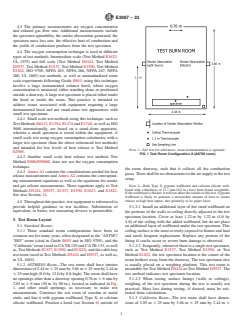
FIG. 1 Test Room Configuration A (ASTM room)
4.4.2 Another small scale heat release test method, Test
Method E906/E906M, does not use the oxygen consumption
technique.
the room doorway, such that it collects all the combustion
4.4.3 Annex A1 contains the considerations needed for heat
gases. There shall be no obstructions to the air supply to the test
release measurements and Annex A2 contains the correspond-
setup.
ing measurement equations as well as the equations for smoke
NOTE 2—Both Type X gypsum wallboard and calcium silicate wall-
and gas release measurements. These equations apply to Test
board with a thickness of 12.7 mm (0.5 in.) have been found acceptable.
Methods D5424, D5537, E1537, E1590, E1623, and E1822.
If the wallboard is thicker, it will not affect the results of this test. Gypsum
See also Section 14.
wallboard is likely to generate a measurable amount of heat or smoke
release at high heat inputs, due primarily to its paper facer.
4.5 Throughout this practice, test equipment is referenced to
provide helpful guidance to test facilities. Substitution of
5.1.2.1 Install an additional layer of fire rated wallboard on
equivalent, or better, test measuring devices is permissible.
the portions of the walls or ceiling directly adjacent to the test
specimen location. Cover at least 1.22 m by 1.22 m (4 ft by
5. Test Room Layout
4 ft) of the ceiling with the added wallboard, but do not place
5.1 Standard Rooms:
an additional layer of wallboard under the test specimen. This
5.1.1 Three standard room configurations have been in ceiling surface is the most severely exposed to flames and heat
common use for many years, often designated as the “ASTM”/ and needs frequent replacement. Replace any portion of the
“ISO” room (cited in Guide E603 and in ISO 9705), and the lining if cracks occur or severe burn damage is observed.
“California” room (used in CA TB 129 and CA TB 133, as well 5.1.2.2 Frequently, whenever there is a single test specimen,
as, Test Methods E1537, E1590, and E1822), and the cable tray such as Test Method E1537, Test Method E1590, or Test
test room (used in Test Methods D5424 and D5537, as well as, Method E1822, the test specimen location is the corner of the
in UL 1685). room furthest away from the doorway. The test specimen also
5.1.2 ASTM/ISO Room—The test room shall have interior is usually placed on a weighing platform. This test room is
dimensions of 2.44 m 6 25 mm by 3.66 m 6 25 mm by 2.44 m unsuitable for Test Method D5424 or Test Method D5537. The
6 25 mm high (8 ft by 12 ft by 8 ft high). The room shall have test method indicates test specimen location.
no openings other than a doorway opening 0.76 m 6 6 mm by 5.1.2.3 When testing surface linings (walls or ceilings),
2.03 m 6 6 mm (30 in. by 80 in.), located as indicated in Fig. weighing of the test specimen during the test is usually not
1, and other small openings, as necessary to make test practical. Mass loss during testing, if desired, must be esti-
measurements. Construct the test room of wooden or metal mated from calculations.
studs, and line it with gypsum wallboard, Type X, or calcium 5.1.3 California Room—The test room shall have dimen-
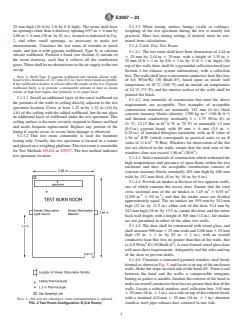
silicate wallboard. Position a hood (see Section 6) outside of sions of 3.05 m 6 25 mm by 3.66 m 6 25 mm by 2.44 m 6
E2067 − 23
25 mm high (10 ft by 2 ft by 8 ft high). The room shall have 5.1.3.3 When testing surface linings (walls or ceilings),
no openings other than a doorway opening 0.97 m 6 6 mm by weighing of the test specimen during the test is usually not
2.06 m 6 6 mm (38 in. by 81 in.), located as indicated in Fig. practical. Mass loss during testing, if desired, must be esti-
2, and other small openings, as necessary to make test mated from calculations.
measurements. Construct the test room of wooden or metal
5.1.4 Cable Tray Test Room:
studs, and line it with gypsum wallboard, Type X, or calcium
5.1.4.1 The test room shall have floor dimensions of 2.44 m
silicate wallboard. Position a hood (see Section 6) outside of
6 25 mm by 2.44 m 6 25 mm, with a height of 3.35 m 6
the room doorway, such that it collects all the combustion
25 mm (8 ft 6 1 in. by 8 ft 6 1 in. by 11 ft 6 1 in. high). On
gases. There shall be no obstructions to the air supply to the test
top of the walls there shall be a pyramidal collection hood (see
set-up.
Section 6 for exhaust system information), with a collection
box. The walls shall have a maximum conductive heat flux loss
NOTE 3—Both Type X gypsum wallboard and calcium silicate wall-
2 2
of 6.8 W/(m K) (30 Btu/h-ft ), based upon an inside wall
board with a thickness of 12.7 mm (0.5 in.) have been found acceptable.
If the wallboard is thicker, it will not affect the results of this test. Gypsum
temperature of 38 °C (100 °F) and an outside air temperature
wallboard likely is to generate a measurable amount of heat or smoke
of 24 °C (75 °F), and the interior surface of the walls shall be
release at high heat inputs, due primarily to its paper facer.
painted flat black.
5.1.3.1 Install an additional layer of fire rated wallboard on
5.1.4.2 Any materials of construction that meet the above
the portions of the walls or ceiling directly adjacent to the test
requirements are acceptable. Two examples of acceptable
specimen location. Cover at least 1.22 m by 1.22 m (4 ft by
construction materials are nominally 152 mm (6 in.) thick
4 ft) of the ceiling with the added wallboard, but do not place –3 –3
concrete masonry blocks (density: 1700 kg m (106 lb ft )
an additional layer of wallboard under the test specimen. This
and thermal conductivity nominally k = 1.75 W/(m K), at
ceiling surface is the most severely exposed to flames and heat 2
21 °C; 12.13 Btu in./ft h °F, at 70 °F) or nominally 13 mm
and needs frequent replacement. Replace any portion of the
(0.5 in.) gypsum board, with 89 mm 6 6 mm (3.5 in. 6
lining if cracks occur or severe burn damage is observed.
0.25 in.) of standard fiberglass insulation, with an R value of
5.1.3.2 This test room commonly is used for furniture 2
1.94 m K/W (which corresponds in practical units to an R
testing only. Usually, the test specimen is located in a corner 2
value of 11 h ft °F ⁄Btu). Windows for observation of the fire
and placed on a weighing platform. This test room is unsuitable
test are allowed in the walls; ensure that the total area of the
for Test Methods D5424 or D5537. The test method indicates 2 2
windows does not exceed 1.86 m (20 ft ).
test specimen location.
5.1.4.3 Select materials of construction which withstand the
high temperatures and presence of open flame within the test
enclosure and duct. An acceptable construction consists of
concrete masonry blocks nominally 203 mm high by 406 mm
wide by 152 mm thick (8 in. by 16 in. by 6 in.).
5.1.4.4 Provide air intakes at the base of two opposite walls,
one of which contains the access door. Ensure that the total
2 2
cross sectional area of the air intakes is 1.45 m 6 0.03 m
2 2
(2250 in. 6 50 in. ), and that the intake areas are divided
approximately equal. The air intakes are 559 mm by 343 mm
high (22 in. by 13.5 in.) either side of the door, 914 mm by
343 mm high (36 in. by 13.5 in.) under the door, and the entire
back wall length, with a height of 305 mm (12 in.). Air intakes
are not permitted in either of the other two walls.
5.1.4.5 The door shall be constructed with wired glass, and
shall measure 900 mm 6 25 mm wide and 2100 mm 6 25 mm
high (35 in. 6 1 in. by 83 in. 6 1 in.), with an overall
conductive heat flux loss no greater than that of the walls, that
2 2
is, 6.8 W/(m K) (30 Btu/h-ft ). A steel-framed wired glass door
will meet these requirements. Adequately seal the sides and top
of the door to prevent drafts.
5.1.4.6 Construct a truncated pyramid stainless steel hood,
formed as shown in Fig. 3, and locate it on top of the enclosure
walls. Make the slope on each side of the hood 40°. Form a seal
between the hood and the walls; a compressible inorganic
batting as gasket is suitable. Insulate the exterior of the hood to
make an overall conductive heat loss no greater than that of the
walls. Locate a cubical stainless steel collection box, 910 mm
6 25 mm (36 in. 6 1 in.), on a side on top of the exhaust hood,
with a nominal 410 mm 6 25 mm (16 in. 6 1 in.) diameter
NOTE 1—See text for tolerances; room instrumentation is optional.
FIG. 2 Test Room Configuration B (CA Room) stainless steel pipe exhaust duct centered in one side.
E2067 − 23
burner at various incident heat inputs to expose a variety of
individual fuel packages, including single decorative objects,
exhibit booths, stage settings and decorative combustible
vegetation. The test method is referenced in several codes. The
gas burner used is a propane burner with a 305 mm by 305 mm
(nominal) top surface and it is the same burner as in NFPA 286
(room-corner test). The gas supply to the burner produces a net
heat output of one of the following six ignition source
intensities for a period of 15 min: 20 kW, 40 kW, 70 kW,
100 kW, 160 kW, and 300 kW.
5.4 Enclosure Room:
5.4.1 Any test room, as well as any furniture calorimeter,
together with the corresponding hood and exhaust duct system,
shall be positioned in a large enclosed room. The enclosure
area shall be constructed of fire resistant materials, such as
concrete, for walls and ceiling, and it shall be completely
isolated from neighboring rooms and facilities. The walls of
FIG. 3 Design of Hood and Exhaust System
the enclosure shall be far enough away from the walls of the
test room for the enclosure room to be ventilated adequately.
5.2 Nonstandard Rooms:
The height of the ceiling shall be sufficient to allow for
5.2.1 Standardized tests also are conducted in rooms of
installation of the exhaust duct and easy access to the heat
somewhat different dimensions than the ASTM or California
release calorimetry and other instrumentation.
rooms, after the attainment of equivalent results has been
5.4.1.1 It is important that during each test a free and
demonstrated.
sufficient flow of make-up air be available to facilitate the
5.2.2 Nonstandardized tests and research experiments are
combustion process, without creating any forced flow of air
conducted in rooms of different sizes. The compartment size,
into or out of the test room. The combination of exhaust hood
shape, and openings shall be chosen to simulate the nature or
and enclosure room shall be sufficiently large to achieve this
type of compartment or facility in which the subject material,
objective.
product, or system is expected to be used in actual service. If
5.4.1.2 Distances of at least 6 m (20 ft) between the
there is a range of sizes, then account shall be taken of the fact
enclosure walls and the walls of the test room and a minimum
that for a given ignition exposure, the smaller compartment
height of 4.6 m (15 ft) are recommended, as minimum
sizes usually will provide the most severe fire development
requirements; larger enclosure rooms are even more desirable
conditions. Whenever possible, a compartment shall be de-
since they will minimize any effects of the enclosure walls on
signed to be symmetrical and as simple as possible for ease of
the test conditions. Such effects include radiative feedback
analysis. Space between the top of door and the ceiling is
from the heated walls and obstruction of air supply into the
critical because of the trapping of the smoke and hot gases. The
room. A larger enclosure also will provide easier access to all
room shall be located inside a larger, carefully ventilated
sides of the test room and instrumentation during the tests, and
enclosure to ensure minimum interference from drafts or wind
in case of an emergency, and for routine repairs and mainte-
currents.
nance. See 11.2.14 for information regarding smaller enclosure
5.1.2 or 5.1.4 for the con-
5.2.3 Follow the guidelines of
rooms.
struction materials, depending on the application. Be especially
5.4.2 The enclosure shall allow for sufficient supply of fresh
mindful of the use of additional fire rated wallboard if test
air into the test room during tests and shall not create any
specimens are placed near walls or ceilings.
obstructions to the ambient air supply. Openings in the enclo-
5.3 Furniture Calorimeter (Open Calorimeter):
sure shall not be situated in a way that would create any forced
5.3.1 This type of testing is appropriate for intermediate
convective air flows inside the test room, and thus, affecting the
scale test methods, such as Test Method E1623, and for testing
burning of the test specimen.
individual products, such as items of furniture, or relatively
5.4.3 When using an open (furniture) calorimeter, it is
large constructions, such as foam displays (UL 1975). Position
recommended that a minimum distance of 6 m (20 ft) be
the test specimen centrally on a weighing platform, which shall
maintained between enclosure walls and the test specimen in
be located centrally under the collection hood.
all directions.
5.3.2 The test enclosure that houses the exhaust hood shall
be of sufficiently large dimensions that there are no spurious
6. Hood and Exhaust Collection System
heat radiation effects from the walls or any other nearby
objects. The air flow to the test specimen shall be symmetrical 6.1 The exhaust collection system shall consist of a blower,
from all sides. The hood is located directly above the test steel hood, duct, bidirectional probe, thermocouple(s), oxygen
specimen (see Section 6). measurement system, smoke obscuration measuring system
5.3.3 A standard fire test developed by the NFPA Technical (white light or laser), and combustion gas sampling and
Committee on Fire Tests and published as NFPA 289 uses a gas analysis system.
E2067 − 23
6.1.1 The system for collecting the combustion products 2.0 mW helium-neon laser, instead of white light system is also
shall have a capacity and be designed in such a way that all of acceptable. It has been shown that white light and laser systems
the combustion products leaving the burning specimen are will give similar results (2-6).
collected. Design the capacity of the evacuation system so as to
6.4 Example Design of a Satisfactory Collection Hood and
exhaust and collect all combustion gases leaving the burning
Exhaust Duct—The system described has been tested in
test specimen without excessive make-up air.
practice and proven to fulfill the requirements (7–8).
6.2 Place probes for sampling of combustion gas and for
6.4.1 The hood is located just outside the room doorway. Its
measurement of flow rate in accordance with 6.3. Measure all
bottom dimensions are 2.4 m by 2.4 m (8 ft by 8 ft) and the
combustion product (smoke obscuration and gas concentra-
height is 1.0 m (3.3 ft). On all four sides steel sheets are
tions) at a position in the exhaust duct where the exhaust is
extended 1.0 m (3.3 ft) downwards, making the effective height
uniformly mixed and there is a nearly uniform velocity across
of the hood 2.0 m (6.6 ft). The distance between the lower edge
the duct section. A distance of 8 to 30 duct diameters is
of the hood and the floor (or the weighing platform when using
satisfactory for this purpose.
a furniture calorimeter) shall be 1.8 m to 2.0 m (6.0 ft to 6.4 ft).
The hood feeds into a plenum having a 0.9 m by 0.9 m (3 ft by
6.3 Instrumentation in Exhaust Duct—Further details are set
3 ft) cross-sectional area, and a height of 0.9 m (3 ft). The
out in Section 7.
maximum acceptable height of this plenum area is 1.8 m (6 ft),
6.3.1 Flow Rate—Measure the flow rate in the exhaust duct
depending on building constraints. In the plenum chamber two
by means of a bidirectional probe located at the center line of
baffle (usually steel) plates approximately 0.5 m by 0.9 m
the duct. Measure the flow rate in the exhaust duct with an
(1.6 ft by 3.0 ft) are located to increase mixing of the combus-
accuracy of at least 610 %. The response time to a stepwise
tion gases. The hood shall be designed and manufactured so
change of the duct flow rate shall be a maximum of 6 s to reach
that no spill-over occurs.
90 % of the final value.
6.4.2 The exhaust duct shall be connected with the plenum
6.3.2 Combustion Gas Analysis:
chamber. The inner diameter of the exhaust duct shall be in the
6.3.2.1 Sampling Line—Make the sampling line tubes of a
range 400 mm to 760 mm (16 in. to 30 in.). To facilitate flow
material not influencing the concentration of the combustion
measurements, guide vanes, if needed, are located at both ends
gas species to be analyzed. See 7.1 for the sequence of the gas
of the exhaust duct. Alternatively, the rectilinear part of the
train.
exhaust duct shall have such a length that a fully-developed
6.3.2.2 Oxygen Measurement—The analyzer shall measure
flow profile is established at the point of measurement.
oxygen concentration with a range from 0 % to 25 % oxygen.
6.4.2.1 The exhaust duct shall be connected to an evacua-
The analyzer shall exhibit a linear response and drift of not
tion system. The capacity of the evacuation system shall be
more than 50 ppm of oxygen over a period of 20 min, and
designed to exhaust all combustion gases leaving the specimen.
noise of not more than 50 ppm of oxygen (root-mean-square
–1
This requires an exhaust capacity of at least 2.7 kg s (about
value) during this same 20 min period in order to have
3 –1
8000 m h at standard atmospheric conditions) corresponding
adequate measurements of rate of heat release. Recommended
to a driving under pressure of about 2 kPa at the end of the
procedures for determining drift and noise of the oxygen
duct. A variable speed exhaust fan with a DC motor drive is
analyzer are described in Appendix X1. Take the combustion
suitable for this use. Alternatively, an adjustable frequency
gas sample from the end of the sampling line. Calculate the
controller also is suitable, in conjunction with a single speed
time delay, including the time constant of the instrument, from
exhaust fan.
the test room, which is a function of the exhaust duct flow rate.
6.4.2.2 The controller generates an adjustable voltage/
It shall be no more than 30 s.
frequency output for complete control of the conventional
6.3.2.3 Carbon Monoxide and Carbon Dioxide
induction motor that runs the exhaust fan. The system allows
Measurement—Measure the combustion gas species with an
for control of the exhaust flow rate from zero to the maximum
instrument having an accuracy of at least 60.1 volume % for
capacity of the fan by adjusting the speed of the motor. It shall
carbon dioxide and 60.02 volume % for carbon monoxide. A
–1
be possible to control the exhaust flow from about 0.5 kg s up
suitable output range is 0 volume % to 1 volume % for carbon
to maximum flow during the test process.
monoxide and 0 volume % to 6 volume % for carbon dioxide.
Take the combustion gas sample from the end of the sampling 6.4.3 The system shall be capable of measuring rates of heat
release with sufficient accuracy (at least 6 %).
line. Calculate the time delay, including the time constant of
the instrument, from the test room; it is a function of the 6.4.4 When the objective of the tests is to perform compari-
exhaust duct flow rate. It shall be a maximum of 30 s.
sons between products expected to release low amounts of heat
6.3.2.4 Smoke Obscuration Measurement—Install an optical or smoke, the system shall still be capable of measuring low
system for measurement of light obscuration across the cen- rates of heat release (such as 10 kW) with sufficient accuracy
terline of the exhaust duct. Determine the optical density of the (at least 6 %). If concentration gradients are found to exist,
smoke by measuring the light transmitted with a photometer mixing vanes are an adequate means of addressing the prob-
system consisting of a lamp, plano convex lenses, an aperture, lem.
a photocell, and an appropriate power supply. Construct the
NOTE 4—It is likely that a single system will not have the same degree
system so that soot deposits on the optics during a test do not
of accuracy of heat release rate measurements over a range of heat release
reduce the light transmission by more than 5 %. Alternatively,
rates as high as 1 MW and as low as 10 kW. Tests designed to assess
instrumentation using a laser beam system, with an 0.5 mW to whether flashover will occur, such as NFPA 265, NFPA 286, or ISO 9705,
E2067 − 23
require measurements as high as 1 MW, while tests designed to assess the
If the minimum straight section before the measuring system is
suitability of single products, such as Test Methods E1537 and E1590 or
at least eight times the inside diameter of the duct the exhaust
UL 1975, require accurate measurements of at levels of < 100 kW; thus,
flow is likely to be uniformly mixed. If the measuring system
measurement accuracy must be a function of test requirements.
is positioned at a distance of less than eight diameters,
6.4.5 Use of an alternative exhaust system design is limited
equivalent results and good mixing shall be demonstrated
to those systems shown to produce equivalent results. Equiva-
before use.
lency is demonstrated by meeting the calibration requirements.
7.3.1.1 The following experiment helps to determine how
Exhaust system designs based on natural convection are not
well the exhaust gases are being mixed. Position a gas burner,
permitted.
such as the burners described in 11.2.3 or 11.2.4, at the location
6.4.6 When using an open calorimeter the hood shall be
of the test specimen in the test room (or under the exhaust hood
installed above the mass measuring system and test specimen.
if using an open calorimeter). Burn propane gas at a constant
The distance between the lower edge of the hood and the mass
gas flow, for example 54 L/min, which produces an 80 kW fire.
measuring system shall range between 1.8 m and 3.0 m (6 ft to
Allow the gas to burn for 2 min to 3 min to reach a steady state.
10 ft). The hood shall be designed and manufactured such that
Use a plain L-shaped 6 mm (0.25 in.) stainless steel tube facing
no spill-over occurs and all the smoke is collected.
downstream of the exhaust duct at the sampling location of the
NOTE 5—If hoods are too large, potential resulting problems are
actual gas sampling probe. Traverse the tube from top to
excessive air entrainment, deposition on cold surfaces, or dilution of
bottom of the duct in 25 mm (1 in.) increments. Record the
smoke.
combustion gas concentration at each position and inspect the
6.4.7 Leakage of combustion products is detectable visually
recorded values. If gas concentrations are fairly constant
during burn tests. Visually observe the collection of gases and
(within 10 %) throughout the experiment, mixing has been
smoke through the exhaust duct. If any smoke escapes into the
achieved. If gas concentrations vary widely throughout the
surroundings, even at high exhaust flow rates, use a skirt
cross sectional area of the exhaust duct, mixing vanes or baffles
capable of withstanding the high temperatures, about 1 m (3 ft)
need to be added to the exhaust system. Repeat these measure-
wide, to hang around the lower edges of the exhaust hood as a
ments until good mixing has been achieved.
curtain. This curtain will assist in guiding more of the
7.3.2 Sampling probes shall collect samples across the full
combustion products into the exhaust hood. Note that, if such
diameter of the exhaust duct, and thus, preferably be of the bar
a curtain is used during burn tests, all system calibrations also
type and minimize disturbance of the air flow in the duct. Ring
shall have been conducted with this curtain in place.
type sampling probes also are acceptable, although they do not
collect gas samples across the full diameter of the duct. In
6.5 If pollution abatement equipment is present, the exhaust
removal system shall still be capable of fulfilling the require- either case turn the intake of the sampling probe downstream to
prevent soot from clogging the probe. The sampling probe
ments of the test method throughout the entire test, without
affecting the results. If the system affects test results, such shall be manufactured from corrosion resistant materials, such
as stainless steel or polytetrafluoroethylene. Collect the com-
results as are obtained after the effect of the abatement
equipment come into effect are invalid. bustion gas samples across the entire diameter of the exhaust
duct. Install the gas sampling probe at the center of the
7. Exhaust Duct Instrumentation
cross-sectional area of the exhaust duct with the holes facing
downstream of the flow.
7.1 A gas analysis system is required to make measurements
of oxygen (for determining heat release), and other gaseous
7.3.2.1 Inspect the sampling probe frequently and remove
species, such as carbon monoxide, carbon dioxide and any any particulate deposit in the holes or in the line. The frequency
other species of interest, in the exhaust duct. The sequence of
of required cleaning of the probe depends on the frequency and
the gas train shall be sampling probe, soot filter, cold trap, gas intensity of the tests conducted in any facility. When all
path pump, vent valve, plastic drying column and carbon
components of the gas train, such as all filters, cold bath,
dioxide removal columns (if used), flow controller, and oxygen valves, rotameters and pump are clean, but a sufficient flow
analyzer. The gas train also shall include appropriate spanning
cannot be maintained through the analyzers, this is an indica-
and zeroing facilities. Other designs are acceptable if equiva- tion that the sampling probe holes are probably clogged. In this
lency has been demonstrated. case, the sampling probe shall be removed and cleaned.
Methanol or other solvents are often needed to remove hard
7.2 To install the instruments in the duct, and for mainte-
soot deposits and other contaminants. Reinstall the gas sam-
nance purposes, one or more access doors shall be provided in
pling probe after cleaning and make sure all the openings are
the exhaust duct. These exhaust duct doors shall be sealed
8 sealed and there is no leakage into the system. The sampling
tightly during testing.
probe shall be cleaned with a frequency no less than monthly.
7.3 Gas Sampling Probe:
7.3.2.2 It is possible to install the gas sampling probe facing
7.3.1 The gas sampling probe shall be located in a position
upstream of the flow; however, in this condition the probe
where the exhaust duct flow is well mixed (turbulent flow).
holes will clog more quickly and need to be cleaned more
Install the gas sampling probe at a distance of at least eight duct
often.
diameters downstream of the last turn from the exhaust hood.
7.3.3 Gas Sampling Line—The gas sampling line shall be
positioned at the desired location, made from a material not
High-temperature silicone rubber sealant is suitable for this purpose. influencing the concentration of the combustion gas species to
E2067 − 23
though various digital techniques have been proposed to correct system
be analyzed. Transport combustion gases through a heated
response errors due to “dead” volume, avoidance is recommended.
(preferably electrically) line to prevent condensation of mois-
ture or other combustion products in the line. Maintain the
7.4 Gas Analyzers:
heated line at a temperature of at least 110 °C (230 °F).
7.4.1 The measurement of oxygen concentration is at the
Remove particulates contained in combustion gases with inert
heart of the determination of rate of heat release by the
filters. Use oil-free pumps, such as diaphragm pumps, to
principle of oxygen consumption. For improved accuracy in
transport sample gases from the test room to the gas analyzers.
rate of heat release measurements, particularly for large fires,
All tube fittings and pipe connections throughout the length of
measurements of carbon monoxide and carbon dioxide con-
the gas train shall be gas tight so as to ensure that no gas
centrations are helpful.
leakages occur in the system. This is particularly crucial on the
7.4.2 Specifications for Oxygen Measurement—The ana-
suction side of the gas sampling pump where outside air might
lyzer shall measure oxygen concentration with a range from
be drawn into the system and dilute the stream of sample gas.
0 % to 25 % oxygen. The analyzer shall exhibit a linear
Leakage of air into the sample gas will cause serious errors in
response and drift of not more than 50 ppm of oxygen over a
the gas concentration measurements.
period of 20 min, and noise of not more than 50 ppm of oxygen
NOTE 6—All tube fittings and pipe connections in the gas analysis
(root-mean-square value) during this same 20 min period in
system shall be made of stainless steel or other corrosion resistant
order to have adequate measurements of rate of heat release.
materials to avoid corrosion. Corrosion of gas handling tubes and fittings
Recommended procedures for determining drift and noise of
potentially affects the chemical composition of the sample gas and causes
the oxygen analyzer are described in Appendix X1. Take the
serious errors in the test measurements.
combustion gas sample from the end of the sampling line.
NOTE 7—Heated lines are not necessary for the measurement of carbon
monoxide, carbon dioxide, or oxygen; however, utilization of heated lines
Calculate the time delay, including the time constant of the
is necessary for the following gases: water, hydrogen chloride, and
instrument, from the test room; it is a function of the exhaust
condensable hydrocarbons. Moreover, even if these gases are not being
duct flow rate. The time delay is the time to transport sample
measured, the use of heated lines prevents their deposition inside the
gases from the source to the inlet port of the gas analyzer, and
sampling tube, which potentially will reduce or obstruct the free flow of
it shall be as short as possible, up to a maximum of 30 s. The
gases inside the line.
response time of the gas analyzer shall not be greater than 5 s
7.3.4 Particulate Filter and Removal System for Condens-
and preferably be in the order of 1 s or less. The lag time is
ables:
simply subtracted from the recorded time to obtain the actual
7.3.4.1 The gas sample entering the gas analyzers shall be
time of the event at the inlet of the gas analyzer.
free of moisture, soot, condensable hydrocarbons, and any
other particulates. Use in-line filters to remove soot and other
NOTE 9—The most satisfactory oxygen analyzers are those of the
particulates before the gas sample enters the gas analysis paramagnetic type (see Appendix X1).
system. These filters shall be replaced daily; however, in some
7.4.3 Specifications for Carbon Dioxide and Carbon Mon-
cases line filters need to be replaced after each fire test,
oxide Measurement—Measure the combustion gas species with
especially if the burn has been particularly intense or especially
an instrument having an accuracy of at least 60.1 volume %
sooty. Soot filters shall be replaced when needed, to ensure a
for carbon dioxide and 60.02 volume % for carbon monoxide.
free and sufficient flow of sample gas through the gas analyzers
A suitable output range is 0 volume % to 1 volume % for
during the test.
carbon monoxide and 0 volume % to 6 volume % for carbon
7.3.4.2 Use a removal system to remove the water content
dioxide. Take the combustion gas sample from the end of the
of the gas sample, and condensables, continuously, as dis-
sampling line. Calculate the time delay, including the time
cussed in 7.3.4.3 – 7.3.4.5.
constant of the instrument, from the test room; it is a function
7.3.4.3 One option for water removal system is a cold trap.
of the exhaust duct flow rate. It shall be a maximum of 30 s.
A cold trap (refrigeration system) consists of condensing unit,
The response of the gas analyzers shall not be greater than 5 s
compressor and evaporator unit, and often also contains a
and preferably be in the order of 1 s or less.
temperature control unit.
NOTE 10—Carbon monoxide and carbon dioxide non dispersive infra-
7.3.4.4 The concept of the cold trap is to continuously cool
red analyzers have been shown to be satisfactory. Instruments exist, which
the sample gas in order to condense the water content in the
assess both carbon monoxide and carbon dioxide.
mixture of gases and provide a moisture-free stream of sample
NOTE 11—The upper limit of the analyzers is exceeded occasionally in
gases to the gas analyzers. An ice bath often is used as a valid
flashover situations. This error, however, often is of relatively low
alternative.
consequence, because, frequently, it is measured in tests after flashover.
7.3.4.5 A dif
...
This document is not an ASTM standard and is intended only to provide the user of an ASTM standard an indication of what changes have been made to the previous version. Because
it may not be technically possible to adequately depict all changes accurately, ASTM recommends that users consult prior editions as appropriate. In all cases only the current version
of the standard as published by ASTM is to be considered the official document.
Designation: E2067 − 22 E2067 − 23 An American National Standard
Standard Practice for
Full-Scale Oxygen Consumption Calorimetry Fire Tests
This standard is issued under the fixed designation E2067; the number immediately following the designation indicates the year of
original adoption or, in the case of revision, the year of last revision. A number in parentheses indicates the year of last reapproval. A
superscript epsilon (´) indicates an editorial change since the last revision or reapproval.
1. Scope*
1.1 This practice deals with methods to construct, calibrate, and use full scale oxygen consumption calorimeters to help minimize
testing result discrepancies between laboratories.
1.2 The methodology described herein is used in a number of ASTM test methods, in a variety of unstandardized test methods,
and for research purposes. This practice will facilitate coordination of generic requirements, which are not specific to the item
under test.
1.3 The principal fire-test-response characteristics obtained from the test methods using this technique are those associated with
heat release from the specimens tested, as a function of time. Other fire-test-response characteristics also are determined.
1.4 This practice is intended to apply to the conduction of different types of tests, including both some in which the objective is
to assess the comparative fire performance of products releasing low amounts of heat or smoke and some in which the objective
is to assess whether flashover will occur.
1.5 This practice does not provide pass/fail criteria that can be used as a regulatory tool, nor does it describe a test method for
any material or product.
1.6 For use of the SI system of units in referee decisions, see IEEE/ASTM SI-10. The units given in parentheses are provided for
information only.
1.7 This standard is used to measure and describe the response of materials, products, or assemblies to heat and flame under
controlled conditions, but does not by itself incorporate all factors required for fire hazard or fire risk assessment of the materials,
products, or assemblies under actual fire conditions.
NOTE 1—This is the standard caveat described in section F2.2.2.1 of the Form and Style for ASTM Standards manual for fire-test-response standards.
In actual fact, this practice does not provide quantitative measures.
1.8 Fire testing of products and materials is inherently hazardous, and adequate safeguards for personnel and property shall be
employed in conducting these tests. Fire testing involves hazardous materials, operations, and equipment. See also Section 7.
This practice is under the jurisdiction of ASTM Committee E05 on Fire Standards and is the direct responsibility of Subcommittee E05.21 on Smoke and Combustion
Products.
Current edition approved July 1, 2022Nov. 1, 2023. Published August 2022November 2023. Originally approved in 2000. Last previous edition approved in 20202022
as E2067 – 20.E2067 – 22. DOI: 10.1520/E2067-22.10.1520/E2067-23.
*A Summary of Changes section appears at the end of this standard
Copyright © ASTM International, 100 Barr Harbor Drive, PO Box C700, West Conshohocken, PA 19428-2959. United States
E2067 − 23
1.9 This standard does not purport to address all of the safety concerns, if any, associated with its use. It is the responsibility
of the user of this standard to establish appropriate safety, health, and environmental practices and determine the applicability of
regulatory limitations prior to use.
1.10 This international standard was developed in accordance with internationally recognized principles on standardization
established in the Decision on Principles for the Development of International Standards, Guides and Recommendations issued
by the World Trade Organization Technical Barriers to Trade (TBT) Committee.
2. Referenced Documents
2.1 ASTM Standards:
D5424 Test Method for Smoke Obscuration of Insulating Materials Contained in Electrical or Optical Fiber Cables When
Burning in a Vertical Cable Tray Configuration
D5537 Test Method for Heat Release, Flame Spread, Smoke Obscuration, and Mass Loss Testing of Insulating Materials
Contained in Electrical or Optical Fiber Cables When Burning in a Vertical Cable Tray Configuration
D6113 Test Method for Using Cone Calorimeter to Determine Fire-Test-Response Characteristics of Insulating Materials
Contained in Electrical or Optical Fiber Cables
E84 Test Method for Surface Burning Characteristics of Building Materials
E176 Terminology of Fire Standards
E603 Guide for Room Fire Experiments
E906E906/E906M Test Method for Heat and Visible Smoke Release Rates for Materials and Products Using a Thermopile
Method
E1354 Test Method for Heat and Visible Smoke Release Rates for Materials and Products Using an Oxygen Consumption
Calorimeter
E1474 Test Method for Determining the Heat Release Rate of Upholstered Furniture and Mattress Components or Composites
Using a Bench Scale Oxygen Consumption Calorimeter
E1537 Test Method for Fire Testing of Upholstered Furniture
E1590 Test Method for Fire Testing of Mattresses
E1623 Test Method for Determination of Fire and Thermal Parameters of Materials, Products, and Systems Using an
Intermediate Scale Calorimeter (ICAL)
E1740 Test Method for Determining the Heat Release Rate and Other Fire-Test-Response Characteristics of Wall Covering or
Ceiling Covering Composites Using a Cone Calorimeter
E1822 Test Method for Fire Testing of Stacked Chairs
E2965 Test Method for Determination of Low Levels of Heat Release Rate for Materials and Products Using an Oxygen
Consumption Calorimeter
IEEE/ASTM SI-10 International System of Units (SI) The Modernized Metric System
2.2 ISO Standards:
ISO 13943 Fire Safety-Vocabulary
ISO 5660-1 Fire Tests—Reaction to Fire—Rate of Heat Release from Building Products (Cone Calorimeter Method)
ISO 9705 Fire Tests - Full-Scale Room Test for Surface Products
2.3 California Bureau of Home Furnishings and Thermal Insulation Standards:
CA Technical Bulletin 129 (October 1992), Flammability Test Procedure for Mattresses for Use in Public Buildings
CA Technical Bulletin 133 (January 1991), Flammability Test Procedure for Seating Furniture for Use in Public Occupancies
2.4 NFPA Standards:
NFPA 265 Standard Methods of Fire Tests for Evaluating Room Fire Growth Contribution of Textile Wall Coverings
NFPA 266 Standard Method of Test for Fire Characteristics of Upholstered Furniture Exposed to Flaming Ignition Source –
Withdrawn
NFPA 267 Standard Method of Test for Fire Characteristics of Mattresses and Bedding Assemblies Exposed to Flaming Ignition
Source – Withdrawn
NFPA 286 Standard Methods of Fire Tests for Evaluating Room Fire Growth Contribution of Wall and Ceiling Interior Finish
NFPA 289 Standard Method of Fire Test for Individual Fuel Packages
For referenced ASTM standards, visit the ASTM website, www.astm.org, or contact ASTM Customer Service at service@astm.org. For Annual Book of ASTM Standards
volume information, refer to the standard’s Document Summary page on the ASTM website.
Available from International Organization for Standardization (ISO), 1, ch. de la Voie-Creuse, Case postale 56, CH-1211, Geneva 20, Switzerland, http://www.iso.ch.
Available from California Bureau of Home Furnishings and Thermal Insulation, State of California, Department of Consumer Affairs, 3485 Orange Grove Avenue, North
Highlands, CA 95660–5595.
Available from National Fire Protection Association (NFPA), 1 Batterymarch Park, Quincy, MA 02169-7471, http://www.nfpa.org.
E2067 − 23
2.5 UL Standards:
UL 1685 Standard Vertical Tray Fire Propagation and Smoke Release Test for Electrical and Optical Fiber Cables
UL 1975 Standard Fire Tests for Foamed Plastics Used for Decorative Purposes
3. Terminology
3.1 Definitions:
3.1.1 For definitions of terms used in this practice, refer to Terminology E176 and ISO 13943. In case of conflict, the definitions
given in Terminology E176 shall prevail.
3.1.2 continuous (as related to data acquisition in large-scale tests), adj—conducted at data collection intervals of 6 s or less.
(E176)
3.1.3 heat release rate, n—the heat evolved from the specimen, per unit of time. (E176)
3.1.4 ignition, n—the initiation of combustion. (E176)
3.1.4.1 Discussion—
The combustion may be evidenced by glow, flame, detonation or explosion. The combustion may be sustained or transient.
3.1.5 oxygen consumption principle, n—the expression of the relationship between the mass of oxygen consumed during
combustion and the heat released. (E176)
3.1.6 smoke, n—the airborne solid and liquid particulates and gases evolved when a material undergoes pyrolysis or combustion.
(E176)
3.1.7 smoke obscuration, n—reduction of light transmission by smoke, as measured by light attenuation. (E176)
3.2 Definitions of Terms Specific to This Standard:
3.2.1 sample, n—an amount of the material, product, or assembly, to be tested, which is representative of the item as a whole.
3.2.2 specimen, n—representative piece of the product, which is to be tested together with any substrate or treatment.
4. Significance and Use
4.1 The oxygen consumption principle, used for the measurements described here, is based on the observation that, generally, the
net heat of combustion is directly related to the amount of oxygen required for combustion (1). Approximately 13.1 MJ of heat
are released per 1 kg of oxygen consumed. Test specimens in the test are burned in ambient air conditions, while being subjected
to a prescribed external heating source.
4.1.1 This technique is not appropriate for use on its own when the combustible fuel is an oxidizer or an explosive agent, which
release oxygen. Further analysis is required in such cases (see Appendix X2).
4.2 The heat release is determined by the measurement of the oxygen consumption, as determined by the oxygen concentration
and the flow rate in the combustion product stream, in a full scale environment.
4.3 The primary measurements are oxygen concentration and exhaust gas flow rate. Additional measurements include the
specimen ignitability, the smoke obscuration generated, the specimen mass loss rate, the effective heat of combustion and the yields
of combustion products from the test specimen.
4.4 The oxygen consumption technique is used in different types of test methods. Intermediate scale (Test Method E1623, UL
1975) and full scale (Test Method D5424, Test Method D5537, Test Method E1537, Test Method E1590, Test Method E1822, ISO
9705, NFPA 265, NFPA 266, NFPA 267, NFPA 286, UL 1685) test methods, as well as unstandardized room scale experiments
Available from Underwriters Laboratories (UL), 333 Pfingsten Rd., Northbrook, IL 60062-2096, http://www.ul.com.
The boldface numbers in parentheses refers to the list of references at the end of this standard.
E2067 − 23
following Guide E603, using this technique involve a large instrumented exhaust hood, where oxygen concentration is measured,
either standing alone or positioned outside a doorway. A large test specimen is placed either under the hood or inside the room.
This practice is intended to address issues associated with equipment requiring a large instrumented hood and not stand-alone test
apparatuses with small test specimens.
4.4.1 Small scale test methods using this technique, such as Test Methods D6113, E1354, E1474 and E1740, as well as ISO 5660
internationally, are based on a stand-alone apparatus, wherein a small specimen is tested within the equipment. A small-scale test
using oxygen consumption calorimetry with a larger test specimen (than the above referenced test methods) and intended for low
levels of heat release is Test Method E2965.
4.4.2 Another small scale heat release test method, Test Method E906E906/E906M, does not use the oxygen consumption
technique.
4.4.3 Annex A1 contains the considerations needed for heat release measurements and Annex A2 contains the corresponding
measurement equations as well as the equations for smoke and gas release measurements. These equations apply to Test Methods
D5424, D5537, E1537, E1590, E1623, and E1822. See also Section 14.
4.5 Throughout this practice, test equipment is referenced to provide helpful guidance to test facilities. Substitution of equivalent,
or better, test measuring devices is permissible.
5. Test Room Layout
5.1 Standard Rooms:
5.1.1 Three standard room configurations have been in common use for many years, often designated as the “ASTM”/“ISO” room
(cited in Guide E603 and in ISO 9705), and the “California” room (used in CA TB 129 and CA TB 133, as well as, Test Methods
E1537, E1590, and E1822), and the cable tray test room (used in Test Methods D5424 and D5537, as well as, in UL 1685).
5.1.2 ASTM/ISO Room—The test room shall have interior dimensions of 2.44 m 6 25 mm by 3.66 m 6 25 mm by 2.44 m 6 25
mm 2.44 m 6 25 mm by 3.66 m 6 25 mm by 2.44 m 6 25 mm high (8 ft by 12 ft by 8 ft high). The room shall have no openings
other than a doorway opening 0.76 m 6 6 mm by 2.03 m 6 6 mm (30 in. by 80 in.), 0.76 m 6 6 mm by 2.03 m 6 6 mm (30 in.
by 80 in.), located as indicated in Fig. 1, and other small openings, as necessary to make test measurements. Construct the test room
of wooden or metal studs, and line it with gypsum wallboard, Type X, or calcium silicate wallboard. Position a hood (see Section
6) outside of the room doorway, such that it collects all the combustion gases. There shall be no obstructions to the air supply to
the test setup.
NOTE 2—Both Type X gypsum wallboard and calcium silicate wallboard with a thickness of 12.7 mm (0.5 in.) have been found acceptable. If the
wallboard is thicker, it will not affect the results of this test. Gypsum wallboard is likely to generate a measurable amount of heat or smoke release at
high heat inputs, due primarily to its paper facer.
5.1.2.1 Install an additional layer of fire rated wallboard on the portions of the walls or ceiling directly adjacent to the test
specimen location. Cover at least 1.22 m by 1.22 m (4 ft by 4 ft) 1.22 m by 1.22 m (4 ft by 4 ft) of the ceiling with the added
wallboard, but do not place an additional layer of wallboard under the test specimen. This ceiling surface is the most severely
exposed to flames and heat and needs frequent replacement. Replace any portion of the lining if cracks occur or severe burn
damage is observed.
5.1.2.2 Frequently, whenever there is a single test specimen, such as Test Method E1537, Test Method E1590, or Test Method
E1822, the test specimen location is the corner of the room furthest away from the doorway. The test specimen also is usually
placed on a weighing platform. This test room is unsuitable for Test Method D5424 or Test Method D5537. The test method
indicates test specimen location.
5.1.2.3 When testing surface linings (walls or ceilings), weighing of the test specimen during the test is usually not practical. Mass
loss during testing, if desired, must be estimated from calculations.
5.1.3 California Room—The test room shall have dimensions of 3.05 m 6 25 mm by 3.66 m 6 25 mm by 2.44 m 6 25 mm high
(10 ft by 2 ft by 8 ft high). The room shall have no openings other than a doorway opening 0.97 m 6 6 mm by 2.06 m 6 6 mm
(38 in. by 81 in.), located as indicated in Fig. 2, and other small openings, as necessary to make test measurements. Construct the
E2067 − 23
NOTE 1—See text for tolerances; room instrumentation is optional.
FIG. 1 Test Room Configuration A (ASTM room)
NOTE 1—See text for tolerances; room instrumentation is optional.
FIG. 2 Test Room Configuration B (CA Room)
E2067 − 23
test room of wooden or metal studs, and line it with gypsum wallboard, Type X, or calcium silicate wallboard. Position a hood
(see Section 6) outside of the room doorway, such that it collects all the combustion gases. There shall be no obstructions to the
air supply to the test set-up.
NOTE 3—Both Type X gypsum wallboard and calcium silicate wallboard with a thickness of 12.7 mm (0.5 in.) have been found acceptable. If the
wallboard is thicker, it will not affect the results of this test. Gypsum wallboard likely is to generate a measurable amount of heat or smoke release at
high heat inputs, due primarily to its paper facer.
5.1.3.1 Install an additional layer of fire rated wallboard on the portions of the walls or ceiling directly adjacent to the test
specimen location. Cover at least 1.22 m by 1.22 m (4 ft by 4 ft) (4 ft by 4 ft) of the ceiling with the added wallboard, but do not
place an additional layer of wallboard under the test specimen. This ceiling surface is the most severely exposed to flames and heat
and needs frequent replacement. Replace any portion of the lining if cracks occur or severe burn damage is observed.
5.1.3.2 This test room commonly is used for furniture testing only. Usually, the test specimen is located in a corner and placed
on a weighing platform. This test room is unsuitable for Test Methods D5424 or D5537. The test method indicates test specimen
location.
5.1.3.3 When testing surface linings (walls or ceilings), weighing of the test specimen during the test is usually not practical. Mass
loss during testing, if desired, must be estimated from calculations.
5.1.4 Cable Tray Test Room:
5.1.4.1 The test room shall have floor dimensions of 2.44 m 6 25 mm by 2.44 m 6 25 mm, 2.44 m 6 25 mm by 2.44 m 6 25 mm,
with a height of 3.35 m 6 25 mm (8 ft 6 1 in. by 8 ft 6 1 in. by 11 ft 6 1 in. 3.35 m 6 25 mm (8 ft 6 1 in. by 8 ft 6 1 in. by
11 ft 6 1 in. high). On top of the walls there shall be a pyramidal collection hood (see Section 6 for exhaust system information),
2 2
with a collection box. The walls shall have a maximum conductive heat flux loss of 6.8 W/(m K) (30 Btu/h-ft ), based upon an
inside wall temperature of 38 °C (100 °F) and an outside air temperature of 24 °C (75 °F), and the interior surface of the walls shall
be painted flat black.
5.1.4.2 Any materials of construction that meet the above requirements are acceptable. Two examples of acceptable construction
–3 –3
materials are nominally 152 mm (6 in.) thick concrete masonry blocks (density: 1700 kg m (106 lb ft ) and thermal conductivity
nominally k = 1.75 W/(m K), at 21 °C; 12.13 Btu in./ft h °F, at 70 °F) or nominally 13 mm (0.5 in.) (0.5 in.) gypsum board, with
89 mm 6 6 mm (3.5 in. 6 0.25 in.) 0.25 in.) of standard fiberglass insulation, with an R value of 1.94 m K/W (which corresponds
in practical units to an R value of 11 h ft11 h ft °F ⁄Btu). Windows for observation of the fire test are allowed in the walls; ensure
2 2
that the total area of the windows does not exceed 1.86 m1.86 m (20 ft(20 ft ).
5.1.4.3 Select materials of construction which withstand the high temperatures and presence of open flame within the test
enclosure and duct. An acceptable construction consists of concrete masonry blocks nominally 203 mm high by 406 mm wide by
152 mm thick (8 in. by 16 in. by 6 in.).
5.1.4.4 Provide air intakes at the base of two opposite walls, one of which contains the access door. Ensure that the total cross
2 2 2 2
sectional area of the air intakes is 1.45 m 6 0.03 m (2250 in. 6 50 in. ), and that the intake areas are divided approximately
equal. The air intakes are 559 mm by 343 mm 343 mm high (22 in. by 13.5 in.) either side of the door, 914 mm by 343 mm 343 mm
high (36 in. by 13.5 in.) under the door, and the entire back wall length, with a height of 305 mm 305 mm (12 in.). Air intakes
are not permitted in either of the other two walls.
5.1.4.5 The door shall be constructed with wired glass, and shall measure 900 mm 6 25 mm wide and 2100 mm 6 25 mm high
(35 in. 6 1 in. by 83 in. 6 1 in.), with an overall conductive heat flux loss no greater than that of the walls, that is, 6.8 W/(m
K) (30 Btu/h-ft ). A steel-framed wired glass door will meet these requirements. Adequately seal the sides and top of the door to
prevent drafts.
5.1.4.6 Construct a truncated pyramid stainless steel hood, formed as shown in Fig. 3, and locate it on top of the enclosure walls.
Make the slope on each side of the hood 40°. Form a seal between the hood and the walls; a compressible inorganic batting as
gasket is suitable. Insulate the exterior of the hood to make an overall conductive heat loss no greater than that of the walls. Locate
a cubical stainless steel collection box, 910 mm 6 25 mm (36 in. 6 1 in.), on a side on top of the exhaust hood, with a nominal
410 6 25-mm (16 6 1-in.)410 mm 6 25 mm (16 in. 6 1 in.) diameter stainless steel pipe exhaust duct centered in one side.
5.2 Nonstandard Rooms:
E2067 − 23
FIG. 3 Design of Hood and Exhaust System
5.2.1 Standardized tests also are conducted in rooms of somewhat different dimensions than the ASTM or California rooms, after
the attainment of equivalent results has been demonstrated.
5.2.2 Nonstandardized tests and research experiments are conducted in rooms of different sizes. The compartment size, shape, and
openings shall be chosen to simulate the nature or type of compartment or facility in which the subject material, product, or system
is expected to be used in actual service. If there is a range of sizes, then account shall be taken of the fact that for a given ignition
exposure, the smaller compartment sizes usually will provide the most severe fire development conditions. Whenever possible, a
compartment shall be designed to be symmetrical and as simple as possible for ease of analysis. Space between the top of door
and the ceiling is critical because of the trapping of the smoke and hot gases. The room shall be located inside a larger, carefully
ventilated enclosure to ensure minimum interference from drafts or wind currents.
5.2.3 Follow the guidelines of 5.1.2 or 5.1.4 for the construction materials, depending on the application. Be especially mindful
of the use of additional fire rated wallboard if test specimens are placed near walls or ceilings.
5.3 Furniture Calorimeter (Open Calorimeter):
5.3.1 This type of testing is appropriate for intermediate scale test methods, such as Test Method E1623, and for testing individual
products, such as items of furniture, or relatively large constructions, such as foam displays (UL 1975). Position the test specimen
centrally on a weighing platform, which shall be located centrally under the collection hood.
5.3.2 The test enclosure that houses the exhaust hood shall be of sufficiently large dimensions that there are no spurious heat
radiation effects from the walls or any other nearby objects. The air flow to the test specimen shall be symmetrical from all sides.
The hood is located directly above the test specimen (see Section 6).
5.3.3 A standard fire test developed by the NFPA Technical Committee on Fire Tests and published as NFPA 289 uses a gas burner
at various incident heat inputs to expose a variety of individual fuel packages, including single decorative objects, exhibit booths,
stage settings and decorative combustible vegetation. The test method is referenced in several codes. The gas burner used is a
propane burner with a 305305 mm by 305 mm (nominal) top surface and it is the same burner as in NFPA 286 (room-corner test).
The gas supply to the burner produces a net heat output of one of the following six ignition source intensities for a period of 15
min: 20, 40, 70, 100, 16020 kW, 40 kW, 70 kW, 100 kW, 160 kW, and 300 kW.
5.4 Enclosure Room:
5.4.1 Any test room, as well as any furniture calorimeter, together with the corresponding hood and exhaust duct system, shall be
positioned in a large enclosed room. The enclosure area shall be constructed of fire resistant materials, such as concrete, for walls
and ceiling, and it shall be completely isolated from neighboring rooms and facilities. The walls of the enclosure shall be far
E2067 − 23
enough away from the walls of the test room for the enclosure room to be ventilated adequately. The height of the ceiling shall
be sufficient to allow for installation of the exhaust duct and easy access to the heat release calorimetry and other instrumentation.
5.4.1.1 It is important that during each test a free and sufficient flow of make-up air be available to facilitate the combustion
process, without creating any forced flow of air into or out of the test room. The combination of exhaust hood and enclosure room
shall be sufficiently large to achieve this objective.
5.4.1.2 Distances of at least 6 m (20 ft) between the enclosure walls and the walls of the test room and a minimum height of 4.6
m (15 ft) are recommended, as minimum requirements; larger enclosure rooms are even more desirable since they will minimize
any effects of the enclosure walls on the test conditions. Such effects include radiative feedback from the heated walls and
obstruction of air supply into the room. A larger enclosure also will provide easier access to all sides of the test room and
instrumentation during the tests, and in case of an emergency, and for routine repairs and maintenance. See 11.2.14 for information
regarding smaller enclosure rooms.
5.4.2 The enclosure shall allow for sufficient supply of fresh air into the test room during tests and shall not create any obstructions
to the ambient air supply. Openings in the enclosure shall not be situated in a way that would create any forced convective air flows
inside the test room, and thus, affecting the burning of the test specimen.
5.4.3 When using an open (furniture) calorimeter, it is recommended that a minimum distance of 6 m (20 ft) be maintained
between enclosure walls and the test specimen in all directions.
6. Hood and Exhaust Collection System
6.1 The exhaust collection system shall consist of a blower, steel hood, duct, bidirectional probe, thermocouple(s), oxygen
measurement system, smoke obscuration measuring system (white light or laser), and combustion gas sampling and analysis
system.
6.1.1 The system for collecting the combustion products shall have a capacity and be designed in such a way that all of the
combustion products leaving the burning specimen are collected. Design the capacity of the evacuation system so as to exhaust
and collect all combustion gases leaving the burning test specimen without excessive make-up air.
6.2 Place probes for sampling of combustion gas and for measurement of flow rate in accordance with 6.3. Measure all combustion
product (smoke obscuration and gas concentrations) at a position in the exhaust duct where the exhaust is uniformly mixed and
there is a nearly uniform velocity across the duct section. A distance of 8 to 30 duct diameters is satisfactory for this purpose.
6.3 Instrumentation in Exhaust Duct—Further details are set out in Section 7.
6.3.1 Flow Rate—Measure the flow rate in the exhaust duct by means of a bidirectional probe located at the center line of the duct.
Measure the flow rate in the exhaust duct with an accuracy of at least 610 %. The response time to a stepwise change of the duct
flow rate shall be a maximum of 6 s to reach 90 % of the final value.
6.3.2 Combustion Gas Analysis:
6.3.2.1 Sampling Line—Make the sampling line tubes of a material not influencing the concentration of the combustion gas species
to be analyzed. See 7.1 for the sequence of the gas train.
6.3.2.2 Oxygen Measurement—Measure the The analyzer shall measure oxygen concentration with an accuracy of at least
60.04 % of full scale in the output range of 0 to 21 volume % oxygen, or 60.01 volume % oxygen, a range from 0 % to 25 %
oxygen. The analyzer shall exhibit a linear response and drift of not more than 50 ppm of oxygen over a period of 20 min, and
noise of not more than 50 ppm of oxygen (root-mean-square value) during this same 20 min period in order to have adequate
measurements of rate of heat release. Recommended procedures for determining drift and noise of the oxygen analyzer are
described in Appendix X1. Take the combustion gas sample from the end of the sampling line. Calculate the time delay, including
the time constant of the instrument, from the test room, which is a function of the exhaust duct flow rate. It shall be no more than
30 s.
6.3.2.3 Carbon Monoxide and Carbon Dioxide Measurement—Measure the combustion gas species with an instrument having an
accuracy of at least 60.1 volume % for carbon dioxide and 60.02 volume % for carbon monoxide. A suitable output range is 0
0 volume % to 1 volume % for carbon monoxide and 0 0 volume % to 6 volume % for carbon dioxide. Take the combustion gas
E2067 − 23
sample from the end of the sampling line. Calculate the time delay, including the time constant of the instrument, from the test
room; it is a function of the exhaust duct flow rate. It shall be a maximum of 30 s.
6.3.2.4 Smoke Obscuration Measurement—Install an optical system for measurement of light obscuration across the centerline of
the exhaust duct. Determine the optical density of the smoke by measuring the light transmitted with a photometer system
consisting of a lamp, plano convex lenses, an aperture, a photocell, and an appropriate power supply. Construct the system so that
soot deposits on the optics during a test do not reduce the light transmission by more than 5 %. Alternatively, instrumentation using
a laser beam system, with an 0.5 mW to 2.0 mW helium-neon laser, instead of white light system is also acceptable. It has been
shown that white light and laser systems will give similar results (2-6).
6.4 Example Design of a Satisfactory Collection Hood and Exhaust Duct—The system described has been tested in practice and
proven to fulfill the requirements (7–8).
6.4.1 The hood is located just outside the room doorway. Its bottom dimensions are 2.4 m by 2.4 m (8 ft by 8 ft) and the height
is 1.0 m (3.3 ft). On all four sides steel sheets are extended 1.0 m (3.3 ft) downwards, making the effective height of the hood 2.0
m (6.6 ft). The distance between the lower edge of the hood and the floor (or the weighing platform when using a furniture
calorimeter) shall be 1.8 m to 2.0 m (6.0 ft to 6.4 ft). The hood feeds into a plenum having a 0.9 m by 0.9 m (3 ft by 3 ft) (3 ft
by 3 ft) cross-sectional area, and a height of 0.9 m (3 ft). (3 ft). The maximum acceptable height of this plenum area is 1.8 m (6
ft), (6 ft), depending on building constraints. In the plenum chamber two baffle (usually steel) plates approximately 0.5 m by 0.9
m (1.6 ft by 3.0 ft) 0.5 m by 0.9 m (1.6 ft by 3.0 ft) are located to increase mixing of the combustion gases. The hood shall be
designed and manufactured so that no spill-over occurs.
6.4.2 The exhaust duct shall be connected with the plenum chamber. The inner diameter of the exhaust duct shall be in the range
400 mm to 760 mm (16 in. to 30 in.). To facilitate flow measurements, guide vanes, if needed, are located at both ends of the
exhaust duct. Alternatively, the rectilinear part of the exhaust duct shall have such a length that a fully-developed flow profile is
established at the point of measurement.
6.4.2.1 The exhaust duct shall be connected to an evacuation system. The capacity of the evacuation system shall be designed to
–1 3 –1
exhaust all combustion gases leaving the specimen. This requires an exhaust capacity of at least 2.7 kg s (about 8000 m h at
standard atmospheric conditions) corresponding to a driving under pressure of about 2 kPa at the end of the duct. A variable speed
exhaust fan with a DC motor drive is suitable for this use. Alternatively, an adjustable frequency controller also is suitable, in
conjunction with a single speed exhaust fan.
6.4.2.2 The controller generates an adjustable voltage/frequency output for complete control of the conventional induction motor
that runs the exhaust fan. The system allows for control of the exhaust flow rate from zero to the maximum capacity of the fan
–1
by adjusting the speed of the motor. It shall be possible to control the exhaust flow from about 0.5 kg s up to maximum flow
during the test process.
6.4.3 The system shall be capable of measuring rates of heat release with sufficient accuracy (at least 6 %).
6.4.4 When the objective of the tests is to perform comparisons between products expected to release low amounts of heat or
smoke, the system shall still be capable of measuring low rates of heat release (such as 10 kW) with sufficient accuracy (at least
6 %). If concentration gradients are found to exist, mixing vanes are an adequate means of addressing the problem.
NOTE 4—It is likely that a single system will not have the same degree of accuracy of heat release rate measurements over a range of heat release rates
as high as 1 MW and as low as 10 kW. Tests designed to assess whether flashover will occur, such as NFPA 265, NFPA 286, or ISO 9705, require
measurements as high as 1 MW, while tests designed to assess the suitability of single products, such as Test Methods E1537 and E1590 or UL 1975,
require accurate measurements of at levels of < 100 kW; thus, measurement accuracy must be a function of test requirements.
6.4.5 Use of an alternative exhaust system design is limited to those systems shown to produce equivalent results. Equivalency
is demonstrated by meeting the calibration requirements. Exhaust system designs based on natural convection are not permitted.
6.4.6 When using an open calorimeter the hood shall be installed above the mass measuring system and test specimen. The
distance between the lower edge of the hood and the mass measuring system shall range between 1.8 m and 3.0 m (6 ft to 10 ft).
The hood shall be designed and manufactured such that no spill-over occurs and all the smoke is collected.
NOTE 5—If hoods are too large, potential resulting problems are excessive air entrainment, deposition on cold surfaces, or dilution of smoke.
E2067 − 23
6.4.7 Leakage of combustion products is detectable visually during burn tests. Visually observe the collection of gases and smoke
through the exhaust duct. If any smoke escapes into the surroundings, even at high exhaust flow rates, use a skirt capable of
withstanding the high temperatures, about 1 m (3 ft) wide, to hang around the lower edges of the exhaust hood as a curtain. This
curtain will assist in guiding more of the combustion products into the exhaust hood. Note that, if such a curtain is used during
burn tests, all system calibrations also shall have been conducted with this curtain in place.
6.5 If pollution abatement equipment is present, the exhaust removal system shall still be capable of fulfilling the requirements
of the test method throughout the entire test, without affecting the results. If the system affects test results, such results as are
obtained after the effect of the abatement equipment come into effect are invalid.
7. Exhaust Duct Instrumentation
7.1 A gas analysis system is required to make measurements of oxygen (for determining heat release), and other gaseous species,
such as carbon monoxide, carbon dioxide and any other species of interest, in the exhaust duct. The sequence of the gas train shall
be sampling probe, soot filter, cold trap, gas path pump, vent valve, plastic drying column and carbon dioxide removal columns
(if used), flow controller, and oxygen analyzer. The gas train also shall include appropriate spanning and zeroing facilities. Other
designs are acceptable if equivalency has been demonstrated.
7.2 To install the instruments in the duct, and for maintenance purposes, one or more access doors shall be provided in the exhaust
duct. These exhaust duct doors shall be sealed tightly during testing.
7.3 Gas Sampling Probe:
7.3.1 The gas sampling probe shall be located in a position where the exhaust duct flow is well mixed (turbulent flow). Install the
gas sampling probe at a distance of at least eight duct diameters downstream of the last turn from the exhaust hood. If the minimum
straight section before the measuring system is at least eight times the inside diameter of the duct the exhaust flow is likely to be
uniformly mixed. If the measuring system is positioned at a distance of less than eight diameters, equivalent results and good
mixing shall be demonstrated before use.
7.3.1.1 The following experiment helps to determine how well the exhaust gases are being mixed. Position a gas burner, such as
the burners described in 11.2.3 or 11.2.4, at the location of the test specimen in the test room (or under the exhaust hood if using
an open calorimeter). Burn propane gas at a constant gas flow, for example 54 L/min, which produces an 80 kW fire. Allow the
gas to burn for 22 min to 3 min to reach a steady state. Use a plain L-shaped 6 mm (0.25 in.) stainless steel tube facing downstream
of the exhaust duct at the sampling location of the actual gas sampling probe. Traverse the tube from top to bottom of the duct
in 25 mm (1 in.) increments. Record the combustion gas concentration at each position and inspect the recorded values. If gas
concentrations are fairly constant (within 10 %) throughout the experiment, mixing has been achieved. If gas concentrations vary
widely throughout the cross sectional area of the exhaust duct, mixing vanes or baffles need to be added to the exhaust system.
Repeat these measurements until good mixing has been achieved.
7.3.2 Sampling probes shall collect samples across the full diameter of the exhaust duct, and thus, preferably be of the bar type
and minimize disturbance of the air flow in the duct. Ring type sampling probes also are acceptable, although they do not collect
gas samples across the full diameter of the duct. In either case turn the intake of the sampling probe downstream to prevent soot
from clogging the probe. The sampling probe shall be manufactured from corrosion resistant materials, such as stainless steel or
polytetrafluoroethylene. Collect the combustion gas samples across the entire diameter of the exhaust duct. Install the gas sampling
probe at the center of the cross-sectional area of the exhaust duct with the holes facing downstream of the flow.
7.3.2.1 Inspect the sampling probe frequently and remove any particulate deposit in the holes or in the line. The frequency of
required cleaning of the probe depends on the frequency and intensity of the tests conducted in any facility. When all components
of the gas train, such as all filters, cold bath, valves, rotameters and pump are clean, but a sufficient flow cannot be maintained
through the analyzers, this is an indication that the sampling probe holes are probably clogged. In this case, the sampling probe
shall be removed and cleaned. Methanol or other solvents are often needed to remove hard soot deposits and other contaminants.
Reinstall the gas sampling probe after cleaning and make sure all the openings are sealed and there is no leakage into the system.
The sampling probe shall be cleaned with a frequency no less than monthly.
High-temperature silicone rubber sealant is suitable for this purpose.
E2067 − 23
7.3.2.2 It is possible to install the gas sampling probe facing upstream of the flow; however, in this condition the probe holes will
clog more quickly and need to be cleaned more often.
7.3.3 Gas Sampling Line—The gas sampling line shall be positioned at the desired location, made from a material not influencing
the concentration of the combustion gas species to be analyzed. Transport combustion gases through a heated (preferably
electrically) line to prevent condensation of moisture or other combustion products in the line. Maintain the heated line at a
temperature of at least 110 °C (230 °F). Remove particulates contained in combustion gases with inert filters. Use oil-free pumps,
such as diaphragm pumps, to transport sample gases from the test room to the gas analyzers. All tube fittings and pipe connections
throughout the length of the gas train shall be gas tight so as to ensure that no gas leakages occur in the system. This is particularly
crucial on the suction side of the gas sampling pump where outside air might be drawn into the system and dilute the stream of
sample gas. Leakage of air into the sample gas will cause serious errors in the gas concentration measurements.
NOTE 6—All tube fittings and pipe connections in the gas analysis system shall be made of stainless steel or other corrosion resistant materials to avoid
corrosion. Corrosion of gas handling tubes and fittings potentially affects the chemical composition of the sample gas and causes serious errors in the
test measurements.
NOTE 7—Heated lines are not necessary for the measurement of carbon monoxide, carbon dioxide, or oxygen; however, utilization of heated lines is
necessary for the following gases: water, hydrogen chloride, and condensable hydrocarbons. Moreover, even if these gases are not being measured, the
use of heated lines prevents their deposition inside the sampling tube, which potentially will reduce or obstruct the free flow of gases inside the line.
7.3.4 Particulate Filter and Removal System for Condensables:
7.3.4.1 The gas sample entering the gas analyzers shall be free of moisture, soot, condensable hydrocarbons, and any other
particulates. Use in-line filters to remove soot and other particulates before the gas sample enters the gas analysis system. These
filters shall be replaced daily; however, in some cases line filters need to be replaced after each fire test, especially if the burn has
been particularly intense or especially sooty. Soot filters shall be replaced when needed, to ensure a free and sufficient flow of
sample gas through the gas analyzers during the test.
7.3.4.2 Use a removal system to remove the water content of the gas sample, and condensables, continuously, as discussed in
7.3.4.3 – 7.3.4.5.
7.3.4.3 One option for water removal system is a cold trap. A cold trap (refrigeration system) consists of condensing unit,
compressor and evaporator unit, and often also contains a temperature control unit.
7.3.4.4 The concept of the cold trap is to continuously cool the sample gas in order to condense the water content in the mixture
of gases and provide a moisture-free stream of sample gases to the gas analyzers. An ice bath often is used as a valid alternative.
7.3.4.5 A different valid alternative to a chiller of any kind is the use of a selective permeability membrane drier, which has been
shown to be very effective (7).
7.3.4.6 Neither the soot filters nor the condensable removal system shall introduce a large “dead” volume into the gas train. A large
“dead” volume is a potential contributor to the loss of peak gas concentration values, especially in the case of sharp peaks.
NOTE 8—Time constants of gas analyzers affect “dead” volumes. Even though various digital techniques have been proposed to correct system response
errors due to “dead” volume, avoidance is recommended.
7.4 Gas Analyzers:
7.4.1 The measurement of oxygen concentration is at the heart of the determination of rate of heat release by the principle of
oxygen consumption. For improved accuracy in rate of heat release measurements, particularly for large fires, measurements of
carbon monoxide and carbon dioxide concentrations are helpful.
7.4.2 Specifications for Oxygen Measurement—Measure the The analyzer shall measure oxygen concentration with an accuracy
of at least 60.04 % of full scale in the output range of 0 to 21 volume % oxygen, or 60.01 volume % oxygen, a range from 0 %
to 25 % oxygen. The analyzer shall exhibit a linear response and drift of not more than 50 ppm of oxygen over a period of 20 min,
and noise of not more than 50 ppm of oxygen (root-mean-square value) during this same 20 min period in order to have adequate
measurements of rate of heat release. Recommended procedures for determining drift and noise of the oxygen analyzer are
E2067 − 23
described in Appendix X1. Take the combustion gas sample from the end of the sampling line. Calculate the time delay, including
the time constant of the instrument, from the test room; it is a function of the exhaust duct flow rate. The time delay is the time
to transport sample gases from the s
...