

ASTM D6744-23
(Test Method)Standard Test Method for Determination of the Thermal Conductivity of Anode Carbons by the Guarded Heat Flow Meter Technique
General Information
- Abstract
SIGNIFICANCE AND USE
5.1 This test method is designed to measure and compare thermal properties of materials under controlled conditions and their ability to maintain required thermal conductance levels.
SCOPE
1.1 This test method covers a steady-state technique for the determination of the thermal conductivity of carbon materials in thicknesses of less than 25 mm. The test method is useful for homogeneous materials having a thermal conductivity in the approximate range 1−4 m2 ·K/W) over the approximate temperature range from 150 K to 600 K. It can be used outside these ranges with reduced accuracy for thicker specimens and for thermal conductivity values up to 60 W/(m·K).
Note 1: It is not recommended to test graphite cathode materials using this test method. Graphites usually have a very low thermal resistance, and the interfaces between the specimen to be tested and the instrument become more significant than the specimen itself.
1.2 This test method is similar in concept to Test Methods E1530 and C518. Significant attention has been paid to ensure that the thermal resistance of contacting surfaces is minimized and reproducible.
1.3 The values stated in SI units are regarded as standard.
1.3.1 Exception—The values given in parentheses are for information only.
1.4 This standard does not purport to address all of the safety concerns, if any, associated with its use. It is the responsibility of the user of this standard to establish appropriate safety, health, and environmental practices and determine the applicability of regulatory limitations prior to use.
1.5 This international standard was developed in accordance with internationally recognized principles on standardization established in the Decision on Principles for the Development of International Standards, Guides and Recommendations issued by the World Trade Organization Technical Barriers to Trade (TBT) Committee.
- Status
- Published
- Publication Date
- 31-Oct-2023
- Technical Committee
- D02 - Petroleum Products, Liquid Fuels, and Lubricants
- Drafting Committee
- D02.05 - Properties of Fuels, Petroleum Coke and Carbon Material
Buy Documents
ASTM D6744-23 - Standard Test Method for Determination of the Thermal Conductivity of Anode Carbons by the Guarded Heat Flow Meter Technique
REDLINE ASTM D6744-23 - Standard Test Method for Determination of the Thermal Conductivity of Anode Carbons by the Guarded Heat Flow Meter Technique
Overview
ASTM D6744-23 is the Standard Test Method for the Determination of the Thermal Conductivity of Anode Carbons by the Guarded Heat Flow Meter Technique. Developed by ASTM International, this method specifies a steady-state approach to accurately measure the thermal conductivity of carbon materials-particularly anode carbons used in industrial processes. The test is most suitable for homogeneous carbon samples in thicknesses below 25 mm, operating within a typical thermal conductivity range of 1 to 30 W/(m·K) and temperature range of 150 K to 600 K. This technique is valuable for industries needing quality control of thermal management materials, such as aluminum production, energy storage, and advanced manufacturing.
Key Topics
- Thermal Conductivity Measurement: This standard describes a controlled method for assessing how well carbon materials, particularly those used as anodes, conduct heat.
- Guarded Heat Flow Meter Technique: A proven steady-state technique whereby the specimen is sandwiched between two plates at different temperatures, ensuring accurate, reproducible values by minimizing lateral heat flow.
- Applicability Range: Intended for carbon materials with thermal conductivities from 1 to 30 W/(m·K) in thicknesses less than 25 mm. It may be used outside this range up to 60 W/(m·K), with reduced accuracy.
- Calibration: Emphasizes the importance of calibrating the test apparatus using reference materials with known thermal resistance to ensure accuracy and reproducibility.
- Exclusions: This method is not recommended for graphite cathode materials due to very low thermal resistance and challenging interface effects.
- Units of Measurement: All results are reported in SI units, ensuring global consistency and comparability.
Applications
ASTM D6744-23 plays a critical role in sectors where the thermal performance of carbon materials is essential:
- Aluminum Smelting: Thermal conductivity of anode carbons directly influences energy efficiency and operational integrity in electrolytic reduction cells.
- Batteries and Fuel Cells: Assessment of thermal properties impacts the safety and efficiency of carbon-based electrodes.
- Industrial Quality Control: Manufacturers rely on standardized testing to compare material batches, identify inconsistencies, and ensure compliance.
- Research and Development: Facilitates material selection and evaluation for high-temperature insulation, composites, and engineered carbon materials.
- Thermal Management: Supports design and maintenance of thermal barriers in process equipment and energy-intensive operations.
Related Standards
Several related ASTM standards complement or inform the use of ASTM D6744-23:
- ASTM C518 – Test Method for Steady-State Thermal Transmission Properties by Means of the Heat Flow Meter Apparatus.
- ASTM E1530 – Test Method for Evaluating Resistance to Thermal Transmission by the Guarded Heat Flow Meter Technique.
- ASTM D4175 – Terminology Relating to Petroleum Products, Liquid Fuels, and Lubricants.
Key terms and concepts:
- Heat flow meter
- Guarded heat flow meter technique
- Thermal conductivity of carbon materials
- Heat flux transducer
- Thermal resistance
- Industrial carbon testing
For organizations seeking consistent, internationally recognized methods for evaluating the thermal properties of anode carbons, adherence to ASTM D6744-23 improves confidence in measurement results, supports regulatory compliance, and underpins critical performance specifications in manufacturing and material science.
Relations
- Effective Date
- 01-Nov-2023
- Effective Date
- 01-Nov-2023
Buy Documents
ASTM D6744-23 - Standard Test Method for Determination of the Thermal Conductivity of Anode Carbons by the Guarded Heat Flow Meter Technique
REDLINE ASTM D6744-23 - Standard Test Method for Determination of the Thermal Conductivity of Anode Carbons by the Guarded Heat Flow Meter Technique
Get Certified
Connect with accredited certification bodies for this standard

BSMI (Bureau of Standards, Metrology and Inspection)
Taiwan's standards and inspection authority.
Sponsored listings
Frequently Asked Questions
ASTM D6744-23 is a standard published by ASTM International. Its full title is "Standard Test Method for Determination of the Thermal Conductivity of Anode Carbons by the Guarded Heat Flow Meter Technique". This standard covers: SIGNIFICANCE AND USE 5.1 This test method is designed to measure and compare thermal properties of materials under controlled conditions and their ability to maintain required thermal conductance levels. SCOPE 1.1 This test method covers a steady-state technique for the determination of the thermal conductivity of carbon materials in thicknesses of less than 25 mm. The test method is useful for homogeneous materials having a thermal conductivity in the approximate range 1−4 m2 ·K/W) over the approximate temperature range from 150 K to 600 K. It can be used outside these ranges with reduced accuracy for thicker specimens and for thermal conductivity values up to 60 W/(m·K). Note 1: It is not recommended to test graphite cathode materials using this test method. Graphites usually have a very low thermal resistance, and the interfaces between the specimen to be tested and the instrument become more significant than the specimen itself. 1.2 This test method is similar in concept to Test Methods E1530 and C518. Significant attention has been paid to ensure that the thermal resistance of contacting surfaces is minimized and reproducible. 1.3 The values stated in SI units are regarded as standard. 1.3.1 Exception—The values given in parentheses are for information only. 1.4 This standard does not purport to address all of the safety concerns, if any, associated with its use. It is the responsibility of the user of this standard to establish appropriate safety, health, and environmental practices and determine the applicability of regulatory limitations prior to use. 1.5 This international standard was developed in accordance with internationally recognized principles on standardization established in the Decision on Principles for the Development of International Standards, Guides and Recommendations issued by the World Trade Organization Technical Barriers to Trade (TBT) Committee.
SIGNIFICANCE AND USE 5.1 This test method is designed to measure and compare thermal properties of materials under controlled conditions and their ability to maintain required thermal conductance levels. SCOPE 1.1 This test method covers a steady-state technique for the determination of the thermal conductivity of carbon materials in thicknesses of less than 25 mm. The test method is useful for homogeneous materials having a thermal conductivity in the approximate range 1−4 m2 ·K/W) over the approximate temperature range from 150 K to 600 K. It can be used outside these ranges with reduced accuracy for thicker specimens and for thermal conductivity values up to 60 W/(m·K). Note 1: It is not recommended to test graphite cathode materials using this test method. Graphites usually have a very low thermal resistance, and the interfaces between the specimen to be tested and the instrument become more significant than the specimen itself. 1.2 This test method is similar in concept to Test Methods E1530 and C518. Significant attention has been paid to ensure that the thermal resistance of contacting surfaces is minimized and reproducible. 1.3 The values stated in SI units are regarded as standard. 1.3.1 Exception—The values given in parentheses are for information only. 1.4 This standard does not purport to address all of the safety concerns, if any, associated with its use. It is the responsibility of the user of this standard to establish appropriate safety, health, and environmental practices and determine the applicability of regulatory limitations prior to use. 1.5 This international standard was developed in accordance with internationally recognized principles on standardization established in the Decision on Principles for the Development of International Standards, Guides and Recommendations issued by the World Trade Organization Technical Barriers to Trade (TBT) Committee.
ASTM D6744-23 is classified under the following ICS (International Classification for Standards) categories: 17.200.20 - Temperature-measuring instruments. The ICS classification helps identify the subject area and facilitates finding related standards.
ASTM D6744-23 has the following relationships with other standards: It is inter standard links to ASTM D6744-06(2017)e1, ASTM D6353-23. Understanding these relationships helps ensure you are using the most current and applicable version of the standard.
ASTM D6744-23 is available in PDF format for immediate download after purchase. The document can be added to your cart and obtained through the secure checkout process. Digital delivery ensures instant access to the complete standard document.
Standards Content (Sample)
This international standard was developed in accordance with internationally recognized principles on standardization established in the Decision on Principles for the
Development of International Standards, Guides and Recommendations issued by the World Trade Organization Technical Barriers to Trade (TBT) Committee.
Designation: D6744 − 23
Standard Test Method for
Determination of the Thermal Conductivity of Anode
Carbons by the Guarded Heat Flow Meter Technique
This standard is issued under the fixed designation D6744; the number immediately following the designation indicates the year of
original adoption or, in the case of revision, the year of last revision. A number in parentheses indicates the year of last reapproval. A
superscript epsilon (´) indicates an editorial change since the last revision or reapproval.
1. Scope* 2. Referenced Documents
2.1 ASTM Standards:
1.1 This test method covers a steady-state technique for the
C518 Test Method for Steady-State Thermal Transmission
determination of the thermal conductivity of carbon materials
Properties by Means of the Heat Flow Meter Apparatus
in thicknesses of less than 25 mm. The test method is useful for
D4175 Terminology Relating to Petroleum Products, Liquid
homogeneous materials having a thermal conductivity in the
Fuels, and Lubricants
approximate range 1< λ < 30 W/(m·K), (thermal resistance in
E1530 Test Method for Evaluating the Resistance to Ther-
−4 2
the range from 10 to 400 × 10 m ·K/W) over the approxi-
mal Transmission by the Guarded Heat Flow Meter
mate temperature range from 150 K to 600 K. It can be used
Technique
outside these ranges with reduced accuracy for thicker speci-
mens and for thermal conductivity values up to 60 W ⁄(m·K).
3. Terminology
3.1 Definitions:
NOTE 1—It is not recommended to test graphite cathode materials using
this test method. Graphites usually have a very low thermal resistance, and
3.1.1 For definitions of terms used in this test method, refer
the interfaces between the specimen to be tested and the instrument
to Terminology D4175.
become more significant than the specimen itself.
3.2 Definitions of Terms Specific to This Standard:
3.2.1 average temperature, n—the average temperature of a
1.2 This test method is similar in concept to Test Methods
surface is the area-weighted mean temperature of that surface.
E1530 and C518. Significant attention has been paid to ensure
that the thermal resistance of contacting surfaces is minimized
3.2.2 heat flux transducer, HFT, n—a device that produces
and reproducible.
an electrical output that is a function of the heat flux, in a
predefined and reproducible manner.
1.3 The values stated in SI units are regarded as standard.
3.2.3 thermal conductance, C, n—the time rate of heat flux
1.3.1 Exception—The values given in parentheses are for
through a unit area of a body induced by unit temperature
information only.
difference between the body surfaces.
1.4 This standard does not purport to address all of the
3.2.4 thermal conductivity, λ, of a solid material, n—the
safety concerns, if any, associated with its use. It is the
time rate of heat flow, under steady conditions, through unit
responsibility of the user of this standard to establish appro-
area, per unit temperature gradient in the direction perpendicu-
priate safety, health, and environmental practices and deter-
lar to the area.
mine the applicability of regulatory limitations prior to use.
3.2.5 thermal resistance, R, n—the reciprocal of thermal
1.5 This international standard was developed in accor-
conductance.
dance with internationally recognized principles on standard-
3.3 Symbols:
ization established in the Decision on Principles for the
Development of International Standards, Guides and Recom- λ = thermal conductivity, W/(m·K), [Btu·in/(h·ft ·°F)]
2 2
C = thermal conductance, W/(m ·K), [Btu/(h·ft ·°F)]
mendations issued by the World Trade Organization Technical
2 2
R = thermal resistance, m ·K/W, (h·ft ·°F/Btu)
Barriers to Trade (TBT) Committee.
Δx = specimen thickness, mm, (in.)
2 2
A = specimen cross sectional area, m , (ft )
This test method is under the jurisdiction of ASTM Committee D02 on
Petroleum Products, Liquid Fuels, and Lubricants and is the direct responsibility of
Subcommittee D02.05 on Properties of Fuels, Petroleum Coke and Carbon Material. For referenced ASTM standards, visit the ASTM website, www.astm.org, or
Current edition approved Nov. 1, 2023. Published February 2024. Originally contact ASTM Customer Service at service@astm.org. For Annual Book of ASTM
ɛ1
approved in 2001. Last previous edition in 2017 as D6744 – 06 (2017) . DOI: Standards volume information, refer to the standard’s Document Summary page on
10.1520/D6744-23. the ASTM website.
*A Summary of Changes section appears at the end of this standard
Copyright © ASTM International, 100 Barr Harbor Drive, PO Box C700, West Conshohocken, PA 19428-2959. United States
D6744 − 23
specimen and the apparatus. The proportionality is obtained
Q = heat flow, W, (Btu/h)
through prior calibration of the system with specimens of
φ = heat flux transducer output, mV
known thermal resistance measured under the same conditions,
N = heat flux transducer calibration constant, W/(m ·mV),
[Btu/(h·ft ·mV)] such that contact resistance at the surface is made reproducible.
2 2
Nφ = heat flux, W/m , [Btu/(h·ft )]
ΔT = temperature difference,° C, (°F)
5. Significance and Use
T = temperature of guard heater, °C, (°F)
g
5.1 This test method is designed to measure and compare
T = temperature of upper heater, °C, (°F)
u
thermal properties of materials under controlled conditions and
T = temperature of lower heater, °C, (°F)
l
their ability to maintain required thermal conductance levels.
T = temperature of one surface of the specimen, °C, (°F)
T = temperature of the other surface of the specimen, °C,
6. Apparatus
(°F)
T = mean temperature of the specimen, °C, (°F)
m
6.1 A schematic rendering of a typical apparatus is shown in
s = unknown specimen
Fig. 1. The relative position of the HFT to sample is not
r = known calibration or reference specimen
important (it may be on the hot or cold side) as the test method
o = contacts
is based on maintaining axial heat flow with minimal heat
losses or gains radially. It is also up to the designer whether to
4. Summary of Test Method
choose heat flow upward or downward or horizontally, al-
4.1 A specimen and a heat flux transducer (HFT) are
though downward heat flow in a vertical stack is the most
sandwiched between two flat plates controlled at different
common one.
temperatures, to produce a heat flow through the test stack. A
6.2 Key Components of a Typical Device:
reproducible load is applied to the test stack by pneumatic or
6.2.1 The compressive force for the stack is to be provided
hydraulic means, to ensure that there is a reproducible contact
by either a regulated pneumatic or hydraulic cylinder (1) or a
resistance between the specimen and plate surfaces. A cylin-
spring loaded mechanism. In either case, means must be
drical guard surrounds the test stack and is maintained at a
provided to ensure that the loading can be varied and set to
uniform mean temperature of the two plates, in order to
certain values reproducibility.
minimize lateral heat flow to and from the stack. At steady-
6.2.2 The loading force must be transmitted to the stack
state, the difference in temperature between the surfaces
contacting the specimen is measured with temperature sensors through a gimball joint (2) that allows up to 5° swivel in the
plane perpendicular to the axis of the stack.
embedded in the surfaces, together with the electrical output of
the HFT. This output (voltage) is proportional to the heat flow 6.2.3 Suitable insulator plate (3) separates the gimball joint
through the specimen, the HFT and the interfaces between the from the top plate (4).
FIG. 1 Key Components of a Typical Device
D6744 − 23
6.2.4 The top plate (assumed to be the hot plate for the 6.3.4 Operating range of a device using a mean temperature
purposes of this description) is equipped with a heater (5) and guard shall be limited to −100 °C to 300 °C, when using
control thermocouple (6) adjacent to the heater, to maintain a thermocouples as temperature sensors, and −180 °C to 300 °C
certain desired temperature. (Other means of producing and with platinum resistance thermometers.
maintaining temperature may also be used as long as the
7. Test Specimen
requirements under 6.3 are met.) The construction of the top
plate is such as to ensure uniform heat distribution across its
7.1 The specimen to be tested shall be representative for the
face contacting the sample (8). Attached to this face (or
sample material. The recommended specimen configuration is
embedded in close proximity to it), in a fashion that does not
a 50.8 mm 6 0.25 mm (2 in. 6 0.010 in.) diameter disk,
interfere with the sample/plate interface, is a temperature
having smooth flat and parallel faces, 60.025 mm
sensor (7) (typically a thermocouple, thermistor) that defines
(60.001 in.), such that a uniform thickness within 0.025 mm
the temperature of the interface on the plate side.
(6 0.001 in.) is attained in the range from 12.7 mm to 25.4 mm
6.2.5 The sample (8) is in direct contact with the top plate
(0.5 in. to 1.0 in.)
on one side and an intermediate plate (9) on the other side.
8. Sampling and Conditioning
6.2.6 The intermediate plate (9) is an optional item. Its
purpose is to provide a highly conductive environment to the 8.1 Cut representative test specimens from larger pieces of
second temperature sensor (10), to obtain an average tempera- the sample material or body.
ture of the surface. If the temperature sensor (10) is embedded
8.2 Condition the cut specimens in accordance with the
into the face of the HFT, or other means are provided to define
requirements of the appropriate material specifications, if any.
the temperature of the surface facing the sample, the use of the
intermediate plate is not mandatory.
9. Calibration
6.2.7 Heat flux transducer (HFT) is a device that will
9.1 Select the mean temperature and load conditions re-
generate an electrical signal in proportion to the heat flux
quired. Adjust the upper heater temperature (T ) and lower
u
across it. The level of output required (sensitivity) greatly
heater temperature (T ) such that the temperature difference at
l
depends on the rest of the instrumentation used to read it. The
the required mean temperature is no less than 30 °C to 35 °C
overall performance of the HFT and its readout instrumentation
and the specimen ∆T is not less than 3 °C. Adjust the guard
shall be such as to meet the requirements in Section 13.
heater temperature (T ) such that it is at approximately the
g
6.2.8 The lower plate (12) is constructed similarly to the
average of T and T .
u l
upper plate (4), except it is positioned as a mirror image.
9.2 Select at least two calibration specimens having thermal
6.2.9 An insulator plate (16) separates the lower plate (12)
resistance values that bracket the range expected for the test
from the heat sink (17). In case of using circulating fluid in
specimens at the temperature conditions required.
place of a heater/thermocouple arrangement in the upper and/or
9.3 Table 1 contains a list of several available materials
lower plates, the heat sink may or may not be present.
commonly used for calibration, together with corresponding
6.2.10 The entire stack is surrounded by a cylindrical guard
thermal resistance (R ) values for a given thickness. This
s
(18) equipped with a heater (19) and a control thermocouple
information is provided to assist the user in selecting optimum
(20) to maintain it at the mean temperature between the upper
specimen thickness for testing a material and in deciding which
and lower plates. A small, generally unfilled gap separates the
calibration specimens to use.
guard from the stack. For instruments limited to operate in the
ambient region, no guard is required. A draft shield is recom- 9.4 The range of thermal conductivity for which this test
mended in place of it. method is most suitable is such that the optimum thermal
−4 −4 −2
resistance range is from 10 × 10 to 400 × 10 m ·K/W. The
NOTE 2—It is permissible to use thin layers of high conductivity grease
or elastomeric material on the two surfaces of the specimen to reduce the
thermal resistance of the interface and promote unifor
...
This document is not an ASTM standard and is intended only to provide the user of an ASTM standard an indication of what changes have been made to the previous version. Because
it may not be technically possible to adequately depict all changes accurately, ASTM recommends that users consult prior editions as appropriate. In all cases only the current version
of the standard as published by ASTM is to be considered the official document.
´1
Designation: D6744 − 06 (Reapproved 2017) D6744 − 23
Standard Test Method for
Determination of the Thermal Conductivity of Anode
Carbons by the Guarded Heat Flow Meter Technique
This standard is issued under the fixed designation D6744; the number immediately following the designation indicates the year of
original adoption or, in the case of revision, the year of last revision. A number in parentheses indicates the year of last reapproval. A
superscript epsilon (´) indicates an editorial change since the last revision or reapproval.
ε NOTE—Units formatting was corrected editorially in February 2017.
1. Scope Scope*
1.1 This test method covers a steady-state technique for the determination of the thermal conductivity of carbon materials in
thicknesses of less than 25 mm. The test method is useful for homogeneous materials having a thermal conductivity in the
−4 2
approximate range 1< λ < 30 W/(m·K), (thermal resistance in the range from 10 to 400 × 10 m ·K/W) over the approximate
temperature range from 150 K to 600 K. It can be used outside these ranges with reduced accuracy for thicker specimens and for
thermal conductivity values up to 60 W ⁄(m·K).
NOTE 1—It is not recommended to test graphite cathode materials using this test method. Graphites usually have a very low thermal resistance, and the
interfaces between the specimen to be tested and the instrument become more significant than the specimen itself.
1.2 This test method is similar in concept to Test Methods E1530 and C518. Significant attention has been paid to ensure that the
thermal resistance of contacting surfaces is minimized and reproducible.
1.3 The values stated in SI units are regarded as standard.
1.3.1 Exception—The values given in parentheses are for information only.
1.4 This standard does not purport to address all of the safety concerns, if any, associated with its use. It is the responsibility
of the user of this standard to establish appropriate safety and healthsafety, health, and environmental practices and determine
the applicability of regulatory limitations prior to use.
1.5 This international standard was developed in accordance with internationally recognized principles on standardization
established in the Decision on Principles for the Development of International Standards, Guides and Recommendations issued
by the World Trade Organization Technical Barriers to Trade (TBT) Committee.
2. Referenced Documents
2.1 ASTM Standards:
C518 Test Method for Steady-State Thermal Transmission Properties by Means of the Heat Flow Meter Apparatus
D4175 Terminology Relating to Petroleum Products, Liquid Fuels, and Lubricants
E1530 Test Method for Evaluating the Resistance to Thermal Transmission by the Guarded Heat Flow Meter Technique
This test method is under the jurisdiction of ASTM Committee D02 on Petroleum Products, Liquid Fuels, and Lubricants and is the direct responsibility of Subcommittee
D02.05 on Properties of Fuels, Petroleum Coke and Carbon Material.
Current edition approved Jan. 1, 2017Nov. 1, 2023. Published February 2017February 2024. Originally approved in 2001. Last previous edition in 20112017 as D6744 – 06
ɛ1
(2011)(2017) . DOI: 10.1520/D6744-06R17E01. 10.1520/D6744-23.
For referenced ASTM standards, visit the ASTM website, www.astm.org, or contact ASTM Customer Service at service@astm.org. For Annual Book of ASTM Standards
volume information, refer to the standard’s Document Summary page on the ASTM website.
*A Summary of Changes section appears at the end of this standard
Copyright © ASTM International, 100 Barr Harbor Drive, PO Box C700, West Conshohocken, PA 19428-2959. United States
D6744 − 23
3. Terminology
3.1 Definitions:
3.1.1 For definitions of terms used in this test method, refer to Terminology D4175.
3.2 Definitions of Terms Specific to This Standard:
3.2.1 average temperature, n—the average temperature of a surface is the area-weighted mean temperature of that surface.
3.2.2 heat flux transducer, HFT, n—a device that produces an electrical output that is a function of the heat flux, in a predefined
and reproducible manner.
3.2.3 thermal conductance, C, n—the time rate of heat flux through a unit area of a body induced by unit temperature difference
between the body surfaces.
3.2.4 thermal conductivity, λ, of a solid material, n—the time rate of heat flow, under steady conditions, through unit area, per unit
temperature gradient in the direction perpendicular to the area.
3.2.5 thermal resistance, R, n—the reciprocal of thermal conductance.
3.3 Symbols:
λ = thermal conductivity, W/(m·K), [Btu·in/(h·ft ·°F)]
2 2
C = thermal conductance, W/(m ·K), [Btu/(h·ft ·°F)]
2 2
R = thermal resistance, m ·K/W, (h·ft ·°F/Btu)
Δx = specimen thickness, mm, (in.)
2 2
A = specimen cross sectional area, m , (ft )
Q = heat flow, W, (Btu/h)
φ = heat flux transducer output, mV
2 2
N = heat flux transducer calibration constant, W/(m ·mV), [Btu/(h·ft ·mV)]
2 2
Nφ = heat flux, W/m , [Btu/(h·ft )]
ΔT = temperature difference,° C, (°F)
T = temperature of guard heater, °C, (°F)
g
T = temperature of upper heater, °C, (°F)
u
T = temperature of lower heater, °C, (°F)
l
T = temperature of one surface of the specimen, °C, (°F)
T = temperature of the other surface of the specimen, °C, (°F)
T = mean temperature of the specimen, °C, (°F)
m
s = unknown specimen
r = known calibration or reference specimen
o = contacts
4. Summary of Test Method
4.1 A specimen and a heat flux transducer (HFT) are sandwiched between two flat plates controlled at different temperatures, to
produce a heat flow through the test stack. A reproducible load is applied to the test stack by pneumatic or hydraulic means, to
ensure that there is a reproducible contact resistance between the specimen and plate surfaces. A cylindrical guard surrounds the
test stack and is maintained at a uniform mean temperature of the two plates, in order to minimize lateral heat flow to and from
the stack. At steady-state, the difference in temperature between the surfaces contacting the specimen is measured with temperature
sensors embedded in the surfaces, together with the electrical output of the HFT. This output (voltage) is proportional to the heat
flow through the specimen, the HFT and the interfaces between the specimen and the apparatus. The proportionality is obtained
through prior calibration of the system with specimens of known thermal resistance measured under the same conditions, such that
contact resistance at the surface is made reproducible.
5. Significance and Use
5.1 This test method is designed to measure and compare thermal properties of materials under controlled conditions and their
ability to maintain required thermal conductance levels.
D6744 − 23
6. Apparatus
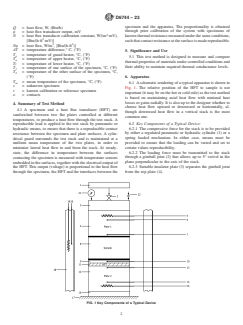
6.1 A schematic rendering of a typical apparatus is shown in Fig. 1. The relative position of the HFT to sample is not important
(it may be on the hot or cold side) as the test method is based on maintaining axial heat flow with minimal heat losses or gains
radially. It is also up to the designer whether to choose heat flow upward or downward or horizontally, although downward heat
flow in a vertical stack is the most common one.
6.2 Key Components of a Typical Device:
6.2.1 The compressive force for the stack is to be provided by either a regulated pneumatic or hydraulic cylinder (1) or a spring
loaded mechanism. In either case, means must be provided to ensure that the loading can be varied and set to certain values
reproducibility.
6.2.2 The loading force must be transmitted to the stack through a gimball joint (2) that allows up to 5° swivel in the plane
perpendicular to the axis of the stack.
6.2.3 Suitable insulator plate (3) separates the gimball joint from the top plate (4).
6.2.4 The top plate (assumed to be the hot plate for the purposes of this description) is equipped with a heater (5) and control
thermocouple (6) adjacent to the heater, to maintain a certain desired temperature. (Other means of producing and maintaining
temperature may also be used as long as the requirements under 6.3 are met.) The construction of the top plate is such as to ensure
uniform heat distribution across its face contacting the sample (8). Attached to this face (or embedded in close proximity to it),
in a fashion that does not interfere with the sample/plate interface, is a temperature sensor (7) (typically a thermocouple,
thermistor) that defines the temperature of the interface on the plate side.
6.2.5 The sample (8) is in direct contact with the top plate on one side and an intermediate plate (9) on the other side.
6.2.6 The intermediate plate (9) is an optional item. Its purpose is to provide a highly conductive environment to the second
temperature sensor (10), to obtain an average temperature of the surface. If the temperature sensor (10) is embedded into the face
of the HFT, or other means are provided to define the temperature of the surface facing the sample, the use of the intermediate
plate is not mandatory.
FIG. 1 Key Components of a Typical Device
D6744 − 23
6.2.7 Heat flux transducer (HFT) is a device that will generate an electrical signal in proportion to the heat flux across it. The level
of output required (sensitivity) greatly depends on the rest of the instrumentation used to read it. The overall performance of the
HFT and its readout instrumentation shall be such as to meet the requirements in Section 13.
6.2.8 The lower plate (12) is constructed similarly to the upper plate (4), except it is positioned as a mirror image.
6.2.9 An insulator plate (16) separates the lower plate (12) from the heat sink (17). In case of using circulating fluid in place of
a heater/thermocouple arrangement in the upper and/or lower plates, the heat sink may or may not be present.
6.2.10 The entire stack is surrounded by a cylindrical guard (18) equipped with a heater (19) and a control thermocouple (20) to
maintain it at the mean temperature between the upper and lower plates. A small, generally unfilled gap separates the guard from
the stack. For instruments limited to operate in the ambient region, no guard is required. A draft shield is recommended in place
of it.
NOTE 2—It is permissible to use thin layers of high conductivity grease or elastomeric material on the two surfaces of the specimen to reduce the thermal
resistance of the interface and promote uniform thermal contact across the interface area.
NOTE 3—The cross sectional area of the specimen may be any, however, most commonly circular and rectangular cross sections are used. Minimum size
is dictated by the magnitude of the disturbance caused by thermal sensors in relation to the overall flux distribution. The most common sizes are 25 mm
round or square to 50 mm round.
6.3 Requirements:
6.3.1 Temperature control of upper and lower plate is to be 60.1 °C (6 0.18 °F) or better.
6.3.2 Reproducible load of 0.28 MPa (40 psi) has been found to be satisfactory for solid specimens. Minimum load shall not be
below 0.07 MPa (10 psi).
6.3.3 Temperature sensors are usually fine gauge or small diameter sheath thermocouples, however, ultraminiature resistance
thermometers and linear thermistors may also be used.
6.3.4 Operating range of a device using a mean temperature guard shall be limited to −100 °C to 300 °C, when using
thermocouples as temperature sensors, and −180 °C to 300 °C with platinum resistance thermometers.
7. Test Specimen
7.1 The specimen to be tested shall be representative for the sample material. The recommended specimen configuration is a
50.8 mm 6 0.25 mm (2 in. 6 0.010 in.) diameter disk, having smooth flat and parallel faces, 60.025 mm (60.001 in.), such that
a uniform thickness within 0.025 mm (6 0.001 in.) is attained in the range from 12.7 mm to 25.4 mm (0.5 in. to 1.0 in.)
8. Sampling and Conditioning
8.1 Cut representative test specimens from larger pieces of the sample material or body.
8.2 Condition the cut specimens in accordance with the requirements of the appropriate material specifications, if any.
9. Calibration
9.1 Select the mean temperature and load conditions required. Adjust the upper heater temperature (T ) and lower heater
u
temperature (T ) such that the temperature difference at the required mean temperature is no less than 30 °C to 35 °C and the
l
specimen ∆T is not less than 3 °C. Adjust the guard heater temperature (T ) such that it is at approximately the average of T and
g u
T .
l
9.2 Select
...