

ASTM D8278-20
(Specification)Standard Specification for Digital Contact Thermometers for Test Methods Measuring Flow Properties of Fuels and Lubricants
General Information
- Abstract
SCOPE
1.1 This specification establishes criteria for digital contact thermometers (DCT) for use in test methods that measure flow properties of materials within the scope of Committee D02. The DCT criteria are based on the design and sensing characteristics of the liquid-in-glass thermometers that are used successfully in Committee D02 test methods.
1.2 The values stated in SI units are to be regarded as standard. No other units of measurement are included in this standard.
1.3 This standard does not purport to address all of the safety concerns, if any, associated with its use. It is the responsibility of the user of this standard to establish appropriate safety, health, and environmental practices and determine the applicability of regulatory limitations prior to use.
1.4 This international standard was developed in accordance with internationally recognized principles on standardization established in the Decision on Principles for the Development of International Standards, Guides and Recommendations issued by the World Trade Organization Technical Barriers to Trade (TBT) Committee.
- Status
- Published
- Publication Date
- 31-Aug-2020
- Technical Committee
- D02 - Petroleum Products, Liquid Fuels, and Lubricants
- Drafting Committee
- D02.07 - Flow Properties
Buy Documents
ASTM D8278-20 - Standard Specification for Digital Contact Thermometers for Test Methods Measuring Flow Properties of Fuels and Lubricants
REDLINE ASTM D8278-20 - Standard Specification for Digital Contact Thermometers for Test Methods Measuring Flow Properties of Fuels and Lubricants
Overview
ASTM D8278-20: Standard Specification for Digital Contact Thermometers for Test Methods Measuring Flow Properties of Fuels and Lubricants defines criteria for digital contact thermometers (DCTs) intended for use in standardized testing methods to measure flow properties of fuels, lubricants, and related petroleum products. Developed by ASTM Committee D02, this standard provides comprehensive requirements to ensure that DCTs perform equivalently to traditional liquid-in-glass thermometers historically used in these applications. Emphasis is placed on SI units as the standard for all measurements, and compliance with internationally recognized calibration and competency requirements is integral to its application.
Key Topics
- Device Requirements: The standard specifies criteria based on design and sensing characteristics aligned with reliable liquid-in-glass thermometers. These include sensor type, measurement accuracy, immersion depth, sensor sheath dimensions, and calibration protocols.
- Sensor Types: DCTs include platinum resistance temperature detectors (PRT), thermistors, and occasionally thermocouples, with direct contact between the sensor sheath and the sample.
- Performance Criteria:
- Accuracy: Measurement accuracy is specified to match industry testing needs.
- Immersion Depth: Proper immersion depth ensures correct temperature readings and is critical for low-volume samples.
- Response Time: Timely measurement updates are required, typically within seconds.
- Calibration: DCTs must be calibrated across their operating range, with calibration traceable to accredited laboratories (such as those with ISO 17025 accreditation).
- Measurement Drift: Periodic checking of measurement drift is essential for maintaining accuracy.
- Test Methods Coverage: DCTs must be suitable for use in a wide range of ASTM D02 test methods for determining pour point, cloud point, viscosity, filterability, yield stress, and cold flow properties.
Applications
ASTM D8278-20 is vital for laboratories, petroleum product manufacturers, and testing organizations adopting digital temperature measurement technology for flow property characterization of fuels and lubricants. Key practical applications include:
- Test Method Replacement: Enables the substitution of digital contact thermometers for liquid-in-glass units in standardized ASTM tests, facilitating more robust data logging and minimizing breakage risks.
- Common Test Scenarios:
- Pour Point and Cloud Point Testing (ASTM D97, D2500, D5853, D6371): Accurate determination of the lowest temperature at which petroleum products remain fluid.
- Viscosity Measurement (ASTM D445, D2162, D2983, D5481, D7279, D8210): Essential for engine oil formulation, hydraulic fluids, and transmission lubricants.
- Low-Temperature Fluidity Tests: Assessment under simulated cold starts or extreme operating conditions.
- Quality Control and Compliance: Ensuring that temperature measurements meet rigorous repeatability and reproducibility requirements for regulatory and quality assurance purposes.
- Calibration and Maintenance: Guidance on establishing ongoing calibration schedules and traceability for instrumentation across a range of laboratory environments.
Related Standards
Adhering to ASTM D8278-20 ensures compatibility and harmonization with key industry standards, such as:
- ASTM D97: Pour Point of Petroleum Products
- ASTM D445: Kinematic Viscosity of Transparent and Opaque Liquids
- ASTM D2500: Cloud Point of Petroleum Products
- ASTM D2162: Basic Calibration of Master Viscometers
- ASTM D2983: Low-Temperature Viscosity Using Rotational Viscometer
- ASTM D5481, D6821: High-Temperature and Low-Temperature Viscosity
- ASTM E563, E644, E1750, E2877: Calibration and use of reference and digital thermometers
- ISO 17025: Competence of testing and calibration laboratories
Summary
ASTM D8278-20 is the definitive specification for digital contact thermometers in testing the flow properties of fuels and lubricants, supporting accurate, traceable, and reliable temperature measurement in critical laboratory applications. Compliance with this standard enables laboratories to modernize measurement technologies while ensuring compatibility with established ASTM test methods and international quality practices.
Relations
- Effective Date
- 01-Apr-2024
- Refers
ASTM D6371-24 - Standard Test Method for Cold Filter Plugging Point of Diesel and Heating Fuels - Effective Date
- 01-Mar-2024
- Effective Date
- 01-Nov-2023
- Effective Date
- 01-Nov-2023
- Effective Date
- 01-Nov-2023
- Effective Date
- 01-May-2020
- Effective Date
- 01-Nov-2019
- Effective Date
- 01-Jul-2019
- Effective Date
- 01-May-2019
- Effective Date
- 01-May-2019
- Effective Date
- 01-Jul-2018
- Refers
ASTM D3829-18 - Standard Test Method for Predicting the Borderline Pumping Temperature of Engine Oil - Effective Date
- 01-Jun-2018
- Effective Date
- 01-Jun-2018
- Refers
ASTM D3829-17 - Standard Test Method for Predicting the Borderline Pumping Temperature of Engine Oil - Effective Date
- 01-May-2017
- Effective Date
- 01-May-2017
Buy Documents
ASTM D8278-20 - Standard Specification for Digital Contact Thermometers for Test Methods Measuring Flow Properties of Fuels and Lubricants
REDLINE ASTM D8278-20 - Standard Specification for Digital Contact Thermometers for Test Methods Measuring Flow Properties of Fuels and Lubricants
Get Certified
Connect with accredited certification bodies for this standard

BSMI (Bureau of Standards, Metrology and Inspection)
Taiwan's standards and inspection authority.
Sponsored listings
Frequently Asked Questions
ASTM D8278-20 is a technical specification published by ASTM International. Its full title is "Standard Specification for Digital Contact Thermometers for Test Methods Measuring Flow Properties of Fuels and Lubricants". This standard covers: SCOPE 1.1 This specification establishes criteria for digital contact thermometers (DCT) for use in test methods that measure flow properties of materials within the scope of Committee D02. The DCT criteria are based on the design and sensing characteristics of the liquid-in-glass thermometers that are used successfully in Committee D02 test methods. 1.2 The values stated in SI units are to be regarded as standard. No other units of measurement are included in this standard. 1.3 This standard does not purport to address all of the safety concerns, if any, associated with its use. It is the responsibility of the user of this standard to establish appropriate safety, health, and environmental practices and determine the applicability of regulatory limitations prior to use. 1.4 This international standard was developed in accordance with internationally recognized principles on standardization established in the Decision on Principles for the Development of International Standards, Guides and Recommendations issued by the World Trade Organization Technical Barriers to Trade (TBT) Committee.
SCOPE 1.1 This specification establishes criteria for digital contact thermometers (DCT) for use in test methods that measure flow properties of materials within the scope of Committee D02. The DCT criteria are based on the design and sensing characteristics of the liquid-in-glass thermometers that are used successfully in Committee D02 test methods. 1.2 The values stated in SI units are to be regarded as standard. No other units of measurement are included in this standard. 1.3 This standard does not purport to address all of the safety concerns, if any, associated with its use. It is the responsibility of the user of this standard to establish appropriate safety, health, and environmental practices and determine the applicability of regulatory limitations prior to use. 1.4 This international standard was developed in accordance with internationally recognized principles on standardization established in the Decision on Principles for the Development of International Standards, Guides and Recommendations issued by the World Trade Organization Technical Barriers to Trade (TBT) Committee.
ASTM D8278-20 is classified under the following ICS (International Classification for Standards) categories: 17.200.20 - Temperature-measuring instruments. The ICS classification helps identify the subject area and facilitates finding related standards.
ASTM D8278-20 has the following relationships with other standards: It is inter standard links to ASTM D445-24, ASTM D6371-24, ASTM D2983-23, ASTM D445-23, ASTM E1750-23, ASTM D5481-13(2020), ASTM E644-11(2019), ASTM D8210-19a, ASTM E2877-12(2019), ASTM D8210-19, ASTM D8210-18, ASTM D3829-18, ASTM D6896-18, ASTM D3829-17, ASTM D6896-17. Understanding these relationships helps ensure you are using the most current and applicable version of the standard.
ASTM D8278-20 is available in PDF format for immediate download after purchase. The document can be added to your cart and obtained through the secure checkout process. Digital delivery ensures instant access to the complete standard document.
Standards Content (Sample)
This international standard was developed in accordance with internationally recognized principles on standardization established in the Decision on Principles for the
Development of International Standards, Guides and Recommendations issued by the World Trade Organization Technical Barriers to Trade (TBT) Committee.
Designation:D8278 −20
Standard Specification for
Digital Contact Thermometers for Test Methods Measuring
Flow Properties of Fuels and Lubricants
This standard is issued under the fixed designation D8278; the number immediately following the designation indicates the year of
original adoption or, in the case of revision, the year of last revision. A number in parentheses indicates the year of last reapproval. A
superscript epsilon (´) indicates an editorial change since the last revision or reapproval.
1. Scope* D2983 Test Method for Low-Temperature Viscosity of Au-
tomaticTransmission Fluids, Hydraulic Fluids, and Lubri-
1.1 This specification establishes criteria for digital contact
cants using a Rotational Viscometer
thermometers (DCT) for use in test methods that measure flow
D3829 Test Method for Predicting the Borderline Pumping
properties of materials within the scope of Committee D02.
Temperature of Engine Oil
The DCT criteria are based on the design and sensing charac-
D4539 Test Method for Filterability of Diesel Fuels by
teristics of the liquid-in-glass thermometers that are used
Low-Temperature Flow Test (LTFT)
successfully in Committee D02 test methods.
D4684 Test Method for Determination of Yield Stress and
1.2 The values stated in SI units are to be regarded as
Apparent Viscosity of Engine Oils at Low Temperature
standard. No other units of measurement are included in this
D5481 Test Method for Measuring Apparent Viscosity at
standard.
High-Temperature and High-Shear Rate by Multicell Cap-
1.3 This standard does not purport to address all of the illary Viscometer
safety concerns, if any, associated with its use. It is the
D5853 Test Method for Pour Point of Crude Oils
responsibility of the user of this standard to establish appro- D6371 Test Method for Cold Filter Plugging Point of Diesel
priate safety, health, and environmental practices and deter-
and Heating Fuels
mine the applicability of regulatory limitations prior to use. D6821 Test Method for LowTemperatureViscosity of Drive
1.4 This international standard was developed in accor-
Line Lubricants in a Constant Shear Stress Viscometer
dance with internationally recognized principles on standard- D6896 Test Method for Determination of Yield Stress and
ization established in the Decision on Principles for the
Apparent Viscosity of Used Engine Oils at Low Tempera-
Development of International Standards, Guides and Recom- ture
mendations issued by the World Trade Organization Technical
D7279 Test Method for Kinematic Viscosity of Transparent
Barriers to Trade (TBT) Committee.
and Opaque Liquids by Automated Houillon Viscometer
D7962 Practice for Determination of Minimum Immersion
2. Referenced Documents
Depth and Assessment of Temperature Sensor Measure-
ment Drift
2.1 ASTM Standards:
D8210 Test Method for Automatic Determination of Low-
D97 Test Method for Pour Point of Petroleum Products
Temperature Viscosity of Automatic Transmission Fluids,
D445 Test Method for Kinematic Viscosity of Transparent
Hydraulic Fluids, and Lubricants Using a Rotational
and Opaque Liquids (and Calculation of Dynamic Viscos-
Viscometer
ity)
E177 Practice for Use of the Terms Precision and Bias in
D2162 Practice for Basic Calibration of Master Viscometers
ASTM Test Methods
and Viscosity Oil Standards
E563 Practice for Preparation and Use of an Ice-Point Bath
D2500 Test Method for Cloud Point of Petroleum Products
as a Reference Temperature
and Liquid Fuels
E644 Test Methods for Testing Industrial Resistance Ther-
mometers
This test method is under the jurisdiction of ASTM Committee D02 on
E1750 Guide for Use of Water Triple Point Cells
Petroleum Products, Liquid Fuels, and Lubricants and is the direct responsibility of
E2877 Guide for Digital Contact Thermometers
Subcommittee D02.07 on Flow Properties.
2.2 ISO Standard:
Current edition approved Sept. 1, 2020. Published October 2020. Originally
approved in 2019. Last previous edition approved in 2019 as D8278 – 19. DOI: ISO 17025 General requirements for the competence of
10.1520/D8278-20.
testing and calibration laboratories
For referenced ASTM standards, visit the ASTM website, www.astm.org, or
contact ASTM Customer Service at service@astm.org. For Annual Book of ASTM
Standards volume information, refer to the standard’s Document Summary page on Available from American National Standards Institute (ANSI), 25 W. 43rd St.,
the ASTM website. 4th Floor, New York, NY 10036, http://www.ansi.org.
*A Summary of Changes section appears at the end of this standard
Copyright © ASTM International, 100 Barr Harbor Drive, PO Box C700, West Conshohocken, PA 19428-2959. United States
D8278−20
3. Terminology 5. Significance and Use
3.1 Definitions: 5.1 The DCTs meeting the indicated requirements have
been found to be suitable for replacing the liquid-in-glass
3.1.1 accuracy, n—the closeness of agreement between a
thermometers in the noted test methods. The criteria are based
test result and an accepted reference value. E177
on key elements of liquid-in-glass (LiG) thermometers, such as
3.1.2 digital contact thermometer (DCT), n—an electronic
bulb length, immersion depth, measurement precision, and
device consisting of a digital display and associated tempera-
thermometerpositioning.Theprescribeddimensionsforsensor
ture sensing probe.
length, immersion depth, and sheath diameter are critical
3.1.2.1 Discussion—This device consists of a temperature
variables when measuring the temperature of small static
sensor connected to a measuring instrument; this instrument
samples due to differences in temperature probe thermal
measures the temperature-dependent quantity of the sensor,
conductivity. Therefore, a DCT that is suitable for use in a
computes the temperature from the measured quantity, and
stirred constant temperature bath will likely result in tempera-
provides a digital output. This digital output goes to a digital
turemeasurementerrorswhenusedtomeasurethetemperature
displayand/orrecordingdevicethatmaybeinternalorexternal
of small static sample volumes.
to the device.
3.1.2.2 Discussion—The devices are often referred to as a 6. DCT Criteria
“digital thermometers,” however the term includes devices that
6.1 The DCT requirements shown in Table 1 are for various
sense temperature by means other than being in physical
temperature measurement applications used in Subcommittee
contact with the media.
D02.07 test methods and reference in the test method. The
3.1.2.3 Discussion—PET is an acronym for portable elec-
DCTresponse time requirements are shown in Table 2 with the
tronic thermometers, a subset of digital contact thermometers
procedure for determining a probe’s response time in 6.4.
(DCT).
NOTE 1—DCT with a PRT element that is a suspended wire, such as
3.1.3 DCT immersion depth, n—depth that a DCT sensor is those used in a SPRT, are extremely sensitive to mechanical shock which
usually will alter its calibration. Other PRT sensing element designs such
immersed in a uniform temperature environment, such that
asthinfilmandmandrelwrappedwirecanbesensitivetovibrationswhich
further immersion does not produce a change in indicated
alter their calibration or result in failure.
temperature greater than the specified tolerance.
6.1.1 When considering the use of a DCT criteria in Table 1
3.1.3.1 Discussion—This is a DCT probe characteristic and
for test methods other than those noted, careful consideration
establishes a baseline immersion for the probe.This is separate
must be given to the DCT probe’s placement in the new
anddistinctfromhowtheprobeislocatedinatestmethod.The
application versus its placement in the media, bath, or sample
use and positioning of a DCT probe in a test method is to be
of the noted method. The metal construction of DCT probes
described in the test method.
can have a significant impact on measured value when com-
3.2 Definitions of Terms Specific to This Standard:
paredtoaliquid-in-glassthermometerinasimilarenvironment
3.2.1 range-of-use, n—a subset of the nominal DCT tem-
due to its greater thermal conductivity. Each of the DCT
perature range.
criteria in the table were developed for the indicated method’s
uniquetestenvironment.Otherfactorscanimpacttheabilityof
3.2.1.1 Discussion—This is the temperature range over
a DCT to mimic the temperature measurement of a LiG
which a particular DCT is to be used. For example, if a DCT
thermometer. When a DCT probe is immersed in the sample,
is to be used for viscosity measurements as 40 °C and 100 °C,
its immersion depth and ratio of probe volume to sample
then its “range-of-use” is 60 °C.
volume will have an impact on the measured value. Thus the
smaller the probe diameter the smaller the impact on sample
4. Summary
temperature.
4.1 This specification sets the criteria for digital contact
NOTE2—TheDCT’selectronicsaretypicallylimitedtoanenvironment
thermometers (DCT) used in measuring flow properties of
of 0 °C to 35 °C. A DCT’s temperature limits can be found in its manual
or in the manufacturer’s specifications.
fuels and lubricants. The DCT criteria were selected so that
DCTtemperature measurements would be essentially the same
6.2 DCT Probe Immersion Depth—This criteria quantifies
as those measured using a liquid-in-glass (LiG) thermometer.
the length of the DCT probe above the tip that needs to be
For some of the noted test methods, the temperature of a small
covered by the material being measured in order to obtain an
static sample volume is measured, thus, the difference in
accurate temperature measurement. Immersing the probe in a
thermal conductivity between the different types of devices
material by less than its minimum immersion depth can result
will have an impact on measurement equivalence.
in temperature measurements that significantly differ from
actual temperature. The error is dependent on the temperature
4.2 The DCT temperature sensing elements noted in this
difference between the material being measured and surround-
specification are platinum resistance temperature (PRT) detec-
ing (ambient) temperature. A test method will set the immer-
tors or thermistors whose sheath or enclosure is in direct
sion requirements for the DCT probe.
contact with the substance being measured and are referred to
as a digital contact thermometers. Both PRTs and thermistors 6.3 Measurement Drift—The drift in calibration should be
are members of a group referred to as resistance temperature checked periodically and at least yearly. This can be accom-
detectors(RTD)astheirresistanceisafunctionoftemperature. plished using Practice D7962, Practice E563, Test Methods
D8278−20
TABLE 1 DCT Criteria for
...
This document is not an ASTM standard and is intended only to provide the user of an ASTM standard an indication of what changes have been made to the previous version. Because
it may not be technically possible to adequately depict all changes accurately, ASTM recommends that users consult prior editions as appropriate. In all cases only the current version
of the standard as published by ASTM is to be considered the official document.
Designation: D8278 − 19 D8278 − 20
Standard Specification for
Digital Contact Thermometers for Test Methods Measuring
Flow Properties of Fuels and Lubricants
This standard is issued under the fixed designation D8278; the number immediately following the designation indicates the year of
original adoption or, in the case of revision, the year of last revision. A number in parentheses indicates the year of last reapproval. A
superscript epsilon (´) indicates an editorial change since the last revision or reapproval.
1. Scope Scope*
1.1 This specification establishes criteria for digital contact thermometers (DCT) for use in test methods that measure flow
properties of materials within the scope of Committee D02. The DCT criteria are based on the design and sensing characteristics
of the liquid-in-glass thermometers that are used successfully in Committee D02 test methods.
1.2 The values stated in SI units are to be regarded as standard. No other units of measurement are included in this standard.
1.3 This standard does not purport to address all of the safety concerns, if any, associated with its use. It is the responsibility
of the user of this standard to establish appropriate safety, health, and environmental practices and determine the applicability of
regulatory limitations prior to use.
1.4 This international standard was developed in accordance with internationally recognized principles on standardization
established in the Decision on Principles for the Development of International Standards, Guides and Recommendations issued
by the World Trade Organization Technical Barriers to Trade (TBT) Committee.
2. Referenced Documents
2.1 ASTM Standards:
D97 Test Method for Pour Point of Petroleum Products
D445 Test Method for Kinematic Viscosity of Transparent and Opaque Liquids (and Calculation of Dynamic Viscosity)
D2162 Practice for Basic Calibration of Master Viscometers and Viscosity Oil Standards
D2500 Test Method for Cloud Point of Petroleum Products and Liquid Fuels
D2983 Test Method for Low-Temperature Viscosity of Automatic Transmission Fluids, Hydraulic Fluids, and Lubricants using
a Rotational Viscometer
D3829 Test Method for Predicting the Borderline Pumping Temperature of Engine Oil
D4539 Test Method for Filterability of Diesel Fuels by Low-Temperature Flow Test (LTFT)
D4684 Test Method for Determination of Yield Stress and Apparent Viscosity of Engine Oils at Low Temperature
D5481 Test Method for Measuring Apparent Viscosity at High-Temperature and High-Shear Rate by Multicell Capillary
Viscometer
D5853 Test Method for Pour Point of Crude Oils
D6371 Test Method for Cold Filter Plugging Point of Diesel and Heating Fuels
D6821 Test Method for Low Temperature Viscosity of Drive Line Lubricants in a Constant Shear Stress Viscometer
D6896 Test Method for Determination of Yield Stress and Apparent Viscosity of Used Engine Oils at Low Temperature
This test method is under the jurisdiction of ASTM Committee D02 on Petroleum Products, Liquid Fuels, and Lubricants and is the direct responsibility of Subcommittee
D02.07 on Flow Properties.
Current edition approved July 1, 2019Sept. 1, 2020. Published July 2019October 2020. Originally approved in 2019. Last previous edition approved in 2019 as D8278 – 19.
DOI: 10.1520/D8278-19.10.1520/D8278-20.
For referenced ASTM standards, visit the ASTM website, www.astm.org, or contact ASTM Customer Service at service@astm.org. For Annual Book of ASTM Standards
volume information, refer to the standard’s Document Summary page on the ASTM website.
*A Summary of Changes section appears at the end of this standard
Copyright © ASTM International, 100 Barr Harbor Drive, PO Box C700, West Conshohocken, PA 19428-2959. United States
D8278 − 20
D7279 Test Method for Kinematic Viscosity of Transparent and Opaque Liquids by Automated Houillon Viscometer
D7962 Practice for Determination of Minimum Immersion Depth and Assessment of Temperature Sensor Measurement Drift
D8210 Test Method for Automatic Determination of Low-Temperature Viscosity of Automatic Transmission Fluids, Hydraulic
Fluids, and Lubricants Using a Rotational Viscometer
E177 Practice for Use of the Terms Precision and Bias in ASTM Test Methods
E563 Practice for Preparation and Use of an Ice-Point Bath as a Reference Temperature
E644 Test Methods for Testing Industrial Resistance Thermometers
E1750 Guide for Use of Water Triple Point Cells
E2877 Guide for Digital Contact Thermometers
2.2 ISO Standard:
ISO 17025 General requirements for the competence of testing and calibration laboratories
3. Terminology
3.1 Definitions:
3.1.1 accuracy, n—the closeness of agreement between a test result and an accepted reference value. E177
3.1.2 digital contact thermometer (DCT), n—an electronic device consisting of a digital display and associated temperature
sensing probe.
3.1.2.1 Discussion—
This device consists of a temperature sensor connected to a measuring instrument; this instrument measures the temperature-
dependent quantity of the sensor, computes the temperature from the measured quantity, and provides a digital output. This digital
output goes to a digital display and/or recording device that may be internal or external to the device.
3.1.2.2 Discussion—
The devices are often referred to as a “digital thermometers,” however the term includes devices that sense temperature by means
other than being in physical contact with the media.
3.1.2.3 Discussion—
PET is an acronym for portable electronic thermometers, a subset of digital contact thermometers (DCT).
3.1.3 DCT immersion depth, n—depth that a DCT sensor should be is immersed in a uniform temperature environment, such that
further immersion does not produce a change in indicated temperature greater than the specified tolerance.
3.1.3.1 Discussion—
This is a DCT probe characteristic and establishes a baseline immersion for the probe. This is separate and distinct from how the
probe is located in a test method. The use and positioning of a DCT probe in a test method is to be described in the test method.
3.2 Definitions of Terms Specific to This Standard:
3.2.1 range-of-use, n—a subset of the nominal DCT temperature range.
3.2.1.1 Discussion—
This is the temperature range over which a particular DCT is to be used. For example, if a DCT is to be used for viscosity
measurements as 40 °C and 100 °C, then its “range-of-use” is 60 °C.
4. Summary
4.1 This specification sets the criteria for digital contact thermometers (DCT) used in measuring flow properties of fuels and
lubricants. The DCT criteria were selected so that DCT temperature measurements would be essentially the same as those
measured using a liquid-in-glass (LiG) thermometer. For some of the noted test methods, the temperature of a small static sample
volume is measured, thus, the difference in thermal conductivity between the different types of devices will have an impact on
measurement equivalence.
4.2 The DCT temperature sensing elements noted in this specification are platinum resistance temperature (PRT) detectors or
thermistors whose sheath or enclosure is in direct contact with the substance being measured and are referred to as a digital contact
thermometers. Both PRTs and thermistors are members of a group referred to as resistance temperature detectors (RTD) as their
resistance is a function of temperature.
Available from American National Standards Institute (ANSI), 25 W. 43rd St., 4th Floor, New York, NY 10036, http://www.ansi.org.
D8278 − 20
5. Significance and Use
5.1 The DCTs meeting the indicated requirements have been found to be suitable for replacing the liquid-in-glass thermometers
in the noted test methods. The criteria are based on key elements of liquid-in-glass (LiG) thermometers, such as bulb length,
immersion depth, measurement precision, and thermometer positioning. The prescribed dimensions for sensor length, immersion
depth, and sheath diameter are critical variables when measuring the temperature of small static samples due to differences in
temperature probe thermal conductivity. Therefore, a DCT that is suitable for use in a stirred constant temperature bath will likely
result in temperature measurement errors when used to measure the temperature of small static sample volumes.
6. DCT Criteria
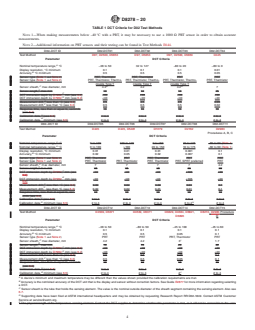
6.1 The DCT requirements shown in Table 1 are for various temperature measurement applications used in Subcommittee D02.07
test methods.methods and reference in the test method. The DCT response time requirements are shown in Table 2 with the
procedure for determining a probe’s response time in 6.4.
NOTE 1—DCT with a PRT element that is a suspended wire, such as those used in a SPRT, are extremely sensitive to mechanical shock which usually
will alter its calibration. Other PRT sensing element designs such as thin film and mandrel wrapped wire can be sensitive to vibrations which alter their
calibration or result in failure.
6.1.1 When considering the use of a DCT criteria in Table 1 for test methods other than those noted, careful consideration must
be given to the DCT probe’s placement in the new application versus its placement in the media, bath, or sample of the noted
method. The metal construction of DCT probes can have a significant impact on measured value when compared to a
liquid-in-glass thermometer in a similar environment due to its greater thermal conductivity. Each of the DCT criteria in the table
were developed for the indicated method’s unique test environment. Other factors can impact the ability of a DCT to mimic the
temperature measurement of a LiG thermometer. When a DCT probe is immersed in the sample, its immersion depth and ratio of
probe volume to sample volume will have an impact on the measured value. Thus the smaller the probe diameter the smaller the
impact on sample temperature.
NOTE 2—The DCT’s electronics are typically limited to an environment of 0 °C to 35 °C. A DCT’s temperature limits can be found in its manual or in
the manufacturer’s specifications.
6.2 DCT Probe Immersion Depth—This criteria quantifies the length of the DCT probe above the tip that needs to be covered by
the material being measured in order to obtain an accurate temperature measurement. Immersing the probe in a material by less
than its minimum immersion depth can result in temperature measurements that significantly differ from actual temperature. The
error is dependent on the temperature difference between the material being measured and surrounding (ambient) temperature. A
test method will set the immersion requirements for the DCT probe.
6.3 Measurement Drift—The drift in calibration should be checked periodically and at least yearly. This can be accomplished using
Practice D7962, Practice E563, Test Methods E644, or similar procedure. When the DCT calibration drift just exceeds the noted
limit for calibration drift, then it is to be rechecked within a short period of time but no longer than month. If the subsequent
measurement of DCT calibration drift exceeds the specified limit, it is to be fully recalibrated consistent with its range-of-use. If
the DCT calibration drift significantly exceeds the noted limit, then it must be recalibrated consistent with its range-of-use. See
Practice E563, Test Methods E644, or Guide E1750 for more information regarding checking calibrations.
NOTE 3—For reference temperatures, additional information on preparing and using an ice bath can be found in Practice E563. Guide E1750 provides
guidance for preparing and using a water triple point cell.
6.4 Response Time—Applies to a digital contact thermom
...