

ASTM C1637-21
(Test Method)Standard Test Method for Determination of Impurities in Plutonium Materials-Acid Digestion and Inductively Coupled Plasma-Mass Spectroscopy (ICP-MS) Analysis
General Information
- Abstract
SIGNIFICANCE AND USE
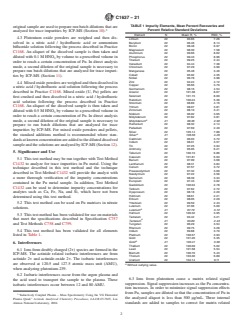
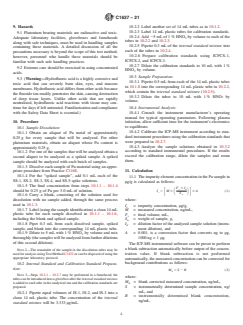
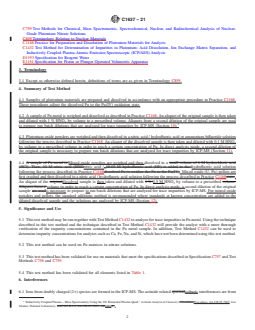
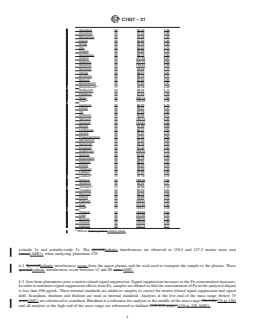
5.1 This test method may be run together with Test Method C1432 to analyze for trace impurities in Pu metal. Using the technique described in this test method and the technique described in Test Method C1432 will provide the analyst with a more thorough verification of the impurity concentrations contained in the Pu metal sample. In addition, Test Method C1432 can be used to determine impurity concentrations for analytes such as Ca, Fe, Na, and Si, which have not been determined using this test method.
5.2 This test method can be used on Pu matrices in nitrate solutions.
5.3 This test method has been validated for use on materials that meet the specifications described in Specification C757 and Test Methods C758 and C759.
5.4 This test method has been validated for all elements listed in Table 1. (A) Without outlying value.
SCOPE
1.1 This test method covers the determination of trace elements in plutonium (Pu) materials such as Pu metal, Pu oxides, and Pu/uranium (U) mixed oxides. The Pu sample is dissolved in acid, and the concentration of the trace impurities are determined by Inductively Coupled Plasma-Mass Spectroscopy (ICP-MS).
1.2 This test method is specific for the determination of trace impurities where the samples are dissolved and the oxidation state is adjusted to the Pu(IV) and, if applicable, the U(VI) state. It may be applied to other matrices; however, it is the responsibility of the user to evaluate the performance of other matrices.
1.3 The use of a quadrupole ICP-MS or a high resolution ICP-MS (HR-ICP-MS) can be employed in all applications relevant to this test method. HR-ICP-MS is a better option in many cases since it can reduce or potentially eliminate interferences encountered in the following complex sample matrices.
1.4 The values stated in SI units are to be regarded as standard. No other units of measurement are included in this standard.
1.5 This standard does not purport to address all of the safety concerns, if any, associated with its use. It is the responsibility of the user of this standard to establish appropriate safety, health, and environmental practices and determine the applicability of regulatory limitations prior to use.
1.6 This international standard was developed in accordance with internationally recognized principles on standardization established in the Decision on Principles for the Development of International Standards, Guides and Recommendations issued by the World Trade Organization Technical Barriers to Trade (TBT) Committee.
- Status
- Published
- Publication Date
- 31-May-2021
- Technical Committee
- C26 - Nuclear Fuel Cycle
- Drafting Committee
- C26.05 - Methods of Test
Buy Documents


ASTM C1637-21 - Standard Test Method for Determination of Impurities in Plutonium Materials—Acid Digestion and Inductively Coupled Plasma-Mass Spectroscopy (ICP-MS) Analysis


REDLINE ASTM C1637-21 - Standard Test Method for Determination of Impurities in Plutonium Materials—Acid Digestion and Inductively Coupled Plasma-Mass Spectroscopy (ICP-MS) Analysis
Overview
ASTM C1637-21 is a globally recognized test method developed by ASTM International for the determination of impurities in plutonium (Pu) materials. Employing acid digestion and Inductively Coupled Plasma-Mass Spectroscopy (ICP-MS), this standard provides a systematic approach for analyzing trace elements in various plutonium matrices, including plutonium metal, oxides, and mixed oxides with uranium. This method is essential in nuclear material analysis, ensuring the quality and suitability of plutonium-based materials for specialized applications.
Key Topics
- Sample Preparation and Acid Digestion: Plutonium materials are precisely prepared and dissolved using established procedures, typically adjusting the oxidation state for optimal analysis.
- ICP-MS Analysis: Utilizes either quadrupole or high-resolution instruments, with the latter preferred for reducing interference in complex matrices.
- Impurity Determination: Validated for a comprehensive set of trace elements, including alkali metals, transition metals, and rare earth elements.
- Matrix Compatibility: Applicable to Pu matrices in nitrate solutions and compliant with materials specified in ASTM C757, C758, and C759.
- Interference Mitigation: Discusses strategies for minimizing signal suppression and spectral interferences, improving accuracy and reproducibility.
- Collaborative Application: This method can be paired with ASTM C1432 for a more thorough analysis by covering a broader range of impurity elements.
- Quality and Precision: Incorporates use of internal standards and calibration protocols to ensure reliable and repeatable results.
Applications
This standard is critical for:
- Quality Assurance in Nuclear Fuels: Used to verify the purity of nuclear-grade plutonium and mixed oxide fuels, which is critical for nuclear reactor safety and efficiency.
- Regulatory Compliance: Ensures plutonium materials meet stringent regulatory and safety thresholds for impurity content.
- Research and Development: Valuable in R&D environments where precise chemical analysis of radioactive materials is required.
- Nuclear Safeguards and Forensics: Supports analysis for nonproliferation monitoring and forensic investigations of nuclear materials.
Related Standards
- ASTM C1432: Determination of impurities in plutonium by acid dissolution, ion exchange, and ICP-AES.
- ASTM C757: Specification for nuclear-grade plutonium dioxide powder for light water reactors.
- ASTM C758 & C759: Test methods for chemical and spectrometric analysis of nuclear-grade plutonium and nitrate solutions.
- ASTM C859: Terminology relating to nuclear materials.
- ASTM C1168: Procedures for preparation and dissolution of plutonium materials.
- ASTM D1193: Specification for reagent water used in laboratory environments.
- ASTM E1154: Specification for piston or plunger operated volumetric apparatus.
Practical Value
Adopting ASTM C1637-21 ensures high standards of accuracy and safety in identifying impurities in plutonium materials, supporting the nuclear industry with:
- Reliable impurity profiling, vital for fuel fabrication, reactor performance, and safety assurance.
- Confidence for operators and regulators through standardized, internationally accepted methodologies.
- Data integrity and reproducibility, essential for audits and long-term material tracking.
For labs, manufacturers, or regulatory authorities involved in the nuclear fuel cycle, this standard provides a comprehensive framework for high-precision impurity determination, fostering safety, compliance, and operational excellence.
Relations
- Effective Date
- 01-Jan-2024
- Effective Date
- 01-Dec-2023
- Effective Date
- 01-Oct-2023
- Effective Date
- 01-Sep-2018
- Effective Date
- 01-Sep-2018
- Effective Date
- 01-Apr-2016
- Effective Date
- 01-Sep-2015
- Effective Date
- 01-Jun-2015
- Effective Date
- 15-Jun-2014
- Effective Date
- 15-Jan-2014
- Effective Date
- 01-Jun-2013
- Effective Date
- 01-May-2013
- Effective Date
- 01-Nov-2010
- Effective Date
- 01-Aug-2010
- Effective Date
- 01-Jun-2010
Buy Documents
ASTM C1637-21 - Standard Test Method for Determination of Impurities in Plutonium Materials—Acid Digestion and Inductively Coupled Plasma-Mass Spectroscopy (ICP-MS) Analysis
REDLINE ASTM C1637-21 - Standard Test Method for Determination of Impurities in Plutonium Materials—Acid Digestion and Inductively Coupled Plasma-Mass Spectroscopy (ICP-MS) Analysis
Get Certified
Connect with accredited certification bodies for this standard

ECOCERT
Organic and sustainability certification.

Eurofins Food Testing Global
Global leader in food, environment, and pharmaceutical product testing.

Intertek Bangladesh
Intertek certification and testing services in Bangladesh.
Sponsored listings
Frequently Asked Questions
ASTM C1637-21 is a standard published by ASTM International. Its full title is "Standard Test Method for Determination of Impurities in Plutonium Materials-Acid Digestion and Inductively Coupled Plasma-Mass Spectroscopy (ICP-MS) Analysis". This standard covers: SIGNIFICANCE AND USE 5.1 This test method may be run together with Test Method C1432 to analyze for trace impurities in Pu metal. Using the technique described in this test method and the technique described in Test Method C1432 will provide the analyst with a more thorough verification of the impurity concentrations contained in the Pu metal sample. In addition, Test Method C1432 can be used to determine impurity concentrations for analytes such as Ca, Fe, Na, and Si, which have not been determined using this test method. 5.2 This test method can be used on Pu matrices in nitrate solutions. 5.3 This test method has been validated for use on materials that meet the specifications described in Specification C757 and Test Methods C758 and C759. 5.4 This test method has been validated for all elements listed in Table 1. (A) Without outlying value. SCOPE 1.1 This test method covers the determination of trace elements in plutonium (Pu) materials such as Pu metal, Pu oxides, and Pu/uranium (U) mixed oxides. The Pu sample is dissolved in acid, and the concentration of the trace impurities are determined by Inductively Coupled Plasma-Mass Spectroscopy (ICP-MS). 1.2 This test method is specific for the determination of trace impurities where the samples are dissolved and the oxidation state is adjusted to the Pu(IV) and, if applicable, the U(VI) state. It may be applied to other matrices; however, it is the responsibility of the user to evaluate the performance of other matrices. 1.3 The use of a quadrupole ICP-MS or a high resolution ICP-MS (HR-ICP-MS) can be employed in all applications relevant to this test method. HR-ICP-MS is a better option in many cases since it can reduce or potentially eliminate interferences encountered in the following complex sample matrices. 1.4 The values stated in SI units are to be regarded as standard. No other units of measurement are included in this standard. 1.5 This standard does not purport to address all of the safety concerns, if any, associated with its use. It is the responsibility of the user of this standard to establish appropriate safety, health, and environmental practices and determine the applicability of regulatory limitations prior to use. 1.6 This international standard was developed in accordance with internationally recognized principles on standardization established in the Decision on Principles for the Development of International Standards, Guides and Recommendations issued by the World Trade Organization Technical Barriers to Trade (TBT) Committee.
SIGNIFICANCE AND USE 5.1 This test method may be run together with Test Method C1432 to analyze for trace impurities in Pu metal. Using the technique described in this test method and the technique described in Test Method C1432 will provide the analyst with a more thorough verification of the impurity concentrations contained in the Pu metal sample. In addition, Test Method C1432 can be used to determine impurity concentrations for analytes such as Ca, Fe, Na, and Si, which have not been determined using this test method. 5.2 This test method can be used on Pu matrices in nitrate solutions. 5.3 This test method has been validated for use on materials that meet the specifications described in Specification C757 and Test Methods C758 and C759. 5.4 This test method has been validated for all elements listed in Table 1. (A) Without outlying value. SCOPE 1.1 This test method covers the determination of trace elements in plutonium (Pu) materials such as Pu metal, Pu oxides, and Pu/uranium (U) mixed oxides. The Pu sample is dissolved in acid, and the concentration of the trace impurities are determined by Inductively Coupled Plasma-Mass Spectroscopy (ICP-MS). 1.2 This test method is specific for the determination of trace impurities where the samples are dissolved and the oxidation state is adjusted to the Pu(IV) and, if applicable, the U(VI) state. It may be applied to other matrices; however, it is the responsibility of the user to evaluate the performance of other matrices. 1.3 The use of a quadrupole ICP-MS or a high resolution ICP-MS (HR-ICP-MS) can be employed in all applications relevant to this test method. HR-ICP-MS is a better option in many cases since it can reduce or potentially eliminate interferences encountered in the following complex sample matrices. 1.4 The values stated in SI units are to be regarded as standard. No other units of measurement are included in this standard. 1.5 This standard does not purport to address all of the safety concerns, if any, associated with its use. It is the responsibility of the user of this standard to establish appropriate safety, health, and environmental practices and determine the applicability of regulatory limitations prior to use. 1.6 This international standard was developed in accordance with internationally recognized principles on standardization established in the Decision on Principles for the Development of International Standards, Guides and Recommendations issued by the World Trade Organization Technical Barriers to Trade (TBT) Committee.
ASTM C1637-21 is classified under the following ICS (International Classification for Standards) categories: 71.060.10 - Chemical elements. The ICS classification helps identify the subject area and facilitates finding related standards.
ASTM C1637-21 has the following relationships with other standards: It is inter standard links to ASTM C859-24, ASTM C1432-23, ASTM C1168-23, ASTM C758-18, ASTM C759-18, ASTM C757-16, ASTM C1168-15, ASTM C1432-15, ASTM C859-14a, ASTM C859-14, ASTM C859-13a, ASTM C859-13, ASTM C859-10b, ASTM C859-10a, ASTM C759-10. Understanding these relationships helps ensure you are using the most current and applicable version of the standard.
ASTM C1637-21 is available in PDF format for immediate download after purchase. The document can be added to your cart and obtained through the secure checkout process. Digital delivery ensures instant access to the complete standard document.
Standards Content (Sample)
This international standard was developed in accordance with internationally recognized principles on standardization established in the Decision on Principles for the
Development of International Standards, Guides and Recommendations issued by the World Trade Organization Technical Barriers to Trade (TBT) Committee.
Designation: C1637 − 21
Standard Test Method for
Determination of Impurities in Plutonium Materials—Acid
Digestion and Inductively Coupled Plasma-Mass
Spectroscopy (ICP-MS) Analysis
This standard is issued under the fixed designation C1637; the number immediately following the designation indicates the year of
original adoption or, in the case of revision, the year of last revision. A number in parentheses indicates the year of last reapproval. A
superscript epsilon (´) indicates an editorial change since the last revision or reapproval.
1. Scope 2. Referenced Documents
1.1 This test method covers the determination of trace
2.1 ASTM Standards:
elements in plutonium (Pu) materials such as Pu metal, Pu
C757 Specification for Nuclear-Grade Plutonium Dioxide
oxides, and Pu/uranium (U) mixed oxides. The Pu sample is
Powder for Light Water Reactors
dissolved in acid, and the concentration of the trace impurities
C758 Test Methods for Chemical, Mass Spectrometric,
aredeterminedbyInductivelyCoupledPlasma-MassSpectros-
Spectrochemical, Nuclear, and RadiochemicalAnalysis of
copy (ICP-MS).
Nuclear-Grade Plutonium Metal
C759 Test Methods for Chemical, Mass Spectrometric,
1.2 This test method is specific for the determination of
Spectrochemical, Nuclear, and RadiochemicalAnalysis of
trace impurities where the samples are dissolved and the
Nuclear-Grade Plutonium Nitrate Solutions
oxidation state is adjusted to the Pu(IV) and, if applicable, the
C859 Terminology Relating to Nuclear Materials
U(VI) state. It may be applied to other matrices; however, it is
C1168 PracticeforPreparationandDissolutionofPlutonium
the responsibility of the user to evaluate the performance of
Materials for Analysis
other matrices.
C1432 Test Method for Determination of Impurities in
1.3 The use of a quadrupole ICP-MS or a high resolution
Plutonium: Acid Dissolution, Ion Exchange Matrix
ICP-MS (HR-ICP-MS) can be employed in all applications
Separation, and Inductively Coupled Plasma-Atomic
relevant to this test method. HR-ICP-MS is a better option in
Emission Spectroscopic (ICP/AES) Analysis
many cases since it can reduce or potentially eliminate inter-
D1193 Specification for Reagent Water
ferences encountered in the following complex sample matri-
E1154 Specification for Piston or Plunger Operated Volu-
ces.
metric Apparatus
1.4 The values stated in SI units are to be regarded as
standard. No other units of measurement are included in this
3. Terminology
standard.
3.1 Except as otherwise defined herein, definitions of terms
1.5 This standard does not purport to address all of the
are as given in Terminology C859.
safety concerns, if any, associated with its use. It is the
responsibility of the user of this standard to establish appro-
4. Summary of Test Method
priate safety, health, and environmental practices and deter-
4.1 Samples of plutonium materials are prepared and dis-
mine the applicability of regulatory limitations prior to use.
solved in accordance with an appropriate procedure in Practice
1.6 This international standard was developed in accor-
C1168.These procedures adjust the dissolved Pu to the Pu(IV)
dance with internationally recognized principles on standard-
oxidation state.
ization established in the Decision on Principles for the
Development of International Standards, Guides and Recom-
4.2 A sample of Pu metal is weighed and dissolved as
mendations issued by the World Trade Organization Technical
described in Practice C1168.An aliquot of the original sample
Barriers to Trade (TBT) Committee.
is then taken and diluted with 1 % HNO by volume to a
prescribed volume. Aliquots from a second dilution of the
This test method is under the jurisdiction ofASTM Committee C26 on Nuclear
Fuel Cycle and is the direct responsibility of Subcommittee C26.05 on Methods of
Test. For referenced ASTM standards, visit the ASTM website, www.astm.org, or
CurrenteditionapprovedJune1,2021.PublishedJuly2021.Originallyapproved contact ASTM Customer Service at service@astm.org. For Annual Book of ASTM
in 2006. Last previous edition approved in 2013 as D1637 – 13. DOI: 10.1520/ Standards volume information, refer to the standard’s Document Summary page on
C1637-21. the ASTM website.
Copyright © ASTM International, 100 Barr Harbor Drive, PO Box C700, West Conshohocken, PA 19428-2959. United States
C1637 − 21
TABLE 1 Impurity Elements, Mean Percent Recoveries and
original sample are used to prepare run batch dilutions that are
3 Percent Relative Standard Deviations
analyzed for trace impurities by ICP-MS (Section 10).
Element N Mean R, % RSD, %
4.3 Plutonium oxide powders are weighed and then dis-
Lithium 22 93.65 7.26
Beryllium 22 96.46 8.14
solved in a nitric acid / hydrofluoric acid or ammonium
Boron 22 98.48 6.97
bifluoride solution following the process described in Practice
Magnesium 22 98.30 7.58
C1168. An aliquot of the dissolved sample is then taken and
Aluminium 22 99.66 8.62
diluted with 0.1 M HNO by volume to a prescribed volume in Phosphorus 22 99.43 8.96
Titanium 22 99.25 2.44
order to reach a certain concentration of Pu. In direct analysis
Vanadium 22 94.44 7.38
mode, a second dilution of the original sample is necessary to
Chromium 22 97.29 3.90
Manganese 22 95.48 3.46
prepare run batch dilutions that are analyzed for trace impuri-
Cobalt 22 95.92 4.35
ties by ICP-MS (Section 11).
Nickel 22 96.78 3.98
Zinc 22 94.24 4.12
4.4 Mixed oxide powders are weighed and then dissolved in
Copper 22 96.66 3.70
a nitric acid / hydrofluoric acid solution following the process
Germanium 22 98.16 4.54
described in Practice C1168. Mixed oxide (U, Pu) pellets are
Arsenic 22 101.38 8.67
Selenium 22 101.15 8.00
first crushed and then dissolved in a nitric acid / hydrofluoric
Rubidium 22 100.24 5.36
acid solution following the process described in Practice
Strontium 22 98.89 4.16
C1168. An aliquot of the dissolved sample is then taken and Yttrium 22 98.07 3.81
Zirconium 22 98.10 3.41
diluted with 0.5 M HNO by volume to a prescribed volume in
Niobium 22 96.92 3.65
order to reach a certain concentration of Pu. In direct analysis
Molybdenum 22 97.82 3.81
A
mode, a second dilution of the original sample is necessary to
Molybdenum 21 98.36 2.90
Ruthenium 22 98.32 2.14
prepare to run batch dilutions that are analyzed for trace
Palladium 22 97.69 2.49
impurities by ICP-MS. For mixed oxide powders and pellets,
Silver 22 105.14 7.88
A
the standard additions method is recommended where stan- Silver 21 106.56 4.26
Cadmium 22 96.03 3.72
dardsatknownconcentrationareaddedtothediluteddissolved
Indium 22 98.01 3.57
sampleandthesolutionsareanalyzedbyICP-MS(Section12).
Tin 22 97.25 3.94
Antimony 22 95.05 6.21
5. Significance and Use
Tellurium 22 100.10 6.86
Caesium 22 101.81 6.93
5.1 This test method may be run together with Test Method
Barium 22 97.99 3.68
Lanthanum 22 98.31 3.84
C1432 to analyze for trace impurities in Pu metal. Using the
Cerium 22 97.57 3.72
technique described in this test method and the technique
Praeseodymium 22 97.32 3.00
described in Test Method C1432 will provide the analyst with
Neodymium 22 97.22 3.56
a more thorough verification of the impurity concentrations Samarium 22 98.39 3.34
Europium 22 97.43 3.02
contained in the Pu metal sample. In addition, Test Method
Gadolinium 22 100.04 2.78
C1432 can be used to determine impurity concentrations for
Terbium 22 97.62 2.72
analytes such as Ca, Fe, Na, and Si, which have not been Dysprosium 22 98.18 2.20
Holmium 22 98.61 2.21
determined using this test method.
Erbium 22 98.05 2.29
Ytterbium 22 99.59 2.43
5.2 This test method can be used on Pu matrices in nitrate
Lutetium 22 97.06 5.00
solutions.
A
Lutetium 21 97.79 3.72
Hafnium 22 100.32 3.95
5.3 This test method has been validated for use on materials
Tantalum 22 93.42 3.21
that meet the specifications described in Specification C757 A
Tantalum 21 93.89 2.43
and Test Methods C758 and C759. Tungsten 22 96.29 3.54
Rhenium 22 99.75 3.28
5.4 This test method has been validated for all elements
Iridium 22 99.88 3.70
Platinum 22 100.57 3.93
listed in Table 1.
Gold 22 101.20 5.35
A
Gold 21 100.41 3.96
6. Interferences
Thallium 22 100.09 5.02
Lead 22 101.58 5.54
6.1 Ionsfromdoublycharged(2+)speciesareformedinthe
Bismuth 22 100.70 5.43
ICP-MS. The actinide related isobaric interferences are from
Thorium 22 103.30 6.89
actinide 2+ and actinide-oxide 2+. The isobaric interferences
Uranium 22 104.14 9.11
are observed at 120.5 and 127.5 atomic mass unit (AMU), A
Without outlying value.
when analyzing plutonium-239.
6.2 Isobaric interferences occur from the argon plasma and
6.3 Ions from plutonium cause a matrix related signal
the acid used to transport the sample to the plasma. These
suppression. Signal suppression increases as the Pu concentra-
isobaric interferences occur between 12 and 80 AMU.
tion increases. In order to minimize signal suppression effects
from Pu, samples are diluted so that the concentration of Pu in
“Inductively Coupled Plasma – Mass Spectrometry Using the VG Elemental
the analyzed aliquot is less than 500 µg/mL. Three internal
Plasma Quad,” Actinide Analytical Chemistry Procedures, LA-UR-05-7605, Los
Alamos National Laboratory, 2004. standards are added to samples to correct for matrix related
C1637 − 21
signal suppression and signal drift. Scandium, rhodium and 8.4 Hydrochloric Acid (HCl, 11.3 M), concentrated HCl.
thulium are used as internal standards.Analytes at the low end
8.5 Hydrochloric Acid (HCl, 6 M)—Add 531 mL of con-
ofthemassrange(below75AMU)arereferencedtoscandium.
centrated HCl (11.3 M) to less than 450 mLof water and dilute
Rhodium is a reference for analytes at the middle of the mass
to 1 liter with water.
range (76 to 138) and all analytes at the high end of the mass
8.6 Nitric Acid (HNO , 15.8 M), concentrated nitric acid.
range are referenced to thulium (139 to 238 AMU).
6.4 The use of a collision/reaction system, or similar 8.7 Nitric Acid (1 % by Volume), one volume of concen-
technology, with a quadrupole ICP-MS, or the use of a trated nitric acid (HNO , 15.8 M) brought to one hundred
high-resolution ICP-MS, may reduce or eliminate some of volumes with water.
these interferences.
8.8 Hydrofluoric Acid (HF, 28.3 M), concentrated HF.
7. Apparatus
8.9 Nitric Acid-hydrofluoric Acid Mixture, 10 M HNO /
0.03 M HF—Add 1 mLof concentrated HF (28.3 M) to water;
7.1 ICP-MS Instrument—One of the following:
using a plastic pipette, while stirring, add 633 mLconcentrated
7.1.1 An ICP-MS instrument with a quadrupole mass spec-
HNO (15.8 M) and dilute to 1 L with water.
trometer and an electron multiplier that operates at 1 AMU
resolution can be used. A collision/reaction system, or similar
8.10 Stock solutions, traceable to a national standards
technology, can be used to reduce interferences.
organization, of multielement spike solutions are available
7.1.2 A high-resolution (also known as magnetic sector)
from commercial vendors. The stock solutions of mulielement
ICP-MS.
spike solutions can also be prepared in-house.
7.1.3 A time-of-flight mass spectrometer.
8.10.1 Spike Solution 1 (SS-1), contains 500 µg/mL of Al,
7.2 The ICP-MS torch box, and the analyzer region of the
As, Ba, Be, Bi, Cs, In, Li, Mg, Rb, Se, and Sr in 0.8 M HNO .
mass spectrometer are glovebox enclosed in an appropriate
8.10.2 Spike Solution 2 (SS-2), contains 500 µg/mL of B,
containment unit, since Pu containing materials come in direct
Ge, Hf, Mo, Nb, P, Re, Sb, Sn, Ta, Ti, W, and Zr in 0.8 M
contact with these sections of the instrument. Methods for
HNO .
enclosing plasma spectroscopic sources so that hazardous
8.10.3 Spike Solution 3 (SS-3), contains 500 µg/mL of Ag,
mater
...
This document is not an ASTM standard and is intended only to provide the user of an ASTM standard an indication of what changes have been made to the previous version. Because
it may not be technically possible to adequately depict all changes accurately, ASTM recommends that users consult prior editions as appropriate. In all cases only the current version
of the standard as published by ASTM is to be considered the official document.
Designation: C1637 − 13 C1637 − 21
Standard Test Method for
the Determination of Impurities in Plutonium Metal: Acid
Materials—Acid Digestion and Inductively Coupled Plasma-
Mass Spectroscopy (ICP-MS) Analysis
This standard is issued under the fixed designation C1637; the number immediately following the designation indicates the year of
original adoption or, in the case of revision, the year of last revision. A number in parentheses indicates the year of last reapproval. A
superscript epsilon (´) indicates an editorial change since the last revision or reapproval.
1. Scope
1.1 This Test Methodtest method covers the determination of 58 trace elements in plutonium (Pu) metal. materials such as Pu
metal, Pu oxides, and Pu/uranium (U) mixed oxides. The Pu sample is dissolved in acid, and the concentration of the trace
impurities are determined by Inductively Coupled Plasma-Mass Spectroscopy (ICP-MS).
1.2 This Test Methodtest method is specific for the determination of trace impurities in Pu metal. It may be applied to other types
of Pu materials, such as Pu oxides, if the samples are dissolved and oxidized to the Pu(IV) state. However, where the samples are
dissolved and the oxidation state is adjusted to the Pu(IV) and, if applicable, the U(VI) state. It may be applied to other matrices;
however, it is the responsibility of the user to evaluate the performance of other matrices.
1.3 The use of a quadrupole ICP-MS or a high resolution ICP-MS (HR-ICP-MS) can be employed in all applications relevant to
this test method. HR-ICP-MS is a better option in many cases since it can reduce or potentially eliminate interferences encountered
in the following complex sample matrices.
1.4 The values stated in SI units are to be regarded as standard. No other units of measurement are included in this standard.
1.5 This standard does not purport to address all of the safety concerns concerns, if any, associated with its use. It is the
responsibility of the user of this methodstandard to establish appropriate safety safety, health, and healthenvironmental practices
and to determine the applicability of regulatory limitations prior to use of this standard.use.
1.6 This international standard was developed in accordance with internationally recognized principles on standardization
established in the Decision on Principles for the Development of International Standards, Guides and Recommendations issued
by the World Trade Organization Technical Barriers to Trade (TBT) Committee.
2. Referenced Documents
2.1 ASTM Standards:
C757 Specification for Nuclear-Grade Plutonium Dioxide Powder for Light Water Reactors
C758 Test Methods for Chemical, Mass Spectrometric, Spectrochemical, Nuclear, and Radiochemical Analysis of Nuclear-
Grade Plutonium Metal
This test method is under the jurisdiction of ASTM Committee C26 on Nuclear Fuel Cycle and is the direct responsibility of Subcommittee C26.05 on Methods of Test.
Current edition approved Jan. 1, 2013June 1, 2021. Published January 2013July 2021. Originally approved in 2006. Last previous edition approveapproved in 20062013
as D1637 – 06.13. DOI: 10.1520/C1637-13.10.1520/C1637-21.
For referenced ASTM standards, visit the ASTM website, www.astm.org, or contact ASTM Customer Service at service@astm.org. For Annual Book of ASTM Standards
volume information, refer to the standard’s Document Summary page on the ASTM website.
Copyright © ASTM International, 100 Barr Harbor Drive, PO Box C700, West Conshohocken, PA 19428-2959. United States
C1637 − 21
C759 Test Methods for Chemical, Mass Spectrometric, Spectrochemical, Nuclear, and Radiochemical Analysis of Nuclear-
Grade Plutonium Nitrate Solutions
C859 Terminology Relating to Nuclear Materials
C1168 Practice for Preparation and Dissolution of Plutonium Materials for Analysis
C1432 Test Method for Determination of Impurities in Plutonium: Acid Dissolution, Ion Exchange Matrix Separation, and
Inductively Coupled Plasma-Atomic Emission Spectroscopic (ICP/AES) Analysis
D1193 Specification for Reagent Water
E1154 Specification for Piston or Plunger Operated Volumetric Apparatus
3. Terminology
3.1 Except as otherwise defined herein, definitions of terms are as given in Terminology C859.
4. Summary of Test Method
4.1 Samples of plutonium materials are prepared and dissolved in accordance with an appropriate procedure in Practice C1168.
These procedures adjust the dissolved Pu to the Pu(IV) oxidation state.
4.2 A sample of Pu metal is weighed and dissolved as described in Practice C1168. An aliquot of the original sample is then taken
and diluted with 1 % HNO by volume to a prescribed volume. Aliquots from a second dilution of the original sample are used
to prepare run batch dilutions that are analyzed for trace impurities by ICP-MS (Section 10).
4.3 Plutonium oxide powders are weighed and then dissolved in a nitric acid / hydrofluoric acid or ammonium bifluoride solution
following the process described in Practice C1168. An aliquot of the dissolved sample is then taken and diluted with 0.1 M HNO
by volume to a prescribed volume in order to reach a certain concentration of Pu. In direct analysis mode, a second dilution of
the original sample is necessary to prepare run batch dilutions that are analyzed for trace impurities by ICP-MS (Section 11).
4.4 A sample of Pu metal is Mixed oxide powders are weighed and then dissolved in a small volume of 6 M hydrochloric acid
(HCl). Then, 10 M nitric acid (HNOnitric acid / )/0.03 M hydrofluoric acid (HF) is added to the hydrofluoric acid solution
following the process described in Practice C1168dissolved Pu to oxidize the Pu to the Pu(IV). Mixed oxide (U, Pu) pellets are
first crushed and then dissolved in a nitric acid / hydrofluoric acid solution following the process described in Practice C1168state.
An aliquot of the originaldissolved sample is then taken and diluted with 1 % 0.5 M HNO by volume to a prescribed volume.
Aliquots from a volume in order to reach a certain concentration of Pu. In direct analysis mode, a second dilution of the original
sample are usedis necessary to prepare to run batch dilutions that are analyzed for trace impurities by ICP-MS. For mixed oxide
powders and pellets, the standard additions method is recommended where standards at known concentration are added to the
diluted dissolved sample and the solutions are analyzed by ICP-MS (Section 12).
5. Significance and Use
5.1 This test method may be run together with Test Method C1432 to analyze for trace impurities in Pu metal. Using the technique
described in this test method and the technique described in Test Method C1432 will provide the analyst with a more thorough
verification of the impurity concentrations contained in the Pu metal sample. In addition, Test Method C1432 can be used to
determine impurity concentrations for analytes such as Ca, Fe, Na, and Si, which have not been determined using this test method.
5.2 This test method can be used on Pu matrices in nitrate solutions.
5.3 This test method has been validated for use on materials that meet the specifications described in Specification C757 and Test
Methods C758 and C759.
5.4 This test method has been validated for all elements listed in Table 1.
6. Interferences
6.1 Ions from doubly charged (2+) species are formed in the ICP-MS. The actinide related spectralisobaric interferences are from
“Inductively Coupled Plasma – Mass Spectrometry Using the VG Elemental Plasma Quad,” Actinide Analytical Chemistry ProceduresProcedures, LA-UR-05-7605, Los
Alamos National Laboratory, ANC102 R.1.2, LA-UR-05-7605, 20020044. .
C1637 − 21
TABLE 1 Impurity Elements, Mean Percent Recoveries and
Percent Relative Standard Deviations
Element N Mean R, % RSD, %
Lithium 22 93.65 7.26
Beryllium 22 96.46 8.14
Boron 22 98.48 6.97
Magnesium 22 98.30 7.58
Aluminium 22 99.66 8.62
Phosphorus 22 99.43 8.96
Titanium 22 99.25 2.44
Vanadium 22 94.44 7.38
Chromium 22 97.29 3.90
Manganese 22 95.48 3.46
Cobalt 22 95.92 4.35
Nickel 22 96.78 3.98
Zinc 22 94.24 4.12
Copper 22 96.66 3.70
Germanium 22 98.16 4.54
Arsenic 22 101.38 8.67
Selenium 22 101.15 8.00
Rubidium 22 100.24 5.36
Strontium 22 98.89 4.16
Yttrium 22 98.07 3.81
Zirconium 22 98.10 3.41
Niobium 22 96.92 3.65
Molybdenum 22 97.82 3.81
A
Molybdenum 21 98.36 2.90
Ruthenium 22 98.32 2.14
Palladium 22 97.69 2.49
Silver 22 105.14 7.88
A
Silver 21 106.56 4.26
Cadmium 22 96.03 3.72
Indium 22 98.01 3.57
Tin 22 97.25 3.94
Antimony 22 95.05 6.21
Tellurium 22 100.10 6.86
Caesium 22 101.81 6.93
Barium 22 97.99 3.68
Lanthanum 22 98.31 3.84
Cerium 22 97.57 3.72
Praeseodymium 22 97.32 3.00
Neodymium 22 97.22 3.56
Samarium 22 98.39 3.34
Europium 22 97.43 3.02
Gadolinium 22 100.04 2.78
Terbium 22 97.62 2.72
Dysprosium 22 98.18 2.20
Holmium 22 98.61 2.21
Erbium 22 98.05 2.29
Ytterbium 22 99.59 2.43
Lutetium 22 97.06 5.00
A
Lutetium 21 97.79 3.72
Hafnium 22 100.32 3.95
Tantalum 22 93.42 3.21
A
Tantalum 21 93.89 2.43
Tungsten 22 96.29 3.54
Rhenium 22 99.75 3.28
Iridium 22 99.88 3.70
Platinum 22 100.57 3.93
Gold 22 101.20 5.35
A
Gold 21 100.41 3.96
Thallium 22 100.09 5.02
Lead 22 101.58 5.54
Bismuth 22 100.70 5.43
Thorium 22 103.30 6.89
Uranium 22 104.14 9.11
TABLE 1 Impurity Elements, Mean Percent Recoveries and
Percent Relative Standard Deviations
Element N Mean R, % RSD, %
Lithium 22 93.65 7.26
Beryllium 22 96.46 8.14
Boron 22 98.48 6.97
Magnesium 22 98.30 7.58
Aluminium 22 99.66 8.62
Phosphorus 22 99.43 8.96
Titanium 22 99.25 2.44
C1637 − 21
Vanadium 22 94.44 7.38
Chromium 22 97.29 3.90
Manganese 22 95.48 3.46
Cobalt 22 95.92 4.35
Nickel 22 96.78 3.98
Zinc 22 94.24 4.12
Copper 22 96.66 3.70
Germanium 22 98.16 4.54
Arsenic 22 101.38 8.67
Selenium 22 101.15 8.00
Rubidium 22 100.24 5.36
Strontium 22 98.89 4.16
Yttrium 22 98.07 3.81
Zirconium 22 98.10 3.41
Niobium 22 96.92 3.65
Molybdenum 22 97.82 3.81
A
Molybdenum 21 98.36 2.90
Ruthenium 22 98.32 2.14
Palladium 22 97.69 2.49
Silver 22 105.14 7.88
A
Silver 21 106.56 4.26
Cadmium 22 96.03 3.72
Indium 22 98.01 3.57
Tin 22 97.25 3.94
Antimony 22 95.05 6.21
Tellurium 22 100.10 6.86
Caesium 22 101.81 6.93
Barium 22 97.99 3.68
Lanthanum 22 98.31 3.84
Cerium 22 97.57 3.72
Praeseodymium 22 97.32 3.00
Neodymium 22 97.22 3.56
Samarium 22 98.39 3.34
Europium 22 97.43 3.02
Gadolinium 22 100.04 2.78
Terbium 22 97.62 2.72
Dysprosium 22 98.18 2.20
Holmium 22 98.61 2.21
Erbium 22 98.05 2.29
Ytterbium 22 99.59 2.43
Lutetium 22 97.06 5.00
A
Lutetium 21 97.79 3.72
Hafnium 22 100.32 3.95
Tantalum 22 93.42 3.21
A
Tantalum 21 93.89 2.43
Tungsten 22 96.29 3.54
Rhenium 22 99.75 3.28
Iridium 22 99.88 3.70
Platinum 22 100.57 3.93
Gold 22 101.20 5.35
A
Gold 21 100.41 3.96
Thallium 22 100.09 5.02
Lead 22 101.58 5.54
Bismuth 22 100.70 5.43
Thorium 22 103.30 6.89
Uranium 22 104.14 9.11
A
Without Outlying Valueoutlying value.
actinide 2+ and actinide-oxide 2+. The spectralisobaric interferences are observed at 120.5 and 127.5 atomic mass unit
(amu),(AMU), when analyzing plutonium-239.
6.2 SpectralIsobaric interferences occur from the argon plasma and the acid used to transport the sample to the plasma. These
spectralisobaric interferences occur between 12 and 80 amu. AMU.
6.3 Ions from plutonium cause a matrix related signal suppression. Signal suppression increases as the Pu concentration increases.
In order to minimize signal suppression effects from Pu, samples are diluted so that the concentration of Pu in the analyzed aliquot
is less than 500 μg/mL. Three internal standards are added to samples to correct for matrix related signal suppression and signal
drift. Scandium, rhodium and thulium are used as internal standards. Analytes at the low end of the mass range (below 75
amu)AMU) are referenced to scandium. Rhodium is a reference for analytes at the middle of the mass range (76-138) (76 to 138)
and all analytes at the high end of the mass range are referenced to thulium (139-238 amu). (139 to 238 AMU).
C1637 − 21
6.4 The use of a collision/reaction system, or similar technology, with a quadrupole ICP-MS, or the use of a high-resolution
ICP-MS, may reduce or eliminate some of these interferences.
7. Apparatus
7.1 ICP-MS Instrument—An ICP-MS instrument with a quadrupole mass spectrometer and a electron multiplier that operates at
1 amu resolution is used for this determination. The instrument can also be a magnetic sector instrument or a time of flight
instrument. One of the following:
7.1.1 An ICP-MS instrument with a quadrupole mass spectrometer and an electron multiplier that operates at 1 AMU resolution
can be used. A collision/reaction system, or similar technology, can be used to reduce interferences.
7.1.2 A high-resolution (also known as magnetic sector) ICP-MS.
7.1.3 A time-of-flight mass spectrometer.
7.2 The ICP-MS is interfaced to a glovebox. The torch box, and the analyzer region of the mass spectrometer are glovebox
enclosed, enclosed in an appropriate containment unit, since Pu containing materials come in direct contact with these sections of
the instrument. Methods for enclosing plasma spectroscopic sources so that hazardous materials can be analyzed safely are
described in ASTM STP 951.
7.3 Graduated 14 mL disposable plastic round bottom tubes and caps or similar.
7.4 Piston-operated Volumetric Pipettors and Dispensers, Electronic pipettes. complying with the requirements of Specification
E1154, for pipetting and dispensing of solutions, acids, and so forth.
8. Reagents and Materials
8.1 Ultra high purity acids (such as spectroscopic grade) shall be used for sample dissolution and calibration standards preparation
unless otherwise noted.
8.2 Purity of Reagents—Reagent grade chemicals shall be used in all tests. Unless otherwise indicated, it is intended that all
reagents shall conform to the specifications of the Committee on Analytical Reagents of the American Chemical Society (ACS),
where such specification are available.
8.3 Purity of Water—Unless otherwise indicated, references to water shall be understood to mean laboratory accepted
demineralized or deionized water as described by Type I of Specification D1193.
NOTE 1—The molarity of ultra high purity acids may vary from standard ACS specifications for concentrated acids.
NOTE 1—All reagents are prepared and stored in polytetrafluoroethylene (PTFE) containers.
8.4 Hydrochloric Acid (HCl, 11.3 M), concentrated HCl.
8.5 Hydrochloric Acid (HCl, 6 M)—(HCl, 6 M), Add 531 mL of concentrated HCl (11.3 M) to less than 450 mL of water and dilute
to 1 liter with water.
8.6 Nitric Acid (HNO , 15.8 M)—M), concentrated nitric acid.
Edellson, M. C., and Daniel, J. Leland,C. and L
...