

ASTM D7954/D7954M-22a
(Practice)Standard Practice for Moisture Surveying of Roofing and Waterproofing Systems Using Nondestructive Electrical Impedance Scanners
General Information
- Abstract
SIGNIFICANCE AND USE
5.1 Excess moisture trapped in roofing or waterproofing systems can adversely affect performance and lead to premature failure of roofing or waterproofing systems and its components. It also reduces thermal resistance, resulting in reduced energy efficiency and inflated energy costs. Impedance scans can be effective in identifying concealed and entrapped moisture within roofing or waterproofing systems.
5.2 This practice is intended to be used at various stages of the roofing and waterproofing system’s life such as: during or at completion of installation of roofing or waterproofing system to determine if there was moisture intrusion into the roofing or waterproofing system or underlying materials; at regular intervals as part of a preventative maintenance program; and to aid in condition assessment, or before replacement or repair work, or combinations thereof, to assist in determining the extent of work and replacement materials.
5.3 This practice alone does not determine the cause of moisture infiltration into roofing or waterproofing systems; however, it can be used to help tracing excess moisture to the point of ingress.
SCOPE
1.1 This practice applies to techniques that use nondestructive electrical impedance (EI) scanners to locate moisture and evaluate the comparative moisture content within insulated low-slope roofing and waterproofing systems.
1.2 This practice is applicable to roofing and waterproofing systems wherein insulation is placed above the deck and positioned underneath and in contact with electrically nonconductive single-ply or built-up roofing and waterproofing membranes and systems such as coal tar, asphalt, modified bitumen, thermoplastics, spray polyurethane foam, and similar electrically nonconductive membrane materials. This practice is also applicable to roofing and waterproofing systems without insulation placed above moisture absorbing decks such as wood, concrete, or gypsum, that are in contact with single-ply or built-up roofing and waterproofing membranes as described above.
1.3 This practice is applicable to roofing and waterproofing systems incorporating electrically nonconductive rigid board insulation made from materials such as organic fibers, perlite, cork, fiberglass, wood-fiber, polyisocyanurate, polystyrene, phenolic foam, composite boards, gypsum substrate boards, and other electrically nonconductive roofing and waterproofing systems such as spray-applied polyurethane foam.
1.4 This practice is not appropriate for all combinations of materials used in roofing and waterproofing systems.
1.4.1 Metal and other electrically conductive surface coverings and near-surface embedded metallic components are not suitable for surveying with impedance scanners because of the electrical conductivity of these materials.
1.4.2 This practice is not appropriate for use with black EPDM, any membranes containing black EPDM, or black EPDM coatings because black EPDM gives false positive readings.
1.4.3 Aluminum foil on top-faced insulation, roofing, or waterproofing membranes gives a false positive reading and is not suitable for surveying with impedance scanners; however, liquid-applied aluminum pigmented emulsified asphalt-based coatings shall not normally affect impedance scanner readings.
1.4.3.1 This practice is not appropriate for use with aluminium foil faced modified bitumen membranes, as the electrical conductivity of the aluminium foil surface can give false positive readings.
1.4.4 While their overburden remains in place, this practice is not appropriate for use with inverted roof membrane assemblies (IRMAs) or protected roof assemblies (PRMAs), which contain above the deck waterproof membrane and overburden that may include insulation, drainage components, pavers, aggregate, ballast, vegetation, or combinations thereof, because the impedance scanner will not differentiate between above and below the membrane moisture.
1.4.5 S...
- Status
- Published
- Publication Date
- 30-Apr-2022
- Technical Committee
- D08 - Roofing and Waterproofing
- Drafting Committee
- D08.20 - Roofing Membrane Systems
Buy Documents
ASTM D7954/D7954M-22a - Standard Practice for Moisture Surveying of Roofing and Waterproofing Systems Using Nondestructive Electrical Impedance Scanners
REDLINE ASTM D7954/D7954M-22a - Standard Practice for Moisture Surveying of Roofing and Waterproofing Systems Using Nondestructive Electrical Impedance Scanners
Overview
ASTM D7954/D7954M-22a is the Standard Practice for Moisture Surveying of Roofing and Waterproofing Systems Using Nondestructive Electrical Impedance Scanners. Developed by ASTM International, this standard establishes procedures and practices for detecting and assessing hidden moisture within low-slope roofing and waterproofing systems. By employing nondestructive electrical impedance (EI) scanning devices, stakeholders can efficiently locate trapped moisture that could otherwise lead to reduced thermal resistance, premature system failure, and inflated energy costs.
Utilizing electrical impedance scanners allows for rapid, qualitative evaluation of moisture conditions without damaging the roofing assembly, making this standard a critical tool for preventative maintenance, quality assurance during installation, and comprehensive condition assessments.
Key Topics
- Moisture Detection: Focuses on locating concealed and entrapped moisture within insulated and non-insulated low-slope roofs or waterproofing membranes.
- Scope of Application: Suitable for assemblies with electrically nonconductive membranes (e.g., coal tar, asphalt, modified bitumen, thermoplastic, spray polyurethane foam) and various rigid board insulations.
- Limitations: Not for use with metal surfaces, membranes with black EPDM, aluminum foil-faced products, or assemblies with near-surface embedded metallic components, as these may result in false positive readings.
- Survey Techniques:
- Continuous systematic scanning (rolling device over the surface) for continuous data.
- Grid format scanning and recording for pinpointing moisture at predefined locations.
- Verification and Reporting: Core samples and gravimetric analysis are required for quantitative validation of findings. Reports must document inspection details, methods, results, and location mapping.
Applications
ASTM D7954/D7954M-22a is extensively used in these scenarios:
- Installation Validation: At the end or during installation of roofing or waterproofing systems to confirm the absence of excess moisture.
- Preventative Maintenance: As part of routine maintenance programs to detect early-stage moisture ingress, thereby extending roof life and maintaining energy efficiency.
- Condition Assessments: Prior to replacement, repair, or restoration projects, to delineate the extent of wet materials and plan appropriate remedial actions.
- Insurance and Warranty Claims: Provides impartial, documented survey methods for dispute resolution or claim validation.
Building owners, facility managers, roofing contractors, consultants, and insurance professionals benefit from using this standard to maintain waterproofing performance and manage lifecycle costs.
Related Standards
Several other ASTM and referenced standards complement ASTM D7954/D7954M-22a for the evaluation of moisture in building systems. Key related documents include:
- ASTM C1616 - Test Method for Determining the Moisture Content of Organic and Inorganic Insulation Materials by Weight
- ASTM D1079 - Terminology Relating to Roofing and Waterproofing
- ASTM D7438 - Practice for Field Calibration and Application of Hand-Held Moisture Meters
- ASTM E2586 - Practice for Calculating and Using Basic Statistics
- ASTM F2659 - Guide for Preliminary Evaluation of Comparative Moisture Condition of Concrete, Gypsum Cement, and Other Floor Slabs and Screeds Using a Non-Destructive Electronic Moisture Meter
- ASTM C1153 - Practice for Location of Wet Insulation in Roofing Systems Using Infrared Imaging
In summary, ASTM D7954/D7954M-22a is a valuable reference for nondestructive moisture surveying, aiding in moisture detection, maintenance, and the life extension of roofing and waterproofing systems. Using this standard helps ensure better building performance, reduced risk of premature failure, and measurable energy efficiency improvements.
Relations
- Effective Date
- 01-May-2020
- Effective Date
- 01-Apr-2019
- Effective Date
- 15-Dec-2018
- Effective Date
- 15-Dec-2018
- Effective Date
- 01-Apr-2018
- Effective Date
- 01-Feb-2016
- Effective Date
- 01-Jun-2014
- Effective Date
- 01-Oct-2013
- Effective Date
- 01-Mar-2013
- Effective Date
- 01-Mar-2013
- Effective Date
- 01-Oct-2012
- Effective Date
- 01-Sep-2012
- Effective Date
- 15-Feb-2012
- Effective Date
- 01-Jan-2012
- Effective Date
- 01-Sep-2010
Buy Documents
ASTM D7954/D7954M-22a - Standard Practice for Moisture Surveying of Roofing and Waterproofing Systems Using Nondestructive Electrical Impedance Scanners
REDLINE ASTM D7954/D7954M-22a - Standard Practice for Moisture Surveying of Roofing and Waterproofing Systems Using Nondestructive Electrical Impedance Scanners
Get Certified
Connect with accredited certification bodies for this standard

DIBt (Deutsches Institut für Bautechnik)
German Institute for Building Technology.
DIN CERTCO
DIN Group product certification.

Aboma Certification B.V.
Specialized in construction, metal, and transport sectors.
Sponsored listings
Frequently Asked Questions
ASTM D7954/D7954M-22a is a standard published by ASTM International. Its full title is "Standard Practice for Moisture Surveying of Roofing and Waterproofing Systems Using Nondestructive Electrical Impedance Scanners". This standard covers: SIGNIFICANCE AND USE 5.1 Excess moisture trapped in roofing or waterproofing systems can adversely affect performance and lead to premature failure of roofing or waterproofing systems and its components. It also reduces thermal resistance, resulting in reduced energy efficiency and inflated energy costs. Impedance scans can be effective in identifying concealed and entrapped moisture within roofing or waterproofing systems. 5.2 This practice is intended to be used at various stages of the roofing and waterproofing system’s life such as: during or at completion of installation of roofing or waterproofing system to determine if there was moisture intrusion into the roofing or waterproofing system or underlying materials; at regular intervals as part of a preventative maintenance program; and to aid in condition assessment, or before replacement or repair work, or combinations thereof, to assist in determining the extent of work and replacement materials. 5.3 This practice alone does not determine the cause of moisture infiltration into roofing or waterproofing systems; however, it can be used to help tracing excess moisture to the point of ingress. SCOPE 1.1 This practice applies to techniques that use nondestructive electrical impedance (EI) scanners to locate moisture and evaluate the comparative moisture content within insulated low-slope roofing and waterproofing systems. 1.2 This practice is applicable to roofing and waterproofing systems wherein insulation is placed above the deck and positioned underneath and in contact with electrically nonconductive single-ply or built-up roofing and waterproofing membranes and systems such as coal tar, asphalt, modified bitumen, thermoplastics, spray polyurethane foam, and similar electrically nonconductive membrane materials. This practice is also applicable to roofing and waterproofing systems without insulation placed above moisture absorbing decks such as wood, concrete, or gypsum, that are in contact with single-ply or built-up roofing and waterproofing membranes as described above. 1.3 This practice is applicable to roofing and waterproofing systems incorporating electrically nonconductive rigid board insulation made from materials such as organic fibers, perlite, cork, fiberglass, wood-fiber, polyisocyanurate, polystyrene, phenolic foam, composite boards, gypsum substrate boards, and other electrically nonconductive roofing and waterproofing systems such as spray-applied polyurethane foam. 1.4 This practice is not appropriate for all combinations of materials used in roofing and waterproofing systems. 1.4.1 Metal and other electrically conductive surface coverings and near-surface embedded metallic components are not suitable for surveying with impedance scanners because of the electrical conductivity of these materials. 1.4.2 This practice is not appropriate for use with black EPDM, any membranes containing black EPDM, or black EPDM coatings because black EPDM gives false positive readings. 1.4.3 Aluminum foil on top-faced insulation, roofing, or waterproofing membranes gives a false positive reading and is not suitable for surveying with impedance scanners; however, liquid-applied aluminum pigmented emulsified asphalt-based coatings shall not normally affect impedance scanner readings. 1.4.3.1 This practice is not appropriate for use with aluminium foil faced modified bitumen membranes, as the electrical conductivity of the aluminium foil surface can give false positive readings. 1.4.4 While their overburden remains in place, this practice is not appropriate for use with inverted roof membrane assemblies (IRMAs) or protected roof assemblies (PRMAs), which contain above the deck waterproof membrane and overburden that may include insulation, drainage components, pavers, aggregate, ballast, vegetation, or combinations thereof, because the impedance scanner will not differentiate between above and below the membrane moisture. 1.4.5 S...
SIGNIFICANCE AND USE 5.1 Excess moisture trapped in roofing or waterproofing systems can adversely affect performance and lead to premature failure of roofing or waterproofing systems and its components. It also reduces thermal resistance, resulting in reduced energy efficiency and inflated energy costs. Impedance scans can be effective in identifying concealed and entrapped moisture within roofing or waterproofing systems. 5.2 This practice is intended to be used at various stages of the roofing and waterproofing system’s life such as: during or at completion of installation of roofing or waterproofing system to determine if there was moisture intrusion into the roofing or waterproofing system or underlying materials; at regular intervals as part of a preventative maintenance program; and to aid in condition assessment, or before replacement or repair work, or combinations thereof, to assist in determining the extent of work and replacement materials. 5.3 This practice alone does not determine the cause of moisture infiltration into roofing or waterproofing systems; however, it can be used to help tracing excess moisture to the point of ingress. SCOPE 1.1 This practice applies to techniques that use nondestructive electrical impedance (EI) scanners to locate moisture and evaluate the comparative moisture content within insulated low-slope roofing and waterproofing systems. 1.2 This practice is applicable to roofing and waterproofing systems wherein insulation is placed above the deck and positioned underneath and in contact with electrically nonconductive single-ply or built-up roofing and waterproofing membranes and systems such as coal tar, asphalt, modified bitumen, thermoplastics, spray polyurethane foam, and similar electrically nonconductive membrane materials. This practice is also applicable to roofing and waterproofing systems without insulation placed above moisture absorbing decks such as wood, concrete, or gypsum, that are in contact with single-ply or built-up roofing and waterproofing membranes as described above. 1.3 This practice is applicable to roofing and waterproofing systems incorporating electrically nonconductive rigid board insulation made from materials such as organic fibers, perlite, cork, fiberglass, wood-fiber, polyisocyanurate, polystyrene, phenolic foam, composite boards, gypsum substrate boards, and other electrically nonconductive roofing and waterproofing systems such as spray-applied polyurethane foam. 1.4 This practice is not appropriate for all combinations of materials used in roofing and waterproofing systems. 1.4.1 Metal and other electrically conductive surface coverings and near-surface embedded metallic components are not suitable for surveying with impedance scanners because of the electrical conductivity of these materials. 1.4.2 This practice is not appropriate for use with black EPDM, any membranes containing black EPDM, or black EPDM coatings because black EPDM gives false positive readings. 1.4.3 Aluminum foil on top-faced insulation, roofing, or waterproofing membranes gives a false positive reading and is not suitable for surveying with impedance scanners; however, liquid-applied aluminum pigmented emulsified asphalt-based coatings shall not normally affect impedance scanner readings. 1.4.3.1 This practice is not appropriate for use with aluminium foil faced modified bitumen membranes, as the electrical conductivity of the aluminium foil surface can give false positive readings. 1.4.4 While their overburden remains in place, this practice is not appropriate for use with inverted roof membrane assemblies (IRMAs) or protected roof assemblies (PRMAs), which contain above the deck waterproof membrane and overburden that may include insulation, drainage components, pavers, aggregate, ballast, vegetation, or combinations thereof, because the impedance scanner will not differentiate between above and below the membrane moisture. 1.4.5 S...
ASTM D7954/D7954M-22a is classified under the following ICS (International Classification for Standards) categories: 91.060.20 - Roofs; 91.100.60 - Thermal and sound insulating materials. The ICS classification helps identify the subject area and facilitates finding related standards.
ASTM D7954/D7954M-22a has the following relationships with other standards: It is inter standard links to ASTM D1079-20, ASTM E2586-19e1, ASTM D1079-18, ASTM D1079-18e1, ASTM C1616-07(2018), ASTM D1079-16, ASTM E2586-14, ASTM E2586-13, ASTM D1079-13e1, ASTM D1079-13, ASTM E2586-12b, ASTM C1616-07(2012), ASTM E2586-12a, ASTM E2586-12, ASTM E2586-10a. Understanding these relationships helps ensure you are using the most current and applicable version of the standard.
ASTM D7954/D7954M-22a is available in PDF format for immediate download after purchase. The document can be added to your cart and obtained through the secure checkout process. Digital delivery ensures instant access to the complete standard document.
Standards Content (Sample)
This international standard was developed in accordance with internationally recognized principles on standardization established in the Decision on Principles for the
Development of International Standards, Guides and Recommendations issued by the World Trade Organization Technical Barriers to Trade (TBT) Committee.
Designation:D7954/D7954M −22a
Standard Practice for
Moisture Surveying of Roofing and Waterproofing Systems
Using Nondestructive Electrical Impedance Scanners
This standard is issued under the fixed designation D7954/D7954M; the number immediately following the designation indicates the
year of original adoption or, in the case of revision, the year of last revision. A number in parentheses indicates the year of last
reapproval. A superscript epsilon (´) indicates an editorial change since the last revision or reapproval.
1. Scope 1.4.3 Aluminum foil on top-faced insulation, roofing, or
waterproofing membranes gives a false positive reading and is
1.1 This practice applies to techniques that use nondestruc-
not suitable for surveying with impedance scanners; however,
tive electrical impedance (EI) scanners to locate moisture and
liquid-applied aluminum pigmented emulsified asphalt-based
evaluate the comparative moisture content within insulated
coatings shall not normally affect impedance scanner readings.
low-slope roofing and waterproofing systems.
1.4.3.1 This practice is not appropriate for use with alu-
1.2 This practice is applicable to roofing and waterproofing
minium foil faced modified bitumen membranes, as the elec-
systems wherein insulation is placed above the deck and
trical conductivity of the aluminium foil surface can give false
positioned underneath and in contact with electrically noncon-
positive readings.
ductive single-ply or built-up roofing and waterproofing mem-
1.4.4 While their overburden remains in place, this practice
branes and systems such as coal tar, asphalt, modified bitumen,
is not appropriate for use with inverted roof membrane
thermoplastics, spray polyurethane foam, and similar electri-
assemblies (IRMAs) or protected roof assemblies (PRMAs),
cally nonconductive membrane materials. This practice is also
which contain above the deck waterproof membrane and
applicable to roofing and waterproofing systems without insu-
overburden that may include insulation, drainage components,
lation placed above moisture absorbing decks such as wood,
pavers, aggregate, ballast, vegetation, or combinations thereof,
concrete, or gypsum, that are in contact with single-ply or
because the impedance scanner will not differentiate between
built-up roofing and waterproofing membranes as described
above and below the membrane moisture.
above.
1.4.5 SeeA1.4forsomecautionarynotesonroofinganoma-
1.3 This practice is applicable to roofing and waterproofing
lies and limitations that affect the impedance test practice.
systems incorporating electrically nonconductive rigid board
1.5 Moisture scanners using impedance-based technology
insulation made from materials such as organic fibers, perlite,
are classified as EI scanners.
cork, fiberglass, wood-fiber, polyisocyanurate, polystyrene,
phenolic foam, composite boards, gypsum substrate boards,
NOTE 1—The term capacitance is sometimes used when describing
andotherelectricallynonconductiveroofingandwaterproofing
impedance scanners. Capacitance scanners are purely capacitive as they
systems such as spray-applied polyurethane foam. do not have a resistive component. Impedance scanners combine both
capacitance and resistance for testing; thus, they are well suited to the
1.4 This practice is not appropriate for all combinations of
measurement of different types of materials and constructions found in
materials used in roofing and waterproofing systems. roofingandwaterproofingsystemsasthecombinationofbothcomponents
allows for a more versatile testing, calibration, and measurement arrange-
1.4.1 Metal and other electrically conductive surface cover-
ment.
ings and near-surface embedded metallic components are not
suitable for surveying with impedance scanners because of the 1.6 This practice also addresses necessary verification of
electrical conductivity of these materials.
impedance data involving invasive test procedures using core
1.4.2 This practice is not appropriate for use with black samples.
EPDM, any membranes containing black EPDM, or black
1.7 This practice addresses two generally accepted scanning
EPDM coatings because black EPDM gives false positive
techniques for conducting moisture surveys using electrical
readings.
impedance scanners:
1.7.1 Technique A—Continuous systematic scanning and
recording (see 8.2), and
ThispracticeisunderthejurisdictionofASTMCommitteeD08onRoofingand
1.7.2 Technique B—Grid format scanning and recording
Waterproofing and is the direct responsibility of Subcommittee D08.20 on Roofing
(see 8.3).
Membrane Systems.
Current edition approved May 1, 2022. Published May 2022. Originally
1.8 This practice addresses some meteorological conditions
approved in 2014. Last previous edition approved in 2022 as D7954/D7954M – 22.
DOI: 10.1520/D7954_D7954M-22A. and limitations for performing impedance inspections.
Copyright © ASTM International, 100 Barr Harbor Drive, PO Box C700, West Conshohocken, PA 19428-2959. United States
D7954/D7954M−22a
1.9 This practice addresses the effect of the roofing or obtained by cutting through these components down to the
waterproofing construction, material differences, and exterior deck and removing them from the roofing section under test.
surface conditions on the moisture inspections.
3.2.2.1 Discussion—Core samples are used to verify the
membrane and insulation composition and ascertain informa-
1.10 This practice addresses operating procedures, operator
tion on their condition.
qualifications, operating methods, scanning, surveying, and
recording techniques. 3.2.3 detect or detection, v or n—for the purpose of imped-
ance scanning, the condition at which there is a consistent
1.11 Units—The values stated in either SI units or inch-
indication that an elevated level of impedance reading is
pound units are to be regarded separately as standard. The
present within the roofing or waterproofing system.
values stated in each system may not be exact equivalents;
therefore,eachsystemshallbeusedindependentlyoftheother. 3.2.4 false-positive, adj—readingthatindicatesthatelevated
Combining values from the two systems may result in noncon- moisture is present when it is not.
formance with the standard. 3.2.4.1 Discussion—For example, a false positive in roofing
for impedance scanning may be returned when some other
1.12 This standard does not purport to address all of the
electrically conductive material is present in the roofing
safety concerns, if any, associated with its use. It is the
system.
responsibility of the user of this standard to establish appro-
priate safety, health, and environmental practices and deter-
3.2.5 gravimetric analysis, n—determination of moisture
mine the applicability of regulatory limitations prior to use.
content by weight of a material by comparing wet weight to
Caution should be taken when accessing, walking, or using
oven dry weight expressed as a percentage.
scanning equipment on the roofing or waterproofing surfaces,
3.2.6 moisture content, MC, n—mass of moisture per unit
or elevated locations, when using ladders, and when raising
mass of dry material.
and lowering equipment to elevated locations.
3.2.6.1 Discussion—The moisture content is usually ex-
1.13 This international standard was developed in accor-
pressed as a percentage by weight and determined gravimetri-
dance with internationally recognized principles on standard-
cally.
ization established in the Decision on Principles for the
3.2.7 roof assembly, n—assembly of interacting roof com-
Development of International Standards, Guides and Recom-
ponents including the roof deck, air or vapor retarder, insula-
mendations issued by the World Trade Organization Technical
tion and membrane, or primary roof covering designed to
Barriers to Trade (TBT) Committee.
weatherproof a structure.
2. Referenced Documents
3.2.8 roof section, n—portion of a roof that is separated
from adjacent portions by walls or expansion joints with no
2.1 ASTM Standards:
changes in the components throughout the section.
C1616 Test Method for Determining the Moisture Content
of Organic and Inorganic Insulation Materials by Weight
4. Summary of Practice
D1079 Terminology Relating to Roofing and Waterproofing
D7438 Practice for Field Calibration and Application of
4.1 This practice covers a procedure in which a specifically
Hand-Held Moisture Meters
developed nondestructive electronic impedance (EI) based
E2586 Practice for Calculating and Using Basic Statistics
moisture scanner is used in conjunction with interpretive data
F2659 Guide for Preliminary Evaluation of Comparative
and invasive verification practices to detect and evaluate the
Moisture Condition of Concrete, Gypsum Cement and
moisture conditions within low-sloped roofing and waterproof-
Other Floor Slabs and Screeds Using a Non-Destructive
ing systems by nondestructively measuring the electrical alter-
Electronic Moisture Meter
nating current (ac) impedance.
NOTE 2—See A1.3 for other referenced documents.
4.2 This practice is intended to be used in conjunction with
the impedance scanner manufacturer’s operation instructions
3. Terminology
and guides.
3.1 For definitions of terms used in this practice, refer to
Terminology D1079.
5. Significance and Use
3.2 Definitions of Terms Specific to This Standard:
5.1 Excess moisture trapped in roofing or waterproofing
3.2.1 comparative moisture, content, n—qualitative charac-
systems can adversely affect performance and lead to prema-
terization of moisture content in relative terms (that is, low,
ture failure of roofing or waterproofing systems and its
medium, and high levels of moisture).
components. It also reduces thermal resistance, resulting in
reduced energy efficiency and inflated energy costs. Impedance
3.2.2 core sample, n—small specimen of insulation and
membrane having a minimum of 2 in. [50 mm] diameter scans can be effective in identifying concealed and entrapped
moisture within roofing or waterproofing systems.
5.2 This practice is intended to be used at various stages of
For referenced ASTM standards, visit the ASTM website, www.astm.org, or
the roofing and waterproofing system’s life such as: during or
contact ASTM Customer Service at service@astm.org. For Annual Book of ASTM
atcompletionofinstallationofroofingorwaterproofingsystem
Standards volume information, refer to the standard’s Document Summary page on
the ASTM website. to determine if there was moisture intrusion into the roofing or
D7954/D7954M−22a
waterproofing system or underlying materials; at regular inter- well as the composition of materials, thickness, and moisture
vals as part of a preventative maintenance program; and to aid content of the roofing or waterproofing system under test.
in condition assessment, or before replacement or repair work, 6.1.2 Apparatus Requirements:
or combinations thereof, to assist in determining the extent of 6.1.2.1 The moisture scanner shall be capable of sending
work and replacement materials. signals nondestructively into the materials below the surfacing
and the scanner.
5.3 This practice alone does not determine the cause of
6.1.2.2 The moisture scanner shall have integrated adjust-
moisture infiltration into roofing or waterproofing systems;
able calibration ability for the differing composition, thickness,
however, it can be used to help tracing excess moisture to the
density of materials, and moisture conditions that can be
point of ingress.
encountered in roofing or waterproofing assemblies.
6.1.2.3 The moisture scanner shall have a display giving
6. Apparatus
comparativereadingsofmoistureconditionsofmaterialsfound
6.1 EI Scanner—This apparatus shall be specifically devel-
in roofing and waterproofing systems.
oped to detect and evaluate nondestructively comparative
6.2 Scanner Types—Two types of impedance scanners are
moisture conditions within roofing and waterproofing systems.
commercially available:
6.1.1 Principles of Operation—The EI of a material varies
6.2.1 Handheld scanner designed to be used for point
in proportion with the material’s moisture content. The EI of
readings on a grid system, and
materials such as those listed in 1.2 and 1.3 in the roofing or
6.2.2 Mobile-wheeled scanner, which can be rolled across
waterproofing system directly under the footprint of the scan-
the roofing or waterproofing to obtain continuous readings as
ner is measured by creating an alternating electric field that
the scanner moves over the surface.
penetrates the materials under test. The small alternating
current (ac) flowing through this field is inversely proportional
NOTE 3—See A1.1 and A1.2 for examples of typical handheld and
with the impedance of these moisture-absorbing materials.The mobile-wheeled types of impedance scanners.
instrumentdeterminesthecurrent’samplitudeandconvertsthis
7. Operator Qualifications and Referenced Materials
value to a comparative moisture value.
6.1.1.1 The depth of the signal penetration varies depending 7.1 The operator shall:
on the sensitivity and signal strength settings of the scanner as 7.1.1 Be familiar with the use of the impedance scanner;
FIG. 1Typical Nondestructive Moisture Scanner
D7954/D7954M−22a
7.1.2 Have knowledge of and available for reference at the grid pattern. Readings are taken and recorded at each grid
roof site a copy of the manufacturer’s operating and calibration intersection point or at regular similar spaced intervals on or
instructions for the impedance scanner used; between grid lines; additional readings are taken and recorded
7.1.3 Have knowledge of how and under what circum- in areas where elevated moisture levels are indicated by
stances the impedance scanning system can be used, as well as increased impedance readings.
its limitations;
8.3.2 See 9.3 for information on grid system layout.
7.1.4 Have a thorough understanding of the construction
8.3.3 This technique is considered applicable to both hand-
and components used in the roofing or waterproofing system
heldandthemobile-wheeledimpedancescannersasreferenced
assembly under test, such as types of membranes, roofing
in 6.2.1 and 6.2.2.
insulations, decking, and attachment;
8.4 When impedance or comparative moisture level read-
7.1.5 Confirm the composition of the roofing or waterproof-
ings or other markings are recorded on the roof surface, obtain
ing assembly and endeavor to obtain historical data regarding
permission from the building owners or their agent before
the construction, age, and performance of the roofing or
marking the roof surface with paint or similar marking mate-
waterproofing assembly; and
rial. Ensure that materials used for marking are compatible
7.1.6 Have a thorough understanding and knowledge of
with the roofing or waterproofing systems so damage does not
roofing and waterproofing technology including types of roof-
occur.
ing or waterproofing membranes and materials, decks, insula-
tion materials, system assemblies and construction procedures,
9. Preparation
equilibrium moisture content, moisture migration in buildings,
as well as health and safety requirements when carrying out
9.1 Preparation as Applying to Both Techniques A and
roofing or waterproofing moisture surveying. B—Before commencement of nondestructive impedance
testing, the operator shall:
7.2 Data Interpreter—Individuals interpreting the field data
9.1.1 Confirm the composition of the roofing or waterproof-
shall have knowledge of: impedance scanner principles of
ing assembly and obtain any available historical data regarding
operation, moisture migration transport mechanisms, environ-
the construction, age, and performance of the roofing or
mental effects, oven dry and equilibrium moisture contents
waterproofing assembly;
(EMC), thermal resistance ratios (TRR), verification methods,
9.1.2 Obtain a roofing and waterproofing plan drawing, if
and roofing and waterproofing construction as it applies to
available; and
moisture analysis and gravimetric analysis to diagnose and
9.1.3 Prepare drawings (if not available) and survey report
interpret the readings from the roofing or waterproofing system
surveyed. sheetsforeachroofingorwaterproofingsectionbeingsurveyed
on to which scanner readings and other relevant data shall be
NOTE 4—See A1.4 for additional information on technique and anoma-
recorded.
lies.
9.2 Calibration as Applying to Both Techniques A and B:
8. Impedance Scanning Techniques
9.2.1 Before carrying out a roofing or waterproofing mois-
8.1 Two techniques, (A) and (B), for conducting moisture ture survey with either a handheld or mobile-wheeled imped-
ance scanner, it is necessary to calibrate the equipment on an
surveys using impedance scanners are:
area of roofing or waterproofing where the surface and subsur-
8.2 Technique A—Continuous Systematic Scanning and
face insulation and components are dry.
Recording—Thispracticeinvolvesmoving(rolling)theimped-
9.2.2 Core samples taken for calibration purposes shall
ance scanner in a systematic and continuous row-by-row
consist of specimens of the roofing or waterproofing system at
manner when traversing the roof surface.
least 2 in. [50 mm] in diameter to include roofing or water-
8.2.1 As the scanner is rolled along each run or row in a
proofing membrane and all materials from the top surface
systematic fashion, continuous impedance readings shall be
down to the deck.
displayed on the scanner’s meter. These readings shall be
9.2.3 Core samples shall be taken by cutting through the
visually observed by the operator.
system down to the deck and shall be evaluated by appropriate
8.2.2 All areas where elevated moisture content levels are
methods to determine composition, condition, and moisture
indicated by increased impedance readings displayed on the
content. If decking material is capable of moisture absorption,
scanner’s meter shall be referenced, recorded, and marked on
its moisture condition shall be also be evaluated by appropriate
the roof surface or the appropriate position on the roof drawing
means (see Note 5). Typically, core samples taken from dry
or both by the operator.
reference locations shall be retained for gravimetric analysis in
8.2.3 This technique is applicable to the mobile-wheeled
accordance with Test Method C1616 at the verification stage
unit as it gives a continuous reading while traversing the roof
(see Section 11).
surface (see 6.2.2).
NOTE 5—Readings obtained by a resistance-pin-type moisture meter to
8.3 Technique B—Grid Format Scanning and Recording—
evaluate moisture conditions of core samples are relative and, typically,
Thispracticeinvolvesthescanningtheroofusingagridformat
need to be correlated with moisture content value at the verificatio
...
This document is not an ASTM standard and is intended only to provide the user of an ASTM standard an indication of what changes have been made to the previous version. Because
it may not be technically possible to adequately depict all changes accurately, ASTM recommends that users consult prior editions as appropriate. In all cases only the current version
of the standard as published by ASTM is to be considered the official document.
Designation: D7954/D7954M − 22 D7954/D7954M − 22a
Standard Practice for
Moisture Surveying of Roofing and Waterproofing Systems
Using Nondestructive Electrical Impedance Scanners
This standard is issued under the fixed designation D7954/D7954M; the number immediately following the designation indicates the
year of original adoption or, in the case of revision, the year of last revision. A number in parentheses indicates the year of last
reapproval. A superscript epsilon (´) indicates an editorial change since the last revision or reapproval.
1. Scope
1.1 This practice applies to techniques that use nondestructive electrical impedance (EI) scanners to locate moisture and evaluate
the comparative moisture content within insulated low-slope roofing and waterproofing systems.
1.2 This practice is applicable to roofing and waterproofing systems wherein insulation is placed above the deck and positioned
underneath and in contact with electrically nonconductive single-ply or built-up roofing and waterproofing membranes and systems
such as coal tar, asphalt, modified bitumen, thermoplastics, spray polyurethane foam, and similar electrically nonconductive
membrane materials. This practice is also applicable to roofing and waterproofing systems without insulation placed above
moisture absorbing decks such as wood, concrete, or gypsum, that are in contact with single-ply or built-up roofing and
waterproofing membranes as described above.
1.3 This practice is applicable to roofing and waterproofing systems incorporating electrically nonconductive rigid board
insulation made from materials such as organic fibers, perlite, cork, fiberglass, wood-fiber, polyisocyanurate, polystyrene, phenolic
foam, composite boards, gypsum substrate boards, and other electrically nonconductive roofing and waterproofing systems such
as spray-applied polyurethane foam.
1.4 This practice is not appropriate for all combinations of materials used in roofing and waterproofing systems.
1.4.1 Metal and other electrically conductive surface coverings and near-surface embedded metallic components are not suitable
for surveying with impedance scanners because of the electrical conductivity of these materials.
1.4.2 This practice is not appropriate for use with black EPDM, any membranes containing black EPDM, or black EPDM coatings
because black EPDM gives false positive readings.
1.4.3 Aluminum foil on top-faced insulation, roofing, or waterproofing membranes gives a false positive reading and is not
suitable for surveying with impedance scanners; however, liquid-applied aluminum pigmented emulsified asphalt-based coatings
shall not normally affect impedance scanner readings.
1.4.3.1 This practice is not appropriate for use with aluminium foil faced modified bitumen membranes, as the electrical
conductivity of the aluminium foil surface can give false positive readings.
1.4.4 While their overburden remains in place, this practice is not appropriate for use with inverted roof membrane assemblies
This practice is under the jurisdiction of ASTM Committee D08 on Roofing and Waterproofing and is the direct responsibility of Subcommittee D08.20 on Roofing
Membrane Systems.
Current edition approved April 15, 2022May 1, 2022. Published May 2022. Originally approved in 2014. Last previous edition approved in 20212022 as
D7954/D7954M – 15a (2021).D7954/D7954M – 22. DOI: 10.1520/D7954_D7954M-22.10.1520/D7954_D7954M-22A.
Copyright © ASTM International, 100 Barr Harbor Drive, PO Box C700, West Conshohocken, PA 19428-2959. United States
D7954/D7954M − 22a
(IRMAs) or protected roof assemblies (PRMAs), which contain above the deck waterproof membrane and overburden that may
include insulation, drainage components, pavers, aggregate, ballast, vegetation, or combinations thereof, because the impedance
scanner will not differentiate between above and below the membrane moisture.
1.4.5 See A1.4 for some cautionary notes on roofing anomalies and limitations that affect the impedance test practice.
1.5 Moisture scanners using impedance-based technology are classified as EI scanners.
NOTE 1—The term capacitance is sometimes used when describing impedance scanners. Capacitance scanners are purely capacitive as they do not have
a resistive component. Impedance scanners combine both capacitance and resistance for testing; thus, they are well suited to the measurement of different
types of materials and constructions found in roofing and waterproofing systems as the combination of both components allows for a more versatile
testing, calibration, and measurement arrangement.
1.6 This practice also addresses necessary verification of impedance data involving invasive test procedures using core samples.
1.7 This practice addresses two generally accepted scanning techniques for conducting moisture surveys using electrical
impedance scanners:
1.7.1 Technique A—Continuous systematic scanning and recording (see 8.2), and
1.7.2 Technique B—Grid format scanning and recording (see 8.3).
1.8 This practice addresses some meteorological conditions and limitations for performing impedance inspections.
1.9 This practice addresses the effect of the roofing or waterproofing construction, material differences, and exterior surface
conditions on the moisture inspections.
1.10 This practice addresses operating procedures, operator qualifications, operating methods, scanning, surveying, and recording
techniques.
1.11 Units—The values stated in either SI units or inch-pound units are to be regarded separately as standard. The values stated
in each system may not be exact equivalents; therefore, each system shall be used independently of the other. Combining values
from the two systems may result in nonconformance with the standard.
1.12 This standard does not purport to address all of the safety concerns, if any, associated with its use. It is the responsibility
of the user of this standard to establish appropriate safety, health, and environmental practices and determine the applicability of
regulatory limitations prior to use. Caution should be taken when accessing, walking, or using scanning equipment on the roofing
or waterproofing surfaces, or elevated locations, when using ladders, and when raising and lowering equipment to elevated
locations.
1.13 This international standard was developed in accordance with internationally recognized principles on standardization
established in the Decision on Principles for the Development of International Standards, Guides and Recommendations issued
by the World Trade Organization Technical Barriers to Trade (TBT) Committee.
2. Referenced Documents
2.1 ASTM Standards:
C1616 Test Method for Determining the Moisture Content of Organic and Inorganic Insulation Materials by Weight
D1079 Terminology Relating to Roofing and Waterproofing
D7438 Practice for Field Calibration and Application of Hand-Held Moisture Meters
E2586 Practice for Calculating and Using Basic Statistics
F2659 Guide for Preliminary Evaluation of Comparative Moisture Condition of Concrete, Gypsum Cement and Other Floor
Slabs and Screeds Using a Non-Destructive Electronic Moisture Meter
For referenced ASTM standards, visit the ASTM website, www.astm.org, or contact ASTM Customer Service at service@astm.org. For Annual Book of ASTM Standards
volume information, refer to the standard’s Document Summary page on the ASTM website.
D7954/D7954M − 22a
NOTE 2—See A1.3 for other referenced documents.
3. Terminology
3.1 For definitions of terms used in this practice, refer to Terminology D1079.
3.2 Definitions of Terms Specific to This Standard:
3.2.1 comparative moisture, content, n—qualitative characterization of moisture content in relative terms (that is, low, medium,
and high levels of moisture).
3.2.2 core sample, n—small specimen of insulation and membrane having a minimum of 2 in. [50 mm] diameter obtained by
cutting through these components down to the deck and removing them from the roofing section under test.
3.2.2.1 Discussion—
Core samples are used to verify the membrane and insulation composition and ascertain information on their condition.
3.2.3 detect or detection, v or n—for the purpose of impedance scanning, the condition at which there is a consistent indication
that an elevated level of impedance reading is present within the roofing or waterproofing system.
3.2.4 false-positive, adj—reading that indicates that elevated moisture is present when it is not.
3.2.4.1 Discussion—
For example, a false positive in roofing for impedance scanning may be returned when some other electrically conductive material
is present in the roofing system.
3.2.5 gravimetric analysis, n—determination of moisture content by weight of a material by comparing wet weight to oven dry
weight expressed as a percentage.
3.2.6 moisture content, MC, n—mass of moisture per unit mass of dry material.
3.2.6.1 Discussion—
The moisture content is usually expressed as a percentage by weight and determined gravimetrically.
3.2.7 roof assembly, n—assembly of interacting roof components including the roof deck, air or vapor retarder, insulation and
membrane, or primary roof covering designed to weatherproof a structure.
3.2.8 roof section, n—portion of a roof that is separated from adjacent portions by walls or expansion joints with no changes in
the components throughout the section.
4. Summary of Practice
4.1 This practice covers a procedure in which a specifically developed nondestructive electronic impedance (EI) based moisture
scanner is used in conjunction with interpretive data and invasive verification practices to detect and evaluate the moisture
conditions within low-sloped roofing and waterproofing systems by nondestructively measuring the electrical alternating current
(ac) impedance.
4.2 This practice is intended to be used in conjunction with the impedance scanner manufacturer’s operation instructions and
guides.
5. Significance and Use
5.1 Excess moisture trapped in roofing or waterproofing systems can adversely affect performance and lead to premature failure
of roofing or waterproofing systems and its components. It also reduces thermal resistance, resulting in reduced energy efficiency
and inflated energy costs. Impedance scans can be effective in identifying concealed and entrapped moisture within roofing or
waterproofing systems.
5.2 This practice is intended to be used at various stages of the roofing and waterproofing system’s life such as: during or at
completion of installation of roofing or waterproofing system to determine if there was moisture intrusion into the roofing or
D7954/D7954M − 22a
waterproofing system or underlying materials; at regular intervals as part of a preventative maintenance program; and to aid in
condition assessment, or before replacement or repair work, or combinations thereof, to assist in determining the extent of work
and replacement materials.
5.3 This practice alone does not determine the cause of moisture infiltration into roofing or waterproofing systems; however, it can
be used to help tracing excess moisture to the point of ingress.
6. Apparatus
6.1 EI Scanner—This apparatus shall be specifically developed to detect and evaluate nondestructively comparative moisture
conditions within roofing and waterproofing systems.
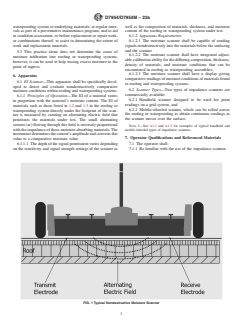
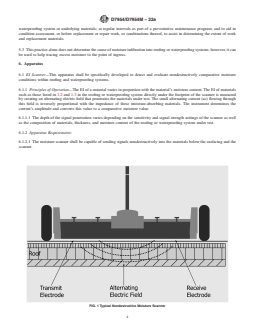
6.1.1 Principles of Operation—The EI of a material varies in proportion with the material’s moisture content. The EI of materials
such as those listed in 1.2 and 1.3 in the roofing or waterproofing system directly under the footprint of the scanner is measured
by creating an alternating electric field that penetrates the materials under test. The small alternating current (ac) flowing through
this field is inversely proportional with the impedance of these moisture-absorbing materials. The instrument determines the
current’s amplitude and converts this value to a comparative moisture value.
6.1.1.1 The depth of the signal penetration varies depending on the sensitivity and signal strength settings of the scanner as well
as the composition of materials, thickness, and moisture content of the roofing or waterproofing system under test.
6.1.2 Apparatus Requirements:
6.1.2.1 The moisture scanner shall be capable of sending signals nondestructively into the materials below the surfacing and the
scanner.
FIG. 1 Typical Nondestructive Moisture Scanner
D7954/D7954M − 22a
6.1.2.2 The moisture scanner shall have integrated adjustable calibration ability for the differing composition, thickness, density
of materials, and moisture conditions that can be encountered in roofing or waterproofing assemblies.
6.1.2.3 The moisture scanner shall have a display giving comparative readings of moisture conditions of materials found in roofing
and waterproofing systems.
6.2 Scanner Types—Two types of impedance scanners are commercially available:
6.2.1 Handheld scanner designed to be used for point readings on a grid system, and
6.2.2 Mobile-wheeled scanner, which can be rolled across the roofing or waterproofing to obtain continuous readings as the
scanner moves over the surface.
NOTE 3—See A1.1 and A1.2 for examples of typical handheld and mobile-wheeled types of impedance scanners.
7. Operator Qualifications and Referenced Materials
7.1 The operator shall:
7.1.1 Be familiar with the use of the impedance scanner;
7.1.2 Have knowledge of and available for reference at the roof site a copy of the manufacturer’s operating and calibration
instructions for the impedance scanner used;
7.1.3 Have knowledge of how and under what circumstances the impedance scanning system can be used, as well as its
limitations;
7.1.4 Have a thorough understanding of the construction and components used in the roofing or waterproofing system assembly
under test, such as types of membranes, roofing insulations, decking, and attachment;
7.1.5 Confirm the composition of the roofing or waterproofing assembly and endeavor to obtain historical data regarding the
construction, age, and performance of the roofing or waterproofing assembly; and
7.1.6 Have a thorough understanding and knowledge of roofing and waterproofing technology including types of roofing or
waterproofing membranes and materials, decks, insulation materials, system assemblies and construction procedures, equilibrium
moisture content, moisture migration in buildings, as well as health and safety requirements when carrying out roofing or
waterproofing moisture surveying.
7.2 Data Interpreter—Individuals interpreting the field data shall have knowledge of: impedance scanner principles of operation,
moisture migration transport mechanisms, environmental effects, oven dry and equilibrium moisture contents (EMC), thermal
resistance ratios (TRR), verification methods, and roofing and waterproofing construction as it applies to moisture analysis and
gravimetric analysis to diagnose and interpret the readings from the roofing or waterproofing system surveyed.
NOTE 4—See A1.4 for additional information on technique and anomalies.
8. Impedance Scanning Techniques
8.1 Two techniques, (A) and (B), for conducting moisture surveys using impedance scanners are:
8.2 Technique A—Continuous Systematic Scanning and Recording—This practice involves moving (rolling) the impedance
scanner in a systematic and continuous row-by-row manner when traversing the roof surface.
8.2.1 As the scanner is rolled along each run or row in a systematic fashion, continuous impedance readings shall be displayed
on the scanner’s meter. These readings shall be visually observed by the operator.
D7954/D7954M − 22a
8.2.2 All areas where elevated moisture content levels are indicated by increased impedance readings displayed on the scanner’s
meter shall be referenced, recorded, and marked on the roof surface or the appropriate position on the roof drawing or both by the
operator.
8.2.3 This technique is applicable to the mobile-wheeled unit as it gives a continuous reading while traversing the roof surface
(see 6.2.2).
8.3 Technique B—Grid Format Scanning and Recording—This practice involves the scanning the roof using a grid format where
the scanner is moved within the grid pattern.
8.3.1 Scanning is done with a grid pattern layout system in which the scanner is moved in a uniform fashion within the grid
pattern. Readings are taken and recorded at each grid intersection point or at regular similar spaced intervals on or between grid
lines; additional readings are taken and recorded in areas where elevated moisture levels are indicated by increased impedance
readings.
8.3.2 See 9.3 for information on grid system layout.
8.3.3 This technique is considered applicable to both handheld and the mobile-wheeled impedance scanners as referenced in 6.2.1
and 6.2.2.
8.4 When impedance or comparative moisture level readings or other markings are recorded on the roof surface, obtain permission
from the building owners or their agent before marking the roof surface with paint or similar marking material. Ensure that
materials used for marking are compatible with the roofing or waterproofing systems so damage does not occur.
9. Preparation
9.1 Preparation as Applying to Both TechniqueTechniques A and B—Before commencement of nondestructive impedance testing,
the operator shall:
9.1.1 Confirm the composition of the roofing or waterproofing assembly and obtain any available historical data regarding the
construction, age, and performance of the roofing or waterproofing assembly;
9.1.2 Obtain a roofing and waterproofing plan drawing, if available; and
9.1.3 Prepare drawings (if not available) and survey report sheets for each roofing or waterproofing section being surveyed on to
which scanner readings and other relevant data shall be recorded.
9.2 Calibration as Applying to Both TechniqueTechniques A and B:
9.2.1 Before carrying out a roofing or waterproofing moisture survey with either a handheld or mobile-wheeled impedance
scanner, it is necessary to calibrate the equipment on an area of roofing or waterproofing where the surface and subsurface
insulation and components are dry.
9.2.2 Core samples taken for calibration purposes shall consist of specimens of the roofing or waterproofing system at least 2 in.
[50 mm] in diameter to include roofing or waterproofing membrane and all materials from the top surface down to the deck.
9.2.3 Core samples shall be taken by cutting through the system down to the deck and shall be evaluated by appropriate methods
to determine composition, condition, and moisture content. If decking material is capable of moisture absorption, its moisture
condition shall be also be evaluated by appropriate means (see Note 5). Typically, core samples taken from dry reference locations
shall be retained for gravimetric analysis in accordance with Test Method C1616 at the
...