

ASTM D4542-22
(Test Method)Standard Test Methods for Pore Water Extraction and Determination of the Soluble Salt Content of Soils by Refractometer
General Information
- Abstract
SIGNIFICANCE AND USE
4.1 The soluble salt content may be used to correct the index properties of soils such as water content, void ratio, specific gravity, degree of saturation, and dry density.
Note 1: The quality of the result produced by this standard is dependent on the competence of the personnel performing it, and the suitability of the equipment and facilities used. Agencies that meet the criteria of Practice D3740 are generally considered capable of competent and objective testing/sampling/inspection/etc. Users of this standard are cautioned that compliance with Practice D3740 does not in itself assure reliable results. Reliable results depend on many factors; Practice D3740 provides a means of evaluating some of those factors.
SCOPE
1.1 These test methods cover a rapid procedure for squeezing pore water from fine-grained soils for the purpose of determining the amount of soluble salts present in the extracted pore water.
1.2 These test methods were developed for soils having a water content equal to or greater than approximately 14 %, for example, marine soils. An extensive summary of procedures for extracting pore water from soils has been presented by Kriukov and Manheim (1).2
1.3 These test methods are not generally applicable for determining the soluble salt content of the pore water extracted from coarse-grained soils, such as clean sands and gravels.
1.4 Test Method A provides a procedure using a refractometer with a refraction index scale; Test Method B provides a procedure using a refractometer with a parts per thousand (ppt) scale.
1.5 Units—The values stated in SI units are to be regarded as the standard.
1.6 All observed and calculated values shall conform to the guidelines for significant digits and rounding established in Practice D6026 unless superseded by these test methods.
1.6.1 The procedures used to specify how data are collected/recorded and calculated in the standard are regarded as the industry standard. In addition, they are representative of the significant digits that generally should be retained. The procedures used do not consider material variation, purpose for obtaining the data, special purpose studies, or any considerations for the user’s objectives; and it is common practice to increase or reduce significant digits of reported data to be commensurate with these considerations. It is beyond the scope of these test methods to consider significant digits used in analysis methods for engineering data.
1.7 This standard does not purport to address all of the safety concerns, if any, associated with its use. It is the responsibility of the user of this standard to establish appropriate safety, health, and environmental practices and determine the applicability of regulatory limitations prior to use.
1.8 This international standard was developed in accordance with internationally recognized principles on standardization established in the Decision on Principles for the Development of International Standards, Guides and Recommendations issued by the World Trade Organization Technical Barriers to Trade (TBT) Committee.
- Status
- Published
- Publication Date
- 31-Jul-2022
- Technical Committee
- D18 - Soil and Rock
- Drafting Committee
- D18.06 - Physical-Chemical Interactions of Soil and Rock
Buy Documents
ASTM D4542-22 - Standard Test Methods for Pore Water Extraction and Determination of the Soluble Salt Content of Soils by Refractometer
REDLINE ASTM D4542-22 - Standard Test Methods for Pore Water Extraction and Determination of the Soluble Salt Content of Soils by Refractometer
Overview
ASTM D4542-22 is the standard test method developed by ASTM International for the extraction of pore water and the determination of soluble salt content in fine-grained soils using a refractometer. This method allows for the rapid collection and analysis of pore water to ascertain salt concentrations, which are essential for geotechnical engineering, environmental studies, and marine soil analysis. The procedure is primarily intended for soils with a water content of 14% or greater, making it particularly relevant for marine and other high-moisture soil environments.
Determining soluble salt content is crucial because it can significantly affect the index properties of soils, such as water content, void ratio, specific gravity, degree of saturation, and dry density. Correcting these properties leads to more accurate soil assessments and improves decision-making in construction, foundation design, and environmental monitoring.
Key Topics
Pore Water Extraction: The standard outlines procedures for extracting pore water from fine-grained soils using a soil press, ensuring minimal disturbance and accurate chemical profiling.
Soluble Salt Content Determination: Salinity is measured using two methods:
- Method A: Utilizes a refractometer with a refraction index scale.
- Method B: Utilizes a refractometer with a parts per thousand (ppt) scale.
Applicability: Best suited for marine soils and other fine-grained soils with high moisture; not generally applicable to coarse-grained soils like sands and gravels.
Instrumentation and Materials: Specifies the use of temperature-compensated refractometers, stainless steel micro-syringe filter holders, special filter papers, accurate balances, clean storage bottles, and reagent-grade chemicals.
Data Recording and Reporting: Requires careful documentation of test location, soil type, depth, refractometer readings (n or ppt), and the method used, following standardized data collection practices.
Applications
Geotechnical Engineering: Adjusts soil index properties for more reliable site characterization and foundation design in areas where soluble salt content may impact soil behavior.
Marine and Coastal Engineering: Essential in the assessment of marine sediments during port construction, dredging, and underwater infrastructure projects.
Environmental Monitoring: Facilitates environmental studies by providing rapid, reliable data on soil salinity, which can influence soil corrosion potential, pollutant mobility, and habitat suitability.
Soil Science Research: Supports academic and industrial research focused on the physical-chemical interactions in soils, especially in saline or high-moisture environments.
Related Standards
- ASTM D3740: Practice for Minimum Requirements for Agencies Engaged in Testing and/or Inspection of Soil and Rock as Used in Engineering Design and Construction.
- ASTM D653: Terminology Relating to Soil, Rock, and Contained Fluids.
- ASTM D4753: Guide for Evaluating, Selecting, and Specifying Balances and Standard Masses for Use in Soil, Rock, and Construction Materials Testing.
- ASTM D6026: Practice for Using Significant Digits and Data Records in Geotechnical Data.
- ASTM E832: Specification for Laboratory Filter Papers.
Practical Value
The ASTM D4542-22 standard delivers a robust framework for efficiently extracting and analyzing pore water from fine-grained soils, especially valuable in marine and moist soil contexts. By quantifying soluble salts, it enhances the reliability of soil investigations and supports better engineering, environmental, and scientific outcomes. Applying this standardized approach ensures data comparability, regulatory compliance, and informed project planning, making it an indispensable tool in modern soil analysis workflows.
Relations
- Effective Date
- 01-Feb-2024
- Effective Date
- 01-Nov-2023
- Effective Date
- 01-Oct-2019
- Effective Date
- 01-Jul-2019
- Effective Date
- 01-May-2015
- Effective Date
- 01-Aug-2014
- Effective Date
- 01-May-2012
- Effective Date
- 01-Mar-2012
- Effective Date
- 01-Sep-2011
- Effective Date
- 01-Sep-2011
- Effective Date
- 01-Mar-2010
- Effective Date
- 01-Jan-2009
- Effective Date
- 01-Dec-2008
- Effective Date
- 01-Nov-2008
- Effective Date
- 01-Nov-2008
Buy Documents
ASTM D4542-22 - Standard Test Methods for Pore Water Extraction and Determination of the Soluble Salt Content of Soils by Refractometer
REDLINE ASTM D4542-22 - Standard Test Methods for Pore Water Extraction and Determination of the Soluble Salt Content of Soils by Refractometer
Get Certified
Connect with accredited certification bodies for this standard

CIS Institut d.o.o.
Personal Protective Equipment (PPE) certification body. Notified Body NB-2890 for EU Regulation 2016/425 PPE.

Kiwa BDA Testing
Building and construction product certification.
Kmetijski inštitut Slovenije
Agricultural Institute of Slovenia. Soil testing, plant health, agricultural product analysis.
Sponsored listings
Frequently Asked Questions
ASTM D4542-22 is a standard published by ASTM International. Its full title is "Standard Test Methods for Pore Water Extraction and Determination of the Soluble Salt Content of Soils by Refractometer". This standard covers: SIGNIFICANCE AND USE 4.1 The soluble salt content may be used to correct the index properties of soils such as water content, void ratio, specific gravity, degree of saturation, and dry density. Note 1: The quality of the result produced by this standard is dependent on the competence of the personnel performing it, and the suitability of the equipment and facilities used. Agencies that meet the criteria of Practice D3740 are generally considered capable of competent and objective testing/sampling/inspection/etc. Users of this standard are cautioned that compliance with Practice D3740 does not in itself assure reliable results. Reliable results depend on many factors; Practice D3740 provides a means of evaluating some of those factors. SCOPE 1.1 These test methods cover a rapid procedure for squeezing pore water from fine-grained soils for the purpose of determining the amount of soluble salts present in the extracted pore water. 1.2 These test methods were developed for soils having a water content equal to or greater than approximately 14 %, for example, marine soils. An extensive summary of procedures for extracting pore water from soils has been presented by Kriukov and Manheim (1).2 1.3 These test methods are not generally applicable for determining the soluble salt content of the pore water extracted from coarse-grained soils, such as clean sands and gravels. 1.4 Test Method A provides a procedure using a refractometer with a refraction index scale; Test Method B provides a procedure using a refractometer with a parts per thousand (ppt) scale. 1.5 Units—The values stated in SI units are to be regarded as the standard. 1.6 All observed and calculated values shall conform to the guidelines for significant digits and rounding established in Practice D6026 unless superseded by these test methods. 1.6.1 The procedures used to specify how data are collected/recorded and calculated in the standard are regarded as the industry standard. In addition, they are representative of the significant digits that generally should be retained. The procedures used do not consider material variation, purpose for obtaining the data, special purpose studies, or any considerations for the user’s objectives; and it is common practice to increase or reduce significant digits of reported data to be commensurate with these considerations. It is beyond the scope of these test methods to consider significant digits used in analysis methods for engineering data. 1.7 This standard does not purport to address all of the safety concerns, if any, associated with its use. It is the responsibility of the user of this standard to establish appropriate safety, health, and environmental practices and determine the applicability of regulatory limitations prior to use. 1.8 This international standard was developed in accordance with internationally recognized principles on standardization established in the Decision on Principles for the Development of International Standards, Guides and Recommendations issued by the World Trade Organization Technical Barriers to Trade (TBT) Committee.
SIGNIFICANCE AND USE 4.1 The soluble salt content may be used to correct the index properties of soils such as water content, void ratio, specific gravity, degree of saturation, and dry density. Note 1: The quality of the result produced by this standard is dependent on the competence of the personnel performing it, and the suitability of the equipment and facilities used. Agencies that meet the criteria of Practice D3740 are generally considered capable of competent and objective testing/sampling/inspection/etc. Users of this standard are cautioned that compliance with Practice D3740 does not in itself assure reliable results. Reliable results depend on many factors; Practice D3740 provides a means of evaluating some of those factors. SCOPE 1.1 These test methods cover a rapid procedure for squeezing pore water from fine-grained soils for the purpose of determining the amount of soluble salts present in the extracted pore water. 1.2 These test methods were developed for soils having a water content equal to or greater than approximately 14 %, for example, marine soils. An extensive summary of procedures for extracting pore water from soils has been presented by Kriukov and Manheim (1).2 1.3 These test methods are not generally applicable for determining the soluble salt content of the pore water extracted from coarse-grained soils, such as clean sands and gravels. 1.4 Test Method A provides a procedure using a refractometer with a refraction index scale; Test Method B provides a procedure using a refractometer with a parts per thousand (ppt) scale. 1.5 Units—The values stated in SI units are to be regarded as the standard. 1.6 All observed and calculated values shall conform to the guidelines for significant digits and rounding established in Practice D6026 unless superseded by these test methods. 1.6.1 The procedures used to specify how data are collected/recorded and calculated in the standard are regarded as the industry standard. In addition, they are representative of the significant digits that generally should be retained. The procedures used do not consider material variation, purpose for obtaining the data, special purpose studies, or any considerations for the user’s objectives; and it is common practice to increase or reduce significant digits of reported data to be commensurate with these considerations. It is beyond the scope of these test methods to consider significant digits used in analysis methods for engineering data. 1.7 This standard does not purport to address all of the safety concerns, if any, associated with its use. It is the responsibility of the user of this standard to establish appropriate safety, health, and environmental practices and determine the applicability of regulatory limitations prior to use. 1.8 This international standard was developed in accordance with internationally recognized principles on standardization established in the Decision on Principles for the Development of International Standards, Guides and Recommendations issued by the World Trade Organization Technical Barriers to Trade (TBT) Committee.
ASTM D4542-22 is classified under the following ICS (International Classification for Standards) categories: 13.080.10 - Chemical characteristics of soils. The ICS classification helps identify the subject area and facilitates finding related standards.
ASTM D4542-22 has the following relationships with other standards: It is inter standard links to ASTM D4753-24, ASTM D3740-23, ASTM D3740-19, ASTM E832-81(2019), ASTM D4753-15, ASTM D653-14, ASTM D3740-12a, ASTM D3740-12, ASTM D653-11, ASTM D3740-11, ASTM D3740-10, ASTM D653-09, ASTM D653-08a, ASTM E832-81(2008), ASTM D653-08. Understanding these relationships helps ensure you are using the most current and applicable version of the standard.
ASTM D4542-22 is available in PDF format for immediate download after purchase. The document can be added to your cart and obtained through the secure checkout process. Digital delivery ensures instant access to the complete standard document.
Standards Content (Sample)
This international standard was developed in accordance with internationally recognized principles on standardization established in the Decision on Principles for the
Development of International Standards, Guides and Recommendations issued by the World Trade Organization Technical Barriers to Trade (TBT) Committee.
Designation: D4542 − 22
Standard Test Methods for
Pore Water Extraction and Determination of the Soluble Salt
Content of Soils by Refractometer
This standard is issued under the fixed designation D4542; the number immediately following the designation indicates the year of
original adoption or, in the case of revision, the year of last revision. A number in parentheses indicates the year of last reapproval. A
superscript epsilon (´) indicates an editorial change since the last revision or reapproval.
1. Scope* 1.7 This standard does not purport to address all of the
safety concerns, if any, associated with its use. It is the
1.1 These test methods cover a rapid procedure for squeez-
responsibility of the user of this standard to establish appro-
ing pore water from fine-grained soils for the purpose of
priate safety, health, and environmental practices and deter-
determiningtheamountofsolublesaltspresentintheextracted
mine the applicability of regulatory limitations prior to use.
pore water.
1.8 This international standard was developed in accor-
1.2 These test methods were developed for soils having a
dance with internationally recognized principles on standard-
water content equal to or greater than approximately 14 %, for
ization established in the Decision on Principles for the
example, marine soils. An extensive summary of procedures
Development of International Standards, Guides and Recom-
for extracting pore water from soils has been presented by
mendations issued by the World Trade Organization Technical
Kriukov and Manheim (1).
Barriers to Trade (TBT) Committee.
1.3 These test methods are not generally applicable for
2. Referenced Documents
determining the soluble salt content of the pore water extracted
from coarse-grained soils, such as clean sands and gravels.
2.1 ASTM Standards:
D653 Terminology Relating to Soil, Rock, and Contained
1.4 Test Method A provides a procedure using a refracto-
Fluids
meter with a refraction index scale; Test Method B provides a
D3740 Practice for Minimum Requirements for Agencies
procedure using a refractometer with a parts per thousand (ppt)
Engaged in Testing and/or Inspection of Soil and Rock as
scale.
Used in Engineering Design and Construction
1.5 Units—The values stated in SI units are to be regarded
D4753 Guide for Evaluating, Selecting, and Specifying Bal-
as the standard.
ances and Standard Masses for Use in Soil, Rock, and
1.6 All observed and calculated values shall conform to the
Construction Materials Testing
guidelines for significant digits and rounding established in
D6026 Practice for Using Significant Digits and Data Re-
Practice D6026 unless superseded by these test methods.
cords in Geotechnical Data
1.6.1 Theproceduresusedtospecifyhowdataarecollected/
E832 Specification for Laboratory Filter Papers
recorded and calculated in the standard are regarded as the
2.2 Federal Document:
industry standard. In addition, they are representative of the
GG-S-945a Specification for Syringe and Needle,
significant digits that generally should be retained. The proce- 4
Disposable, Hypodermic, Sterile, Single Injection
dures used do not consider material variation, purpose for
obtaining the data, special purpose studies, or any consider-
3. Terminology
ations for the user’s objectives; and it is common practice to
3.1 Definitions:
increase or reduce significant digits of reported data to be
3.1.1 Fordefinitionsofcommontechnicaltermsusedinthis
commensuratewiththeseconsiderations.Itisbeyondthescope
standard, refer to Terminology D653.
of these test methods to consider significant digits used in
analysis methods for engineering data. 3.2 Acronyms:
3.2.1 ppt, n—parts per thousand
ThistestmethodisunderthejurisdictionofASTMCommitteeD18onSoiland
RockandisthedirectresponsibilityofSubcommitteeD18.06onPhysical-Chemical
Interactions of Soil and Rock. For referenced ASTM standards, visit the ASTM website, www.astm.org, or
Current edition approved Aug. 1, 2022. Published August 2022. Originally contact ASTM Customer Service at service@astm.org. For Annual Book of ASTM
approved in 1985. Last previous edition approved in 2015 as D4542 – 15. DOI: Standards volume information, refer to the standard’s Document Summary page on
10.1520/D4542-22. the ASTM website.
2 4
The boldface numbers in parentheses refer to the list of references appended to Available from Naval Publications and Forms Center, 5801 Tabor Ave.,
this standard. Philadelphia, PA, 19120.
*A Summary of Changes section appears at the end of this standard
Copyright © ASTM International, 100 Barr Harbor Drive, PO Box C700, West Conshohocken, PA 19428-2959. United States
D4542 − 22
4. Significance and Use 5.6 Refrigerator—Cooling unit capable of maintaining a
uniform temperature between 1 and 5°C.
4.1 Thesolublesaltcontentmaybeusedtocorrecttheindex
properties of soils such as water content, void ratio, specific 5.7 Micro-Syringe Filter Holder—A device made of stain-
gravity, degree of saturation, and dry density. less steel to filter a liquid directly from a syringe.
NOTE 1—The quality of the result produced by this standard is
5.8 Bottle—A clean 100 mL polyethylene or glass bottle
dependent on the competence of the personnel performing it, and the
with cap.
suitability of the equipment and facilities used. Agencies that meet the
5.8.1 Aclean bottle is one that is washed with detergent and
criteria of Practice D3740 are generally considered capable of competent
and objective testing/sampling/inspection/etc. Users of this standard are
rinsed with tap water. Then rinsed once with diluted HCl
cautioned that compliance with Practice D3740 does not in itself assure
(1:10), twice with distilled water, and then drained thoroughly.
reliable results. Reliable results depend on many factors; Practice D3740
provides a means of evaluating some of those factors. 5.9 Miscellaneous Supplies—Itemssuchassteelwool,soap/
detergent, compressed air, and sterile plastic bags may be
5. Apparatus
useful, necessary, or both.
5.1 Refractometer—A temperature compensated refracto-
6. Reagents
meter scaled to either index of refraction (Method A) or ppt
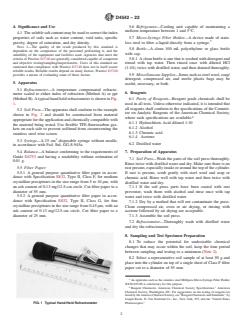
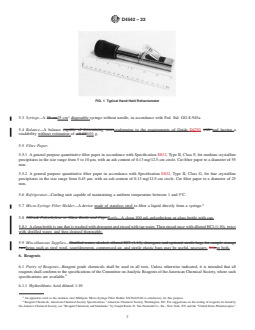
(Method B).Atypical hand held refractometer is shown in Fig.
6.1 Purity of Reagents—Reagent grade chemicals shall be
1. used in all tests. Unless otherwise indicated, it is intended that
all reagents shall conform to the specifications of the Commit-
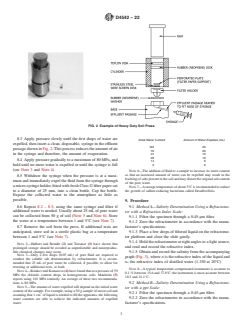
5.2 Soil Press—The apparatus shall conform to the example
tee on Analytic Reagents of the American Chemical Society,
shown in Fig. 2 and should be constructed from material
where such specifications are available.
appropriate for the application and chemically compatible with
6.1.1 Hydrochloric Acid diluted 1:10
the material being tested. Use flexible TFE-fluorocarbon gas-
6.1.2 Alcohol
kets on each side to prevent soil/mud from circumventing the
6.1.3 Chromic acid
stainless steel wire screen.
6.1.4 Acetone
5.3 Syringe—A25cm disposable syringe without needle,
6.2 Distilled water
in accordance with Fed. Std. GG-S-945a.
5.4 Balance—A balance conforming to the requirements of
7. Preparation of Apparatus
Guide D4753 and having a readability without estimation of
7.1 Soil Press—Wash the parts of the soil press thoroughly.
0.01 g.
Rinse twice with distilled water and dry. Make sure there is no
5.5 Filter Paper:
rust present, especially inside or around the top of the cylinder.
5.5.1 A general purpose quantitative filter paper in accor-
If rust is present, scrub gently with steel wool and soap or
dance with Specification E832, Type II, Class F, for medium
chromic acid. Rinse well with tap water and then twice with
crystalline precipitates in the size range from 5 to 10 µm, with
distilled water and dry.
an ash content of 0.13 mg/12.5-cm circle. Cut filter paper to a
7.1.1 If the soil press parts have been coated with rust
diameter of 55 mm.
preventer, wash them with alcohol and rinse once with tap
5.5.2 A general purpose quantitative filter paper in accor-
water and twice with distilled water.
dance with Specification E832, Type II, Class G, for fine
7.1.2 Dry by a method that will not contaminate the press.
crystalline precipitates in the size range from 0.45 µm, with an
Clean compressed air, oven or air drying, or rinsing with
ash content of 0.13 mg/12.5-cm circle. Cut filter paper to a
acetone followed by air drying are acceptable.
diameter of 25 mm.
7.1.3 Assemble the soil press.
7.2 Refractometer—Thoroughly wash with distilled water
and dry the refractometer.
8. Sampling and Test Specimen Preparation
8.1 To reduce the potential for undesirable chemical
changes that may occur within the soil, keep the time period
between sampling and testing to a minimum (Note 2).
8.2 Select a representative soil sample of at least 50 g and
place into the cylinder on top of a single sheet of Class F filter
paper cut to a diameter of 55 mm.
An apparatus such as the stainless steel Millipore Micro-Syringe Filter Holder
XX30-025-00 is satisfactory for this purpose.
Reagent Chemicals, American Chemical Society Specifications,” American
Chemical Society, Washington, DC. For suggestions on the testing of reagents lot
listedbytheAmericaChemicalSociety,see“ReagentChemicalsandStandards,”by
Joseph Rosin, D. Van Nostrand Co., Inc., New York, NY, and the “United States
FIG. 1 Typical Hand-Held Refractometer Pharmacopeia.”
D4542 − 22
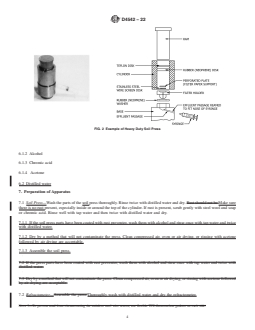
FIG. 2 Example of Heavy Duty Soil Press
8.3 Apply pressure slowly until the first drops of water are
Initial Water Content Amount of Water Expelled (mL)
expelled, then insert a clean, disposable, syringe in the effluent
104 25
passageshowninFig.2.Thisprocessreducestheamountofair
70 20
in the syringe and therefore, the amount of evaporation.
47 15
28 10
8.4 Apply pressure gradually to a maximum of 80 MPa, and
14 5
hold until no more water is expelled or until the syringe is full
(see Note 3 and Note 4).
NOTE 6—The addition of fluid to a sample to increase its water content
so that an increased amount of water can be expelled may result in the
8.5 Withdraw the syringe when the pressure is at a maxi-
leachingofsaltspresentinthesoilandmaydistorttheoriginalsaltcontent
mum and immediately expel the fluid from the syringe through
of the pore water.
amicro-syringeholder,fittedwithfreshClassGfilterpapercut
NOTE7—Astoragetemperatureofabout5°Cisrecommendedtoreduce
to a diameter of 25 mm, into a clean bottle. Cap the bottle.
the growth of sulfate-reducing bacterium called Desulfovibrio.
Expose the collected water to the atmosphere as little as
possible.
9. Procedure
8.6 Repeat 8.2 – 8.5, using the same syringe and filter if
9.1 Method A—Salinity Determination Using a Refractome-
additional water is needed. Usually about 25 mLof pore water
ter with a Refraction Index Scale:
can be collected from 50 g of soil (Note 5 and Note 6). Store
9.1.1 Fil
...
This document is not an ASTM standard and is intended only to provide the user of an ASTM standard an indication of what changes have been made to the previous version. Because
it may not be technically possible to adequately depict all changes accurately, ASTM recommends that users consult prior editions as appropriate. In all cases only the current version
of the standard as published by ASTM is to be considered the official document.
Designation: D4542 − 15 D4542 − 22
Standard Test Methods for
Pore Water Extraction and Determination of the Soluble Salt
Content of Soils by Refractometer
This standard is issued under the fixed designation D4542; the number immediately following the designation indicates the year of
original adoption or, in the case of revision, the year of last revision. A number in parentheses indicates the year of last reapproval. A
superscript epsilon (´) indicates an editorial change since the last revision or reapproval.
1. Scope*
1.1 These test methods cover a rapid procedure for squeezing pore water from finegrainedfine-grained soils for the purpose of
determining the amount of soluble salts present in the extracted pore water.
1.2 These test methods were developed for soils having a water content equal to or greater than approximately 14 %, for example,
marine soils. An extensive summary of procedures for extracting pore water from soils has been presented by Kriukov and
Manheim (1).
1.3 These test methods are not generally applicable for determining the soluble salt content of the pore water extracted from
coarse-grained soils, such as clean sands and gravels.
1.4 Test Method A provides a procedure using a refractometer with a refraction index scale; Test Method B provides a procedure
using a refractometer with a parts per thousand (ppt) scale.
1.5 Units—The values stated in SI units are to be regarded as the standard.
1.6 All observed and calculated values shall conform to the guidelines for significant digits and rounding established in Practice
D6026 unless superseded by these test methods.
1.6.1 The procedures used to specify how data are collected/recorded and calculated in the standard are regarded as the industry
standard. In addition, they are representative of the significant digits that generally should be retained. The procedures used do not
consider material variation, purpose for obtaining the data, special purpose studies, or any considerations for the user’s objectives;
and it is common practice to increase or reduce significant digits of reported data to be commensurate with these considerations.
It is beyond the scope of these test methods to consider significant digits used in analysis methods for engineering data.
1.7 This standard does not purport to address all of the safety concerns, if any, associated with its use. It is the responsibility
of the user of this standard to establish appropriate safety safety, health, and healthenvironmental practices and determine the
applicability of regulatory limitations prior to use.
1.8 All observed and calculated values shall conform to the guidelines for significant digits and rounding established in Practice
D6026.
This test method is under the jurisdiction of ASTM Committee D18 on Soil and Rock and is the direct responsibility of Subcommittee D18.06 on Physical-Chemical
Interactions of Soil and Rock.
Current edition approved Nov. 1, 2015Aug. 1, 2022. Published December 2015August 2022. Originally approved in 1985. Last previous edition approved in 20072015
as D4542 – 07.D4542 – 15. DOI: 10.1520/D4542-15.10.1520/D4542-22.
The boldface numbers in parentheses refer to the list of references appended to this standard.
*A Summary of Changes section appears at the end of this standard
Copyright © ASTM International, 100 Barr Harbor Drive, PO Box C700, West Conshohocken, PA 19428-2959. United States
D4542 − 22
1.8 This international standard was developed in accordance with internationally recognized principles on standardization
established in the Decision on Principles for the Development of International Standards, Guides and Recommendations issued
by the World Trade Organization Technical Barriers to Trade (TBT) Committee.
2. Referenced Documents
2.1 ASTM Standards:
D653 Terminology Relating to Soil, Rock, and Contained Fluids
D3740 Practice for Minimum Requirements for Agencies Engaged in Testing and/or Inspection of Soil and Rock as Used in
Engineering Design and Construction
D4753 Guide for Evaluating, Selecting, and Specifying Balances and Standard Masses for Use in Soil, Rock, and Construction
Materials Testing
D6026 Practice for Using Significant Digits and Data Records in Geotechnical Data
E832 Specification for Laboratory Filter Papers
2.2 Federal Document:
GG-S-945a Specification for Syringe and Needle, Disposable, Hypodermic, Sterile, Single Injection
3. Terminology
3.1 Definitions:
3.1.1 For definitions of common technical terms used in this standard, refer to Terminology D653.
3.2 Acronyms:
3.2.1 ppt, n—parts per thousand
4. Significance and Use
4.1 The soluble salt content may be used to correct the index properties of soils such as water content, void ratio, specific gravity,
degree of saturation, and dry density).density.
4.2 Minimize the time period between sampling and testing to reduce chemical changes, which may occur within the soil sample.
NOTE 1—The quality of the result produced by this standard is dependent on the competence of the personnel performing it, and the suitability of the
equipment and facilities used. Agencies that meet the criteria of Practice D3740 are generally considered capable of competent and objective
testing/sampling/inspection/etc. Users of this standard are cautioned that compliance with Practice D3740 does not in itself ensure reliable results.
Reliable results depend on many factors; Practice D3740 provides a means of evaluating some of those factors.
NOTE 2—Hulbert and Brindle (2) and Torrance (3) have shown that prolonged storage should be avoided as unpredictable and non-reproducible chemical
changes may occur.
NOTE 1—The quality of the result produced by this standard is dependent on the competence of the personnel performing it, and the suitability of the
equipment and facilities used. Agencies that meet the criteria of Practice D3740 are generally considered capable of competent and objective
testing/sampling/inspection/etc. Users of this standard are cautioned that compliance with Practice D3740 does not in itself assure reliable results. Reliable
results depend on many factors; Practice D3740 provides a means of evaluating some of those factors.
5. Apparatus
5.1 Refractometer—A temperature compensated refractometer scaled to either index of refraction (Method A) or ppt (parts per
thousand). (Method B). A typical hand held refractometer is shown in Fig. 1.
5.2 Soil Press—The apparatus shall conform to the example shown in Fig. 2. It and should be constructed from material
appropriate for the application and chemically compatible with the material being tested. Use flexible TFE-fluorocarbon gaskets
on each side to prevent soil/mud from circumventing the stainless steel wire screen.
For referenced ASTM standards, visit the ASTM website, www.astm.org, or contact ASTM Customer Service at service@astm.org. For Annual Book of ASTM Standards
volume information, refer to the standard’s Document Summary page on the ASTM website.
Available from Naval Publications and Forms Center, 5801 Tabor Ave., Philadelphia, PA, 19120.
D4542 − 22
FIG. 1 Typical Hand-Held Refractometer
5.3 Syringe—A 25-cm25 cm disposable syringe without needle, in accordance with Fed. Std. GG-S-945a.
5.4 Balance—A balance capable of determining massconforming to the requirements of Guide D4753 with and having a
readability without estimation of 60.010.01 g.
5.5 Filter Paper:
5.5.1 A general purpose quantitative filter paper in accordance with Specification E832, Type II, Class F, for medium crystalline
precipitates in the size range from 5 to 10 μm, with an ash content of 0.13 mg/12.5-cm circle. Cut filter paper to a diameter of 55
mm.
5.5.2 A general purpose quantitative filter paper in accordance with Specification E832, Type II, Class G, for fine crystalline
precipitates in the size range from 0.45 μm, with an ash content of 0.13 mg/12.5-cm circle. Cut filter paper to a diameter of 25
mm.
5.6 Refrigerator—Cooling unit capable of maintaining a uniform temperature between 1 and 5°C.
5.7 Micro-Syringe Filter Holder—A device made of stainless steel to filter a liquid directly from a syringe.
5.8 100-mL Polyethylene or Glass Bottle and Cap. Bottle—A clean 100 mL polyethylene or glass bottle with cap.
5.8.1 A clean bottle is one that is washed with detergent and rinsed with tap water. Then rinsed once with diluted HCl (1:10), twice
with distilled water, and then drained thoroughly.
5.9 Miscellaneous Supplies—Distilled water, alcohol, diluted HCl (1:10), detergent, and optional sterile bags for sample storage
(seeItems such as steel wool, soap/detergent, compressed air, and sterile plastic bags may be useful, necessary, 8.6).or both.
6. Reagents
6.1 Purity of Reagents—Reagent grade chemicals shall be used in all tests. Unless otherwise indicated, it is intended that all
reagents shall conform to the specifications of the Committee on Analytic Reagents of the American Chemical Society, where such
specifications are available.
6.1.1 Hydrochloric Acid diluted 1:10
An apparatus such as the stainless steel Millipore Micro-Syringe Filter Holder XX30-025-00 is satisfactory for this purpose.
Reagent Chemicals, American Chemical Society Specifications,” American Chemical Society, Washington, DC. For suggestions on the testing of reagents lot listed by
the America Chemical Society, see “Reagent Chemicals and Standards,” by Joseph Rosin, D. Van Nostrand Co., Inc., New York, NY, and the “United States Pharmacopeia.”
D4542 − 22
FIG. 2 Example of Heavy Duty Soil Press
6.1.2 Alcohol
6.1.3 Chromic acid
6.1.4 Acetone
6.2 Distilled water
7. Preparation of Apparatus
7.1 Soil Press—Wash the parts of the soil press thoroughly. Rinse twice with distilled water and dry. Rust should not be Make sure
there is no rust present, especially inside or around the top of the cylinder. If rust is present, scrub gently with steel wool and soap
or chromic acid. Rinse well with tap water and then twice with distilled water and dry.
7.1.1 If the soil press parts have been coated with rust preventer, wash them with alcohol and rinse once with tap water and twice
with distilled water.
7.1.2 Dry by a method that will not contaminate the press. Clean compressed air, oven or air drying, or rinsing with acetone
followed by air drying are acceptable.
7.1.3 Assemble the soil press.
7.2 If the press parts have been coated with rust preventer, wash them with alcohol and rinse once with tap water and twice with
distilled water.
7.3 Dry by a method that will not contaminate the press. Clean compressed air, oven or air drying, or rinsing with acetone followed
by air drying are acceptable.
7.2 Refractometer—Assemble the press.Thoroughly wash with distilled water and dry the refractometer.
NOTE 3—To prevent mud from circumventing the stainless steel wire screen, use flexible TFE-fluorocarbon gaskets on each side.
D4542 − 22
8. Sampling and Test Specimen SqueezingPreparation
8.1 To reduce the potential for undesirable chemical changes that may occur within the soil, keep the time period between
sampling and testing to a minimum (Note 2).
8.2 Select a representative soil sample of approximately at least 50 g and place into the cylinder on top of a single sheet of 5 to
10-μm (55-mm) filter paper.Class F filter paper cut to a diameter of 55 mm.
8.3 Apply pressure slowly until the first drops of water are expelled, then insert a clean, disposable, syringe (25 mL) in the effluent
passage shown in Fig. 2. This process reduces the amount of air in the syringe and therefore, the amount of evaporation.
8.4 Apply pressure gradually to a maximum of 80 MPa, and hold until no more water is expelled or until the syringe is full (see
Note 43 and Note 54).
8.5 Withdraw the syringe when the pressure is at a maximum and immediately expel the fluid from the syringe through a stainless
steel micro-syringe holder, fitted with fresh 0.45-μm (25-mm) filter paper, Class G filter paper cut to a diameter of 25 mm, into
a clean 100-mL bottle (see bottle. Note 6). Cap the bottle. Expose the collected water to the atmosphere as little as possible.
8.6 Repeat 8.18.2 – 8.48.5, using the same syringe and filter if additional water is needed for experimentation and can be collected.
needed. Usually about 25 mL of pore water maycan be collected from 50 g of soil (see (Note 75 and Note 86). Store the water
at a temperature between 1 and 5°C (see Note 97 and Sections 9 and 10).
8.7 Remove the soil from the press. If additional tests are anticipated, store soil in a sterile plastic bag at a temperature between
1 and 5°C (see Note 97).
NOTE 2—Hulbert and Brindle (2) and Torrance (3) have shown that prolonged storage should be avoided as unpredictable and nonreproducible chemical
changes may occur.
NOTE 3—Only a few drops (0.05 mL) of pore fluid are required to conduct the soluble salt determination by refractometer. It is recommended that 25
mL of pore water be collected, if possible, to allow for retesting or additional tests, or both.
NOTE 4—Kriukov and Komarova (4) have found that at a pr
...