

ASTM C902-22
(Specification)Standard Specification for Pedestrian and Light Traffic Paving Brick
General Information
- Abstract
ABSTRACT
This specification covers brick intended for use as paving material subjected to pedestrian and light vehicular traffic. The units are designed for use in pedestrian applications and vehicular areas that are subjected to low volumes of vehicular traffic, such as residential driveways and streets and commercial driveways (passenger drop-offs). Abrasion resistance is specified by one of three types: type I - brick subjected to extensive vibration, type II - brick subjected to intermediate abrasion, and type III - brick subjected to low abrasion. The brick shall conform to the physical requirements for the class specified as prescribed. The requirements for water absorption (24-h cold) and saturation coefficient specified, shall not be required if a sample of five brick survives 15 cycles of the sulfate soundness test. The brick shall meet the requirements of either column for the applicable traffic use.
SCOPE
1.1 This specification covers brick intended for use as paving material subjected to pedestrian and light vehicular traffic. The units are designed for use in pedestrian applications and vehicular areas that are subjected to low volumes of vehicular traffic, such as residential driveways and streets and commercial driveways (passenger drop-offs). The units are not intended to support heavy vehicular traffic covered by Specification C1272 or for industrial applications covered by Specification C410.
Note 1: Heavy vehicular traffic is defined as high volumes of heavy vehicles (trucks having 3 or more axles) in Specification C1272.
1.2 The requirements of this specification apply at the time of purchase. The use of results from testing of brick extracted from pavements for determining compliance with the requirements of this specification is beyond the intent of this standard.
1.3 Brick are manufactured from clay, shale, or similar naturally occurring earthy substances and subjected to a heat treatment at elevated temperatures (firing). The heat treatment must develop sufficient fired bond between the particulate constituents to provide the strength and durability requirement of this specification (see Terminology C1232).
1.4 Use of this standard and the requirements herein to evaluate and corroborate the performance of a paving unit made from other materials, or made with other forming methods, or other means of binding the materials is not covered by the scope of this standard.
1.5 The brick are available in a variety of sizes, colors, and shapes. They are available in three classes according to exposure environment and three types according to type of traffic exposure.
1.6 The values stated in inch-pound units are to be regarded as standard. The values given in parentheses are mathematical conversions to SI units that are provided for information only and are not considered standard.
1.7 This international standard was developed in accordance with internationally recognized principles on standardization established in the Decision on Principles for the Development of International Standards, Guides and Recommendations issued by the World Trade Organization Technical Barriers to Trade (TBT) Committee.
- Status
- Published
- Publication Date
- 31-May-2022
- Technical Committee
- C15 - Masonry – Manufactured Masonry Units, Mortars and Grouts
- Drafting Committee
- C15.02 - Brick and Structural Clay Tile
Buy Documents
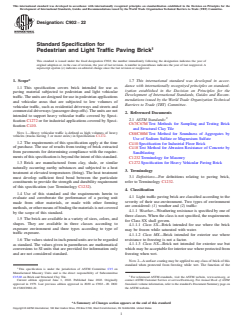
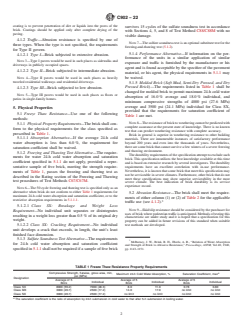
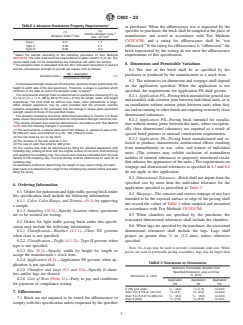

ASTM C902-22 - Standard Specification for Pedestrian and Light Traffic Paving Brick
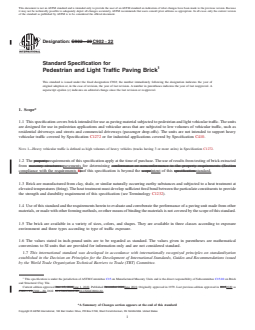
REDLINE ASTM C902-22 - Standard Specification for Pedestrian and Light Traffic Paving Brick
Overview
ASTM C902-22: Standard Specification for Pedestrian and Light Traffic Paving Brick sets forth requirements for brick designed for use in pedestrian areas and settings subject to light vehicular traffic. Issued by ASTM International, this standard ensures that paving bricks used in residential driveways, sidewalks, streets with low-traffic volumes, and commercial drop-off areas are durable, resilient, and suitable for their intended environment.
ASTM C902-22 addresses key factors such as strength, resistance to weathering, abrasion resistance, and dimensional tolerance. The standard helps specifiers, contractors, and manufacturers select paving bricks that will deliver long-term performance and structural integrity in walkways, patios, and lightly trafficked vehicle zones.
Key Topics
- Intended Use: Covers requirements for bricks exposed to pedestrian traffic and low-volume vehicular loads, but excludes bricks for heavy-duty or industrial applications.
- Classification:
- Weather Resistance: Three classes (SX, MX, NX) based on exposure to freezing-thawing cycles or interior use.
- Traffic Abrasion: Three types (Type I, II, III) reflecting expected levels of surface wear.
- Physical Requirements: Sets minimum compressive strength, controls water absorption, and includes freeze-thaw and sulfate soundness test alternatives.
- Abrasion Resistance: Establishes strict criteria for volume loss or abrasion index to ensure surface durability in expected use scenarios.
- Dimensional Tolerances: Regulates permissible variations in size, warpage, and chippage to provide reliable, aesthetically pleasing installations.
- Ordering Guidance: Buyers must specify attributes such as color, surface texture, classification, size, and any special features (e.g., chamfers, lugs).
Applications
ASTM C902-22 paving brick are widely used in:
- Public Walkways and Sidewalks: Offering slip resistance and long life in urban and suburban pedestrian corridors.
- Residential Driveways and Paths: Providing durable surfacing that withstands both foot and light vehicle traffic.
- Commercial Drop-off Areas: Suitable for driveways where passenger cars regularly pass, such as hotel entrances or shopping centers.
- Patios and Courtyards: Delivering robust and attractive surfaces in private or public spaces.
- Light-Traffic Streets: Ideal for lanes or streets with limited exposure to heavy vehicles.
Use of bricks meeting ASTM C902-22 helps deliver surfaces that are attractive, easy to maintain, and engineered to cope with environmental stresses such as freeze-thaw cycles and repeated pedestrian use.
Related Standards
When specifying paving bricks, it may be useful to consider these associated ASTM standards:
- ASTM C1272: Specification for Heavy Vehicular Paving Brick, for applications requiring support for high-traffic or heavy vehicles.
- ASTM C410: Specification for Industrial Floor Brick, used in industrial applications not covered by C902.
- ASTM C67/C67M: Test Methods for Sampling and Testing Brick and Structural Clay Tile, referenced for quality assurance.
- ASTM C88/C88M: Test Method for Soundness of Aggregates, included for sulfate soundness testing.
- ASTM C418: Test Method for Abrasion Resistance of Concrete by Sandblasting, used to verify brick abrasion resistance.
- ASTM C1232: Terminology for Masonry, standard definitions pertinent to paving brick.
Practical Value
Using paving bricks compliant with ASTM C902-22 delivers proven durability, lower maintenance needs, and greater assurance of safety and performance in pedestrian and light traffic environments. This standard guides manufacturers, designers, and project owners in selecting paving solutions that are both functional and visually appealing, and supports compliance with internationally recognized quality benchmarks for site paving materials.
Keywords: pedestrian paving brick, light traffic paving, ASTM C902, sidewalk brick, driveway brick, abrasion resistance, freeze-thaw durability, paving standards
Relations
- Effective Date
- 01-Jan-2024
- Effective Date
- 15-Dec-2023
- Effective Date
- 01-Apr-2020
- Refers
ASTM C67/C67M-19 - Standard Test Methods for Sampling and Testing Brick and Structural Clay Tile - Effective Date
- 01-Jul-2019
- Effective Date
- 01-Aug-2018
- Refers
ASTM C67/C67M-18 - Standard Test Methods for Sampling and Testing Brick and Structural Clay Tile - Effective Date
- 01-Feb-2018
- Effective Date
- 01-Jun-2017
- Effective Date
- 01-Dec-2016
- Effective Date
- 01-Jun-2016
- Effective Date
- 15-Jan-2016
- Effective Date
- 01-Dec-2015
- Effective Date
- 01-Sep-2015
- Effective Date
- 01-Jun-2015
- Effective Date
- 15-Dec-2014
- Effective Date
- 01-Sep-2014
Buy Documents
ASTM C902-22 - Standard Specification for Pedestrian and Light Traffic Paving Brick
REDLINE ASTM C902-22 - Standard Specification for Pedestrian and Light Traffic Paving Brick
Get Certified
Connect with accredited certification bodies for this standard

Zavod za gradbeništvo Slovenije (ZAG) - Inšpekcija
ZAG inspection body for construction products, structures, and materials.
Sponsored listings
Frequently Asked Questions
ASTM C902-22 is a technical specification published by ASTM International. Its full title is "Standard Specification for Pedestrian and Light Traffic Paving Brick". This standard covers: ABSTRACT This specification covers brick intended for use as paving material subjected to pedestrian and light vehicular traffic. The units are designed for use in pedestrian applications and vehicular areas that are subjected to low volumes of vehicular traffic, such as residential driveways and streets and commercial driveways (passenger drop-offs). Abrasion resistance is specified by one of three types: type I - brick subjected to extensive vibration, type II - brick subjected to intermediate abrasion, and type III - brick subjected to low abrasion. The brick shall conform to the physical requirements for the class specified as prescribed. The requirements for water absorption (24-h cold) and saturation coefficient specified, shall not be required if a sample of five brick survives 15 cycles of the sulfate soundness test. The brick shall meet the requirements of either column for the applicable traffic use. SCOPE 1.1 This specification covers brick intended for use as paving material subjected to pedestrian and light vehicular traffic. The units are designed for use in pedestrian applications and vehicular areas that are subjected to low volumes of vehicular traffic, such as residential driveways and streets and commercial driveways (passenger drop-offs). The units are not intended to support heavy vehicular traffic covered by Specification C1272 or for industrial applications covered by Specification C410. Note 1: Heavy vehicular traffic is defined as high volumes of heavy vehicles (trucks having 3 or more axles) in Specification C1272. 1.2 The requirements of this specification apply at the time of purchase. The use of results from testing of brick extracted from pavements for determining compliance with the requirements of this specification is beyond the intent of this standard. 1.3 Brick are manufactured from clay, shale, or similar naturally occurring earthy substances and subjected to a heat treatment at elevated temperatures (firing). The heat treatment must develop sufficient fired bond between the particulate constituents to provide the strength and durability requirement of this specification (see Terminology C1232). 1.4 Use of this standard and the requirements herein to evaluate and corroborate the performance of a paving unit made from other materials, or made with other forming methods, or other means of binding the materials is not covered by the scope of this standard. 1.5 The brick are available in a variety of sizes, colors, and shapes. They are available in three classes according to exposure environment and three types according to type of traffic exposure. 1.6 The values stated in inch-pound units are to be regarded as standard. The values given in parentheses are mathematical conversions to SI units that are provided for information only and are not considered standard. 1.7 This international standard was developed in accordance with internationally recognized principles on standardization established in the Decision on Principles for the Development of International Standards, Guides and Recommendations issued by the World Trade Organization Technical Barriers to Trade (TBT) Committee.
ABSTRACT This specification covers brick intended for use as paving material subjected to pedestrian and light vehicular traffic. The units are designed for use in pedestrian applications and vehicular areas that are subjected to low volumes of vehicular traffic, such as residential driveways and streets and commercial driveways (passenger drop-offs). Abrasion resistance is specified by one of three types: type I - brick subjected to extensive vibration, type II - brick subjected to intermediate abrasion, and type III - brick subjected to low abrasion. The brick shall conform to the physical requirements for the class specified as prescribed. The requirements for water absorption (24-h cold) and saturation coefficient specified, shall not be required if a sample of five brick survives 15 cycles of the sulfate soundness test. The brick shall meet the requirements of either column for the applicable traffic use. SCOPE 1.1 This specification covers brick intended for use as paving material subjected to pedestrian and light vehicular traffic. The units are designed for use in pedestrian applications and vehicular areas that are subjected to low volumes of vehicular traffic, such as residential driveways and streets and commercial driveways (passenger drop-offs). The units are not intended to support heavy vehicular traffic covered by Specification C1272 or for industrial applications covered by Specification C410. Note 1: Heavy vehicular traffic is defined as high volumes of heavy vehicles (trucks having 3 or more axles) in Specification C1272. 1.2 The requirements of this specification apply at the time of purchase. The use of results from testing of brick extracted from pavements for determining compliance with the requirements of this specification is beyond the intent of this standard. 1.3 Brick are manufactured from clay, shale, or similar naturally occurring earthy substances and subjected to a heat treatment at elevated temperatures (firing). The heat treatment must develop sufficient fired bond between the particulate constituents to provide the strength and durability requirement of this specification (see Terminology C1232). 1.4 Use of this standard and the requirements herein to evaluate and corroborate the performance of a paving unit made from other materials, or made with other forming methods, or other means of binding the materials is not covered by the scope of this standard. 1.5 The brick are available in a variety of sizes, colors, and shapes. They are available in three classes according to exposure environment and three types according to type of traffic exposure. 1.6 The values stated in inch-pound units are to be regarded as standard. The values given in parentheses are mathematical conversions to SI units that are provided for information only and are not considered standard. 1.7 This international standard was developed in accordance with internationally recognized principles on standardization established in the Decision on Principles for the Development of International Standards, Guides and Recommendations issued by the World Trade Organization Technical Barriers to Trade (TBT) Committee.
ASTM C902-22 is classified under the following ICS (International Classification for Standards) categories: 93.080.10 - Road construction. The ICS classification helps identify the subject area and facilitates finding related standards.
ASTM C902-22 has the following relationships with other standards: It is inter standard links to ASTM C88/C88M-24, ASTM C1232-23, ASTM C418-20, ASTM C67/C67M-19, ASTM C88/C88M-18, ASTM C67/C67M-18, ASTM C1232-17, ASTM C1272-16b, ASTM C1272-16a, ASTM C1272-16, ASTM C1272-15, ASTM C1232-15a, ASTM C1232-15, ASTM C1272-14b, ASTM C1272-14a. Understanding these relationships helps ensure you are using the most current and applicable version of the standard.
ASTM C902-22 is available in PDF format for immediate download after purchase. The document can be added to your cart and obtained through the secure checkout process. Digital delivery ensures instant access to the complete standard document.
Standards Content (Sample)
This international standard was developed in accordance with internationally recognized principles on standardization established in the Decision on Principles for the
Development of International Standards, Guides and Recommendations issued by the World Trade Organization Technical Barriers to Trade (TBT) Committee.
Designation:C902 −22
Standard Specification for
Pedestrian and Light Traffic Paving Brick
This standard is issued under the fixed designation C902; the number immediately following the designation indicates the year of
original adoption or, in the case of revision, the year of last revision. A number in parentheses indicates the year of last reapproval. A
superscript epsilon (´) indicates an editorial change since the last revision or reapproval.
1. Scope* 1.7 This international standard was developed in accor-
dance with internationally recognized principles on standard-
1.1 This specification covers brick intended for use as
ization established in the Decision on Principles for the
paving material subjected to pedestrian and light vehicular
Development of International Standards, Guides and Recom-
traffic.The units are designed for use in pedestrian applications
mendations issued by the World Trade Organization Technical
and vehicular areas that are subjected to low volumes of
Barriers to Trade (TBT) Committee.
vehicular traffic, such as residential driveways and streets and
commercial driveways (passenger drop-offs). The units are not
2. Referenced Documents
intended to support heavy vehicular traffic covered by Speci-
2.1 ASTM Standards:
fication C1272 or for industrial applications covered by Speci-
C67/C67M Test Methods for Sampling and Testing Brick
fication C410.
and Structural Clay Tile
NOTE 1—Heavy vehicular traffic is defined as high volumes of heavy
C88/C88M Test Method for Soundness of Aggregates by
vehicles (trucks having 3 or more axles) in Specification C1272.
Use of Sodium Sulfate or Magnesium Sulfate
1.2 The requirements of this specification apply at the time
C410 Specification for Industrial Floor Brick
of purchase. The use of results from testing of brick extracted
C418 Test Method for Abrasion Resistance of Concrete by
from pavements for determining compliance with the require-
Sandblasting
ments of this specification is beyond the intent of this standard.
C1232 Terminology for Masonry
C1272 Specification for Heavy Vehicular Paving Brick
1.3 Brick are manufactured from clay, shale, or similar
naturally occurring earthy substances and subjected to a heat
3. Terminology
treatment at elevated temperatures (firing). The heat treatment
3.1 Definitions—For definitions relating to paving brick,
must develop sufficient fired bond between the particulate
refer to Terminology C1232.
constituents to provide the strength and durability requirement
of this specification (see Terminology C1232).
4. Classification
1.4 Use of this standard and the requirements herein to
4.1 Light traffic paving brick are classified according to the
evaluate and corroborate the performance of a paving unit
severity of their use-environment. Two types of environment
made from other materials, or made with other forming
are considered: (1) weather and (2) traffic:
methods,orothermeansofbindingthematerialsisnotcovered
4.1.1 Weather—Weathering resistance is specified by one of
by the scope of this standard.
three classes. When the class is not specified, the requirements
1.5 The brick are available in a variety of sizes, colors, and
for Class SX shall govern.
shapes. They are available in three classes according to
4.1.1.1 Class SX—Brick intended for use where the brick
exposure environment and three types according to type of
may be frozen while saturated with water.
traffic exposure.
4.1.1.2 Class MX—Brick intended for exterior use where
resistance to freezing is not a factor.
1.6 The values stated in inch-pound units are to be regarded
as standard. The values given in parentheses are mathematical 4.1.1.3 Class NX—Brick not intended for exterior use but
which may be acceptable for interior use where protected from
conversions to SI units that are provided for information only
and are not considered standard. freezing when wet.
NOTE 2—Asurface coating may be applied to any class of brick of this
standard when protected from freezing while wet. The function of the
This specification is under the jurisdiction of ASTM Committee C15 on
Manufactured Masonry Units and is the direct responsibility of Subcommittee
C15.02 on Brick and Structural Clay Tile. For referenced ASTM standards, visit the ASTM website, www.astm.org, or
Current edition approved June 1, 2022. Published June 2022. Originally contact ASTM Customer Service at service@astm.org. For Annual Book of ASTM
approved in 1979. Last previous edition approved in 2020 as C902 – 20. DOI: Standards volume information, refer to the standard’s Document Summary page on
10.1520/C0902-22. the ASTM website.
*A Summary of Changes section appears at the end of this standard
Copyright © ASTM International, 100 Barr Harbor Drive, PO Box C700, West Conshohocken, PA 19428-2959. United States
C902−22
coating is to prevent penetration of dirt or liquids into the pores of the
survives 15 cycles of the sulfate soundness test in accordance
brick. Coatings should be applied only after complete drying of the
with Sections 4, 5, and 8 of Test Method C88/C88M with no
paving.
visible damage.
4.1.2 Traffıc—Abrasion resistance is specified by one of
NOTE 7—The sulfate soundness test is an optional substitute test for the
three types. When the type is not specified, the requirements
freezing-and-thawing test (5.1.2).
for Type II govern.
5.1.4 Performance Alternative—If information on the per-
4.1.2.1 Type I—Brick subjected to extensive abrasion.
formance of the units in a similar application of similar
NOTE 3—Type I pavers would be used in such places as sidewalks and
exposure and traffic is furnished by the manufacturer or his
driveways in publicly occupied spaces.
agent and is found acceptable by the specifier of the pavement
4.1.2.2 Type II—Brick subjected to intermediate abrasion.
material, or his agent, the physical requirements in 5.1.1 may
be waived.
NOTE 4—Type II pavers would be used in such places as heavily
traveled residential walkways and residential driveways.
5.1.5 Molded Brick (Soft Mud, Semi-Dry Pressed, and Dry
Pressed Brick)—The requirements listed in Table 1 shall be
4.1.2.3 Type III—Brick subjected to low abrasion.
changed for molded brick to permit maximum 24-h cold water
NOTE 5—Type III pavers would be used in such places as floors or
absorption of 16.0 % average and 18.0 % individual, and
patios in single-family homes.
minimum compressive strengths of 4000 psi (27.6 MPa)
average and 3500 psi (24.1 MPa) individual for Class SX,
5. Physical Properties
provided that the requirements for saturation coefficient of
5.1 Freeze Thaw Resistance—Use one of the following
Table 1 are met.
methods:
NOTE8—Theresistanceofbricktoweatheringcannotbepredictedwith
5.1.1 Physical Property Requirements—Thebrickshallcon-
complete assurance at the present state of knowledge. There is no known
form to the physical requirements for the class specified as
test that can predict weathering resistance with complete accuracy.
prescribed in Table 1.
Brick in general is superior in weathering resistance to other building
5.1.1.1 Absorption Alternative—If the average 24-h cold
materials. There are innumerable instances of satisfactory performance
water absorption is less than 6.0 %, the requirement for beyond 200 years and even into the thousands of years. Nevertheless,
there are some brick that cannot survive a few winters of a severe freezing
saturation coefficient shall be waived.
and thawing environment.
5.1.2 Freezing and Thawing Test Alternative—The require-
Thedurabilityrequirementsofthespecificationattempttoexcludesuch
ments for water 24-h cold water absorption and saturation
brick. This specification utilizes the best knowledge available at this time
coefficient specified in 5.1.1 do not apply, provided a repre-
and is based on extensive research by several investigators. The durability
requirements have an excellent correlation with in-use performance.
sentative sample of five brick, meeting the strength require-
Nevertheless, it is known that some brick that meet this specification may
ments of Table 1, passes the freezing and thawing test as
not be serviceable in severe climates. Furthermore, other brick that do not
described in the Rating section of the Freezing and Thawing
meet these specifications may show superior serviceability in the most
test procedures of Test Methods C67/C67M.
severe climate. The best indication of brick durability is its service
experience record.
NOTE 6—The 50 cycle freezing and thawing test is specified only as an
alternative when brick do not conform to either Table 1 requirements for
5.2 Abrasion Resistance—The brick shall meet the require-
maximum 24-h cold water absorption and saturation coefficient, or to the
ments of either column (1) or (2) of Table 2 for the applicable
restrictive absorption requirements in 5.1.1.1.
traffic use (see 4.1.2).
5.1.2.1 Class SX: Breakage and Weight Loss
NOTE 9—Skid/slip resistance should be considered by the purchaser for
Requirement—No individual unit separates or disintegrates
usesofbrickwherepedestriantrafficisanticipated.Methodsoftestingthis
resulting in a weight loss greater than 0.5 % of its original dry
characteristic are under study and it is hoped that a specification for this
weight.
property can be added in future revisions of this standard when suitable
5.1.2.2 Class SX: Cracking Requirement—No individual
test methods are developed.
unit develops a crack that exceeds, in length, the unit’s least
finished face dimension.
5.1.3 Sulfate Soundness Test Alternative—The requirements
McBurney, J. W., Brink, R. H., Eberle, A. R., “Relation of Water Absorption
for 24-h cold water absorption and saturation coefficient
and Strength of Brick to Abrasive Resistance,” Proceedings, ASTM, Vol 40, 1940,
specified in 5.1.1 shall not be required if a sample of five brick pp.1143–1151.
TABLE 1 Freeze Thaw Resistance Property Requirements
Compressive Strength, flatwise, gross area, min,
A
Maximum 24-h Cold Water Absorption, % Saturation Coefficient, max
psi (MPa)
Designation
Average of 5 Average of 5 Average of 5
Individual Individual Individual
Brick Brick Brick
Class SX 8000 (55.2) 7000 (48.3) 8.0 11.0 0.78 0.80
Class MX 3000 (20.7) 2500 (17.2) 14.0 17.0 no limit no limit
Class NX 3000 (20.7) 2500 (17.2) no limit no limit no limit no limit
A
The saturation coefficient is the ratio of absorption by 24-h submersion in cold water to that after 5-h submersion in boiling water.
C902−22
A
TABLE 2 Abrasion Resistance Property Requirements
or purchaser. When the efflorescence test is requested by the
(2)
spec
...
This document is not an ASTM standard and is intended only to provide the user of an ASTM standard an indication of what changes have been made to the previous version. Because
it may not be technically possible to adequately depict all changes accurately, ASTM recommends that users consult prior editions as appropriate. In all cases only the current version
of the standard as published by ASTM is to be considered the official document.
Designation: C902 − 20 C902 − 22
Standard Specification for
Pedestrian and Light Traffic Paving Brick
This standard is issued under the fixed designation C902; the number immediately following the designation indicates the year of
original adoption or, in the case of revision, the year of last revision. A number in parentheses indicates the year of last reapproval. A
superscript epsilon (´) indicates an editorial change since the last revision or reapproval.
1. Scope*
1.1 This specification covers brick intended for use as paving material subjected to pedestrian and light vehicular traffic. The units
are designed for use in pedestrian applications and vehicular areas that are subjected to low volumes of vehicular traffic, such as
residential driveways and streets and commercial driveways (passenger drop-offs). The units are not intended to support heavy
vehicular traffic covered by Specification C1272 or for industrial applications covered by Specification C410.
NOTE 1—Heavy vehicular traffic is defined as high volumes of heavy vehicles (trucks having 3 or more axles) in Specification C1272.
1.2 The property requirements of this specification apply at the time of purchase. The use of results from testing of brick extracted
from masonry structures pavements for determining conformance or nonconformance to the property requirements (Section
compliance with the requirements 5) of this specification is beyond the scopeintent of this specification.standard.
1.3 Brick are manufactured from clay, shale, or similar naturally occurring earthy substances and subjected to a heat treatment at
elevated temperatures (firing). The heat treatment must develop sufficient fired bond between the particulate constituents to provide
the strength and durability requirement of this specification (see Terminology C1232).
1.4 Use of this standard and the requirements herein to evaluate and corroborate the performance of a paving unit made from other
materials, or made with other forming methods, or other means of binding the materials is not covered by the scope of this standard.
1.5 The brick are available in a variety of sizes, colors, and shapes. They are available in three classes according to exposure
environment and three types according to type of traffic exposure.
1.6 The values stated in inch-pound units are to be regarded as standard. The values given in parentheses are mathematical
conversions to SI units that are provided for information only and are not considered standard.
1.7 This international standard was developed in accordance with internationally recognized principles on standardization
established in the Decision on Principles for the Development of International Standards, Guides and Recommendations issued
by the World Trade Organization Technical Barriers to Trade (TBT) Committee.
This specification is under the jurisdiction of ASTM Committee C15 on Manufactured Masonry Units and is the direct responsibility of Subcommittee C15.02 on Brick
and Structural Clay Tile.
Current edition approved Dec. 15, 2020June 1, 2022. Published December 2020June 2022. Originally approved in 1979. Last previous edition approved in 20152020 as
C902 – 15.C902 – 20. DOI: 10.1520/C0902-20.10.1520/C0902-22.
*A Summary of Changes section appears at the end of this standard
Copyright © ASTM International, 100 Barr Harbor Drive, PO Box C700, West Conshohocken, PA 19428-2959. United States
C902 − 22
2. Referenced Documents
2.1 ASTM Standards:
C67/C67M Test Methods for Sampling and Testing Brick and Structural Clay Tile
C88/C88M Test Method for Soundness of Aggregates by Use of Sodium Sulfate or Magnesium Sulfate
C410 Specification for Industrial Floor Brick
C418 Test Method for Abrasion Resistance of Concrete by Sandblasting
C1232 Terminology for Masonry
C1272 Specification for Heavy Vehicular Paving Brick
3. Terminology
3.1 Definitions—For definitions relating to paving brick, refer to Terminology C1232.
4. Classification
4.1 Light traffic paving brick are classified according to the severity of their use-environment. Two types of environment are
considered: (1) weather and (2) traffic:
4.1.1 Weather—Weathering resistance is specified by one of three classes. When the class is not specified, the requirements for
Class SX shall govern.
4.1.1.1 Class SX—Brick intended for use where the brick may be frozen while saturated with water.
4.1.1.2 Class MX—Brick intended for exterior use where resistance to freezing is not a factor.
4.1.1.3 Class NX—Brick not intended for exterior use but which may be acceptable for interior use where protected from freezing
when wet.
NOTE 2—A surface coating may be applied to any class of brick of this standard when protected from freezing while wet. The function of the coating
is to prevent penetration of dirt or liquids into the pores of the brick. Coatings should be applied only after complete drying of the paving.
4.1.2 Traffıc—Abrasion resistance is specified by one of three types. When the type is not specified, the requirements for Type II
govern.
4.1.2.1 Type I—Brick subjected to extensive abrasion.
NOTE 3—Type I pavers would be used in such places as sidewalks and driveways in publicly occupied spaces.
4.1.2.2 Type II—Brick subjected to intermediate abrasion.
NOTE 4—Type II pavers would be used in such places as heavily traveled residential walkways and residential driveways.
4.1.2.3 Type III—Brick subjected to low abrasion.
NOTE 5—Type III pavers would be used in such places as floors or patios in single-family homes.
5. Physical Properties
5.1 Freeze Thaw Resistance—Use one of the following methods:
5.1.1 Physical Property Requirements—The brick shall conform to the physical requirements for the class specified as prescribed
in Table 1.
For referenced ASTM standards, visit the ASTM website, www.astm.org, or contact ASTM Customer Service at service@astm.org. For Annual Book of ASTM Standards
volume information, refer to the standard’s Document Summary page on the ASTM website.
C902 − 22
TABLE 1 Freeze Thaw Resistance Property Requirements
Compressive Strength, flatwise, gross area, min,
A
Maximum 24-h Cold Water Absorption, % Saturation Coefficient, max
psi (MPa)
Designation
Average of 5 Average of 5 Average of 5
Individual Individual Individual
Brick Brick Brick
Class SX 8000 (55.2) 7000 (48.3) 8.0 11.0 0.78 0.80
Class MX 3000 (20.7) 2500 (17.2) 14.0 17.0 no limit no limit
Class NX 3000 (20.7) 2500 (17.2) no limit no limit no limit no limit
A
The saturation coefficient is the ratio of absorption by 24-h submersion in cold water to that after 5-h submersion in boiling water.
5.1.1.1 Absorption Alternative—If the average 24-h cold water absorption is less than 6.0 %, the requirement for saturation
coefficient shall be waived.
5.1.2 Freezing and Thawing Test Alternative—The requirements for water 24-h cold water absorption and saturation coefficient
specified in 5.1.1 do not apply, provided a representative sample of five brick, meeting the strength requirements of Table 1, passes
the freezing and thawing test as described in the Rating section of the Freezing and Thawing test procedures of Test Methods
C67/C67M.
NOTE 6—The 50 cycle freezing and thawing test is specified only as an alternative when brick do not conform to either Table 1 requirements for maximum
24-h cold water absorption and saturation coefficient, or to the restrictive absorption requirements in 5.1.1.1.
5.1.2.1 Class SX: Breakage and Weight Loss Requirement—No individual unit separates or disintegrates resulting in a weight loss
greater than 0.5 % of its original dry weight.
5.1.2.2 Class SX: Cracking Requirement—No individual unit develops a crack that exceeds, in length, the unit’s least finished face
dimension.
5.1.3 Sulfate Soundness Test Alternative—The requirements for 24-h cold water absorption and saturation coefficient specified in
5.1.1 shall not be required if a sample of five brick survives 15 cycles of the sulfate soundness test in accordance with Sections
4, 5, and 8 of Test Method C88/C88M with no visible damage.
NOTE 7—The sulfate soundness test is an optional substitute test for the freezing-and-thawing test (5.1.2).
5.1.4 Performance Alternative—If information on the performance of the units in a similar application of similar exposure and
traffic is furnished by the manufacturer or his agent and is found acceptable by the specifier of the pavement material, or his agent,
the physical requirements in 5.1.1 may be waived.
5.1.5 Molded Brick (Soft Mud, Semi-Dry Pressed, and Dry Pressed Brick)—The requirements listed in Table 1 shall be changed
for molded brick to permit maximum 24-h cold water absorption of 16.0 % average and 18.0 % individual, and minimum
compressive strengths of 4000 psi (27.6 MPa) average and 3500 psi (24.1 MPa) individual for Class SX, provided that the
requirements for saturation coefficient of Table 1 are met.
NOTE 8—The resistance of brick to weathering cannot be predicted with complete assurance at the present state of knowledge. There is no known test
that can predict weathering resistance with complete accuracy.
Brick in general is superior in weathering resistance to other building materials. There are innumerable instances of satisfactory performance beyond
200 years and even into the thousands of years. Nevertheless, there are some brick that cannot survive a few winters of a severe freezing and thawing
environment.
The durability requirements of the specification attempt to exclude such brick. This specification utilizes the best knowledge available at this time and
is based on extensive research by several investigators. The durability requirements have an excellent correlation with in-use performance. Nevertheless,
it is known that some brick that meet this specification may not be serviceable in severe climates. Furthermore, other brick that do not meet these
specifications may show superior serviceability in the most severe climate. The best indication of brick durability is its service experience record.
5.2 Abrasion Resistance—The brick shall meet the requirements of either column (1) or (2) of Table 2 for the applicable traffic
use (see 4.1.2).
McBurney, J. W., Brink, R. H., Eberle, A. R., “Relation of Water Absorption and Strength of Brick to Abrasive Resistance,” Proceedings, ASTM, Vol 40, 1940, pp.
1143–1151.
C902 − 22
A
TABLE 2 Abrasion Resistance Property Requirements
(2)
(1)
C
Volume Abrasion Loss,
B
Abrasion Index, max
3 2
max, cm /cm
Type I 0.11 1.7
Type II 0.25 2.7
Type III 0.50 4.0
A
Select the sample according to the sampling procedure of Test Methods
C67/C67M. The brick shall meet the requirements of either column (1) or (2). The
values listed shall not be exceeded by any individual unit within the sample.
B
The abrasion index is calculated from the 24-
...