

ASTM E2529-06(2022)
(Guide)Standard Guide for Testing the Resolution of a Raman Spectrometer
General Information
- Abstract
SIGNIFICANCE AND USE
4.1 Assessment of the spectrometer resolution and instrument line shape (ILS) function of a Raman spectrometer is important for intercomparability of spectra obtained among widely varying spectrometer systems, if spectra are to be transferred among systems, if various sampling accessories are to be used, or if the spectrometer can be operated at more than one laser excitation wavelength.
4.2 Low-pressure discharge lamps (pen lamps such as mercury, argon, or neon) provide a low-cost means to provide both resolution and wave number calibration for a variety of Raman systems over an extended wavelength range.
4.3 There are several disadvantages in the use of emission lines for this purpose, however.
4.3.1 First, it may be difficult to align the lamps properly with the sample position leading to distortion of the line, especially if the entrance slit of the spectrometer is underfilled or not symmetrically illuminated.
4.3.2 Second, many of the emission sources have highly dense spectra that may complicate both resolution and wave number calibration, especially on low-resolution systems.
4.3.3 Third, a significant contributor to line broadening of Raman spectral features may be the excitation laser line width itself, a component that is not assessed when evaluating the spectrometer resolution with pen lamps.
4.3.4 An alternative would use a Raman active compound in place of the emission source. This compound should be chemically inert, stable, and safe and ideally should provide Raman bands that are evenly distributed from 0 cm-1 (Raman shift) to the C-H stretching region 3000 cm-1 and above. These Raman bands should be of varying bandwidth.
4.4 To date, no such ideal sample has been identified; however carbon tetrachloride (see Practice E1683) and naphthalene (see Guide E1840) have been used previously for both resolution and Raman shift calibration.
4.5 The use of calcite to assess the resolution of a Raman system will be addressed in this guide...
SCOPE
1.1 This guide is designed for routine testing and assessment of the spectral resolution of Raman spectrometers using either a low-pressure arc lamp emission lines or a calibrated Raman band of calcite.
1.2 The values stated in SI units are to be regarded as standard. No other units of measurement are included in this standard.
1.3 Because of the significant dangers associated with the use of lasers, ANSI Z136.1 shall be followed in conjunction with this practice.
1.4 This standard does not purport to address all of the safety concerns, if any, associated with its use. It is the responsibility of the user of this standard to establish appropriate safety, health, and environmental practices and determine the applicability of regulatory limitations prior to use.
1.5 This international standard was developed in accordance with internationally recognized principles on standardization established in the Decision on Principles for the Development of International Standards, Guides and Recommendations issued by the World Trade Organization Technical Barriers to Trade (TBT) Committee.
- Status
- Published
- Publication Date
- 14-Dec-2022
- Technical Committee
- E13 - Molecular Spectroscopy and Separation Science
- Drafting Committee
- E13.08 - Raman Spectroscopy
Overview
ASTM E2529-06(2022): Standard Guide for Testing the Resolution of a Raman Spectrometer provides a comprehensive framework for the routine testing and assessment of the spectral resolution in Raman spectrometers. Developed by ASTM International, this standard is integral for laboratories and industries utilizing Raman spectroscopy, ensuring measurement accuracy, quality control, and inter-laboratory data comparability. Accurate resolution testing is critical for applications requiring spectral precision across different Raman instruments and settings.
Key Topics
Resolution Assessment
The standard outlines procedures for evaluating the spectral resolution of Raman spectrometers, a vital parameter affecting the quality of Raman spectral data.Calibration Methods
Two primary calibration approaches are described:- Use of low-pressure arc lamp emission lines (pen lamps such as mercury, argon, krypton, or neon), a widely available and cost-effective option for both resolution and wavenumber calibration across a broad wavelength range.
- Use of a calibrated Raman band of calcite (calcium carbonate), leveraging its suitable optical properties and accessibility as a reference material.
Instrument Performance Consistency
Guidance is provided for validating instrument resolution, a necessary step when:- Comparing data across different spectrometers
- Transferring spectra between systems
- Implementing new sampling accessories
- Operating with multiple laser excitation wavelengths
Instrument Line Shape (ILS) Function
The guide discusses the importance of evaluating the instrument line shape as part of comprehensive spectrometer characterization.
Applications
Routine Quality Assurance
Regular resolution testing ensures spectrometers deliver reliable and reproducible Raman spectra, which is essential for industrial process monitoring, material verification, and research analysis.Cross-Instrument Data Transfer
By standardizing the resolution assessment method, this guide facilitates the transfer of spectral data between different Raman systems and laboratories.Spectrometer Calibration
Enables calibration of Raman spectrometers using reliable standards such as calcite and commercially available emission lamps, improving data accuracy.Instrument Qualification and Validation
Fulfills requirements in regulated environments (e.g., pharmaceuticals, materials science) for instrument verification and documentation.Safe Use Practices
The standard highlights the importance of compliance with ANSI Z136.1 for laser safety and requires users to establish safety and environmental practices.
Related Standards
- ASTM E131: Terminology Relating to Molecular Spectroscopy - Offers consistent definitions relevant to Raman spectrometry.
- ASTM E1683: Practice for Testing the Performance of Scanning Raman Spectrometers - Describes further performance evaluation methods.
- ASTM E1840: Guide for Raman Shift Standards for Spectrometer Calibration - Provides additional calibration guidelines using Raman shift standards.
- ANSI Z136.1: American National Standard for Safe Use of Lasers - Mandates safety procedures for Raman laboratory environments.
Keywords: Raman spectrometer resolution, spectral calibration, ASTM E2529, low-pressure arc lamp calibration, calcite Raman standard, Raman spectroscopy accuracy, instrument validation, emission line calibration, spectroscopy standard, laboratory best practices.
Relations
- Effective Date
- 01-Mar-2010
- Effective Date
- 01-Mar-2007
- Refers
ASTM E1683-02(2007) - Standard Practice for Testing the Performance of Scanning Raman Spectrometers - Effective Date
- 01-Mar-2007
- Effective Date
- 01-Sep-2005
- Effective Date
- 10-Sep-2002
- Effective Date
- 10-Mar-2002
- Refers
ASTM E1683-95A - Standard Practice for Testing the Performance of Scanning Raman Spectrometers - Effective Date
- 10-Mar-2002
- Effective Date
- 10-Sep-2000
- Effective Date
- 10-Oct-1996
- Effective Date
- 10-Oct-1996
Get Certified
Connect with accredited certification bodies for this standard

ECOCERT
Organic and sustainability certification.

Eurofins Food Testing Global
Global leader in food, environment, and pharmaceutical product testing.

Intertek Bangladesh
Intertek certification and testing services in Bangladesh.
Sponsored listings
Frequently Asked Questions
ASTM E2529-06(2022) is a guide published by ASTM International. Its full title is "Standard Guide for Testing the Resolution of a Raman Spectrometer". This standard covers: SIGNIFICANCE AND USE 4.1 Assessment of the spectrometer resolution and instrument line shape (ILS) function of a Raman spectrometer is important for intercomparability of spectra obtained among widely varying spectrometer systems, if spectra are to be transferred among systems, if various sampling accessories are to be used, or if the spectrometer can be operated at more than one laser excitation wavelength. 4.2 Low-pressure discharge lamps (pen lamps such as mercury, argon, or neon) provide a low-cost means to provide both resolution and wave number calibration for a variety of Raman systems over an extended wavelength range. 4.3 There are several disadvantages in the use of emission lines for this purpose, however. 4.3.1 First, it may be difficult to align the lamps properly with the sample position leading to distortion of the line, especially if the entrance slit of the spectrometer is underfilled or not symmetrically illuminated. 4.3.2 Second, many of the emission sources have highly dense spectra that may complicate both resolution and wave number calibration, especially on low-resolution systems. 4.3.3 Third, a significant contributor to line broadening of Raman spectral features may be the excitation laser line width itself, a component that is not assessed when evaluating the spectrometer resolution with pen lamps. 4.3.4 An alternative would use a Raman active compound in place of the emission source. This compound should be chemically inert, stable, and safe and ideally should provide Raman bands that are evenly distributed from 0 cm-1 (Raman shift) to the C-H stretching region 3000 cm-1 and above. These Raman bands should be of varying bandwidth. 4.4 To date, no such ideal sample has been identified; however carbon tetrachloride (see Practice E1683) and naphthalene (see Guide E1840) have been used previously for both resolution and Raman shift calibration. 4.5 The use of calcite to assess the resolution of a Raman system will be addressed in this guide... SCOPE 1.1 This guide is designed for routine testing and assessment of the spectral resolution of Raman spectrometers using either a low-pressure arc lamp emission lines or a calibrated Raman band of calcite. 1.2 The values stated in SI units are to be regarded as standard. No other units of measurement are included in this standard. 1.3 Because of the significant dangers associated with the use of lasers, ANSI Z136.1 shall be followed in conjunction with this practice. 1.4 This standard does not purport to address all of the safety concerns, if any, associated with its use. It is the responsibility of the user of this standard to establish appropriate safety, health, and environmental practices and determine the applicability of regulatory limitations prior to use. 1.5 This international standard was developed in accordance with internationally recognized principles on standardization established in the Decision on Principles for the Development of International Standards, Guides and Recommendations issued by the World Trade Organization Technical Barriers to Trade (TBT) Committee.
SIGNIFICANCE AND USE 4.1 Assessment of the spectrometer resolution and instrument line shape (ILS) function of a Raman spectrometer is important for intercomparability of spectra obtained among widely varying spectrometer systems, if spectra are to be transferred among systems, if various sampling accessories are to be used, or if the spectrometer can be operated at more than one laser excitation wavelength. 4.2 Low-pressure discharge lamps (pen lamps such as mercury, argon, or neon) provide a low-cost means to provide both resolution and wave number calibration for a variety of Raman systems over an extended wavelength range. 4.3 There are several disadvantages in the use of emission lines for this purpose, however. 4.3.1 First, it may be difficult to align the lamps properly with the sample position leading to distortion of the line, especially if the entrance slit of the spectrometer is underfilled or not symmetrically illuminated. 4.3.2 Second, many of the emission sources have highly dense spectra that may complicate both resolution and wave number calibration, especially on low-resolution systems. 4.3.3 Third, a significant contributor to line broadening of Raman spectral features may be the excitation laser line width itself, a component that is not assessed when evaluating the spectrometer resolution with pen lamps. 4.3.4 An alternative would use a Raman active compound in place of the emission source. This compound should be chemically inert, stable, and safe and ideally should provide Raman bands that are evenly distributed from 0 cm-1 (Raman shift) to the C-H stretching region 3000 cm-1 and above. These Raman bands should be of varying bandwidth. 4.4 To date, no such ideal sample has been identified; however carbon tetrachloride (see Practice E1683) and naphthalene (see Guide E1840) have been used previously for both resolution and Raman shift calibration. 4.5 The use of calcite to assess the resolution of a Raman system will be addressed in this guide... SCOPE 1.1 This guide is designed for routine testing and assessment of the spectral resolution of Raman spectrometers using either a low-pressure arc lamp emission lines or a calibrated Raman band of calcite. 1.2 The values stated in SI units are to be regarded as standard. No other units of measurement are included in this standard. 1.3 Because of the significant dangers associated with the use of lasers, ANSI Z136.1 shall be followed in conjunction with this practice. 1.4 This standard does not purport to address all of the safety concerns, if any, associated with its use. It is the responsibility of the user of this standard to establish appropriate safety, health, and environmental practices and determine the applicability of regulatory limitations prior to use. 1.5 This international standard was developed in accordance with internationally recognized principles on standardization established in the Decision on Principles for the Development of International Standards, Guides and Recommendations issued by the World Trade Organization Technical Barriers to Trade (TBT) Committee.
ASTM E2529-06(2022) is classified under the following ICS (International Classification for Standards) categories: 71.040.50 - Physicochemical methods of analysis. The ICS classification helps identify the subject area and facilitates finding related standards.
ASTM E2529-06(2022) has the following relationships with other standards: It is inter standard links to ASTM E131-10, ASTM E1840-96(2007), ASTM E1683-02(2007), ASTM E131-05, ASTM E131-02, ASTM E1683-02, ASTM E1683-95A, ASTM E131-00a, ASTM E1840-96(2002), ASTM E1840-96. Understanding these relationships helps ensure you are using the most current and applicable version of the standard.
ASTM E2529-06(2022) is available in PDF format for immediate download after purchase. The document can be added to your cart and obtained through the secure checkout process. Digital delivery ensures instant access to the complete standard document.
Standards Content (Sample)
This international standard was developed in accordance with internationally recognized principles on standardization established in the Decision on Principles for the
Development of International Standards, Guides and Recommendations issued by the World Trade Organization Technical Barriers to Trade (TBT) Committee.
Designation: E2529 − 06 (Reapproved 2022)
Standard Guide for
Testing the Resolution of a Raman Spectrometer
This standard is issued under the fixed designation E2529; the number immediately following the designation indicates the year of
original adoption or, in the case of revision, the year of last revision. A number in parentheses indicates the year of last reapproval. A
superscript epsilon (´) indicates an editorial change since the last revision or reapproval.
1. Scope 3. Terminology
1.1 This guide is designed for routine testing and assess-
3.1 Definitions—Terminology used in this guide conforms
ment of the spectral resolution of Raman spectrometers using
to the definitions in Terminology E131.
either a low-pressure arc lamp emission lines or a calibrated
Raman band of calcite.
4. Significance and Use
1.2 The values stated in SI units are to be regarded as
4.1 Assessment of the spectrometer resolution and instru-
standard. No other units of measurement are included in this
ment line shape (ILS) function of a Raman spectrometer is
standard.
important for intercomparability of spectra obtained among
1.3 Because of the significant dangers associated with the
widely varying spectrometer systems, if spectra are to be
use of lasers, ANSI Z136.1 shall be followed in conjunction
transferred among systems, if various sampling accessories are
with this practice.
to be used, or if the spectrometer can be operated at more than
1.4 This standard does not purport to address all of the
one laser excitation wavelength.
safety concerns, if any, associated with its use. It is the
4.2 Low-pressure discharge lamps (pen lamps such as
responsibility of the user of this standard to establish appro-
mercury, argon, or neon) provide a low-cost means to provide
priate safety, health, and environmental practices and deter-
both resolution and wave number calibration for a variety of
mine the applicability of regulatory limitations prior to use.
Raman systems over an extended wavelength range.
1.5 This international standard was developed in accor-
dance with internationally recognized principles on standard-
4.3 There are several disadvantages in the use of emission
ization established in the Decision on Principles for the
lines for this purpose, however.
Development of International Standards, Guides and Recom-
4.3.1 First, it may be difficult to align the lamps properly
mendations issued by the World Trade Organization Technical
with the sample position leading to distortion of the line,
Barriers to Trade (TBT) Committee.
especially if the entrance slit of the spectrometer is underfilled
2. Referenced Documents
or not symmetrically illuminated.
2.1 ASTM Standards: 4.3.2 Second, many of the emission sources have highly
E131 Terminology Relating to Molecular Spectroscopy dense spectra that may complicate both resolution and wave
E1683 Practice for Testing the Performance of Scanning
number calibration, especially on low-resolution systems.
Raman Spectrometers
4.3.3 Third, a significant contributor to line broadening of
E1840 Guide for Raman Shift Standards for Spectrometer
Raman spectral features may be the excitation laser line width
Calibration
itself, a component that is not assessed when evaluating the
2.2 ANSI Standard:
spectrometer resolution with pen lamps.
ANSI Z136.1 Safe Use of Lasers
4.3.4 AnalternativewoulduseaRamanactivecompoundin
place of the emission source. This compound should be
This guide is under the jurisdiction of ASTM Committee E13 on Molecular
chemically inert, stable, and safe and ideally should provide
Spectroscopy and Separation Science and is the direct responsibility of Subcom-
-1
Raman bands that are evenly distributed from 0 cm (Raman
mittee E13.08 on Raman Spectroscopy.
-1
Current edition approved Dec. 15, 2022. Published December 2022. Originally
shift) to the C-H stretching region 3000 cm and above. These
approved in 2006. Last previous edition approved in 2014 as E2529–06 (2014).
Raman bands should be of varying bandwidth.
DOI: 10.1520/E2529-06R22.
For referenced ASTM standards, visit the ASTM website, www.astm.org, or
4.4 To date, no such ideal sample has been identified;
contact ASTM Customer Service at service@astm.org. For Annual Book of ASTM
however carbon tetrachloride (see Practice E1683) and naph-
Standards volume information, refer to the standard’s Document Summary page on
the ASTM website.
thalene (see Guide E1840) have been used previously for both
Available fromAmerican National Standards Institute (ANSI), 25 W. 43rd St.,
resolution and Raman shift calibration.
4th Floor, New York, NY 10036, http://www.ansi.org.
Copyright © ASTM International, 100 Barr Harbor Drive, PO Box C700, West Conshohocken, PA 19428-2959. United States
E2529 − 06 (2022)
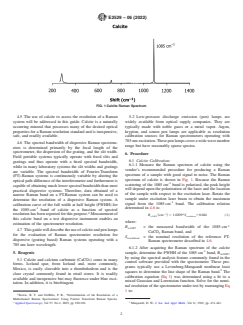
FIG. 1 Calcite Raman Spectrum
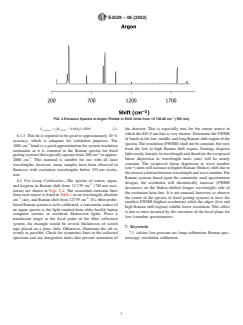
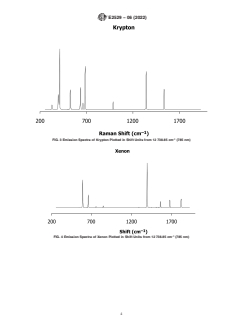
4.5 The use of calcite to assess the resolution of a Raman 5.2 Low-pressure discharge emission (pen) lamps are
system will be addressed in this guide. Calcite is a naturally widely available from optical supply companies. They are
occurring mineral that possesses many of the desired optical typically made with noble gases or a metal vapor. Argon,
properties for a Raman resolution standard and is inexpensive, krypton, and xenon pen lamps are applicable as resolution
safe, and readily available. calibration sources for Raman spectrometers operating with
785 nmexcitation.Thesepenlampscoverawidewavenumber
4.6 The spectral bandwidth of dispersive Raman spectrom-
range but have reasonably sparse spectra.
eters is determined primarily by the focal length of the
spectrometer, the dispersion of the grating, and the slit width.
6. Procedure
Field portable systems typically operate with fixed slits and
6.1 Calcite Calibration:
gratings and thus operate with a fixed spectral bandwidth,
6.1.1 Measure the Raman spectrum of calcite using the
while in many laboratory systems the slit widths and gratings
vendor’s recommended procedure for producing a Raman
are variable. The spectral bandwidth of Fourier-Transform
spectrum of a sample with good signal to noise. The Raman
(FT)-Raman systems is continuously variable by altering the
spectrum of calcite is shown in Fig. 1. Because the Raman
optical path difference of the interferometer and furthermore is
-1
scattering of the 1085 cm band is polarized, the peak height
capable of obtaining much lower spectral bandwidth than most
will depend upon the polarization of the laser and the location
practical dispersive systems. Therefore, data obtained of a
of the sample with respect to the excitation laser. Rotate the
narrow Raman band on a FT-Raman system can be used to
sample under excitation laser beam to obtain the maximum
determine the resolution of a dispersive Raman system. A
-1
signal from the 1085 cm band. The calibration relation
calibration curve of the full width at half height (FWHH) for
-1
determined in 4.6 is:
the 1085-cm band of calcite as a function of spectral
resolution has been reported for thi
...