

ASTM E1683-02(2022)
(Practice)Standard Practice for Testing the Performance of Scanning Raman Spectrometers
General Information
- Abstract
SIGNIFICANCE AND USE
4.1 A scanning Raman spectrometer should be checked regularly to determine if its condition is adequate for routine measurements or if it has changed. This practice is designed to facilitate that determination and, if performance is unsatisfactory, to identify the part of the system that needs attention. These tests apply for single-, double-, or triple-monochromator scanning Raman instruments commercially available. They do not apply for multichannel or Fourier transform instruments, or for gated integrator systems requiring a pulsed laser source. Use of this practice is intended only for trained optical spectroscopists and should be used in conjunction with standard texts.
SCOPE
1.1 This practice covers routine testing of scanning Raman spectrometer performance and to assist in locating problems when performance has degraded. It is also intended as a guide for obtaining and reporting Raman spectra.
1.2 The values stated in SI units are to be regarded as standard. No other units of measurement are included in this standard.
1.3 This standard does not purport to address all of the safety concerns, if any, associated with its use. It is the responsibility of the user of this standard to establish appropriate safety, health, and environmental practices and determine the applicability of regulatory limitations prior to use. For specific precautions, see 7.2.1.
1.4 Because of the significant dangers associated with the use of lasers, ANSI Z136.1 should be followed in conjunction with this practice.
1.5 This international standard was developed in accordance with internationally recognized principles on standardization established in the Decision on Principles for the Development of International Standards, Guides and Recommendations issued by the World Trade Organization Technical Barriers to Trade (TBT) Committee.
- Status
- Published
- Publication Date
- 14-Dec-2022
- Technical Committee
- E13 - Molecular Spectroscopy and Separation Science
- Drafting Committee
- E13.08 - Raman Spectroscopy
Overview
ASTM E1683-02(2022): Standard Practice for Testing the Performance of Scanning Raman Spectrometers is an internationally recognized standard published by ASTM International. This document provides guidance for routine testing of the performance of scanning Raman spectrometers, covering procedures to evaluate instrument condition, troubleshooting methods when performance degradation is identified, and best practices for obtaining and reporting Raman spectra.
This practice is specifically applicable to single-, double-, or triple-monochromator scanning Raman instruments and is intended for use by trained optical spectroscopists. It does not apply to multichannel, Fourier transform instruments, or systems requiring a pulsed laser source. Adherence to this standard helps laboratories ensure the ongoing reliability and accuracy of their Raman spectroscopy results, supporting both research and industrial applications.
Key Topics
- Performance Evaluation: Provides techniques to regularly verify whether a scanning Raman spectrometer functions as expected for routine measurements and to identify affected system components if the instrument's condition changes.
- Instrument Testing Procedures: Details step-by-step methods for assessing core elements including laser sources, monochromators, photomultiplier tubes, and sampling optics.
- Calibration Guidance: Describes how to calibrate spectrometers using standard emission sources to check wavenumber accuracy and spectral response.
- Recording and Reporting Raman Spectra: Outlines best practices for recording spectra using various data acquisition systems and emphasizes comprehensive documentation of experimental conditions.
- Troubleshooting and Problem Identification: Recommends specific materials, such as carbon tetrachloride and cyclohexane, for use as test samples in verifying performance and isolating malfunctions within the spectrometer.
- Safety Considerations: Stresses the need to establish appropriate safety, health, and environmental procedures, especially regarding laser use, in accordance with ANSI Z136.1.
Applications
The primary application of ASTM E1683-02(2022) is the quality assurance and maintenance of scanning Raman spectrometers in laboratory settings. Key practical benefits include:
- Routine Instrument Verification: Ensures that Raman spectrometers maintain their performance standards over time, minimizing errors in spectral data.
- Instrument Calibration: Provides a standardized approach for calibrating wavenumber scales and spectral responses, increasing the accuracy and comparability of Raman spectra between laboratories.
- Troubleshooting Tool: Offers systematic steps to identify performance issues, reducing downtime and helping users make informed maintenance or service decisions.
- Support for Data Integrity: Promotes comprehensive reporting of all conditions and parameters related to Raman measurements, which is crucial for transparency, validation, and reproducibility in both research and industrial quality control.
- Enhanced Instrument Safety: Reinforces the importance of following laser safety guidelines to protect personnel and maintain a safe laboratory environment.
Related Standards
- ASTM E131: Terminology Relating to Molecular Spectroscopy - Provides standard definitions used throughout the field of molecular spectroscopy.
- ASTM E1840: Guide for Raman Shift Standards for Spectrometer Calibration - Offers specific reference materials and procedures for calibrating Raman shift accuracy.
- ANSI Z136.1: Safe Use of Lasers - Establishes safety requirements for control of laser hazards, which must be followed alongside this standard.
- IUPAC Recommendations: Guidelines for the presentation and data reporting of Raman spectra in scientific publications.
Summary
By implementing ASTM E1683-02(2022), organizations can ensure the sustained accuracy, reliability, and safety of their scanning Raman spectrometers, facilitating high-quality Raman spectroscopy analysis in diverse research and industrial settings. This standard is an essential resource for laboratories and professionals seeking a comprehensive, internationally recognized framework for Raman spectrometer maintenance and performance validation.
Relations
- Effective Date
- 01-Mar-2010
- Effective Date
- 01-Mar-2007
- Effective Date
- 01-Sep-2005
- Effective Date
- 10-Sep-2002
- Effective Date
- 10-Sep-2000
- Effective Date
- 10-Oct-1996
- Effective Date
- 10-Oct-1996
Get Certified
Connect with accredited certification bodies for this standard

ECOCERT
Organic and sustainability certification.

Eurofins Food Testing Global
Global leader in food, environment, and pharmaceutical product testing.

Intertek Bangladesh
Intertek certification and testing services in Bangladesh.
Sponsored listings
Frequently Asked Questions
ASTM E1683-02(2022) is a standard published by ASTM International. Its full title is "Standard Practice for Testing the Performance of Scanning Raman Spectrometers". This standard covers: SIGNIFICANCE AND USE 4.1 A scanning Raman spectrometer should be checked regularly to determine if its condition is adequate for routine measurements or if it has changed. This practice is designed to facilitate that determination and, if performance is unsatisfactory, to identify the part of the system that needs attention. These tests apply for single-, double-, or triple-monochromator scanning Raman instruments commercially available. They do not apply for multichannel or Fourier transform instruments, or for gated integrator systems requiring a pulsed laser source. Use of this practice is intended only for trained optical spectroscopists and should be used in conjunction with standard texts. SCOPE 1.1 This practice covers routine testing of scanning Raman spectrometer performance and to assist in locating problems when performance has degraded. It is also intended as a guide for obtaining and reporting Raman spectra. 1.2 The values stated in SI units are to be regarded as standard. No other units of measurement are included in this standard. 1.3 This standard does not purport to address all of the safety concerns, if any, associated with its use. It is the responsibility of the user of this standard to establish appropriate safety, health, and environmental practices and determine the applicability of regulatory limitations prior to use. For specific precautions, see 7.2.1. 1.4 Because of the significant dangers associated with the use of lasers, ANSI Z136.1 should be followed in conjunction with this practice. 1.5 This international standard was developed in accordance with internationally recognized principles on standardization established in the Decision on Principles for the Development of International Standards, Guides and Recommendations issued by the World Trade Organization Technical Barriers to Trade (TBT) Committee.
SIGNIFICANCE AND USE 4.1 A scanning Raman spectrometer should be checked regularly to determine if its condition is adequate for routine measurements or if it has changed. This practice is designed to facilitate that determination and, if performance is unsatisfactory, to identify the part of the system that needs attention. These tests apply for single-, double-, or triple-monochromator scanning Raman instruments commercially available. They do not apply for multichannel or Fourier transform instruments, or for gated integrator systems requiring a pulsed laser source. Use of this practice is intended only for trained optical spectroscopists and should be used in conjunction with standard texts. SCOPE 1.1 This practice covers routine testing of scanning Raman spectrometer performance and to assist in locating problems when performance has degraded. It is also intended as a guide for obtaining and reporting Raman spectra. 1.2 The values stated in SI units are to be regarded as standard. No other units of measurement are included in this standard. 1.3 This standard does not purport to address all of the safety concerns, if any, associated with its use. It is the responsibility of the user of this standard to establish appropriate safety, health, and environmental practices and determine the applicability of regulatory limitations prior to use. For specific precautions, see 7.2.1. 1.4 Because of the significant dangers associated with the use of lasers, ANSI Z136.1 should be followed in conjunction with this practice. 1.5 This international standard was developed in accordance with internationally recognized principles on standardization established in the Decision on Principles for the Development of International Standards, Guides and Recommendations issued by the World Trade Organization Technical Barriers to Trade (TBT) Committee.
ASTM E1683-02(2022) is classified under the following ICS (International Classification for Standards) categories: 71.040.50 - Physicochemical methods of analysis. The ICS classification helps identify the subject area and facilitates finding related standards.
ASTM E1683-02(2022) has the following relationships with other standards: It is inter standard links to ASTM E131-10, ASTM E1840-96(2007), ASTM E131-05, ASTM E131-02, ASTM E131-00a, ASTM E1840-96(2002), ASTM E1840-96. Understanding these relationships helps ensure you are using the most current and applicable version of the standard.
ASTM E1683-02(2022) is available in PDF format for immediate download after purchase. The document can be added to your cart and obtained through the secure checkout process. Digital delivery ensures instant access to the complete standard document.
Standards Content (Sample)
This international standard was developed in accordance with internationally recognized principles on standardization established in the Decision on Principles for the
Development of International Standards, Guides and Recommendations issued by the World Trade Organization Technical Barriers to Trade (TBT) Committee.
Designation: E1683 − 02 (Reapproved 2022)
Standard Practice for
Testing the Performance of Scanning Raman
Spectrometers
This standard is issued under the fixed designation E1683; the number immediately following the designation indicates the year of
original adoption or, in the case of revision, the year of last revision. A number in parentheses indicates the year of last reapproval. A
superscript epsilon (´) indicates an editorial change since the last revision or reapproval.
1. Scope 3. Terminology
1.1 This practice covers routine testing of scanning Raman
3.1 Terminology used in this practice conforms to the
spectrometer performance and to assist in locating problems
definitions in Terminology E131.
when performance has degraded. It is also intended as a guide
for obtaining and reporting Raman spectra.
4. Significance and Use
1.2 The values stated in SI units are to be regarded as
4.1 A scanning Raman spectrometer should be checked
standard. No other units of measurement are included in this
regularly to determine if its condition is adequate for routine
standard.
measurements or if it has changed. This practice is designed to
1.3 This standard does not purport to address all of the facilitate that determination and, if performance is
safety concerns, if any, associated with its use. It is the unsatisfactory, to identify the part of the system that needs
responsibility of the user of this standard to establish appro- attention. These tests apply for single-, double-, or triple-
priate safety, health, and environmental practices and deter- monochromator scanning Raman instruments commercially
mine the applicability of regulatory limitations prior to use. available. They do not apply for multichannel or Fourier
For specific precautions, see 7.2.1. transform instruments, or for gated integrator systems requir-
1.4 Because of the significant dangers associated with the ing a pulsed laser source. Use of this practice is intended only
use of lasers, ANSI Z136.1 should be followed in conjunction for trained optical spectroscopists and should be used in
with this practice. conjunction with standard texts.
1.5 This international standard was developed in accor-
5. Apparatus
dance with internationally recognized principles on standard-
ization established in the Decision on Principles for the
5.1 Laser—Amonochromatic,continuouslasersource,such
Development of International Standards, Guides and Recom-
asanargon,krypton,orhelium-neonlaser,isnormallyusedfor
mendations issued by the World Trade Organization Technical
Raman measurements. The laser intensity should be measured
Barriers to Trade (TBT) Committee.
at the sample with a power meter because optical components
between the laser and sample reduce laser intensity.Afiltering
2. Referenced Documents
device should also be used to remove non-lasting plasma
2.1 ASTM Standards:
emission lines from the laser beam before they reach the
E131 Terminology Relating to Molecular Spectroscopy
sample. Plasma lines can seriously interfere with Raman
E1840 Guide for Raman Shift Standards for Spectrometer
measurements. Filtering devices include dispersive monochro-
Calibration
mators and interference filters.
2.2 ANSI Standard:
5.2 Sampling Optics—Commercial instruments can be pur-
Z136.1 Safe Use of Lasers
chased with sampling optics to focus the laser beam onto a
sample and to image the Raman scattering onto the monochro-
This practice is under the jurisdiction of ASTM Committee E13 on Molecular
mator entrance slit. Sample chamber adjustments are used to
Spectroscopy and Separation Science and is the direct responsibility of Subcom-
mittee E13.08 on Raman Spectroscopy.
centerthesampleproperlyandaligntheRamanscatteredlight.
Current edition approved Dec. 15, 2022. Published December 2022. Originally
A schematic view of a conventional 90° Raman scattering
ɛ1
approved in 1995. Last previous edition approved in 2014 as E1683 – 02(2014) .
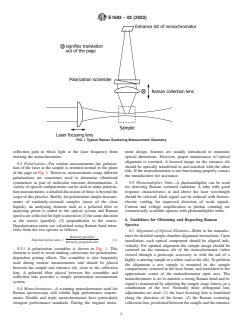
geometry is shown in Fig. 1. The laser beam propagates at a
DOI: 10.1520/E1683-02R22.
right angle to the direction in which scattered light is collected.
For referenced ASTM standards, visit the ASTM website, www.astm.org, or
contact ASTM Customer Service at service@astm.org. For Annual Book of ASTM
It is focused on the sample at the same position as the
Standards volume information, refer to the standard’s Document Summary page on
monochromator entrance slit image. Other geometries such as
the ASTM website.
3 180° backscattering are also used. With single
Available fromAmerican National Standards Institute (ANSI), 25 W. 43rd St.,
4th Floor, New York, NY 10036, http://www.ansi.org. monochromators, a filter is normally placed in the optical
Copyright © ASTM International, 100 Barr Harbor Drive, PO Box C700, West Conshohocken, PA 19428-2959. United States
E1683 − 02 (2022)
FIG. 1 Typical Raman Scattering Measurement Geometry
collection path to block light at the laser frequency from ment design, features are usually introduced to minimize
entering the monochromator. optical aberrations. However, proper maintenance of optical
alignment is essential. A focused image on the entrance slit
5.3 Polarization—For routine measurements the polariza-
should be optically transferred to and matched with the other
tion of the laser at the sample is oriented normal to the plane
slits. If the monochromator is not functioning properly contact
of the page in Fig. 1. However, measurements using different
the manufacturer for assistance.
polarizations are sometimes used to determine vibrational
symmetries as part of molecular structure determinations. A 5.5 Photomultiplier Tube—A photomultiplier can be used
variety of optical configurations can be used to make polariza- for detecting Raman scattered radiation. A tube with good
tionmeasurements;adetaileddiscussionoftheseisbeyondthe response characteristics at and above the laser wavelength
scope of this practice. Briefly, for polarization simple measure- should be selected. Dark signal can be reduced with thermo-
ments of randomly-oriented samples (most of the clear electric cooling for improved detection of weak signals.
liquids), an analyzing element such as a polaroid filter or Current and voltage amplification or photon counting are
analyzing prism is added to the optical system and Raman commercially available options with photomultiplier tubes.
spectraarecollectedforlightscatteredin(1)thesamedirection
6. Guidelines for Obtaining and Reporting Raman
as the source (parallel), (2) perpendicular to the source.
Spectra
Depolarization ratios are calculated using Raman band inten-
sities from the two spectra as follows:
6.1 Alignment of Optical Elements—Refer to the manufac-
turerfordetailedsamplechamberalignmentinstructions.Upon
Intensityparallel
Depolarizationratio 5 (1)
installation, each optical component should be aligned indi-
Intensityperpendicular
vidually. For optimal alignment the sample image should be
5.3.1 A polarization scrambler is shown in Fig. 1. This
centered on the entrance slit of the monochromator (often
element is used to avoid making corrections for polarization-
viewed through a periscope accessory or with the aid of a
dependent grating effects. The scrambler is also frequently
highly scattering sample or a white card at the slit).To perform
used during routine measurements and should be placed
the alignment a test sample is mounted in the sample
between the sample and entrance slit, close to the collection
compartment, centered in the laser beam, and translated to the
lens. A polaroid filter placed between the scrambler and
approximate center of the monochromator optic axis. The
collection lens provides a simple polarization measurement
monochromator is set to monitor a strong Raman band and its
system.
signal is maximized by adjusting the sample stage, lenses, or a
5.4 Monochromator—A scanning monochromator used for combination of the two. Normally three orthogonal lens
Raman spectroscopy will exhibit high performance require- adjustments are used: (1) the laser focusing lens is translated
ments. Double and triple monochromators have particularly along the direction of the beam; (2) the Raman scattering
stringent performance standards. During the original instru- collectionlens,positionedbetweenthesampleandtheentrance
E1683 − 02 (2022)
slit, is translated along the direction of the propagating scat- pointsinthefullwidthathalfthemaximumintensity(FWHM)
tered light in order to provide focus; and (3) the collection lens of the narrowest spectral band. For example, if the slits were
istranslatedperpendiculartothescatteredlightinordertoscan set to provide a measured band width at half maximum of
the image of the laser-excited scattering volume across the 4 wavenumbers, then 1-wavenumber increments would pro-
width of the monochromator entrance slit. (Refer to Fig. 1.) ducefivedatapointswithintheFWHMinascanofalinefrom
This collection lens adjustment should be made during major aplasmaemissionsource.Tobetterdefinepeakshapedecrease
instrument alignment (for example, during initial set-up), but the size of the increments. This is especially important for
should not be necessary during routine sample-to-sample bands that deviate from Lorentzian shape.
alignment. Sample and lens adjustments should be repeated as
6.4 Reporting Experimental Conditions—The spectral slit
necessary while the slits are narrowed from a relatively large
width(wavenumbers),scanrate,laserwavelengthandpowerat
initial width down to the size determined by the resolution
the sample, polarization conditions, integration time, correc-
requirements of the measurement.
tions for instrumental response, type of spectrometer and
6.2 Calibration: detector, sample information (physical state, concentration,
geometry, and so forth), and other important experimental
6.2.1 Spectral Response—The spectral response of an opti-
cal spectrometric system will depend on the efficiency of the conditions should always be recorded with the spectra and
gratings (which is both wavelength and polarization depen- reproduced for performance testing. A complete record of the
dent) and the spectral response of the photomultiplier tube. parameters to be specified is available in Table 1 of the IUPAC
This can be measured routinely by collecting light from a Recommendations for the Presentation of Raman Spectra in
tungsten halogen lamp or other NIST-traceable standard light Data Collections (10).
source.Acomplete procedure for performing spectral response
7. Evaluation of Raman Instrument Parameters
corrections has been published by Scherer and Kint (1). It is
stronglyrecommendedthatcorrectionsforspectralresponsebe
7.1 The performance of an instrument should be evaluated
incorporateddirectlyintothesoftwarewhenacomputerisused
regularly to determine if it has degraded. This is most easily
to collect spectra.
accomplished with a test sample such as carbon tetrachloride
6.2.2 Wavenumber—The accuracy of the wavenumber cali-
measured under a set of standard conditions established for the
bration over a large region should be determined using a
particular instrument. Signal intensity and wavelength accu-
standard low-pressure emission source with enough lines to
racyarethetwospectralfeaturestocheck.Ifpeaksignallevels
make many measurements over the range of the instrument.
have diminished or are shifted from accepted wavenumber
Low-pressure mercury, argon, and neon lamps are frequently
values, the components of the system should be evaluated
used. The non-lasing emission lines of the laser can also be
independentlytolocatethesourceofperformancedegradation.
used if the laser filtering device is removed. Accurate wave-
Guidelines for such an evaluation are as follows:
number values are available (2-9). For measurement at resolu-
7.2 TestSamples—Thefollowingreadilyavailablematerials
tions <0.5 wavenumbers a more rigorous calibration method
are commonly used for evaluating the performance of Raman
should be employed.
spectrometers:
6.3 Recording Raman Spectra—The following guidelines
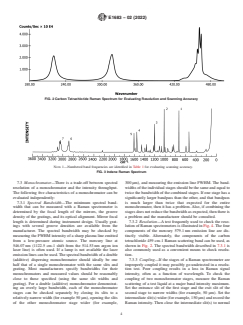
7.2.1 Carbon Tetrachloride—The major Raman bands are
are provided for recording spectra with a rare meter and strip
218 cm-1, 314 cm-1, and 459 cm-1 (see Fig. 2). (Warn
...