

ASTM D874-23
(Test Method)Standard Test Method for Sulfated Ash from Lubricating Oils and Additives
General Information
- Abstract
SIGNIFICANCE AND USE
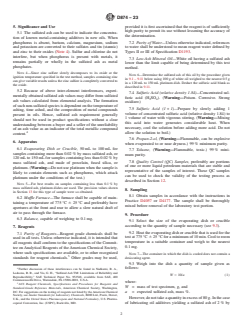
5.1 The sulfated ash can be used to indicate the concentration of known metal-containing additives in new oils. When phosphorus is absent, barium, calcium, magnesium, sodium and potassium are converted to their sulfates and tin (stannic) and zinc to their oxides (Note 4). Sulfur and chlorine do not interfere, but when phosphorus is present with metals, it remains partially or wholly in the sulfated ash as metal phosphates.
Note 4: Since zinc sulfate slowly decomposes to its oxide at the ignition temperature specified in the test method, samples containing zinc can give variable results unless the zinc sulfate is completely converted to the oxide.
5.2 Because of above inter-element interferences, experimentally obtained sulfated ash values may differ from sulfated ash values calculated from elemental analysis. The formation of such non-sulfated species is dependent on the temperature of ashing, time ashed, and the composition of metal compounds present in oils. Hence, sulfated ash requirement generally should not be used in product specifications without a clear understanding between a buyer and a seller of the unreliability of an ash value as an indicator of the total metallic compound content.4
SCOPE
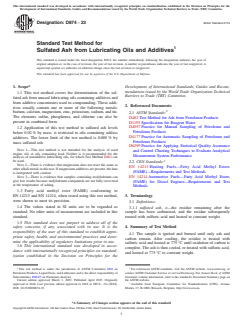
1.1 This test method covers the determination of the sulfated ash from unused lubricating oils containing additives and from additive concentrates used in compounding. These additives usually contain one or more of the following metals: barium, calcium, magnesium, zinc, potassium, sodium, and tin. The elements sulfur, phosphorus, and chlorine can also be present in combined form.
1.2 Application of this test method to sulfated ash levels below 0.02 % by mass is restricted to oils containing ashless additives. The lower limit of the test method is 0.005 % by mass sulfated ash.
Note 1: This test method is not intended for the analysis of used engine oils or oils containing lead. Neither is it recommended for the analysis of nonadditive lubricating oils, for which Test Method D482 can be used.
Note 2: There is evidence that magnesium does not react the same as other alkali metals in this test. If magnesium additives are present, the data is interpreted with caution.
Note 3: There is evidence that samples containing molybdenum can give low results because molybdenum compounds are not fully recovered at the temperature of ashing.
1.3 Fatty acid methyl ester (FAME) conforming to EN 14213 and EN 14214, when tested using this test method, were shown to meet its precision.
1.4 The values stated in SI units are to be regarded as standard. No other units of measurement are included in this standard.
1.5 This standard does not purport to address all of the safety concerns, if any, associated with its use. It is the responsibility of the user of this standard to establish appropriate safety, health, and environmental practices and determine the applicability of regulatory limitations prior to use.
1.6 This international standard was developed in accordance with internationally recognized principles on standardization established in the Decision on Principles for the Development of International Standards, Guides and Recommendations issued by the World Trade Organization Technical Barriers to Trade (TBT) Committee.
- Status
- Published
- Publication Date
- 28-Feb-2023
- Technical Committee
- D02 - Petroleum Products, Liquid Fuels, and Lubricants
- Drafting Committee
- D02.03 - Elemental Analysis
Overview
ASTM D874-23 – "Standard Test Method for Sulfated Ash from Lubricating Oils and Additives" – is an internationally recognized standard developed and maintained by ASTM International. This test method provides a procedure for determining the sulfated ash content in unused lubricating oils and additive concentrates. These oils and additives often contain metal-containing compounds such as barium, calcium, magnesium, zinc, potassium, sodium, and tin, which are measured through this standardized ash determination method.
Sulfated ash measurement is a critical indicator for monitoring the concentration of known metal-based additives in oil formulations. The standard is widely referenced within the petroleum, automotive, and lubricant industries to ensure conformity, quality control, and regulatory compliance.
Key Topics
- Sulfated Ash Determination: The method involves carbonizing the sample, treating the residue with sulfuric acid, and then heating to a constant weight at high temperature. The resulting residue – termed "sulfated ash" – represents metallic components in the oil.
- Elemental Interferences: The standard highlights that certain elements, such as phosphorus, sulfur, and chlorine, may affect the ash residue, sometimes resulting in the formation of metal phosphates or other non-sulfated compounds.
- Precision and Limitations:
- Recommended for new, unused oils; not suitable for used oils or oils containing lead.
- The detectable range is from 0.005% to values above 25% by mass.
- Special attention is required when magnesium or molybdenum-containing additives are present, as results may vary due to their unique reactions during the ashing process.
- Variation can occur due to ashing temperature, sample composition, and the presence of certain additives.
- Significance of Sulfated Ash Values: While sulfated ash can be used to estimate the concentration of metal additives, it is not always a reliable proxy for total metallic compound content due to possible formation of non-sulfated residues.
Applications
- Quality Control for Lubricating Oils: Manufacturers use ASTM D874-23 to verify that lubricating oils and additives meet specified sulfated ash content, which impacts engine performance, emissions, and wear characteristics.
- Formulation and Development: Blenders and formulators employ the test to develop new oil blends, ensuring additive compatibility and compliance with performance standards.
- Regulatory Compliance: The method is commonly referenced in product specification sheets, industry regulations, and purchasing agreements to confirm adherence to allowable ash limits.
- Product Certification and Verification: Sulfated ash measurements are used as part of certification programs for automotive, industrial, and marine lubricants.
- Suitability for Biodiesel Additives: The standard has validated applicability when measuring sulfated ash in fatty acid methyl esters (FAME) conforming to EN 14213 and EN 14214, making it useful for bio-lubricants.
Related Standards
- ASTM D482 – Test Method for Ash from Petroleum Products: Recommended for nonadditive lubricating oils.
- ASTM D1193 – Specification for Reagent Water: Reference for water quality used during analysis.
- ASTM D4057 / D4177 – Practices for Manual and Automatic Sampling of Petroleum Products: Guidance on obtaining representative test samples.
- ASTM D6299 – Quality Control for Analytical Measurement Systems: Procedures for ensuring consistent test results.
- EN 14213 – Heating Fuels; Fatty Acid Methyl Esters (FAME): Test methods and requirements for FAME, often used in conjunction with ASTM D874-23.
- EN 14214 – Automotive Fuels; FAME for Diesel Engines: Applies to automotive biodiesel, cross-referenced for precision in sulfated ash testing.
Practical Value
Adhering to ASTM D874-23 offers significant benefits for lubricant producers, additive manufacturers, and end-users:
- Confirms additive dosages for optimal engine and machinery protection.
- Supports informed purchasing and supply agreements by providing a clear, comparable test metric.
- Enhances compliance with industry regulations on metallic content and emissions.
- Provides quality assurance in both routine manufacturing and new product development.
For accurate, reproducible results and confidence in lubricating oil quality, ASTM D874-23 remains a cornerstone in elemental analysis and oil additive verification.
Relations
- Effective Date
- 01-Dec-2023
- Effective Date
- 15-Dec-2017
- Effective Date
- 15-Nov-2017
- Effective Date
- 01-Jan-2017
- Effective Date
- 01-Oct-2013
- Effective Date
- 01-Dec-2012
- Refers
ASTM D4057-06(2011) - Standard Practice for Manual Sampling of Petroleum and Petroleum Products - Effective Date
- 01-Jun-2011
- Effective Date
- 01-Mar-2010
- Effective Date
- 01-Mar-2010
- Effective Date
- 01-Nov-2009
- Effective Date
- 15-Oct-2008
- Effective Date
- 01-Dec-2007
- Effective Date
- 01-Nov-2007
- Effective Date
- 01-Nov-2007
- Effective Date
- 01-Mar-2006
Get Certified
Connect with accredited certification bodies for this standard

Element Materials Technology
Materials testing and product certification.

ABS Group Brazil
ABS Group certification services in Brazil.

ABS Quality Evaluations Inc.
American Bureau of Shipping quality certification.
Sponsored listings
Frequently Asked Questions
ASTM D874-23 is a standard published by ASTM International. Its full title is "Standard Test Method for Sulfated Ash from Lubricating Oils and Additives". This standard covers: SIGNIFICANCE AND USE 5.1 The sulfated ash can be used to indicate the concentration of known metal-containing additives in new oils. When phosphorus is absent, barium, calcium, magnesium, sodium and potassium are converted to their sulfates and tin (stannic) and zinc to their oxides (Note 4). Sulfur and chlorine do not interfere, but when phosphorus is present with metals, it remains partially or wholly in the sulfated ash as metal phosphates. Note 4: Since zinc sulfate slowly decomposes to its oxide at the ignition temperature specified in the test method, samples containing zinc can give variable results unless the zinc sulfate is completely converted to the oxide. 5.2 Because of above inter-element interferences, experimentally obtained sulfated ash values may differ from sulfated ash values calculated from elemental analysis. The formation of such non-sulfated species is dependent on the temperature of ashing, time ashed, and the composition of metal compounds present in oils. Hence, sulfated ash requirement generally should not be used in product specifications without a clear understanding between a buyer and a seller of the unreliability of an ash value as an indicator of the total metallic compound content.4 SCOPE 1.1 This test method covers the determination of the sulfated ash from unused lubricating oils containing additives and from additive concentrates used in compounding. These additives usually contain one or more of the following metals: barium, calcium, magnesium, zinc, potassium, sodium, and tin. The elements sulfur, phosphorus, and chlorine can also be present in combined form. 1.2 Application of this test method to sulfated ash levels below 0.02 % by mass is restricted to oils containing ashless additives. The lower limit of the test method is 0.005 % by mass sulfated ash. Note 1: This test method is not intended for the analysis of used engine oils or oils containing lead. Neither is it recommended for the analysis of nonadditive lubricating oils, for which Test Method D482 can be used. Note 2: There is evidence that magnesium does not react the same as other alkali metals in this test. If magnesium additives are present, the data is interpreted with caution. Note 3: There is evidence that samples containing molybdenum can give low results because molybdenum compounds are not fully recovered at the temperature of ashing. 1.3 Fatty acid methyl ester (FAME) conforming to EN 14213 and EN 14214, when tested using this test method, were shown to meet its precision. 1.4 The values stated in SI units are to be regarded as standard. No other units of measurement are included in this standard. 1.5 This standard does not purport to address all of the safety concerns, if any, associated with its use. It is the responsibility of the user of this standard to establish appropriate safety, health, and environmental practices and determine the applicability of regulatory limitations prior to use. 1.6 This international standard was developed in accordance with internationally recognized principles on standardization established in the Decision on Principles for the Development of International Standards, Guides and Recommendations issued by the World Trade Organization Technical Barriers to Trade (TBT) Committee.
SIGNIFICANCE AND USE 5.1 The sulfated ash can be used to indicate the concentration of known metal-containing additives in new oils. When phosphorus is absent, barium, calcium, magnesium, sodium and potassium are converted to their sulfates and tin (stannic) and zinc to their oxides (Note 4). Sulfur and chlorine do not interfere, but when phosphorus is present with metals, it remains partially or wholly in the sulfated ash as metal phosphates. Note 4: Since zinc sulfate slowly decomposes to its oxide at the ignition temperature specified in the test method, samples containing zinc can give variable results unless the zinc sulfate is completely converted to the oxide. 5.2 Because of above inter-element interferences, experimentally obtained sulfated ash values may differ from sulfated ash values calculated from elemental analysis. The formation of such non-sulfated species is dependent on the temperature of ashing, time ashed, and the composition of metal compounds present in oils. Hence, sulfated ash requirement generally should not be used in product specifications without a clear understanding between a buyer and a seller of the unreliability of an ash value as an indicator of the total metallic compound content.4 SCOPE 1.1 This test method covers the determination of the sulfated ash from unused lubricating oils containing additives and from additive concentrates used in compounding. These additives usually contain one or more of the following metals: barium, calcium, magnesium, zinc, potassium, sodium, and tin. The elements sulfur, phosphorus, and chlorine can also be present in combined form. 1.2 Application of this test method to sulfated ash levels below 0.02 % by mass is restricted to oils containing ashless additives. The lower limit of the test method is 0.005 % by mass sulfated ash. Note 1: This test method is not intended for the analysis of used engine oils or oils containing lead. Neither is it recommended for the analysis of nonadditive lubricating oils, for which Test Method D482 can be used. Note 2: There is evidence that magnesium does not react the same as other alkali metals in this test. If magnesium additives are present, the data is interpreted with caution. Note 3: There is evidence that samples containing molybdenum can give low results because molybdenum compounds are not fully recovered at the temperature of ashing. 1.3 Fatty acid methyl ester (FAME) conforming to EN 14213 and EN 14214, when tested using this test method, were shown to meet its precision. 1.4 The values stated in SI units are to be regarded as standard. No other units of measurement are included in this standard. 1.5 This standard does not purport to address all of the safety concerns, if any, associated with its use. It is the responsibility of the user of this standard to establish appropriate safety, health, and environmental practices and determine the applicability of regulatory limitations prior to use. 1.6 This international standard was developed in accordance with internationally recognized principles on standardization established in the Decision on Principles for the Development of International Standards, Guides and Recommendations issued by the World Trade Organization Technical Barriers to Trade (TBT) Committee.
ASTM D874-23 is classified under the following ICS (International Classification for Standards) categories: 75.100 - Lubricants, industrial oils and related products. The ICS classification helps identify the subject area and facilitates finding related standards.
ASTM D874-23 has the following relationships with other standards: It is inter standard links to ASTM D6299-23a, ASTM D6299-17b, ASTM D6299-17a, ASTM D6299-17, ASTM D6299-13e1, ASTM D482-12, ASTM D4057-06(2011), ASTM D6299-10, ASTM D6299-10e2, ASTM D6299-09, ASTM D6299-08, ASTM D482-07, ASTM D6299-07e1, ASTM D6299-07, ASTM D1193-06. Understanding these relationships helps ensure you are using the most current and applicable version of the standard.
ASTM D874-23 is available in PDF format for immediate download after purchase. The document can be added to your cart and obtained through the secure checkout process. Digital delivery ensures instant access to the complete standard document.
Standards Content (Sample)
This international standard was developed in accordance with internationally recognized principles on standardization established in the Decision on Principles for the
Development of International Standards, Guides and Recommendations issued by the World Trade Organization Technical Barriers to Trade (TBT) Committee.
Designation: D874 − 23 British Standard 4716
Standard Test Method for
Sulfated Ash from Lubricating Oils and Additives
This standard is issued under the fixed designation D874; the number immediately following the designation indicates the year of
original adoption or, in the case of revision, the year of last revision. A number in parentheses indicates the year of last reapproval. A
superscript epsilon (´) indicates an editorial change since the last revision or reapproval.
This standard has been approved for use by agencies of the U.S. Department of Defense.
1. Scope* Development of International Standards, Guides and Recom-
mendations issued by the World Trade Organization Technical
1.1 This test method covers the determination of the sul-
Barriers to Trade (TBT) Committee.
fated ash from unused lubricating oils containing additives and
from additive concentrates used in compounding. These addi-
2. Referenced Documents
tives usually contain one or more of the following metals:
barium, calcium, magnesium, zinc, potassium, sodium, and tin.
2.1 ASTM Standards:
The elements sulfur, phosphorus, and chlorine can also be
D482 Test Method for Ash from Petroleum Products
present in combined form.
D1193 Specification for Reagent Water
D4057 Practice for Manual Sampling of Petroleum and
1.2 Application of this test method to sulfated ash levels
Petroleum Products
below 0.02 % by mass is restricted to oils containing ashless
D4177 Practice for Automatic Sampling of Petroleum and
additives. The lower limit of the test method is 0.005 % by
Petroleum Products
mass sulfated ash.
D6299 Practice for Applying Statistical Quality Assurance
NOTE 1—This test method is not intended for the analysis of used
and Control Charting Techniques to Evaluate Analytical
engine oils or oils containing lead. Neither is it recommended for the
Measurement System Performance
analysis of nonadditive lubricating oils, for which Test Method D482 can
be used.
2.2 CEN Standards:
NOTE 2—There is evidence that magnesium does not react the same as
EN 14213 Heating Fuels—Fatty Acid Methyl Esters
other alkali metals in this test. If magnesium additives are present, the data
(FAME)—Requirements and Test Methods
is interpreted with caution.
EN 14214 Automotive Fuels—Fatty Acid Methyl Esters
NOTE 3—There is evidence that samples containing molybdenum can
give low results because molybdenum compounds are not fully recovered
(FAME) for Diesel Engines—Requirements and Test
at the temperature of ashing.
Methods
1.3 Fatty acid methyl ester (FAME) conforming to
EN 14213 and EN 14214, when tested using this test method, 3. Terminology
were shown to meet its precision.
3.1 Definitions:
1.4 The values stated in SI units are to be regarded as
3.1.1 sulfated ash, n—the residue remaining after the
standard. No other units of measurement are included in this
sample has been carbonized, and the residue subsequently
standard.
treated with sulfuric acid and heated to constant weight.
1.5 This standard does not purport to address all of the
4. Summary of Test Method
safety concerns, if any, associated with its use. It is the
responsibility of the user of this standard to establish appro-
4.1 The sample is ignited and burned until only ash and
priate safety, health, and environmental practices and deter-
carbon remain. After cooling, the residue is treated with
mine the applicability of regulatory limitations prior to use.
sulfuric acid and heated at 775 °C until oxidation of carbon is
1.6 This international standard was developed in accor-
complete. The ash is then cooled, re-treated with sulfuric acid,
dance with internationally recognized principles on standard-
and heated at 775 °C to constant weight.
ization established in the Decision on Principles for the
1 2
This test method is under the jurisdiction of ASTM Committee D02 on For referenced ASTM standards, visit the ASTM website, www.astm.org, or
Petroleum Products, Liquid Fuels, and Lubricants and is the direct responsibility of contact ASTM Customer Service at service@astm.org. For Annual Book of ASTM
Subcommittee D02.03 on Elemental Analysis. Standards volume information, refer to the standard’s Document Summary page on
Current edition approved March 1, 2023. Published April 2023. Originally the ASTM website.
approved in 1946. Last previous edition approved in 2018 as D874 – 13a (2018). Available from European Committee for Standardization (CEN), Avenue
DOI: 10.1520/D0874-23. Marnix 17, B-1000, Brussels, Belgium, http://www.cen.eu.
*A Summary of Changes section appears at the end of this standard
Copyright © ASTM International, 100 Barr Harbor Drive, PO Box C700, West Conshohocken, PA 19428-2959. United States
D874 − 23
5. Significance and Use provided it is first ascertained that the reagent is of sufficiently
high purity to permit its use without lessening the accuracy of
5.1 The sulfated ash can be used to indicate the concentra-
the determination.
tion of known metal-containing additives in new oils. When
phosphorus is absent, barium, calcium, magnesium, sodium 7.2 Purity of Water—Unless otherwise indicated, references
and potassium are converted to their sulfates and tin (stannic) to water shall be understood to mean reagent water defined by
and zinc to their oxides (Note 4). Sulfur and chlorine do not Types II or III of Specification D1193.
interfere, but when phosphorus is present with metals, it
7.3 Low-Ash Mineral Oil—White oil having a sulfated ash
remains partially or wholly in the sulfated ash as metal
lower than the limit capable of being determined by this test
phosphates.
method.
NOTE 4—Since zinc sulfate slowly decomposes to its oxide at the
NOTE 6—Determine the sulfated ash of this oil by the procedure given
ignition temperature specified in the test method, samples containing zinc
in 9.1 – 9.11 below using 100 g of white oil weighed to the nearest 0.5 g
can give variable results unless the zinc sulfate is completely converted to
in a 120 mL to 150 mL platinum dish. Deduct the sulfuric acid blank as
the oxide.
described in 9.11.
5.2 Because of above inter-element interferences, experi-
7.4 Sulfuric Acid (relative density 1.84)—Concentrated sul-
mentally obtained sulfated ash values may differ from sulfated
furic acid (H SO ). (Warning—Poison. Corrosive. Strong
2 4
ash values calculated from elemental analysis. The formation
oxidizer.)
of such non-sulfated species is dependent on the temperature of
7.5 Sulfuric Acid (1 + 1)—Prepare by slowly adding 1
ashing, time ashed, and the composition of metal compounds
volume of concentrated sulfuric acid (relative density 1.84) to
present in oils. Hence, sulfated ash requirement generally
1 volume of water with vigorous stirring. (Warning—Mixing
should not be used in product specifications without a clear
this acid into water generates considerable heat. When
understanding between a buyer and a seller of the unreliability
necessary, cool the solution before adding more acid. Do not
of an ash value as an indicator of the total metallic compound
4 allow the solution to boil.)
content.
7.6 Propan-2-ol, (Warning—Flammable, can be explosive
6. Apparatus
when evaporated to or near dryness.) 99 % minimum purity.
6.1 Evaporating Dish or Crucible, 50 mL to 100 mL for
7.7 Toluene, (Warning—Flammable, toxic.) 99 % mini-
samples containing more than 0.02 % by mass sulfated ash, or
mum purity.
120 mL to 150 mL for samples containing less than 0.02 % by
7.8 Quality Control (QC) Samples, preferably are portions
mass sulfated ash, and made of porcelain, fused silica, or
of one or more liquid petroleum materials that are stable and
platinum. (Warning—Do not use platinum when the sample is
representative of the samples of interest. These QC samples
likely to contain elements such as phosphorus, which attack
can be used to check the validity of the testing process as
platinum under the conditions of the test.)
described in Section 12.
NOTE 5—For best results on samples containing less than 0.1 % by
mass sulfated ash, platinum dishes are used. The precision values shown
8. Sampling
in Section 13 for this type of sample were so obtained.
8.1 Obtain samples in accordance with the instructions in
6.2 Muffle Furnace—The furnace shall be capable of main-
Practice D4057 or D4177. The sample shall be thoroughly
taining a temperature of 775 °C 6 25 °C and preferably have
mixed before removal of the laboratory test portion.
apertures at the front and rear to allow a slow natural draft of
air to pass through the furnace.
9. Procedure
6.3 Balance, capable of weighing to 0.1 mg.
9.1 Select the size of the evaporating dish or crucible
according to the quantity of sample necessary (see 9.3).
7. Reagents
9.2 Heat the evaporating dish or crucible that is used for the
7.1 Purity of Reagents—Reagent grade chemicals shall be
test at 775 °C 6 25 °C for a minimum of 10 min. Cool to room
used in all tests. Unless otherwise indicated, it is intended that
temperature in a suitable container and weigh to the nearest
all reagents shall conform to the specifications of the Commit-
0.1 mg.
tee on Analytical Reagents of the American Chemical Society,
where such specifications are available, or to other recognized
NOTE 7—The container in which the dish is cooled does not contain a
standards for reagent chemicals. Other grades may be used, desiccating agent.
9.3 Weigh into the dish a quantity of sample given as
4 follows:
Further discussion of these interferences can be found in Nadkarni, R. A.,
Ledesma, R. R., and Via, G. H., “Sulfated Ash TM: Limitations of Reliability and
W 5 10/a (1)
Reproducibility,” SAE Technical Paper No. 952548, available from SAE, 400
Commonwealth Drive, Warrendale, PA 15096-0001, U.S.A.
where:
ACS Reagent Chemicals, Specifications and Procedures for Reagents and
W = mass of test specimen, g, and
Standard-Grade Reference Materials, American Chemical Society, Washington,
DC. For suggestions on the testing of reagents not listed by the American Chemical
a = expected sulfated ash, mass %.
Society, see Analar Standards for Laboratory Chemicals, BDH Ltd., Poole, Dorset,
However, do not take a quantity in excess of 80 g. In the case
U.K., and the United States Pharmacopeia and National Formulary, U.S. Pharma-
copeial Convention, Inc. (USPC), Rockville, MD. of lubricating oil additives yielding a sulfated ash of 2 % by
D874 − 23
mass or more, dilute the weighed sample in the dish with 9.10 Repeat 9.8 and 9.9 until two successive weighings
approximately 10 times its weight of low-ash mineral oil. If the differ by no more than 1.0 mg.
amount of sulfated ash found differs from the expected amount
NOTE 9—Normally one repeat will suffice, unless a high proportion of
by more than a factor of two, repeat the analysis with a
zinc is present, when three or four heating periods can be required.
different weight of sample calculated from the first analysis
9.11 For samples expected to contain 0.02 % mass or less of
unless the calculated sample size >80 g.
sulfated ash, determine a sulfuric acid blank by adding 1 mL of
9.4 Heat the dish or crucible and sample carefully until the
the concentrated sulfuric acid to a tared platinum dish or
contents can be ignited with a flame. Maintain at
...
This document is not an ASTM standard and is intended only to provide the user of an ASTM standard an indication of what changes have been made to the previous version. Because
it may not be technically possible to adequately depict all changes accurately, ASTM recommends that users consult prior editions as appropriate. In all cases only the current version
of the standard as published by ASTM is to be considered the official document.
Designation: D874 − 13a (Reapproved 2018) D874 − 23 British Standard 4716
Standard Test Method for
Sulfated Ash from Lubricating Oils and Additives
This standard is issued under the fixed designation D874; the number immediately following the designation indicates the year of
original adoption or, in the case of revision, the year of last revision. A number in parentheses indicates the year of last reapproval. A
superscript epsilon (´) indicates an editorial change since the last revision or reapproval.
This standard has been approved for use by agencies of the U.S. Department of Defense.
1. Scope Scope*
1.1 This test method covers the determination of the sulfated ash from unused lubricating oils containing additives and from
additive concentrates used in compounding. These additives usually contain one or more of the following metals: barium, calcium,
magnesium, zinc, potassium, sodium, and tin. The elements sulfur, phosphorus, and chlorine can also be present in combined form.
1.2 Application of this test method to sulfated ash levels below 0.02 % by mass is restricted to oils containing ashless additives.
The lower limit of the test method is 0.005 % by mass sulfated ash.
NOTE 1—This test method is not intended for the analysis of used engine oils or oils containing lead. Neither is it recommended for the analysis of
nonadditive lubricating oils, for which Test Method D482 can be used.
NOTE 2—There is evidence that magnesium does not react the same as other alkali metals in this test. If magnesium additives are present, the data is
interpreted with caution.
NOTE 3—There is evidence that samples containing molybdenum can give low results because molybdenum compounds are not fully recovered at the
temperature of ashing.
1.3 Fatty acid methyl ester (FAME) conforming to EN 14213 EN 14213 and EN 14214, when tested using this test method, were
shown to meet its precision.
1.4 The values stated in SI units are to be regarded as standard. No other units of measurement are included in this standard.
1.5 This standard does not purport to address all of the safety concerns, if any, associated with its use. It is the responsibility
of the user of this standard to establish appropriate safety, health, and environmental practices and determine the applicability of
regulatory limitations prior to use.
1.6 This international standard was developed in accordance with internationally recognized principles on standardization
established in the Decision on Principles for the Development of International Standards, Guides and Recommendations issued
by the World Trade Organization Technical Barriers to Trade (TBT) Committee.
This test method is under the jurisdiction of ASTM Committee D02 on Petroleum Products, Liquid Fuels, and Lubricants and is the direct responsibility of Subcommittee
D02.03 on Elemental Analysis.
Current edition approved April 1, 2018March 1, 2023. Published June 2018April 2023. Originally approved in 1946. Last previous edition approved in 20132018 as
D874 – 13a.D874 – 13a (2018). DOI: 10.1520/D0874-13AR18.10.1520/D0874-23.
In the IP, this test method is under the jurisdiction of the Standardization Committee. This test method has been approved by the sponsoring committees and accepted by
the cooperating societies in accordance with established procedures.
*A Summary of Changes section appears at the end of this standard
Copyright © ASTM International, 100 Barr Harbor Drive, PO Box C700, West Conshohocken, PA 19428-2959. United States
D874 − 23
2. Referenced Documents
2.1 ASTM Standards:
D482 Test Method for Ash from Petroleum Products
D1193 Specification for Reagent Water
D4057 Practice for Manual Sampling of Petroleum and Petroleum Products
D4177 Practice for Automatic Sampling of Petroleum and Petroleum Products
D6299 Practice for Applying Statistical Quality Assurance and Control Charting Techniques to Evaluate Analytical Measure-
ment System Performance
2.2 CEN Standards:
EN 14213 Heating Fuels—Fatty Acid Methyl Esters (FAME)—Requirements and Test Methods
EN 14214 Automotive Fuels—Fatty Acid Methyl Esters (FAME) for Diesel Engines—Requirements and Test Methods
3. Terminology
3.1 Definitions:
3.1.1 sulfated ash, n—the residue remaining after the sample has been carbonized, and the residue subsequently treated with
sulfuric acid and heated to constant weight.
4. Summary of Test Method
4.1 The sample is ignited and burned until only ash and carbon remain. After cooling, the residue is treated with sulfuric acid and
heated at 775 °C until oxidation of carbon is complete. The ash is then cooled, re-treated with sulfuric acid, and heated at 775 °C
to constant weight.
5. Significance and Use
5.1 The sulfated ash can be used to indicate the concentration of known metal-containing additives in new oils. When phosphorus
is absent, barium, calcium, magnesium, sodium and potassium are converted to their sulfates and tin (stannic) and zinc to their
oxides (Note 4). Sulfur and chlorine do not interfere, but when phosphorus is present with metals, it remains partially or wholly
in the sulfated ash as metal phosphates.
NOTE 4—Since zinc sulfate slowly decomposes to its oxide at the ignition temperature specified in the test method, samples containing zinc can give
variable results unless the zinc sulfate is completely converted to the oxide.
5.2 Because of above inter-element interferences, experimentally obtained sulfated ash values may differ from sulfated ash values
calculated from elemental analysis. The formation of such non-sulfated species is dependent on the temperature of ashing, time
ashed, and the composition of metal compounds present in oils. Hence, sulfated ash requirement generally should not be used in
product specifications without a clear understanding between a buyer and a seller of the unreliability of an ash value as an indicator
of the total metallic compound content.
6. Apparatus
6.1 Evaporating Dish or Crucible;Crucible, 50 mL to 100 mL for samples containing more than 0.02 % by mass sulfated ash, or
120 mL to 150 mL for samples containing less than 0.02 % by mass sulfated ash, and made of porcelain, fused silica, or platinum.
(Warning—Do not use platinum when the sample is likely to contain elements such as phosphorus, which attack platinum under
the conditions of the test.)
NOTE 5—For best results on samples containing less than 0.1 % by mass sulfated ash, platinum dishes are used. The precision values shown in Section
13 for this type of sample were so obtained.
For referenced ASTM standards, visit the ASTM website, www.astm.org, or contact ASTM Customer Service at service@astm.org. For Annual Book of ASTM Standards
volume information, refer to the standard’s Document Summary page on the ASTM website.
Available from European Committee for Standardization (CEN), Avenue Marnix 17, B-1000, Brussels, Belgium, http://www.cen.eu.
Further discussion of these interferences can be found in Nadkarni, R. A., Ledesma, R. R., and Via, G. H., “Sulfated Ash TM: Limitations of Reliability and
Reproducibility,” SAE Technical Paper No. 952548, available from SAE, 400 Commonwealth Drive, Warrendale, PA 15096-0001, U.S.A.
D874 − 23
6.2 Electric Muffle Furnace—The furnace shall be capable of maintaining a temperature of 775 °C 6 25 °C and preferably have
apertures at the front and rear to allow a slow natural draft of air to pass through the furnace.
6.3 Balance, capable of weighing to 0.1 mg.
7. Reagents
7.1 Purity of Reagents—Reagent grade chemicals shall be used in all tests. Unless otherwise indicated, it is intended that all
reagents shall conform to the specifications of the Committee on Analytical Reagents of the American Chemical Society, where
such specifications are available, or to other recognized standards for reagent chemicals. Other grades may be used, provided it
is first ascertained that the reagent is of sufficiently high purity to permit its use without lessening the accuracy of the determination.
7.2 Purity of Water—Unless otherwise indicated, references to water shall be understood to mean reagent water defined by Types
II or III of Specification D1193.
7.3 Low-Ash Mineral Oil—White oil having a sulfated ash lower than the limit capable of being determined by this test method.
NOTE 6—Determine the sulfated ash of this oil by the procedure given in 9.1 – 9.11 below using 100 g of white oil weighed to the nearest 0.5 g in a 120 mL
to 150 mL platinum dish. Deduct the sulfuric acid blank as described in 9.11.
7.4 Sulfuric Acid (relative density 1.84)—Concentrated sulfuric acid (H SO ). (Warning—Poison. Corrosive. Strong oxidizer.)
2 4
7.5 Sulfuric Acid (1 + 1)—Prepare by slowly adding 1 volume of concentrated sulfuric acid (relative density 1.84) to 1 volume
of water with vigorous stirring. (Warning—Mixing this acid into water generates considerable heat. When necessary, cool the
solution before adding more acid. Do not allow the solution to boil.)
7.6 Propan-2-ol, (Warning—Flammable, can be explosive when evaporated to or near dryness.) 99 % minimum purity.
7.7 Toluene, (Warning—Flammable, toxic.) 99 % minimum purity.
7.8 Quality Control (QC) Samples, preferably are portions of one or more liquid petroleum materials that are stable and
representative of the samples of interest. These QC samples can be used to check the validity of the testing process as described
in Section 12.
8. Sampling
8.1 Obtain samples in accordance with the instructions in Practice D4057 or D4177. The sample shall be thoroughly mixed before
removal of the laboratory test portion.
9. Procedure
9.1 Select the size of the evaporating dish or crucible according to the quantity of sample necessary (see 9.3).
9.2 Heat the evaporating dish or crucible that is used for the test at 775 °C 6 25 °C for a minimum of 10 min. Cool to room
temperature in a suitable container and weigh to the nearest 0.1 mg.
NOTE 7—The container in which the dish is cooled does not contain a desiccating agent.
9.3 Weigh into the dish a quantity of sample given as follows:
ACS Reagent Chemicals, American Chemical Society Specifications Specifications and Procedures for Reagents and Standard-Grade Reference Materials, , American
Chemical Society, Washington, DC. For suggestions on the testing of reagents not listed by the American Chemical Society, see Analar Standards for Laboratory Chemicals,
BDH Ltd., Poole, Dorset, U.K., and the United States Pharmacopeia and National Formulary, U.S. Pharmacopeial Convention, Inc. (USPC), Rockville, MD.
D874 − 23
W 5 10/a (1)
where:
W = mass of test specimen, g, and
a = expected sulfated ash, mass %.
However, do not take a quantity in excess of 80 g. In the case of lubricating oil additives yielding a sulfated ash of 2 % by mass
or more, dilute the weighed sample in the dish with approximately 10 times its weight of low-ash mineral oil. If the amount of
sulfated ash found differs from the expected amount by more than a factor of two, repeat the analysis with a different weight of
sample calculated from the first analysis unless the calculated sample size >80 g.
9.4 Heat the dish or crucible and sample carefully until the contents can be ignited with a flame. Maintain at such a temperature
that the sample continues to burn at a uniform and moderate rate. When burning ceases, continue to heat gently until no further
smoke or fumes are evolved.
9.4.1 If the samp
...