

ASTM F1037-18(2022)
(Test Method)Standard Test Method for Visual Rating of Appearance of Resilient Floors
General Information
- Abstract
SIGNIFICANCE AND USE
4.1 Ratings are developed by some subjective or comparative evaluation criteria, or both, of a sample(s) to some reference criteria or when compared to a control sample. These parameters generally include change in gloss, color, surface texture, alterations to pattern and possibly restorability of appearance with normal maintenance procedures, including the use of finishes or buffing. Rating is done by a qualified individual or preferably by a panel of qualified observers under specified lighting conditions in accordance with prescribed procedures.
SCOPE
1.1 This test method is intended to provide a numerical rating system for classification of resilient floors during the various stages of their wear life in relation to their condition, as perceived by a knowledgeable user.
1.2 This test method is intended to allow comparison between two or more samples or groups of samples for differences in visual appearance.
1.3 This method provides recommended viewing conditions and lighting for rating visual differences between samples or groups of samples.
1.4 This method can be utilized to evaluate change in visual appearance before and after some specified test condition exposure, for example, in service wear due to foot traffic, or other tests where change in appearance might occur.
1.5 The values stated in inch-pound units are to be regarded as standard. The values given in parentheses are mathematical conversions to SI units that are provided for information only and are not considered standard.
1.6 This standard does not purport to address all of the safety problems, if any, associated with its use. It is the responsibility of the user of this standard to establish appropriate safety, health, and environmental health practices and determine the applicability of regulatory limitations prior to use.
1.7 This international standard was developed in accordance with internationally recognized principles on standardization established in the Decision on Principles for the Development of International Standards, Guides and Recommendations issued by the World Trade Organization Technical Barriers to Trade (TBT) Committee.
- Status
- Published
- Publication Date
- 30-Nov-2022
- Technical Committee
- F06 - Resilient Floor Coverings
- Drafting Committee
- F06.20 - Test Methods
Overview
ASTM F1037-18(2022): Standard Test Method for Visual Rating of Appearance of Resilient Floors provides a systematic approach for visually assessing and numerically rating the appearance of resilient floor coverings throughout their service life. Developed by ASTM International, this standard ensures consistency in evaluating changes in gloss, color, surface texture, and pattern of resilient flooring materials. Ratings are assigned by qualified observers under controlled lighting and viewing conditions, making this test method a reliable tool for product evaluation, quality control, and comparison between different flooring products or samples.
Key Topics
- Visual Appearance Rating: The method helps to classify the condition of resilient floors using a structured, numerical scale based on visual examination.
- Parameters Evaluated: Change in gloss, color, surface texture, pattern alterations, and the impact of restorative maintenance procedures (such as buffing or applying finishes).
- Procedure for Evaluation:
- Qualified panel of observers rates floor samples, preferably including a diverse mix of backgrounds to minimize subjectivity.
- Assessment occurs under specified, standardized lighting and viewing conditions to ensure accurate, repeatable results.
- Both pre- and post-exposure (such as wear, foot traffic) samples can be evaluated to determine the level of appearance change.
- Scoring System: Total scores correspond to categories ranging from “Excellent” to “Unacceptable,” facilitating clear communication of results.
Applications
- Product Development & Comparison: Manufacturers utilize this standard test method to benchmark new resilient flooring products against existing ones or competitive samples.
- Quality Assurance in Manufacturing: Regular application of the visual rating method helps ensure consistent quality in resilient floor coverings before they reach consumers.
- Service Life Assessment: Facilities staff and flooring professionals can monitor and document the visual condition of floors over time, guiding maintenance decisions.
- Response to Wear or Maintenance: The method quantifies changes in appearance due to service wear-including abrasion, cleaning, and restoration-allowing informed choices about floor maintenance or replacement.
- Regulatory and Procurement Specifications: The numerical rating scale supports compliance with industry and procurement standards by providing objective criteria for product acceptance.
Related Standards
- ASTM D1436: Test Methods for Application of Emulsion Floor Polishes to Substrates for Testing Purposes - referenced for maintenance procedures integral to the visual rating method.
- ASTM F141: Terminology Relating to Resilient Floor Coverings - provides key vocabulary for evaluating and discussing results within ASTM F1037.
- ISO and International Best Practices: ASTM F1037 aligns with internationally recognized principles put forth by the World Trade Organization’s TBT Committee, ensuring global relevance.
- Other ASTM and ISO Test Methods: Many flooring standards reference similar principles for visual evaluation, enabling coordination and consistency across the flooring industry.
Keywords: ASTM F1037-18(2022), resilient floors, visual rating, floor appearance, gloss, color, surface texture, flooring maintenance, floor assessment, flooring quality control, flooring standards, ASTM, numerical rating, restoration, floor wear.
Relations
- Effective Date
- 01-Aug-2023
- Effective Date
- 15-Jan-2020
- Effective Date
- 01-Mar-2017
- Effective Date
- 01-Nov-2015
- Effective Date
- 01-Mar-2012
- Effective Date
- 01-Dec-2011
- Effective Date
- 01-Dec-2008
- Effective Date
- 01-Nov-2008
- Effective Date
- 01-Mar-2008
- Effective Date
- 01-Nov-2004
- Effective Date
- 10-Jun-2003
- Effective Date
- 10-Aug-2001
- Effective Date
- 10-Aug-2001
- Effective Date
- 10-Aug-2001
- Effective Date
- 10-Aug-2001
Frequently Asked Questions
ASTM F1037-18(2022) is a standard published by ASTM International. Its full title is "Standard Test Method for Visual Rating of Appearance of Resilient Floors". This standard covers: SIGNIFICANCE AND USE 4.1 Ratings are developed by some subjective or comparative evaluation criteria, or both, of a sample(s) to some reference criteria or when compared to a control sample. These parameters generally include change in gloss, color, surface texture, alterations to pattern and possibly restorability of appearance with normal maintenance procedures, including the use of finishes or buffing. Rating is done by a qualified individual or preferably by a panel of qualified observers under specified lighting conditions in accordance with prescribed procedures. SCOPE 1.1 This test method is intended to provide a numerical rating system for classification of resilient floors during the various stages of their wear life in relation to their condition, as perceived by a knowledgeable user. 1.2 This test method is intended to allow comparison between two or more samples or groups of samples for differences in visual appearance. 1.3 This method provides recommended viewing conditions and lighting for rating visual differences between samples or groups of samples. 1.4 This method can be utilized to evaluate change in visual appearance before and after some specified test condition exposure, for example, in service wear due to foot traffic, or other tests where change in appearance might occur. 1.5 The values stated in inch-pound units are to be regarded as standard. The values given in parentheses are mathematical conversions to SI units that are provided for information only and are not considered standard. 1.6 This standard does not purport to address all of the safety problems, if any, associated with its use. It is the responsibility of the user of this standard to establish appropriate safety, health, and environmental health practices and determine the applicability of regulatory limitations prior to use. 1.7 This international standard was developed in accordance with internationally recognized principles on standardization established in the Decision on Principles for the Development of International Standards, Guides and Recommendations issued by the World Trade Organization Technical Barriers to Trade (TBT) Committee.
SIGNIFICANCE AND USE 4.1 Ratings are developed by some subjective or comparative evaluation criteria, or both, of a sample(s) to some reference criteria or when compared to a control sample. These parameters generally include change in gloss, color, surface texture, alterations to pattern and possibly restorability of appearance with normal maintenance procedures, including the use of finishes or buffing. Rating is done by a qualified individual or preferably by a panel of qualified observers under specified lighting conditions in accordance with prescribed procedures. SCOPE 1.1 This test method is intended to provide a numerical rating system for classification of resilient floors during the various stages of their wear life in relation to their condition, as perceived by a knowledgeable user. 1.2 This test method is intended to allow comparison between two or more samples or groups of samples for differences in visual appearance. 1.3 This method provides recommended viewing conditions and lighting for rating visual differences between samples or groups of samples. 1.4 This method can be utilized to evaluate change in visual appearance before and after some specified test condition exposure, for example, in service wear due to foot traffic, or other tests where change in appearance might occur. 1.5 The values stated in inch-pound units are to be regarded as standard. The values given in parentheses are mathematical conversions to SI units that are provided for information only and are not considered standard. 1.6 This standard does not purport to address all of the safety problems, if any, associated with its use. It is the responsibility of the user of this standard to establish appropriate safety, health, and environmental health practices and determine the applicability of regulatory limitations prior to use. 1.7 This international standard was developed in accordance with internationally recognized principles on standardization established in the Decision on Principles for the Development of International Standards, Guides and Recommendations issued by the World Trade Organization Technical Barriers to Trade (TBT) Committee.
ASTM F1037-18(2022) is classified under the following ICS (International Classification for Standards) categories: 97.150 - Floor coverings. The ICS classification helps identify the subject area and facilitates finding related standards.
ASTM F1037-18(2022) has the following relationships with other standards: It is inter standard links to ASTM F141-23, ASTM F141-12(2020), ASTM D1436-17, ASTM D1436-97(2015), ASTM F141-12, ASTM F141-11, ASTM F141-08a, ASTM F141-08, ASTM D1436-97(2008), ASTM F141-04, ASTM F141-03, ASTM F141-00A, ASTM F141-01, ASTM F141-00B, ASTM F141-01a. Understanding these relationships helps ensure you are using the most current and applicable version of the standard.
ASTM F1037-18(2022) is available in PDF format for immediate download after purchase. The document can be added to your cart and obtained through the secure checkout process. Digital delivery ensures instant access to the complete standard document.
Standards Content (Sample)
This international standard was developed in accordance with internationally recognized principles on standardization established in the Decision on Principles for the
Development of International Standards, Guides and Recommendations issued by the World Trade Organization Technical Barriers to Trade (TBT) Committee.
Designation: F1037 − 18 (Reapproved 2022)
Standard Test Method for
Visual Rating of Appearance of Resilient Floors
This standard is issued under the fixed designation F1037; the number immediately following the designation indicates the year of
original adoption or, in the case of revision, the year of last revision. A number in parentheses indicates the year of last reapproval. A
superscript epsilon (´) indicates an editorial change since the last revision or reapproval.
1. Scope 2. Referenced Documents
2.1 ASTM Standards:
1.1 This test method is intended to provide a numerical
rating system for classification of resilient floors during the D1436 Test Methods for Application of Emulsion Floor
Polishes to Substrates for Testing Purposes
various stages of their wear life in relation to their condition, as
perceived by a knowledgeable user. F141 Terminology Relating to Resilient Floor Coverings
1.2 This test method is intended to allow comparison
3. Terminology
between two or more samples or groups of samples for
3.1 See Terminology F141 for general Resilient terms and
differences in visual appearance.
definitions, in addition to the more specific terms that have
1.3 This method provides recommended viewing conditions
been defined below.
and lighting for rating visual differences between samples or
3.2 Definitions of Terms Specific to This Standard:
groups of samples.
3.2.1 appearance, n—the collected visual aspects regarding
1.4 This method can be utilized to evaluate change in visual
the flooring material’s surface, including color, texture, gloss,
appearance before and after some specified test condition
etc.
exposure, for example, in service wear due to foot traffic, or
3.2.2 color, perceived, n—attribute of visual perception that
other tests where change in appearance might occur.
can be described by color names, such as white, gray, black,
1.5 The values stated in inch-pound units are to be regarded
yellow, brown, red, purple, etc., as this practice utilizes the
as standard. The values given in parentheses are mathematical
term it is more of a visible color difference between two
conversions to SI units that are provided for information only
adjacent areas or samples.
and are not considered standard.
3.2.3 gloss, n—a level of shiny or lustrous appearance
1.6 This standard does not purport to address all of the
resulting from the tendency of a flooring surface to reflect light
safety problems, if any, associated with its use. It is the
at one angle more than at others. Resilient flooring surface
responsibility of the user of this standard to establish appro-
gloss may range from very low (dull) to very high (shiny).
priate safety, health, and environmental health practices and
3.2.4 qualified panel, n—individual(s) who participate in
determine the applicability of regulatory limitations prior to
comparative evaluation of a sample’s appearance change, that
use.
represent the spectrum of having familiarity with the product,
1.7 This international standard was developed in accor-
familiarity with maintenance of the product, and familiarity
dance with internationally recognized principles on standard-
with the product’s use; sometimes referred to as a knowledge-
ization established in the Decision on Principles for the
able user.
Development of International Standards, Guides and Recom-
3.2.5 surface scratches, n—deterioration of a product’s
mendations issued by the World Trade Organization Technical
surface texture and appearance due to abrasive wear exposure.
Barriers to Trade (TBT) Committee.
3.2.6 surface texture—multi-level dimensioning of the
flooring surface, which can be natural or artificially generated,
ThistestmethodisunderthejurisdictionofASTMCommitteeF06onResilient
Floor Coverings and is the direct responsibility of Subcommittee F06.20 on Test
Methods. For referenced ASTM standards, visit the ASTM website, www.astm.org, or
Current edition approved Dec. 1, 2022. Published December 2022. Originally contact ASTM Customer Service at service@astm.org. For Annual Book of ASTM
approved in 1987. Last previous edition approved in 2018 as F1037–18. DOI: Standards volume information, refer to the standard’s Document Summary page on
10.1520/F1037-18R22. the ASTM website.
Copyright © ASTM International, 100 Barr Harbor Drive, PO Box C700, West Conshohocken, PA 19428-2959. United States
F1037 − 18 (2022)
thatprovidesaestheticorfunctionaluseattributes,forexample, 6. Reagent
mechanical or chemical embossing.
6.1 Cleaning Solution, shall be neutral cleaner as recom-
mended by the flooring manufacturer and shall be prepared in
4. Significance and Use
sufficient quantity in accordance with the manufacturer’s
4.1 Ratings are developed by some subjective or compara-
instructions.
tive evaluation criteria, or both, of a sample(s) to some
reference criteria or when compared to a control sample.These
7. Sampling, Test Specimens, and Test Units
parameters generally include change in gloss, color, surface
7.1 Specimen size will vary, generally as a function of
texture, alterations to pattern and possibly restorability of
individual tile or plank size. It may also vary depending upon
appearance with normal maintenance procedures, including the
use, that is, simple comparative differences, does sample (tile
use of finishes or buffing. Rating is done by a qualified
or plank) match standard, or if all samples within a particular
individual or preferably by a panel of qualified observers under
sample set are of equal visual quality, etc. The specimen or
specified lighting conditions in accordance with prescribed
specimen panel (group of tiles or planks of the same material)
procedures.
size can vary based on desired lay-up size, for example, the
5. Apparatus particular test evaluation, the package content size, etc., or
whatever is utilized as part of a standard sampling procedure.
5.1 Buffıng Machine, equipped with single or double brush
(pad), soft fiber polishing brushes, and lamb’s wool pads or
7.2 For comparison before and after something is done to a
appropriate microfiber pad. When equipped with polishing specimen or specimen set, for example, wear exposure test, the
brushes, the unit should deliver a nominal lineal velocity
specimen size can vary as desired. A typical size panel would
(loaded) of 1100 ft⁄min to 1400 ft/min (each brush) and a be 24 in. by 24 in. (610 mm by 610 mm) and contain four
2 2 2 2
Dwell ratio of 190 ft to 210 ft (17 m to 19 m ) per min at a
12 in. by 12 in. (305 mm by 305 mm) specimens. In addition, a
pressure of 0.40 psi to 0.50 psi. When equipped with buffing companion specimen must be retained and stored in a location
pads, the unit shall deliver a nominal lineal velocity (loaded) of
where its appearance will not be altered. This specimen will be
1100 linealfpmto1400linealfpm(eachpad)andaDwellratio used for comparison purposes throughout the test cycle. If a
2 2 2 2
of 500 ft to 550 ft (45 m to 50 m ) per min at a pressure of specimen or specimen panel set has been exposed to use or
0.15 psi to 0.20 psi.
abrasive wear conditions then each specimen or specimen
panel is to be cleaned in accordance with manufacturer’s
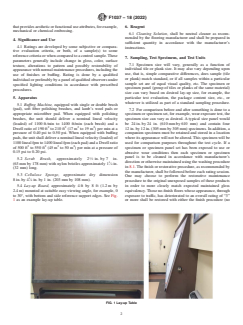
5.2 Scrub Brush, approximately 2 ⁄2in.by7 in.
direction or otherwise maintained using the washing procedure
(63 mm by 178 mm) with nylon bristles approximately 1 ⁄4 in.
in 8.1. The finish or restorative procedure, as recommended by
(32 mm) long.
the manufacturer, shall be followed before each rating session.
5.3 Cellulose Sponge, approximate dry dimension
One may choose to perform the restorative maintenance
8 in. by 4 ⁄4 in. by 1 in. (203 mm by 108 mm).
procedure to the original unexposed samples of these products
5.4 Lay-up Board, approximately 4 ft by 8 ft (1.2 m by in order to more closely match expected maintained gloss
2.4 m) mounted at suitable easy viewing angle, for example, 0 equivalency. Those no-finish floors whose appearance, through
to 30°, with bottom and side reference support edges. See Fig. exposure to traffic, has deteriorated to an overall rating of “3”
1 as an example lay-up table. or more shall be restored with either the finish procedure (no
FIG. 1 Lay-up Table
F1037 − 18 (2022)
samples receive double-finish) (see 8.2) or the buffing proce- 8.3.4.1 Pads are to be washed in a mild detergent and cold
dure (see 8.3). The choice of restorative maintenance is water (2 heaping teaspoons (10.0 g) per gallon (3.8 L) of
determined by the manufacturer’s recommended procedure. water), rinsed in cold water and air dried (do not “wring out”
All cleaning and restorative maintenance procedures shall be pads).
performed on the entire sample.
9. Observer Panel
8. Procedure
9.1 The panel of observers shall consist of at least three
8.1 Mix the cleaning solution and stir thoroughly. people. One-third of the panel shall consist of a person(s)
8.1.1 Soak brush in solution for 1 min. technically trained in the composition and use of household
8.1.2 Apply enough solution so that the panel is covered cleaning products, such as a home economist or chemist.
One-third of the panel shall consist of a person(s) trained in the
with a thin coat of solution. Allow the solution to remain
undisturbed for 3 min. technical characteristics and testing procedures used on resil-
ient flooring, such as an engineer or chemist. One-third of the
8.1.3 Dip brush in solution, then scrub the panel 30 times in
each direction with enough pressure to slightly bend the panel shall be a non-technically trained person(s) who regu-
bristles. Localized, abnormal stains such as chewing gum, larly maintains resilient floors in a home. No panel member
ground-out cigarettes, tar, or other spots considered abnormal shall be color blind
...