

ASTM D1436-17
(Test Method)Standard Test Methods for Application of Emulsion Floor Polishes to Substrates for Testing Purposes
General Information
- Abstract
SIGNIFICANCE AND USE
2.1 All five of the test methods described will produce polish films from emulsion floor polishes which can be used for various performance tests. The choice of test method is left up to the individual laboratory.
SCOPE
1.1 These test methods cover procedures for application of emulsion floor polish films to suitable substrates for testing purposes. Five test methods are covered, as outlined in Section 3.
1.2 These procedures are limited to use on flat, rigid substrates mounted, if necessary, on a nonabsorbent backing.
1.3 The values stated in SI units are to be regarded as the standard. The values given in parentheses are provided for information only.
1.4 This standard does not purport to address all of the safety concerns, if any, associated with its use. It is the responsibility of the user of this standard to establish appropriate safety and health practices and determine the applicability of regulatory limitations prior to use.
1.5 This international standard was developed in accordance with internationally recognized principles on standardization established in the Decision on Principles for the Development of International Standards, Guides and Recommendations issued by the World Trade Organization Technical Barriers to Trade (TBT) Committee.
- Status
- Published
- Publication Date
- 28-Feb-2017
- Technical Committee
- D21 - Polishes
- Drafting Committee
- D21.04 - Performance Tests
Buy Documents


ASTM D1436-17 - Standard Test Methods for Application of Emulsion Floor Polishes to Substrates for Testing Purposes

REDLINE ASTM D1436-17 - Standard Test Methods for Application of Emulsion Floor Polishes to Substrates for Testing Purposes
Overview
ASTM D1436-17: Standard Test Methods for Application of Emulsion Floor Polishes to Substrates for Testing Purposes provides comprehensive procedures for applying emulsion floor polish films to flat, rigid substrates for subsequent performance testing. Developed by ASTM International, this standard supports the reproducible preparation of polish films, enabling accurate evaluation of floor polish performance under controlled laboratory conditions. The document outlines five primary test methods to accommodate variations in substrate type and desired film characteristics, ensuring versatility for different testing requirements.
Key Topics
This standard covers essential aspects of applying floor polish emulsions:
- Five Application Methods:
- Automatic Dip Coater (Method A): Achieves thin, highly uniform films on substrates with low to moderate porosity, suitable for consistent application.
- Hand Applicator (Method B): Closely simulates actual use conditions, yielding satisfactory film uniformity on smaller test panels.
- Manual Dip Method (Method C): Produces wedge-shaped polish films, ideal for comparative analysis and surface property testing.
- Blade Applicator (Method D): Spreads a known volume of emulsion across a defined area, allowing for control over film thickness on level substrates.
- Pour Surface (Method E): Used for thicker films, particularly in slip resistance tests, by pouring and flowing polish over an inclined substrate.
- Substrate Specification: Limits use to flat, rigid substrates, which may require nonabsorbent backing to ensure consistent film application.
- Standard Conditions: Application and drying of polish films should occur at a temperature of 23.8 ± 1.1°C and 50 ± 4% relative humidity to standardize testing environments.
- Unit Consistency: SI units are considered the official standard, with imperial equivalents included for reference.
Applications
ASTM D1436-17 is widely used by:
- Laboratories: Preparing standard test samples for evaluating floor polish performance, such as gloss, wear resistance, durability, and slip resistance.
- Manufacturers: Ensuring product quality and consistency by benchmarking new emulsion floor polishes against standard test methods.
- Quality Control: Uniform application methods make it easier to compare results across different lots, products, or development stages.
- Research and Development: Supporting innovation by providing reliable base conditions for performance comparison during the formulation of new polishes.
- Contract Laboratories and Third-Party Testing Services: Offering standardized protocols that are recognized internationally for objective performance assessment.
By employing standardized application techniques, users can minimize variability, improve repeatability, and facilitate reliable decision-making based on test results.
Related Standards
Organizations and laboratories using ASTM D1436-17 may also reference related standards to extend test methodology and reporting:
- ASTM D2047: Standard Test Method for Static Coefficient of Friction of Polish-Coated Floor Surfaces as Measured by the James Machine.
- ASTM D1792: Standard Specification for Polishes.
- ASTM D543: Standard Practices for Evaluating the Resistance of Plastics to Chemical Reagents, for substrate compatibility.
- ASTM D5847: Standard Practice for Writing Quality Control Specifications for Standard Test Methods for Water-Based Polishes.
These related standards can be used to perform additional tests or ensure compatibility and comprehensive evaluation in the development and assessment of floor care products.
By adhering to ASTM D1436-17, laboratories and manufacturers can achieve more reliable, standardized results in the testing of emulsion floor polishes, facilitating quality assurance, compliance, and product development in the floor care industry.
Relations
- Effective Date
- 01-Mar-2017
- Effective Date
- 01-Mar-2017
- Referred By
ASTM D1455-17(2023) - Standard Test Method for 60° Specular Gloss of Emulsion Floor Polish - Effective Date
- 01-Mar-2017
- Referred By
ASTM D5678-17(2023) - Standard Test Method for Freeze/Thaw Resistance of Wax Emulsion Floor Polish - Effective Date
- 01-Mar-2017
- Effective Date
- 01-Mar-2017
- Effective Date
- 01-Mar-2017
- Effective Date
- 01-Mar-2017
- Effective Date
- 01-Mar-2017
- Referred By
ASTM F1037-18(2022) - Standard Test Method for Visual Rating of Appearance of Resilient Floors - Effective Date
- 01-Mar-2017
- Effective Date
- 01-Mar-2017
- Effective Date
- 01-Mar-2017
Buy Documents
ASTM D1436-17 - Standard Test Methods for Application of Emulsion Floor Polishes to Substrates for Testing Purposes
REDLINE ASTM D1436-17 - Standard Test Methods for Application of Emulsion Floor Polishes to Substrates for Testing Purposes
Get Certified
Connect with accredited certification bodies for this standard

ECOCERT
Organic and sustainability certification.

Eurofins Food Testing Global
Global leader in food, environment, and pharmaceutical product testing.

Intertek Bangladesh
Intertek certification and testing services in Bangladesh.
Sponsored listings
Frequently Asked Questions
ASTM D1436-17 is a standard published by ASTM International. Its full title is "Standard Test Methods for Application of Emulsion Floor Polishes to Substrates for Testing Purposes". This standard covers: SIGNIFICANCE AND USE 2.1 All five of the test methods described will produce polish films from emulsion floor polishes which can be used for various performance tests. The choice of test method is left up to the individual laboratory. SCOPE 1.1 These test methods cover procedures for application of emulsion floor polish films to suitable substrates for testing purposes. Five test methods are covered, as outlined in Section 3. 1.2 These procedures are limited to use on flat, rigid substrates mounted, if necessary, on a nonabsorbent backing. 1.3 The values stated in SI units are to be regarded as the standard. The values given in parentheses are provided for information only. 1.4 This standard does not purport to address all of the safety concerns, if any, associated with its use. It is the responsibility of the user of this standard to establish appropriate safety and health practices and determine the applicability of regulatory limitations prior to use. 1.5 This international standard was developed in accordance with internationally recognized principles on standardization established in the Decision on Principles for the Development of International Standards, Guides and Recommendations issued by the World Trade Organization Technical Barriers to Trade (TBT) Committee.
SIGNIFICANCE AND USE 2.1 All five of the test methods described will produce polish films from emulsion floor polishes which can be used for various performance tests. The choice of test method is left up to the individual laboratory. SCOPE 1.1 These test methods cover procedures for application of emulsion floor polish films to suitable substrates for testing purposes. Five test methods are covered, as outlined in Section 3. 1.2 These procedures are limited to use on flat, rigid substrates mounted, if necessary, on a nonabsorbent backing. 1.3 The values stated in SI units are to be regarded as the standard. The values given in parentheses are provided for information only. 1.4 This standard does not purport to address all of the safety concerns, if any, associated with its use. It is the responsibility of the user of this standard to establish appropriate safety and health practices and determine the applicability of regulatory limitations prior to use. 1.5 This international standard was developed in accordance with internationally recognized principles on standardization established in the Decision on Principles for the Development of International Standards, Guides and Recommendations issued by the World Trade Organization Technical Barriers to Trade (TBT) Committee.
ASTM D1436-17 is classified under the following ICS (International Classification for Standards) categories: 71.100.99 - Other products of the chemical industry; 97.080 - Cleaning appliances. The ICS classification helps identify the subject area and facilitates finding related standards.
ASTM D1436-17 has the following relationships with other standards: It is inter standard links to ASTM D1436-97(2015), ASTM D3543-17, ASTM D1455-17(2023), ASTM D5678-17(2023), ASTM D3206-17, ASTM D1793-17, ASTM D4103-17, ASTM D3207-17, ASTM F1037-18(2022), ASTM D2047-17, ASTM D1792-17(2023). Understanding these relationships helps ensure you are using the most current and applicable version of the standard.
ASTM D1436-17 is available in PDF format for immediate download after purchase. The document can be added to your cart and obtained through the secure checkout process. Digital delivery ensures instant access to the complete standard document.
Standards Content (Sample)
This international standard was developed in accordance with internationally recognized principles on standardization established in the Decision on Principles for the
Development of International Standards, Guides and Recommendations issued by the World Trade Organization Technical Barriers to Trade (TBT) Committee.
Designation: D1436 − 17
Standard Test Methods for
Application of Emulsion Floor Polishes to Substrates for
Testing Purposes
This standard is issued under the fixed designation D1436; the number immediately following the designation indicates the year of
original adoption or, in the case of revision, the year of last revision. A number in parentheses indicates the year of last reapproval. A
superscript epsilon (´) indicates an editorial change since the last revision or reapproval.
1. Scope the thickness of the deposited films. Therefore, several alter-
native methods have been developed. Unless otherwise
1.1 These test methods cover procedures for application of
specified, the choice of method of application and substrate
emulsion floor polish films to suitable substrates for testing
shall be mutually agreed upon by the purchaser and the seller.
purposes. Five test methods are covered, as outlined in Section
The characteristics of the five methods are as follows:
3.
3.1.1 Method A. Automatic Dip Coater—This method pro-
1.2 These procedures are limited to use on flat, rigid
duces thin films of excellent uniformity on the first coat with
substrates mounted, if necessary, on a nonabsorbent backing.
substrates of low or moderate porosity. Two- or three-coat
1.3 The values stated in SI units are to be regarded as the
applications may produce partial solubility of the earlier coats
standard. The values given in parentheses are provided for
with consequent loss of uniformity.
information only.
3.1.2 Method B. Hand Applicator—This method simulates
1.4 This standard does not purport to address all of the
use conditions and produces thin films of satisfactory unifor-
safety concerns, if any, associated with its use. It is the
mity for many test purposes where the area of the test panel is
responsibility of the user of this standard to establish appro-
small(304.8by304.8mm(12by12in.)orsmaller).Withlarge
priate safety and health practices and determine the applica-
panels, considerable local nonuniformity of film thickness may
bility of regulatory limitations prior to use.
result.
1.5 This international standard was developed in accor-
3.1.3 Method C. Manual Dip Method—This method results
dance with internationally recognized principles on standard-
in wedge-shaped films, of moderate thickness, that are thicker
ization established in the Decision on Principles for the
at the bottom than at the top of the panel. This method is rapid
Development of International Standards, Guides and Recom-
and results in reproducible films in the center of the test panel
mendations issued by the World Trade Organization Technical
which are useful for comparison tests and for tests involving
Barriers to Trade (TBT) Committee.
the surface properties of the wax film.
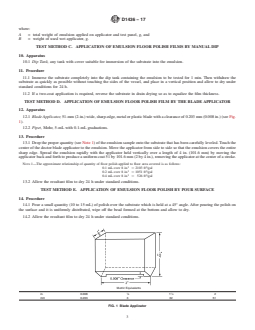
3.1.4 Method D. Blade Applicator—This method merely
2. Significance and Use
spreads a known volume of emulsion over a known surface
2.1 All five of the test methods described will produce
area. The uniformity of the resulting film depends on the
polishfilmsfromemulsionfloorpolisheswhichcanbeusedfor
flatness of the substrate, the surface tension of the emulsion,
various performance tests. The choice of test method is left up
and the interfacial tension between the emulsion and the
to the individual laboratory.
substrate. The method is satisfactory for producing thick to
3. Choice of Test Method moderately thin films. Some practice and familiarity with the
method are necessary to produce uniform thin films.
3.1 Under actual use conditions, the thickness of the dried
3.1.5 MethodE.PourSurface—This method covers pouring
film deposited from water emulsion floor polishes ranges from
a small amount of polish over a tile held at a 45° angle and
0.03 mil to 0.4 mil. No one laboratory method has been found
allowing it to flow uniformly down the tile and coating it.After
that will produce uniformly thick films throughout this range
the polish is poured and the bottom bead forms, it is wiped off
on all substrates. In many cases, the surface roughness and
and allowed to dry. The method is satisfactory for producing
porosity of the substrate is of the same order of magnitude as
thick films for slip resistance testing.
These test methods are under the jurisdiction of ASTM Committee D21 on
4. Standard Conditions
Polishes and are the direct responsibility of Subcommittee D21.04 on Performance
Tests.
4.1 The materials and apparatus shall be permitted to come
Current edition approved March 1, 2017. Published April 2017. Originally
to equilibrium in an atmosphere having a relative humidity of
approved in 1956. Last previous edition approved in 2015 as D1436 – 97(2015).
DOI: 10.1520/D1436-17. 50 6 4 % and a temperature of 23.8 6 1.1°C (75 6 2°F).
Copyright © ASTM International, 100 Barr Harbor Drive, PO Box C700, West Conshohocken, PA 19428-2959. United States
D1436 − 17
4.2 The application of the emulsion floor polish shall be weighing bottle, weigh, and calculate and record the net weight
carried out under the conditions specified in 4.1. of the used wet applicator.
8.3 To ensure a constant film thickness, the weight of the
TEST METHOD A. APPLICATION OF EMULSION
spent applicators should not vary by more than 0.15 g. If the
FLOOR POLISH BY THE AUTOMATIC DIP COATER
weight variation exceeds 0.15 g, the test panel should be
discarded.
5. Apparatus
8.4 Dry the coated substrates for 18 to 24 h under standard-
5.1 Automatic Dip Coater—The automatic dip coater shall
conditions before testing.
consist of a mechanism that will withdraw a panel from a tank
of the emulsion at a predetermined rate. A suitable apparatus
9. Calculation
consists of a constant-speed motor to which a pulley is
9.1 Assuming 1 mL of the emulsion as equal to 1 g,
attached. The diameter of the pulley is such that the cord and
calculate the weight of emulsion applied to the test panel as
hook assembly attached to it will have a speed of 101.6 mm (4
follows:
in.)/min. The speed of withdrawal is kept uniform and is lower
than that at which the coating drains.The test substrate must be
Weight of emul
...
This document is not an ASTM standard and is intended only to provide the user of an ASTM standard an indication of what changes have been made to the previous version. Because
it may not be technically possible to adequately depict all changes accurately, ASTM recommends that users consult prior editions as appropriate. In all cases only the current version
of the standard as published by ASTM is to be considered the official document.
Designation: D1436 − 97 (Reapproved 2015) D1436 − 17
Standard Test Methods for
Application of Emulsion Floor Polishes to Substrates for
Testing Purposes
This standard is issued under the fixed designation D1436; the number immediately following the designation indicates the year of
original adoption or, in the case of revision, the year of last revision. A number in parentheses indicates the year of last reapproval. A
superscript epsilon (´) indicates an editorial change since the last revision or reapproval.
1. Scope
1.1 These test methods cover procedures for application of emulsion floor polish films to suitable substrates for testing purposes.
Five test methods are covered, as outlined in Section 3.
1.2 These procedures are limited to use on flat, rigid substrates mounted, if necessary, on a nonabsorbent backing.
1.3 The values stated in SI units are to be regarded as the standard. The values given in parentheses are provided for information
only.
1.4 This standard does not purport to address all of the safety concerns, if any, associated with its use. It is the responsibility
of the user of this standard to establish appropriate safety and health practices and determine the applicability of regulatory
limitations prior to use.
1.5 This international standard was developed in accordance with internationally recognized principles on standardization
established in the Decision on Principles for the Development of International Standards, Guides and Recommendations issued
by the World Trade Organization Technical Barriers to Trade (TBT) Committee.
2. Significance and Use
2.1 All five of the test methods described will produce polish films from emulsion floor polishes which can be used for various
performance tests. The choice of test method is left up to the individual laboratory.
3. Choice of Test Method
3.1 Under actual use conditions, the thickness of the dried film deposited from water emulsion floor polishes ranges from 0.03
mil to 0.4 mil. No one laboratory method has been found that will produce uniformly thick films throughout this range on all
substrates. In many cases, the surface roughness and porosity of the substrate is of the same order of magnitude as the thickness
of the deposited films. Therefore, several alternative methods have been developed. Unless otherwise specified, the choice of
method of application and substrate shall be mutually agreed upon by the purchaser and the seller. The characteristics of the five
methods are as follows:
3.1.1 Method A. Automatic Dip Coater—This method produces thin films of excellent uniformity on the first coat with substrates
of low or moderate porosity. Two- or three-coat applications may produce partial solubility of the earlier coats with consequent
loss of uniformity.
3.1.2 Method B. Hand Applicator—This method simulates use conditions and produces thin films of satisfactory uniformity for
many test purposes where the area of the test panel is small (304.8 by 304.8 mm (12 by 12 in.) or smaller). With large panels,
considerable local nonuniformity of film thickness may result.
3.1.3 Method C. Manual Dip Method—This method results in wedge-shaped films, of moderate thickness, that are thicker at the
bottom than at the top of the panel. This method is rapid and results in reproducible films in the center of the test panel which are
useful for comparison tests and for tests involving the surface properties of the wax film.
3.1.4 Method D. Blade Applicator—This method merely spreads a known volume of emulsion over a known surface area. The
uniformity of the resulting film depends on the flatness of the substrate, the surface tension of the emulsion, and the interfacial
tension between the emulsion and the substrate. The method is satisfactory for producing thick to moderately thin films. Some
practice and familiarity with the method are necessary to produce uniform thin films.
These test methods are under the jurisdiction of ASTM Committee D21 on Polishes and are the direct responsibility of Subcommittee D21.04 on Performance Tests.
Current edition approved Nov. 1, 2015March 1, 2017. Published November 2015April 2017. Originally approved in 1956. Last previous edition approved in 20082015
as D1436 – 97(2008).(2015). DOI: 10.1520/D1436-97R15.10.1520/D1436-17.
Copyright © ASTM International, 100 Barr Harbor Drive, PO Box C700, West Conshohocken, PA 19428-2959. United States
D1436 − 17
3.1.5 Method E. Pour Surface—This method covers pouring a small amount of polish over a tile held at a 45° angle and
allowing it to flow uniformly down the tile and coating it. After the polish is poured and the bottom bead forms, it is wiped off
and allowed to dry. The method is satisfactory for producing thick films for slip resistance testing.
4. Standard Conditions
4.1 The materials and apparatus shall be permitted to come to equilibrium in an atmosphere having a relative humidity of 50
6 4 % and a temperature of 23.8 6 1.1°C (75 6 2°F).
4.2 The application of the emulsion floor polish shall be carried out under the conditions specified in 4.1.
TEST METHOD A. APPLICATION OF EMULSION FLOOR POLISH BY THE AUTOMATIC DIP COATER
5. Apparatus
5.1 Automatic Dip Coater—The automatic dip coater shall consist of a mechanism that will withdraw a panel from a tank of
the emulsion at a predetermined rate. A suitable apparatus consists of a constant-speed motor to which a pulley is attached. The
diameter of the pulley is such that the cord and hook assembly attached to it will have a speed of 101.6 mm (4 in.)/min. The speed
of withdrawal is kept uniform and is lower than that at which the coating drains. The test substrate must be withdrawn from the
test solution entirely free of vibration.
5.2 Dip Tank, any tank with cover suitable for immersion of the substrate into the emulsion. The substrate must not touch the
sides of the tank during withdrawal.
6. Procedure
6.1 Place the test substrate on the hook and lower it sufficiently into the dip tank to coat the panel to the desired area, using the
cord. Place the other end of the cord around the pulley and give it one complete turn about
...