

ASTM D4103-17
(Practice)Standard Practice for Preparation of Substrate Surfaces for Coefficient of Friction Testing
General Information
- Abstract
SIGNIFICANCE AND USE
3.1 The reliability of any of the practices using panels prepared by these procedures may be dependent upon the manner and care in which the test panels are prepared. Having these practices in a single procedure eliminates the necessity for covering these details in all of the practices wherein the panels are used.
SCOPE
1.1 This practice covers procedures for the preparation of OVCT (Official Vinyl Composition Tile) and wood panels for subsequent use in tests to measure the coefficient of friction.
1.2 This standard does not purport to address all of the safety concerns, if any, associated with its use. It is the responsibility of the user of this standard to establish appropriate safety and health practices and determine the applicability of regulatory limitations prior to use.
1.3 This international standard was developed in accordance with internationally recognized principles on standardization established in the Decision on Principles for the Development of International Standards, Guides and Recommendations issued by the World Trade Organization Technical Barriers to Trade (TBT) Committee.
- Status
- Published
- Publication Date
- 28-Feb-2017
- Technical Committee
- D21 - Polishes
- Drafting Committee
- D21.06 - Slip Resistance
Buy Documents
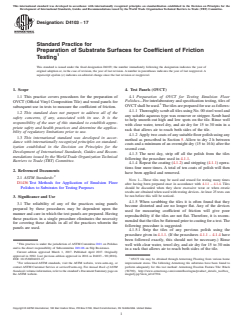


ASTM D4103-17 - Standard Practice for Preparation of Substrate Surfaces for Coefficient of Friction Testing
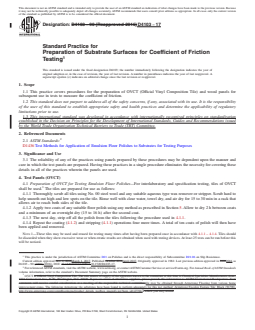


REDLINE ASTM D4103-17 - Standard Practice for Preparation of Substrate Surfaces for Coefficient of Friction Testing
Overview
ASTM D4103-17: Standard Practice for Preparation of Substrate Surfaces for Coefficient of Friction Testing provides a comprehensive, internationally recognized procedure for preparing test panels, specifically Official Vinyl Composition Tile (OVCT) and wood panels, for subsequent coefficient of friction (COF) testing. Consistent substrate preparation is vital to ensure the accuracy, reliability, and comparability of slip resistance and floor polish performance tests. By standardizing panel preparation, this practice helps eliminate inconsistencies between laboratories and test results, offering a trusted foundation for evaluating slip-resistance properties in flooring materials and coatings.
Key Topics
Surface Preparation of OVCT Panels
- Detailed steps for cleaning, coating, and stripping OVCT tiles to ensure uniform test conditions.
- Recommendations for flattening tiles if they become distorted during cleaning, vital for reproducible friction measurements.
Preparation of Wood Panels
- Methods for cleaning laminated oak test blocks, including the removal of factory-applied wax and prevention of warping to guarantee surface uniformity.
Application of Test Polishes
- Standardized approach for applying both emulsion and solvent-based polishes, including the number of coats, drying times, and buffing techniques.
- Guidance on maintaining consistency in application for comparative testing.
Reusability and Panel Maintenance
- OVCT and wood panels may be reused multiple times, provided they are stored flat and maintained in good condition to ensure repeatable results.
Significance of Panel Preparation
- Emphasizes that the reliability of any coefficient of friction testing is closely tied to the precise, careful preparation of substrate surfaces.
Applications
Proper implementation of ASTM D4103-17 is crucial for a range of practical applications, including:
Slip Resistance Testing
- Ensuring a consistent test surface allows for accurate measurement of slip resistance for floor coverings, polishes, and coatings.
- Widely used in product development, quality assurance, and compliance testing across manufacturing, construction, and maintenance sectors.
Interlaboratory and Specification Testing
- Used by testing laboratories performing comparative evaluations and research into flooring safety solutions.
- Supports regulatory compliance for safety standards in public, commercial, and industrial buildings.
Coating Performance Evaluation
- Enables fair assessment of floor polishes and coatings by removing surface preparation as a variable, leading to more meaningful results in product comparisons.
Related Standards
Organizations and professionals implementing ASTM D4103-17 may also refer to the following related standards for comprehensive testing protocols:
- ASTM D1436: Test Methods for Application of Emulsion Floor Polishes to Substrates for Testing Purposes - details methods for polish application referenced in the substrate preparation process.
- Other relevant ASTM standards on slip resistance, floor coverings, and testing methodologies.
Practical Value
Adhering to ASTM D4103-17 helps ensure that all coefficient of friction testing is performed on uniformly prepared surfaces, significantly reducing variability and improving the credibility of test results. This practice is essential for manufacturers, quality control laboratories, and safety professionals concerned with the slip-resistance and durability of floor coverings. Proper substrate preparation contributes directly to safer environments and greater confidence in testing and product claims.
Keywords: ASTM D4103-17, substrate surface preparation, coefficient of friction testing, slip resistance, OVCT panels, wood panel preparation, test panel maintenance, floor polish testing, ASTM standards, surface preparation methods.
Relations
- Effective Date
- 01-Mar-2017
- Effective Date
- 01-Mar-2017
- Effective Date
- 01-Nov-2015
- Effective Date
- 01-Mar-2008
- Effective Date
- 10-Sep-1997
- Effective Date
- 01-Mar-2017
- Effective Date
- 01-Mar-2017
- Effective Date
- 01-Mar-2017
- Effective Date
- 01-Mar-2017
Buy Documents
ASTM D4103-17 - Standard Practice for Preparation of Substrate Surfaces for Coefficient of Friction Testing
REDLINE ASTM D4103-17 - Standard Practice for Preparation of Substrate Surfaces for Coefficient of Friction Testing
Frequently Asked Questions
ASTM D4103-17 is a standard published by ASTM International. Its full title is "Standard Practice for Preparation of Substrate Surfaces for Coefficient of Friction Testing". This standard covers: SIGNIFICANCE AND USE 3.1 The reliability of any of the practices using panels prepared by these procedures may be dependent upon the manner and care in which the test panels are prepared. Having these practices in a single procedure eliminates the necessity for covering these details in all of the practices wherein the panels are used. SCOPE 1.1 This practice covers procedures for the preparation of OVCT (Official Vinyl Composition Tile) and wood panels for subsequent use in tests to measure the coefficient of friction. 1.2 This standard does not purport to address all of the safety concerns, if any, associated with its use. It is the responsibility of the user of this standard to establish appropriate safety and health practices and determine the applicability of regulatory limitations prior to use. 1.3 This international standard was developed in accordance with internationally recognized principles on standardization established in the Decision on Principles for the Development of International Standards, Guides and Recommendations issued by the World Trade Organization Technical Barriers to Trade (TBT) Committee.
SIGNIFICANCE AND USE 3.1 The reliability of any of the practices using panels prepared by these procedures may be dependent upon the manner and care in which the test panels are prepared. Having these practices in a single procedure eliminates the necessity for covering these details in all of the practices wherein the panels are used. SCOPE 1.1 This practice covers procedures for the preparation of OVCT (Official Vinyl Composition Tile) and wood panels for subsequent use in tests to measure the coefficient of friction. 1.2 This standard does not purport to address all of the safety concerns, if any, associated with its use. It is the responsibility of the user of this standard to establish appropriate safety and health practices and determine the applicability of regulatory limitations prior to use. 1.3 This international standard was developed in accordance with internationally recognized principles on standardization established in the Decision on Principles for the Development of International Standards, Guides and Recommendations issued by the World Trade Organization Technical Barriers to Trade (TBT) Committee.
ASTM D4103-17 is classified under the following ICS (International Classification for Standards) categories: 97.150 - Floor coverings. The ICS classification helps identify the subject area and facilitates finding related standards.
ASTM D4103-17 has the following relationships with other standards: It is inter standard links to ASTM D4103-90(2016), ASTM D1436-17, ASTM D1436-97(2015), ASTM D1436-97(2008), ASTM D1436-97(2002), ASTM D2047-17, ASTM D6205-20, ASTM D2825-21e1, ASTM G115-10(2018). Understanding these relationships helps ensure you are using the most current and applicable version of the standard.
ASTM D4103-17 is available in PDF format for immediate download after purchase. The document can be added to your cart and obtained through the secure checkout process. Digital delivery ensures instant access to the complete standard document.
Standards Content (Sample)
This international standard was developed in accordance with internationally recognized principles on standardization established in the Decision on Principles for the
Development of International Standards, Guides and Recommendations issued by the World Trade Organization Technical Barriers to Trade (TBT) Committee.
Designation: D4103 − 17
Standard Practice for
Preparation of Substrate Surfaces for Coefficient of Friction
Testing
This standard is issued under the fixed designation D4103; the number immediately following the designation indicates the year of
original adoption or, in the case of revision, the year of last revision. A number in parentheses indicates the year of last reapproval. A
superscript epsilon (´) indicates an editorial change since the last revision or reapproval.
1. Scope 4. Test Panels (OVCT)
4.1 Preparation of OVCT for Testing Emulsion Floor
1.1 This practice covers procedures for the preparation of
Polishes—For interlaboratory and specification testing, tiles of
OVCT (Official Vinyl Composition Tile) and wood panels for
OVCTshall be used. The tiles are prepared for use as follows:
subsequent use in tests to measure the coefficient of friction.
4.1.1 Thoroughly scrub all tiles using No. 00 steel wool and
1.2 This standard does not purport to address all of the
any suitable aqueous type wax remover or stripper. Scrub hard
safety concerns, if any, associated with its use. It is the
to help smooth out high and low spots on the tile. Rinse well
responsibility of the user of this standard to establish appro-
with clear water, towel dry, and air dry for 15 to 30 min in a
priate safety and health practices and determine the applica-
rack that allows air to reach both sides of the tile.
bility of regulatory limitations prior to use.
4.1.2 Apply two coats of any suitable floor polish using any
1.3 This international standard was developed in accor-
method as prescribed in Section 5. Allow to dry 2 h between
dance with internationally recognized principles on standard-
coats and a minimum of an overnight dry (15 to 16 h) after the
ization established in the Decision on Principles for the
second coat.
Development of International Standards, Guides and Recom-
4.1.3 The next day, strip off all the polish from the tiles
mendations issued by the World Trade Organization Technical
following the procedure used in 4.1.1.
Barriers to Trade (TBT) Committee.
4.1.4 Repeat the coating (4.1.2) and stripping (4.1.1) opera-
tions four more times. A total of ten coats of polish will then
2. Referenced Documents
have been applied and removed.
2.1 ASTM Standards:
NOTE 1—These tiles may be used and reused for testing many times
D1436 Test Methods for Application of Emulsion Floor
after having been prepared once in accordance with 4.1.1 – 4.1.4. Tiles
Polishes to Substrates for Testing Purposes should be discarded when they show excessive wear or when erratic
results are obtained when used with testing devices. At least 25 tests can
be run before this will be noticed.
3. Significance and Use
4.1.5 When scrubbing the tiles it is often found that they
3.1 The reliability of any of the practices using panels
become distorted and are no longer flat. Any of the devices
prepared by these procedures may be dependent upon the
used for measuring coefficient of friction will give poor
manner and care in which the test panels are prepared. Having
reproducibility if the tiles are not flat. Therefore, it is recom-
these practices in a single procedure eliminates the necessity
mended that the tiles be flattened prior to coating for a test.The
for covering these details in all of the practices wherein the
following procedure is suggested:
panels are used.
4.1.5.1 Strip the tiles of any previous polish using the
procedure given in 4.1.1. (If the procedures 4.1.1 – 4.1.4 have
been followed exactly, this should not be necessary.) Rinse
This practice is under the jurisdiction of ASTM Committee D21 on Polishes well with clear water, towel dry, and air dry for 15 to 30 min
and is the direct responsibility of Subcommittee D21.06 on Slip Resistance.
in a rack that allows air to reach both sides of the tile.
Current edition approved March 1, 2017. Published April 2017. Originally
approved in 1982. Last previous edition approved in 2016 as D4103 – 90 (2016).
DOI: 10.1520/D4103-17. OVCT tile may be obtained through Armstrong Flooring from various home
For referenced ASTM standards, visit the ASTM website, www.astm.org, or improvement stores. The following Armstrong tile substrates have been found to
contact ASTM Customer Service at service@astm.org. For Annual Book of ASTM perform adequately for this test method: Armstrong Excelon Feature Tile: Black
Standards volume information, refer to the standard’s Document S
...
This document is not an ASTM standard and is intended only to provide the user of an ASTM standard an indication of what changes have been made to the previous version. Because
it may not be technically possible to adequately depict all changes accurately, ASTM recommends that users consult prior editions as appropriate. In all cases only the current version
of the standard as published by ASTM is to be considered the official document.
Designation: D4103 − 90 (Reapproved 2016) D4103 − 17
Standard Practice for
Preparation of Substrate Surfaces for Coefficient of Friction
Testing
This standard is issued under the fixed designation D4103; the number immediately following the designation indicates the year of
original adoption or, in the case of revision, the year of last revision. A number in parentheses indicates the year of last reapproval. A
superscript epsilon (´) indicates an editorial change since the last revision or reapproval.
1. Scope
1.1 This practice covers procedures for the preparation of OVCT (Official Vinyl Composition Tile) and wood panels for
subsequent use in tests to measure the coefficient of friction.
1.2 This standard does not purport to address all of the safety concerns, if any, associated with its use. It is the responsibility
of the user of this standard to establish appropriate safety and health practices and determine the applicability of regulatory
limitations prior to use.
1.3 This international standard was developed in accordance with internationally recognized principles on standardization
established in the Decision on Principles for the Development of International Standards, Guides and Recommendations issued
by the World Trade Organization Technical Barriers to Trade (TBT) Committee.
2. Referenced Documents
2.1 ASTM Standards:
D1436 Test Methods for Application of Emulsion Floor Polishes to Substrates for Testing Purposes
3. Significance and Use
3.1 The reliability of any of the practices using panels prepared by these procedures may be dependent upon the manner and
care in which the test panels are prepared. Having these practices in a single procedure eliminates the necessity for covering these
details in all of the practices wherein the panels are used.
4. Test Panels (OVCT)
4.1 Preparation of OVCT for Testing Emulsion Floor Polishes—For interlaboratory and specification testing, tiles of OVCT
shall be used. The tiles are prepared for use as follows:
4.1.1 Thoroughly scrub all tiles using No. 00 steel wool and any suitable aqueous type wax remover or stripper. Scrub hard to
help smooth out high and low spots on the tile. Rinse well with clear water, towel dry, and air dry for 15 to 30 min in a rack that
allows air to reach both sides of the tile.
4.1.2 Apply two coats of any suitable floor polish using any method as prescribed in Section 5. Allow to dry 2 h between coats
and a minimum of an overnight dry (15 to 16 h) after the second coat.
4.1.3 The next day, strip off all the polish from the tiles following the procedure used in 4.1.1.
4.1.4 Repeat the coating (4.1.2) and stripping (4.1.1) operations four more times. A total of ten coats of polish will then have
been applied and removed.
NOTE 1—These tiles may be used and reused for testing many times after having been prepared once in accordance with 4.1.1 – 4.1.4. Tiles should
be discarded when they show excessive wear or when erratic results are obtained when used with testing devices. At least 25 tests can be run before this
will be noticed.
This practice is under the jurisdiction of ASTM Committee D21 on Polishes and is the direct responsibility of Subcommittee D21.06 on Slip Resistance.
Current edition approved Oct. 1, 2016March 1, 2017. Published October 2016April 2017. Originally approved in 1982. Last previous edition approved in 20092016 as
D4103 – 90 (2009).(2016). DOI: 10.1520/D4103-90R16.10.1520/D4103-17.
For referenced ASTM standards, visit the ASTM website, www.astm.org, or contact ASTM Customer Service at service@astm.org. For Annual Book of ASTM Standards
volume information, refer to the standard’s Document Summary page on the ASTM website.
OVCT is Official Vinyl Composition Tile. The sole source of supply of the apparatus known to the committee at this time is Chemical Specialties Manufacturers Assn.,
1001 Connecticut Ave., N.W., Washington, D.C. 20036. If you are aware of alternative suppliers, please provide this information to ASTM International Headquarters. Your
comments will receive careful consideration at a meeting of the responsible technical committee,tile may be obtained through Armstrong Flooring from various home
improvement stores. The following Armstrong tile substrates have been found to perform adequately for this test method: Armstrong Excelon Feature Tile: Black (56790),
http://www.armstrong.com/commflooringna/product_details_toolbox_magnify.jsp?item_id=47394. which you may attend.
Copyright © ASTM International, 100 Barr Harbor Drive, PO Box C700, West Conshohocken, PA 19428-2959. United States
D4103 − 17
4.1.5 When scrubbing the tiles
...