

ASTM D6540-24
(Test Method)Standard Test Method for Accelerated Soiling of Pile Yarn Floor Covering
General Information
- Abstract
SIGNIFICANCE AND USE
5.1 This test method may be used to soil test specimens in the absence of abrasive wear and texture changes under controlled conditions using a standard synthetic soil, or as a preliminary step to other procedures.
5.2 This test method will provide a uniformly soiled test specimen to evaluate, is reproducible (see Section 11), and is economical for Testing Laboratories.
5.3 This test method has been found to give results similar to the actual floor service soiling, but its use is recommended only as a screening test method and not as a replacement for floor testing.
5.4 The acceptance criteria of this test method shall be set by mutual agreement between the purchaser and supplier.
SCOPE
1.1 This test method describes the equipment, and the test method for assessing the propensity of pile yarn floor coverings to soiling in the absence of abrasive wear and texture changes, using a standard synthetic soil composition.
1.2 This test method is applicable for use in testing unused pile yarn floor covering of all types. It is not applicable for use in testing used pile yarn floor covering.
1.3 This test method can be used to compare the soiling propensity of two or more carpets; or it can be used to soil carpets as a preliminary step to other test procedures.
1.4 The values stated in inch-pound units are to be regarded as standard. The values given in parentheses are mathematical conversions to SI units that are provided for information only and are not considered standard.
1.5 This standard does not purport to address all of the safety concerns, if any, associated with its use. It is the responsibility of the user of this standard to establish appropriate safety, health, and environmental practices and determine the applicability of regulatory limitations prior to use.
1.6 This international standard was developed in accordance with internationally recognized principles on standardization established in the Decision on Principles for the Development of International Standards, Guides and Recommendations issued by the World Trade Organization Technical Barriers to Trade (TBT) Committee.
- Status
- Published
- Publication Date
- 31-Dec-2023
- Technical Committee
- D13 - Textiles
- Drafting Committee
- D13.21 - Pile Floor Coverings

Overview
ASTM D6540-24: Standard Test Method for Accelerated Soiling of Pile Yarn Floor Covering is an internationally recognized method developed by ASTM for evaluating the propensity of unused pile yarn floor coverings, such as carpets, to accumulate soil under controlled laboratory conditions. This test simulates soiling caused by exposure to a standard synthetic soil compound but does not introduce or account for abrasive wear and texture changes. The method enables consistent, reproducible, and economic assessment of soiling potential, supporting manufacturers, suppliers, and testing laboratories in quality control, product development, and screening processes.
Key Topics
Purpose and Significance
- Simulates soiling of pile yarn floor coverings to assess resistance to visible soiling in the absence of wear.
- Offers a reproducible, economic, and laboratory-based technique for uniform soiling that reflects service conditions.
- Recommended strictly as a screening tool, not a full replacement for in-use floor testing.
Scope of Application
- Applicable to unused pile yarn floor coverings of all types, including cut pile, loop pile, and variations in fiber.
- Not intended for use on previously used or soiled flooring materials.
- Ideal for comparing the soiling tendencies between two or more carpets or as a pre-treatment for further test methods.
Testing Procedure Overview
- Test specimens are exposed to a standard synthetic soil compound in a drum (Hexapod Tumble Tester) with controlled motion.
- Uniform application of soil ensures consistent results across samples.
- Assessment by either color measurement devices or visual Gray Scale comparison.
Precision and Reproducibility
- Provides statistical guidelines for interpreting results and evaluating inter-laboratory consistency.
- Acceptance criteria are set through mutual agreement between purchasers and suppliers.
Applications
Product Comparison and Development
- Manufacturers use ASTM D6540-24 to benchmark new carpet designs or materials against existing products.
- R&D teams utilize this method to fine-tune pile yarn constructions for enhanced soiling resistance before field trials.
Quality Assurance
- Flooring suppliers and testing laboratories rely on this standard for objective assessment of soiling performance in new carpet lots.
- Supports claims for soil resistance in marketing and product labeling.
Preliminary Testing
- Acts as an initial screening step before more comprehensive durability and wear assessments.
- Helps identify products requiring further optimization early in the product development cycle.
Contractual Agreement
- Used in purchase agreements where the soiling propensity of floor coverings must meet mutually established acceptance criteria.
Related Standards
- ASTM D123 - Terminology Relating to Textiles: Defines terms used in textile testing.
- ASTM D1776 / D1776M - Practice for Conditioning and Testing Textiles: Specifies standard atmospheric conditions and procedures.
- ASTM D5684 - Terminology Relating to Pile Floor Coverings: Provides definitions pertinent to pile carpet testing.
- AATCC EP1 - Gray Scale for Color Change: Guides visual color assessment methods.
- AATCC TM 122 / LP4 - Carpet Soiling: Test methods for service soiling using a synthetic soil formulation.
Utilizing ASTM D6540-24 for textile and carpet soiling assessment ensures reliable, internationally harmonized results and supports informed decision-making for manufacturers, suppliers, and customers within the floor covering industry. This standard is a valuable tool for maintaining high performance and customer satisfaction in residential, commercial, and industrial applications where appearance retention is critical.
Relations
- Effective Date
- 01-Jan-2024
- Effective Date
- 01-Jan-2024
- Effective Date
- 01-Jan-2024
- Effective Date
- 01-Jan-2024
Frequently Asked Questions
ASTM D6540-24 is a standard published by ASTM International. Its full title is "Standard Test Method for Accelerated Soiling of Pile Yarn Floor Covering". This standard covers: SIGNIFICANCE AND USE 5.1 This test method may be used to soil test specimens in the absence of abrasive wear and texture changes under controlled conditions using a standard synthetic soil, or as a preliminary step to other procedures. 5.2 This test method will provide a uniformly soiled test specimen to evaluate, is reproducible (see Section 11), and is economical for Testing Laboratories. 5.3 This test method has been found to give results similar to the actual floor service soiling, but its use is recommended only as a screening test method and not as a replacement for floor testing. 5.4 The acceptance criteria of this test method shall be set by mutual agreement between the purchaser and supplier. SCOPE 1.1 This test method describes the equipment, and the test method for assessing the propensity of pile yarn floor coverings to soiling in the absence of abrasive wear and texture changes, using a standard synthetic soil composition. 1.2 This test method is applicable for use in testing unused pile yarn floor covering of all types. It is not applicable for use in testing used pile yarn floor covering. 1.3 This test method can be used to compare the soiling propensity of two or more carpets; or it can be used to soil carpets as a preliminary step to other test procedures. 1.4 The values stated in inch-pound units are to be regarded as standard. The values given in parentheses are mathematical conversions to SI units that are provided for information only and are not considered standard. 1.5 This standard does not purport to address all of the safety concerns, if any, associated with its use. It is the responsibility of the user of this standard to establish appropriate safety, health, and environmental practices and determine the applicability of regulatory limitations prior to use. 1.6 This international standard was developed in accordance with internationally recognized principles on standardization established in the Decision on Principles for the Development of International Standards, Guides and Recommendations issued by the World Trade Organization Technical Barriers to Trade (TBT) Committee.
SIGNIFICANCE AND USE 5.1 This test method may be used to soil test specimens in the absence of abrasive wear and texture changes under controlled conditions using a standard synthetic soil, or as a preliminary step to other procedures. 5.2 This test method will provide a uniformly soiled test specimen to evaluate, is reproducible (see Section 11), and is economical for Testing Laboratories. 5.3 This test method has been found to give results similar to the actual floor service soiling, but its use is recommended only as a screening test method and not as a replacement for floor testing. 5.4 The acceptance criteria of this test method shall be set by mutual agreement between the purchaser and supplier. SCOPE 1.1 This test method describes the equipment, and the test method for assessing the propensity of pile yarn floor coverings to soiling in the absence of abrasive wear and texture changes, using a standard synthetic soil composition. 1.2 This test method is applicable for use in testing unused pile yarn floor covering of all types. It is not applicable for use in testing used pile yarn floor covering. 1.3 This test method can be used to compare the soiling propensity of two or more carpets; or it can be used to soil carpets as a preliminary step to other test procedures. 1.4 The values stated in inch-pound units are to be regarded as standard. The values given in parentheses are mathematical conversions to SI units that are provided for information only and are not considered standard. 1.5 This standard does not purport to address all of the safety concerns, if any, associated with its use. It is the responsibility of the user of this standard to establish appropriate safety, health, and environmental practices and determine the applicability of regulatory limitations prior to use. 1.6 This international standard was developed in accordance with internationally recognized principles on standardization established in the Decision on Principles for the Development of International Standards, Guides and Recommendations issued by the World Trade Organization Technical Barriers to Trade (TBT) Committee.
ASTM D6540-24 is classified under the following ICS (International Classification for Standards) categories: 97.150 - Floor coverings. The ICS classification helps identify the subject area and facilitates finding related standards.
ASTM D6540-24 has the following relationships with other standards: It is inter standard links to ASTM D6540-22, ASTM D5684-19a, ASTM D6719-22e1, ASTM F2828-20. Understanding these relationships helps ensure you are using the most current and applicable version of the standard.
ASTM D6540-24 is available in PDF format for immediate download after purchase. The document can be added to your cart and obtained through the secure checkout process. Digital delivery ensures instant access to the complete standard document.
Standards Content (Sample)
This international standard was developed in accordance with internationally recognized principles on standardization established in the Decision on Principles for the
Development of International Standards, Guides and Recommendations issued by the World Trade Organization Technical Barriers to Trade (TBT) Committee.
Designation: D6540 − 24
Standard Test Method for
Accelerated Soiling of Pile Yarn Floor Covering
This standard is issued under the fixed designation D6540; the number immediately following the designation indicates the year of
original adoption or, in the case of revision, the year of last revision. A number in parentheses indicates the year of last reapproval. A
superscript epsilon (´) indicates an editorial change since the last revision or reapproval.
1. Scope 2.2 ASTM Adjunct:
TEX-PAC
1.1 This test method describes the equipment, and the test
2.3 AATCC Standards :
method for assessing the propensity of pile yarn floor coverings
Evaluation Procedure 1 – Gray Scale for Color Change
to soiling in the absence of abrasive wear and texture changes,
AATCC LP4 : Laboratory Procedure for Synthetic Soil
using a standard synthetic soil composition.
3. Terminology
1.2 This test method is applicable for use in testing unused
pile yarn floor covering of all types. It is not applicable for use
3.1 For definitions of terms relating to Pile Floor Coverings,
in testing used pile yarn floor covering.
D13.21, refer to Terminology D5684.
3.1.1 The following terms are relevant to this standard:
1.3 This test method can be used to compare the soiling
carpet, finished, finished pile yarn floor covering, floor
propensity of two or more carpets; or it can be used to soil
covering, pile, pile lay, pile yarn floor covering, soiling, textile
carpets as a preliminary step to other test procedures.
floor covering, tufted fabric, use-surface.
1.4 The values stated in inch-pound units are to be regarded
3.2 For all other terminology related to textiles, refer to
as standard. The values given in parentheses are mathematical
Terminology D123.
conversions to SI units that are provided for information only
and are not considered standard.
4. Summary of Test Method
1.5 This standard does not purport to address all of the
4.1 The carpet test specimens are secured to a backing sheet
safety concerns, if any, associated with its use. It is the
that is mounted inside the drum with the pile surface exposed,
responsibility of the user of this standard to establish appro-
and are subjected to an accelerated soiling process. The degree
priate safety, health, and environmental practices and deter-
of soiling is measured or assessed by comparing the change in
mine the applicability of regulatory limitations prior to use.
color between soiled and original pile yarn floor covering,
1.6 This international standard was developed in accor-
using a measurement device or visually matching the differ-
dance with internationally recognized principles on standard-
ences on the light-dark axis of Gray Scales.
ization established in the Decision on Principles for the
NOTE 1—Differentiation between test samples is significantly reduced
Development of International Standards, Guides and Recom-
when Gray Scales are used.
mendations issued by the World Trade Organization Technical
Barriers to Trade (TBT) Committee.
5. Significance and Use
5.1 This test method may be used to soil test specimens in
2. Referenced Documents
the absence of abrasive wear and texture changes under
2.1 ASTM Standards:
controlled conditions using a standard synthetic soil, or as a
D123 Terminology Relating to Textiles
preliminary step to other procedures.
D1776/D1776M Practice for Conditioning and Testing Tex-
5.2 This test method will provide a uniformly soiled test
tiles
specimen to evaluate, is reproducible (see Section 11), and is
D5684 Terminology Relating to Pile Floor Coverings
economical for Testing Laboratories.
5.3 This test method has been found to give results similar
to the actual floor service soiling, but its use is recommended
This test method is under the jurisdiction of ASTM Committee D13 on Textiles
and is the direct responsibility of Subcommittee D13.21 on Pile Floor Coverings.
only as a screening test method and not as a replacement for
Current edition approved Jan. 1, 2024. Published March 2024. Originally
floor testing.
approved in 2000. Last previous edition approved in 2022 as D6540–22. DOI:
10.1520/D6540-24.
2 3
For referenced ASTM standards, visit the ASTM website, www.astm.org, or The PC program on floppy disks for analyzing Committee D13 interlaboratory
contact ASTM Customer Service at service@astm.org. For Annual Book of ASTM data are available from ASTM. RequestADJD2904.
Standards volume information, refer to the standard’s Document Summary page on Available from American Association of Textile Chemists and Colorists, PO
the ASTM website. Box 12215, Research Triangle Park, NC 27709.
Copyright © ASTM International, 100 Barr Harbor Drive, PO Box C700, West Conshohocken, PA 19428-2959. United States
D6540 − 24
5.4 The acceptance criteria of this test method shall be set 6.13 Template—to be the same size as the test specimen
by mutual agreement between the purchaser and supplier. with 3 holes of the same dimensions as the measuring head of
the color measuring device. See Fig. 1.
6. Apparatus and Materials
6.14 Magnet—capable of attracting and holding several
chrome alloy steel balls at one time.
6.1 Hexapod Tumble Tester
6.1.1 Drum—Constructed of molded PVC and is capped by
7. Sampling, and Preparation of Soiled Pellets, Sampling,
a lid that is secured. The drum base and lid have a locating
and Test Specimens
groove to hold the specimen backing sheet flat to the inner wall
7.1 Preparation of Soiled Polyamide Polymer Pellets
of the drum. The drum dimensions are:
7.1.1 Place 0.1058 oz 6 0.0017 oz (3.00 g 6 0.05 g) of the
Internal Diameter 12.00 in. ± 0.04 in. (305 mm ± 1 mm)
standard soiling compound (see 6.9) and 2.205 lb 6 0.002 lb
Wall Thickness 0.03 in. approx. (8 mm approx.)
Internal Depth 7.90 in. ± 0.04 in. (200 mm ± 1 mm)
(1000 g 6 1 g) of polyamide polymer pellets (see 6.7) in the
mixing container. Secure the lid and place the mixing container
6.1.2 Driving System—Cradles the drum on rollers and
on the driving system for 10 min, reverse direction and
keeps the axis of the drum level, rotates at 0.60 r/s 6 0.03 r/s
continue for an additional 10 min, for a total of 20 min to
(35 r/min 6 2 r/min). The driving system reverses every 15
ensure a homogeneous mixture of the soil and polyamide
min with approximately one minute stationary time.
polymer pellets.
6.2 Specimen Backing Sheet—is a polyethylene sheet 37.40
NOTE 2—To simulate particular use areas, it may be necessary to adjust
in. by 8.50 in. by 0.08 in. (950 mm by 215 mm by 2 mm).
the type or quantity, or both, of soiling compound and document the
change in the written report.
6.3 Tape—double sided pressure sensitive adhesive, 2.0 in.
NOTE 3—If large quantities of soiled pellets are prepared, that is more
(50 mm) width.
than 4.409 lb (2000 g), they shall be kept in an airtight container to ensure
6.4 Cleaning Frame—a rectangular frame 39.4 in. by 11.8 no loss of moisture from the mixture occurs, and the supply shall not be
allowed to dwindle below 25 % of the original quantity.
in. (1000 mm × 300 mm) with a central rectangular aperture
NOTE 4—This test method was developed using AATCC synthetic
37.0 in. by 7.9 in. (940 mm by 200 mm) to receive the test
soiling compound and if another soiling compound is used the amount of
specimen, of material similar in construction to the test
soil used to prepare the soiled polymer pellets must be adjusted.
specimen and mounted on a backing sheet.
7.2 Ensure the inside of the drum and chrome alloy steel
6.5 Vacuum Cleaner—upright type, with a rotating brush.
balls are clean.
An approved vacuum certified in the CRI Seal of Approval
7.3 Size of Test Specimens
Program (SOA) shall be acceptable for use in this practice.
7.3.1 Cut a minimum of two test specimens per pile yarn
Alternatively, a handheld vacuum that meets the following
floor covering, measuring a minimum of 5.00 in. 6 0.04 in.
general specifications can be used: powered rotating brush,
(125 mm 6 1 mm) in the direction of manufacture by 8.00 in.
bagless design HEPA filtration 7A motor, nozzle width 6.5 in.
6 0.08 in. (205 mm 6 2 mm) wide. Mark an arrow in the
6 0.3 in. (165 mm 6 7 mm). Replace the bristles when the
direction of the pile lay on the back of the test specimen. All
bristles length changes more than 15 % of the original length.
6.6 Mixing Container—a wide mouth container such as a
Standard Mill jar.
6.7 Polymer Pellets—polyamide polymer pellets having a
maximum size of 0.27 in. 6 0.08 in. (7 mm 6 2 mm)
6.8 Chrome Alloy Steel Balls (Ball Bearings)—with a 0.37
in. 6 0.01 in. (9.50 mm 6 0.02 mm) diameter.
6.9 Standard Soiling Compound—a soiling compound
which is compatible with the test equipment, such as AATCC
Synthetic Soil Formula listed in AATCC LP4: Laboratory
Procedure for Synthetic Soil.
6.10 Control Pile Yarn Floor Covering—an internal stan-
dard light colored carpet of known specifications used as a
reference for each test evaluation.
6.11 Color Measurement Equipment—A color measurement
device with a 2.0 in. 6 0.2 in. (50 mm 6 0.5 mm) aperture,
capable of measuring the color of pile yarn floor covering and
expressing the results in Delta E (dE) or Delta L (dL).
6.12 Gray Scales—standard gray scales used to visibly
assess change in color of pile yarn floor covering as per
AATCC Procedure 1. FIG. 1 Example of a Suitable Template for Color Measurement
D6540 − 24
test specimens shall be conditioned (clause 8.1), flat singly, and strips with the sample in between when cleaning. Alternately,
with use-surface uppermost, for a minimum of 24 h. use a self-made template made of any suitable material to serve
as traction underlay. In the case of cut pile carpets, ensure that
7.4 Specimen Attachment
the last stroke of the vacuum is against the lay of the pile.
7.4.1 To the speci
...
This document is not an ASTM standard and is intended only to provide the user of an ASTM standard an indication of what changes have been made to the previous version. Because
it may not be technically possible to adequately depict all changes accurately, ASTM recommends that users consult prior editions as appropriate. In all cases only the current version
of the standard as published by ASTM is to be considered the official document.
Designation: D6540 − 22 D6540 − 24
Standard Test Method for
Accelerated Soiling of Pile Yarn Floor Covering
This standard is issued under the fixed designation D6540; the number immediately following the designation indicates the year of
original adoption or, in the case of revision, the year of last revision. A number in parentheses indicates the year of last reapproval. A
superscript epsilon (´) indicates an editorial change since the last revision or reapproval.
1. Scope
1.1 This test method describes the equipment, and the test method for assessing the propensity of pile yarn floor coverings to
soiling in the absence of abrasive wear and texture changes, using a standard synthetic soil composition.
1.2 This test method is applicable for use in testing unused pile yarn floor covering of all types. It is not applicable for use in
testing used pile yarn floor covering.
1.3 This test method can be used to compare the soiling propensity of two or more carpets; or it can be used to soil carpets as
a preliminary step to other test procedures.
1.4 The values stated in inch-pound units are to be regarded as standard. The values given in parentheses are mathematical
conversions to SI units that are provided for information only and are not considered standard.
1.5 This standard does not purport to address all of the safety concerns, if any, associated with its use. It is the responsibility
of the user of this standard to establish appropriate safety, health, and environmental practices and determine the applicability of
regulatory limitations prior to use.
1.6 This international standard was developed in accordance with internationally recognized principles on standardization
established in the Decision on Principles for the Development of International Standards, Guides and Recommendations issued
by the World Trade Organization Technical Barriers to Trade (TBT) Committee.
2. Referenced Documents
2.1 ASTM Standards:
D123 Terminology Relating to Textiles
D1776D1776/D1776M Practice for Conditioning and Testing Textiles
D5684 Terminology Relating to Pile Floor Coverings
2.2 ASTM Adjunct:
TEX-PAC
2.3 AATCC Standards :
Evaluation Procedure 1 – Gray Scale for Color Change
TM 122AATCC LP4 Carpet Soiling: Service Soiling Method: Laboratory Procedure for Synthetic Soil
This test method is under the jurisdiction of ASTM Committee D13 on Textiles and is the direct responsibility of Subcommittee D13.21 on Pile Floor Coverings.
Current edition approved Feb. 15, 2022Jan. 1, 2024. Published March 2022March 2024. Originally approved in 2000. Last previous edition approved in 20172022 as
D6540–17. DOI: 10.1520/D6540-22.–22. DOI: 10.1520/D6540-24.
For referenced ASTM standards, visit the ASTM website, www.astm.org, or contact ASTM Customer Service at service@astm.org. For Annual Book of ASTM Standards
volume information, refer to the standard’s Document Summary page on the ASTM website.
The PC program on floppy disks for analyzing Committee D13 interlaboratory data are available from ASTM. RequestADJD2904ADJ:D2904.
Available from American Association of Textile Chemists and Colorists, PO Box 12215, Research Triangle Park, NC 27709.
Copyright © ASTM International, 100 Barr Harbor Drive, PO Box C700, West Conshohocken, PA 19428-2959. United States
D6540 − 24
3. Terminology
3.1 For definitions of terms relating to Pile Floor Coverings, D13.21, refer to Terminology D5684.
3.1.1 The following terms are relevant to this standard: carpet, finished, finished pile yarn floor covering, floor covering, pile, pile
lay, pile yarn floor covering, soiling, textile floor covering, tufted fabric, use-surface.
3.2 For all other terminology related to textiles, refer to Terminology D123.
4. Summary of Test Method
4.1 The carpet test specimens are secured to a backing sheet that is mounted inside the drum with the pile surface exposed, and
are subjected to an accelerated soiling process. The degree of soiling is measured or assessed by comparing the change in color
between soiled and original pile yarn floor covering, using a measurement device or visually matching the differences on the
light-dark axis of Gray Scales.
NOTE 1—Differentiation between test samples is significantly reduced when Gray Scales are used.
5. Significance and Use
5.1 This test method may be used to soil test specimens in the absence of abrasive wear and texture changes under controlled
conditions using a standard synthetic soil, or as a preliminary step to other procedures.
5.2 This test method will provide a uniformly soiled test specimen to evaluate, is reproducible (see sectionSection 11), and is
economical for Testing Laboratories.
5.3 This test method has been found to give results similar to the actual floor service soiling, but its use is recommended only as
a screening test method and not as a replacement for floor testing.
5.4 The acceptance criteria of this test method shall be set by mutual agreement between the purchaser and supplier.
6. Apparatus and Materials
6.1 Hexapod Tumble Tester
6.1.1 Drum—Constructed of molded PVC and is capped by a lid that is secured. The drum base and lid have a locating groove
to hold the specimen backing sheet flat to the inner wall of the drum. The drum dimensions are:
Internal Diameter 12.00 in. ± 0.04 in. (305 mm ± 1 mm)
Wall Thickness 0.03 in. approx. (8 mm approx.)
Internal Depth 7.90 in. ± 0.04 in. (200 mm ± 1 mm)
6.1.2 Driving System—Cradles the drum on rollers and keeps the axis of the drum level, rotates at 0.60 r/s 6 0.03 r/s (35 r/min
6 2 r/min). The driving system reverses every 15 min with approximately one minute stationary time.
6.2 Specimen Backing Sheet—is a polyethylene sheet 37.40 in. by 8.50 in. by 0.08 in. (950 mm by 215 mm by 2 mm).
6.3 Tape—double sided pressure sensitive adhesive, 2.0 in. (50 mm) width.
6.4 Cleaning Frame—a rectangular frame 39.4 in. by 11.8 in. (1000 mm × 300 mm) with a central rectangular aperture 37.0 in.
by 7.9 in. (940 mm by 200 mm) to receive the test specimen, of material similar in construction to the test specimen and mounted
on a backing sheet.
6.5 Vacuum Cleaner—upright type, with a rotating brush. An approved vacuum certified in the CRI Seal of Approval Program
D6540 − 24
(SOA) shall be acceptable for use in this practice. Alternatively, a handheld vacuum that meets the following general specifications
can be used: powered rotating brush, bagless design HEPA filtration 7A motor, nozzle width 6.5 in. 6 0.3 in. (165 7 mm 6 7 mm).
Replace the bristles when the bristles length changes more than 15 % of the original length.
6.6 Mixing Container—a wide mouth container such as a Standard Mill jar.
6.7 Polymer Pellets—polyamide polymer pellets having a maximum size of 0.27 in. 6 0.08 in. (7 mm 6 2 mm)
6.8 Chrome Alloy Steel Balls (Ball Bearings)—with a 0.37 in. 6 0.01 in. (9.50 mm 6 0.02 mm) diameter.
6.9 Standard Soiling Compound—a soiling compound which is compatible with the test equipment, such as AATCC Synthetic Soil
Formula listed in AATCC Test Method 122.LP4: Laboratory Procedure for Synthetic Soil.
6.10 Control Pile Yarn Floor Covering—an internal standard light colored carpet of known specifications used as a reference for
each test evaluation.
6.11 Color Measurement Equipment—A color measurement device with a 2.0 in. 6 0.2 in. (50 mm 6 0.5 mm) aperture, capable
of measuring the color of pile yarn floor covering and expressing the results in Delta E (dE) or Delta L (dL).
6.12 Gray Scales—standard gray scales used to visibly assess change in color of pile yarn floor covering as per AATCC Procedure
1.
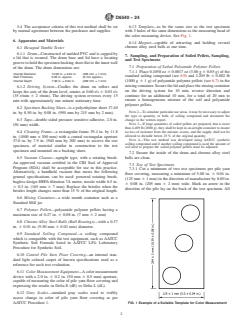
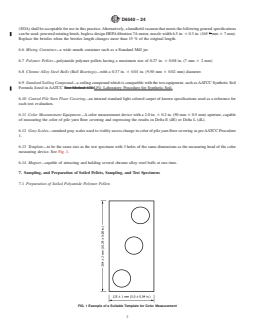
6.13 Template—to be the same size as the test specimen with 3 holes of the same dimensions as the measuring head of the color
measuring device. See Fig. 1.
6.14 Magnet—capable of attracting and holding several chrome alloy steel balls at one time.
7. Sampling, and Preparation of Soiled Pellets, Sampling, and Test Specimens
7.1 Preparation of Soiled Polyamide Polymer Pellets
FIG. 1 Example of a Suitable Template for Color Measurement
D6540 − 24
7.1.1 Place 0.1058 oz 6 0.0017 oz (3.00 g 6 0.05 g) of the standard soiling compound (see 6.9) and 2.205 lb 6 0.002 lb (1000
g 6 1 g) of polyamide polymer pellets (see 6.7) in the mixing container. Secure the lid and place the mixing container on the
driving system for 10 min, reverse direction and continue for an additional 10 min, for a total of 20 min to ensure a homogeneous
mixture of the soil and polyamide polymer pellets.
NOTE 2—To simulate particular use areas, it may be necessary to adjust the type or quantity, or both, of soiling compound and document the change in
the written report.
NOTE 3—If large quantities of soiled pellets are prepared, that is more than 4.409 lb (2000 g), they shall be kept in an airtight container to ensure no loss
of moisture from the mixture occurs, and the supply shall not be allowed to dwindle below 25 % of the original quantity.
NOTE 4—This Test Methodtest method was developed using AATCC synthetic soiling compound and if another soiling compound is used the amount
of soil used to prepare the soiled polymer pellets must be adjusted.
7.2 Ensure the inside of the drum and chrome alloy steel balls are clean.
7.3 Size of Test Specimens
7.3.1 Cut a minimum of two test specimens per pile yarn floor covering, measuring a minimum of 5.00 in. 6 0.04 in. (125 mm
6 1 mm) in the direction of manufacture by 8.00 in. 6 0.08 in. (205 mm 6 2 mm) wide. Mark an arrow in the direction of the
pile lay on the back of the test specimen. All test specimens shall be conditioned (clause 8.1), flat singly, and with use-surface
uppermost, for a minimum of 24 h.
7.4 Specimen Attachment
7.4.1 To the specimen backing sheet (see 6.2) attach double sided pressure sensitive adhesive tape (see 6.3) at each edge, across
the ends and at each junction of the test specimen. M
...