

ASTM G219-23
(Guide)Standard Guide for Determination of Static Coefficient of Friction of Test Couples Using an Inclined Plane Testing Device
General Information
- Abstract
SIGNIFICANCE AND USE
5.1 Guide G115 lists a number of ASTM International standards that use the inclined plane test rig to measure the static coefficient of specific tribosystems. This guide applies to any material couple that can be made into test specimens; one being in the form of a rider and the other a plane that can be angled to produce motion of the rider on the plane. Footwear on walkway surfaces is an example of a very important application. Flooring surfaces that are slippery to various types of footwear can produce accidents and testing should be done on candidate flooring surfaces and candidate shoe soles and heels to quantify their relative slip resistance. This guide shows how an inclined plane can be used to make such a comparison.
5.2 The inclined plane method is also very useful in machine design in which parts of components shall slide unassisted down chutes and the like. An inclined plane test can be used to determine the chute angle that is needed to allow motion on all parts that are placed on the chute. The applications are numerous.
SCOPE
1.1 This guide is intended to standardize the use of an inclined plane testing device to measure the static (breakaway) coefficient of friction between two bodies. One body is in the form of a small “rider” (few centimeters) and the other a rectangular flat plane (50 mm to 75 mm by 400 mm). The rider is placed on the plane and the plane is inclined at an angle to produce motion of the rider. The tangent of the angle at which macroscopic motion of the rider initiates on the angled plane is the breakaway or static coefficient of friction for that sliding couple.
1.2 Units—The values stated in SI units are to be regarded as the standard. No other units of measurement are included in this standard.
1.3 This standard does not purport to address all of the safety concerns, if any, associated with its use. It is the responsibility of the user of this standard to establish appropriate safety, health, and environmental practices and determine the applicability of regulatory limitations prior to use.
1.4 This international standard was developed in accordance with internationally recognized principles on standardization established in the Decision on Principles for the Development of International Standards, Guides and Recommendations issued by the World Trade Organization Technical Barriers to Trade (TBT) Committee.
- Status
- Published
- Publication Date
- 14-Dec-2023
- Technical Committee
- G02 - Wear and Erosion
- Drafting Committee
- G02.50 - Friction
Buy Documents
ASTM G219-23 - Standard Guide for Determination of Static Coefficient of Friction of Test Couples Using an Inclined Plane Testing Device
REDLINE ASTM G219-23 - Standard Guide for Determination of Static Coefficient of Friction of Test Couples Using an Inclined Plane Testing Device
Overview
ASTM G219-23: Standard Guide for Determination of Static Coefficient of Friction of Test Couples Using an Inclined Plane Testing Device establishes a reliable method for measuring the static (breakaway) coefficient of friction between two materials using an inclined plane test setup. Applicable across a wide range of industries, this guide provides standardized procedures to ensure accurate, repeatable, and comparable friction measurements. The method involves incrementally raising one end of a flat surface (plane) until a test object (rider) placed on it begins to slide, with the angle at which motion initiates being used to calculate the static coefficient of friction.
Key Topics
- Static Coefficient of Friction: The guide focuses on determining the breakaway friction or static coefficient, which is critical for assessing the slip resistance and performance of material combinations.
- Inclined Plane Testing Device: Outlines specifications for the apparatus, ensuring consistent and reliable results across different test setups.
- Test Specimens: The methodology allows for a wide array of specimen types, including footwear soles, flooring materials, packaging, machine parts, and more.
- Procedure and Metrics: Details steps for test preparation, execution, and result calculation, emphasizing the importance of repeatability and statistical significance.
- Surface Preparation: Stresses the requirement for clean, representative surfaces to eliminate variables that may affect friction measurements.
- Data Reporting: Highlights the need for comprehensive reporting, including material details, environmental conditions, cleaning procedures, and statistical outcomes.
Applications
The inclined plane method outlined in ASTM G219-23 offers valuable applications across several sectors, enhancing product safety, design optimization, and quality control:
- Footwear and Flooring Safety: Quantifies slip resistance of various combinations of shoe soles and walkway surfaces, helping prevent slip-related accidents and supporting regulatory compliance for commercial and public flooring.
- Machine and Equipment Design: Enables engineers to determine appropriate chute angles and surface combinations, assuring unassisted movement of components in automated processes.
- Product Development: Assists manufacturers in comparing the frictional characteristics of different materials or surface treatments to select the ideal solution for performance or safety.
- Comparative Testing: Offers an objective basis to assess new versus existing materials, supporting research and innovation in tribology.
These practical applications support safer environments, enhanced product functionality, and informed decision-making in material selection and machine design.
Related Standards
For a comprehensive approach to friction testing and terminology, the following referenced ASTM standards provide supporting guidance:
- ASTM G40 – Terminology Relating to Wear and Erosion
- ASTM G115 – Standard Guide for Measuring and Reporting Friction Coefficients
These related documents ensure harmonized terminology and reporting, benefiting users who require an integrated framework for tribological evaluation and reporting.
By following ASTM G219-23, organizations can ensure consistency in measuring and reporting the static coefficient of friction, leading to safer products, minimized risks, and reliable performance data. The guide aligns with internationally recognized standardization principles and supports a broad range of industrial, commercial, and research applications where friction measurement is critical.
Relations
- Effective Date
- 15-Dec-2023
Buy Documents
ASTM G219-23 - Standard Guide for Determination of Static Coefficient of Friction of Test Couples Using an Inclined Plane Testing Device
REDLINE ASTM G219-23 - Standard Guide for Determination of Static Coefficient of Friction of Test Couples Using an Inclined Plane Testing Device
Frequently Asked Questions
ASTM G219-23 is a guide published by ASTM International. Its full title is "Standard Guide for Determination of Static Coefficient of Friction of Test Couples Using an Inclined Plane Testing Device". This standard covers: SIGNIFICANCE AND USE 5.1 Guide G115 lists a number of ASTM International standards that use the inclined plane test rig to measure the static coefficient of specific tribosystems. This guide applies to any material couple that can be made into test specimens; one being in the form of a rider and the other a plane that can be angled to produce motion of the rider on the plane. Footwear on walkway surfaces is an example of a very important application. Flooring surfaces that are slippery to various types of footwear can produce accidents and testing should be done on candidate flooring surfaces and candidate shoe soles and heels to quantify their relative slip resistance. This guide shows how an inclined plane can be used to make such a comparison. 5.2 The inclined plane method is also very useful in machine design in which parts of components shall slide unassisted down chutes and the like. An inclined plane test can be used to determine the chute angle that is needed to allow motion on all parts that are placed on the chute. The applications are numerous. SCOPE 1.1 This guide is intended to standardize the use of an inclined plane testing device to measure the static (breakaway) coefficient of friction between two bodies. One body is in the form of a small “rider” (few centimeters) and the other a rectangular flat plane (50 mm to 75 mm by 400 mm). The rider is placed on the plane and the plane is inclined at an angle to produce motion of the rider. The tangent of the angle at which macroscopic motion of the rider initiates on the angled plane is the breakaway or static coefficient of friction for that sliding couple. 1.2 Units—The values stated in SI units are to be regarded as the standard. No other units of measurement are included in this standard. 1.3 This standard does not purport to address all of the safety concerns, if any, associated with its use. It is the responsibility of the user of this standard to establish appropriate safety, health, and environmental practices and determine the applicability of regulatory limitations prior to use. 1.4 This international standard was developed in accordance with internationally recognized principles on standardization established in the Decision on Principles for the Development of International Standards, Guides and Recommendations issued by the World Trade Organization Technical Barriers to Trade (TBT) Committee.
SIGNIFICANCE AND USE 5.1 Guide G115 lists a number of ASTM International standards that use the inclined plane test rig to measure the static coefficient of specific tribosystems. This guide applies to any material couple that can be made into test specimens; one being in the form of a rider and the other a plane that can be angled to produce motion of the rider on the plane. Footwear on walkway surfaces is an example of a very important application. Flooring surfaces that are slippery to various types of footwear can produce accidents and testing should be done on candidate flooring surfaces and candidate shoe soles and heels to quantify their relative slip resistance. This guide shows how an inclined plane can be used to make such a comparison. 5.2 The inclined plane method is also very useful in machine design in which parts of components shall slide unassisted down chutes and the like. An inclined plane test can be used to determine the chute angle that is needed to allow motion on all parts that are placed on the chute. The applications are numerous. SCOPE 1.1 This guide is intended to standardize the use of an inclined plane testing device to measure the static (breakaway) coefficient of friction between two bodies. One body is in the form of a small “rider” (few centimeters) and the other a rectangular flat plane (50 mm to 75 mm by 400 mm). The rider is placed on the plane and the plane is inclined at an angle to produce motion of the rider. The tangent of the angle at which macroscopic motion of the rider initiates on the angled plane is the breakaway or static coefficient of friction for that sliding couple. 1.2 Units—The values stated in SI units are to be regarded as the standard. No other units of measurement are included in this standard. 1.3 This standard does not purport to address all of the safety concerns, if any, associated with its use. It is the responsibility of the user of this standard to establish appropriate safety, health, and environmental practices and determine the applicability of regulatory limitations prior to use. 1.4 This international standard was developed in accordance with internationally recognized principles on standardization established in the Decision on Principles for the Development of International Standards, Guides and Recommendations issued by the World Trade Organization Technical Barriers to Trade (TBT) Committee.
ASTM G219-23 is classified under the following ICS (International Classification for Standards) categories: 97.150 - Floor coverings. The ICS classification helps identify the subject area and facilitates finding related standards.
ASTM G219-23 has the following relationships with other standards: It is inter standard links to ASTM G219-18. Understanding these relationships helps ensure you are using the most current and applicable version of the standard.
ASTM G219-23 is available in PDF format for immediate download after purchase. The document can be added to your cart and obtained through the secure checkout process. Digital delivery ensures instant access to the complete standard document.
Standards Content (Sample)
This international standard was developed in accordance with internationally recognized principles on standardization established in the Decision on Principles for the
Development of International Standards, Guides and Recommendations issued by the World Trade Organization Technical Barriers to Trade (TBT) Committee.
Designation: G219 − 23
Standard Guide for
Determination of Static Coefficient of Friction of Test
Couples Using an Inclined Plane Testing Device
This standard is issued under the fixed designation G219; the number immediately following the designation indicates the year of
original adoption or, in the case of revision, the year of last revision. A number in parentheses indicates the year of last reapproval. A
superscript epsilon (´) indicates an editorial change since the last revision or reapproval.
1. Scope 3.1.1 friction force, n—resisting force tangential to the
interface between two bodies, when under action of an external
1.1 This guide is intended to standardize the use of an
force, one body moves or tends to move relative to the other.
inclined plane testing device to measure the static (breakaway)
G40
coefficient of friction between two bodies. One body is in the
form of a small “rider” (few centimeters) and the other a
3.1.2 static coeffıcient of friction, n—coefficient of friction
rectangular flat plane (50 mm to 75 mm by 400 mm). The rider
corresponding to the maximum friction force that shall be
is placed on the plane and the plane is inclined at an angle to
overcome to initiate macroscopic motion between two bodies.
produce motion of the rider. The tangent of the angle at which
G40
macroscopic motion of the rider initiates on the angled plane is
3.1.2.1 Discussion—Breakaway friction coefficient is syn-
the breakaway or static coefficient of friction for that sliding
onymous with static coefficient of friction.
couple.
3.2 Definitions of Terms Specific to This Standard:
1.2 Units—The values stated in SI units are to be regarded
3.2.1 inclined plane device, n—mechanism with a flat hori-
as the standard. No other units of measurement are included in
zontal surface to be made of or covered with a material of
this standard.
interest on which a second member made of a material of
1.3 This standard does not purport to address all of the
interest can be placed and the mechanism is then actuated such
safety concerns, if any, associated with its use. It is the
that the horizontal plane is increasingly angled with respect to
responsibility of the user of this standard to establish appro-
its original horizontal position until motion is produced on the
priate safety, health, and environmental practices and deter-
member placed on the raising plane.
mine the applicability of regulatory limitations prior to use.
3.2.1.1 Discussion—The device allows for the continuous
1.4 This international standard was developed in accor-
measurement of the angle of inclination and the angle at which
dance with internationally recognized principles on standard-
motion of the rider commences.
ization established in the Decision on Principles for the
Development of International Standards, Guides and Recom-
3.2.2 rider, n—body to be placed on the inclined plane.
mendations issued by the World Trade Organization Technical
Barriers to Trade (TBT) Committee.
4. Summary of Guide
2. Referenced Documents
4.1 The technique of placing an object on a flat and
horizontal “plane” such as a piece of sheet metal and raising
2.1 ASTM Standards:
one end of the sheet until the body placed on the sheet starts to
G40 Terminology Relating to Wear and Erosion
slide has been used for centuries to compare the ease with
G115 Guide for Measuring and Reporting Friction Coeffi-
which different objects or materials slide on each other.
cients
Quantitative comparison of various couples can be made by
3. Terminology
measuring the angle at which the body placed on the plane
3.1 Definitions:
starts to slide. The angle at which motion commences is the test
metric. The test couple is the plane surface and the surface that
This guide is under the jurisdiction of ASTM Committee G02 on Wear and
contacts the plane. For example, if a shoe is placed on a
Erosion and is the direct responsibility of Subcommittee G02.50 on Friction.
flooring sample on the inclined plane, the test couple is the
Current edition approved Dec. 15, 2023. Published February 2024. Originally
shoe sole versus the type of flooring. Different shoe bottoms
approved in 2018. Last previous edition approved in 2018 as G219 – 18. DOI:
10.1520/G0219-23.
can be compared for their ability to slip on a particular flooring.
For referenced ASTM standards, visit the ASTM website, www.astm.org, or
The materials of construction as well as the nature of the
contact ASTM Customer Service at service@astm.org. For Annual Book of ASTM
contacting surfaces determine the breakaway angle. When
Standards volume information, refer to the standard’s Document Summary page on
the ASTM website. ranking, for example, different shoe soles on a particular
Copyright © ASTM International, 100 Barr Harbor Drive, PO Box C700, West Conshohocken, PA 19428-2959. United States
G219 − 23
flooring, the shoes are weighted so that they are all the same 6.4 The plane to be inclined could be elevated with a servo
weight when compared for ease of sliding on the flooring of motor and a rotary encoder could monitor the angle with the
interest. horizontal. Whatever the mechanism, the required features
shall be:
4.2 The tangent of the breakaway angle becomes the final
6.4.1 A flat plane large enough to hold the rider of interest
test metric. This converts the breakaway angle to a dimension-
with free space all around;
less number: the static coefficient of friction.
6.4.2 A way to put a surface of interest on the flat plane;
6.4.3 A mechanism to raise the plane progressively on an
5. Significance and Use
angle of inclination with the horizontal;
5.1 Guide G115 lists a number of ASTM International
6.4.4 A way to measure the angle of inclination of the plane
standards that use the inclined plane test rig to measure the
continuously; and
static coefficient of specific tribosystems. This guide applies to
6.4.5 A way to apply weights to riders when necessary, for
any material couple that can be made into test specimens; one
example, in the shoe study shown in Appendix X1, the shoes
being in the form of a rider and the other a plane that can be
were made by different manufacturers and were of different
angled to produce motion of the rider on the plane. Footwear
styles so they had different weights. When they were friction
on walkway surfaces is an example of a very important
tested against the same counterface, weights were added to the
application. Flooring surfaces that are slippery to various types
shoes so that they had the same mass. In this way, weight
of footwear can produce accidents and testing should be done
differences were eliminated as factors in measuring friction
on candidate flooring surfaces and candidate shoe soles and
versus counterface differences.
heels to quantify their relative slip resistance. This guide shows
how an inclined plane can be used to make such a comparison. 6.5 If a specific environment is part of a study (wet,
controlled humidity, with particles, etc.), a means will be
5.2 The inclined plan
...
This document is not an ASTM standard and is intended only to provide the user of an ASTM standard an indication of what changes have been made to the previous version. Because
it may not be technically possible to adequately depict all changes accurately, ASTM recommends that users consult prior editions as appropriate. In all cases only the current version
of the standard as published by ASTM is to be considered the official document.
Designation: G219 − 18 G219 − 23
Standard Guide for
Determination of Static Coefficient of Friction of Test
Couples Using an Inclined Plane Testing Device
This standard is issued under the fixed designation G219; the number immediately following the designation indicates the year of
original adoption or, in the case of revision, the year of last revision. A number in parentheses indicates the year of last reapproval. A
superscript epsilon (´) indicates an editorial change since the last revision or reapproval.
1. Scope
1.1 This guide is intended to standardize the use of an inclined plane testing device to measure the breakaway friction (static)
coefficient of mating couples that are of such size and shape that they can be made into a rider (one member of the sliding couple)
on a flat surface (the second member of the sliding couple) that can bestatic (breakaway) coefficient of friction between two bodies.
One body is in the form of a small “rider” (few centimeters) and the other a rectangular flat plane (50 mm to 75 mm by 400 mm).
The rider is placed on the plane and the plane is inclined at an angle to produce motion of the rider. The tangent of the angle at
which breakawaymacroscopic motion of the rider occursinitiates on the angled plane is the breakaway or static coefficient of
friction for that sliding couple.
1.2 Units—The values stated in SI units are to be regarded as the standard. No other units of measurement are included in this
standard.
1.3 This standard does not purport to address all of the safety concerns, if any, associated with its use. It is the responsibility
of the user of this standard to establish appropriate safety, health, and environmental practices and determine the applicability of
regulatory limitations prior to use.
1.4 This international standard was developed in accordance with internationally recognized principles on standardization
established in the Decision on Principles for the Development of International Standards, Guides and Recommendations issued
by the World Trade Organization Technical Barriers to Trade (TBT) Committee.
2. Referenced Documents
2.1 ASTM Standards:
G40 Terminology Relating to Wear and Erosion
G115 Guide for Measuring and Reporting Friction Coefficients
3. Terminology
3.1 Definitions:
3.1.1 friction force, n—resisting force tangential to the interface between two bodies, when under action of an external force, one
body moves or tends to move relative to the other. G40
3.1.2 static coeffıcient of friction, n—coefficient of friction corresponding to the maximum friction force that shall be overcome
to initiate macroscopic motion between two bodies. G40
This guide is under the jurisdiction of ASTM Committee G02 on Wear and Erosion and is the direct responsibility of Subcommittee G02.50 on Friction.
Current edition approved Aug. 1, 2018Dec. 15, 2023. Published August 2018February 2024. Originally approved in 2018. Last previous edition approved in 2018 as
G219DOI: 10.1520/G0219-18. – 18. DOI: 10.1520/G0219-23.
For referenced ASTM standards, visit the ASTM website, www.astm.org, or contact ASTM Customer Service at service@astm.org. For Annual Book of ASTM Standards
volume information, refer to the standard’s Document Summary page on the ASTM website.
Copyright © ASTM International, 100 Barr Harbor Drive, PO Box C700, West Conshohocken, PA 19428-2959. United States
G219 − 23
3.1.2.1 Discussion—
Breakaway friction coefficient is synonymous with static coefficient of friction.
3.2 Definitions of Terms Specific to This Standard:
3.2.1 inclined plane device, n—mechanism with a flat horizontal surface to be made of or covered with a material of interest on
which a second member made of a material of interest can be placed and the mechanism is then actuated such that the horizontal
plane is increasingly angled with respect to its original horizontal position until motion is produced on the member placed on the
raising plane.
3.2.1.1 Discussion—
The device allows for the continuous measurement of the angle of inclination and the angle at which motion of the rider
commences.
3.2.2 rider, n—body to be placed on the inclined plane.
4. Summary of Guide
4.1 The technique of placing an object on a flat and horizontal “plane” such as a piece of sheet metal and raising one end of the
sheet until the body placed on the sheet starts to slide has been used for centuries to compare the ease with which different objects
or materials slide on each other. Quantitative comparison of various couples can be made by measuring the angle at which the body
placed on the plane starts to slide. The angle at which motion commences is the test metric. The test couple is the plane surface
and the surface that contacts the plane. For example, if a shoe is placed on a flooring sample on the inclined plane, the test couple
is the shoe sole versus the type of flooring. Different shoe bottoms can be compared for their ability to slip on a particular flooring.
The materials of construction as well as the nature of the contacting surfaces determine the breakaway angle. When ranking, for
example, different shoe soles on a particular flooring, the shoes are weighted so that they are all the same weight when compared
for ease of sliding on the flooring of interest.
4.2 The tangent of the breakaway angle becomes the final test metric. This converts the breakaway angle to a dimensionless
number: the static coefficient of friction.
5. Significance and Use
5.1 Guide G115 lists a number of ASTM International standards that use the inclined plane test rig to measure the static coefficient
of specific tribosystems. This guide applies to any material couple that can be made into test specimens that can be made into a
rider on specimens; one being in the form of a rider and the other a plane that can be angled to produce motion of the bodyrider
on the plane. Footwear on walkway surfaces is an example of a very important application. Flooring surfaces that are slippery to
various types of footwear can produce accidents and testing should be done on candidate flooring surfaces and candidate shoe soles
and heels to quantify their relative slip resistance. This guide shows how an inclined plane can be used to make such a comparison.
5.2 The inclined plane method is also very useful in machine design in which parts of components shall slide unassisted down
chutes and the like. An inclined plane test can be used to determine the chute angle that is needed to allow motion on all parts that
are placed on the chute. The applications are numerous.
6. Apparatus
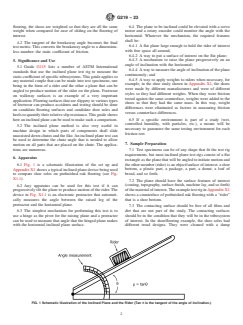
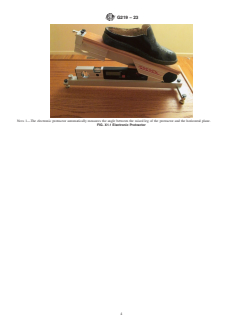
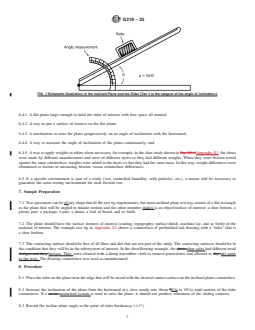
6.1 Fig. 1 is a schematic illustration of the set up and Appendix X1 shows a typical inclined plane device being used to compare
shoe soles on prefinished oak flooring (see Fig. X1.1).
6.2 Any apparatus can be used for this test if it can progressively tilt the plane to produce motion of the rider. The device in Fig.
X1.1 is an electronic protractor that automatically measures the angle of one between the raised leg of the protractor.protractor and
the horizontal plane.
6.3 The simplest mechanism for performing this test is to use a hinge as the pivot for the raising plane and a protractor can be
used to measure that angle that the hinged plane makes with the horizonta
...