

ASTM D7351/D7351M-21
(Test Method)Standard Test Method for Determination of Sediment Retention Device (SRD) Effectiveness in Sheet Flow Applications
General Information
- Abstract
SIGNIFICANCE AND USE
5.1 This test method quantifies the effectiveness of a sediment retention device (SRD) by measuring the ability of the SRD to retain eroded sediments caused by sheet flowing water under full-scale conditions. This test method may also assist in identifying physical attributes of SRDs that contribute to their erosion control performance.
5.2 The effectiveness of SRDs is installation dependent. Thus, replicating field installation techniques is an important aspect of this test method. This test method is full-scale and therefore, appropriate as an indication of product performance, for general comparison of product capabilities, and for assessment of product installation techniques.
Note 1: Test Method D5141 is an alternate test method for evaluating sediment retention device effectiveness, if it is not necessary to simulate field installation conditions.
Note 2: The quality of the result produced by this standard is dependent on the competence of the personnel performing it, and the suitability of the equipment and facilities used. Agencies that meet the criteria of Practice D3740 are generally considered capable of competent and objective testing/sampling/inspection/etc. Users of this standard are cautioned that compliance with Practice D3740 does not in itself assure reliable results. Reliable results depend on many factors: Practice D3740 provides a means of evaluating some of those factors.
SCOPE
1.1 This test method establishes the guidelines, requirements and procedures for evaluating the ability of Sediment Retention Devices (SRDs) to retain sediment when exposed to sediment-laden water “sheet” flows.
1.2 This test method is applicable to the use of an SRD as a vertical permeable interceptor designed to remove suspended soil from overland, nonconcentrated water flow. The function of an SRD is to trap and allow settlement of soil particles from sediment laden water. The purpose is to reduce the transport of eroded soil from a disturbed site by water runoff.
1.3 The test method presented herein is intended to indicate representative performance and is not necessarily adequate for all purposes in view of the wide variety of possible sediments and performance objectives.
1.4 Units—The values stated in either SI units or inch-pound units [given in brackets] are to be regarded separately as standard. Only SI units are used in equations and appendixes. The values stated in each system may not be exact equivalents; therefore, each system shall be used independently of the other. Combining values from the two systems may result in nonconformance with the standard. Reporting of test results in units other than SI shall not be regarded as nonconformance with this standard.
1.5 All observed and calculated values shall conform to the guidelines for significant digits and rounding established in Practice D6026.
1.5.1 The procedures used to specify how data are collected/recorded and calculated in this standard are regarded as the industry standard. In addition, they are representative of the significant digits that should generally be retained. The procedures used do not consider material variation, purpose for obtaining the data, special purpose studies, or any consideration for the user’s objectives; and it is common practice to increase or reduce significant digits of reported data to commensurate with these considerations. It is beyond the scope of this standard to consider significant digits used in analysis methods for engineering design.
1.6 This standard does not purport to address all of the safety concerns, if any, associated with its use. It is the responsibility of the user of this standard to establish appropriate safety, health, and environmental practices and determine the applicability of regulatory limitations prior to use.
1.7 This international standard was developed in accordance with internationally recognized principles on standardization established...
- Status
- Published
- Publication Date
- 14-Aug-2021
- Technical Committee
- D18 - Soil and Rock
- Drafting Committee
- D18.25 - Erosion and Sediment Control Technology
Buy Documents
ASTM D7351/D7351M-21 - Standard Test Method for Determination of Sediment Retention Device (SRD) Effectiveness in Sheet Flow Applications

REDLINE ASTM D7351/D7351M-21 - Standard Test Method for Determination of Sediment Retention Device (SRD) Effectiveness in Sheet Flow Applications
Overview
ASTM D7351/D7351M-21, titled "Standard Test Method for Determination of Sediment Retention Device (SRD) Effectiveness in Sheet Flow Applications," is a key international standard developed by ASTM International. This test method provides comprehensive guidelines and procedures for evaluating how effectively sediment retention devices (SRDs)-such as silt fences, wattles, or socks-capture and retain sediment from overland, sheet-flowing water under controlled, full-scale conditions.
By simulating real-world conditions, this ASTM standard ensures the measurement of SRD performance is meaningful for field applications, especially for erosion and sediment control in construction and land-disturbance scenarios.
Key Topics
Test Scope and Purpose
- Evaluates the ability of SRDs to trap sediment in sheet flow (nonconcentrated overland water flow).
- Measures performance using standardized procedures, enabling product comparisons and assessment of installation techniques.
Installation and Testing Parameters
- Emphasizes the importance of replicating field installation techniques for accurate results.
- Indicates that SRD effectiveness is highly installation-dependent.
Data Collection and Evaluation
- Measures sediment-laden water upstream and downstream of the SRD.
- Requires analysis of collected grab samples for turbidity and percent solids.
- All measurements are made using standardized units and follow precise guidelines for significant digits and rounding (see Practice D6026).
Reporting and Documentation
- Specifies minimum requirements for reporting, including product and soil descriptions, test setup and conditions, calibration data, and calculated retention effectiveness.
- Requires detailed raw data and observations during testing.
Applications
Erosion Control Product Evaluation
- Widely used by SRD manufacturers, regulators, and construction stakeholders to verify and benchmark the performance of sediment control products such as silt fences, wattles, and sediment socks.
Quality Assurance for Stormwater Management
- Supports regulatory compliance by providing a consistent method for comparing different sediment retention solutions in stormwater management.
- Assists project managers and engineers in selecting and installing the most effective SRD systems on construction sites and other disturbed lands.
Installation Guidance
- Provides guidance for replicating field conditions, so that lab testing accurately reflects actual installation performance.
Comparative Analysis
- Enables side-by-side comparison of various SRDs, aiding designers and specifiers in product selection based on measurable performance data.
Related Standards
Professionals using ASTM D7351/D7351M-21 may also reference:
- ASTM D5141 – Alternate test method for evaluating SRD effectiveness when simulation of field installation is not needed.
- ASTM D653 – Terminology related to soil, rock, and contained fluids.
- ASTM D698 – Tests for laboratory compaction characteristics of soil.
- ASTM D4318 – Determination of soil liquid and plastic limits.
- ASTM D4491/D4491M, D4632/D4632M, D4751, D5261 – Tests for geotextiles used in SRDs.
- ASTM D3740 – Practice for minimum requirements for agencies engaged in soil and rock testing.
- ASTM D6026 – Guidelines for significant digits and data records in geotechnical data.
- ASTM D6913/D6913M, D7928 – Soil particle-size distribution by sieve analysis and hydrometer.
Practical Value
Adopting ASTM D7351/D7351M-21 in your sediment retention device evaluations ensures:
- Reliable, full-scale testing that replicates real-world conditions.
- Consistent data reporting for regulatory and design purposes.
- Effective selection and installation guidance for temporary sediment control products.
- Enhanced erosion and sediment control management for environmental protection and regulatory compliance.
This standard is vital for those specifying, installing, or assessing SRDs in erosion control and stormwater management projects-ensuring that site-specific solutions are both effective and verifiable.
Relations
- Effective Date
- 01-Feb-2024
- Effective Date
- 01-Nov-2023
- Effective Date
- 01-Jan-2020
- Effective Date
- 01-Oct-2019
- Effective Date
- 01-Jul-2018
- Effective Date
- 01-Jun-2017
- Refers
ASTM D4318-17 - Standard Test Methods for Liquid Limit, Plastic Limit, and Plasticity Index of Soils - Effective Date
- 01-Jun-2017
- Refers
ASTM D4491/D4491M-17 - Standard Test Methods for Water Permeability of Geotextiles by Permittivity - Effective Date
- 01-Jan-2017
- Effective Date
- 01-Jul-2016
- Refers
ASTM D4491/D4491M-16 - Standard Test Methods for Water Permeability of Geotextiles by Permittivity - Effective Date
- 01-Jul-2016
- Effective Date
- 01-May-2016
- Effective Date
- 01-May-2016
- Refers
ASTM D4491/D4491M-15 - Standard Test Methods for Water Permeability of Geotextiles by Permittivity - Effective Date
- 01-Jul-2015
- Effective Date
- 01-May-2015
- Refers
ASTM D4632/D4632M-15 - Standard Test Method for Grab Breaking Load and Elongation of Geotextiles - Effective Date
- 01-Jan-2015
Buy Documents
ASTM D7351/D7351M-21 - Standard Test Method for Determination of Sediment Retention Device (SRD) Effectiveness in Sheet Flow Applications
REDLINE ASTM D7351/D7351M-21 - Standard Test Method for Determination of Sediment Retention Device (SRD) Effectiveness in Sheet Flow Applications
Get Certified
Connect with accredited certification bodies for this standard

CIS Institut d.o.o.
Personal Protective Equipment (PPE) certification body. Notified Body NB-2890 for EU Regulation 2016/425 PPE.

Kiwa BDA Testing
Building and construction product certification.
Kmetijski inštitut Slovenije
Agricultural Institute of Slovenia. Soil testing, plant health, agricultural product analysis.
Sponsored listings
Frequently Asked Questions
ASTM D7351/D7351M-21 is a standard published by ASTM International. Its full title is "Standard Test Method for Determination of Sediment Retention Device (SRD) Effectiveness in Sheet Flow Applications". This standard covers: SIGNIFICANCE AND USE 5.1 This test method quantifies the effectiveness of a sediment retention device (SRD) by measuring the ability of the SRD to retain eroded sediments caused by sheet flowing water under full-scale conditions. This test method may also assist in identifying physical attributes of SRDs that contribute to their erosion control performance. 5.2 The effectiveness of SRDs is installation dependent. Thus, replicating field installation techniques is an important aspect of this test method. This test method is full-scale and therefore, appropriate as an indication of product performance, for general comparison of product capabilities, and for assessment of product installation techniques. Note 1: Test Method D5141 is an alternate test method for evaluating sediment retention device effectiveness, if it is not necessary to simulate field installation conditions. Note 2: The quality of the result produced by this standard is dependent on the competence of the personnel performing it, and the suitability of the equipment and facilities used. Agencies that meet the criteria of Practice D3740 are generally considered capable of competent and objective testing/sampling/inspection/etc. Users of this standard are cautioned that compliance with Practice D3740 does not in itself assure reliable results. Reliable results depend on many factors: Practice D3740 provides a means of evaluating some of those factors. SCOPE 1.1 This test method establishes the guidelines, requirements and procedures for evaluating the ability of Sediment Retention Devices (SRDs) to retain sediment when exposed to sediment-laden water “sheet” flows. 1.2 This test method is applicable to the use of an SRD as a vertical permeable interceptor designed to remove suspended soil from overland, nonconcentrated water flow. The function of an SRD is to trap and allow settlement of soil particles from sediment laden water. The purpose is to reduce the transport of eroded soil from a disturbed site by water runoff. 1.3 The test method presented herein is intended to indicate representative performance and is not necessarily adequate for all purposes in view of the wide variety of possible sediments and performance objectives. 1.4 Units—The values stated in either SI units or inch-pound units [given in brackets] are to be regarded separately as standard. Only SI units are used in equations and appendixes. The values stated in each system may not be exact equivalents; therefore, each system shall be used independently of the other. Combining values from the two systems may result in nonconformance with the standard. Reporting of test results in units other than SI shall not be regarded as nonconformance with this standard. 1.5 All observed and calculated values shall conform to the guidelines for significant digits and rounding established in Practice D6026. 1.5.1 The procedures used to specify how data are collected/recorded and calculated in this standard are regarded as the industry standard. In addition, they are representative of the significant digits that should generally be retained. The procedures used do not consider material variation, purpose for obtaining the data, special purpose studies, or any consideration for the user’s objectives; and it is common practice to increase or reduce significant digits of reported data to commensurate with these considerations. It is beyond the scope of this standard to consider significant digits used in analysis methods for engineering design. 1.6 This standard does not purport to address all of the safety concerns, if any, associated with its use. It is the responsibility of the user of this standard to establish appropriate safety, health, and environmental practices and determine the applicability of regulatory limitations prior to use. 1.7 This international standard was developed in accordance with internationally recognized principles on standardization established...
SIGNIFICANCE AND USE 5.1 This test method quantifies the effectiveness of a sediment retention device (SRD) by measuring the ability of the SRD to retain eroded sediments caused by sheet flowing water under full-scale conditions. This test method may also assist in identifying physical attributes of SRDs that contribute to their erosion control performance. 5.2 The effectiveness of SRDs is installation dependent. Thus, replicating field installation techniques is an important aspect of this test method. This test method is full-scale and therefore, appropriate as an indication of product performance, for general comparison of product capabilities, and for assessment of product installation techniques. Note 1: Test Method D5141 is an alternate test method for evaluating sediment retention device effectiveness, if it is not necessary to simulate field installation conditions. Note 2: The quality of the result produced by this standard is dependent on the competence of the personnel performing it, and the suitability of the equipment and facilities used. Agencies that meet the criteria of Practice D3740 are generally considered capable of competent and objective testing/sampling/inspection/etc. Users of this standard are cautioned that compliance with Practice D3740 does not in itself assure reliable results. Reliable results depend on many factors: Practice D3740 provides a means of evaluating some of those factors. SCOPE 1.1 This test method establishes the guidelines, requirements and procedures for evaluating the ability of Sediment Retention Devices (SRDs) to retain sediment when exposed to sediment-laden water “sheet” flows. 1.2 This test method is applicable to the use of an SRD as a vertical permeable interceptor designed to remove suspended soil from overland, nonconcentrated water flow. The function of an SRD is to trap and allow settlement of soil particles from sediment laden water. The purpose is to reduce the transport of eroded soil from a disturbed site by water runoff. 1.3 The test method presented herein is intended to indicate representative performance and is not necessarily adequate for all purposes in view of the wide variety of possible sediments and performance objectives. 1.4 Units—The values stated in either SI units or inch-pound units [given in brackets] are to be regarded separately as standard. Only SI units are used in equations and appendixes. The values stated in each system may not be exact equivalents; therefore, each system shall be used independently of the other. Combining values from the two systems may result in nonconformance with the standard. Reporting of test results in units other than SI shall not be regarded as nonconformance with this standard. 1.5 All observed and calculated values shall conform to the guidelines for significant digits and rounding established in Practice D6026. 1.5.1 The procedures used to specify how data are collected/recorded and calculated in this standard are regarded as the industry standard. In addition, they are representative of the significant digits that should generally be retained. The procedures used do not consider material variation, purpose for obtaining the data, special purpose studies, or any consideration for the user’s objectives; and it is common practice to increase or reduce significant digits of reported data to commensurate with these considerations. It is beyond the scope of this standard to consider significant digits used in analysis methods for engineering design. 1.6 This standard does not purport to address all of the safety concerns, if any, associated with its use. It is the responsibility of the user of this standard to establish appropriate safety, health, and environmental practices and determine the applicability of regulatory limitations prior to use. 1.7 This international standard was developed in accordance with internationally recognized principles on standardization established...
ASTM D7351/D7351M-21 is classified under the following ICS (International Classification for Standards) categories: 13.080.05 - Examination of soils in general. The ICS classification helps identify the subject area and facilitates finding related standards.
ASTM D7351/D7351M-21 has the following relationships with other standards: It is inter standard links to ASTM D4753-24, ASTM D3740-23, ASTM D4751-20, ASTM D3740-19, ASTM D5261-10(2018), ASTM D4318-17e1, ASTM D4318-17, ASTM D4491/D4491M-17, ASTM D4751-16, ASTM D4491/D4491M-16, ASTM D7928-16e1, ASTM D7928-16, ASTM D4491/D4491M-15, ASTM D4753-15, ASTM D4632/D4632M-15. Understanding these relationships helps ensure you are using the most current and applicable version of the standard.
ASTM D7351/D7351M-21 is available in PDF format for immediate download after purchase. The document can be added to your cart and obtained through the secure checkout process. Digital delivery ensures instant access to the complete standard document.
Standards Content (Sample)
This international standard was developed in accordance with internationally recognized principles on standardization established in the Decision on Principles for the
Development of International Standards, Guides and Recommendations issued by the World Trade Organization Technical Barriers to Trade (TBT) Committee.
Designation: D7351/D7351M − 21
Standard Test Method for
Determination of Sediment Retention Device (SRD)
Effectiveness in Sheet Flow Applications
This standard is issued under the fixed designation D7351/D7351M; the number immediately following the designation indicates the
year of original adoption or, in the case of revision, the year of last revision. A number in parentheses indicates the year of last
reapproval. A superscript epsilon (´) indicates an editorial change since the last revision or reapproval.
1. Scope* increase or reduce significant digits of reported data to com-
mensurate with these considerations. It is beyond the scope of
1.1 This test method establishes the guidelines, require-
this standard to consider significant digits used in analysis
ments and procedures for evaluating the ability of Sediment
methods for engineering design.
Retention Devices (SRDs) to retain sediment when exposed to
1.6 This standard does not purport to address all of the
sediment-laden water “sheet” flows.
safety concerns, if any, associated with its use. It is the
1.2 This test method is applicable to the use of an SRD as a
responsibility of the user of this standard to establish appro-
vertical permeable interceptor designed to remove suspended
priate safety, health, and environmental practices and deter-
soil from overland, nonconcentrated water flow. The function
mine the applicability of regulatory limitations prior to use.
ofanSRDistotrapandallowsettlementofsoilparticlesfrom
1.7 This international standard was developed in accor-
sediment laden water.The purpose is to reduce the transport of
dance with internationally recognized principles on standard-
eroded soil from a disturbed site by water runoff.
ization established in the Decision on Principles for the
1.3 The test method presented herein is intended to indicate
Development of International Standards, Guides and Recom-
representative performance and is not necessarily adequate for
mendations issued by the World Trade Organization Technical
all purposes in view of the wide variety of possible sediments
Barriers to Trade (TBT) Committee.
and performance objectives.
2. Referenced Documents
1.4 Units—The values stated in either SI units or inch-
poundunits[giveninbrackets]aretoberegardedseparatelyas
2.1 ASTM Standards:
standard. Only SI units are used in equations and appendixes.
D653Terminology Relating to Soil, Rock, and Contained
Thevaluesstatedineachsystemmaynotbeexactequivalents;
Fluids
therefore,eachsystemshallbeusedindependentlyoftheother.
D698Test Methods for Laboratory Compaction Character-
Combiningvaluesfromthetwosystemsmayresultinnoncon-
istics of Soil Using Standard Effort (12,400 ft-lbf/ft (600
formance with the standard. Reporting of test results in units
kN-m/m ))
other than SI shall not be regarded as nonconformance with
D3740Practice for Minimum Requirements for Agencies
this standard.
Engaged in Testing and/or Inspection of Soil and Rock as
Used in Engineering Design and Construction
1.5 All observed and calculated values shall conform to the
D4318Test Methods for Liquid Limit, Plastic Limit, and
guidelines for significant digits and rounding established in
Plasticity Index of Soils
Practice D6026.
D4491/D4491MTest Methods for Water Permeability of
1.5.1 Theproceduresusedtospecifyhowdataarecollected/
Geotextiles by Permittivity
recorded and calculated in this standard are regarded as the
D4632/D4632MTest Method for Grab Breaking Load and
industry standard. In addition, they are representative of the
Elongation of Geotextiles
significant digits that should generally be retained. The proce-
D4751Test Methods for Determining Apparent Opening
dures used do not consider material variation, purpose for
Size of a Geotextile
obtaining the data, special purpose studies, or any consider-
D4753Guide for Evaluating, Selecting, and Specifying Bal-
ation for the user’s objectives; and it is common practice to
ances and Standard Masses for Use in Soil, Rock, and
Construction Materials Testing
ThistestmethodisunderthejurisdictionofASTMCommitteeD18onSoiland
Rock and is the direct responsibility of Subcommittee D18.25 on Erosion and
Sediment Control Technology. For referenced ASTM standards, visit the ASTM website, www.astm.org, or
Current edition approved Aug. 15, 2021. Published August 2021. Originally contact ASTM Customer Service at service@astm.org. For Annual Book of ASTM
approved in 2007. Last previous edition approved in 2019 as D7351 – 19. DOI: Standards volume information, refer to the standard’s Document Summary page on
10.1520/D7351_D7351M-21. the ASTM website.
*A Summary of Changes section appears at the end of this standard
Copyright © ASTM International, 100 Barr Harbor Drive, PO Box C700, West Conshohocken, PA 19428-2959. United States
D7351/D7351M − 21
D5141TestMethodforDeterminingFilteringEfficiencyand 5. Significance and Use
Flow Rate of the Filtration Component of a Sediment
5.1 This test method quantifies the effectiveness of a sedi-
Retention Device
ment retention device (SRD) by measuring the ability of the
D5261Test Method for Measuring Mass per Unit Area of
SRD to retain eroded sediments caused by sheet flowing water
Geotextiles
under full-scale conditions.This test method may also assist in
D6026Practice for Using Significant Digits and Data Re-
identifying physical attributes of SRDs that contribute to their
cords in Geotechnical Data
erosion control performance.
D6913/D6913MTest Methods for Particle-Size Distribution
5.2 The effectiveness of SRDs is installation dependent.
(Gradation) of Soils Using Sieve Analysis
Thus, replicating field installation techniques is an important
D7928Test Method for Particle-Size Distribution (Grada-
aspect of this test method. This test method is full-scale and
tion) of Fine-Grained Soils Using the Sedimentation
therefore, appropriate as an indication of product performance,
(Hydrometer) Analysis
for general comparison of product capabilities, and for assess-
ment of product installation techniques.
3. Terminology
3.1 Definitions: NOTE 1—Test Method D5141 is an alternate test method for evaluating
sediment retention device effectiveness, if it is not necessary to simulate
3.1.1 Fordefinitionsofcommontechnicaltermsusedinthis
field installation conditions.
standard, refer to Terminology D653.
NOTE 2—The quality of the result produced by this standard is
dependent on the competence of the personnel performing it, and the
4. Summary of Test Method
suitability of the equipment and facilities used. Agencies that meet the
criteria of Practice D3740 are generally considered capable of competent
4.1 Sediment-laden water is mixed in a tank and then
and objective testing/sampling/inspection/etc. Users of this standard are
dischargedfor30minutesas“sheetflow”downaslope.Atthe
cautioned that compliance with Practice D3740 does not in itself assure
toe-of-slope the sheet flow reaches an installed sediment
reliable results. Reliable results depend on many factors: Practice D3740
retention device (SRD). The flow then seeps through, over, or
provides a means of evaluating some of those factors.
under, or a combination thereof, the SRD. At a minimum, the
6. Apparatus
amount (via water and soil weight) of sediment-laden flow is
measured both upstream and downstream of the SRD.
6.1 The following equipment is required to perform testing
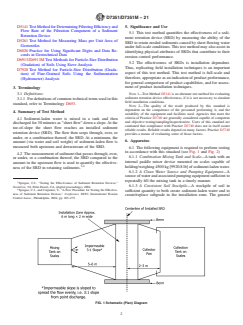
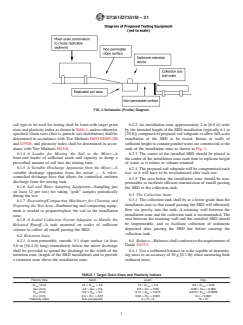
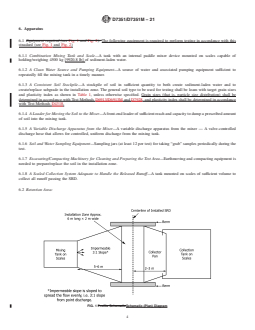
in accordance with this stnadard (see Fig. 1 and Fig. 2)
4.2 Themeasurementofsedimentthatpassesthrough,over,
6.1.1 Combination Mixing Tank and Scale—Atank with an
or under, or a combination thereof, the SRD compared to the
internal paddle mixer device mounted on scales capable of
amount in the upstream flow is used to quantify the effective-
3,4
holding/weighing4500kg[9920.8lb]ofsediment-ladenwater.
ness of the SRD in retaining sediments.
6.1.2 A Clean Water Source and Pumping Equipment—A
sourceofwaterandassociatedpumpingequipmentsufficientto
repeatedly fill the mixing tank in a timely manner.
Sprague, C.J., “Testing the Effectiveness of Sediment Retention Devices,”
6.1.3 A Consistent Soil Stockpile—A stockpile of soil in
StormCon ‘04, Palm Desert, CA, (digital proceedings), 2004.
Sprague, C.J., and Carpenter, T., “A New Procedure for Testing the Effective- sufficient quantity to both create sediment-laden water and to
ness of Sediment Retention Devices,” Conference XXXV, International Erosion
create/replace subgrade in the installation zone. The general
Control Assoc., Philadelphia, 2004, pp. 265–275.
FIG. 1 Schematic (Plan) Diagram
D7351/D7351M − 21
FIG. 2 Schematic (Profile) Diagram
soil type to be used for testing shall be loam with target grain 6.2.2 An installation zone approximately 2 m [6.6 ft] wide
sizesandplasticityindexasshowninTable1,unlessotherwise by the intended length of the SRD installation (typically 6.1 m
specified.Grainsizes(thatis,particlesizedistribution)shallbe [20ft])comprisedofpreparedsoilsubgradetoallowfull-scale
determined in accordance with Test Methods D6913/D6913M installation of the SRD to be tested. Berms or walls of
and D7928, and plasticity index shall be determined in accor- sufficient height to contain ponded water are constructed at the
dance with Test Methods D4318. ends of the installation zone as shown in Fig. 1.
6.1.4 A Loader for Moving the Soil to the Mixer—A
6.2.3 The center of the installed SRD should be placed in
front-end loader of sufficient reach and capacity to dump a
the center of the installation zone each time to replicate height
prescribed amount of soil into the mixing tank.
of water as it relates to volume retained.
6.1.5 A Variable Discharge Apparatus from the Mixer—A
6.2.4 The prepared soil subgrade will be compromised each
variable discharge apparatus from the mixer — A valve-
test, so it will have to be reconstructed after each test.
controlled discharge hose that allows for controlled, uniform
6.2.5 The area below the installation zone should be non-
discharge from the mixing tank.
permeable to facilitate efficient transmission of runoff passing
6.1.6 Soil and Water Sampling Equipment—Sampling jars
the SRD to the collection tank.
(at least 12 per test) for taking “grab” samples periodically
6.3 The Collection Area:
during the test.
6.3.1 The collection tank shall be at a lower grade than the
6.1.7 Excavating/Compacting Machinery for Cleaning and
installation area so that runoff passing the SRD will efficiently
Preparing the Test Area—Earthmoving and compacting equip-
flow via gravity into the tank. A retaining wall between the
ment is needed to prepare/replace the soil in the installation
installation zone and the collection tank is recommended. The
zone.
area between the retaining wall and the installed SRD should
6.1.8 A Scaled Collection System Adequate to Handle the
be impermeable, and so facilitate collection of sediments
Released Runoff—A tank mounted on scales of sufficient
deposited after passing the SRD but before entering the
volume to collect all runoff passing the SRD.
collection tank.
6.2 Retention Area:
6.4 Balance—Balancesshallconformtotherequirementsof
6.2.1 A non-permeable, smooth, 3:1 slope surface (at least
Guide D4753.
5.0 m [16.4 ft] long) immediately below the mixer discharge
shall be provided to spread the discharge to the width of the 6.4.1 Use a calibrated balance or scale capable of determin-
retention zone (length of the SRD installation) and to provide ing mass to an accuracy of 50 g [0.1 lb] when measuring bulk
a retention zone above the installation zone. sediment mass.
TABLE 1 Target Grain Sizes and Plasticity Indices
Particle Size Sand Loam Clay
D (mm) 25 > D >3.0 10>D >0.3 3.0>D > 0.02
100 100 100 100
D (mm) 4.0 > D >0.8 0.8>D >0.08 0.08>D > 0.003
85 85 85 85
D (mm) 0.9 > D >0.2 0.15>D > 0.015 0.015 > D > 0.0008
50 50 50 50
D (mm) 0.3 > D >0.01 0.03>D > 0.001 D < 0.002
15 15 15 15
Plasticity Index N/A (nonplastic) 2 < PI < 8 10 < PI
D7351/D7351M − 21
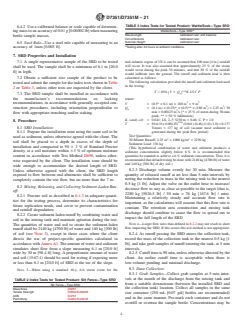
TABLE 3 Index Tests for Tested Product: Wattle/Sock—Type SRD
6.4.2 Use a calibrated balance or scale capable of determin-
A
ingmasstoanaccuracyof0.01g[0.00002lb]whenmeasuring Wattle/Sock—Type SRD
Mass/Length calibrated ruler and balance
bottle sample masses.
Circumference calibrated ruler
Nominal Height calibrated ruler
6.5 Steel Rule—Use a steel rule capable of measuring to an
A
accuracy of 1mm [0.003 ft]. Testing after 24 hours at ambient conditions.
7. SRD Properties and Installation
7.1 A single representative sample of the SRD to be tested mid-Atlantic region of US it can be assumed that 100 mm [4 in.] rainfall
will occur. It was also assumed that approximately 25 % of the storm
shall be used. The sample shall be a minimum of 6.1 m [20.0
would occur during the peak 30 minutes, and that 50 % of the rainfall
ft] in legth.
would infiltrate into the ground. The runoff and sediment load is then
calculated as follows:
7.2 Obtain a sufficient size sample of the product to be
The following calculations provided the runoff and sediment load used
testedandsubmitthesamplefortheindextestsshowninTable
in the testing:
2 or Table 3, unless other tests are requested by the client.
0.56
T 5 89.6 V 3 Q KLSC P
~ !
p
7.3 The SRD sample shall be installed in accordance with
the manufacture’s recommendations or, lacking
where:
2 3
recommendations, in accordance with generally accepted con-
V = (0.5* × 0.1 m) × 180 m =9m
2 3
Q = (0.1 m) × (0.25)* × (0.5)** × (180 m ) = 2.25 m/30
struction procedures, including orientation p
...
This document is not an ASTM standard and is intended only to provide the user of an ASTM standard an indication of what changes have been made to the previous version. Because
it may not be technically possible to adequately depict all changes accurately, ASTM recommends that users consult prior editions as appropriate. In all cases only the current version
of the standard as published by ASTM is to be considered the official document.
Designation: D7351 − 19 D7351/D7351M − 21
Standard Test Method for
Determination of Sediment Retention Device (SRD)
Effectiveness in Sheet Flow Applications
This standard is issued under the fixed designation D7351;D7351/D7351M; the number immediately following the designation indicates
the year of original adoption or, in the case of revision, the year of last revision. A number in parentheses indicates the year of last
reapproval. A superscript epsilon (´) indicates an editorial change since the last revision or reapproval.
1. Scope Scope*
1.1 This test method establishes the guidelines, requirements and procedures for evaluating the ability of Sediment Retention
Devices (SRDs) to retain sediment when exposed to sediment-laden water “sheet” flows.
1.2 This test method is applicable to the use of an SRD as a vertical permeable interceptor designed to remove suspended soil from
overland, nonconcentrated water flow. The function of an SRD is to trap and allow settlement of soil particles from sediment laden
water. The purpose is to reduce the transport of eroded soil from a disturbed site by water runoff.
1.3 The test method presented herein is intended to indicate representative performance and is not necessarily adequate for all
purposes in view of the wide variety of possible sediments and performance objectives.
1.4 Units—The values stated in either SI units or inch-pound units [given in brackets] are to be regarded separately as standard.
Only SI units are used in equations and appendixes. The values stated in each system may not be exact equivalents; therefore, each
system shall be used independently of the other. Combining values from the two systems may result in nonconformance with the
standard. Reporting of test results in units other than SI shall not be regarded as nonconformance with this standard.
1.5 All observed and calculated values shall conform to the guidelines for significant digits and rounding established in Practice
D6026.
1.5.1 The procedures used to specify how data are collected/recorded and calculated in this standard are regarded as the industry
standard. In addition, they are representative of the significant digits that should generally be retained. The procedures used do not
consider material variation, purpose for obtaining the data, special purpose studies, or any consideration for the user’s objectives;
and it is common practice to increase or reduce significant digits of reported data to commensurate with these considerations. It
is beyond the scope of this standard to consider significant digits used in analysis methods for engineering design.
1.6 This standard does not purport to address all of the safety concerns, if any, associated with its use. It is the responsibility
of the user of this standard to establish appropriate safety, health, and environmental practices and determine the applicability of
regulatory limitations prior to use.
1.7 This international standard was developed in accordance with internationally recognized principles on standardization
established in the Decision on Principles for the Development of International Standards, Guides and Recommendations issued
by the World Trade Organization Technical Barriers to Trade (TBT) Committee.
This test method is under the jurisdiction of ASTM Committee D18 on Soil and Rock and is the direct responsibility of Subcommittee D18.25 on Erosion and Sediment
Control Technology.
Current edition approved May 1, 2019Aug. 15, 2021. Published May 2019August 2021. Originally approved in 2007. Last previous edition approved in 20132019 as
D7351 – 13.19. DOI: 10.1520/D7351-19.10.1520/D7351_D7351M-21.
*A Summary of Changes section appears at the end of this standard
Copyright © ASTM International, 100 Barr Harbor Drive, PO Box C700, West Conshohocken, PA 19428-2959. United States
D7351/D7351M − 21
2. Referenced Documents
2.1 ASTM Standards:
D653 Terminology Relating to Soil, Rock, and Contained Fluids
3 3
D698 Test Methods for Laboratory Compaction Characteristics of Soil Using Standard Effort (12,400 ft-lbf/ft (600 kN-m/m ))
D3740 Practice for Minimum Requirements for Agencies Engaged in Testing and/or Inspection of Soil and Rock as Used in
Engineering Design and Construction
D4318 Test Methods for Liquid Limit, Plastic Limit, and Plasticity Index of Soils
D4491/D4491M Test Methods for Water Permeability of Geotextiles by Permittivity
D4632/D4632M Test Method for Grab Breaking Load and Elongation of Geotextiles
D4751 Test Methods for Determining Apparent Opening Size of a Geotextile
D4753 Guide for Evaluating, Selecting, and Specifying Balances and Standard Masses for Use in Soil, Rock, and Construction
Materials Testing
D5141 Test Method for Determining Filtering Efficiency and Flow Rate of the Filtration Component of a Sediment Retention
Device
D5261 Test Method for Measuring Mass per Unit Area of Geotextiles
D6026 Practice for Using Significant Digits and Data Records in Geotechnical Data
D6913/D6913M Test Methods for Particle-Size Distribution (Gradation) of Soils Using Sieve Analysis
D7928 Test Method for Particle-Size Distribution (Gradation) of Fine-Grained Soils Using the Sedimentation (Hydrometer)
Analysis
3. Terminology
3.1 For definitions of terms used in this test method, see Terminology D653.Definitions:
3.1.1 For definitions of common technical terms used in this standard, refer to Terminology D653.
4. Summary of Test Method
4.1 Sediment-laden water is allowed to “sheet flow” up to and seep mixed in a tank and then discharged for 30 minutes as “sheet
flow” down a slope. At the toe-of-slope the sheet flow reaches an installed sediment retention device (SRD). The flow then seeps
through, over, or under, or a combination thereof, an installed sediment retention device (SRD). the SRD. At a minimum, the
amount (via water and soil weight) of sediment-laden flow is measured both upstream and downstream of the SRD.
4.2 The measurement of sediment that passes through, over, or under, or a combination thereof, the SRD compared to the amount
3,4
in the upstream flow is used to quantify the effectiveness of the SRD in retaining sediments.
5. Significance and Use
5.1 This test method quantifies the abilityeffectiveness of a sediment retention device (SRD) by measuring the ability of the SRD
to retain eroded sediments caused by sheet flowing water under full-scale conditions. This test method may also assist in
identifying physical attributes of SRDs that contribute to their erosion control performance.
5.2 The effectiveness of SRDs is installation dependent. Thus, replicating field installation techniques is an important aspect of
this test method. This test method is full-scale and therefore, appropriate as an indication of product performance, for general
comparison of product capabilities, and for assessment of product installation techniques.
NOTE 1—Test Method D5141 is an alternate test method for evaluating sediment retention device effectiveness, if it is not necessary to simulate field
installation conditions.
NOTE 2—The quality of the result produced by this standard is dependent on the competence of the personnel performing it, and the suitability of the
equipment and facilities used. Agencies that meet the criteria of Practice D3740 are generally considered capable of competent and objective
For referenced ASTM standards, visit the ASTM website, www.astm.org, or contact ASTM Customer Service at service@astm.org. For Annual Book of ASTM Standards
volume information, refer to the standard’s Document Summary page on the ASTM website.
Sprague, C.J., “Testing the Effectiveness of Sediment Retention Devices,” StormCon ‘04, Palm Desert, CA, (digital proceedings), 2004.
Sprague, C.J., and Carpenter, T., “A New Procedure for Testing the Effectiveness of Sediment Retention Devices,” Conference XXXV, International Erosion Control
Assoc., Philadelphia, 2004, pp. 265–275.
D7351/D7351M − 21
testing/sampling/inspection/etc. Users of this standard are cautioned that compliance with Practice D3740 does not in itself assure reliable results. Reliable
results depend on many factors: Practice D3740 provides a means of evaluating some of those factors.
D7351/D7351M − 21
6. Apparatus
6.1 Equipment required (see Fig. 1 and Fig. 2): The following equipment is required to perform testing in accordance with this
stnadard (see Fig. 1 and Fig. 2)
6.1.1 Combination Mixing Tank and Scale—A tank with an internal paddle mixer device mounted on scales capable of
holding/weighing 4500 kg [9920.8 lb] of sediment-laden water.
6.1.2 A Clean Water Source and Pumping Equipment—A source of water and associated pumping equipment sufficient to
repeatedly fill the mixing tank in a timely manner.
6.1.3 A Consistent Soil Stockpile—A stockpile of soil in sufficient quantity to both create sediment-laden water and to
create/replace subgrade in the installation zone. The general soil type to be used for testing shall be loam with target grain sizes
and plasticity index as shown in Table 1, unless otherwise specified. Grain sizes (that is, particle size distribution) shall be
determined in accordance with Test Methods D6913/D6913M and D7928, and plasticity index shall be determined in accordance
with Test Methods D4318.
6.1.4 A Loader for Moving the Soil to the Mixer—A front-end loader of sufficient reach and capacity to dump a prescribed amount
of soil into the mixing tank.
6.1.5 A Variable Discharge Apparatus from the Mixer—A variable discharge apparatus from the mixer — A valve-controlled
discharge hose that allows for controlled, uniform discharge from the mixing tank.
6.1.6 Soil and Water Sampling Equipment—Sampling jars (at least 12 per test) for taking “grab” samples periodically during the
test.
6.1.7 Excavating/Compacting Machinery for Cleaning and Preparing the Test Area—Earthmoving and compacting equipment is
needed to prepare/replace the soil in the installation zone.
6.1.8 A Scaled Collection System Adequate to Handle the Released Runoff—A tank mounted on scales of sufficient volume to
collect all runoff passing the SRD.
6.2 Retention Area:
FIG. 1 Profile SchematicSchematic (Plan) Diagram
D7351/D7351M − 21
FIG. 2 Schematic (Plan)(Profile) Diagram
TABLE 1 Target Grain Sizes and Plasticity Indices
Particle Size Sand Loam Clay
D (mm) 25 > D > 3.0 10 > D > 0.3 3.0 > D > 0.02
100 100 100 100
D (mm) 4.0 > D > 0.8 0.8 > D > 0.08 0.008 > D > 0.003
85 85 85 85
D (mm) 4.0 > D > 0.8 0.8 > D > 0.08 0.08 > D > 0.003
85 85 85 85
D (mm) 0.9 > D > 0.2 0.15 > D > 0.015 0.015 > D > 0.0008
50 50 50 50
D (mm) 0.3 > D > 0.01 0.03 > D > 0.001 D > 0.002
15 15 15 15
D (mm) 0.3 > D > 0.01 0.03 > D > 0.001 D < 0.002
15 15 15 15
Plasticity Index N/A (nonplastic) 2 < PI < 8 10 < PI
6.2.1 A non-permeable, smooth, 3:1 slope surface (at least 55.0 m [16.4 ft] long) immediately below the mixer discharge shall be
provided to spread the discharge to the width of the retention zone (length of the SRD installation) and to provide a retention zone
above the installation zone.
6.2.2 An installation zone approximately 2 m [6.6 ft] wide by the intended length of the SRD installation (typically 20 ft) 6.1 m
[20 ft]) comprised of prepared soil subgrade to allow full-scale installation of the SRD to be tested. Berms or walls of sufficient
height to contain ponded water are constructed at the ends of the installation zone as shown in Fig. 1.
6.2.3 The center of the installed SRD should be placed in the center of the installation zone each time to replicate height of water
as it relates to volume retained.
6.2.4 The prepared soil subgrade will be compromised each test, so it will have to be reconstructed after each test.
6.2.5 The area below the installation zone should be non-permeable to facilitate efficient transmission of runoff passing the SRD
to the collection tank.
6.3 The Collection Area:
6.3.1 The collection tank shall be at a lower grade than the installation area so that runoff passing the SRD will efficiently flow
via gravity into the tank. A retaining wall between the installation zone and the collection tank is recommended. The area between
the retaining wall and the installed SRD should be impermeable, and so facilitate collection of sediments deposited after passing
the SRD but before entering the collection tank.
6.4 Balance—Balances shall conform to the requirements of Guide D4753.
6.4.1 Use a calibrated balance or scale capable of determining mass to an accuracy of 50 g [0.1 lb] when measuring bulk sediment
mass.
D7351/D7351M − 21
6.4.2 Use a calibrated balance or scale capable of determining mass to an accuracy of 0.01 g [0.00002 lb] when measuring bottle
sample masses.
6.5 Steel Rule—Use a steel rule capable of measuring to an accuracy of 1mm [0.003 ft].
7. SRD Properties and Installation
7.1 A single representative sample of the SRD to be tested shall be used. The sample shall be a minimum of 6.1 m [20.0 ft] in
legth.
7.2 Obtain a sufficient size sample of the product to be tested and submit the sample for the index tests shown in Table 2 or Table
3, unless other tests are requested by the client.
7.3 The SRD sample shall be installed in accordance with the manufacture’s recommendations or, lacking recommendations, in
accordance with generally accepted construction procedures, including orientation perpendicular to flow with appropriate trenching
and/or staking.
8. Procedure
8.1 SRD Installation:
8.1.1 Prepare the installation zone using the same soil to be used as sediment, unless otherwise agreed with the client. The soil
shall be placed to a depth in excess of the depth of installation and compacted to 90 6 3 % of Standard Proctor density, at a soil
moisture within 63 % of optimum moisture content in accordance with Test Method D698, unless otherwise requested by the
client. The installation zone should be wide enough to accommodate the desired length of SRD. Unless otherwise agreed with the
client, the SRD length exposed to flow between end abutments shall be suffic
...