

ASTM D7313-20
(Test Method)Standard Test Method for Determining Fracture Energy of Asphalt Mixtures Using the Disk-Shaped Compact Tension Geometry
General Information
- Abstract
SIGNIFICANCE AND USE
4.1 The test method was developed for determining the fracture resistance of asphalt mixtures. The fracture resistance can help differentiate asphalt mixtures whose service life might be compromised by cracking. The test method is generally valid for specimens that are tested at temperatures of 10 °C or below (see Note 1). The specimen geometry is readily adapted to 150 mm diameter specimens, such as fabricated from Superpave (trademark) gyratory compactors (Test Method D6925), which are used for the asphalt mixture design process. The specimen geometry can also be adapted for forensic investigations using field cores of pavements where thin lifts are present. This geometry has been found to produce satisfactory results for asphalt mixtures with nominal maximum aggregates size ranging from 4.75 to 19 mm (2).
Note 1: The stiffness of the asphalt binder tends to influence the assessment of a valid test as described in 7.4. For instance, a soft asphalt binder which may be required for a very cold climate might not lead to a mixture that would produce valid results at +10 °C and, conversely, a hard asphalt binder utilized in hot climates may require higher temperatures to provide any meaningful information.
Note 2: The quality of the results produced by this test method are dependent on the competence of the personnel performing the procedure and the capability, calibration, and maintenance of the equipment used. Agencies that meet the criteria of Specification D3666 are generally considered capable of competent and objective testing, sampling, inspection, etc. Users of this test method are cautioned that compliance with Specification D3666 alone does not completely ensure reliable results. Reliable results may depend on many factors; following the suggestions of Specification D3666 or some similar acceptable guidelines provides a means of evaluating and controlling some of those factors.
Note 3: The failure mechanism experienced in this test is influenced by the ...
SCOPE
1.1 This test method covers the determination of fracture energy (Gf) of asphalt mixtures using the disk-shaped compact tension geometry. The disk-shaped compact tension geometry is a circular specimen with a single edge notch loaded in tension. The fracture energy can be utilized as a parameter to describe the fracture resistance of asphalt mixtures. The fracture energy parameter is particularly useful in the evaluation of asphalt mixtures with ductile asphalt binders, such as polymer-modified asphalt mixture, and has been shown to discriminate between these materials more broadly than the indirect tensile strength parameter (AASHTO T 322, Ref (1)).2 The test is generally valid at temperatures of 10 °C and below, or for material and temperature combinations which produce valid material fracture, as outlined in 7.4.
1.2 The specimen geometry and terminology (disk-shaped compact tension, DC(T)) is modeled after Test Method E399 for Plane-Strain Fracture Toughness of Metallic Materials, Appendix A6, with modifications to allow fracture testing of asphalt mix.
1.3 The test method describes the testing apparatus, instrumentation, specimen fabrication, and analysis procedures required to determine fracture energy of asphalt mixture and similar quasi-brittle materials.
1.4 The text of this test method references notes and footnotes which provide explanatory material. These notes and footnotes (excluding those in tables and figures) shall not be considered as requirements of the test method.
1.5 The values stated in SI units are to be regarded as the standard. No other units of measurement are included in this standard.
1.6 This standard does not purport to address all of the safety concerns, if any, associated with its use. It is the responsibility of the user of this standard to establish appropriate safety, health, and environmental practices and determine the applicability of regulatory limitations prior to u...
- Status
- Published
- Publication Date
- 14-Dec-2020
- Technical Committee
- D04 - Road and Paving Materials
- Drafting Committee
- D04.26 - Fundamental/Mechanistic Tests
Buy Documents
ASTM D7313-20 - Standard Test Method for Determining Fracture Energy of Asphalt Mixtures Using the Disk-Shaped Compact Tension Geometry
REDLINE ASTM D7313-20 - Standard Test Method for Determining Fracture Energy of Asphalt Mixtures Using the Disk-Shaped Compact Tension Geometry
Overview
ASTM D7313-20 - Standard Test Method for Determining Fracture Energy of Asphalt Mixtures Using the Disk-Shaped Compact Tension (DC(T)) Geometry specifies a laboratory procedure for measuring the fracture energy of asphalt mixtures. Fracture energy is a critical indicator of an asphalt mixture's resistance to cracking, making this test method particularly useful for evaluating materials intended for use in cold climates or structures where longevity and crack resistance are essential.
This standard provides a reliable approach for characterizing the cracking potential of asphalt materials by measuring how much energy is required to create a unit surface area of a crack. The disk-shaped compact tension (DC(T)) geometry is adaptable to specimens produced through standard industry compaction methods and also permits evaluation of pavement cores from the field.
Key Topics
- Fracture Energy Measurement: Evaluates the energy needed to propagate a crack in asphalt mixtures, facilitating assessment of material durability and crack resistance.
- Test Applicability: Primarily valid for testing at 10 °C or below, addressing low-temperature cracking, which is a common cause of pavement distress. Suitable for materials with nominal maximum aggregate sizes between 4.75 mm and 19 mm.
- Specimen Versatility: The disk-shaped compact tension geometry is compatible with laboratory fabricated specimens (such as those made using the Superpave gyratory compactor) and field cores, supporting both design and forensic investigations.
- Relevance to Mixture Types: Especially effective in evaluating mixtures with ductile or polymer-modified asphalt binders, providing a more comprehensive understanding than traditional tensile strength testing.
Applications
- Asphalt Mixture Design: Used during the formulation phase to assess the fracture resistance and predict potential for cracking, leading to the development of more durable pavements.
- Quality Assurance and Control: Integrates into construction quality programs to verify that produced asphalt meets required fracture criteria, helping reduce premature pavement failures.
- Forensic Analysis: Applied to field cores, especially from thin overlays or rehabilitations, to investigate causes of unexpected pavement cracking and improve future designs.
- Performance Grading: Provides guidance in selecting binder grades and aggregate combinations based on fracture energy results, optimizing mixtures for specific climate and traffic conditions.
Related Standards
- ASTM D8: Terminology Relating to Materials for Roads and Pavements.
- ASTM D3666: Minimum Requirements for Agencies Testing and Inspecting Road and Paving Materials, ensuring laboratory competence.
- ASTM D6373: Specification for Performance Graded Asphalt Binder, relevant for specifying binder properties.
- ASTM D6925: Test Method for Preparation and Determination of the Relative Density of Asphalt Mix Specimens by Superpave Gyratory Compactor.
- AASHTO T 322: Creep Compliance and Strength of Hot Mix Asphalt (HMA) Using the Indirect Tensile Test Device, another method for evaluating asphalt cracking.
- ASTM E399: Test Method for Linear-Elastic Plane-Strain Fracture Toughness, origin of the DC(T) geometry adopted for asphalt in this standard.
Practical Value
By adopting ASTM D7313-20, transportation agencies, consulting engineers, and material producers can:
- Reduce pavement cracking risk: Ensure chosen materials perform well under expected service conditions, especially in cold climates.
- Enhance pavement longevity: Select mixes with proven resistance to fracture, reducing maintenance costs.
- Support innovation: Assess new or modified asphalt binders and mixtures more thoroughly.
- Streamline forensic evaluations: Obtain clear insight into in-service pavement failures, leading to actionable recommendations.
Using this method aligns asphalt mixture evaluation with international best practices, promoting high-performing and sustainable infrastructure.
Keywords: fracture energy, asphalt mixture, disk-shaped compact tension, cracking resistance, asphalt binder, cold climate pavements, ASTM D7313, Superpave gyratory compactor, forensic pavement analysis, asphalt durability.
Relations
- Effective Date
- 15-Feb-2024
- Effective Date
- 01-Feb-2024
- Effective Date
- 01-Dec-2023
- Effective Date
- 01-Feb-2020
- Effective Date
- 01-Aug-2019
- Effective Date
- 15-Dec-2018
- Effective Date
- 15-Aug-2018
- Effective Date
- 01-Jul-2018
- Effective Date
- 01-Feb-2018
- Effective Date
- 15-Jul-2017
- Effective Date
- 15-Jun-2017
- Effective Date
- 01-May-2017
- Effective Date
- 01-Mar-2017
- Effective Date
- 01-Dec-2016
- Effective Date
- 01-Oct-2016
Buy Documents
ASTM D7313-20 - Standard Test Method for Determining Fracture Energy of Asphalt Mixtures Using the Disk-Shaped Compact Tension Geometry
REDLINE ASTM D7313-20 - Standard Test Method for Determining Fracture Energy of Asphalt Mixtures Using the Disk-Shaped Compact Tension Geometry
Get Certified
Connect with accredited certification bodies for this standard

Zavod za gradbeništvo Slovenije (ZAG) - Inšpekcija
ZAG inspection body for construction products, structures, and materials.
Sponsored listings
Frequently Asked Questions
ASTM D7313-20 is a standard published by ASTM International. Its full title is "Standard Test Method for Determining Fracture Energy of Asphalt Mixtures Using the Disk-Shaped Compact Tension Geometry". This standard covers: SIGNIFICANCE AND USE 4.1 The test method was developed for determining the fracture resistance of asphalt mixtures. The fracture resistance can help differentiate asphalt mixtures whose service life might be compromised by cracking. The test method is generally valid for specimens that are tested at temperatures of 10 °C or below (see Note 1). The specimen geometry is readily adapted to 150 mm diameter specimens, such as fabricated from Superpave (trademark) gyratory compactors (Test Method D6925), which are used for the asphalt mixture design process. The specimen geometry can also be adapted for forensic investigations using field cores of pavements where thin lifts are present. This geometry has been found to produce satisfactory results for asphalt mixtures with nominal maximum aggregates size ranging from 4.75 to 19 mm (2). Note 1: The stiffness of the asphalt binder tends to influence the assessment of a valid test as described in 7.4. For instance, a soft asphalt binder which may be required for a very cold climate might not lead to a mixture that would produce valid results at +10 °C and, conversely, a hard asphalt binder utilized in hot climates may require higher temperatures to provide any meaningful information. Note 2: The quality of the results produced by this test method are dependent on the competence of the personnel performing the procedure and the capability, calibration, and maintenance of the equipment used. Agencies that meet the criteria of Specification D3666 are generally considered capable of competent and objective testing, sampling, inspection, etc. Users of this test method are cautioned that compliance with Specification D3666 alone does not completely ensure reliable results. Reliable results may depend on many factors; following the suggestions of Specification D3666 or some similar acceptable guidelines provides a means of evaluating and controlling some of those factors. Note 3: The failure mechanism experienced in this test is influenced by the ... SCOPE 1.1 This test method covers the determination of fracture energy (Gf) of asphalt mixtures using the disk-shaped compact tension geometry. The disk-shaped compact tension geometry is a circular specimen with a single edge notch loaded in tension. The fracture energy can be utilized as a parameter to describe the fracture resistance of asphalt mixtures. The fracture energy parameter is particularly useful in the evaluation of asphalt mixtures with ductile asphalt binders, such as polymer-modified asphalt mixture, and has been shown to discriminate between these materials more broadly than the indirect tensile strength parameter (AASHTO T 322, Ref (1)).2 The test is generally valid at temperatures of 10 °C and below, or for material and temperature combinations which produce valid material fracture, as outlined in 7.4. 1.2 The specimen geometry and terminology (disk-shaped compact tension, DC(T)) is modeled after Test Method E399 for Plane-Strain Fracture Toughness of Metallic Materials, Appendix A6, with modifications to allow fracture testing of asphalt mix. 1.3 The test method describes the testing apparatus, instrumentation, specimen fabrication, and analysis procedures required to determine fracture energy of asphalt mixture and similar quasi-brittle materials. 1.4 The text of this test method references notes and footnotes which provide explanatory material. These notes and footnotes (excluding those in tables and figures) shall not be considered as requirements of the test method. 1.5 The values stated in SI units are to be regarded as the standard. No other units of measurement are included in this standard. 1.6 This standard does not purport to address all of the safety concerns, if any, associated with its use. It is the responsibility of the user of this standard to establish appropriate safety, health, and environmental practices and determine the applicability of regulatory limitations prior to u...
SIGNIFICANCE AND USE 4.1 The test method was developed for determining the fracture resistance of asphalt mixtures. The fracture resistance can help differentiate asphalt mixtures whose service life might be compromised by cracking. The test method is generally valid for specimens that are tested at temperatures of 10 °C or below (see Note 1). The specimen geometry is readily adapted to 150 mm diameter specimens, such as fabricated from Superpave (trademark) gyratory compactors (Test Method D6925), which are used for the asphalt mixture design process. The specimen geometry can also be adapted for forensic investigations using field cores of pavements where thin lifts are present. This geometry has been found to produce satisfactory results for asphalt mixtures with nominal maximum aggregates size ranging from 4.75 to 19 mm (2). Note 1: The stiffness of the asphalt binder tends to influence the assessment of a valid test as described in 7.4. For instance, a soft asphalt binder which may be required for a very cold climate might not lead to a mixture that would produce valid results at +10 °C and, conversely, a hard asphalt binder utilized in hot climates may require higher temperatures to provide any meaningful information. Note 2: The quality of the results produced by this test method are dependent on the competence of the personnel performing the procedure and the capability, calibration, and maintenance of the equipment used. Agencies that meet the criteria of Specification D3666 are generally considered capable of competent and objective testing, sampling, inspection, etc. Users of this test method are cautioned that compliance with Specification D3666 alone does not completely ensure reliable results. Reliable results may depend on many factors; following the suggestions of Specification D3666 or some similar acceptable guidelines provides a means of evaluating and controlling some of those factors. Note 3: The failure mechanism experienced in this test is influenced by the ... SCOPE 1.1 This test method covers the determination of fracture energy (Gf) of asphalt mixtures using the disk-shaped compact tension geometry. The disk-shaped compact tension geometry is a circular specimen with a single edge notch loaded in tension. The fracture energy can be utilized as a parameter to describe the fracture resistance of asphalt mixtures. The fracture energy parameter is particularly useful in the evaluation of asphalt mixtures with ductile asphalt binders, such as polymer-modified asphalt mixture, and has been shown to discriminate between these materials more broadly than the indirect tensile strength parameter (AASHTO T 322, Ref (1)).2 The test is generally valid at temperatures of 10 °C and below, or for material and temperature combinations which produce valid material fracture, as outlined in 7.4. 1.2 The specimen geometry and terminology (disk-shaped compact tension, DC(T)) is modeled after Test Method E399 for Plane-Strain Fracture Toughness of Metallic Materials, Appendix A6, with modifications to allow fracture testing of asphalt mix. 1.3 The test method describes the testing apparatus, instrumentation, specimen fabrication, and analysis procedures required to determine fracture energy of asphalt mixture and similar quasi-brittle materials. 1.4 The text of this test method references notes and footnotes which provide explanatory material. These notes and footnotes (excluding those in tables and figures) shall not be considered as requirements of the test method. 1.5 The values stated in SI units are to be regarded as the standard. No other units of measurement are included in this standard. 1.6 This standard does not purport to address all of the safety concerns, if any, associated with its use. It is the responsibility of the user of this standard to establish appropriate safety, health, and environmental practices and determine the applicability of regulatory limitations prior to u...
ASTM D7313-20 is classified under the following ICS (International Classification for Standards) categories: 93.080.20 - Road construction materials. The ICS classification helps identify the subject area and facilitates finding related standards.
ASTM D7313-20 has the following relationships with other standards: It is inter standard links to ASTM E1823-24a, ASTM E1823-24, ASTM D6925-23, ASTM E1823-20, ASTM D8-19, ASTM D8-18c, ASTM D8-18b, ASTM D8-18a, ASTM D8-18, ASTM D8-17c, ASTM D8-17b, ASTM D8-17a, ASTM D8-17, ASTM D8-16b, ASTM D3666-16. Understanding these relationships helps ensure you are using the most current and applicable version of the standard.
ASTM D7313-20 is available in PDF format for immediate download after purchase. The document can be added to your cart and obtained through the secure checkout process. Digital delivery ensures instant access to the complete standard document.
Standards Content (Sample)
This international standard was developed in accordance with internationally recognized principles on standardization established in the Decision on Principles for the
Development of International Standards, Guides and Recommendations issued by the World Trade Organization Technical Barriers to Trade (TBT) Committee.
Designation: D7313 − 20
Standard Test Method for
Determining Fracture Energy of Asphalt Mixtures Using the
Disk-Shaped Compact Tension Geometry
This standard is issued under the fixed designation D7313; the number immediately following the designation indicates the year of
original adoption or, in the case of revision, the year of last revision. A number in parentheses indicates the year of last reapproval. A
superscript epsilon (´) indicates an editorial change since the last revision or reapproval.
1. Scope responsibility of the user of this standard to establish appro-
priate safety, health, and environmental practices and deter-
1.1 This test method covers the determination of fracture
mine the applicability of regulatory limitations prior to use.
energy (G) of asphalt mixtures using the disk-shaped compact
f
1.7 This international standard was developed in accor-
tension geometry. The disk-shaped compact tension geometry
dance with internationally recognized principles on standard-
is a circular specimen with a single edge notch loaded in
ization established in the Decision on Principles for the
tension. The fracture energy can be utilized as a parameter to
Development of International Standards, Guides and Recom-
describe the fracture resistance of asphalt mixtures. The
mendations issued by the World Trade Organization Technical
fracture energy parameter is particularly useful in the evalua-
Barriers to Trade (TBT) Committee.
tion of asphalt mixtures with ductile asphalt binders, such as
polymer-modified asphalt mixture, and has been shown to
2. Referenced Documents
discriminate between these materials more broadly than the
2.1 ASTM Standards:
indirect tensile strength parameter (AASHTO T 322, Ref (1)).
D8 Terminology Relating to Materials for Roads and Pave-
The test is generally valid at temperatures of 10 °C and below,
ments
or for material and temperature combinations which produce
D3666 Specification for Minimum Requirements for Agen-
valid material fracture, as outlined in 7.4.
cies Testing and Inspecting Road and Paving Materials
1.2 The specimen geometry and terminology (disk-shaped
D6925 Test Method for Preparation and Determination of
compact tension, DC(T)) is modeled after Test Method E399
the Relative Density ofAsphalt Mix Specimens by Means
for Plane-Strain Fracture Toughness of Metallic Materials,
of the Superpave Gyratory Compactor
Appendix A6, with modifications to allow fracture testing of
D7643 Practice for Determining the Continuous Grading
asphalt mix.
Temperatures and Continuous Grades for PG Graded
1.3 The test method describes the testing apparatus,
Asphalt Binders
instrumentation, specimen fabrication, and analysis procedures
E177 Practice for Use of the Terms Precision and Bias in
required to determine fracture energy of asphalt mixture and
ASTM Test Methods
similar quasi-brittle materials.
E399 Test Method for Linear-Elastic Plane-Strain Fracture
Toughness of Metallic Materials
1.4 The text of this test method references notes and
E691 Practice for Conducting an Interlaboratory Study to
footnotes which provide explanatory material. These notes and
Determine the Precision of a Test Method
footnotes (excluding those in tables and figures) shall not be
E1823 TerminologyRelatingtoFatigueandFractureTesting
considered as requirements of the test method.
2.2 AASHTO Standards:
1.5 The values stated in SI units are to be regarded as the
AASHTO T 322 Method of Test for Determining the Creep
standard. No other units of measurement are included in this
Compliance and Strength of Hot Mix Asphalt (HMA)
standard.
Using the Indirect Tensile Test Device
1.6 This standard does not purport to address all of the
AASHTO R 30 Practice for Mixture Conditioning of Hot-
safety concerns, if any, associated with its use. It is the
Mix Asphalt (HMA)
This test method is under the jurisdiction of ASTM Committee D04 on Road
and Paving Materials and is the direct responsibility of Subcommittee D04.26 on For referenced ASTM standards, visit the ASTM website, www.astm.org, or
Fundamental/Mechanistic Tests. contact ASTM Customer Service at service@astm.org. For Annual Book of ASTM
Current edition approved Dec. 15, 2020. Published January 2021. Originally Standards volume information, refer to the standard’s Document Summary page on
approved in 2007. Last previous edition approved in 2013 as D7313 – 13. DOI: the ASTM website.
10.1520/D7313-20. Available from American Association of State Highway and Transportation
The boldface numbers in parentheses refer to a list of references at the end of Officials (AASHTO), 444 N. Capitol St., NW, Suite 249, Washington, DC 20001,
this standard. http://www.transportation.org.
Copyright © ASTM International, 100 Barr Harbor Drive, PO Box C700, West Conshohocken, PA 19428-2959. United States
D7313 − 20
softer aggregates may not be sufficient in improving fracture energy to
3. Terminology
meet a target value.
3.1 Definitions:
3.1.1 TerminologiesE1823andD8areapplicabletothistest
5. Apparatus
method.
5.1 Loading—Specimens shall be tested in a loading frame
3.2 Definitions of Terms Specific to This Standard:
capable of delivering a minimum of 20 kN in tension.The load
3.2.1 crack mouth—the portion of the notch that is on the
apparatus shall be capable of maintaining a constant crack
flat surface of the specimen (bull nose), perpendicular to the
mouth opening displacement within 2 % of the target value
notch tip as identified by letters a and C (see Fig. 3).
throughout the test. Closed-loop servo-hydraulic or servo-
3.2.2 crack mouth opening displacement (CMOD)—the
pneumatic test frames are highly recommended, but not re-
relative displacement of the crack mouth.
quired if the CMOD rate meets the specifications listed above.
The load cell shall have a resolution of 20 N or better.
3.2.3 disk-shaped compact tension geometry—a geometry
thatutilizesadisk-shapedspecimenwithasingleedgenotchas
5.2 Loading Fixtures—An example of a loading clevis
described in Test Method E399.
suitable for testing of the specimen is shown in Fig. 1. The
specimen is loaded through the pins which shall roll freely on
3.2.4 fracture energy, G—the energy required to create a
f
theflatsurfacesoftheloadingclevis.Anyclevisdesignmaybe
unit surface area of a crack.
used if the design demonstrates the ability to accomplish the
3.2.5 notch tip—end of notch where the crack will initiate
same result. The recommended dimensions of the loading
and propagate.
clevis are shown in Fig. 1.
5.3 Environmental Chamber (Temperature Control
4. Significance and Use
System)—The environmental chamber shall enclose the entire
4.1 The test method was developed for determining the
specimen and maintain the specimen at the desired test
fracture resistance of asphalt mixtures. The fracture resistance
temperature. The temperature in the environmental chamber
canhelpdifferentiateasphaltmixtureswhoseservicelifemight
shall be monitored using a dummy instrumented specimen of
be compromised by cracking. The test method is generally
similar geometry as the test specimen within 60.5 °C through-
valid for specimens that are tested at temperatures of 10 °C or
out the conditioning and testing times. Specimens can also be
below (see Note 1). The specimen geometry is readily adapted
pre-conditioned in a separate environmental chamber that can
to 150 mm diameter specimens, such as fabricated from
maintainthetemperatureofthedummyinstrumentedspecimen
Superpave (trademark) gyratory compactors (Test Method
to within 60.5 °C throughout the condition period prior to
D6925), which are used for the asphalt mixture design process.
testing. However, Note 4 provides additional guidance on
The specimen geometry can also be adapted for forensic
temperature tolerance to improve the test variability.
investigations using field cores of pavements where thin lifts
NOTE 4—It is recommended that a 60.2 °C tolerance be used for
are present. This geometry has been found to produce satisfac-
conditioning and testing to lower test variability. Testing temperature
tory results for asphalt mixtures with nominal maximum
tolerance of 60.2 °C is recommended on the basis of ruggedness testing
aggregates size ranging from 4.75 to 19 mm (2).
performed by ASTM in 2012. While other asphalt cracking performance
NOTE 1—The stiffness of the asphalt binder tends to influence the
tests currently use a 60.5 °C tolerance: (1) these other tests have not yet
assessment of a valid test as described in 7.4. For instance, a soft asphalt
gone through ruggedness evaluation to establish the test temperature
binder which may be required for a very cold climate might not lead to a
sensitivity; and (2) these other tests are not conducted at lower test
mixture that would produce valid results at +10 °C and, conversely, a hard
temperatures where variations in temperatures on fracture response of
asphalt binder utilized in hot climates may require higher temperatures to
materialismoresensitive.RecentworksbyDaveetal. (4)haveshownthe
provide any meaningful information.
impact of test temperature and its sensitivity and supports use of smaller
NOTE 2—The quality of the results produced by this test method are
temperature tolerance. Furthermore, at present there are already a number
dependent on the competence of the personnel performing the procedure
of devices (over 20) that routinely conduct DCT tests with conditioning
and the capability, calibration, and maintenance of the equipment used.
and testing temperature tolerance of less than 60.2 °C.
Agencies that meet the criteria of Specification D3666 are generally
5.4 Thermometer—Temperature of an instrumented dummy
considered capable of competent and objective testing, sampling,
specimen shall be measured with resistance temperature detec-
inspection, etc. Users of this test method are cautioned that compliance
with Specification D3666 alone does not completely ensure reliable
tors (RTDs) or other suitable devices accurate to within
results. Reliable results may depend on many factors; following the
0.05 °C.The RTD and controller or other suitable devices shall
suggestions of Specification D3666 or some similar acceptable guidelines
be NIST traceable.
provides a means of evaluating and controlling some of those factors.
NOTE 3—The failure mechanism experienced in this test is influenced 5.5 CMOD Displacement Gage—Adisplacement gage shall
by the aggregate type due to the interactive effect of asphalt binder
be used to measure the relative displacement of the crack
stiffness and aggregate quality on the fracture path and, therefore, fracture
mouth across two points, initially 5 mm apart. The gage shall
energy values. At high values of asphalt binder stiffness, similar to those
be attached securely to gage points, yet have the ability to be
experienced near the low-temperature performance grade of the asphalt
released without damage if the specimen breaks.
binder, the crack will travel around the aggregate when the mixture
includes hard, non-absorptive (for example, granite, trap rock) aggregates
5.5.1 A recommended gage would be a clip-on gage, de-
resulting in a longer crack path and higher values of fracture energy. For
scribed in Test Method E399, which is attached to gage points
softer, more absorptive aggregates, the crack will travel through the
viaknifeedges.Gagepoints(seeFig.2(a))shallbegluedtothe
aggregate, shortening the crack path and leading to lower values of
specimen so that the clip-on gage is set to the proper gage
fracture energy (3). Due to the influence of aggregate type on fracture
energy, mixture design and/or binder grade adjustments in mixes that use length, which is typically 5 mm. Fig. 2(b) illustrates the
D7313 − 20
FIG. 1 Schematic of Loading Clevis
attachment of the clip-on gage to the gage points. Fig. 2(c) diameter by 150 mm in height is fabricated. Two specimens
illustrates the test setup with the specimen in the fixtures and can be cut from the fabricated sample.
clip-on gage attached.
6.2 Lab mix lab compacted (LMLC), plant mix lab com-
5.5.2 At the beginning of the test, the displacement gage
pacted (PMLC), or reheated plant mix lab compacted (RP-
shall have an ability to travel a minimum displacement of
MLC) asphalt mixtures may require special curing techniques.
6.35 mm.
NOTE 5—Heating asphalt mixtures for a period of time prior to
5.6 Data Acquisition—Three channels of data acquisition
compaction may result in specimens having properties that are different
are required: load, temperature, and CMOD. The acquisition
from those that are compacted immediately after mixing.Asphalt mixture
system shall have the ability to acquire the data at a minimum conditioning, reheat temperature, and reheat time should be defined in the
applicable specification.
of 25 data points per second.
NOTE 6—Aging of the loose asphalt mixture and/or compacted asphalt
mixture and the air voids of the compacted sample can significantly affect
6. Test Specimens
the fracture energy of the asphalt mixture. There are references for
6.1 Test specimens shall be fabricated in accordance with
short-term aging of the loose asphalt mixture such as AASHTO R 30,
the dimensions shown in Fig. 3.Typically, a sample 150 mm in which is4hat135°C. AASHTO R 30 also refers to long-term aging of
D7313 − 20
FIG. 2 Example of Clip-On Gage and Attachment Procedures
thecompactedsample,whichisshort-termovenagingofthelooseasphalt
6.3 Specimen Fabrication—The equipment used for speci-
mixture followed by aging of the compacted specimen for five days at
men fabrication shall utilize diamond-impregnated cutting
85 °C. Braham et al. (5) proposed 24 h at 135 °C loose mixture aging to
faces and water-cooling to minimize damage to the specimen.
simulate long-term aging of the asphalt mixture.The NCHRPproject 9-54
titled“Long-TermAgingofAsphaltMixturesforPerformanceTestingand
6.3.1 Specimen Thickness—The target thickness for labora-
Prediction” developed a procedure that is calibrated and validated with
tory compacted specimens
...
This document is not an ASTM standard and is intended only to provide the user of an ASTM standard an indication of what changes have been made to the previous version. Because
it may not be technically possible to adequately depict all changes accurately, ASTM recommends that users consult prior editions as appropriate. In all cases only the current version
of the standard as published by ASTM is to be considered the official document.
Designation: D7313 − 13 D7313 − 20
Standard Test Method for
Determining Fracture Energy of Asphalt-AggregateAsphalt
Mixtures Using the Disk-Shaped Compact Tension
Geometry
This standard is issued under the fixed designation D7313; the number immediately following the designation indicates the year of
original adoption or, in the case of revision, the year of last revision. A number in parentheses indicates the year of last reapproval. A
superscript epsilon (´) indicates an editorial change since the last revision or reapproval.
1. Scope
1.1 This test method covers the determination of fracture energy (G ) of asphalt-aggregateasphalt mixtures using the disk-shaped
f
compact tension geometry. The disk-shaped compact tension geometry is a circular specimen with a single edge notch loaded in
tension. The fracture energy can be utilized as a parameter to describe the fracture resistance of asphalt concrete.mixtures. The
fracture energy parameter is particularly useful in the evaluation of asphalt mixtures with ductile asphalt binders, such as
polymer-modified asphalt concrete,mixture, and has been shown to discriminate between these materials more broadly than the
indirect tensile strength parameter (AASHTO T322, WagonerT 322, Ref (1)). ). The test is generally valid at temperatures of 10°C
(50°F) 10 °C and below, or for material and temperature combinations which produce valid material fracture, as outlined in 7.4.
1.2 The specimen geometry and terminology (disk-shaped compact tension, DC(T)) is modeled after Test Method E399 for
Plane-Strain Fracture Toughness of Metallic Materials, Appendix A6, with modifications to allow fracture testing of asphalt
concrete.mix.
1.3 The test method describes the testing apparatus, instrumentation, specimen fabrication, and analysis procedures required to
determine fracture energy of asphalt concretemixture and similar quasi-brittle materials.
1.4 The text of this test method references notes and footnotes which provide explanatory material. These notes and footnotes
(excluding those in tables and figures) shall not be considered as requirements of the test method.
1.5 The values stated in SI units are to be regarded as the standard. The values given in parentheses are for information only. No
other units of measurement are included in this standard.
1.6 This standard does not purport to address all of the safety concerns, if any, associated with its use. It is the responsibility
of the user of this standard to establish appropriate safety safety, health, and healthenvironmental practices and determine the
applicability of regulatory limitations prior to use.
1.7 This international standard was developed in accordance with internationally recognized principles on standardization
established in the Decision on Principles for the Development of International Standards, Guides and Recommendations issued
by the World Trade Organization Technical Barriers to Trade (TBT) Committee.
This test method is under the jurisdiction of ASTM Committee D04 on Road and Paving Materials and is the direct responsibility of Subcommittee D04.26 on
Fundamental/Mechanistic Tests.
Current edition approved Dec. 1, 2013Dec. 15, 2020. Published January 2014January 2021. Originally approved in 2007. Last previous edition approved in 20072013 as
D7313 – 07a.D7313 – 13. DOI: 10.1520/D7313-13.10.1520/D7313-20.
Wagoner, M. P., Buttlar, W. G., Paulino, G. H., and Blankenship, P., “Laboratory Testing Suite for Characterization of Asphalt Concrete Mixtures Obtained from Field
Cores,” The boldface numbers in parentheses refer to a list of references at Journal of the Association of Asphalt Paving Technologists,end of this standard. 2006.
Copyright © ASTM International, 100 Barr Harbor Drive, PO Box C700, West Conshohocken, PA 19428-2959. United States
D7313 − 20
2. Referenced Documents
2.1 ASTM Standards:
D8 Terminology Relating to Materials for Roads and Pavements
D3666 Specification for Minimum Requirements for Agencies Testing and Inspecting Road and Paving Materials
D6373 Specification for Performance Graded Asphalt Binder
D6925 Test Method for Preparation and Determination of the Relative Density of Asphalt Mix Specimens by Means of the
Superpave Gyratory Compactor
D7643 Practice for Determining the Continuous Grading Temperatures and Continuous Grades for PG Graded Asphalt Binders
E177 Practice for Use of the Terms Precision and Bias in ASTM Test Methods
E399 Test Method for Linear-Elastic Plane-Strain Fracture Toughness of Metallic Materials
E691 Practice for Conducting an Interlaboratory Study to Determine the Precision of a Test Method
E1823 Terminology Relating to Fatigue and Fracture Testing
2.2 AASHTO Standard:Standards:
AASHTO T322T 322 Standard Method of Test for Determining the Creep Compliance and Strength of Hot Mix Asphalt (HMA)
Using the Indirect Tensile Test Device
AASHTO R 30 Practice for Mixture Conditioning of Hot-Mix Asphalt (HMA)
3. Terminology
3.1 Definitions:
3.1.1 Terminologies E1823 and D8 are applicable to this test method.
3.2 Definitions—Definitions of Terms Specific to This Standard:Terminologies E1823 and D8 are applicable to this test method.
3.2.1 crack mouth—the portion of the notch that is on the flat surface of the specimen, that is, opposite specimen (bull nose),
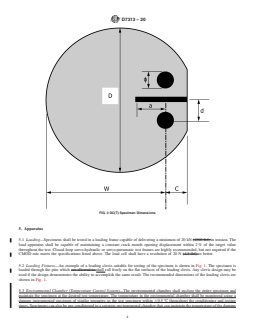
perpendicular to the notch tip as identified by letters a and C (see Fig. 3).Fig. 3).
3.2.2 crack mouth opening displacement (CMOD)—the relative displacement of the crack mouth.
3.2.3 disk-shaped compact tension geometry—a geometry that utilizes a disk-shaped specimen with a single edge notch as
described in Test Method E399.
3.2.4 2 fracture energy, G —the energy required to create a unit surface area of a crack.
f
3.2.5 notch tip—end of notch where the crack will initiate and propagate.
4. Significance and Use
4.1 The test method was developed for determining the fracture resistance of asphalt-aggregateasphalt mixtures. The fracture
resistance can help differentiate asphalt mixtures whose service life might be compromised by cracking. The test method is
generally valid for specimens that are tested at temperatures of 10°C (50°F) 10 °C or below (see Note 1). The specimen geometry
is readily adapted to 150 mm diameter specimens, such as fabricated from Superpave (trademark) gyratory compactors (Test
Method D6925), thatwhich are used for the asphalt concretemixture design process. The specimen geometry can also be adapted
for forensic investigations using field cores of pavements where thin lifts are present. This geometry has been found to produce
satisfactory results for asphalt mixtures with nominal maximum aggregates size ranging from 4.75 to 19 mm.mm (2).
NOTE 1—The stiffness of the asphalt binder tends to influence the assessment of a valid test as described in 7.4. For instance, a soft asphalt binder,binder
which may be required for a very cold climate might not lead to a mixture that would produce valid results at 10°C and+10 °C and, conversely, a hard
asphalt binder utilized in hot climates may require higher temperatures to provide any meaningful information.
NOTE 2—The quality of the results produced by this test method are dependent on the competence of the personnel performing the procedure and the
capability, calibration, and maintenance of the equipment used. Agencies that meet the criteria of Specification D3666 are generally considered capable
of competent and objective testing/sampling/inspection/etc. testing, sampling, inspection, etc. Users of this test method are cautioned that compliance with
Specification D3666 alone does not completely assureensure reliable results. Reliable results may depend on many factors; following the suggestions of
For referenced ASTM standards, visit the ASTM website, www.astm.org, or contact ASTM Customer Service at service@astm.org. For Annual Book of ASTM Standards
volume information, refer to the standard’s Document Summary page on the ASTM website.
Available from American Association of State Highway and Transportation Officials (AASHTO), 444 N. Capitol St., NW, Suite 249, Washington, DC 20001,
http://www.transportation.org.
D7313 − 20
FIG. 2 Example of Clip-onClip-On Gage and Attachment Procedures
Specification D3666 or some similar acceptable guidelines provides a means of evaluating and controlling some of those factors.
NOTE 3—The failure mechanism experienced in this test is influenced by the aggregate type due to the interactive effect of asphalt binder stiffness and
aggregate quality on the fracture path and, therefore, fracture energy values. At high values of asphalt binder stiffness, similar to those experienced near
the low-temperature performance grade of the asphalt binder, the crack will travel around the aggregate when the mixture includes hard, non-absorptive
(for example, granite, trap rock) aggregates resulting in a longer crack path and higher values of fracture energy. For softer, more absorptive aggregates,
the crack will travel through the aggregate, shortening the crack path and leading to lower values of fracture energy (3). Due to the influence of aggregate
type on fracture energy, mixture design and/or binder grade adjustments in mixes that use softer aggregates may not be sufficient in improving fracture
energy to meet a target value.
D7313 − 20
FIG. 3 DC(T) Specimen Dimensions
5. Apparatus
5.1 Loading—Specimens shall be tested in a loading frame capable of delivering a minimum of 20 kN (4500 lbf) in tension. The
load apparatus shall be capable of maintaining a constant crack mouth opening displacement within 2 % of the target value
throughout the test. Closed-loop servo-hydraulic or servo-pneumatic test frames are highly recommended, but not required if the
CMOD rate meets the specifications listed above. The load cell shall have a resolution of 20 N (4.5 lbf) or better.
5.2 Loading Fixtures—An example of a loading clevis suitable for testing of the specimen is shown in Fig. 1. The specimen is
loaded through the pins which are allowed to shall roll freely on the flat surfaces of the loading clevis. Any clevis design may be
used if the design demonstrates the ability to accomplish the same result. The recommended dimensions of the loading clevis are
shown in Fig. 1.
5.3 Environmental Chamber (Temperature Control System)—The environmental chamber shall enclose the entire specimen and
maintain the specimen at the desired test temperature. The temperature in the environmental chamber shall be monitored using a
dummy instrumented specimen of similar geometry as the test specimen within 60.5 °C throughout the conditioning and testing
times. Specimens can also be pre-conditioned in a separate environmental chamber that can maintain the temperature of the dummy
D7313 − 20
FIG. 3 DC(T) Specimen Dimensions (continued)
instrumented specimen to within 60.5 °C throughout the condition period prior to testing. However, Note 4 provides additional
guidance on temperature tolerance to improve the test variability.
NOTE 4—It is recommended that a 60.2 °C tolerance be used for conditioning and testing to lower test variability. Testing temperature tolerance of
60.2 °C is recommended on the basis of ruggedness testing performed by ASTM in 2012. While other asphalt cracking performance tests currently use
a 60.5 °C tolerance: (1) these other tests have not yet gone through ruggedness evaluation to establish the test temperature sensitivity; and (2) these other
tests are not conducted at lower test temperatures where variations in temperatures on fracture response of material is more sensitive. Recent works by
Dave et al. (4) have shown the impact of test temperature and its sensitivity and supports use of smaller temperature tolerance. Furthermore, at present
there are already a number of devices (over 20) that routinely conduct DCT tests with conditioning and testing temperature tolerance of less than 60.2 °C.
5.4 Thermometer—Temperature of an instrumented dummy specimen shall be measured with resistance temperature detectors
(RTDs) or other suitable devices accurate to within 0.05 °C. The RTD and controller or other suitable devices shall be NIST
traceable.
5.5 CMOD Displacement Gage—A displacement gage shall be used to measure the relative displacement of the crack mouth
across two points, initially 5 mm (0.2 in.) apart. The gage shall be attached securely to gage points, yet have the ability to be
released without damage if the specimen breaks.
5.5.1 A recommended gage would be a clip-on gage, described in Test Method E399, which is attached to gage points via knife
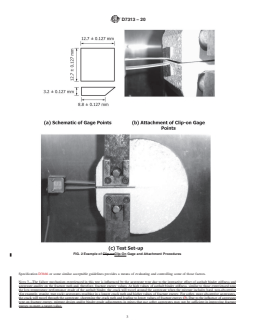
edges. Gage points (see Fig. 2(a)) shall be glued to the specimen so that the clip-on gage is set to the proper gage length, which
is typically 5 mm (0.2 in.). mm. Fig. 2(b) illustrates the attachment of the clip-on gage to the gage points. Fig. 2(c) illustrates the
test set-upsetup with the specimen in the fixtures and clip-on gage attached.
5.5.2 At the beginning of the test, the displacement gage shall have an ability to travel a minimum displacement of 6.35 mm (0.25
in.).6.35 mm.
5.6 Data Acquisition—TwoThree channels of data acquisition are required: load load, temperature, and CMOD. The acquisition
system shall have the ability to acquire the data at a minimum of 25 data points per second.
D7313 − 20
FIG. 1 Schematic of Loading Clevis
NOTE 3—A third channel is recommended for temperature data acquisition. The acquisition system should have the ability to acquire the data at a
minimum of 25 data points per second.
6. Test Specimens
6.1 Test specimens shall be fabricated in accordance with the dimensions shown in Fig. 3. Typically, a sample 150 mm in diameter
by 150 mm in height is fabricated. Two specimens can be cut from the fabricated sample.
6.2 Lab mix lab compacted (LMLC), plant mix lab compacted (PMLC), or reheated plant mix lab compacted (RPMLC) asphalt
mixtures may require special curing techniques.
NOTE 5—Heating asphalt mixtures for a period of time prior to compaction may result in specimens having properties that are different from those that
are compacted immediately after mixing. Asphalt mixture conditioning, reheat temperature, and reheat time should be defined in the applicable
specification.
D7313 − 20
NOTE 6—Aging of the loose asphalt mixture and/or compacted asphalt mixture and the air voids of the compacted sample can significantly affect the
fracture energy of the asphalt mixture. There are references for short-term aging of the loose asphalt mixture such as AASHTO R 30, which is 4 h at
135 °C. AASHTO R 30 also refers to long-term aging of the compacted sample, which is short-term oven aging of the loose asphalt mixture followed
by aging of the compacted specimen for five days at 85 °C. Braham et al. (5) proposed 24 h at 135 °C loose mixture aging to simulate long-term aging
of the asphalt mixture. The NCHRP project 9-54 titled “Long-Term Aging of Asphalt Mixtures for Performance Testing and Prediction” developed a
procedure that is calibrated and validated with field data to simulate long-term aging of asphalt mixtures (6). Recommendations from this study should
be considered in selection of long-term aging protocol.
6.3 Specimen Fabrication—The equipment used for specimen fabrication shall utilize diamond-impregnated cutting faces and
water-cooling to minimize damage to the specimen.
6.3.1 Specimen Thickness—The target thickness for laboratory
...