

ASTM D698-12(2021)
(Test Method)Standard Test Methods for Laboratory Compaction Characteristics of Soil Using Standard Effort (12,400 ft-lbf/ft3 (600 kN-m/m3))
General Information
- Abstract
SIGNIFICANCE AND USE
5.1 Soil placed as engineering fill (embankments, foundation pads, road bases) is compacted to a dense state to obtain satisfactory engineering properties such as, shear strength, compressibility, or permeability. In addition, foundation soils are often compacted to improve their engineering properties. Laboratory compaction tests provide the basis for determining the percent compaction and molding water content needed to achieve the required engineering properties, and for controlling construction to assure that the required compaction and water contents are achieved.
5.2 During design of an engineered fill, shear, consolidation, permeability, or other tests require preparation of test specimens by compacting at some molding water content to some unit weight. It is common practice to first determine the optimum water content (wopt) and maximum dry unit weight (γd,max) by means of a compaction test. Test specimens are compacted at a selected molding water content (w), either wet or dry of optimum (wopt) or at optimum (wopt), and at a selected dry unit weight related to a percentage of maximum dry unit weight (γd,max). The selection of molding water content (w), either wet or dry of optimum (wopt) or at optimum (wopt) and the dry unit weight (γd,max) may be based on past experience, or a range of values may be investigated to determine the necessary percent of compaction.
5.3 Experience indicates that the methods outlined in 5.2 or the construction control aspects discussed in 5.1 are extremely difficult to implement or yield erroneous results when dealing with certain soils. 5.3.1 – 5.3.3 describe typical problem soils, the problems encountered when dealing with such soils and possible solutions for these problems.
5.3.1 Oversize Fraction—Soils containing more than 30 % oversize fraction (material retained on the 3/4-in. (19-mm) sieve) are a problem. For such soils, there is no ASTM test method to control their compaction and very few laboratories are equip...
SCOPE
1.1 These test methods cover laboratory compaction methods used to determine the relationship between molding water content and dry unit weight of soils (compaction curve) compacted in a 4 or 6-in. (101.6 or 152.4-mm) diameter mold with a 5.50-lbf (24.5-N) rammer dropped from a height of 12.0 in. (305 mm) producing a compactive effort of 12 400 ft-lbf/ft3 (600 kN-m/m3).
Note 1: The equipment and procedures are similar as those proposed by R. R. Proctor (Engineering News Record—September 7, 1933) with this one major exception: his rammer blows were applied as “12 inch firm strokes” instead of free fall, producing variable compactive effort depending on the operator, but probably in the range 15 000 to 25 000 ft-lbf/ft3 (700 to 1200 kN-m/m3). The standard effort test (see 3.1.4) is sometimes referred to as the Proctor Test.
1.1.1 Soils and soil-aggregate mixtures are to be regarded as natural occurring fine- or coarse-grained soils, or composites or mixtures of natural soils, or mixtures of natural and processed soils or aggregates such as gravel or crushed rock. Hereafter referred to as either soil or material.
1.2 These test methods apply only to soils (materials) that have 30 % or less by mass of particles retained on the 3/4-in. (19.0-mm) sieve and have not been previously compacted in the laboratory; that is, do not reuse compacted soil.
1.2.1 For relationships between unit weights and molding water contents of soils with 30 % or less by mass of material retained on the 3/4-in. (19.0-mm) sieve to unit weights and molding water contents of the fraction passing 3/4-in. (19.0-mm) sieve, see Practice D4718/D4718M.
1.3 Three alternative methods are provided. The method used shall be as indicated in the specification for the material being tested. If no method is specified, the choice should be based on the material gradation.
1.3.1 Method A:
1.3.1.1 Mold—4-in. (101.6-mm) diameter.
1.3.1.2 Material—Pa...
- Status
- Published
- Publication Date
- 30-Jun-2021
- Technical Committee
- D18 - Soil and Rock
- Drafting Committee
- D18.03 - Texture, Plasticity and Density Characteristics of Soils
Overview
ASTM D698-12(2021), published by ASTM International, specifies standard laboratory test methods for determining the compaction characteristics of soils using standard effort (12,400 ft-lbf/ft³ or 600 kN-m/m³). Referred to commonly as the "Standard Proctor Test," this method is fundamental for evaluating the relationship between molding water content and dry unit weight of soils-a key parameter for assessing soil suitability in construction and engineering projects.
These test methods are critical for quality control when soils are used as engineered fills in embankments, foundations, and road bases. The standard provides guidance for preparing soil samples in a controlled laboratory setting, enabling engineers to determine the optimum moisture and maximum dry density required for reliable, stable soil compaction in the field.
Key Topics
- Laboratory Soil Compaction: The primary focus is to measure how soil density changes with varying water content when compacted under standard energy. This yields the “compaction curve,” which identifies optimum water content and maximum dry unit weight.
- Sample Preparation: Methods are defined for preparing soils and soil-aggregate mixtures by compacting material in cylindrical molds of 4 or 6 inches diameter using a specified rammer and drop height.
- Soil Suitability: The standard applies to materials with no more than 30% by mass retained on a 3/4-inch sieve, ensuring consistent and accurate testing conditions.
- Engineering Properties: Compacted soil’s characteristics such as shear strength, compressibility, and permeability are directly influenced by laboratory-determination of optimum moisture and density.
- Problematic Soils: Guidance is included for soils with large particles, those prone to degradation during compaction, and gap-graded materials. Such soils may require alternative control measures or field test fills.
Applications
ASTM D698-12(2021) is widely used in geotechnical engineering for:
- Earthworks Quality Control: Ensuring soil placed in embankments, foundation pads, road subgrades, and other structures meets specified compaction standards to support loads and minimize settlement.
- Soil Characterization: Laboratory compaction tests inform the selection of materials and construction procedures, and serve as a baseline for field compaction requirements.
- Construction Specification Compliance: Helps contractors and inspectors verify that earthwork meets project requirements by comparing field compaction results to laboratory standards.
- Material Comparison: Enables evaluation and comparison of various soils and soil-aggregate mixtures for construction suitability.
- Engineering Design: Results are used as input for further testing, including shear, consolidation, and permeability assessments, and for establishing field control protocols.
Related Standards
Several related ASTM standards complement D698 by providing additional methods and guidelines relevant to soil testing and compaction, including:
- ASTM D4253: Methods for maximum index density and unit weight of soils using vibratory table.
- ASTM D2216: Test methods for laboratory determination of water (moisture) content of soil and rock.
- ASTM D4718/D4718M: Practice for correction of unit weight and water content for soils containing oversize particles.
- ASTM D2487: Practices for classification of soils for engineering purposes (Unified Soil Classification System).
- ASTM D6913/D6913M: Methods for particle-size distribution (gradation) of soils.
- ASTM D2168: Practices for calibration of laboratory mechanical-rammer soil compactors.
Practical Value
Using ASTM D698-12(2021) ensures that:
- Soil compaction in infrastructure projects is reliable and conforms to international best practices.
- The risk of settlement, instability, or water permeability issues is minimized by proper laboratory evaluation.
- Field compaction procedures can be effectively controlled and verified, minimizing costly construction errors.
In summary, ASTM D698-12(2021) provides a standardized methodology critical for optimizing soil performance in engineered fills, improving the safety, quality, and durability of civil engineering projects worldwide.
Relations
- Effective Date
- 01-Feb-2024
- Effective Date
- 01-Nov-2023
- Effective Date
- 01-Nov-2023
- Effective Date
- 01-Oct-2019
- Effective Date
- 01-Mar-2019
- Effective Date
- 01-Jul-2018
- Effective Date
- 15-Dec-2017
- Effective Date
- 15-Dec-2017
- Effective Date
- 15-Jul-2017
- Effective Date
- 01-Mar-2016
- Effective Date
- 01-Mar-2016
- Effective Date
- 01-Mar-2016
- Effective Date
- 01-May-2015
- Effective Date
- 15-Dec-2014
- Effective Date
- 01-Aug-2014
Get Certified
Connect with accredited certification bodies for this standard

Zavod za gradbeništvo Slovenije (ZAG) - Inšpekcija
ZAG inspection body for construction products, structures, and materials.
Sponsored listings
Frequently Asked Questions
ASTM D698-12(2021) is a standard published by ASTM International. Its full title is "Standard Test Methods for Laboratory Compaction Characteristics of Soil Using Standard Effort (12,400 ft-lbf/ft<sup>3</sup> (600 kN-m/m<sup>3</sup>))". This standard covers: SIGNIFICANCE AND USE 5.1 Soil placed as engineering fill (embankments, foundation pads, road bases) is compacted to a dense state to obtain satisfactory engineering properties such as, shear strength, compressibility, or permeability. In addition, foundation soils are often compacted to improve their engineering properties. Laboratory compaction tests provide the basis for determining the percent compaction and molding water content needed to achieve the required engineering properties, and for controlling construction to assure that the required compaction and water contents are achieved. 5.2 During design of an engineered fill, shear, consolidation, permeability, or other tests require preparation of test specimens by compacting at some molding water content to some unit weight. It is common practice to first determine the optimum water content (wopt) and maximum dry unit weight (γd,max) by means of a compaction test. Test specimens are compacted at a selected molding water content (w), either wet or dry of optimum (wopt) or at optimum (wopt), and at a selected dry unit weight related to a percentage of maximum dry unit weight (γd,max). The selection of molding water content (w), either wet or dry of optimum (wopt) or at optimum (wopt) and the dry unit weight (γd,max) may be based on past experience, or a range of values may be investigated to determine the necessary percent of compaction. 5.3 Experience indicates that the methods outlined in 5.2 or the construction control aspects discussed in 5.1 are extremely difficult to implement or yield erroneous results when dealing with certain soils. 5.3.1 – 5.3.3 describe typical problem soils, the problems encountered when dealing with such soils and possible solutions for these problems. 5.3.1 Oversize Fraction—Soils containing more than 30 % oversize fraction (material retained on the 3/4-in. (19-mm) sieve) are a problem. For such soils, there is no ASTM test method to control their compaction and very few laboratories are equip... SCOPE 1.1 These test methods cover laboratory compaction methods used to determine the relationship between molding water content and dry unit weight of soils (compaction curve) compacted in a 4 or 6-in. (101.6 or 152.4-mm) diameter mold with a 5.50-lbf (24.5-N) rammer dropped from a height of 12.0 in. (305 mm) producing a compactive effort of 12 400 ft-lbf/ft3 (600 kN-m/m3). Note 1: The equipment and procedures are similar as those proposed by R. R. Proctor (Engineering News Record—September 7, 1933) with this one major exception: his rammer blows were applied as “12 inch firm strokes” instead of free fall, producing variable compactive effort depending on the operator, but probably in the range 15 000 to 25 000 ft-lbf/ft3 (700 to 1200 kN-m/m3). The standard effort test (see 3.1.4) is sometimes referred to as the Proctor Test. 1.1.1 Soils and soil-aggregate mixtures are to be regarded as natural occurring fine- or coarse-grained soils, or composites or mixtures of natural soils, or mixtures of natural and processed soils or aggregates such as gravel or crushed rock. Hereafter referred to as either soil or material. 1.2 These test methods apply only to soils (materials) that have 30 % or less by mass of particles retained on the 3/4-in. (19.0-mm) sieve and have not been previously compacted in the laboratory; that is, do not reuse compacted soil. 1.2.1 For relationships between unit weights and molding water contents of soils with 30 % or less by mass of material retained on the 3/4-in. (19.0-mm) sieve to unit weights and molding water contents of the fraction passing 3/4-in. (19.0-mm) sieve, see Practice D4718/D4718M. 1.3 Three alternative methods are provided. The method used shall be as indicated in the specification for the material being tested. If no method is specified, the choice should be based on the material gradation. 1.3.1 Method A: 1.3.1.1 Mold—4-in. (101.6-mm) diameter. 1.3.1.2 Material—Pa...
SIGNIFICANCE AND USE 5.1 Soil placed as engineering fill (embankments, foundation pads, road bases) is compacted to a dense state to obtain satisfactory engineering properties such as, shear strength, compressibility, or permeability. In addition, foundation soils are often compacted to improve their engineering properties. Laboratory compaction tests provide the basis for determining the percent compaction and molding water content needed to achieve the required engineering properties, and for controlling construction to assure that the required compaction and water contents are achieved. 5.2 During design of an engineered fill, shear, consolidation, permeability, or other tests require preparation of test specimens by compacting at some molding water content to some unit weight. It is common practice to first determine the optimum water content (wopt) and maximum dry unit weight (γd,max) by means of a compaction test. Test specimens are compacted at a selected molding water content (w), either wet or dry of optimum (wopt) or at optimum (wopt), and at a selected dry unit weight related to a percentage of maximum dry unit weight (γd,max). The selection of molding water content (w), either wet or dry of optimum (wopt) or at optimum (wopt) and the dry unit weight (γd,max) may be based on past experience, or a range of values may be investigated to determine the necessary percent of compaction. 5.3 Experience indicates that the methods outlined in 5.2 or the construction control aspects discussed in 5.1 are extremely difficult to implement or yield erroneous results when dealing with certain soils. 5.3.1 – 5.3.3 describe typical problem soils, the problems encountered when dealing with such soils and possible solutions for these problems. 5.3.1 Oversize Fraction—Soils containing more than 30 % oversize fraction (material retained on the 3/4-in. (19-mm) sieve) are a problem. For such soils, there is no ASTM test method to control their compaction and very few laboratories are equip... SCOPE 1.1 These test methods cover laboratory compaction methods used to determine the relationship between molding water content and dry unit weight of soils (compaction curve) compacted in a 4 or 6-in. (101.6 or 152.4-mm) diameter mold with a 5.50-lbf (24.5-N) rammer dropped from a height of 12.0 in. (305 mm) producing a compactive effort of 12 400 ft-lbf/ft3 (600 kN-m/m3). Note 1: The equipment and procedures are similar as those proposed by R. R. Proctor (Engineering News Record—September 7, 1933) with this one major exception: his rammer blows were applied as “12 inch firm strokes” instead of free fall, producing variable compactive effort depending on the operator, but probably in the range 15 000 to 25 000 ft-lbf/ft3 (700 to 1200 kN-m/m3). The standard effort test (see 3.1.4) is sometimes referred to as the Proctor Test. 1.1.1 Soils and soil-aggregate mixtures are to be regarded as natural occurring fine- or coarse-grained soils, or composites or mixtures of natural soils, or mixtures of natural and processed soils or aggregates such as gravel or crushed rock. Hereafter referred to as either soil or material. 1.2 These test methods apply only to soils (materials) that have 30 % or less by mass of particles retained on the 3/4-in. (19.0-mm) sieve and have not been previously compacted in the laboratory; that is, do not reuse compacted soil. 1.2.1 For relationships between unit weights and molding water contents of soils with 30 % or less by mass of material retained on the 3/4-in. (19.0-mm) sieve to unit weights and molding water contents of the fraction passing 3/4-in. (19.0-mm) sieve, see Practice D4718/D4718M. 1.3 Three alternative methods are provided. The method used shall be as indicated in the specification for the material being tested. If no method is specified, the choice should be based on the material gradation. 1.3.1 Method A: 1.3.1.1 Mold—4-in. (101.6-mm) diameter. 1.3.1.2 Material—Pa...
ASTM D698-12(2021) is classified under the following ICS (International Classification for Standards) categories: 93.020 - Earthworks. Excavations. Foundation construction. Underground works. The ICS classification helps identify the subject area and facilitates finding related standards.
ASTM D698-12(2021) has the following relationships with other standards: It is inter standard links to ASTM D4753-24, ASTM D854-23, ASTM D3740-23, ASTM D3740-19, ASTM D2216-19, ASTM D2168-10(2018), ASTM D2487-17, ASTM D2487-17e1, ASTM D2488-17, ASTM D4253-16e1, ASTM D4253-16, ASTM D4914/D4914M-16, ASTM D4753-15, ASTM D4253-14, ASTM D653-14. Understanding these relationships helps ensure you are using the most current and applicable version of the standard.
ASTM D698-12(2021) is available in PDF format for immediate download after purchase. The document can be added to your cart and obtained through the secure checkout process. Digital delivery ensures instant access to the complete standard document.
Standards Content (Sample)
This international standard was developed in accordance with internationally recognized principles on standardization established in the Decision on Principles for the
Development of International Standards, Guides and Recommendations issued by the World Trade Organization Technical Barriers to Trade (TBT) Committee.
Designation: D698 − 12 (Reapproved 2021)
Standard Test Methods for
Laboratory Compaction Characteristics of Soil Using
3 3 1
Standard Effort (12,400 ft-lbf/ft (600 kN-m/m ))
This standard is issued under the fixed designation D698; the number immediately following the designation indicates the year of
original adoption or, in the case of revision, the year of last revision.Anumber in parentheses indicates the year of last reapproval.A
superscript epsilon (´) indicates an editorial change since the last revision or reapproval.
This standard has been approved for use by agencies of the U.S. Department of Defense.
1. Scope 1.3.1.1 Mold—4-in. (101.6-mm) diameter.
1.3.1.2 Material—Passing No. 4 (4.75-mm) sieve.
1.1 These test methods cover laboratory compaction meth-
1.3.1.3 Layers—Three.
ods used to determine the relationship between molding water
1.3.1.4 Blows per Layer—25.
content and dry unit weight of soils (compaction curve)
1.3.1.5 Usage—May be used if 25% or less (see 1.4)by
compacted ina4or 6-in. (101.6 or 152.4-mm) diameter mold
mass of the material is retained on the No. 4 (4.75-mm) sieve.
witha5.50-lbf(24.5-N)rammerdroppedfromaheightof12.0
1.3.1.6 Other Usage—If this gradation requirement cannot
in. (305 mm) producing a compactive effort of 12400 ft-lbf/
3 3 be met, then Method C may be used.
ft (600 kN-m/m ).
1.3.2 Method B:
NOTE 1—The equipment and procedures are similar as those proposed
1.3.2.1 Mold—4-in. (101.6-mm) diameter.
by R. R. Proctor (Engineering News Record—September 7, 1933) with
1.3.2.2 Material—Passing ⁄8-in. (9.5-mm) sieve.
thisonemajorexception:hisrammerblowswereappliedas“12inchfirm
1.3.2.3 Layers—Three.
strokes”insteadoffreefall,producingvariablecompactiveeffortdepend-
1.3.2.4 Blows per Layer—25.
ing on the operator, but probably in the range 15000 to 25000
3 3
ft-lbf/ft (700 to 1200 kN-m/m ). The standard effort test (see 3.1.4)is
1.3.2.5 Usage—May be used if 25% or less (see 1.4)by
sometimes referred to as the Proctor Test. 3
mass of the material is retained on the ⁄8-in. (9.5-mm) sieve.
1.1.1 Soilsandsoil-aggregatemixturesaretoberegardedas 1.3.2.6 Other Usage—If this gradation requirement cannot
naturaloccurringfine-orcoarse-grainedsoils,orcompositesor be met, then Method C may be used.
mixtures of natural soils, or mixtures of natural and processed 1.3.3 Method C:
soils or aggregates such as gravel or crushed rock. Hereafter 1.3.3.1 Mold—6-in. (152.4-mm) diameter.
referred to as either soil or material. 1.3.3.2 Material—Passing ⁄4-in. (19.0-mm) sieve.
1.3.3.3 Layers—Three.
1.2 These test methods apply only to soils (materials) that
1.3.3.4 Blows per Layer—56.
have 30% or less by mass of particles retained on the ⁄4-in.
1.3.3.5 Usage—May be used if 30% or less (see 1.4)by
(19.0-mm) sieve and have not been previously compacted in
mass of the material is retained on the ⁄4-in. (19.0-mm) sieve.
the laboratory; that is, do not reuse compacted soil.
1.3.4 The6-in.(152.4-mm)diametermoldshallnotbeused
1.2.1 For relationships between unit weights and molding
with Method A or B.
water contents of soils with 30% or less by mass of material
retained on the ⁄4-in. (19.0-mm) sieve to unit weights and
NOTE 2—Results have been found to vary slightly when a material is
tested at the same compactive effort in different size molds, with the
molding water contents of the fraction passing ⁄4-in. (19.0-
smaller mold size typically yielding larger values of density/unit weight
mm) sieve, see Practice D4718/D4718M.
(1, pp. 21+).
1.3 Three alternative methods are provided. The method
1.4 If the test specimen contains more than 5% by mass of
used shall be as indicated in the specification for the material
oversize fraction (coarse fraction) and the material will not be
being tested. If no method is specified, the choice should be
included in the test, corrections must be made to the unit mass
based on the material gradation.
and molding water content of the specimen or to the appropri-
1.3.1 Method A:
ate field-in-place density test specimen using Practice D4718/
D4718M.
1 1.5 This test method will generally produce a well-defined
These Test Methods are under the jurisdiction of ASTM Committee D18 on
SoilandRockandarethedirectresponsibilityofSubcommitteeD18.03onTexture,
maximum dry unit weight for non-free draining soils. If this
Plasticity and Density Characteristics of Soils.
CurrenteditionapprovedJuly1,2021.PublishedJuly2021.Originallyapproved
ε2
in 1942. Last previous edition approved in 2012 as D698 – 12 . DOI: 10.1520/ Theboldfacenumbersinparenthesesrefertothelistofreferencesattheendof
D0698-12R21. this standard.
*A Summary of Changes section appears at the end of this standard
Copyright © ASTM International, 100 Barr Harbor Drive, PO Box C700, West Conshohocken, PA 19428-2959. United States
D698 − 12 (2021)
test method is used for free-draining soils the maximum unit C136/C136MTest Method for Sieve Analysis of Fine and
weight may not be well defined, and can be less than obtained Coarse Aggregates
using Test Methods D4253. D653Terminology Relating to Soil, Rock, and Contained
Fluids
1.6 All observed and calculated values shall conform to the
D854Test Methods for Specific Gravity of Soil Solids by
guidelines for significant digits and rounding established in
Water Pycnometer
Practice D6026, unless superseded by this standard.
D2168Practices for Calibration of Laboratory Mechanical-
1.6.1 For purposes of comparing measured or calculated
Rammer Soil Compactors
value(s) with specified limits, the measured or calculated
D2216Test Methods for Laboratory Determination ofWater
value(s) shall be rounded to the nearest decimal or significant
(Moisture) Content of Soil and Rock by Mass
digits in the specified limits.
D2487Practice for Classification of Soils for Engineering
1.6.2 Theproceduresusedtospecifyhowdataarecollected/
Purposes (Unified Soil Classification System)
recorded or calculated, in this standard are regarded as the
D2488Practice for Description and Identification of Soils
industry standard. In addition, they are representative of the
(Visual-Manual Procedures)
significant digits that generally should be retained. The proce-
D3740Practice for Minimum Requirements for Agencies
dures used do not consider material variation, purpose for
Engaged in Testing and/or Inspection of Soil and Rock as
obtaining the data, special purpose studies, or any consider-
Used in Engineering Design and Construction
ations for the user’s objectives; and it is common practice to
D4253Test Methods for Maximum Index Density and Unit
increase or reduce significant digits of reported data to be
Weight of Soils Using a Vibratory Table
commensuratewiththeseconsiderations.Itisbeyondthescope
D4718/D4718MPractice for Correction of Unit Weight and
of this standard to consider significant digits used in analytical
Water Content for Soils Containing Oversize Particles
methods for engineering design.
D4753Guide for Evaluating, Selecting, and Specifying Bal-
1.7 The values in inch-pound units are to be regarded as the
ances and Standard Masses for Use in Soil, Rock, and
standard. The values stated in SI units are provided for
Construction Materials Testing
information only, except for units of mass. The units for mass
D4914/D4914MTest Methods for Density of Soil and Rock
are given in SI units only, g or kg.
in Place by the Sand Replacement Method in a Test Pit
1.7.1 It is common practice in the engineering profession to
D5030/D5030MTest Methods for Density of In-Place Soil
concurrently use pounds to represent both a unit of mass (lbm)
and Rock Materials by the Water Replacement Method in
and a force (lbf). This implicitly combines two separate
a Test Pit
systems of units; that is, the absolute system and the gravita-
D6026Practice for Using Significant Digits and Data Re-
tionalsystem.Itisscientificallyundesirabletocombinetheuse
cords in Geotechnical Data
of two separate sets of inch-pound units within a single
D6913/D6913MTest Methods for Particle-Size Distribution
standard.Thisstandardhasbeenwrittenusingthegravitational
(Gradation) of Soils Using Sieve Analysis
system of units when dealing with the inch-pound system. In
E11Specification forWovenWireTest Sieve Cloth andTest
this system, the pound (lbf) represents a unit of force (weight).
Sieves
However, the use of balances or scales recording pounds of
E177Practice for Use of the Terms Precision and Bias in
mass (lbm) or the recording of density in lbm/ft shall not be
ASTM Test Methods
regarded as a nonconformance with this standard.
E691Practice for Conducting an Interlaboratory Study to
1.8 This standard does not purport to address all of the Determine the Precision of a Test Method
safety concerns, if any, associated with its use. It is the
IEEE/ASTM SI 10Standard for Use of the International
responsibility of the user of this standard to establish appro- System of Units (SI): the Modern Metric System
priate safety, health, and environmental practices and deter-
3. Terminology
mine the applicability of regulatory limitations prior to use.
1.9 This international standard was developed in accor-
3.1 Definitions:
dance with internationally recognized principles on standard-
3.1.1 See Terminology D653 for general definitions.
ization established in the Decision on Principles for the
3.1.2 molding water content, n—the adjusted water content
Development of International Standards, Guides and Recom-
of a soil (material) that will be compacted/reconstituted.
mendations issued by the World Trade Organization Technical
3.1.3 standard effort—in compaction testing, the term for
Barriers to Trade (TBT) Committee. 3 3
the 12400 ft-lbf/ft (600 kN-m/m ) compactive effort applied
by the equipment and methods of this test.
2. Referenced Documents
3.1.4 standard maximum dry unit weight, γ in lbf/
d,max
2.1 ASTM Standards:
3 3
ft (kN ⁄m )—in compaction testing, the maximum value de-
C127Test Method for Relative Density (Specific Gravity)
fined by the compaction curve for a compaction test using
and Absorption of Coarse Aggregate
standard effort.
3.1.5 standard optimum water content, w in%—in com-
opt
For referenced ASTM standards, visit the ASTM website, www.astm.org, or
paction testing, the molding water content at which a soil can
contact ASTM Customer Service at service@astm.org. For Annual Book of ASTM
be compacted to the maximum dry unit weight using standard
Standards volume information, refer to the standard’s Document Summary page on
the ASTM website. compactive effort.
D698 − 12 (2021)
3.2 Definitions of Terms Specific to This Standard: 5.3.1 Oversize Fraction—Soils containing more than 30%
3.2.1 oversize fraction (coarse fraction), P in %—the por- oversize fraction (material retained on the ⁄4-in. (19-mm)
C
tion of total specimen not used in performing the compaction sieve) are a problem. For such soils, there is no ASTM test
test;itmaybetheportionoftotalspecimenretainedontheNo. method to control their compaction and very few laboratories
4 (4.75-mm) sieve in Method A, ⁄8-in. (9.5-mm) sieve in areequippedtodeterminethelaboratorymaximumunitweight
Method B, or ⁄4-in. (19.0-mm) sieve in Method C. (density) of such soils (USDI Bureau of Reclamation, Denver,
CO and U.S. Army Corps of Engineers, Vicksburg, MS).
3.2.2 test fraction (finer fraction), P in %—the portion of
F
Although Test Methods D4914/D4914M and D5030/D5030M
thetotalspecimenusedinperformingthecompactiontest;itis
determine the “field” dry unit weight of such soils, they are
the fraction passing the No. 4 (4.75-mm) sieve in Method A,
3 difficult and expensive to perform.
passing the ⁄8-in. (9.5-mm) sieve in Method B, or passing the
5.3.1.1 Onemethodtodesignandcontrolthecompactionof
⁄4-in. (19.0-mm) sieve in Method C.
such soils is to use a test fill to determine the required degree
4. Summary of Test Method
of compaction and the method to obtain that compaction,
followed by use of a method specification to control the
4.1 A soil at a selected molding water content is placed in
compaction. Components of a method specification typically
three layers into a mold of given dimensions, with each layer
contain the type and size of compaction equipment to be used,
compacted by 25 or 56 blows of a 5.50-lbf (24.47-N) rammer
the lift thickness, acceptable range in molding water content,
dropped from a distance of 12.00 in. (304.8 mm), subjecting
and the number of passes.
the soil to a total compactive effort of about 12400 ft-lbf/
3 3
ft (600 kN-m/m ). The resulting dry unit weight is deter-
NOTE 3—Success in executing the compaction control of an earthwork
mined. The procedure is repeated for a sufficient number of
project, especially when a method specification is used, is highly
molding water contents to establish a relationship between the
dependentuponthequalityandexperienceofthecontractorandinspector.
dryunitweightandthemoldingwatercontentforthesoil.This
5.3.1.2 Another method is to apply the use of density
data, when plotted, represents a curvilinear relationship known
correction factors developed by the USDI Bureau of Reclama-
asthecompactioncurve.Thevaluesofoptimumwatercontent
tion (2, 3) and U.S. Corps of Engineers (4). These correction
and standard maximum dry unit weight are determined from
factors may be applied for soils containing up to about 50 to
the compaction curve.
70% oversize fraction. Each agency uses a different term for
these density correction factors. The USDI Bureau of Recla-
5. Significance and Use
mation uses D ratio (or D–VALUE), while the U.S. Corps of
5.1 Soil placed as engineering fill (embankments, founda-
Engineers uses Density Interference Coefficient (I ).
c
tion pads, road bases) is compacted to a dense state to obtain
5.3.1.3 The use of the replacement technique (Test Method
satisfactory engineering properties such as, shear strength,
D698–78, Method D), in which the oversize fraction is
compressibility, or permeability. In addition, foundation soils
replaced with a finer fraction, is inappropriate to determine the
are often compacted to improve their engineering properties.
maximum dry unit weight, γ , of soils containing oversize
d,max
Laboratory compaction tests provide the basis for determining
fractions (4).
the percent compaction and molding water content needed to
5.3.2 Degradation—Soils containing particles that degrade
achievetherequiredengineeringproperties,andforcontrolling
during compaction are a problem, especially when more
construction to assure that the required compaction and water
degradation occurs during laboratory compaction than field
contents are achieved.
compaction, as is typical. Degradation typically occurs during
5.2 Duringdesignofanengineeredfill,shear,consolidation,
the compaction of a granular-residual soil or aggregate. When
permeability, or other tests require preparation of test speci-
degradationoccurs,themaximumdry-unitweightincreases(1,
mens by compacting at some molding water content to some
p. 73) so that the laboratory maximum value is not represen-
unit weight. It is common practice to first determine the
tative of field conditions. Often, in these cases, the maximum
optimum water content (w ) and maximum dry unit weight
opt
dry unit weight is impossible to achieve in the field.
(γ ) by means of a compaction test. Test specimens are
d,max
5.3.2.1 Again, for soils subject to degradation, the use of
compacted at a selected molding water content (w), either wet
test fills and method specifications may help. Use of replace-
ordryofoptimum(w )oratoptimum(w ),andataselected
opt opt
ment techniques is not correct.
dry unit weight related to a percentage of maximum dry unit
5.3.3 Gap Graded—Gap-graded soils (soils containing
weight (γ ). The selection of molding water content (w),
d,max
manylargeparticleswithlimitedsmallparticles)areaproblem
either wet or dry of optimum (w ) or at optimum (w ) and
opt opt
because the compacted soil will have larger voids than usual.
the dry unit weight (γ ) may be based on past experience,
d,max
To handle these large voids, standard test methods (laboratory
or a range of values may be investigated to determine the
or field) typically have to be modified using engineering
necessary percent of compaction.
judgement.
5.3 Experience indicates that the methods outlined in 5.2 or NOTE 4—The quality of the result produced by this standard is
dependent on the competence of the personnel performing it, and the
the construction control aspects discussed in 5.1 are extremely
suitability of the equipment and facilities used. Agencies that meet the
difficult to implement or yield erroneous results when dealing
criteria of Practice D3740 are generally considered capable of competent
with certain soils. 5.3.1 – 5.3.3 describe typical problem soils,
and objective testing/sampling/inspection, and the like. Users of this
the problems encountered when dealing with such soils and
standard are cautioned that compliance with Practice D3740 does not in
possible solutions for these problems. itself assure reliable results. Reliable results depend on many factors;
D698 − 12 (2021)
Practice D3740 provides a means of evaluating some of those factors.
6. Apparatus
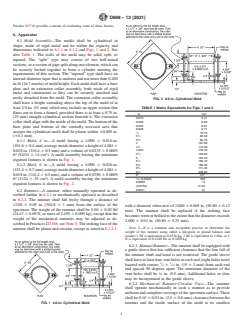
6.1 Mold Assembly—The molds shall be cylindrical in
shape, made of rigid metal and be within the capacity and
dimensions indicated in 6.1.1 or 6.1.2 and Figs. 1 and 2. See
also Table 1. The walls of the mold may be solid, split, or
tapered. The “split” type may consist of two half-round
sections,orasectionofpipesplitalongoneelement,whichcan
be securely locked together to form a cylinder meeting the
requirements of this section. The “tapered” type shall have an
internaldiametertaperthatisuniformandnotmorethan0.200
in./ft(16.7mm/m)ofmoldheight.Eachmoldshallhaveabase
plate and an extension collar assembly, both made of rigid
metal and constructed so they can be securely attached and
easily detached from the mold. The extension collar assembly
FIG. 2 6.0-in. Cylindrical Mold
shall have a height extending above the top of the mold of at
least 2.0 in. (51 mm) which may include an upper section that
TABLE 1 Metric Equivalents for Figs. 1 and 2
flares out to form a funnel, provided there is at least a 0.75 in.
in. mm
(19 mm) straight cylindrical section beneath it. The extension
0.016 0.41
0.026 0.66
collarshallalignwiththeinsideofthemold.Thebottomofthe
0.032 0.81
base plate and bottom of the centrally recessed area that
0.028 0.71
accepts the cylindrical mold shall be planar within 60.005 in. 1
⁄2 12.70
(60.1 mm). 2 ⁄2 63.50
2 ⁄8 66.70
6.1.1 Mold, 4 in.—A mold having a 4.000 6 0.016-in.
4 101.60
(101.6 60.4-mm)averageinsidediameter,aheightof4.584 6 1
4 ⁄2 114.30
0.018 in. (116.4 6 0.5 mm) and a volume of 0.0333 6 0.0005 4.584 116.43
3 3 4 ⁄4 120.60
ft (943.0 6 14 cm ). A mold assembly having the minimum
6 152.40
required features is shown in Fig. 1.
6 ⁄2 165.10
6 ⁄8 168.30
6.1.2 Mold, 6 in.—A mold having a 6.000 6 0.026-in.
6 ⁄4 171.40
(152.4 60.7-mm)averageinsidediameter,aheightof4.584 6
8 ⁄4 209.60
3 3
0.018 in. (116.4 6 0.5 mm), and a volume of 0.0750 6 0.0009
ft cm
3 3
⁄30 (0.0333) 943
ft (2124 6 25 cm ). A mold assembly having the minimum
0.0005 14
required features is shown in Fig. 2.
(0.0750) 2,124
0.0011 31
6.2 Rammer—A rammer, either manually operated as de-
scribed further in 6.2.1 or mechanically operated as described
in 6.2.2. The rammer shall fall freely through a distance of
12.00 6 0.05 in. (304.8 6 1 mm) from the surface of the
with a diameter when new of 2.000 6 0.005 in. (50.80 6 0.13
specimen. The weight of the rammer shall be 5.50 6 0.02 lbf
mm). The rammer shall be replaced if the striking face
(24.47 60.09N,ormassof2.495 60.009kg),exceptthatthe
becomeswornorbelliedtotheextentthatthediameterexceeds
weight of the mechanical rammers may be adjusted as de-
2.000 6 0.01 in. (50.80 6 0.25 mm).
scribedinPracticesD2168;seeNote5.Thestrikingfaceofthe
NOTE 5—It is a common and acceptable practice to determine the
rammer shall be planar and circular, except as noted in 6.2.2.1,
weight of the rammer using either a kilogram or pound balance and
assume 1 lbf is equivalent to 0.4536 kg, 1 lbf is equivalent to 1 lbm, or 1
N is equivalent to 0.2248 lbf or 0.1020 kg.
6.2.1 Manual Rammer—Therammershallbeequippedwith
a guide sleeve that has sufficient clearance that the free fall of
the rammer shaft and head is not restricted. The guide sleeve
shallhaveatleastfourventholesateachend(eightholestotal)
3 1
located with centers ⁄4 6 ⁄16 in. (19 6 2 mm) from each end
and spaced 90 degrees apart. The minimum diameter of the
vent holes shall be ⁄8 in. (9.5 mm). Additional holes or slots
may be incorporated in the guide sleeve.
6.2.2 Mechanical Rammer-Circular Face—The rammer
shall operate mechanically in such a manner as to provide
uniformandcompletecoverageofthespecimensurface.There
shallbe0.10 60.03-in.(2.5 60.8-mm)clearancebetweenthe
FIG. 1 4.0-in. Cylindrical Mold rammer and the inside surface of the mold at its smallest
D698 − 12 (2021)
diameter. The mechanical rammer shall meet the and (preferably, but optional) suitable mechanical device for
standardization/calibration requirements of Practices D2168. thoroughly mixing the subspecimen of soil with increments of
The mechanical rammer shall be equipped with a positive water.
mechanical means to support the rammer when not in opera-
7. Standardization/Calibration
tion.
6.2.2.1 Mechanical Rammer-Sector Face—The sector face
7.1 Perform standardizations before initial use, after repairs
can be used with the 6-in. (152.4-mm) mold, as an alternative
or other occurrences that might affect the test results, at
to the circular face mechanical rammer described in 6.2.2.The
intervals not exceeding 1,000 test specimens, or annually,
striking face shall have the shape of a sector of a circle of
whichever occurs first, for the following apparatus:
radius equal to 2.90 6 0.02 in. (73.7 6 0.5 mm) and an area
7.1.1 Balance—Evaluate in accordance with Guide D4753.
about the same as the circular face, see 6.2. The rammer shall
7.1.2 Molds—Determine the volume as described in Annex
operate in such a manner that the vertex of the sector is
A1.
positioned at the center of the specimen and follow the
7.1.3 Manual Rammer—Verify the free fall distance, ram-
compaction pattern given in Fig. 3b.
merweight,andrammerfaceareinaccordancewith6.2.Verify
the guide sleeve requirements are in accordance with 6.2.1.
6.3 Sample Extruder (optional)—A jack, with frame or
7.1.4 Mechanical Rammer—Verify and adjust if necessary
other device adapted for the purpose of extruding compacted
that the mechanical rammer is in accordance with Practices
specimens from the mold.
D2168. In addition, the clearance between the rammer and the
6.4 Balance—A Class GP5 balance meeting the require-
inside surface of the mold shall be verified in accordance with
ments of Guide D4753 for a balance of 1-g readability. If the
6.2.2.
water content of the compacted specimens is determined using
a representative portion of the specimen, rather than the whole
8. Test Specimen
specimen, and if the representative portion is less than 1000 g,
8.1 The minimum specimen (test fraction) mass for Meth-
a Class GP2 balance having a 0.1-g readability is needed in
odsAand B is about 16 kg, and for Method C is about 29 kg
order to comply with Test Methods D2216 requirements for
of dry soil. Therefore, the field sample should have a moist
determining water content to 0.1%.
mass of at least 23 kg and 45 kg, respectively. Greater masses
NOTE 6—Use of a balance having an equivalent capacity and a
would be required if the oversize fraction is large (see 10.2 or
readability of 0.002 lbm as an alternative to a class GP5 balance should
not be regarded as nonconformance to this standard. 10.3) or an additional molding water content is taken during
compaction of each point (see 10.4.2.1).
6.5 Drying Oven—Thermostatically controlled oven, ca-
pableofmaintainingauniformtemperatureof230 69°F(110
8.2 If gradation data is not available, estimate the percent-
6 5°C) throughout the drying chamber. These requirements age of material (by mass) retained on the No. 4 (4.75-mm),
3 3
typicallyrequiretheuseofaforced-drafttypeoven.Preferably
⁄8-in. (9.5-mm), or ⁄4-in. (19.0-mm) sieve as appropriate for
the oven should be vented outside the building. selecting Method A, B, or C, respectively. If it appears the
percentage retained of interest is close to the allowable value
6.6 Straightedge—A stiff metal straightedge of any conve-
for a given Method (A, B, or C), then either:
nient length but not less than 10 in. (250 mm).The total length
8.2.1 Select a Method that allows a higher percentage
of the straightedge shall be machined straight to a tolerance of
retained (B or C).
60.005 in. (60.1 mm). The scraping edge shall be beveled if
8.2.2 Using the Method of interest, process the specimen in
it is thicker than ⁄8 in. (3 mm).
accordance with 10.2 or 10.3, this determines the percentage
3 3
6.7 Sieves— ⁄4 in. (19.0 mm), ⁄8 in. (9.5 mm), and No. 4
retainedforthatmethod.Ifacceptable,proceed,ifnotgotothe
(4.75 mm), conforming to the requirements of Specification
next Method (B or C).
E11.
8.2.3 Determine percentage retained values by using a
6.8 Mixing Tools—Miscellaneous tools such as mixing pan, representative portion from the total sample, and performing a
spoon, trowel, spatula, spraying device (to add water evenly), simplified or complete gradation analysis using the sieve(s) of
FIG. 3 Rammer Pattern for Compaction in 4 in. (101.6 mm) Mold
D698 − 12 (2021)
interest andTest Methods D6913/D6913M or C136/C136M.It soils with very high optimum water content or a relatively flat
is only necessary to calculate the retained percentage(s) for the compaction curve may require larger molding water content
sieve or sieves for which information is desired. increments to obtain a well-defined maximum dry unit weight.
Molding water content increments should not exceed about
9. Preparation of Apparatus
4%.
9.1 Select the proper compaction mold(s), collar, and base
NOTE 8—With practice it is usually possible to visually judge a point
plate in accordance with the Method (A, B, or C) being used.
near optimum water content. Typically, cohesive soils at the optimum
Checkthatitsvolumeisknownanddeterminedwithorwithout water content can be squeezed into a lump that sticks together when hand
pressure is released, but will break cleanly into two sections when “bent.”
base plate, free of nicks or dents, and will fit together properly.
They tend to crumble at molding water contents dry of optimum; while,
NOTE 7—Mass requirements are given in 10.4.
they tend to stick together in a sticky cohesive mass wet of optimum.The
9.2 Check that the manual or mechanical rammer assembly
optimum water content is typically slightly less than the plastic limit.
While for cohesionless soils, the optimum water content is typically close
is in good working condition and that parts are not loose or
to zero or at the point where bleeding occurs.
worn. Make any necessary adjustments or repairs. If adjust-
mentsorrepairsaremade,therammermustbere-standardized. 10.2.2 Thoroughly mix the test fraction, then using a scoop
select representative soil for each subspecimen (compaction
10. Procedure
point).Selectabout2.3kgwhenusingMethodAorB,orabout
5.9kgforMethodC.TestMethodsD6913/D6913Msectionon
10.1 Soils:
Specimen and Annex A2 gives additional details on obtaining
10.1.1 Donotreusesoilthathasbeenpreviouslycompacted
representative soil using this procedure and why it is the
inthelaboratory.Thereuseofpreviouslycompactedsoilyields
preferred method. To obtain the subspecimen’s molding water
a significantly greater maximum dry unit weight (1, p. 31).
contents selected in 10.2.1, add or remove the required
10.1.2 When using this test method for soils containing
amountsofwaterasfollows.Toaddwater,sprayitintothesoil
hydrated halloysite, or in which past experience indicates that
during mixing; to remove water, allow the soil to dry in air at
results will be altered by air-drying, use the moist preparation
ambient temperature or in a drying apparatus such that the
method(see10.2).Inrefereetesting,eachlaboratoryhastouse
temperature of the sample does not exceed 140°F (60°C). Mix
the same method of preparation, either moist (preferred) or
the soil frequently during drying to facilitate an even water
air-dried.
content distribution. Thoroughly mix each subspecimen to
10.1.3 Prepare the soil specimens for testing in accordance
facilitate even distribution of water throughout and then place
with 10.2 (preferred) or with 10.3.
in a separate covered container to stand (cure) in accordance
10.2 Moist Preparation Method (preferred)—Without pre-
withTable2priortocompaction.Forselectingastandingtime,
viously drying the sample/specimen, process it over a No. 4
the soil may be classified using Practice D2487, Practice
3 3
(4.75-mm), ⁄8-in. (9.5-mm), or ⁄4-in. (19.0-mm) sieve, de-
D2488, or data on other samples from the same material
pending on the Method (A, B, or C) being used or required as
source. For referee testing, classification shall be by Practice
covered in 8.2. For additional processing details, see Test
D2487.
Methods D6913/D6913M. Determine and record the mass of
10.3 Dry Preparation Method—If the sample/specimen is
both the retained and passing portions (oversize fraction and
too damp to be friable, reduce the water content by air drying
test fraction, respectively) to the nearest g. Oven dry the
until the material is friable. Drying may be in air or by the use
oversize fraction and determine and record its dry mass to the
of drying apparatus such that the temperature of the sample
nearestg.Ifitappearsmorethan0.5%ofthetotaldrymassof
does not exceed 140°F (60°C). Thoroughly break up the
the specimen is adhering to the oversize fraction, wash that
aggregations in such a manner as to avoid breaking individual
fraction. Then determine and record its oven dry mass to the
particles. Process the material over the appropriate sieve: No.
nearest g. Determine and record the water content of the
3 3
4 (4.75-mm), ⁄8-in. (9.5-mm), or ⁄4-in. (19.0-mm). When
processed soil (test fraction). Using that water content, deter-
preparing the material by passing over the ⁄4-in. sieve for
mine and record the oven dry mass of the test fraction to the
compaction in the 6-in. mold, break up aggregations suffi-
nearestg.Basedontheseovendrymasses,thepercentoversize
ciently to at least pass the ⁄8-in. sieve in order to facilitate the
fraction, P , and test fraction, P , shall be determined and
C F
distribution of water throughout the soil in later mixing.
recorded, unless a gradation analysis has already bee
...