

ASTM B344-20
(Specification)Standard Specification for Drawn or Rolled Nickel-Chromium and Nickel-Chromium-Iron Alloys for Electrical Heating Elements
General Information
- Abstract
SCOPE
1.1 This specification covers annealed, drawn, or rolled shapes for electrical heating purposes, of alloys having the nominal compositions of 80 % nickel and 20 % chromium; 60 % nickel, 16 % chromium, and remainder iron; and 35 % nickel, 20 % chromium, and remainder iron; 38 % nickel, 21 % chromium, and remainder iron; and 35 % nickel, 20 % chromium remainder iron.
1.2 The values stated in inch-pound units are to be regarded as standard. The values given in parentheses are mathematical conversions to SI units that are provided for information only and are not considered standard.
1.3 This standard does not purport to address all of the safety concerns, if any, associated with its use. It is the responsibility of the user of this standard to become familiar with all hazards including those identified in the appropriate Safety Data Sheet (SDS) for this product/material as provided by the manufacturer, to establish appropriate safety, health, and environmental practices, and determine the applicability of regulatory limitations prior to use.
1.4 This international standard was developed in accordance with internationally recognized principles on standardization established in the Decision on Principles for the Development of International Standards, Guides and Recommendations issued by the World Trade Organization Technical Barriers to Trade (TBT) Committee.
- Status
- Published
- Publication Date
- 30-Sep-2020
- Technical Committee
- B02 - Nonferrous Metals and Alloys
- Drafting Committee
- B02.10 - Thermostat Metals and Electrical Resistance Heating Materials
Buy Documents
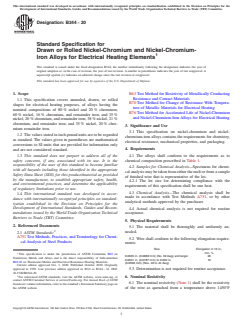
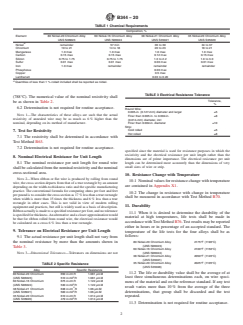
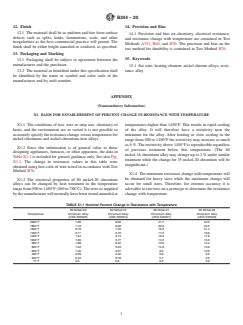

ASTM B344-20 - Standard Specification for Drawn or Rolled Nickel-Chromium and Nickel-Chromium-Iron Alloys for Electrical Heating Elements
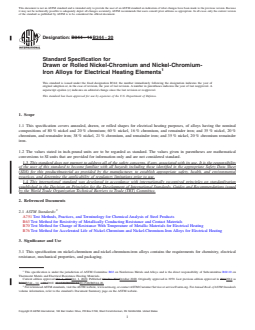
REDLINE ASTM B344-20 - Standard Specification for Drawn or Rolled Nickel-Chromium and Nickel-Chromium-Iron Alloys for Electrical Heating Elements
Overview
ASTM B344-20 is the standard specification developed by ASTM International for drawn or rolled nickel-chromium and nickel-chromium-iron alloys used in electrical heating elements. This specification encompasses the requirements for chemical composition, mechanical performance, and electrical properties of annealed, drawn, or rolled shapes specifically designed for heating applications. The alloys covered by ASTM B344-20 include several compositions with varying percentages of nickel, chromium, and iron, optimized for consistent performance in high-temperature, electrically resistive environments.
This standard promotes uniformity, quality, and interchangeability in the production of nickel-chromium and nickel-chromium-iron resistance alloys, crucial for manufacturers and users in the heating element industry. It applies internationally to the production and procurement of wire, strip, and ribbon forms intended for electrical resistance heating.
Key Topics
Alloy Compositions: Covered alloys include the following nominal compositions:
- 80% nickel, 20% chromium
- 60% nickel, 16% chromium, balance iron
- 35% nickel, 20% chromium, balance iron
- 38% nickel, 21% chromium, balance iron
Physical and Mechanical Requirements:
- Materials must be thoroughly and uniformly annealed.
- Minimum elongation requirements for wires of various diameters.
- Uniform surface finish, free from defects as per commercial practice.
Electrical Properties:
- Defined resistivity values for each alloy type.
- Tolerances for electrical resistance per unit length.
- Calculations and guidelines for electrical resistance, including considerations for rolled ribbons.
Testing and Quality Assurance:
- Chemical analysis methods per ASTM A751.
- Electrical tests per ASTM B63 and B70.
- Durability (accelerated life) testing as prescribed in ASTM B76.
- Guidelines for resistance change with temperature for reliable performance.
Packaging and Marking:
- Agreement-based packaging and clear identification through manufacturer’s symbols and melt numbers.
Applications
ASTM B344-20 compliant nickel-chromium and nickel-chromium-iron alloys are widely used for:
- Electrical Heating Elements: Ideal for use in appliances such as toasters, ovens, water heaters, and industrial furnaces due to their stable resistance characteristics at high temperatures.
- Resistive Wire Manufacturing: Used in the production of round wire, flat wire, and ribbons for resistors and heating applications.
- Industrial Processing: Employed in the construction of heating coils and elements exposed to oxidizing environments where longevity and precise resistance values are needed.
- Research and Development: Suitable for prototyping and testing in temperature control devices, and laboratory heating equipment.
These resistance alloys are selected for their durability, consistent electrical resistance, and ability to withstand repeated heating and cooling cycles, helping ensure the longevity and safety of heating equipment.
Related Standards
For comprehensive compliance and quality assurance, consider these related ASTM standards:
- ASTM A751 - Test Methods, Practices, and Terminology for Chemical Analysis of Steel Products
- ASTM B63 - Test Method for Resistivity of Metallically Conducting Resistance and Contact Materials
- ASTM B70 - Test Method for Change of Resistance with Temperature of Metallic Materials for Electrical Heating
- ASTM B76 - Test Method for Accelerated Life of Nickel-Chromium and Nickel-Chromium-Iron Alloys for Electrical Heating
These standards provide complementary procedures for testing chemical composition, resistivity, resistance stability, and durability, supporting the consistent quality of electrical resistance heating materials as outlined in ASTM B344-20.
Keywords: ASTM B344, nickel-chromium alloys, nickel-chromium-iron alloys, electrical heating elements, resistance alloy, heating wire, ASTM heating material standard, resistivity specification
Relations
- Effective Date
- 01-Apr-2019
- Effective Date
- 01-Nov-2018
- Effective Date
- 01-Mar-2014
- Effective Date
- 01-May-2013
- Effective Date
- 01-May-2013
- Effective Date
- 01-May-2013
- Effective Date
- 01-Oct-2008
- Effective Date
- 01-Jun-2007
- Effective Date
- 01-May-2007
- Effective Date
- 01-May-2007
- Effective Date
- 01-May-2007
- Effective Date
- 01-Apr-2007
- Effective Date
- 01-May-2006
- Effective Date
- 10-Sep-2001
- Effective Date
- 10-Sep-2001
Buy Documents
ASTM B344-20 - Standard Specification for Drawn or Rolled Nickel-Chromium and Nickel-Chromium-Iron Alloys for Electrical Heating Elements
REDLINE ASTM B344-20 - Standard Specification for Drawn or Rolled Nickel-Chromium and Nickel-Chromium-Iron Alloys for Electrical Heating Elements
Get Certified
Connect with accredited certification bodies for this standard

Element Materials Technology
Materials testing and product certification.

Inštitut za kovinske materiale in tehnologije
Institute of Metals and Technology. Materials testing, metallurgical analysis, NDT.
Sponsored listings
Frequently Asked Questions
ASTM B344-20 is a technical specification published by ASTM International. Its full title is "Standard Specification for Drawn or Rolled Nickel-Chromium and Nickel-Chromium-Iron Alloys for Electrical Heating Elements". This standard covers: SCOPE 1.1 This specification covers annealed, drawn, or rolled shapes for electrical heating purposes, of alloys having the nominal compositions of 80 % nickel and 20 % chromium; 60 % nickel, 16 % chromium, and remainder iron; and 35 % nickel, 20 % chromium, and remainder iron; 38 % nickel, 21 % chromium, and remainder iron; and 35 % nickel, 20 % chromium remainder iron. 1.2 The values stated in inch-pound units are to be regarded as standard. The values given in parentheses are mathematical conversions to SI units that are provided for information only and are not considered standard. 1.3 This standard does not purport to address all of the safety concerns, if any, associated with its use. It is the responsibility of the user of this standard to become familiar with all hazards including those identified in the appropriate Safety Data Sheet (SDS) for this product/material as provided by the manufacturer, to establish appropriate safety, health, and environmental practices, and determine the applicability of regulatory limitations prior to use. 1.4 This international standard was developed in accordance with internationally recognized principles on standardization established in the Decision on Principles for the Development of International Standards, Guides and Recommendations issued by the World Trade Organization Technical Barriers to Trade (TBT) Committee.
SCOPE 1.1 This specification covers annealed, drawn, or rolled shapes for electrical heating purposes, of alloys having the nominal compositions of 80 % nickel and 20 % chromium; 60 % nickel, 16 % chromium, and remainder iron; and 35 % nickel, 20 % chromium, and remainder iron; 38 % nickel, 21 % chromium, and remainder iron; and 35 % nickel, 20 % chromium remainder iron. 1.2 The values stated in inch-pound units are to be regarded as standard. The values given in parentheses are mathematical conversions to SI units that are provided for information only and are not considered standard. 1.3 This standard does not purport to address all of the safety concerns, if any, associated with its use. It is the responsibility of the user of this standard to become familiar with all hazards including those identified in the appropriate Safety Data Sheet (SDS) for this product/material as provided by the manufacturer, to establish appropriate safety, health, and environmental practices, and determine the applicability of regulatory limitations prior to use. 1.4 This international standard was developed in accordance with internationally recognized principles on standardization established in the Decision on Principles for the Development of International Standards, Guides and Recommendations issued by the World Trade Organization Technical Barriers to Trade (TBT) Committee.
ASTM B344-20 is classified under the following ICS (International Classification for Standards) categories: 77.150.40 - Nickel and chromium products. The ICS classification helps identify the subject area and facilitates finding related standards.
ASTM B344-20 has the following relationships with other standards: It is inter standard links to ASTM B70-90(2019), ASTM B76-90(2018), ASTM A751-14, ASTM B63-07(2013), ASTM B76-90(2013), ASTM B70-90(2013), ASTM A751-08, ASTM A751-07a, ASTM B70-90(2007), ASTM B76-90(2007), ASTM B63-07, ASTM A751-07, ASTM A751-01(2006), ASTM A751-96, ASTM A751-01. Understanding these relationships helps ensure you are using the most current and applicable version of the standard.
ASTM B344-20 is available in PDF format for immediate download after purchase. The document can be added to your cart and obtained through the secure checkout process. Digital delivery ensures instant access to the complete standard document.
Standards Content (Sample)
This international standard was developed in accordance with internationally recognized principles on standardization established in the Decision on Principles for the
Development of International Standards, Guides and Recommendations issued by the World Trade Organization Technical Barriers to Trade (TBT) Committee.
Designation:B344 −20
Standard Specification for
Drawn or Rolled Nickel-Chromium and Nickel-Chromium-
Iron Alloys for Electrical Heating Elements
This standard is issued under the fixed designation B344; the number immediately following the designation indicates the year of
original adoption or, in the case of revision, the year of last revision. A number in parentheses indicates the year of last reapproval. A
superscript epsilon (´) indicates an editorial change since the last revision or reapproval.
This standard has been approved for use by agencies of the U.S. Department of Defense.
1. Scope B63 Test Method for Resistivity of Metallically Conducting
Resistance and Contact Materials
1.1 This specification covers annealed, drawn, or rolled
B70 Test Method for Change of Resistance With Tempera-
shapes for electrical heating purposes, of alloys having the
ture of Metallic Materials for Electrical Heating
nominal compositions of 80 % nickel and 20 % chromium;
B76 Test Method for Accelerated Life of Nickel-Chromium
60 % nickel, 16 % chromium, and remainder iron; and 35 %
and Nickel-Chromium-Iron Alloys for Electrical Heating
nickel,20 %chromium,andremainderiron;38 %nickel,21 %
chromium, and remainder iron; and 35 % nickel, 20 % chro-
3. Significance and Use
mium remainder iron.
3.1 This specification on nickel-chromium and nickel-
1.2 The values stated in inch-pound units are to be regarded
chromium-iron alloys contains the requirements for chemistry,
as standard. The values given in parentheses are mathematical
electrical resistance, mechanical properties, and packaging.
conversions to SI units that are provided for information only
4. Requirements
and are not considered standard.
1.3 This standard does not purport to address all of the 4.1 The alloys shall conform to the requirements as to
safety concerns, if any, associated with its use. It is the chemical composition prescribed in Table 1.
responsibility of the user of this standard to become familiar
4.2 Samples for Chemical Analysis—Specimens for chemi-
with all hazards including those identified in the appropriate
calanalysismaybetakenfromeitherthemeltorfromasample
Safety Data Sheet (SDS) for this product/material as provided
of finished wire that is representative of the lot.
by the manufacturer, to establish appropriate safety, health,
4.2.1 The lot size for determining compliance with the
and environmental practices, and determine the applicability
requirements of this specification shall be one heat.
of regulatory limitations prior to use.
4.3 Chemical Analysis—The chemical analysis shall be
1.4 This international standard was developed in accor-
made in accordance with Test Methods A751, or by other
dance with internationally recognized principles on standard-
analytical methods approved by the purchaser.
ization established in the Decision on Principles for the
Development of International Standards, Guides and Recom- 4.4 Actual chemical analysis is not required for routine
mendations issued by the World Trade Organization Technical
acceptance.
Barriers to Trade (TBT) Committee.
5. Physical Requirements
2. Referenced Documents
5.1 The material shall be thoroughly and uniformly an-
nealed.
2.1 ASTM Standards:
A751 Test Methods, Practices, and Terminology for Chemi-
5.2 Wire shall conform to the following elongation require-
cal Analysis of Steel Products
ments:
Size Elongation in 10 in.,
min, %
This specification is under the jurisdiction of ASTM Committee B02 on
0.0035 in. (0.0889 mm) (No. 39 Awg) and larger 20
Nonferrous Metals and Alloys and is the direct responsibility of Subcommittee
0.0031 in. (0.0787 mm) to 0.002 in. 10
B02.10 on Thermostat Metals and Electrical Resistance Heating Materials.
(0.0508 mm) (Nos. 40 to 44 Awg)
Current edition approved Oct. 1, 2020. Published October 2020. Originally
approved in 1959. Last previous edition approved in 2014 as B344 – 14. DOI: 5.3 Determination is not required for routine acceptance.
10.1520/B0344-20.
For referenced ASTM standards, visit the ASTM website, www.astm.org, or 6. Nominal Resistivity
contact ASTM Customer Service at service@astm.org. For Annual Book of ASTM
6.1 The nominal resistivity (Note 1) shall be the resistivity
Standards volume information, refer to the standard’s Document Summary page on
the ASTM website. of the wire as quenched from a temperature above 1450°F
Copyright © ASTM International, 100 Barr Harbor Drive, PO Box C700, West Conshohocken, PA 19428-2959. United States
B344−20
TABLE 1 Chemical Requirements
Composition, %
Element
80 Nickel-20 Chromium Alloy 60 Nickel-16 Chromium Alloy 38 Nickel-21 Chromium Alloy 35 Nickel-20 Chromium Alloy
UNS N06023 UNS N06024 UNS S35021 UNS S35020
A
Nickel remainder 57 min 36 to 39 34 to 37
Chromium 19 to 21 14 to 18 20 to 23 18 to 21
Manganese 1.0 max 1.0 max 1.0 max 1.0 max
Carbon 0.15 max 0.15 max 0.12 max 0.15 max
Silicon 0.75 to 1.75 0.75 to 1.75 1.3 to 2.2 1.0 to 3.0
Sulfur 0.01 max 0.01 max 0.03 max 0.01 max
Iron 1.0 max remainder remainder remainder
Phosphorus 0.03 max
Copper 0.5 max
Lanthanum 0.03 to 0.20
A
Quantities of less than 1 % cobalt included shall be reported as nickel.
TABLE 3 Electrical Resistance Tolerance
(788°C). The numerical value of the nominal resistivity shall
Tolerance,
be as shown in Table 2.
%
6.2 Determination is not required for routine acceptance.
Round Wire:
0.005-in. (0.127-mm) diameter and larger ±5
NOTE 1—The characteristics of these alloys are such that the actual
Finer than 0.005 in. to 0.002-in. ±8
resistivity of annealed wire may be as much as 6 % higher than the
(0.014-mm) diameter, incl
nominal, depending on its method of manufacture.
Finer than 0.002-in. diameter ±10
Strip:
Cold rolled ±5
7. Test for Resistivity
Hot rolled ±8
7.1 The resistivity shall be determined in accordance with
Test Method B63.
7.2 Determination is not required for routine acceptance.
specified since the material is used for resistance purposes in which the
resistivity and the electrical resistance per unit length rather than the
8. Nominal Electrical Resistance for Unit Length
dimensions are of prime importance. The electrical resistance per unit
8.1 The nominal resistance per unit length for round wire length can be determined more accurately than the dimensions of very
small sizes of wire or strip.
shallbecalculatedfromthenominalresistivityandthenominal
cross-sectional area.
10. Resistance Change with Temperature
NOTE 2—When ribbon or flat wire is produced by rolling from round
10.1 Nominal values for resistance change with temperature
wire, the cross section departs from that of a true rectangle by an amount
are contained in Appendix X1.
depending on the width-to-thickness ratio and the specific manufacturing
prac
...
This document is not an ASTM standard and is intended only to provide the user of an ASTM standard an indication of what changes have been made to the previous version. Because
it may not be technically possible to adequately depict all changes accurately, ASTM recommends that users consult prior editions as appropriate. In all cases only the current version
of the standard as published by ASTM is to be considered the official document.
Designation: B344 − 14 B344 − 20
Standard Specification for
Drawn or Rolled Nickel-Chromium and Nickel-Chromium-
Iron Alloys for Electrical Heating Elements
This standard is issued under the fixed designation B344; the number immediately following the designation indicates the year of
original adoption or, in the case of revision, the year of last revision. A number in parentheses indicates the year of last reapproval. A
superscript epsilon (´) indicates an editorial change since the last revision or reapproval.
This standard has been approved for use by agencies of the U.S. Department of Defense.
1. Scope
1.1 This specification covers annealed, drawn, or rolled shapes for electrical heating purposes, of alloys having the nominal
compositions of 80 % nickel and 20 % chromium; 60 % nickel, 16 % chromium, and remainder iron; and 35 % nickel, 20 %
chromium, and remainder iron; 38 % nickel, 21 % chromium, and remainder iron; and 35 % nickel, 20 % chromium remainder
iron.
1.2 The values stated in inch-pound units are to be regarded as standard. The values given in parentheses are mathematical
conversions to SI units that are provided for information only and are not considered standard.
1.3 This standard does not purport to address all of the safety concerns, if any, associated with its use. It is the responsibility
of the user of this standard to become familiar with all hazards including those identified in the appropriate Safety Data Sheet
(SDS) for this product/material as provided by the manufacturer, to establish appropriate safety, health, and environmental
practices, and determine the applicability of regulatory limitations prior to use.
1.4 This international standard was developed in accordance with internationally recognized principles on standardization
established in the Decision on Principles for the Development of International Standards, Guides and Recommendations issued
by the World Trade Organization Technical Barriers to Trade (TBT) Committee.
2. Referenced Documents
2.1 ASTM Standards:
A751 Test Methods, Practices, and Terminology for Chemical Analysis of Steel Products
B63 Test Method for Resistivity of Metallically Conducting Resistance and Contact Materials
B70 Test Method for Change of Resistance With Temperature of Metallic Materials for Electrical Heating
B76 Test Method for Accelerated Life of Nickel-Chromium and Nickel-Chromium-Iron Alloys for Electrical Heating
3. Significance and Use
3.1 This specification on nickel-chromium and nickel-chromium-iron alloys contains the requirements for chemistry, electrical
resistance, mechanical properties, and packaging.
This specification is under the jurisdiction of ASTM Committee B02 on Nonferrous Metals and Alloys and is the direct responsibility of Subcommittee B02.10 on
Thermostat Metals and Electrical Resistance Heating Materials.
Current edition approved Oct. 1, 2014Oct. 1, 2020. Published October 2014October 2020. Originally approved in 1959. Last previous edition approved in 20112014 as
B344B344 – 14. – 11. DOI: 10.1520/B0344-14.10.1520/B0344-20.
For referenced ASTM standards, visit the ASTM website, www.astm.org, or contact ASTM Customer Service at service@astm.org. For Annual Book of ASTM Standards
volume information, refer to the standard’s Document Summary page on the ASTM website.
Copyright © ASTM International, 100 Barr Harbor Drive, PO Box C700, West Conshohocken, PA 19428-2959. United States
B344 − 20
4. Requirements
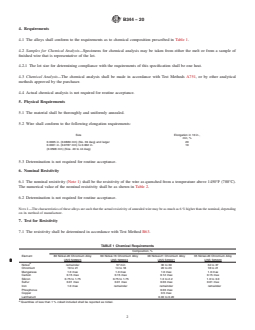
4.1 The alloys shall conform to the requirements as to chemical composition prescribed in Table 1.
4.2 Samples for Chemical Analysis—Specimens for chemical analysis may be taken from either the melt or from a sample of
finished wire that is representative of the lot.
4.2.1 The lot size for determining compliance with the requirements of this specification shall be one heat.
4.3 Chemical Analysis—The chemical analysis shall be made in accordance with Test Methods A751, or by other analytical
methods approved by the purchaser.
4.4 Actual chemical analysis is not required for routine acceptance.
5. Physical Requirements
5.1 The material shall be thoroughly and uniformly annealed.
5.2 Wire shall conform to the following elongation requirements:
Size Elongation in 10 in.,
min, %
0.0035 in. (0.0889 mm) (No. 39 Awg) and larger 20
0.0031 in. (0.0787 mm) to 0.002 in. 10
(0.0508 mm) (Nos. 40 to 44 Awg)
5.3 Determination is not required for routine acceptance.
6. Nominal Resistivity
6.1 The nominal resistivity (Note 1) shall be the resistivity of the wire as quenched from a temperature above 1450°F (788°C).
The numerical value of the nominal resistivity shall be as shown in Table 2.
6.2 Determination is not required for routine acceptance.
NOTE 1—The characteristics of these alloys are such that the actual resistivity of annealed wire may be as much as 6 % higher than the nominal, depending
on its method of manufacture.
7. Test for Resistivity
7.1 The resistivity shall be determined in accordance with Test Method B63.
TABLE 1 Chemical Requirements
Composition, %
Element
80 Nickel-20 Chromium Alloy 60 Nickel-16 Chromium Alloy 38 Nickel-21 Chromium Alloy 35 Nickel-20 Chromium Alloy
UNS N06023 UNS N06024 UNS S35021 UNS S35020
A
Nickel remainder 57 min 36 to 39 34 to 37
Chromium 19 to 21 14 to 18 20 to 23 18 to 21
Manganese 1.0 max 1.0 max 1.0 max 1.0 max
Carbon 0.15 max 0.15 max 0.12 max 0.15 max
Silicon 0.75 to 1.75 0.75 to 1.75 1.3 to 2.2 1.0 to 3.0
Sulfur 0.01 max 0.01 max 0.03 max 0.01 max
Iron 1.0 max remainder remainder remainder
Phosphorus 0.03 max
Copper 0.5 max
Lanthanum 0.03 to 0.20
A
Quantities of less than 1 % cobalt included shall be reported as nickel.
B344 − 20
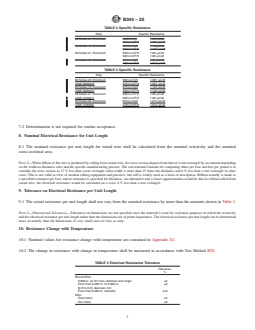
TABLE 2 Specific Resistance
Alloy Specific Resistance
80 Nickel-20 Chromium 650Ω·cm/ft 1.081μΩ·M
510 Ω·mil /ft 1.081 μΩ·M
60 Nickel-16 Chromium 675 Ω·cm/ft 1.122μΩ·M
530 Ω·mil /ft 1.122 μΩ·M
38 Nickel-21 Chromium 638 Ω·cm /ft 1.06 μΩ·M
500 Ω·mil /ft 1.06 μΩ·M
35 Nickel-20 Chromium 610 Ω·cm/ft 1.014μΩ·M
479 Ω·mil /ft 1.014 μΩ·M
TABLE 2 Specific Resistance
Alloy Specific Resistance
80 Nickel-20 Chromium 650 Ω·cm/ft 1.081 μΩ·M
(UNS N06023) 510 Ω·mil /ft 1.081 μΩ·M
60 Nickel-16 Chromium 675 Ω·cm/ft 1.122 μΩ·M
(UNS N06024) 530 Ω·mil /ft 1.122 μΩ·M
38 Nickel-21 Chromium 638 Ω·cm /ft 1.06 μΩ·M
(UNS S35021) 500 Ω·mil /ft 1.06 μΩ·M
35 Nickel-20 Chromium 610 Ω·cm/ft 1.014 μΩ·M
(UNS S35020) 479 Ω·mil /ft 1.014 μΩ·M
7.2 Determination is not required for routine acceptance.
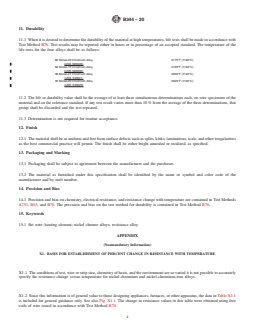
8. Nominal Electrical Resistance for Unit Length
8.1 The nominal resistance per unit length for round wire shall be calculated from the nominal resistivity and the nominal
cross-sectional area.
NOTE 2—When ribbon or flat wire is produced by rolling from round wire, the cross section departs from that of a true rectangle by an amount depending
on the width-to-thickness ratio and the specific manufacturing practice. The conventional formula for computing ohms per foot and feet per p
...