

ASTM F2011-02(2018)
(Specification)Standard Specification for Safety and Performance of Fun-Karts
General Information
- Abstract
ABSTRACT
This specification deals with the safety performance specifications for commercially manufactured fun-karts intended for private use, on suitable off-road terrain, by consumers, and does not apply to concession, race, home-made, consumer-modified fun-karts, fun-karts that are pedal-powered, unpowered fun-karts, or fun-karts, which are used for commercial purposes. This specification does not cover labeling, maintenance, or use. Materials shall be tested and shall conform to the requirements for fun-kart frame, fun-kart controls, tire capacity, paint, electrical system, fun-kart engines, shields and guards, brush bars, seat belts, fasteners, and plastics.
SCOPE
1.1 This specification relates to the safety performance specifications for commercially manufactured fun-karts intended for private use, on suitable off-road terrain, by consumers.
1.2 This specification is intended to reduce hazards, other than those inherent in the sport of fun-karting, to the users of fun-karts during normal intended use by specifying performance standards of manufacturing.
1.3 This specification applies to fun-karts for private use and does not apply to concession, race, home-made, consumer-modified fun-karts, fun-karts that are pedal-powered, unpowered fun-karts, or fun-karts, which are used for commercial purposes.
1.4 This specification recognizes that there are operational hazards relating to fun-karts, which operators and passengers are deemed to have accepted by their use and operation of the fun-kart including, but not limited to, falling out, running into, through, under or over objects, upsetting the fun-kart, general operator recklessness, pinches, scratches, or bruises, or a combination thereof.
1.5 This specification does not cover labeling, maintenance, or use. For use and maintenance, see Safety Guide F1928.
1.6 The values stated in inch-pound units are to be regarded as standard. The values given in parentheses are mathematical conversions to SI units that are provided for information only and are not considered standard.
1.7 This international standard was developed in accordance with internationally recognized principles on standardization established in the Decision on Principles for the Development of International Standards, Guides and Recommendations issued by the World Trade Organization Technical Barriers to Trade (TBT) Committee.
- Status
- Published
- Publication Date
- 31-Jan-2018
- Technical Committee
- F15 - Consumer Products
- Drafting Committee
- F15.41 - Fun Karts
Overview
ASTM F2011-02(2018) is the internationally recognized standard specification for the safety and performance of commercially manufactured fun-karts intended for private, off-road use by consumers. Developed by ASTM International, this standard addresses the core features necessary to reduce hazards in fun-kart operation that are not inherent to the recreational activity itself. The standard outlines requirements for the design, structure, and operation of fun-karts, ensuring a baseline of safety and performance for users. It intentionally excludes fun-karts used for commercial purposes, race or concession karts, home-made, consumer-modified, pedal-powered, or unpowered karts. Labeling, maintenance, and use instructions are not covered by this document.
Key Topics
Scope of Applicability
The standard applies strictly to fun-karts designed and manufactured for private use on suitable off-road terrain. It does not extend to commercially operated fun-karts or those significantly modified by consumers.Safety Performance Specifications
ASTM F2011-02(2018) establishes requirements that address:- Fun-kart frame design, including floor pan characteristics
- Operator and passenger seat and position retention devices
- Steering support, controls, and prevention of over-center steering conditions
- Mandatory presence of engine stop switches and throttle return mechanisms
- Required seat belts for high-speed fun-karts
- Shields and guards for moving components to avoid entanglement and injuries
Engine and Electrical Systems
- Specifications for battery compartment marking and safety features for vented batteries
- Requirements for engine safety, including heat guards and safe mounting of components
Tire and Material Specifications
- Minimum tire load ratings appropriate to vehicle weight
- Compliance with regulations limiting hazardous substances such as lead in paint
- Use of fire-retardant and UV-inhibited plastics in critical components
Fasteners and Structural Hardware
- Requirements for locking fasteners at critical joints and attachment points
Applications
The practical value of ASTM F2011-02(2018) lies in its ability to support manufacturers, designers, and regulators in the development, production, and approval of safe recreational fun-karts for private use. Key applications include:
Manufacturing and Product Development:
Fun-kart designers and manufacturers use these guidelines to build safe vehicles that minimize the risk of injury due to mechanical failure or design flaws.Compliance and Safety Assessment:
Safety inspectors, testers, and regulators can reference this standard to evaluate whether a fun-kart meets baseline safety expectations regarding construction and critical safety features.Procurement and Consumer Assurance:
Buyers and retailers can request evidence of ASTM F2011-02(2018) compliance to ensure the fun-karts they purchase or sell meet recognized safety performance criteria.Risk Management:
Reducing liability by adhering to standardized safety and performance requirements helps decrease the likelihood of accidents stemming from design oversights or avoidable hazards.
Related Standards
- ASTM F1928: Safety Guide for Consumer Recreational Use of Fun-Karts - provides guidance on fun-kart use and maintenance.
- CFR 1303: Ban of Lead-Containing Paint - referenced for paint safety compliance.
- FMVSS 571.209: Seat Belt Assemblies - defines requirements for seat belt performance and design in vehicles.
- SAE J386: Operator Restraint Systems for Off-Road Work Machines - details construction and performance expectations for operator restraints.
- ANSI/OPEI B71.1: Safety Specification for Power Lawn Tractors - provides references for guarding and safety features relevant to off-road vehicles.
For complete compliance and effective implementation, industry stakeholders should review these related standards alongside ASTM F2011-02(2018) for fun-kart safety and performance.
Keywords: fun-kart safety standard, ASTM F2011-02, recreational go-karts, off-road vehicle safety, fun-kart manufacturing, consumer fun-karts, fun-kart performance requirements.
Relations
- Effective Date
- 01-Feb-2018
- Effective Date
- 01-Feb-2018
- Effective Date
- 01-Sep-2010
- Effective Date
- 01-Jul-2004
- Effective Date
- 10-Dec-1998
Get Certified
Connect with accredited certification bodies for this standard

TÜV Rheinland
TÜV Rheinland is a leading international provider of technical services.

TÜV SÜD
TÜV SÜD is a trusted partner of choice for safety, security and sustainability solutions.

DEKRA Certification Inc.
DEKRA US certification services.
Sponsored listings
Frequently Asked Questions
ASTM F2011-02(2018) is a technical specification published by ASTM International. Its full title is "Standard Specification for Safety and Performance of Fun-Karts". This standard covers: ABSTRACT This specification deals with the safety performance specifications for commercially manufactured fun-karts intended for private use, on suitable off-road terrain, by consumers, and does not apply to concession, race, home-made, consumer-modified fun-karts, fun-karts that are pedal-powered, unpowered fun-karts, or fun-karts, which are used for commercial purposes. This specification does not cover labeling, maintenance, or use. Materials shall be tested and shall conform to the requirements for fun-kart frame, fun-kart controls, tire capacity, paint, electrical system, fun-kart engines, shields and guards, brush bars, seat belts, fasteners, and plastics. SCOPE 1.1 This specification relates to the safety performance specifications for commercially manufactured fun-karts intended for private use, on suitable off-road terrain, by consumers. 1.2 This specification is intended to reduce hazards, other than those inherent in the sport of fun-karting, to the users of fun-karts during normal intended use by specifying performance standards of manufacturing. 1.3 This specification applies to fun-karts for private use and does not apply to concession, race, home-made, consumer-modified fun-karts, fun-karts that are pedal-powered, unpowered fun-karts, or fun-karts, which are used for commercial purposes. 1.4 This specification recognizes that there are operational hazards relating to fun-karts, which operators and passengers are deemed to have accepted by their use and operation of the fun-kart including, but not limited to, falling out, running into, through, under or over objects, upsetting the fun-kart, general operator recklessness, pinches, scratches, or bruises, or a combination thereof. 1.5 This specification does not cover labeling, maintenance, or use. For use and maintenance, see Safety Guide F1928. 1.6 The values stated in inch-pound units are to be regarded as standard. The values given in parentheses are mathematical conversions to SI units that are provided for information only and are not considered standard. 1.7 This international standard was developed in accordance with internationally recognized principles on standardization established in the Decision on Principles for the Development of International Standards, Guides and Recommendations issued by the World Trade Organization Technical Barriers to Trade (TBT) Committee.
ABSTRACT This specification deals with the safety performance specifications for commercially manufactured fun-karts intended for private use, on suitable off-road terrain, by consumers, and does not apply to concession, race, home-made, consumer-modified fun-karts, fun-karts that are pedal-powered, unpowered fun-karts, or fun-karts, which are used for commercial purposes. This specification does not cover labeling, maintenance, or use. Materials shall be tested and shall conform to the requirements for fun-kart frame, fun-kart controls, tire capacity, paint, electrical system, fun-kart engines, shields and guards, brush bars, seat belts, fasteners, and plastics. SCOPE 1.1 This specification relates to the safety performance specifications for commercially manufactured fun-karts intended for private use, on suitable off-road terrain, by consumers. 1.2 This specification is intended to reduce hazards, other than those inherent in the sport of fun-karting, to the users of fun-karts during normal intended use by specifying performance standards of manufacturing. 1.3 This specification applies to fun-karts for private use and does not apply to concession, race, home-made, consumer-modified fun-karts, fun-karts that are pedal-powered, unpowered fun-karts, or fun-karts, which are used for commercial purposes. 1.4 This specification recognizes that there are operational hazards relating to fun-karts, which operators and passengers are deemed to have accepted by their use and operation of the fun-kart including, but not limited to, falling out, running into, through, under or over objects, upsetting the fun-kart, general operator recklessness, pinches, scratches, or bruises, or a combination thereof. 1.5 This specification does not cover labeling, maintenance, or use. For use and maintenance, see Safety Guide F1928. 1.6 The values stated in inch-pound units are to be regarded as standard. The values given in parentheses are mathematical conversions to SI units that are provided for information only and are not considered standard. 1.7 This international standard was developed in accordance with internationally recognized principles on standardization established in the Decision on Principles for the Development of International Standards, Guides and Recommendations issued by the World Trade Organization Technical Barriers to Trade (TBT) Committee.
ASTM F2011-02(2018) is classified under the following ICS (International Classification for Standards) categories: 43.160 - Special purpose vehicles. The ICS classification helps identify the subject area and facilitates finding related standards.
ASTM F2011-02(2018) has the following relationships with other standards: It is inter standard links to ASTM F2011-02(2010), ASTM F1928-98(2018), ASTM F1928-98(2010), ASTM F1928-98(2004)e1, ASTM F1928-98. Understanding these relationships helps ensure you are using the most current and applicable version of the standard.
ASTM F2011-02(2018) is available in PDF format for immediate download after purchase. The document can be added to your cart and obtained through the secure checkout process. Digital delivery ensures instant access to the complete standard document.
Standards Content (Sample)
This international standard was developed in accordance with internationally recognized principles on standardization established in the Decision on Principles for the
Development of International Standards, Guides and Recommendations issued by the World Trade Organization Technical Barriers to Trade (TBT) Committee.
Designation:F2011 −02 (Reapproved 2018)
Standard Specification for
Safety and Performance of Fun-Karts
This standard is issued under the fixed designation F2011; the number immediately following the designation indicates the year of
original adoption or, in the case of revision, the year of last revision. A number in parentheses indicates the year of last reapproval. A
superscript epsilon (´) indicates an editorial change since the last revision or reapproval.
1. Scope 2. Referenced Documents
2.1 ASTM Standards:
1.1 This specification relates to the safety performance
F1928 Safety Guide for Consumer Recreational Use of
specifications for commercially manufactured fun-karts in-
Fun-Karts
tended for private use, on suitable off-road terrain, by consum-
2.2 CPSA Document:
ers.
CFR 1303 Ban of Lead-Containing Paint
1.2 This specification is intended to reduce hazards, other
2.3 FMVSS Standards:
than those inherent in the sport of fun-karting, to the users of
FMVSS 571.209 Seat Belt Assemblies
fun-karts during normal intended use by specifying perfor-
2.4 SAE Standard:
mance standards of manufacturing.
SAE J 386 Operator Restraint Systems for Off-Road Work
1.3 This specification applies to fun-karts for private use
Machines
and does not apply to concession, race, home-made, consumer-
2.5 ANSI Standard:
modified fun-karts, fun-karts that are pedal-powered, unpow-
ANSI/OPEI B71.1 Safety Specification for Power Lawn
ered fun-karts, or fun-karts, which are used for commercial
Tractors
purposes.
3. Terminology
1.4 This specification recognizes that there are operational
hazards relating to fun-karts, which operators and passengers 3.1 Definitions of Terms Specific to This Standard:
3.1.1 axle guard, n—a device that covers the drive axle on
are deemed to have accepted by their use and operation of the
fun-kart including, but not limited to, falling out, running into, fun-karts so that the possibility of injury resulting from hand,
hair, loose clothing, or body parts contacting the axle is
through, under or over objects, upsetting the fun-kart, general
reduced.
operator recklessness, pinches, scratches, or bruises, or a
combination thereof.
3.1.2 brush bars, n—any device supplied by the manufac-
turer intended to deflect loose vegetation from the path of the
1.5 This specification does not cover labeling, maintenance,
fun-kart operator, and passenger in two-seat fun-karts.
or use. For use and maintenance, see Safety Guide F1928.
3.1.3 control pedal pivot, n—the center point about which
1.6 The values stated in inch-pound units are to be regarded
the control pedal rotates. Excluded from this definition are any
as standard. The values given in parentheses are mathematical
control device(s) attached to the pedal itself.
conversions to SI units that are provided for information only
3.1.4 deck plates, n—a form of guarding through the use of
and are not considered standard.
relatively flat barriers to cover rotating components.
1.7 This international standard was developed in accor-
3.1.5 engine stop switch, n—a toggle switch, or other
dance with internationally recognized principles on standard-
two-position positively engaging switch, which when activated
ization established in the Decision on Principles for the
causes the engine to stop or not operate, or both.
Development of International Standards, Guides and Recom-
mendations issued by the World Trade Organization Technical
Barriers to Trade (TBT) Committee.
For referenced ASTM standards, visit the ASTM website, www.astm.org, or
contact ASTM Customer Service at service@astm.org. For Annual Book of ASTM
Standards volume information, refer to the standard’s Document Summary page on
the ASTM website.
1 3
This specification is under the jurisdiction of ASTM Committee F15 on Code of Federal Regulations, available from U.S. Government Printing Office,
Consumer Products and is the direct responsibility of Subcommittee F15.41 on Fun Washington, DC 20402.
Karts. Available from SAE International (SAE), 400 Commonwealth Dr.,Warrendale,
Current edition approved Feb. 1, 2018. Published February 2018. Originally PA 15096-0001, http://www.sae.org.
approved in 2000. Last previous edition approved in 2010 as F2011 – 02 (2010). Available from American National Standards Institute (ANSI), 25 W. 43rd St.,
DOI: 10.1520/F2011-02R18. 4th Floor, New York, NY 10036, http://www.ansi.org.
Copyright © ASTM International, 100 Barr Harbor Drive, PO Box C700, West Conshohocken, PA 19428-2959. United States
F2011−02 (2018)
FIG. 1Diagram of Fun-Kart Frame
3.1.6 engine throttle system, n—the throttle mechanism 3.1.14 throttle stop, n—a device used to limit the travel of
attached to the engine, as provided by the engine manufacturer. the accelerator system.
3.1.7 fun-kart, n—a motorized vehicle with four wheels, 3.1.15 two-seat fun-kart, n—a fun-kart with designed seat-
excludingvehicleswhichtheoperator,andpassenger,ifany,sit ing to accommodate one operator and one passenger.
astride, sold commercially as consumer goods and intended for
4. Fun-Kart Frame
private personal recreational use by consumers for off-road use
on suitable terrain, as recommended by the manufacturer, at
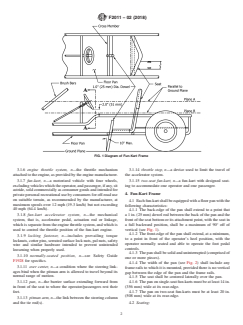
4.1 Eachfun-kartshallbeequippedwithafloorpanwiththe
maximum speeds over 12 mph (19.3 km/h) but not exceeding
following characteristics:
40 mph (64.4 km/h).
4.1.1 The back-edge of the pan shall extend to a point that
3.1.8 fun-kart accelerator system, n—the mechanical a 1 in. (25 mm) dowel rod between the back of the pan and the
front of the seat bottom or its attachment point, with the seat in
system, that is, accelerator pedal, actuation rod or linkage,
a full backward position, shall be a maximum of 90° off of
which is separate from the engine throttle system, and which is
used to control the throttle position of the fun-kart engine. vertical (see Fig. 1).
4.1.2 The front-edge of the pan shall extend, at a minimum,
3.1.9 locking fastener, n—includes prevailing torque
to a point in front of the operator’s heel position, with the
locknuts, cotter pins, serrated surface lock nuts, pal nuts, safety
operator normally seated and able to operate the foot pedal
wire and similar hardware intended to prevent unintended
controls.
loosening when properly used.
4.1.3 Thepanshallbesolidanduninterrupted(comprisedof
3.1.10 normally-seated position, n—see Safety Guide
one or more pieces).
F1928 for specifics.
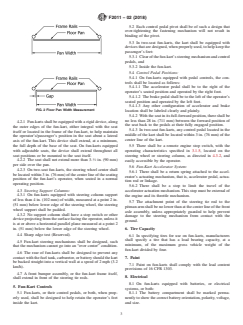
4.1.4 The width of the pan (see Fig. 2) shall include any
3.1.11 over center, n—a condition where the steering link-
frame rails to which it is mounted, provided there is no vertical
ages bind when the pitman arm is allowed to travel beyond its
gap between the edge of the pan and the frame rails.
normal range of motion.
4.1.5 The seat shall be centered laterally over the pan.
4.1.6 The pan on single-seat fun-karts must be at least 14 in.
3.1.12 pan, n—the barrier surface extending forward from
(356 mm) wide at its rear-edge.
in front of the seat to where the operator/passengers rest their
4.1.7 The pan on two-seat fun-karts must be at least 20 in.
feet.
(508 mm) wide at its rear-edge.
3.1.13 pitman arm, n—the link between the steering column
and the tie rod(s). 4.2 Seating:
F2011−02 (2018)
5.2 Each control pedal pivot shall be of such a design that
over-tightening the fastening mechanism will not result in
binding of the pivot.
5.3 In two-seat fun-karts, the kart shall be equipped with
devices that are designed, when properly used, to help keep the
passenger’s feet:
5.3.1 Clearofthefun-kart’ssteeringmechanismandcontrol
pedals, and
5.3.2 Inside the fun-kart.
5.4 Control Pedal Positions:
5.4.1 On fun-karts equipped with pedal controls, the con-
trols shall be located as follows:
5.4.1.1 The accelerator pedal shall be to the right of the
operator’s seated position and operated by the right foot.
5.4.1.2 The brake pedal shall be to the left of the operator’s
seated position and operated by the left foot.
5.4.1.3 Any other configuration of accelerator and brake
FIG. 2Floor Pan Width Measurement
location shall be labeled clearly and plainly.
5.4.2 Withtheseatinitsfull-forwardposition,thereshallbe
no less than 28 in. (711 mm) between the forward position of
4.2.1 Fun-karts shall be equipped with a rigid device, along
the seat back to the pedals at their fully engaged position.
the outer edges of the fun-kart, either integral with the seat
5.4.3 In two-seat fun-karts, any control pedal located in the
itself or located in the frame of the fun-kart, to help maintain
middle of the kart shall be located within 3 in. (76 mm) of the
the operator’s/passenger’s position in the seat about a lateral
center line of the kart.
axis of the fun-kart. This device shall extend, at a minimum,
the full depth of the base of the seat. On fun-karts equipped
5.5 There shall be a remote engine stop switch, with the
with adjustable seats, the device shall extend throughout all operating characteristics specified in 3.1.5, located on the
seat positions or be mounted to the seat itself.
steering wheel or steering column, as directed in 4.3.2, and
4.2.2 The seat shall not extend more than 3- ⁄2 in. (90 mm) easily accessible by the operator.
per side over the pan.
5.6 Fun-Kart Accelerator System:
4.2.3 On two-seat fun-karts, the steering wheel center shall
5.6.1 There shall be a return spring attached to the accel-
be located within 3 in. (76 mm) of the center line of the seating
erator’s actuating mechanism, that is, accelerator pedal, actua-
position of the fun-kart’s operator, when seated in a normal
tion rod or linkage.
operating position.
5.6.2 There shall be a stop to limit the travel of the
4.3 Steering Support Columns:
accelerator actuation mechanism.This stop must be external of
4.3.1 On fun-karts equipped with steering column support the engine and its throttle mechanism.
of less than 4 in. (102 mm) of width, measured at a point 2 in.
5.7 The attachment point of the steering tie rod to the
(51 mm) below lower edge of the steering wheel, the steering
pitman arm shall be no lower than at the center line of the front
wheel support shall be padded.
axle assembly, unless appropriately guarded to help prevent
4.3.2 No support column shall have a stop switch or other
damage to the steering mechanism from contact with the
device projecting from the surface facing the operator, unless it
ground.
is at or above a horizontal parallel plane measured at a point 2
in. (51 mm) below the lower edge of the steering wheel.
6. Tire Capacity
4.4 Sharp edge test (Reserved).
6.1 In specifying tires for use on fun-karts, manufacturers
shall specify a tire that has a load bearing capacity, at a
4.5 Fun-kart steering mechanisms shall be designed, such
minimum, of the maximum gros
...