

ASTM F2214-23
(Test Method)Standard Test Method for In Situ Determination of Network Parameters of Crosslinked Ultra High Molecular Weight Polyethylene (UHMWPE)
General Information
- Abstract
SIGNIFICANCE AND USE
5.1 This test method is designed to produce data indicative of the degree of crosslinking in ultra high molecular weight polyethylene that has been crosslinked chemically or by ionizing radiation.
5.2 The results are sensitive to the test temperature, solvent, and method used. For the comparison of data between institutions, care must be taken to have the same test conditions and reagents.
5.3 The data can be used for dose uniformity analysis, fundamental research, and quality assurance testing.
SCOPE
1.1 This test method describes how the crosslink density, molecular weight between crosslinks, and number of repeat units between crosslinks in ultra high molecular weight polyethylene (UHMWPE) crosslinked by ionizing radiation or by chemical means can be determined by measuring the swelling ratio of samples immersed in o-xylene. Examples of experimental techniques used to make these measurements are discussed herein.
1.2 The test method reported here measures the change in height of a sample specimen while it is immersed in the solvent. Volumetric swell ratios assume that the sample is crosslinked isotropically, and that the change in dimension will be uniform in all directions. This technique avoids uncertainty induced by solvent evaporation or temperature change.
1.3 The values stated in SI units are to be regarded as standard. No other units of measurement are included in this standard.
1.4 This standard does not purport to address all of the safety concerns, if any, associated with its use. It is the responsibility of the user of this standard to establish appropriate safety, health, and environmental practices and determine the applicability of regulatory limitations prior to use.
1.5 This international standard was developed in accordance with internationally recognized principles on standardization established in the Decision on Principles for the Development of International Standards, Guides and Recommendations issued by the World Trade Organization Technical Barriers to Trade (TBT) Committee.
- Status
- Published
- Publication Date
- 31-Aug-2023
- Technical Committee
- F04 - Medical and Surgical Materials and Devices
- Drafting Committee
- F04.15 - Material Test Methods
Buy Documents
ASTM F2214-23 - Standard Test Method for <emph type="ital"> In Situ</emph> Determination of Network Parameters of Crosslinked Ultra High Molecular Weight Polyethylene (UHMWPE)
REDLINE ASTM F2214-23 - Standard Test Method for <emph type="ital"> In Situ</emph> Determination of Network Parameters of Crosslinked Ultra High Molecular Weight Polyethylene (UHMWPE)
Overview
ASTM F2214-23 - Standard Test Method for In Situ Determination of Network Parameters of Crosslinked Ultra High Molecular Weight Polyethylene (UHMWPE) - defines procedures for assessing key network parameters of crosslinked UHMWPE materials. This method is essential in measuring and understanding the degree of crosslinking, molecular weight between crosslinks, and the number of repeat units between crosslinks in materials processed via ionizing radiation or chemical means. By employing swelling measurements in o-xylene at controlled temperatures, laboratories can generate repeatable data to support dose uniformity analysis, research, and quality assurance testing in UHMWPE.
This standard is especially relevant for industries that rely on the superior wear resistance and mechanical properties of crosslinked UHMWPE, such as medical devices and industrial components.
Key Topics
The ASTM F2214-23 standard covers the following essential areas:
- Crosslink Density Measurement: Determines the average number of crosslinks in UHMWPE per unit volume, informing about network structure and expected performance.
- Molecular Weight between Crosslinks: Calculates the average molecular weight segment between crosslinks, a key parameter for predicting physical and mechanical behavior.
- Swelling Ratio Assessment: Uses the ratio of the volume of a swollen specimen to its dry state in o-xylene to derive network parameters using Flory’s network theory.
- Test Methodology: Describes sample preparation, solvent selection, test apparatus, temperature control, and measurement processes to ensure consistent results.
- Interlaboratory Repeatability: Addresses factors essential for consistent comparison of results between laboratories, emphasizing the importance of uniform test conditions, particularly test temperature and solvent used.
Applications
The test method outlined in ASTM F2214-23 is widely utilized in several practical contexts:
- Medical Device Manufacturing: Used extensively for orthopedic implant components, particularly in quality control of joint replacements, to ensure reliable wear resistance and longevity.
- Material Research and Development: Supports fundamental research into the effects of crosslinking on UHMWPE properties, enabling optimization of processing techniques.
- Quality Assurance: Provides a robust approach for manufacturers to verify the crosslinking degree and uniformity in each batch, reducing variability and improving product performance.
- Dose Uniformity Studies: Essential for validating and calibrating irradiation and chemical crosslinking processes, ensuring homogeneous material properties throughout the product.
- Regulatory Compliance: Offers a standardized method recognized across the global industry, supporting compliance with international norms and technical barriers to trade.
Related Standards
Several ASTM standards are referenced or related to ASTM F2214-23, including:
- ASTM D2765: Test Methods for Determination of Gel Content and Swell Ratio of Crosslinked Ethylene Plastics.
- ASTM E177: Practice for Use of the Terms Precision and Bias in ASTM Test Methods.
- ASTM E691: Practice for Conducting an Interlaboratory Study to Determine the Precision of a Test Method.
These standards support enhanced reliability and comparability of test data across different laboratories and applications.
Keywords: ASTM F2214-23, UHMWPE, crosslink density, network parameters, molecular weight between crosslinks, swelling ratio, in situ determination, quality assurance, medical device materials, standard test method, o-xylene, interlaboratory reproducibility, polymer testing.
For further information or to access the official ASTM F2214-23 standard, visit the ASTM International website.
Relations
- Effective Date
- 01-Sep-2023
- Effective Date
- 01-Sep-2023
- Effective Date
- 01-Sep-2023
- Effective Date
- 01-Sep-2023
Buy Documents
ASTM F2214-23 - Standard Test Method for <emph type="ital"> In Situ</emph> Determination of Network Parameters of Crosslinked Ultra High Molecular Weight Polyethylene (UHMWPE)
REDLINE ASTM F2214-23 - Standard Test Method for <emph type="ital"> In Situ</emph> Determination of Network Parameters of Crosslinked Ultra High Molecular Weight Polyethylene (UHMWPE)
Get Certified
Connect with accredited certification bodies for this standard

DIN CERTCO
DIN Group product certification.

Smithers Quality Assessments
US management systems and product certification.
Sponsored listings
Frequently Asked Questions
ASTM F2214-23 is a standard published by ASTM International. Its full title is "Standard Test Method for <emph type="ital"> In Situ</emph> Determination of Network Parameters of Crosslinked Ultra High Molecular Weight Polyethylene (UHMWPE)". This standard covers: SIGNIFICANCE AND USE 5.1 This test method is designed to produce data indicative of the degree of crosslinking in ultra high molecular weight polyethylene that has been crosslinked chemically or by ionizing radiation. 5.2 The results are sensitive to the test temperature, solvent, and method used. For the comparison of data between institutions, care must be taken to have the same test conditions and reagents. 5.3 The data can be used for dose uniformity analysis, fundamental research, and quality assurance testing. SCOPE 1.1 This test method describes how the crosslink density, molecular weight between crosslinks, and number of repeat units between crosslinks in ultra high molecular weight polyethylene (UHMWPE) crosslinked by ionizing radiation or by chemical means can be determined by measuring the swelling ratio of samples immersed in o-xylene. Examples of experimental techniques used to make these measurements are discussed herein. 1.2 The test method reported here measures the change in height of a sample specimen while it is immersed in the solvent. Volumetric swell ratios assume that the sample is crosslinked isotropically, and that the change in dimension will be uniform in all directions. This technique avoids uncertainty induced by solvent evaporation or temperature change. 1.3 The values stated in SI units are to be regarded as standard. No other units of measurement are included in this standard. 1.4 This standard does not purport to address all of the safety concerns, if any, associated with its use. It is the responsibility of the user of this standard to establish appropriate safety, health, and environmental practices and determine the applicability of regulatory limitations prior to use. 1.5 This international standard was developed in accordance with internationally recognized principles on standardization established in the Decision on Principles for the Development of International Standards, Guides and Recommendations issued by the World Trade Organization Technical Barriers to Trade (TBT) Committee.
SIGNIFICANCE AND USE 5.1 This test method is designed to produce data indicative of the degree of crosslinking in ultra high molecular weight polyethylene that has been crosslinked chemically or by ionizing radiation. 5.2 The results are sensitive to the test temperature, solvent, and method used. For the comparison of data between institutions, care must be taken to have the same test conditions and reagents. 5.3 The data can be used for dose uniformity analysis, fundamental research, and quality assurance testing. SCOPE 1.1 This test method describes how the crosslink density, molecular weight between crosslinks, and number of repeat units between crosslinks in ultra high molecular weight polyethylene (UHMWPE) crosslinked by ionizing radiation or by chemical means can be determined by measuring the swelling ratio of samples immersed in o-xylene. Examples of experimental techniques used to make these measurements are discussed herein. 1.2 The test method reported here measures the change in height of a sample specimen while it is immersed in the solvent. Volumetric swell ratios assume that the sample is crosslinked isotropically, and that the change in dimension will be uniform in all directions. This technique avoids uncertainty induced by solvent evaporation or temperature change. 1.3 The values stated in SI units are to be regarded as standard. No other units of measurement are included in this standard. 1.4 This standard does not purport to address all of the safety concerns, if any, associated with its use. It is the responsibility of the user of this standard to establish appropriate safety, health, and environmental practices and determine the applicability of regulatory limitations prior to use. 1.5 This international standard was developed in accordance with internationally recognized principles on standardization established in the Decision on Principles for the Development of International Standards, Guides and Recommendations issued by the World Trade Organization Technical Barriers to Trade (TBT) Committee.
ASTM F2214-23 is classified under the following ICS (International Classification for Standards) categories: 83.080.01 - Plastics in general. The ICS classification helps identify the subject area and facilitates finding related standards.
ASTM F2214-23 has the following relationships with other standards: It is inter standard links to ASTM F2214-16, ASTM F2565-21, ASTM F2759-19, ASTM F561-19. Understanding these relationships helps ensure you are using the most current and applicable version of the standard.
ASTM F2214-23 is available in PDF format for immediate download after purchase. The document can be added to your cart and obtained through the secure checkout process. Digital delivery ensures instant access to the complete standard document.
Standards Content (Sample)
This international standard was developed in accordance with internationally recognized principles on standardization established in the Decision on Principles for the
Development of International Standards, Guides and Recommendations issued by the World Trade Organization Technical Barriers to Trade (TBT) Committee.
Designation: F2214 − 23
Standard Test Method for
In Situ Determination of Network Parameters of Crosslinked
Ultra High Molecular Weight Polyethylene (UHMWPE)
This standard is issued under the fixed designation F2214; the number immediately following the designation indicates the year of
original adoption or, in the case of revision, the year of last revision. A number in parentheses indicates the year of last reapproval. A
superscript epsilon (´) indicates an editorial change since the last revision or reapproval.
1. Scope E177 Practice for Use of the Terms Precision and Bias in
ASTM Test Methods
1.1 This test method describes how the crosslink density,
E691 Practice for Conducting an Interlaboratory Study to
molecular weight between crosslinks, and number of repeat
Determine the Precision of a Test Method
units between crosslinks in ultra high molecular weight poly-
ethylene (UHMWPE) crosslinked by ionizing radiation or by
3. Terminology
chemical means can be determined by measuring the swelling
3.1 Definitions of Terms Specific to This Standard:
ratio of samples immersed in o-xylene. Examples of experi-
3.1.1 crosslink density, ν —the theoretical average number
d
mental techniques used to make these measurements are
of crosslinks per unit volume [mol/dm ].
discussed herein.
3.1.2 molecular weight between crosslinks, M —the theo-
c
1.2 The test method reported here measures the change in
retical average molecular weight between crosslinks [g/mol].
height of a sample specimen while it is immersed in the
3.1.3 swell ratio, q —the ratio of the volume of the sample
solvent. Volumetric swell ratios assume that the sample is s
in an equilibrium swollen state to its volume in the unswollen
crosslinked isotropically, and that the change in dimension will
state.
be uniform in all directions. This technique avoids uncertainty
induced by solvent evaporation or temperature change.
4. Summary of Test Method
1.3 The values stated in SI units are to be regarded as
4.1 The height of a cubic specimen is measured, and the
standard. No other units of measurement are included in this
specimen is placed in a dry chamber. A selected solvent is
standard.
chosen according to the Flory network theory and is introduced
1.4 This standard does not purport to address all of the into the chamber. The chamber is heated to the reference
safety concerns, if any, associated with its use. It is the
temperature. The sample height is monitored as a function of
responsibility of the user of this standard to establish appro-
time until steady state (equilibrium) is achieved. The swell
priate safety, health, and environmental practices and deter-
ratio is calculated from the final steady state (equilibrium)
mine the applicability of regulatory limitations prior to use.
height and the initial height.
1.5 This international standard was developed in accor-
5. Significance and Use
dance with internationally recognized principles on standard-
ization established in the Decision on Principles for the 5.1 This test method is designed to produce data indicative
Development of International Standards, Guides and Recom- of the degree of crosslinking in ultra high molecular weight
mendations issued by the World Trade Organization Technical polyethylene that has been crosslinked chemically or by
Barriers to Trade (TBT) Committee. ionizing radiation.
5.2 The results are sensitive to the test temperature, solvent,
2. Referenced Documents
and method used. For the comparison of data between
2.1 ASTM Standards:
institutions, care must be taken to have the same test conditions
and reagents.
This test method is under the jurisdiction of ASTM Committee F04 on Medical
5.3 The data can be used for dose uniformity analysis,
and Surgical Materials and Devices and is the direct responsibility of Subcommittee
fundamental research, and quality assurance testing.
F04.15 on Material Test Methods.
Current edition approved Sept. 1, 2023. Published October 2023. Originally
6. Apparatus
approved in 2002. Last previous edition approved in 2016 as F2214 – 16. DOI:
10.1520/F2214-23.
6.1 The apparatus shall include any device that allows a
For referenced ASTM standards, visit the ASTM website, www.astm.org, or
non-invasive measurement of the change in one dimension of
contact ASTM Customer Service at service@astm.org. For Annual Book of ASTM
the sample as it swells in the solvent. This measurement could
Standards volume information, refer to the standard’s Document Summary page on
the ASTM website. include, but is not limited to:
Copyright © ASTM International, 100 Barr Harbor Drive, PO Box C700, West Conshohocken, PA 19428-2959. United States
F2214 − 23
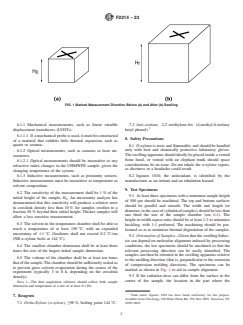
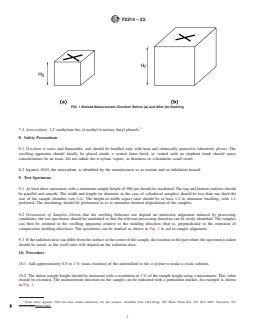
FIG. 1 Marked Measurement Direction Before (a) and After (b) Swelling
6.1.1 Mechanical measurements, such as linear variable 7.2 Anti-oxidant, 2,2'-methylene-bis (4-methyl-6-tertiary
displacement transducers (LVDTs). butyl phenol).
6.1.1.1 If a mechanical probe is used, it must be constructed
8. Safety Precautions
of a material that exhibits little thermal expansion, such as
quartz or ceramic. 8.1 O-xylene is toxic and flammable, and should be handled
only with heat and chemically protective laboratory gloves.
6.1.2 Optical measurements, such as cameras or laser mi-
The swelling apparatus should ideally be placed inside a vented
crometers.
fume hood, or vented with an elephant trunk should space
6.1.2.1 Optical measurements should be insensitive to any
considerations be an issue. Do not inhale the o-xylene vapors,
refractive index changes in the UHMWPE sample, given the
as dizziness or a headache could result.
changing temperature of the system.
8.2 Irganox 1010, the antioxidant, is identified by the
6.1.3 Inductive measurements, such as proximity sensors.
manufacturer as an irritant and an inhalation hazard.
Inductive measurements must be insensitive to temperature or
solvent composition.
9. Test Specimens
6.2 The sensitivity of the measurement shall be 1 % of the
9.1 At least three specimens with a minimum sample height
initial height of the sample, H . An uncertainty analysis has
of 500 μm should be machined. The top and bottom surfaces
demonstrated that this sensitivity will produce a relative error
should be parallel and smooth. The width and length (or
in crosslink density less than 10 % for samples swollen to a
diameter, in the case of cylindrical samples) should be less than
fraction 50 % beyond their initial height. Thicker samples will
one third the size of the sample chamber (see 6.4). The
allow a less sensitive measurement.
height-to-width aspect ratio should be at least 1:2 to minimize
6.3 The solvent in the temperature chamber shall be able to
buckling, with 1:1 preferred. The machining should be per-
reach a temperature of at least 150 °C, with an expanded
formed so as to minimize thermal degradation of the samples.
uncertainty of 61 °C. Gradients shall not exceed 0.2 °C ⁄cm
9.2 Orientation of Samples—Given that the swelling behav-
(NB o-xylene boils at 144 °C).
ior can depend on molecular alignment induced by processing
6.4 The smallest chamber dimension shall be at least three conditions, the test specimens should be machined so that the
relevant processing direction can be easily identified. The
times the size of the largest initial sample dimension.
samples can then be oriented in the swelling apparatus relative
6.5 The volume of the chamber shall be at least ten times
to the molding direction (that is, perpendicular to the extrusion
that of the sample. The chamber should be sufficiently sealed as
of compression molding direction). The specimens can be
to prevent gross solvent evaporation during the course of the
marked as shown in Fig. 1 to aid in sample alignment.
experiment (typically 3 to 8 h, depending on the crosslink
9.3 If the radiation dose can differ from the surface to the
density).
center of the sample, the location in the part where the
NOTE 1—The data acquisition software should collect both sample
dimension and temperature at a rate of at least 0.1 Hz.
Trade name: Irganox 1010 has been found satisfactory for this purpose.
7. Reagents
Available from Ciba-Geigy, 540 White Plains Rd., P.O. Box 2005, Tarrytown, NY
7.1 Ortho-Xylene (o-xylene), ≥98 %, boiling point 144 °C. 10591-9005.
F2214 − 23
specimen is taken should be noted, as the swell ratio will elastic forces and forces derived from the free energy of
depend on the radiation dose. mixing, the following expression is derived for the crosslink
density, ν , as a function of the steady state swelling ratio, the
d
10. Procedure
Flory interaction parameter, and φ , the molar volume of the
4,5
10.1 Add approximately 0.5 to 1 % (mass fraction) of the
solvent.
antioxidant to the o-xylene to make a stock solution.
21 21 22
ln 1 2 q 1q 1χ q
~ !
s s 1 s
ν 5 2 (2)
x 21/3 21
10.2 The initial sample height should be measured with a
φ q 2 0.5q
~ !
1 s s
resolution of 1 % of the sample height using a micrometer. This
12.2.1 The expression in Eq 2 assumes a three-dimensional
value should be recorded. The measurement direction on the
network composed primarily of “H-bonding,” or the formation
sample can be indicated with a permanent marker. An example
of crosslinks along the main chain rather than at the chain ends.
is shown in Fig. 1.
Additionally, network entanglements may partially contribute
10.3 The sample should be pre-wet with o-xylene, then
to the refractive forces. Thus the calculated crosslink density
quickly placed in the dry chamber with the sample correctly
will account for these contributions as well. The expression in
oriented as marked in 10.2.
Eq 2 has been shown to be valid for swelling ratios up to q =
10.4 The initial sample dimension, as determined with the 10, or M >10 000 g/mol.
c
measurement system of the instrument described in 6.1, should
12.3 The expression in Eq 2 can be reduced to calculate the
be recorded.
molecular weight between crosslinks, M , where ν¯ is the
c
10.5 Start recording the sample dimension at a minimum
specific volume of the polymer.
rate of one point every 10 s.
M 5 ~ν¯ν ! (3)
c d
10.6 Introduce the o-xylene stock solution into the chamber
12.4 For polyethylene in o-xylene at 130 °C, the following
at a slow rate to prevent disturbing the sample.
approximate parameters shall be used:
10.7 Raise the temperature of the solvent in the chamber to
Parameter Value
130 6 1 °C.
χ (o-xylene-PE, 130 °C) 0.33 + 0.55/q
1 s
φ (o-xylene) [cm /mol] 136
10.8 Continue to monitor the temperature and sample di-
21 3
ν¯ fg/dm g
mension until equilibrium is achieved (within 610 μm) over a
period of 15 min.
10.9 Decrease the temperature to below 50 °C. Discard the
13. Report
o-xylene in an environmentally responsible manner, and clean
13.1 Report the following information:
the sample cell thoroughly.
13.1.1 Complete identification of the sample,
10.10 Examine the sample after the test is complete. If it has
13.1.2 Solvent and temperature used,
shown signs of cracking, or is yellowed, thermal degradation is
likely to have occurred. This data will be suspect and should be 13.1.3 In
...
This document is not an ASTM standard and is intended only to provide the user of an ASTM standard an indication of what changes have been made to the previous version. Because
it may not be technically possible to adequately depict all changes accurately, ASTM recommends that users consult prior editions as appropriate. In all cases only the current version
of the standard as published by ASTM is to be considered the official document.
Designation: F2214 − 16 F2214 − 23
Standard Test Method for
In Situ Determination of Network Parameters of Crosslinked
Ultra High Molecular Weight Polyethylene (UHMWPE)
This standard is issued under the fixed designation F2214; the number immediately following the designation indicates the year of
original adoption or, in the case of revision, the year of last revision. A number in parentheses indicates the year of last reapproval. A
superscript epsilon (´) indicates an editorial change since the last revision or reapproval.
1. Scope
1.1 This test method describes how the crosslink density, molecular weight between crosslinks, and number of repeat units
between crosslinks in ultra-high ultra high molecular weight polyethylene (UHMWPE) crosslinked by ionizing radiation or by
chemical means can be determined by measuring the swelling ratio of samples immersed in o-xylene. Examples of experimental
techniques used to make these measurements are discussed herein.
1.2 The test method reported here measures the change in height of a sample specimen while it is immersed in the solvent.
Volumetric swell ratios assume that the sample is crosslinked isotropically, and that the change in dimension will be uniform in
all directions. This technique avoids uncertainty induced by solvent evaporation or temperature change.
1.3 The values stated in SI units are to be regarded as standard. No other units of measurement are included in this standard.
1.4 This standard does not purport to address all of the safety concerns, if any, associated with its use. It is the responsibility
of the user of this standard to establish appropriate safety and healthsafety, health, and environmental practices and determine
the applicability of regulatory limitations prior to use.
1.5 This international standard was developed in accordance with internationally recognized principles on standardization
established in the Decision on Principles for the Development of International Standards, Guides and Recommendations issued
by the World Trade Organization Technical Barriers to Trade (TBT) Committee.
2. Referenced Documents
2.1 ASTM Standards:
D2765E177 Test Methods for Determination of Gel Content and Swell Ratio of Crosslinked Ethylene PlasticsPractice for Use
of the Terms Precision and Bias in ASTM Test Methods
E691 Practice for Conducting an Interlaboratory Study to Determine the Precision of a Test Method
3. Terminology
3.1 Definitions of Terms Specific to This Standard:
3.1.1 crosslink density, ν —the theoretical average number of crosslinks per unit volume [mol/dm ].
d
This test method is under the jurisdiction of ASTM Committee F04 on Medical and Surgical Materials and Devices and is the direct responsibility of Subcommittee
F04.15 on Material Test Methods.
Current edition approved Oct. 1, 2016Sept. 1, 2023. Published October 2016October 2023. Originally approved in 2002. Last previous edition approved in 20082016 as
F2214 – 02 (2008).F2214 – 16. DOI: 10.1520/F2214-16.10.1520/F2214-23.
For referenced ASTM standards, visit the ASTM website, www.astm.org, or contact ASTM Customer Service at service@astm.org. For Annual Book of ASTM Standards
volume information, refer to the standard’s Document Summary page on the ASTM website.
Copyright © ASTM International, 100 Barr Harbor Drive, PO Box C700, West Conshohocken, PA 19428-2959. United States
F2214 − 23
3.1.2 molecular weight between crosslinks, M —the theoretical average molecular weight between crosslinks [g/mol].
c
3.1.3 swell ratio, q —the ratio of the volume of the sample in an equilibrium swollen state to its volume in the unswollen state.
s
4. Summary of Test Method
4.1 The height of a cubic specimen is measured, and the specimen is placed in a dry chamber. A selected solvent is chosen
according to the Flory network theory and is introduced into the chamber. The chamber is heated to the reference temperature. The
sample height is monitored as a function of time until steady state (equilibrium) is achieved. The swell ratio is calculated from the
final steady state (equilibrium) height and the initial height.
5. Significance and Use
5.1 This test method is designed to produce data indicative of the degree of crosslinking in ultra high molecular weight
polyethylene that has been crosslinked chemically or by ionizing radiation.
5.2 The results are sensitive to the test temperature, solvent, and method used. For the comparison of data between institutions,
care must be taken to have the same test conditions and reagents.
5.3 The data can be used for dose uniformity analysis, fundamental research, and quality assurance testing.
6. Apparatus
6.1 The apparatus shall include any device that allows a non-invasive measurement of the change in one dimension of the sample
as it swells in the solvent. This measurement could include, but is not limited to:
6.1.1 Mechanical measurements, such as linear variable displacement transducers (LVDTs).
6.1.1.1 If a mechanical probe is used, it must be constructed of a material that exhibits little thermal expansion, such as quartz
or ceramic.
6.1.2 Optical measurements, such as cameras or laser micrometers.
6.1.2.1 Optical measurements should be insensitive to any refractive index changes in the UHMWPE sample, given the changing
temperature of the system.
6.1.3 Inductive measurements, such as proximity sensors. Inductive measurements must be insensitive to temperature or solvent
composition.
6.2 The sensitivity of the measurement shall be 1 % of the initial height of the sample, H . An uncertainty analysis has
demonstrated that this sensitivity will produce a relative error in crosslink density less than 10 % for samples swollen to a fraction
50 % beyond their initial height. Thicker samples will allow a less sensitive measurement.
6.3 The solvent in the temperature chamber shall be able to reach a temperature of at least 150°C,150 °C, with an expanded
uncertainty of 61°C.61 °C. Gradients shall not exceed 0.2°C/cm0.2 °C ⁄cm (NB o-xylene boils at 144°C).144 °C).
6.4 The smallest chamber dimension shall be at least three times the size of the largest initial sample dimension.
6.5 The volume of the chamber shall be at least ten times that of the sample. The chamber should be sufficiently sealed as to
prevent gross solvent evaporation during the course of the experiment (typically 3 to 8 h, depending on the crosslink density).
NOTE 1—The data acquisition software should collect both sample dimension and temperature at a rate of at least 0.1 Hz.
7. Reagents
7.1 Ortho-Xylene (o-xylene), ≥98 %, boiling point 144°C.144 °C.
F2214 − 23
FIG. 1 Marked Measurement Direction Before (a) and After (b) Swelling
7.2 Anti-oxidant, 2,2'-methylene-bis (4-methyl-6-tertiary butyl phenol).
8. Safety Precautions
8.1 O-xylene is toxic and flammable, and should be handled only with heat and chemically protective laboratory gloves. The
swelling apparatus should ideally be placed inside a vented fume hood, or vented with an elephant trunk should space
considerations be an issue. Do not inhale the o-xylene vapors, as dizziness or a headache could result.
8.2 Irganox 1010, the antioxidant, is identified by the manufacturer as an irritant and an inhalation hazard.
9. Test Specimens
9.1 At least three specimens with a minimum sample height of 500 μm should be machined. The top and bottom surfaces should
be parallel and smooth. The width and length (or diameter, in the case of cylindrical samples) should be less than one third the
size of the sample chamber (see 6.4). The height-to-width aspect ratio should be at least 1:2 to minimize buckling, with 1:1
preferred. The machining should be performed so as to minimize thermal degradation of the samples.
9.2 Orientation of Samples—Given that the swelling behavior can depend on molecular alignment induced by processing
conditions, the test specimens should be machined so that the relevant processing direction can be easily identified. The samples
can then be oriented in the swelling apparatus relative to the molding direction (that is, perpendicular to the extrusion of
compression molding direction). The specimens can be marked as shown in Fig. 1 to aid in sample alignment.
9.3 If the radiation dose can differ from the surface to the center of the sample, the location in the part where the specimen is taken
should be noted, as the swell ratio will depend on the radiation dose.
10. Procedure
10.1 Add approximately 0.5 to 1 % (mass fraction) of the antioxidant to the o-xylene to make a stock solution.
10.2 The initial sample height should be measured with a resolution of 1 % of the sample height using a micrometer. This value
should be recorded. The measurement direction on the sample can be indicated with a permanent marker. An example is shown
in Fig. 1.
Trade name: Irganox 1010 has been found satisfactory for this purpose. Available from Ciba-Geigy, 540 White Plains Rd., P.O. Box 2005, Tarrytown, NY
10591–9005.10591-9005.
F2214 − 23
10.3 The sample should be pre-wet with o-xylene, then quickly placed in the dry chamber with the sample correctly oriented as
marked in 10.2.
10.4 The initial sample dimension, as determined with the measurement system of the instrument described in 6.1, should be
recorded.
10.5 Start recording the sample dimension at a minimum rate of 1one point every 10 s.
10.6 Introduce the o-xylene stock solution into the chamber at a slow rate to prevent disturbing the sample.
10.7 Raise the temperature of the solvent in the chamber to 130 6 1°C.1 °C.
10.8 Continue to monitor the temperature and sample dimension until equilibrium is achieved (within 610 μm) over a period of
15 min.
10.9 Decrease the temperature to below 50°C.50 °C. Discard the o-xylene in an environmentally responsible manner, and clean
the sample cell thoroughly.
10.10 Examine the sample after the test is complete. If it has shown signs of cracking, or is yellowed, thermal degradation is likely
to have occurred. This data will be suspect and should be discarded.
11. Calculation of Swell Ratio
11.1 The swell ratio, q , is computed as indicated from the height measurement:
s
q 5 ~V /V !5 ~H /H ! (1)
s f 0 f 0
where:
V = final volume,
f
V = initial volume,
H = final height, and
f
H = initial height.
NOTE 2—This calculation assumes that the sample is isotropic.
12. Calculation of Crosslink Density and Molecular Weight Between Crosslinks
12.1 Given the steady state swell ratio, q , of a polymer immersed in a specific solvent at a particular temperature, the crosslink
s
density, molecular weight between crosslinks, and number of crosslinks/chain can be computed if one knows the Flory interaction
parameter, χ , for the polymer-solvent system.
12.2 From Flory’s network theory, which explains the swell ratio of a polymer-solvent system as a competition between elastic
forces and forces derived from the free energy of mixing, the following expression is derived for the crosslink density, ν , as a
d
4,5
function of the steady state swelling ratio, the Flory interaction parameter, and φ , the molar volume of the solvent.
21 21 22
ln ~12 q !1q 1χ q
s s 1 s
ν 52 (2)
x 21/3 21
φ q 2 0.5q
~ !
1 s s
12.2.1 The expression in Eq 2 assumes a three-dimensional network composed primarily of “H-bonding,” or the formation of
crosslinks along the main chain rather than at the chain ends. Additionally, network entanglements may partially contribute to the
refractive forces. Thus the calculated crosslink density will account for these contributions as well. The expression in Eq 2 has been
shown to be valid for swelling ratios up to q = 10, or M >10 000 g/mol.
c
Flory, P. J., Principles of Polymer Chemistry, Ithaca and London, Cornell University Press, 1953.
Flory, P. J., and Rehner, J., “Statistical mechanics of cross-linked polymer networks. II. Swelling,” J. Chem. Phys., Vol 11, No. 11, 1943, pp. 521–526.
F2214 − 23
TABLE 1 Summary of Mean (±S , Absolute Interlaboratory Uncertainty) Swell Ratio (q), Crosslink Density (ν ), and Molecular Weight
R d
Between Crosslinks (M ) for the Four Samples
c
Molecular Weight
Dose, Swell Ratio, Crosslink Density, Between
kGy q ν [mol/dm ] Crosslinks,
d
M [g/mol]
c
0.17 ±
54.2 3.37 ± 0.26 5,475 ± 804
0.02
71.5 3.12 ± 0.24 0.20 ± 0.03 4,741 ± 723
89.2 3.12 ± 0.24 0.20 ± 0.03 4,724 ± 698
110.1 2.95 ± 0.32 0.23 ± 0.05 4,235 ± 998
TABLE 1 Swell Ratio (unitless)
Number of Repeatability Reproducibility Repeatability Reproducibility
A
Average
Material Laboratories Standard Deviation Standard Deviation Limit Limit
x¯
n S S r R
r R
A-GUR 1050, gamma (nitrogen) 6 2.950 0.183 0.332 0.512 0.930
crosslinked to 11
...