

ASTM D1824-24
(Test Method)Standard Test Method for Apparent Viscosity of Plastisols and Organosols at Low Shear Rates
General Information
- Abstract
SIGNIFICANCE AND USE
5.1 The suitability of a dispersion resin for any given application process is dependent upon its viscosity characteristics.
5.2 The viscosity defines the flow behavior of a plastisol or organosol under low shear. This viscosity relates to the conditions encountered in pouring, casting, molding, and dipping processes.
SCOPE
1.1 This test method covers the measurement of plastisol and organosol viscosity at low shear rates.
1.2 Apparent viscosity at high shear rates is covered in Test Method D1823.
1.3 The values stated in SI units are to be regarded as the standard. The values given in parentheses are for information only.
1.4 This standard does not purport to address all of the safety concerns, if any, associated with its use. It is the responsibility of the user of this standard to establish appropriate safety, health, and environmental practices and determine the applicability of regulatory limitations prior to use.
Note 1: This test method resembles ISO 3219-1977 in title only. The content is significantly different.
1.5 This international standard was developed in accordance with internationally recognized principles on standardization established in the Decision on Principles for the Development of International Standards, Guides and Recommendations issued by the World Trade Organization Technical Barriers to Trade (TBT) Committee.
- Status
- Published
- Publication Date
- 31-Mar-2024
- Technical Committee
- D20 - Plastics
- Drafting Committee
- D20.15 - Thermoplastic Materials
Buy Documents

ASTM D1824-24 - Standard Test Method for Apparent Viscosity of Plastisols and Organosols at Low Shear Rates
REDLINE ASTM D1824-24 - Standard Test Method for Apparent Viscosity of Plastisols and Organosols at Low Shear Rates
Overview
ASTM D1824-24: Standard Test Method for Apparent Viscosity of Plastisols and Organosols at Low Shear Rates provides a widely recognized procedure for measuring the apparent viscosity of plastisols and organosols when subjected to low shear rates. Developed and maintained by ASTM International, this standard applies primarily to PVC plastisol and PVC organosol formulations commonly used in the plastics and coatings industries. The viscosity characteristics defined by this method are critical for assessing the flow properties and processability of dispersion resins during industrial operations such as pouring, casting, molding, and dipping.
Proper viscosity measurement at low shear rates is essential for product consistency, quality assurance, and process optimization in manufacturing environments dealing with polymer dispersions. The method utilizes a rotational viscometer to evaluate the flow resistance of samples, reported in SI units, ensuring international relevance and comparability.
Key Topics
- Apparent Viscosity: Focuses on the resistance to flow in plastisols and organosols under low shear conditions, which reflects how the material will behave in real-world manufacturing or application processes.
- Plastisol and Organosol Analysis: Applies specifically to poly(vinyl chloride) (PVC) dispersion resins suspended in plasticizers (plastisols) or in a combination of plasticizer and volatile organic liquids (organosols).
- Low Shear Measurement: Critical for processes like pouring and casting, where material is not exposed to high mechanical force.
- Viscometer Requirements: Details the use and calibration of concentric cylinder rotational viscometers, stressing accurate temperature control and sample conditioning for valid results.
- Sample Conditioning: Specifies maintenance of materials at controlled temperature and humidity to ensure reliable viscosity measurements.
- Precision and Bias: Outlines procedures for repeatability and reproducibility, with reference to interlaboratory studies to validate the method's reliability.
Applications
ASTM D1824-24 is essential for industries and laboratories involved in the preparation, analysis, and use of plastisol and organosol materials. Key application areas include:
- Quality Control: Manufacturers of PVC coatings, sealants, and molded products use this method to verify batch-to-batch consistency and optimize formulations for processability.
- Process Optimization: Engineers and technicians depend on precise viscosity data to adjust formulations or processing parameters, ensuring smooth operations in pouring, casting, molding, or dipping.
- Product Development: R&D teams utilize this standard to benchmark new resin blends or plasticizers regarding their low-shear flow behavior.
- Regulatory Compliance: Adhering to internationally recognized methods like ASTM D1824-24 helps companies fulfill quality assurance obligations and client specifications.
- Comparison and Validation: The results obtained help in evaluating alternative resins or process modifications for desired viscosity performance.
Related Standards
- ASTM D1823: Provides methods for measuring apparent viscosity at high shear rates, complementing D1824 for a full profile of material behavior.
- ASTM D883: Offers relevant terminology related to plastics and is cited within D1824 for vocabulary consistency.
- ASTM D1755: Specifies requirements for poly(vinyl chloride) resins used in plastisols and organosols.
- ASTM E1: Outlines specifications for liquid-in-glass thermometers, a key temperature measurement tool for the test.
- ASTM E456: Defines terminology relating to quality and statistics for test methods.
- ASTM E691: Provides guidance on conducting interlaboratory studies to determine precision.
- ASTM E2935: Details practice for evaluating testing process equivalency.
- ISO 3219-1977: An international reference for rotational viscometer measurement of liquid polymers; however, D1824-24 content significantly differs from ISO 3219.
Keywords: ASTM D1824, apparent viscosity, low shear rate viscometry, PVC plastisol, PVC organosol, rotational viscometer, quality control, polymer dispersion, plastics testing.
Relations
- Effective Date
- 01-Apr-2024
- Effective Date
- 01-Apr-2024
- Effective Date
- 01-May-2016
- Effective Date
- 01-Apr-2024
- Effective Date
- 01-Apr-2024
- Effective Date
- 01-Apr-2024
- Effective Date
- 01-Apr-2024
- Effective Date
- 01-Apr-2024
Buy Documents
ASTM D1824-24 - Standard Test Method for Apparent Viscosity of Plastisols and Organosols at Low Shear Rates
REDLINE ASTM D1824-24 - Standard Test Method for Apparent Viscosity of Plastisols and Organosols at Low Shear Rates
Get Certified
Connect with accredited certification bodies for this standard

DIN CERTCO
DIN Group product certification.

Smithers Quality Assessments
US management systems and product certification.
Sponsored listings
Frequently Asked Questions
ASTM D1824-24 is a standard published by ASTM International. Its full title is "Standard Test Method for Apparent Viscosity of Plastisols and Organosols at Low Shear Rates". This standard covers: SIGNIFICANCE AND USE 5.1 The suitability of a dispersion resin for any given application process is dependent upon its viscosity characteristics. 5.2 The viscosity defines the flow behavior of a plastisol or organosol under low shear. This viscosity relates to the conditions encountered in pouring, casting, molding, and dipping processes. SCOPE 1.1 This test method covers the measurement of plastisol and organosol viscosity at low shear rates. 1.2 Apparent viscosity at high shear rates is covered in Test Method D1823. 1.3 The values stated in SI units are to be regarded as the standard. The values given in parentheses are for information only. 1.4 This standard does not purport to address all of the safety concerns, if any, associated with its use. It is the responsibility of the user of this standard to establish appropriate safety, health, and environmental practices and determine the applicability of regulatory limitations prior to use. Note 1: This test method resembles ISO 3219-1977 in title only. The content is significantly different. 1.5 This international standard was developed in accordance with internationally recognized principles on standardization established in the Decision on Principles for the Development of International Standards, Guides and Recommendations issued by the World Trade Organization Technical Barriers to Trade (TBT) Committee.
SIGNIFICANCE AND USE 5.1 The suitability of a dispersion resin for any given application process is dependent upon its viscosity characteristics. 5.2 The viscosity defines the flow behavior of a plastisol or organosol under low shear. This viscosity relates to the conditions encountered in pouring, casting, molding, and dipping processes. SCOPE 1.1 This test method covers the measurement of plastisol and organosol viscosity at low shear rates. 1.2 Apparent viscosity at high shear rates is covered in Test Method D1823. 1.3 The values stated in SI units are to be regarded as the standard. The values given in parentheses are for information only. 1.4 This standard does not purport to address all of the safety concerns, if any, associated with its use. It is the responsibility of the user of this standard to establish appropriate safety, health, and environmental practices and determine the applicability of regulatory limitations prior to use. Note 1: This test method resembles ISO 3219-1977 in title only. The content is significantly different. 1.5 This international standard was developed in accordance with internationally recognized principles on standardization established in the Decision on Principles for the Development of International Standards, Guides and Recommendations issued by the World Trade Organization Technical Barriers to Trade (TBT) Committee.
ASTM D1824-24 is classified under the following ICS (International Classification for Standards) categories: 83.080.01 - Plastics in general. The ICS classification helps identify the subject area and facilitates finding related standards.
ASTM D1824-24 has the following relationships with other standards: It is inter standard links to ASTM D1824-16, ASTM D1823-24, ASTM D1823-16, ASTM D3468/D3468M-99(2020), ASTM D3794-22, ASTM D1755-21, ASTM F3337-23, ASTM F942-18(2023)e1. Understanding these relationships helps ensure you are using the most current and applicable version of the standard.
ASTM D1824-24 is available in PDF format for immediate download after purchase. The document can be added to your cart and obtained through the secure checkout process. Digital delivery ensures instant access to the complete standard document.
Standards Content (Sample)
This international standard was developed in accordance with internationally recognized principles on standardization established in the Decision on Principles for the
Development of International Standards, Guides and Recommendations issued by the World Trade Organization Technical Barriers to Trade (TBT) Committee.
Designation: D1824 − 24
Standard Test Method for
Apparent Viscosity of Plastisols and Organosols at Low
Shear Rates
This standard is issued under the fixed designation D1824; the number immediately following the designation indicates the year of
original adoption or, in the case of revision, the year of last revision. A number in parentheses indicates the year of last reapproval. A
superscript epsilon (´) indicates an editorial change since the last revision or reapproval.
This standard has been approved for use by agencies of the U.S. Department of Defense.
1. Scope* E691 Practice for Conducting an Interlaboratory Study to
Determine the Precision of a Test Method
1.1 This test method covers the measurement of plastisol
E2935 Practice for Evaluating Equivalence of Two Testing
and organosol viscosity at low shear rates.
Processes
1.2 Apparent viscosity at high shear rates is covered in Test
2.2 ISO Standard:
Method D1823.
ISO 3219-1977: Polymers in the Liquid, Emulsified, or
1.3 The values stated in SI units are to be regarded as the Dispersed State—Determination of Viscosity With a Ro-
tational Viscometer Working at a Defined Shear Rate
standard. The values given in parentheses are for information
only.
3. Terminology
1.4 This standard does not purport to address all of the
3.1 For definitions of terms used in this test method and
safety concerns, if any, associated with its use. It is the
associated with plastics issues refer to the terminology con-
responsibility of the user of this standard to establish appro-
tained in D883.
priate safety, health, and environmental practices and deter-
mine the applicability of regulatory limitations prior to use. 3.2 For terms relating to precision and bias and associated
issues, the terms used in this test method are in accordance
NOTE 1—This test method resembles ISO 3219-1977 in title only. The
with the definitions in Terminology E456.
content is significantly different.
3.3 Definitions:
1.5 This international standard was developed in accor-
3.3.1 organosol, n—a suspension of a finely divided poly-
dance with internationally recognized principles on standard-
mer in a plasticizer, together with a volatile organic liquid.
ization established in the Decision on Principles for the
Development of International Standards, Guides and Recom-
3.3.2 plasticizer, n—a substance incorporated in a material
mendations issued by the World Trade Organization Technical
to increase its workability, flexibility, or distensibility.
Barriers to Trade (TBT) Committee.
3.3.3 plastisol, n—a liquid suspension of a finely divided
PVC polymer or copolymer in a plasticizer.
2. Referenced Documents
3.3.4 poly(vinyl chloride), n—a polymer prepared by the
2.1 ASTM Standards:
polymerization of vinyl chloride as the sole monomer (vinyl
D883 Terminology Relating to Plastics
chloride content in monomer not less than 99 %).
D1755 Specification for Poly(Vinyl Chloride) Resins
3.3.5 viscosity, n—the property of resistance of flow exhib-
D1823 Test Method for Apparent Viscosity of Plastisols and
ited within the body of a material.
Organosols at High Shear Rates by Extrusion Viscometer
3.3.5.1 Discussion—In testing, the ratio of the shearing
E1 Specification for ASTM Liquid-in-Glass Thermometers
stress to the rate of shear of a fluid. Viscosity is usually taken
E456 Terminology Relating to Quality and Statistics
to mean “Newtonian viscosity,” in which case the ratio of
shearing stress to rate of shearing strain is constant. In
This test method is under the jurisdiction of ASTM Committee D20 on Plastics
non-Newtonian behavior which is the usual case with plastics
and is the direct responsibility of Subcommittee D20.15 on Thermoplastic Materi-
materials, the ratio varies with the shearing rate. Such ratios are
als.
often called the “apparent viscosities” at the corresponding
Current edition approved April 1, 2024. Published April 2024. Originally
approved in 1961. Last previous edition approved in 2016 as D1824 - 16. shear rates. (See viscosity coefficient.) (IUPAC symbol: η)
DOI:10.1520/D1824-24.
(ISO)
For referenced ASTM standards, visit the ASTM website, www.astm.org, or
contact ASTM Customer Service at service@astm.org. For Annual Book of ASTM
Standards volume information, refer to the standard’s Document Summary page on Available from American National Standards Institute (ANSI), 25 W. 43rd St.,
the ASTM website. 4th Floor, New York, NY 10036, http://www.ansi.org.
*A Summary of Changes section appears at the end of this standard
Copyright © ASTM International, 100 Barr Harbor Drive, PO Box C700, West Conshohocken, PA 19428-2959. United States
D1824 − 24
4. Summary of Test Method
4.1 The sample is conditioned to the proper temperature and
its viscosity is determined.
5. Significance and Use
5.1 The suitability of a dispersion resin for any given
application process is dependent upon its viscosity character-
istics.
5.2 The viscosity defines the flow behavior of a plastisol or
organosol under low shear. This viscosity relates to the
conditions encountered in pouring, casting, molding, and
dipping processes.
6. Apparatus
6.1 Viscometer, Concentric Cylinder Rotational—The es-
sential instrumentation required providing the minimum rota-
tional viscometer analytical capabilities include:
6.1.1 A drive motor to apply a unidirectional displacement
to the specimen at a rate from 0.5 to 60 r/min constant to
60.5 %.
6.1.2 A force sensor to measurement the torque developed
by the specimen by the rotational element.
6.1.3 A coupling shaft, or other means, to transmit the
rotational displacement from the motor to the spindle.
NOTE 2—It is helpful to have a mark on the shaft to indicate appropriate
test fluid level.
6.1.4 A rotational element, spindle or tool of the right
circular cylindrical shape as shown in Fig. 1, to fix the
specimen between the drive shaft and a stationary position.
NOTE 3—The rotational element dimensions L and D, are selected so
that the measured viscosity is between 10 and 90 % of the range of that
FIG. 1 Rotational Spindle Configuration
element.
6.1.5 A data collection device, to provide a means of
temperature measuring devices such as liquid-in-glass
acquiring, storing, and displaying measured or calculated
thermometers, thermocouples, or platinum resistance ther-
signals, or both. The minimum output signals required for
mometers having equivalent or better accuracy and precision,
rotational viscometry are torque, rotational speed, temperature
while covering the temperature range of Thermometer 37C.
and time.
(Warning—Mercury has been designated by EPA and many
NOTE 4—Manual observation and recording of data are acceptable.
state agencies as a hazardous material that can cause central
nervous system, kidney, and liver damage. Mercury, or its
6.1.6 A stand to support, level, and adjust the height of the
vapor, may be hazardous to health and corrosive to materials.
drive motor, shaft and rotational element.
Caution should be taken when handling mercury and mercury-
6.1.7 Auxiliary instrumentation considered useful in con-
containing products. See the applicable product
...
This document is not an ASTM standard and is intended only to provide the user of an ASTM standard an indication of what changes have been made to the previous version. Because
it may not be technically possible to adequately depict all changes accurately, ASTM recommends that users consult prior editions as appropriate. In all cases only the current version
of the standard as published by ASTM is to be considered the official document.
Designation: D1824 − 16 D1824 − 24
Standard Test Method for
Apparent Viscosity of Plastisols and Organosols at Low
Shear Rates
This standard is issued under the fixed designation D1824; the number immediately following the designation indicates the year of
original adoption or, in the case of revision, the year of last revision. A number in parentheses indicates the year of last reapproval. A
superscript epsilon (´) indicates an editorial change since the last revision or reapproval.
This standard has been approved for use by agencies of the U.S. Department of Defense.
1. Scope*
1.1 This test method covers the measurement of plastisol and organosol viscosity at low shear rates.
1.2 Apparent viscosity at high shear rates is covered in Test Method D1823.
1.3 The values stated in SI units are to be regarded as the standard. The values given in parentheses are for information only.
1.4 This standard does not purport to address all of the safety concerns, if any, associated with its use. It is the responsibility
of the user of this standard to establish appropriate safety and healthsafety, health, and environmental practices and determine
the applicability of regulatory limitations prior to use.
NOTE 1—This test method resembles ISO 3219-1977 in title only. The content is significantly different.
1.5 This international standard was developed in accordance with internationally recognized principles on standardization
established in the Decision on Principles for the Development of International Standards, Guides and Recommendations issued
by the World Trade Organization Technical Barriers to Trade (TBT) Committee.
2. Referenced Documents
2.1 ASTM Standards:
D883 Terminology Relating to Plastics
D1755 Specification for Poly(Vinyl Chloride) Resins
D1823 Test Method for Apparent Viscosity of Plastisols and Organosols at High Shear Rates by Extrusion Viscometer
E1 Specification for ASTM Liquid-in-Glass Thermometers
E456 Terminology Relating to Quality and Statistics
E691 Practice for Conducting an Interlaboratory Study to Determine the Precision of a Test Method
E2935 Practice for Evaluating Equivalence of Two Testing Processes
2.2 ISO Standard:
ISO 3219-1977: Polymers in the Liquid, Emulsified, or Dispersed State—Determination of Viscosity With a Rotational
Viscometer Working at a Defined Shear Rate
This test method is under the jurisdiction of ASTM Committee D20 on Plastics and is the direct responsibility of Subcommittee D20.15 on Thermoplastic Materials.
Current edition approved April 1, 2016April 1, 2024. Published April 2016April 2024. Originally approved in 1961. Last previous edition approved in 20102016 as
D1824 - 95D1824 - 16.(2010). DOI:10.1520/D1824-16. DOI:10.1520/D1824-24.
For referenced ASTM standards, visit the ASTM website, www.astm.org, or contact ASTM Customer Service at service@astm.org. For Annual Book of ASTM Standards
volume information, refer to the standard’s Document Summary page on the ASTM website.
Available from American National Standards Institute (ANSI), 25 W. 43rd St., 4th Floor, New York, NY 10036, http://www.ansi.org.
*A Summary of Changes section appears at the end of this standard
Copyright © ASTM International, 100 Barr Harbor Drive, PO Box C700, West Conshohocken, PA 19428-2959. United States
D1824 − 24
3. Terminology
3.1 For definitions of terms used in this test method and associated with plastics issues refer to the terminology contained in D883.
3.2 For terms relating to precision and bias and associated issues, the terms used in this test method are in accordance with the
definitions in Terminology E456.
3.3 Definitions:
3.3.1 organosol, n—a suspension of a finely divided polymer in a plasticizer, together with a volatile organic liquid.
3.3.2 plasticizer, n—a substance incorporated in a material to increase its workability, flexibility, or distensibility.
3.3.3 plastisol, n—a liquid suspension of a finely divided PVC polymer or copolymer in a plasticizer.
3.3.4 poly(vinyl chloride), n—a polymer prepared by the polymerization of vinyl chloride as the sole monomer (vinyl chloride
content in monomer not less than 99 %).
3.3.5 viscosity, n—the property of resistance of flow exhibited within the body of a material.
3.3.5.1 Discussion—
In testing, the ratio of the shearing stress to the rate of shear of a fluid. Viscosity is usually taken to mean “Newtonian viscosity,”
in which case the ratio of shearing stress to rate of shearing strain is constant. In non-Newtonian behavior which is the usual case
with plastics materials, the ratio varies with the shearing rate. Such ratios are often called the “apparent viscosities” at the
corresponding shear rates. (See viscosity coefficient.) (IUPAC symbol: η) (ISO)
4. Summary of Test Method
4.1 The sample is conditioned to the proper temperature and its viscosity is determined.
5. Significance and Use
5.1 The suitability of a dispersion resin for any given application process is dependent upon its viscosity characteristics.
5.2 The viscosity defines the flow behavior of a plastisol or organosol under low shear. This viscosity relates to the conditions
encountered in pouring, casting, molding, and dipping processes.
6. Apparatus
6.1 Viscometer, Concentric Cylinder Rotational—The essential instrumentation required providing the minimum rotational
viscometer analytical capabilities include:
6.1.1 A drive motor to apply a unidirectional displacement to the specimen at a rate from 0.5 to 60 r/min constant to 60.5 %.
6.1.2 A force sensor to measurement the torque developed by the specimen by the rotational element.
6.1.3 A coupling shaft, or other means, to transmit the rotational displacement from the motor to the spindle.
NOTE 2—It is helpful to have a mark on the shaft to indicate appropriate test fluid level.
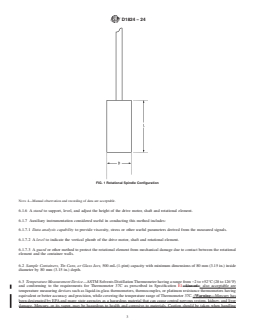
6.1.4 A rotational element, spindle or tool of the right circular cylindrical shape as shown in Fig. 1, to fix the specimen between
the drive shaft and a stationary position.
NOTE 3—The rotational element dimensions L and D, are selected so that the measured viscosity is between 10 and 90 % of the range of that element.
6.1.5 A data collection device, to provide a means of acquiring, storing, and displaying measured or calculated signals, or both.
The minimum output signals required for rotational viscometry are torque, rotational speed, temperature and time.
D1824 − 24
FIG. 1 Rotational Spindle Configuration
NOTE 4—Manual observation and recording of data are acceptable.
6.1.6 A stand to support, level, and adjust the height of the drive motor, shaft and rotational element.
6.1.7 Auxiliary instrumentation considered useful in conducting this method includes:
6.1.7.1 Data analysis capability to provide viscosity, stress or other useful parameters derived from the measured signals.
6.1.7.2 A level to indicate the vertical plumb of the drive motor, shaft and rotational element.
6.1.7.3 A guard or other method to protect the rotational element from mechanical damage due to contact between the rotational
element and the container walls.
6.2 Sample Containers, Tin Cans, or Glass Jars, 500-mL (1-pint) capacity with minimum dimensions of 80 mm (3.15 in.) inside
diameter by 80 mm (3.15 in.) depth.
6.3 Temperature Measurement Device—ASTM Solvents Distillation Thermometer having a range from −2 to +52°C (28 to 126°F)
and conforming to the requirements for Thermometer 37C as prescribed in Specification E1. Use of ; also acceptable are
temperature measuring devices such as liquid-in-glass thermometers, thermocouples, or platinum resistance thermometers having
equivalent or better accuracy and precision, while covering the temperature range of Thermometer 37C. (Warning—Mercury has
been desig
...