

ASTM D6954-24
(Guide)Standard Guide for Exposing and Testing Plastics that Degrade in the Environment by a Combination of Oxidation and Biodegradation
General Information
- Abstract
SIGNIFICANCE AND USE
5.1 This guide is a sequential assembly of extant but unconnected standard tests and practices for the oxidation and biodegradation of plastics, which will permit the comparison and ranking of the overall rate of environmental degradation of plastics that require thermal or photooxidation to initiate degradation. Each degradation stage is independently evaluated to allow a combined evaluation of a polymer’s environmental performance under a controlled laboratory setting. This enables a laboratory assessment of its disposal performance in, soil, municipal or industrial compost, landfill, and water and for use in agricultural products such as mulch film without detriment to that particular environment.
Note 5: For determining biodegradation rates under municipal or industrial composting conditions, Specification D6400 is to be used, including test methods and conditions as specified.
5.2 The correlation of results from this guide to actual disposal environments (for example, agricultural mulch films, municipal or industrial composting, or landfill applications) has not been determined, and as such, the results should be used only for comparative and ranking purposes.
5.3 The results of laboratory exposure cannot be directly extrapolated to estimate absolute rate of deterioration by the environment because the acceleration factor is material dependent and can be significantly different for each material and for different formulations of the same material. However, exposure of a similar material of known outdoor performance, a control, at the same time as the test specimens allows comparison of the durability relative to that of the control under the test conditions.
SCOPE
1.1 This guide provides a framework or road map to compare and rank the controlled laboratory rates of degradation and degree of physical property losses of polymers by thermal and photooxidation processes as well as the biodegradation and ecological impacts in defined applications and disposal environments after degradation. Disposal environments range from exposure in soil, landfill, and municipal or industrial compost in which thermal oxidation may occur and land cover and agricultural use in which photooxidation may also occur.
1.2 In this guide, established ASTM International standards are used in three tiers for accelerating and measuring the loss in properties and molecular weight by both thermal and photooxidation processes and other abiotic processes (Tier 1), measuring biodegradation (Tier 2), and assessing ecological impact of the products from these processes (Tier 3).
1.3 The Tier 1 conditions selected for thermal oxidation and photooxidation accelerate the degradation likely to occur in a chosen application and disposal environment. The conditions should include a range of humidity or water concentrations based on the application and disposal environment in mind. The measured rate of degradation at typical oxidation temperatures is required to compare and rank the polymers being evaluated in that chosen application to reach a molecular weight that constitutes a demonstrable biodegradable residue (using ASTM International biometer tests for CO2 evolution appropriate to the chosen environment). By way of example, accelerated oxidation data must be obtained at temperatures and humidity ranges typical in that chosen application and disposal environment, for example, in soil (20 to 30°C), landfill (20 to 35°C), and municipal or industrial composting facilities (30 to 65°C). For applications in soils, local temperatures and humidity ranges must be considered as they vary widely with geography. At least one temperature must be reasonably close to the end use or disposal temperature, but under no circumstances should this be more than 20°C away from the removed that temperature. It must also be established that the polymer does not undergo a phase change, such as glass transition temperature (Tg) within the...
- Status
- Published
- Publication Date
- 31-Dec-2023
- Technical Committee
- D20 - Plastics
- Drafting Committee
- D20.96 - Environmentally Degradable Plastics and Biobased Products
Buy Documents
ASTM D6954-24 - Standard Guide for Exposing and Testing Plastics that Degrade in the Environment by a Combination of Oxidation and Biodegradation
REDLINE ASTM D6954-24 - Standard Guide for Exposing and Testing Plastics that Degrade in the Environment by a Combination of Oxidation and Biodegradation
Overview
ASTM D6954-24 is a comprehensive standard guide developed by ASTM International for exposing and testing plastics that degrade in the environment through a combination of oxidation and biodegradation. This guide provides a structured framework to compare and rank the degradation rates of polymers under controlled laboratory conditions, simulating environmental settings such as soil, landfill, water, and municipal or industrial compost environments. By leveraging a series of established test methods, ASTM D6954-24 enables stakeholders to assess the environmental performance of plastics that require thermal or photooxidation to initiate degradation, supporting sustainable product development and responsible end-of-life management.
Key Topics
- Tiered Testing System: The standard employs a three-tier approach:
- Tier 1 - Abiotic Degradation: Evaluates loss of physical properties and molecular weight via thermal and photooxidation, accelerating degradation processes typical of various disposal environments.
- Tier 2 - Biodegradation Assessment: Measures the biodegradability of the oxidized plastic residues in environments such as soil, compost, or landfill, using standard CO₂ evolution tests.
- Tier 3 - Ecotoxicity and Impact: Assesses the ecological impact of the degraded residues, ensuring they do not produce harmful or persistent substances.
- Controlled Laboratory Conditions: Simulations use specific humidity, temperature, and exposure durations relevant to targeted disposal or use scenarios.
- Comparative Ranking: Results allow for comparison and ranking of different polymers or formulations under equivalent test settings.
- Limitations: Laboratory results are intended for comparative purposes and cannot be directly extrapolated to predict absolute environmental degradation rates in real-world settings.
Applications
ASTM D6954-24 is applicable to a wide range of industries and stakeholders, including polymer manufacturers, product designers, regulators, and environmental assessors. Key applications include:
- Product Development: Facilitates the design of environmentally degradable plastic products by providing a clear protocol for evaluating environmental performance.
- Agricultural Films: Supports assessment of plastic mulch films and other agricultural plastics to ensure safe degradation without environmental harm.
- Packaging and Single-Use Plastics: Assists in evaluating alternative materials for packaging, carrier bags, and disposables with consideration for eventual breakdown in landfill or compost environments.
- Regulatory Compliance: Offers a framework for demonstrating that plastics meet national or international sustainability initiatives or requirements for environmental degradability.
- Eco-Labeling and Claims: Provides substantiated, comparative data to support eco-labeling initiatives, demonstrating biodegradability under various controlled environments.
Related Standards
ASTM D6954-24 references and complements numerous other standards that define specific methodologies for testing and assessment:
- ASTM D6400: Specification for labeling of plastics designed to be aerobically composted in municipal or industrial facilities.
- ASTM D3826: Practice for determining degradation end point in degradable polyethylene and polypropylene using tensile tests.
- ASTM D5071, D5208, D5272: Practices for exposing and testing photodegradable plastics under specific conditions.
- ASTM D5338, D5526, D5988: Test methods for determining aerobic and anaerobic biodegradation of plastic materials in composting and soil environments.
- ASTM D3987: Practice for shake extraction for toxicity assessment.
- OECD Guidelines 207 & 208: Standardized ecotoxicity test methods for earthworms and terrestrial plants.
- EPA Reference Methods: For assessing regulated substances and environmental safety.
Keywords: environmental degradation of plastics, oxidation, biodegradation, ecotoxicity, degradable polymers, ASTM D6954-24, sustainable plastics, photooxidation, testing plastics for environmental impact
By following ASTM D6954-24, stakeholders can rigorously and consistently evaluate the environmental degradability of plastics, enabling more sustainable material choices and reducing potential environmental impacts.
Relations
- Effective Date
- 01-Jan-2024
- Effective Date
- 01-Feb-2024
- Effective Date
- 01-Nov-2023
- Referred By
ASTM D7444-18a - Standard Practice for Heat and Humidity Aging of Oxidatively Degradable Plastics - Effective Date
- 01-Jan-2024
- Effective Date
- 01-Jan-2024
Buy Documents
ASTM D6954-24 - Standard Guide for Exposing and Testing Plastics that Degrade in the Environment by a Combination of Oxidation and Biodegradation
REDLINE ASTM D6954-24 - Standard Guide for Exposing and Testing Plastics that Degrade in the Environment by a Combination of Oxidation and Biodegradation
Get Certified
Connect with accredited certification bodies for this standard

DIN CERTCO
DIN Group product certification.

Smithers Quality Assessments
US management systems and product certification.
Sponsored listings
Frequently Asked Questions
ASTM D6954-24 is a guide published by ASTM International. Its full title is "Standard Guide for Exposing and Testing Plastics that Degrade in the Environment by a Combination of Oxidation and Biodegradation". This standard covers: SIGNIFICANCE AND USE 5.1 This guide is a sequential assembly of extant but unconnected standard tests and practices for the oxidation and biodegradation of plastics, which will permit the comparison and ranking of the overall rate of environmental degradation of plastics that require thermal or photooxidation to initiate degradation. Each degradation stage is independently evaluated to allow a combined evaluation of a polymer’s environmental performance under a controlled laboratory setting. This enables a laboratory assessment of its disposal performance in, soil, municipal or industrial compost, landfill, and water and for use in agricultural products such as mulch film without detriment to that particular environment. Note 5: For determining biodegradation rates under municipal or industrial composting conditions, Specification D6400 is to be used, including test methods and conditions as specified. 5.2 The correlation of results from this guide to actual disposal environments (for example, agricultural mulch films, municipal or industrial composting, or landfill applications) has not been determined, and as such, the results should be used only for comparative and ranking purposes. 5.3 The results of laboratory exposure cannot be directly extrapolated to estimate absolute rate of deterioration by the environment because the acceleration factor is material dependent and can be significantly different for each material and for different formulations of the same material. However, exposure of a similar material of known outdoor performance, a control, at the same time as the test specimens allows comparison of the durability relative to that of the control under the test conditions. SCOPE 1.1 This guide provides a framework or road map to compare and rank the controlled laboratory rates of degradation and degree of physical property losses of polymers by thermal and photooxidation processes as well as the biodegradation and ecological impacts in defined applications and disposal environments after degradation. Disposal environments range from exposure in soil, landfill, and municipal or industrial compost in which thermal oxidation may occur and land cover and agricultural use in which photooxidation may also occur. 1.2 In this guide, established ASTM International standards are used in three tiers for accelerating and measuring the loss in properties and molecular weight by both thermal and photooxidation processes and other abiotic processes (Tier 1), measuring biodegradation (Tier 2), and assessing ecological impact of the products from these processes (Tier 3). 1.3 The Tier 1 conditions selected for thermal oxidation and photooxidation accelerate the degradation likely to occur in a chosen application and disposal environment. The conditions should include a range of humidity or water concentrations based on the application and disposal environment in mind. The measured rate of degradation at typical oxidation temperatures is required to compare and rank the polymers being evaluated in that chosen application to reach a molecular weight that constitutes a demonstrable biodegradable residue (using ASTM International biometer tests for CO2 evolution appropriate to the chosen environment). By way of example, accelerated oxidation data must be obtained at temperatures and humidity ranges typical in that chosen application and disposal environment, for example, in soil (20 to 30°C), landfill (20 to 35°C), and municipal or industrial composting facilities (30 to 65°C). For applications in soils, local temperatures and humidity ranges must be considered as they vary widely with geography. At least one temperature must be reasonably close to the end use or disposal temperature, but under no circumstances should this be more than 20°C away from the removed that temperature. It must also be established that the polymer does not undergo a phase change, such as glass transition temperature (Tg) within the...
SIGNIFICANCE AND USE 5.1 This guide is a sequential assembly of extant but unconnected standard tests and practices for the oxidation and biodegradation of plastics, which will permit the comparison and ranking of the overall rate of environmental degradation of plastics that require thermal or photooxidation to initiate degradation. Each degradation stage is independently evaluated to allow a combined evaluation of a polymer’s environmental performance under a controlled laboratory setting. This enables a laboratory assessment of its disposal performance in, soil, municipal or industrial compost, landfill, and water and for use in agricultural products such as mulch film without detriment to that particular environment. Note 5: For determining biodegradation rates under municipal or industrial composting conditions, Specification D6400 is to be used, including test methods and conditions as specified. 5.2 The correlation of results from this guide to actual disposal environments (for example, agricultural mulch films, municipal or industrial composting, or landfill applications) has not been determined, and as such, the results should be used only for comparative and ranking purposes. 5.3 The results of laboratory exposure cannot be directly extrapolated to estimate absolute rate of deterioration by the environment because the acceleration factor is material dependent and can be significantly different for each material and for different formulations of the same material. However, exposure of a similar material of known outdoor performance, a control, at the same time as the test specimens allows comparison of the durability relative to that of the control under the test conditions. SCOPE 1.1 This guide provides a framework or road map to compare and rank the controlled laboratory rates of degradation and degree of physical property losses of polymers by thermal and photooxidation processes as well as the biodegradation and ecological impacts in defined applications and disposal environments after degradation. Disposal environments range from exposure in soil, landfill, and municipal or industrial compost in which thermal oxidation may occur and land cover and agricultural use in which photooxidation may also occur. 1.2 In this guide, established ASTM International standards are used in three tiers for accelerating and measuring the loss in properties and molecular weight by both thermal and photooxidation processes and other abiotic processes (Tier 1), measuring biodegradation (Tier 2), and assessing ecological impact of the products from these processes (Tier 3). 1.3 The Tier 1 conditions selected for thermal oxidation and photooxidation accelerate the degradation likely to occur in a chosen application and disposal environment. The conditions should include a range of humidity or water concentrations based on the application and disposal environment in mind. The measured rate of degradation at typical oxidation temperatures is required to compare and rank the polymers being evaluated in that chosen application to reach a molecular weight that constitutes a demonstrable biodegradable residue (using ASTM International biometer tests for CO2 evolution appropriate to the chosen environment). By way of example, accelerated oxidation data must be obtained at temperatures and humidity ranges typical in that chosen application and disposal environment, for example, in soil (20 to 30°C), landfill (20 to 35°C), and municipal or industrial composting facilities (30 to 65°C). For applications in soils, local temperatures and humidity ranges must be considered as they vary widely with geography. At least one temperature must be reasonably close to the end use or disposal temperature, but under no circumstances should this be more than 20°C away from the removed that temperature. It must also be established that the polymer does not undergo a phase change, such as glass transition temperature (Tg) within the...
ASTM D6954-24 is classified under the following ICS (International Classification for Standards) categories: 83.080.01 - Plastics in general. The ICS classification helps identify the subject area and facilitates finding related standards.
ASTM D6954-24 has the following relationships with other standards: It is inter standard links to ASTM D6954-18, ASTM D883-24, ASTM D883-23, ASTM D7444-18a, ASTM D7475-20. Understanding these relationships helps ensure you are using the most current and applicable version of the standard.
ASTM D6954-24 is available in PDF format for immediate download after purchase. The document can be added to your cart and obtained through the secure checkout process. Digital delivery ensures instant access to the complete standard document.
Standards Content (Sample)
This international standard was developed in accordance with internationally recognized principles on standardization established in the Decision on Principles for the
Development of International Standards, Guides and Recommendations issued by the World Trade Organization Technical Barriers to Trade (TBT) Committee.
Designation: D6954 − 24
Standard Guide for
Exposing and Testing Plastics that Degrade in the
Environment by a Combination of Oxidation and
Biodegradation
This standard is issued under the fixed designation D6954; the number immediately following the designation indicates the year of
original adoption or, in the case of revision, the year of last revision. A number in parentheses indicates the year of last reapproval. A
superscript epsilon (´) indicates an editorial change since the last revision or reapproval.
1. Scope* geography. At least one temperature must be reasonably close
to the end use or disposal temperature, but under no circum-
1.1 This guide provides a framework or road map to
stances should this be more than 20°C away from the removed
compare and rank the controlled laboratory rates of degrada-
that temperature. It must also be established that the polymer
tion and degree of physical property losses of polymers by
does not undergo a phase change, such as glass transition
thermal and photooxidation processes as well as the biodegra-
temperature (Tg) within the temperature range of testing.
dation and ecological impacts in defined applications and
disposal environments after degradation. Disposal environ-
1.4 The residues resulting from the oxidations are then
ments range from exposure in soil, landfill, and municipal or
exposed to appropriate disposal or use environments in stan-
industrial compost in which thermal oxidation may occur and
dard biometric test methods to measure the rate and degree of
land cover and agricultural use in which photooxidation may
biodegradation (Tier 2).
also occur.
1.5 The data generated under Tier 1 evaluation and the
1.2 In this guide, established ASTM International standards
determined time for the biodegradation in the chosen environ-
are used in three tiers for accelerating and measuring the loss
ment (Tier 2) allow ranking relative to other polymers evalu-
in properties and molecular weight by both thermal and
ated under similar environmental conditions with this guide.
photooxidation processes and other abiotic processes (Tier 1),
The degree and time for biodegradation should be consistent
measuring biodegradation (Tier 2), and assessing ecological
with ASTM International methods, and any residues from the
impact of the products from these processes (Tier 3).
intermediate oxidation stage and from biodegradation must be
1.3 The Tier 1 conditions selected for thermal oxidation and shown to be environmentally benign and not persistent (Tier 3).
photooxidation accelerate the degradation likely to occur in a
NOTE 1—The intended use of this guide is for comparison and ranking
of data to aid in the design and development and the reduction of
chosen application and disposal environment. The conditions
environmental impacts of polymers that require no more than 24 months
should include a range of humidity or water concentrations
to oxidize and biodegrade in the intended use and disposal options and
based on the application and disposal environment in mind.
create no harmful or persistent residues under the appropriate disposal
The measured rate of degradation at typical oxidation tempera-
conditions (for example, two seasons of crop-growing conditions in soil).
tures is required to compare and rank the polymers being
1.6 It is cautioned that the results of any laboratory exposure
evaluated in that chosen application to reach a molecular
in this guide cannot be directly extrapolated to actual disposal
weight that constitutes a demonstrable biodegradable residue
environments; confirmation to real world exposure is ulti-
(using ASTM International biometer tests for CO evolution
mately required as with all ASTM International standards.
appropriate to the chosen environment). By way of example,
accelerated oxidation data must be obtained at temperatures
1.7 The values stated in SI units are to be regarded as
and humidity ranges typical in that chosen application and
standard.
disposal environment, for example, in soil (20 to 30°C), landfill
NOTE 2—There is no ISO standard that is the equivalent of this standard
(20 to 35°C), and municipal or industrial composting facilities guide.
(30 to 65°C). For applications in soils, local temperatures and
1.8 This standard does not purport to address all of the
humidity ranges must be considered as they vary widely with
safety concerns, if any, associated with its use. It is the
responsibility of the user of this standard to establish appro-
priate safety, health, and environmental practices and deter-
This guide is under the jurisdiction of ASTM Committee D20 on Plastics and
is the direct responsibility of Subcommittee D20.96 on Environmentally Degradable mine the applicability of regulatory limitations prior to use.
Plastics and Biobased Products.
1.9 This international standard was developed in accor-
Current edition approved Jan. 1, 2024. Published January 2024. Originally
dance with internationally recognized principles on standard-
approved in 2004. Last previous edition approved in 2018 as D6954 - 18. DOI:
10.1520/D6954-24. ization established in the Decision on Principles for the
*A Summary of Changes section appears at the end of this standard
Copyright © ASTM International, 100 Barr Harbor Drive, PO Box C700, West Conshohocken, PA 19428-2959. United States
D6954 − 24
Development of International Standards, Guides and Recom- 3.2 Definitions of Terms Specific to This Standard:
mendations issued by the World Trade Organization Technical 3.2.1 environmental degradation of a plastic, n—abiotic or
Barriers to Trade (TBT) Committee. biotic degradation process or both that occurs in a given
environment and includes photodegradation, oxidation,
2. Referenced Documents
hydrolysis, and biodegradation. Living organisms effect biotic
degradation processes and abiotic degradation processes are
2.1 ASTM Standards:
nonbiological in nature.
D883 Terminology Relating to Plastics
3.2.1.1 Discussion—Term not defined in Terminology
D3826 Practice for Determining Degradation End Point in
D883.
Degradable Polyethylene and Polypropylene Using a Ten-
sile Test
3.2.2 gels, n—cross-linked polymer structures insoluble in
D3987 Practice for Shake Extraction of Solid Waste with solvents that do not break the primary or cross-linking bonds in
Water
the polymer. Cross-links created during oxobiodegradadation
D5071 Practice for Exposure of Photodegradable Plastics in of polymers are chemical bonds created by the degradation
a Xenon Arc Apparatus
process, mostly carbon-carbon bonds, and thus extremely
D5208 Practice for Fluorescent Ultraviolet (UV) Exposure resistant to solvent degradation.
of Photodegradable Plastics
3.2.3 oxidation, n—process promoted thermally or by irra-
D5272 Practice for Outdoor Exposure Testing of Photode-
diation in the presence of oxygen.
gradable Plastics
4. Summary of Guide
D5338 Test Method for Determining Aerobic Biodegrada-
tion of Plastic Materials Under Controlled Composting
4.1 This guide may be used to compare and rank the rate
Conditions, Incorporating Thermophilic Temperatures
and degree of thermal oxidative degradation of a plastic
D5510 Practice for Heat Aging of Oxidatively Degradable
material relatively to a molecular weight range that can be
Plastics (Withdrawn 2010)
established as biodegradable in a chosen environment.
D5526 Test Method for Determining Anaerobic Biodegrada-
Subsequently, the biodegradation of these degraded polymers
tion of Plastic Materials Under Accelerated Landfill Con-
in diverse environments such as soil, municipal or industrial
ditions
compost, landfill, and water may be compared and ranked
D5951 Practice for Preparing Residual Solids Obtained Af-
using standard biometric test methods and measuring carbon
ter Biodegradability Standard Methods for Plastics in
dioxide evolution.
Solid Waste for Toxicity and Compost Quality Testing
NOTE 3—If municipal or industrial composting is the designated
disposal route, Specification D6400 is the only ultimate and definitive
(Withdrawn 2011)
applicable specification for measuring biodegradation in a municipal or
D5988 Test Method for Determining Aerobic Biodegrada-
industrial compostability process. Oxidation followed by biodegradation
tion of Plastic Materials in Soil
under the conditions found in this guide does not confer the designation
D6002 Guide for Assessing the Compostability of Environ-
“municipally or industrially compostable” or any connotation that the
mentally Degradable Plastics (Withdrawn 2011) applications are acceptable for composting in a commercial or municipal
composting facility.
D6400 Specification for Labeling of Plastics Designed to be
Aerobically Composted in Municipal or Industrial Facili-
4.2 This guide uses a tiered criteria-based approach to
ties
assess the consecutive oxidation and biodegradability of plastic
E1440 Guide for Acute Toxicity Test with the Rotifer Bra-
products and ecological impacts in defined applications. This is
chionus
shown schematically in Section 6. Each tier in this guide
includes objectives and a summary that presents test methods,
2.2 Other Standards:
method principles, test duration, and interpretation of results.
EPA TITLE 40 CFA 40CFR62, 40CFR50-189, 40CFR260-
299, 40CFR300-399, 700-799, and 49CFR100-180
4.3 The tiered approach is chosen in the laboratory for
OECD Guideline 207 Earthworm, Acute Toxicity Tests
convenient separation of oxidative degradation,
OECD Guideline 208 Terrestrial Plants, Growth Test
biodegradation, and ecological impact stages even though in
the real world all three are likely to be concurrent rather than
3. Terminology
consecutive.
3.1 Definitions:
4.4 Tiered Methodology:
3.1.1 Definitions of most terms applicable to this guide
4.4.1 Tier 1 measures the rate and extent of molecular
appear in Terminology D883 and Guide D6002.
weight loss resulting from oxidation that is indicative of losses
in physical properties from oxidation. Tier 1 requires either
accelerated testing or long-term testing over a range of relative
For referenced ASTM standards, visit the ASTM website, www.astm.org, or
humidity or amount of moisture. Accelerated testing must be
contact ASTM Customer Service at service@astm.org. For Annual Book of ASTM
performed under conditions and temperatures that are accept-
Standards volume information, refer to the standard’s Document Summary page on
the ASTM website.
ably typical of the specific application and disposal environ-
The last approved version of this historical standard is referenced on
ments under consideration. Practices D5208, D5510, and
www.astm.org.
Available from United States Environmental Protection Association (EPA),
Ariel Rios Bldg., 1200 Pennsylvania Ave., NW, Washington, DC 20460. Vollmert, B., Polymer Chemistry, Springer-Verlag, New York, 1973, p. 27, also
Available from OECD, 2 rue Andre Pascal, F-75775 Paris Cedex 16, France. pp. 543- 561.
D6954 − 24
D5071 may be used to specify the oxidative conditions and biodegradation of plastics, which will permit the comparison
Practice D3826 may be used to define the point of embrittle- and ranking of the overall rate of environmental degradation of
ment. plastics that require thermal or photooxidation to initiate
degradation. Each degradation stage is independently evalu-
NOTE 4—For measuring the extent of disintegration/fragmentation, a
ated to allow a combined evaluation of a polymer’s environ-
sieve test is required. In this tier, the fragments are subjected to molecular
mental performance under a controlled laboratory setting. This
weight analysis and a total mass balance is obtained in the process.
Exposure temperatures may range from 20 to 70°C in the presence of air
enables a laboratory assessment of its disposal performance in,
and specified moisture or water levels for selected periods of time. At least
soil, municipal or industrial compost, landfill, and water and
one temperature must be reasonably close to the end use or disposal
for use in agricultural products such as mulch film without
temperature, but under no circumstances should this be more than 20°C
detriment to that particular environment.
away from that temperature. It must also be established that the polymer
NOTE 5—For determining biodegradation rates under municipal or
does not undergo a phase change, such as glass transition temperature (Tg)
industrial composting conditions, Specification D6400 is to be used,
within the temperature range of testing. As an alternate degradation
including test methods and conditions as specified.
process, the test samples may be exposed to photooxidation in air as per
Practices D5208 or D5071 and the mass change of the plastic recorded
5.2 The correlation of results from this guide to actual
after exposure.
disposal environments (for example, agricultural mulch films,
4.4.2 Tier 1 accelerated oxidation tests are not indicators of
municipal or industrial composting, or landfill applications)
biodegradability and should not be used for the purpose of
has not been determined, and as such, the results should be
meeting the specifications as described in Specification D6400
used only for comparative and ranking purposes.
and claiming municipal or industrial compostability or biodeg-
5.3 The results of laboratory exposure cannot be directly
radation during municipal or industrial composting. (If oxida-
extrapolated to estimate absolute rate of deterioration by the
tion is thought to be sufficiently rapid in Tier 1, suggesting that
environment because the acceleration factor is material depen-
municipal or industrial composting may be a disposal
dent and can be significantly different for each material and for
environment, then Specification D6400 must be done and all
different formulations of the same material. However, exposure
the specifications in Section 6 (Detailed Requirements) must be
of a similar material of known outdoor performance, a control,
met.
at the same time as the test specimens allows comparison of the
4.5 Gel Formation and Consequences During Oxidation
durability relative to that of the control under the test condi-
Phase—Discussion:
tions.
4.5.1 Gel formation is a frequent side reaction of the
6. Procedures
oxidative degradation of polymers, especially polyolefins. Gels
are cross-linked structures arising from the free radical nature
6.1 Test sample selected to be in the thickness of the
of oxidative degradation. They are insoluble in nonreactive
application form.
solvents, that is, solvents that do not break additional bonds.
6.2 The tier testing procedure is outlined schematically in
Normally, gels are not available to biodegradation. Some gels
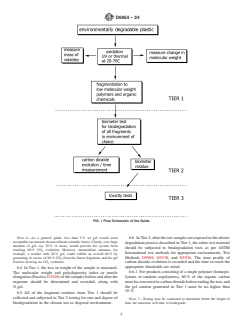
Fig. 1.
dissolve on further oxidative degradation and become available
6.3 In Tier 1, the test sample is exposed to several discrete
for ultimate biodegradation. However, the prooxidant (catalyst)
temperatures (one being within 20°C of the end use tempera-
may be excluded from the gel structure because of solubility
ture) within the range of 20 to 70°C in the presence of specified
changes in gel phase. In this case,
...
This document is not an ASTM standard and is intended only to provide the user of an ASTM standard an indication of what changes have been made to the previous version. Because
it may not be technically possible to adequately depict all changes accurately, ASTM recommends that users consult prior editions as appropriate. In all cases only the current version
of the standard as published by ASTM is to be considered the official document.
Designation: D6954 − 18 D6954 − 24
Standard Guide for
Exposing and Testing Plastics that Degrade in the
Environment by a Combination of Oxidation and
Biodegradation
This standard is issued under the fixed designation D6954; the number immediately following the designation indicates the year of
original adoption or, in the case of revision, the year of last revision. A number in parentheses indicates the year of last reapproval. A
superscript epsilon (´) indicates an editorial change since the last revision or reapproval.
1. Scope*
1.1 This guide provides a framework or road map to compare and rank the controlled laboratory rates of degradation and degree
of physical property losses of polymers by thermal and photooxidation processes as well as the biodegradation and ecological
impacts in defined applications and disposal environments after degradation. Disposal environments range from exposure in soil,
landfill, and municipal or industrial compost in which thermal oxidation may occur and land cover and agricultural use in which
photooxidation may also occur.
1.2 In this guide, established ASTM International standards are used in three tiers for accelerating and measuring the loss in
properties and molecular weight by both thermal and photooxidation processes and other abiotic processes (Tier 1), measuring
biodegradation (Tier 2), and assessing ecological impact of the products from these processes (Tier 3).
1.3 The Tier 1 conditions selected for thermal oxidation and photooxidation accelerate the degradation likely to occur in a chosen
application and disposal environment. The conditions should include a range of humidity or water concentrations based on the
application and disposal environment in mind. The measured rate of degradation at typical oxidation temperatures is required to
compare and rank the polymers being evaluated in that chosen application to reach a molecular weight that constitutes a
demonstrable biodegradable residue (using ASTM International biometer tests for CO evolution appropriate to the chosen
environment). By way of example, accelerated oxidation data must be obtained at temperatures and humidity ranges typical in that
chosen application and disposal environment, for example, in soil (20 to 30°C), landfill (20 to 35°C), and municipal or industrial
composting facilities (30 to 65°C). For applications in soils, local temperatures and humidity ranges must be considered as they
vary widely with geography. At least one temperature must be reasonably close to the end use or disposal temperature, but under
no circumstances should this be more than 20°C away from the removed that temperature. It must also be established that the
polymer does not undergo a phase change, such as glass transition temperature (Tg) within the temperature range of testing.
1.4 The residues resulting from the oxidations are then exposed to appropriate disposal or use environments in standard biometric
test methods to measure the rate and degree of biodegradation (Tier 2).
1.5 The data generated under Tier 1 evaluation and the determined time for the biodegradation in the chosen environment (Tier
2) allow ranking relative to other polymers evaluated under similar environmental conditions with this guide. The degree and time
for biodegradation should be consistent with ASTM International methods, and any residues from the intermediate oxidation stage
and from biodegradation must be shown to be environmentally benign and not persistent (Tier 3).
This guide is under the jurisdiction of ASTM Committee D20 on Plastics and is the direct responsibility of Subcommittee D20.96 on Environmentally Degradable Plastics
and Biobased Products.
Current edition approved March 1, 2018Jan. 1, 2024. Published March 2018January 2024. Originally approved in 2004. Last previous edition approved in 20132018 as
D6954 - 04 (2013). DOI: 10.1520/D6954-18.18. DOI: 10.1520/D6954-24.
*A Summary of Changes section appears at the end of this standard
Copyright © ASTM International, 100 Barr Harbor Drive, PO Box C700, West Conshohocken, PA 19428-2959. United States
D6954 − 24
NOTE 1—The intended use of this guide is for comparison and ranking of data to aid in the design and development and the reduction of environmental
impacts of polymers that require no more than 24 months to oxidize and biodegrade in the intended use and disposal options and create no harmful or
persistent residues under the appropriate disposal conditions (for example, two seasons of crop-growing conditions in soil).
1.6 It is cautioned that the results of any laboratory exposure in this guide cannot be directly extrapolated to actual disposal
environments; confirmation to real world exposure is ultimately required as with all ASTM International standards.
1.7 The values stated in SI units are to be regarded as standard.
NOTE 2—There is no ISO standard that is the equivalent of this standard guide.
1.8 This standard does not purport to address all of the safety concerns, if any, associated with its use. It is the responsibility
of the user of this standard to establish appropriate safety, health, and environmental practices and determine the applicability of
regulatory limitations prior to use.
1.9 This international standard was developed in accordance with internationally recognized principles on standardization
established in the Decision on Principles for the Development of International Standards, Guides and Recommendations issued
by the World Trade Organization Technical Barriers to Trade (TBT) Committee.
2. Referenced Documents
2.1 ASTM Standards:
D883 Terminology Relating to Plastics
D3826 Practice for Determining Degradation End Point in Degradable Polyethylene and Polypropylene Using a Tensile Test
D3987 Practice for Shake Extraction of Solid Waste with Water
D5071 Practice for Exposure of Photodegradable Plastics in a Xenon Arc Apparatus
D5208 Practice for Fluorescent Ultraviolet (UV) Exposure of Photodegradable Plastics
D5272 Practice for Outdoor Exposure Testing of Photodegradable Plastics
D5338 Test Method for Determining Aerobic Biodegradation of Plastic Materials Under Controlled Composting Conditions,
Incorporating Thermophilic Temperatures
D5510 Practice for Heat Aging of Oxidatively Degradable Plastics (Withdrawn 2010)
D5526 Test Method for Determining Anaerobic Biodegradation of Plastic Materials Under Accelerated Landfill Conditions
D5951 Practice for Preparing Residual Solids Obtained After Biodegradability Standard Methods for Plastics in Solid Waste for
Toxicity and Compost Quality Testing (Withdrawn 2011)
D5988 Test Method for Determining Aerobic Biodegradation of Plastic Materials in Soil
D6002 Guide for Assessing the Compostability of Environmentally Degradable Plastics (Withdrawn 2011)
D6400 Specification for Labeling of Plastics Designed to be Aerobically Composted in Municipal or Industrial Facilities
E1440 Guide for Acute Toxicity Test with the Rotifer Brachionus
2.2 Other Standards:
EPA TITLE 40 CFA 40CFR62, 40CFR50-189, 40CFR260-299, 40CFR300-399, 700-799, and 49CFR100-180
OECD Guideline 207 Earthworm, Acute Toxicity Tests
OECD Guideline 208 Terrestrial Plants, Growth Test
3. Terminology
3.1 Definitions:
3.1.1 Definitions of most terms applicable to this guide appear in Terminology D883 and Guide D6002.
3.2 Definitions of Terms Specific to This Standard:
3.2.1 environmental degradation of a plastic, n—abiotic or biotic degradation process or both that occurs in a given environment
and includes photodegradation, oxidation, hydrolysis, and biodegradation. Living organisms effect biotic degradation processes
and abiotic degradation processes are nonbiological in nature.
For referenced ASTM standards, visit the ASTM website, www.astm.org, or contact ASTM Customer Service at service@astm.org. For Annual Book of ASTM Standards
volume information, refer to the standard’s Document Summary page on the ASTM website.
The last approved version of this historical standard is referenced on www.astm.org.
Available from United States Environmental Protection Association (EPA), Ariel Rios Bldg., 1200 Pennsylvania Ave., NW, Washington, DC 20460.
Available from OECD, 2 rue Andre Pascal, F-75775 Paris Cedex 16, France.
D6954 − 24
3.2.1.1 Discussion—
Term not defined in Terminology D883.
3.2.2 gels, n—cross-linked polymer structures insoluble in solvents that do not break the primary or cross-linking bonds in the
polymer. Cross-links created during oxobiodegradadation of polymers are chemical bonds created by the degradation process,
mostly carbon-carbon bonds, and thus extremely resistant to solvent degradation.
3.2.3 oxidation, n—process promoted thermally or by irradiation in the presence of oxygen.
4. Summary of Guide
4.1 This guide may be used to compare and rank the rate and degree of thermal oxidative degradation of a plastic material
relatively to a molecular weight range that can be established as biodegradable in a chosen environment. Subsequently, the
biodegradation of these degraded polymers in diverse environments such as soil, municipal or industrial compost, landfill, and
water may be compared and ranked using standard biometric test methods and measuring carbon dioxide evolution.
NOTE 3—If municipal or industrial composting is the designated disposal route, Specification D6400 is the only ultimate and definitive applicable
specification for measuring biodegradation or compostability. in a municipal or industrial compostability process. Oxidation followed by biodegradation
under the conditions found in this guide does not confer the designation “compostable” or “municipally or industrially compostable” or any connotation
that the applications are acceptable for composting in a commercial or municipal composting facility.
4.2 This guide uses a tiered criteria-based approach to assess the consecutive oxidation and biodegradability of plastic products
and ecological impacts in defined applications. This is shown schematically in Section 6. Each tier in this guide includes objectives
and a summary that presents test methods, method principles, test duration, and interpretation of results.
4.3 The tiered approach is chosen in the laboratory for convenient separation of oxidative degradation, biodegradation, and
ecological impact stages even though in the real world all three are likely to be concurrent rather than consecutive.
4.4 Tiered Methodology:
4.4.1 Tier 1 measures the rate and extent of molecular weight loss resulting from oxidation that is indicative of losses in physical
properties from oxidation. Tier 1 requires either accelerated testing or long-term testing over a range of relative humidity or amount
of moisture. Accelerated testing must be performed under conditions and temperatures that are acceptably typical of the specific
application and disposal environments under consideration. Practices D5208, D5510, and D5071 may be used to specify the
oxidative conditions and Practice D3826 may be used to define the point of embrittlement.
NOTE 4—For measuring the extent of disintegration/fragmentation, a sieve test is required. In this tier, the fragments are subjected to molecular weight
analysis and a total mass balance is obtained in the process. Exposure temperatures may range from 20 to 70°C in the presence of air and specified
moisture or water levels for selected periods of time. At least one temperature must be reasonably close to the end use or disposal temperature, but under
no circumstances should this be more than 20°C away from that temperature. It must also be established that the polymer does not undergo a phase change,
such as glass transition temperature (Tg) within the temperature range of testing. As an alternate degradation process, the test samples may be exposed
to photooxidation in air as per Practices D5208 or D5071 and the mass change of the plastic recorded after exposure.
4.4.2 Tier 1 accelerated oxidation tests are not indicators of biodegradability and should not be used for the purpose of meeting
the specifications as described in Specification D6400 and claiming municipal or industrial compostability or biodegradation
during municipal or industrial composting. (If oxidation is thought to be sufficiently rapid in Tier 1, suggesting that municipal or
industrial composting may be a disposal environment, then Specification D6400 must be done and all the specifications in Section
6 (Detailed Requirements) must be met.
4.5 Gel Formation and Consequences During Oxidation Phase—Discussion:
4.5.1 Gel formation is a frequent side reaction of the oxidative degradation of polymers, especially polyolefins. Gels are
cross-linked structures arising from the free radical nature of oxidative degradation. They are insoluble in nonreactive solvents, that
is, solvents that do not break additional bonds. Normally, gels are not available to biodegradation. Some gels dissolve on further
oxidative degradation and become available for ultimate biodegradation. However, the prooxidant (catalyst) may be excluded from
Vollmert, B., Polymer Chemistry, Springer-Verlag, New York, 1973, p. 27, also pp. 543- 561.
D6954 − 24
the gel structure because of solubility changes in gel phase. In this case, the gel would become a nondegradable or very slowly
degradable new fraction within the polymer. It is important to establish the extent of gel and its nature or permanence in the
polymer residue and report these findings.
4.5.2 The purpose of Tier 2 is to estimate the biodegradability of all the fragmented products from Tier 1 under laboratory scale
conditions appropriate to the application using current Test Methods D5988 and D5338. The entire material from the Tier 1
exposure is subjected to biodegradation testing. The percent biodegradation shall be calculated and reported as stated in the above
referenced standards. The results from Tier 1 and Tier 2 shall be combined and used for comparison and ranking purposes between
polymers of interest.
4.5.3 Tier 3 involves considerations of the ecological impacts in the final disposal medium such as soil, as in all biodegradation
testing methods, which is basically a comparison of the test medium before and following oxidation and biodegradation.
5. Significance and Use
5.1 This guide is a sequential assembly of extant but unconnected standard tests and practices for the oxidation and biodegradation
of plastics, which will permit the comparison and ranking of the overall rate of environmental degradation of plastics that require
thermal or photooxidation to initiate degradation. Each degradation stage is independently evaluated to allow a combined
evaluation of a polymer’s environmental performance under a controlled laboratory setting. This enables a laboratory assessment
of its disposal performance in, soil, municipal or industrial compost, landfill, and water and for use in agricultural products such
as mulch film without detriment to that particular environment.
NOTE 5—For determining biodegradation rates under municipal or industrial composting conditions, Specification D6
...