

ASTM D5675-13(2023)
(Classification)Standard Classification for Low Molecular Weight PTFE and FEP Micronized Powders
General Information
- Abstract
ABSTRACT
This classification system provides a method of adequately identifying PTFE micropowders using a system consistent with that also of another specific classification. These powders are sometimes known as lubricant powders which usually have a much smaller particle size than those used for molding or extrusion. The test methods and properties included are those required to identify and specify the various types of fluoropolymer micropowders. This classification covers two groups of fluoropolymer micropowders. Fluoropolymer micropowders are classified into groups according to their base fluoropolymer. These groups are further subdivided into classes and grades. Different tests shall be performed in order to determine the following properties of the micropowders: melting characteristics, melt flow rate, specific gravity, water content, particle size, surface area, and bulk density.
SCOPE
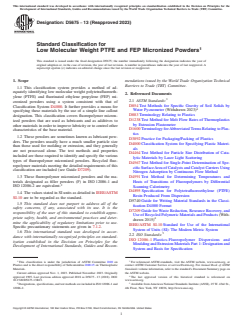
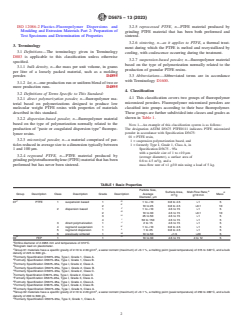
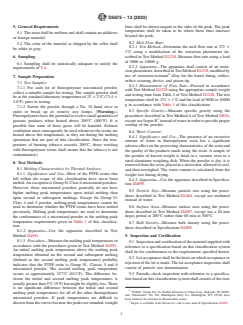
1.1 This classification system provides a method of adequately identifying low molecular weight polytetrafluoroethylene (PTFE) and fluorinated ethylene propylene (FEP) micronized powders using a system consistent with that of Classification System D4000. It further provides a means for specifying these materials by the use of a simple line callout designation. This classification covers fluoropolymer micronized powders that are used as lubricants and as additives to other materials in order to improve lubricity or to control other characteristics of the base material.
1.2 These powders are sometimes known as lubricant powders. The powders usually have a much smaller particle size than those used for molding or extrusion, and they generally are not processed alone. The test methods and properties included are those required to identify and specify the various types of fluoropolymer micronized powders. Recycled fluoropolymer materials meeting the detailed requirements of this classification are included (see Guide D7209).
1.3 These fluoropolymer micronized powders and the materials designated as filler powders (F) in ISO 12086-1 and ISO 12086-2 are equivalent.2
1.4 The values stated in SI units as detailed in IEEE/ASTM SI-10 are to be regarded as the standard.
1.5 This standard does not purport to address all of the safety concerns, if any, associated with its use. It is the responsibility of the user of this standard to establish appropriate safety, health, and environmental practices and determine the applicability of regulatory limitations prior to use. Specific precautionary statements are given in 7.1.2.
1.6 This international standard was developed in accordance with internationally recognized principles on standardization established in the Decision on Principles for the Development of International Standards, Guides and Recommendations issued by the World Trade Organization Technical Barriers to Trade (TBT) Committee.
- Status
- Published
- Publication Date
- 31-Oct-2023
- Technical Committee
- D20 - Plastics
- Drafting Committee
- D20.15 - Thermoplastic Materials

Overview
ASTM D5675-13(2023) - Standard Classification for Low Molecular Weight PTFE and FEP Micronized Powders defines a systematic method for classifying, specifying, and identifying low molecular weight polytetrafluoroethylene (PTFE) and fluorinated ethylene propylene (FEP) micronized powders. These high-performance fluoropolymer micropowders, also known as lubricant powders, feature extremely fine particle sizes and are primarily used as lubricants or as additive materials to enhance the performance of various base materials. The standard provides a uniform classification system, facilitating the comparison and specification of these materials for industrial applications.
Key Topics
- Classification Structure
- Micronized powders are grouped by their base fluoropolymer: PTFE or FEP.
- Each group is subdivided into classes and grades, covering aspects such as polymerization type, particle size range, surface area, and melt flow characteristics.
- Material Identification
- Designation and callout systems derived from this classification enable straightforward specification and procurement.
- The system is consistent with ASTM D4000 and aligned with ISO 12086 standards for fluoropolymer materials.
- Required Properties and Test Methods
- The standard details properties essential for identification: melting characteristics, melt flow rate, specific gravity, water content, particle size, surface area, and bulk density.
- It references standardized test methods for consistent and reproducible evaluation of these characteristics.
- Quality and Safety Considerations
- Materials must be uniform, free of foreign material, and meet color requirements.
- Safety guidelines are outlined due to potential evolution of harmful gases above certain temperatures.
- Includes provisions for the use of recycled fluoropolymers, provided they meet specification criteria.
Applications
Low molecular weight PTFE and FEP micronized powders classified under ASTM D5675-13(2023) offer distinct advantages across a wide spectrum of industries due to their exceptional lubricity, chemical resistance, and thermal stability. Typical applications include:
- Lubricant Powders
- Used as solid lubricants in diverse mechanical systems, reducing friction and wear.
- Additives in Plastics and Coatings
- Incorporated into polymer composites and coatings to enhance non-stick, low-friction, or chemical resistance properties.
- Processing Aids
- Serve as processing aids in plastics extrusion, molding, or other high-temperature processes.
- Filler Materials
- Used in compounds requiring improvement in surface properties or modifications such as improved electrical insulation or reduced surface energy.
- Industrial and Electronics
- Support enhanced performance in bearings, gaskets, seals, and cable insulation.
The adaptable classification system ensures that users can accurately select the appropriate type, class, and grade of PTFE or FEP micropowder for their specific requirements.
Related Standards
ASTM D5675-13(2023) references and aligns with several important international and ASTM standards, ensuring global interoperability and consistency, including:
- ASTM D4000 - Classification System for Specifying Plastic Materials
- ASTM D1238 - Test Method for Melt Flow Rates of Thermoplastics by Extrusion Plastometer
- ASTM D854 - Test Methods for Specific Gravity of Soil Solids by Water Pycnometer
- ASTM D4464 - Test Method for Particle Size Distribution of Catalytic Materials
- ASTM D4567 - Test Method for Specific Surface Area of Catalysts by Nitrogen Adsorption
- ASTM D4591 - Determining Temperatures and Heats of Transitions of Fluoropolymers by Differential Scanning Calorimetry
- ISO 12086-1 & ISO 12086-2 - Plastics - Fluoropolymer Dispersions and Moulding/Extrusion Materials
By adhering to ASTM D5675-13(2023), manufacturers, suppliers, and users can ensure consistent classification, reliable product selection, and improved industrial outcomes for PTFE and FEP micronized powders.
Keywords: PTFE micronized powder, FEP micropowder, fluoropolymer classification, ASTM D5675, lubricant powder, additive, plastics, industrial standards.
Relations
- Effective Date
- 01-Nov-2023
- Effective Date
- 01-Feb-2024
- Refers
ASTM D1238-23a - Standard Test Method for Melt Flow Rates of Thermoplastics by Extrusion Plastometer - Effective Date
- 15-Nov-2023
- Effective Date
- 01-Nov-2023
- Effective Date
- 01-Nov-2023
- Refers
ASTM D1238-23 - Standard Test Method for Melt Flow Rates of Thermoplastics by Extrusion Plastometer - Effective Date
- 01-Feb-2023
- Effective Date
- 01-Nov-2022
- Refers
ASTM D1600-18 - Standard Terminology for Abbreviated Terms Relating to Plastics (Withdrawn 2024) - Effective Date
- 01-Jan-2018
- Effective Date
- 01-May-2014
Get Certified
Connect with accredited certification bodies for this standard

DIN CERTCO
DIN Group product certification.

Smithers Quality Assessments
US management systems and product certification.
Sponsored listings
Frequently Asked Questions
ASTM D5675-13(2023) is a standard published by ASTM International. Its full title is "Standard Classification for Low Molecular Weight PTFE and FEP Micronized Powders". This standard covers: ABSTRACT This classification system provides a method of adequately identifying PTFE micropowders using a system consistent with that also of another specific classification. These powders are sometimes known as lubricant powders which usually have a much smaller particle size than those used for molding or extrusion. The test methods and properties included are those required to identify and specify the various types of fluoropolymer micropowders. This classification covers two groups of fluoropolymer micropowders. Fluoropolymer micropowders are classified into groups according to their base fluoropolymer. These groups are further subdivided into classes and grades. Different tests shall be performed in order to determine the following properties of the micropowders: melting characteristics, melt flow rate, specific gravity, water content, particle size, surface area, and bulk density. SCOPE 1.1 This classification system provides a method of adequately identifying low molecular weight polytetrafluoroethylene (PTFE) and fluorinated ethylene propylene (FEP) micronized powders using a system consistent with that of Classification System D4000. It further provides a means for specifying these materials by the use of a simple line callout designation. This classification covers fluoropolymer micronized powders that are used as lubricants and as additives to other materials in order to improve lubricity or to control other characteristics of the base material. 1.2 These powders are sometimes known as lubricant powders. The powders usually have a much smaller particle size than those used for molding or extrusion, and they generally are not processed alone. The test methods and properties included are those required to identify and specify the various types of fluoropolymer micronized powders. Recycled fluoropolymer materials meeting the detailed requirements of this classification are included (see Guide D7209). 1.3 These fluoropolymer micronized powders and the materials designated as filler powders (F) in ISO 12086-1 and ISO 12086-2 are equivalent.2 1.4 The values stated in SI units as detailed in IEEE/ASTM SI-10 are to be regarded as the standard. 1.5 This standard does not purport to address all of the safety concerns, if any, associated with its use. It is the responsibility of the user of this standard to establish appropriate safety, health, and environmental practices and determine the applicability of regulatory limitations prior to use. Specific precautionary statements are given in 7.1.2. 1.6 This international standard was developed in accordance with internationally recognized principles on standardization established in the Decision on Principles for the Development of International Standards, Guides and Recommendations issued by the World Trade Organization Technical Barriers to Trade (TBT) Committee.
ABSTRACT This classification system provides a method of adequately identifying PTFE micropowders using a system consistent with that also of another specific classification. These powders are sometimes known as lubricant powders which usually have a much smaller particle size than those used for molding or extrusion. The test methods and properties included are those required to identify and specify the various types of fluoropolymer micropowders. This classification covers two groups of fluoropolymer micropowders. Fluoropolymer micropowders are classified into groups according to their base fluoropolymer. These groups are further subdivided into classes and grades. Different tests shall be performed in order to determine the following properties of the micropowders: melting characteristics, melt flow rate, specific gravity, water content, particle size, surface area, and bulk density. SCOPE 1.1 This classification system provides a method of adequately identifying low molecular weight polytetrafluoroethylene (PTFE) and fluorinated ethylene propylene (FEP) micronized powders using a system consistent with that of Classification System D4000. It further provides a means for specifying these materials by the use of a simple line callout designation. This classification covers fluoropolymer micronized powders that are used as lubricants and as additives to other materials in order to improve lubricity or to control other characteristics of the base material. 1.2 These powders are sometimes known as lubricant powders. The powders usually have a much smaller particle size than those used for molding or extrusion, and they generally are not processed alone. The test methods and properties included are those required to identify and specify the various types of fluoropolymer micronized powders. Recycled fluoropolymer materials meeting the detailed requirements of this classification are included (see Guide D7209). 1.3 These fluoropolymer micronized powders and the materials designated as filler powders (F) in ISO 12086-1 and ISO 12086-2 are equivalent.2 1.4 The values stated in SI units as detailed in IEEE/ASTM SI-10 are to be regarded as the standard. 1.5 This standard does not purport to address all of the safety concerns, if any, associated with its use. It is the responsibility of the user of this standard to establish appropriate safety, health, and environmental practices and determine the applicability of regulatory limitations prior to use. Specific precautionary statements are given in 7.1.2. 1.6 This international standard was developed in accordance with internationally recognized principles on standardization established in the Decision on Principles for the Development of International Standards, Guides and Recommendations issued by the World Trade Organization Technical Barriers to Trade (TBT) Committee.
ASTM D5675-13(2023) is classified under the following ICS (International Classification for Standards) categories: 83.080.01 - Plastics in general. The ICS classification helps identify the subject area and facilitates finding related standards.
ASTM D5675-13(2023) has the following relationships with other standards: It is inter standard links to ASTM D5675-13(2018), ASTM D883-24, ASTM D1238-23a, ASTM D854-23, ASTM D883-23, ASTM D1238-23, ASTM D883-22, ASTM D1600-18, ASTM D854-14. Understanding these relationships helps ensure you are using the most current and applicable version of the standard.
ASTM D5675-13(2023) is available in PDF format for immediate download after purchase. The document can be added to your cart and obtained through the secure checkout process. Digital delivery ensures instant access to the complete standard document.
Standards Content (Sample)
This international standard was developed in accordance with internationally recognized principles on standardization established in the Decision on Principles for the
Development of International Standards, Guides and Recommendations issued by the World Trade Organization Technical Barriers to Trade (TBT) Committee.
Designation: D5675 − 13 (Reapproved 2023)
Standard Classification for
Low Molecular Weight PTFE and FEP Micronized Powders
This standard is issued under the fixed designation D5675; the number immediately following the designation indicates the year of
original adoption or, in the case of revision, the year of last revision. A number in parentheses indicates the year of last reapproval. A
superscript epsilon (´) indicates an editorial change since the last revision or reapproval.
1. Scope mendations issued by the World Trade Organization Technical
Barriers to Trade (TBT) Committee.
1.1 This classification system provides a method of ad-
equately identifying low molecular weight polytetrafluoroeth-
2. Referenced Documents
ylene (PTFE) and fluorinated ethylene propylene (FEP) mi-
2.1 ASTM Standards:
cronized powders using a system consistent with that of
D854 Test Methods for Specific Gravity of Soil Solids by
Classification System D4000. It further provides a means for
Water Pycnometer (Withdrawn 2023)
specifying these materials by the use of a simple line callout
D883 Terminology Relating to Plastics
designation. This classification covers fluoropolymer micron-
D1238 Test Method for Melt Flow Rates of Thermoplastics
ized powders that are used as lubricants and as additives to
by Extrusion Plastometer
other materials in order to improve lubricity or to control other
D1600 Terminology for Abbreviated Terms Relating to Plas-
characteristics of the base material.
tics
1.2 These powders are sometimes known as lubricant pow-
D3892 Practice for Packaging/Packing of Plastics
ders. The powders usually have a much smaller particle size
D4000 Classification System for Specifying Plastic Materi-
than those used for molding or extrusion, and they generally
als
are not processed alone. The test methods and properties
D4464 Test Method for Particle Size Distribution of Cata-
included are those required to identify and specify the various
lytic Materials by Laser Light Scattering
types of fluoropolymer micronized powders. Recycled fluo-
D4567 Test Method for Single-Point Determination of Spe-
ropolymer materials meeting the detailed requirements of this
cific Surface Area of Catalysts and Catalyst Carriers Using
classification are included (see Guide D7209).
Nitrogen Adsorption by Continuous Flow Method
1.3 These fluoropolymer micronized powders and the ma-
D4591 Test Method for Determining Temperatures and
terials designated as filler powders (F) in ISO 12086-1 and
Heats of Transitions of Fluoropolymers by Differential
ISO 12086-2 are equivalent.
Scanning Calorimetry
D4895 Specification for Polytetrafluoroethylene (PTFE)
1.4 The values stated in SI units as detailed in IEEE/ASTM
Resin Produced From Dispersion
SI-10 are to be regarded as the standard.
D5740 Guide for Writing Material Standards in the Classi-
1.5 This standard does not purport to address all of the
fication D4000 Format
safety concerns, if any, associated with its use. It is the
D7209 Guide for Waste Reduction, Resource Recovery, and
responsibility of the user of this standard to establish appro-
Use of Recycled Polymeric Materials and Products (With-
priate safety, health, and environmental practices and deter-
drawn 2015)
mine the applicability of regulatory limitations prior to use.
IEEE/ASTM SI-10 Standard for Use of the International
Specific precautionary statements are given in 7.1.2.
System of Units (SI): The Modern Metric System
1.6 This international standard was developed in accor-
2.2 ISO Standards:
dance with internationally recognized principles on standard-
ISO 12086-1 Plastics-Fluoropolymer Dispersions and
ization established in the Decision on Principles for the
Moulding and Extrusion Materials Part 1: Designation and
Development of International Standards, Guides and Recom-
System and Basis for Specification
1 3
This classification is under the jurisdiction of ASTM Committee D20 on For referenced ASTM standards, visit the ASTM website, www.astm.org, or
Plastics and is the direct responsibility of Subcommittee D20.15 on Thermoplastic contact ASTM Customer Service at service@astm.org. For Annual Book of ASTM
Materials. Standards volume information, refer to the standard’s Document Summary page on
Current edition approved Nov. 1, 2023. Published November 2023. Originally the ASTM website.
approved 1995. Last previous edition approved 2018 as D5675 - 13 (2018). DOI: The last approved version of this historical standard is referenced on
10.1520/D5675-13R23. www.astm.org.
2 5
Designations, specifications, and test methods are included in ISO 12086-1 and Available from American National Standards Institute (ANSI), 25 W. 43rd St.,
12086-2. 4th Floor, New York, NY 10036, http://www.ansi.org.
Copyright © ASTM International, 100 Barr Harbor Drive, PO Box C700, West Conshohocken, PA 19428-2959. United States
D5675 − 13 (2023)
ISO 12086-2 Plastics-Fluoropolymer Dispersions and 3.2.5 reprocessed PTFE, n—PTFE material produced by
Moulding and Extrusion Materials Part 2: Preparation of grinding PTFE material that has been both preformed and
Test Specimens and Determination of Properties
sintered.
3.2.6 sintering, n—as it applies to PTFE, a thermal treat-
3. Terminology
ment during which the PTFE is melted and recrystallized by
3.1 Definitions—The terminology given in Terminology
cooling, with coalescence occurring during the treatment.
D883 is applicable to this classification unless otherwise
3.2.7 suspension-based powder, n—fluoropolymer material
specified.
based on the type of polymerization normally related to the
3.1.1 bulk density, n—the mass per unit volume, in grams
production of granular PTFE resins.
per litre of a loosely packed material, such as a molding
3.3 Abbreviations—Abbreviated terms are in accordance
powder. D4895
with Terminology D1600.
3.1.2 lot, n—one production run or uniform blend of two or
more production runs. D4895
4. Classification
3.2 Definitions of Terms Specific to This Standard:
4.1 This classification covers two groups of fluoropolymer
3.2.1 direct polymerization powder, n—fluoropolymer ma-
micronized powders. Fluoropolymer micronized powders are
terial based on polymerizations designed to produce low
classified into groups according to their base fluoropolymer.
molecular weight PTFE resins with properties of materials
These groups are further subdivided into classes and grades as
described in this standard.
shown in Table 1.
3.2.2 dispersion-based powder, n—fluoropolymer material
based on the type of polymerization normally related to the
NOTE 1—An example of this classification system is as follows:
production of “paste or coagulated dispersion type” fluoropo-
The designation ASTM D5675 PTFE0111 indicates PTFE micronized
powder in accordance with Specification D5675:
lymer resins.
01 = PTFE resin,
3.2.3 micronized powder, n—a material comprised of par-
1 = suspension polymerization based, and
ticles reduced in average size to a dimension typically between
1 = formerly Type I, Grade 1, Class A, in
1 and 100 μm. Specification D5675 - 95a
with a particle size of 1 to <10 μm
3.2.4 reground PTFE, n—PTFE material produced by
(average diameter), a surface area of
grinding polytetrafluoroethylene (PTFE) material that has been
0.8 to 4.5 m /g, and a
preformed but has never been sintered. mass flow rate of >1 g/10 min using a load of 5 kg.
TABLE 1 Basic Properties
Particle Size,
A
Surface Area,
Melt-Flow Rate,
B
Group Description Class Description Grade Description Average Mass
g/10 min
m /g
Diameter, μm
C D
01 PTFE 1 suspension based 1 1 to <10 0.8 to 4.5 >1 5
E
2 10 to 25 0.8 to 4.5 >0.1 10
F
2 dispersion based 1 1 to <10 4.6 to 15 >1 5
G
2 10 to 30 4.6 to 15 >0.1 10
H
3 25 to 50 4.6 to 15 >1 5
I
4 50 to 150 4.6 to 15 >1 5
J
3 direct polymerization 1 2 to 15 4.6 to 15 >1 5
K
4 reground suspension 1 1 to <10 0.8 to 4.5 >1 5
L
5 reground dispersion 1 1 to 25 0.8 to 4.5 >1 5
M
6 previously sintered 1 10 to 50 <1.5 >20 5
N O
02 FEP 1 1 10 to 30 4.6 to 15 4 to 12 5
A
Orifice diameter of 2.0955 mm and temperature of 372°C.
B
Kilogram load on plastometer.
C 3
Group 01 materials have a specific gravity of 2.10 to 2.30 g/cm , a water content (maximum) of <0.1 %, a melting point (peak temperature) of 315 to 340°C, and a bulk
density of 225 to 600 g/L.
D
Formerly Specification D5675–95a, Type I, Grade 1, Class A.
E
Formerly Specification D5675–95a, Type I, Grade 1, Class B.
F
Formerly Specification D5675–95a, Type I, Grade 2, Class A.
G
Formerly Specification D5675–95a, Type I, Grade 2, Class B.
H
...