

ASTM D3468/D3468M-99(2020)
(Specification)Standard Specification for Liquid-Applied Neoprene and Chlorosulfonated Polyethylene Used in Roofing and Waterproofing
General Information
- Abstract
SCOPE
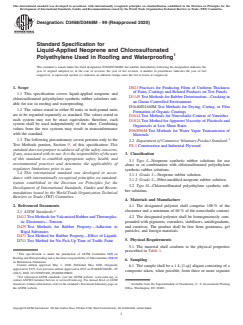
1.1 This specification covers liquid-applied neoprene and chlorosulfonated polyethylene synthetic rubber solutions suitable for use in roofing and waterproofing.
1.2 The values stated in either SI units or inch-pound units are to be regarded separately as standard. The values stated in each system may not be exact equivalents; therefore, each system shall be used independently of the other. Combining values from the two systems may result in nonconformance with the standard.
1.3 The following precautionary caveat pertains only to the Test Methods portion, Section 9, of this specification: This standard does not purport to address all of the safety concerns, if any, associated with its use. It is the responsibility of the user of this standard to establish appropriate safety, health, and environmental practices and determine the applicability of regulatory limitations prior to use.
1.4 This international standard was developed in accordance with internationally recognized principles on standardization established in the Decision on Principles for the Development of International Standards, Guides and Recommendations issued by the World Trade Organization Technical Barriers to Trade (TBT) Committee.
- Status
- Published
- Publication Date
- 30-Apr-2020
- Technical Committee
- D08 - Roofing and Waterproofing

Overview
ASTM D3468/D3468M-99(2020) is the standard specification developed by ASTM International for liquid-applied neoprene and chlorosulfonated polyethylene synthetic rubber solutions used in roofing and waterproofing applications. This specification details the requirements for materials, manufacturing, physical properties, sampling, testing, and packaging to ensure the reliability and effectiveness of these synthetic rubber coatings in protecting building structures from water ingress. The standard applies to products designed for either roof membranes or waterproof barriers, and is applicable to both new constructions and refurbishment projects.
Key Topics
- Material Types and Grades
- Type I: Neoprene synthetic rubber solutions, available as Grade 1 (standard) and Grade 2 (fiber-modified)
- Type II: Chlorosulfonated polyethylene synthetic rubber solutions
- Physical Property Requirements
- Solids content by weight and volume
- Viscosity
- Drying times (dry-to-touch and dry-hard times)
- Tensile strength and elongation (including aged film performance)
- Water absorption and vapor permeability
- Ozone resistance and adhesion
- Testing and Sampling
- Procedures for film preparation, viscosity and drying tests, and physical property measurements
- Sampling from random containers, with special attention to representative and nonrepresentative samples
- Packaging and Marking
- Requirements for safe transport, correct labeling, shelf life, storage conditions, and hazard information
- Safety and Regulatory Considerations
- Precautions for safe handling and compliance with health, safety, and environmental regulations
Applications
The ASTM D3468/D3468M-99(2020) standard provides essential guidelines for the use of liquid-applied neoprene and chlorosulfonated polyethylene coatings in:
- Roof waterproofing membranes: Providing long-lasting protection against water penetration in both flat and low-slope roofing systems
- Basement and foundation waterproofing: Creating impermeable barriers against groundwater and soil moisture
- Balcony and terrace coatings: Ensuring watertight sealants for exposed outdoor surfaces
- Repair and maintenance: Restoration of existing waterproofing or roofing layers by recoating with qualified synthetic rubber solutions
Typical users of this standard include roofing contractors, material manufacturers, architects, and building maintenance professionals seeking durable and high-performance liquid-applied waterproofing solutions.
Related Standards
Several ASTM standards are referenced or closely associated with ASTM D3468/D3468M-99(2020), providing additional protocols for physical testing and quality assessment:
- ASTM D412 - Test Methods for Vulcanized Rubber and Thermoplastic Elastomers-Tension
- ASTM D429 - Test Methods for Rubber Property-Adhesion to Rigid Substrates
- ASTM D471 - Test Method for Rubber Property-Effect of Liquids
- ASTM D711 - Test Method for No-Pick-Up Time of Traffic Paint
- ASTM D823 - Practices for Producing Films of Uniform Thickness
- ASTM D1640/D1640M - Test Methods for Drying, Curing, or Film Formation of Organic Coatings
- ASTM D1149 - Test Methods for Rubber Deterioration-Cracking in an Ozone Controlled Environment
- ASTM E96/E96M - Test Methods for Water Vapor Transmission of Materials
- Department of Commerce Voluntary Product Standard PS-1 - Construction and Industrial Plywood
Practical Value
Compliance with ASTM D3468/D3468M-99(2020) ensures that liquid-applied neoprene and chlorosulfonated polyethylene coatings meet rigorous quality standards for roofing and waterproofing performance. Adhering to this standard helps reduce risks of water damage, increases longevity, and provides reliable benchmarks for material selection, improving overall building durability and protection.
Keywords: liquid-applied roofing, neoprene waterproofing, chlorosulfonated polyethylene, ASTM roofing standard, synthetic rubber coatings, waterproof membrane, construction material standards.
Relations
- Effective Date
- 01-May-2020
- Effective Date
- 01-Apr-2024
- Effective Date
- 01-Mar-2024
- Effective Date
- 15-Nov-2023
- Effective Date
- 01-Dec-2017
- Effective Date
- 01-Apr-2016
- Effective Date
- 01-Jun-2015
- Effective Date
- 01-May-2015
- Effective Date
- 15-Oct-2014
- Effective Date
- 01-Nov-2013
- Effective Date
- 15-Dec-2012
- Effective Date
- 01-Nov-2012
- Effective Date
- 01-Jun-2012
- Effective Date
- 15-Dec-2010
- Effective Date
- 01-Dec-2010
Get Certified
Connect with accredited certification bodies for this standard

DIBt (Deutsches Institut für Bautechnik)
German Institute for Building Technology.
DIN CERTCO
DIN Group product certification.

Aboma Certification B.V.
Specialized in construction, metal, and transport sectors.
Sponsored listings
Frequently Asked Questions
ASTM D3468/D3468M-99(2020) is a technical specification published by ASTM International. Its full title is "Standard Specification for Liquid-Applied Neoprene and Chlorosulfonated Polyethylene Used in Roofing and Waterproofing". This standard covers: SCOPE 1.1 This specification covers liquid-applied neoprene and chlorosulfonated polyethylene synthetic rubber solutions suitable for use in roofing and waterproofing. 1.2 The values stated in either SI units or inch-pound units are to be regarded separately as standard. The values stated in each system may not be exact equivalents; therefore, each system shall be used independently of the other. Combining values from the two systems may result in nonconformance with the standard. 1.3 The following precautionary caveat pertains only to the Test Methods portion, Section 9, of this specification: This standard does not purport to address all of the safety concerns, if any, associated with its use. It is the responsibility of the user of this standard to establish appropriate safety, health, and environmental practices and determine the applicability of regulatory limitations prior to use. 1.4 This international standard was developed in accordance with internationally recognized principles on standardization established in the Decision on Principles for the Development of International Standards, Guides and Recommendations issued by the World Trade Organization Technical Barriers to Trade (TBT) Committee.
SCOPE 1.1 This specification covers liquid-applied neoprene and chlorosulfonated polyethylene synthetic rubber solutions suitable for use in roofing and waterproofing. 1.2 The values stated in either SI units or inch-pound units are to be regarded separately as standard. The values stated in each system may not be exact equivalents; therefore, each system shall be used independently of the other. Combining values from the two systems may result in nonconformance with the standard. 1.3 The following precautionary caveat pertains only to the Test Methods portion, Section 9, of this specification: This standard does not purport to address all of the safety concerns, if any, associated with its use. It is the responsibility of the user of this standard to establish appropriate safety, health, and environmental practices and determine the applicability of regulatory limitations prior to use. 1.4 This international standard was developed in accordance with internationally recognized principles on standardization established in the Decision on Principles for the Development of International Standards, Guides and Recommendations issued by the World Trade Organization Technical Barriers to Trade (TBT) Committee.
ASTM D3468/D3468M-99(2020) is classified under the following ICS (International Classification for Standards) categories: 91.100.50 - Binders. Sealing materials. The ICS classification helps identify the subject area and facilitates finding related standards.
ASTM D3468/D3468M-99(2020) has the following relationships with other standards: It is inter standard links to ASTM D3468/D3468M-99(2013)e1, ASTM D1824-24, ASTM E96/E96M-24, ASTM E96/E96M-23, ASTM D823-17, ASTM D1824-16, ASTM D711-10(2015), ASTM E96/E96M-15, ASTM E96/E96M-14, ASTM E96/E96M-13, ASTM E96/E96M-12, ASTM D823-95(2012), ASTM D1644-01(2012), ASTM D1824-95(2010), ASTM D711-10. Understanding these relationships helps ensure you are using the most current and applicable version of the standard.
ASTM D3468/D3468M-99(2020) is available in PDF format for immediate download after purchase. The document can be added to your cart and obtained through the secure checkout process. Digital delivery ensures instant access to the complete standard document.
Standards Content (Sample)
This international standard was developed in accordance with internationally recognized principles on standardization established in the Decision on Principles for the
Development of International Standards, Guides and Recommendations issued by the World Trade Organization Technical Barriers to Trade (TBT) Committee.
Designation:D3468/D3468M −99 (Reapproved 2020)
Standard Specification for
Liquid-Applied Neoprene and Chlorosulfonated
Polyethylene Used in Roofing and Waterproofing
This standard is issued under the fixed designation D3468/D3468M; the number immediately following the designation indicates the
year of original adoption or, in the case of revision, the year of last revision. A number in parentheses indicates the year of last
reapproval. A superscript epsilon (´) indicates an editorial change since the last revision or reapproval.
1. Scope D823Practices for Producing Films of Uniform Thickness
of Paint, Coatings and Related Products on Test Panels
1.1 This specification covers liquid-applied neoprene and
D1149TestMethodsforRubberDeterioration—Crackingin
chlorosulfonated polyethylene synthetic rubber solutions suit-
an Ozone Controlled Environment
able for use in roofing and waterproofing.
D1640/D1640MTest Methods for Drying, Curing, or Film
1.2 The values stated in either SI units or inch-pound units
Formation of Organic Coatings
are to be regarded separately as standard. The values stated in
D1644Test Methods for Nonvolatile Content of Varnishes
each system may not be exact equivalents; therefore, each
D1824Test Method forApparentViscosity of Plastisols and
system shall be used independently of the other. Combining
Organosols at Low Shear Rates
values from the two systems may result in nonconformance
E96/E96MTest Methods for Water Vapor Transmission of
with the standard.
Materials
1.3 The following precautionary caveat pertains only to the
2.2 Department of Commerce Voluntary Product Standard:
Test Methods portion, Section 9, of this specification: This
PS-1Construction and Industrial Plywood
standard does not purport to address all of the safety concerns,
if any, associated with its use. It is the responsibility of the user 3. Classification
of this standard to establish appropriate safety, health, and
3.1 Type I—Neoprene synthetic rubber solutions for use
environmental practices and determine the applicability of
alone or in combination with chlorosulfonated polyethylene
regulatory limitations prior to use.
synthetic rubber solutions:
1.4 This international standard was developed in accor-
3.1.1 Grade 1—Neoprene rubber solution.
dance with internationally recognized principles on standard-
3.1.2 Grade 2—Fiber-modified neoprene rubber solution.
ization established in the Decision on Principles for the
3.2 Type II—Chlorosulfonated polyethylene synthetic rub-
Development of International Standards, Guides and Recom-
ber solutions.
mendations issued by the World Trade Organization Technical
Barriers to Trade (TBT) Committee.
4. Materials and Manufacture
2. Referenced Documents 4.1 The designated polymer shall comprise 100% of the
2 elastomer and a minimum of 60% of the nonvolatile content.
2.1 ASTM Standards:
D412TestMethodsforVulcanizedRubberandThermoplas- 4.2 The designated polymer shall be homogeneously com-
tic Elastomers—Tension pounded with pigments, extenders, stabilizers, antidegradants,
D429Test Methods for Rubber Property—Adhesion to and curatives. The product shall be free from graininess, gel
Rigid Substrates particles, and foreign materials.
D471Test Method for Rubber Property—Effect of Liquids
5. Physical Requirements
D711Test Method for No-Pick-Up Time of Traffic Paint
5.1 The material shall conform to the physical properties
prescribed in Table 1.
This specification is under the jurisdiction of ASTM Committee D08 on
RoofingandWaterproofingandisthedirectresponsibilityofSubcommitteeD08.09
6. Sampling
on Bituminous Emulsions.
Current edition approved May 1, 2020. Published May 2020. Originally
6.1 The sample shall be a 1-L [1-qt] aliquot consisting of a
approved in 1975. Last previous edition approved in 2013 as D3468/D3468M–99
composite taken, when possible, from three or more separate
(2013). DOI: 10.1520/D3468_D3468M-99R20.
For referenced ASTM standards, visit the ASTM website, www.astm.org, or
contact ASTM Customer Service at service@astm.org. For Annual Book of ASTM
Standards volume information, refer to the standard’s Document Summary page on Available from the Superintendent of Documents, U. S. Government Printing
the ASTM website. Office, Washington, DC 20402.
Copyright © ASTM International, 100 Barr Harbor Drive, PO Box C700, West Conshohocken, PA 19428-2959. United States
D3468/D3468M−99 (2020)
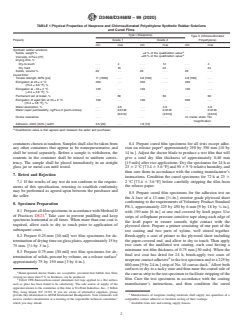
TABLE 1 Physical Properties of Neoprene and Chlorosulfonated Polyethylene Synthetic Rubber Solutions
and Cured Films
Type I (Neoprene)
Type II (Chlorosulfonated
Polyethylene)
Property Grade 1 Grade 2
min max min max min max
Synthetic rubber solutions:
A
Solids, weight % ±2 % of the qualification value
A
±20 % of the qualification value
Viscosity, mPa·s [cP]
Drying time, h:
Dry-to-touch . . . 4 . . . 12 . . . 4
Dry hard . . . 16 . . . 24 . . . 24
Solids, volume % 20 . . . 20 . . . 20 . . .
Cured films:
Tensile strength, MPa [psi] 11 [1600] . . . 4.8 [700] . . . 4.8 [700] . . .
Elongation at 23 ± 2 °C 450 . . . 450 . . . 350 . . .
[73.4 ± 3.6 °F], %
Elongation at −18 ± 2 °C 120 . . . 120 . . . 120 . . .
[−0.4 ± 3.6 °F], %
Permanent set at break, % . . . 50 . . . 50 . . . 50
Elongation of aged film at 23 ± 2 °C 100 . . . 100 . . . 200 . . .
[73.4 ± 3.6 °F], %
Water absorption, % . . . 4.0 . . . 4.0 . . . 4.0
Water vapor permeability, ng/Pa·s·m [perm-inches] . . . 0.0146 . . . 0.0146 . . . 0.0146
[0.010] [0.010] [0.010]
Ozone resistance . . . . . . . . . . . . no cracks under 10×
magnification
Adhesion, kN/m [lbf/in.] width 3.5 [20] . . . 1.8 [10] . . . . . . . . .
A
Qualification value is that agreed upon between the seller and purchaser.
containers chosen at random. Samples shall also be taken from 8.4 Prepare cured film specimens for all tests except adhe-
any other containers that appear to be nonrepresentative and sion on release paper approximately 250 by 350 mm [10 by
shall be tested separately. Before a sample is withdrawn, the 14in.].Adjust the doctor blade to produce a wet film that will
contents in the container shall be mixed to uniform consis- give a total dry film thickness of approximately 0.40 mm
tency. The sample shall be placed immediately in an airtight [15mils] after two applications. Dry the specimens for 24 h at
glass jar or metal can until tested. 23 62°C[73.4 63.6°F]and50 65%relativehumidity,and
then cure them in accordance with the coating manufacturer’s
7. Retest and Rejection
instructions. Condition the cured specimens for 72 h at 23 6
7.1 If the results of any test do not conform to the require- 2°C [73.4 6 3.6°F] before carefully stripping the film from
the release paper.
ments of this specification, retesting to establish conformity
may be performed as agreed upon between the purchaser and
8.5 Prepare cured film specimens for the adhesion test on
the seller.
the A face of a 13-mm [ ⁄2-in.] exterior grade plywood sheet
conforming to the requirements ofVoluntary Product Standard
8. Specimen Preparation
PS-1, approximately 225 by 450 by 6 mm [9 by 18 by ⁄4 in.],
8.1 PrepareallfilmspecimensinaccordancewithMethodD
with 150 mm [6 in.] at one end covered by kraft paper. Use
of Practices D823. Take care to prevent puddling and keep
strips of cellophane pressure-sensitive tape along each edge of
specimens horizontal at all times. When more than one coat is
the kraft paper to ensure smooth, tight contact with the
required, allow each to dry to touch prior to application of
plywood sheet. Prepare a primer consisting of one part of the
subsequent coats.
test coating and two parts of xylene, well stirred together.
Brush-apply a coat of primer to the plywood sheet including
8.2 Prepare 0.25-mm [10-mil] wet film specimens for de-
the paper-covered end, and allow to dry to touch. Then apply
terminationofdryingtimeonglassplates,approximately15by
two coats of the undiluted test coating, each coat having a
75 mm. [ ⁄8 by 3 in.].
minimum wet-film thickness of 0.75 mm [30 mils]. When the
8.3 Prepare 0.75-mm [30-mil] wet film specimens for de-
final test coat has dried
...