

oSIST prEN 215:2017
(Main)Thermostatic radiator valves - Requirements and test methods
General Information
- Abstract
Mutual understanding and communication. Interchangeability. Performance. Quality. Energy economy. Consumer protection.
- Status
- Not Published
- Public Enquiry End Date
- 28-Feb-2017
- Technical Committee
- OGS - Heating for buildings
- Current Stage
- 98 - Abandoned project (Adopted Project)
- Start Date
- 17-Jan-2018
- Due Date
- 22-Jan-2018
- Completion Date
- 17-Jan-2018

Overview
Standard Reference: prEN 215
Title: Thermostatic radiator valves - requirements and test methods
Organization: CEN (Technical Committee CEN/TC 130)
prEN 215 specifies definitions, performance requirements and test methods for thermostatic radiator valves used in wet central heating installations. It applies to two‑port valves (with or without pre‑setting) and to thermostatic integrated valves for radiators, rated for water temperatures up to 120 °C and nominal pressure PN 10. The draft standard supersedes EN 215:2004 and can serve as a reference for CEN/CENELEC certification schemes.
Key Topics
- Scope and types: Covers straight and angle pattern valves, integrated radiator valves, valves with integral or remote sensors and selectors, and valves with pre‑setting facilities.
- Dimensions and connections: Standardizes dimensions, materials and connection details for four series of valves; annexes include dimension tables and connection types.
- Mechanical requirements: Tests and criteria for valve body strength, resistance to pressure, leak‑tightness, stem seal integrity, bending moment and torque on selectors, and exchangeability of stem seals.
- Operating characteristics: Specifies hydraulic performance testing including nominal and characteristic flow rates, flow at S‑1, hysteresis, differential‑pressure and static‑pressure influences, sensor temperatures at selector end stops, response time, and effects of ambient and water temperature.
- Endurance and temperature resistance: Mechanical and thermal endurance tests and temperature resistance checks to ensure long‑term performance and consumer protection.
- Test apparatus & methods: Detailed test rigs and procedures (hydraulic apparatus, water bath, air stream setups), methods for determining characteristic curves and plotting theoretical curves.
- Manufacturer information: Required technical information to be published by manufacturers, including CA value calculation and marking guidance.
Applications
Who uses prEN 215 and why:
- Manufacturers: to design, test and mark thermostatic radiator valves that meet European performance, safety and interchangeability expectations.
- Test laboratories & certification bodies: to perform standardized tests for product approval and CEN/CENELEC certification.
- Specifier, HVAC engineers & installers: to select appropriate valves for central heating systems ensuring energy economy, compatibility and consumer protection.
- Regulators & purchasers: to reference uniform requirements for procurement and compliance checks.
Practical benefits include improved interchangeability, predictable hydraulic performance, better energy economy of space heating systems, and enhanced consumer safety and product quality.
Related Standards
Normative references cited include key materials and thread standards such as EN 1982 (copper alloys), EN ISO 228‑1, ISO 7‑1 and ISO 965‑1, and prEN 15316‑2 for heating system energy calculations. prEN 215 is intended to replace EN 215:2004.
Relations
- Effective Date
- 08-Jun-2022
- Effective Date
- 01-Feb-2017
Get Certified
Connect with accredited certification bodies for this standard

DIBt (Deutsches Institut für Bautechnik)
German Institute for Building Technology.
DIN CERTCO
DIN Group product certification.

Aboma Certification B.V.
Specialized in construction, metal, and transport sectors.
Sponsored listings
Frequently Asked Questions
oSIST prEN 215:2017 is a draft published by the Slovenian Institute for Standardization (SIST). Its full title is "Thermostatic radiator valves - Requirements and test methods". This standard covers: Mutual understanding and communication. Interchangeability. Performance. Quality. Energy economy. Consumer protection.
Mutual understanding and communication. Interchangeability. Performance. Quality. Energy economy. Consumer protection.
oSIST prEN 215:2017 is classified under the following ICS (International Classification for Standards) categories: 23.060.01 - Valves in general; 91.140.10 - Central heating systems. The ICS classification helps identify the subject area and facilitates finding related standards.
oSIST prEN 215:2017 has the following relationships with other standards: It is inter standard links to SIST EN 215:2004, SIST EN 215:2004. Understanding these relationships helps ensure you are using the most current and applicable version of the standard.
oSIST prEN 215:2017 is available in PDF format for immediate download after purchase. The document can be added to your cart and obtained through the secure checkout process. Digital delivery ensures instant access to the complete standard document.
Standards Content (Sample)
SLOVENSKI STANDARD
01-februar-2017
Termostatni ventili za ogrevala - Zahteve in preskusne metode
Thermostatic radiator valves - Requirements and test methods
Thermostatische Heizkörperventile - Anforderungen und Prüfung
Robinets thermostatiques d'équipement du corps de chauffe - Exigences et méthodes
d'essai
Ta slovenski standard je istoveten z: prEN 215
ICS:
23.060.01 Ventili na splošno Valves in general
91.140.10 Sistemi centralnega Central heating systems
ogrevanja
2003-01.Slovenski inštitut za standardizacijo. Razmnoževanje celote ali delov tega standarda ni dovoljeno.
DRAFT
EUROPEAN STANDARD
NORME EUROPÉENNE
EUROPÄISCHE NORM
January 2017
ICS 91.140.10 Will supersede EN 215:2004
English Version
Thermostatic radiator valves - Requirements and test
methods
Robinets thermostatiques d'équipement du corps de Thermostatische Heizkörperventile - Anforderungen
chauffe - Exigences et méthodes d'essai und Prüfung
This draft European Standard is submitted to CEN members for enquiry. It has been drawn up by the Technical Committee
CEN/TC 130.
If this draft becomes a European Standard, CEN members are bound to comply with the CEN/CENELEC Internal Regulations
which stipulate the conditions for giving this European Standard the status of a national standard without any alteration.
This draft European Standard was established by CEN in three official versions (English, French, German). A version in any other
language made by translation under the responsibility of a CEN member into its own language and notified to the CEN-CENELEC
Management Centre has the same status as the official versions.
CEN members are the national standards bodies of Austria, Belgium, Bulgaria, Croatia, Cyprus, Czech Republic, Denmark, Estonia,
Finland, Former Yugoslav Republic of Macedonia, France, Germany, Greece, Hungary, Iceland, Ireland, Italy, Latvia, Lithuania,
Luxembourg, Malta, Netherlands, Norway, Poland, Portugal, Romania, Slovakia, Slovenia, Spain, Sweden, Switzerland, Turkey and
United Kingdom.
Recipients of this draft are invited to submit, with their comments, notification of any relevant patent rights of which they are
aware and to provide supporting documentation.
Warning : This document is not a European Standard. It is distributed for review and comments. It is subject to change without
notice and shall not be referred to as a European Standard.
EUROPEAN COMMITTEE FOR STANDARDIZATION
COMITÉ EUROPÉEN DE NORMALISATION
EUROPÄISCHES KOMITEE FÜR NORMUNG
CEN-CENELEC Management Centre: Avenue Marnix 17, B-1000 Brussels
© 2017 CEN All rights of exploitation in any form and by any means reserved Ref. No. prEN 215:2017 E
worldwide for CEN national Members.
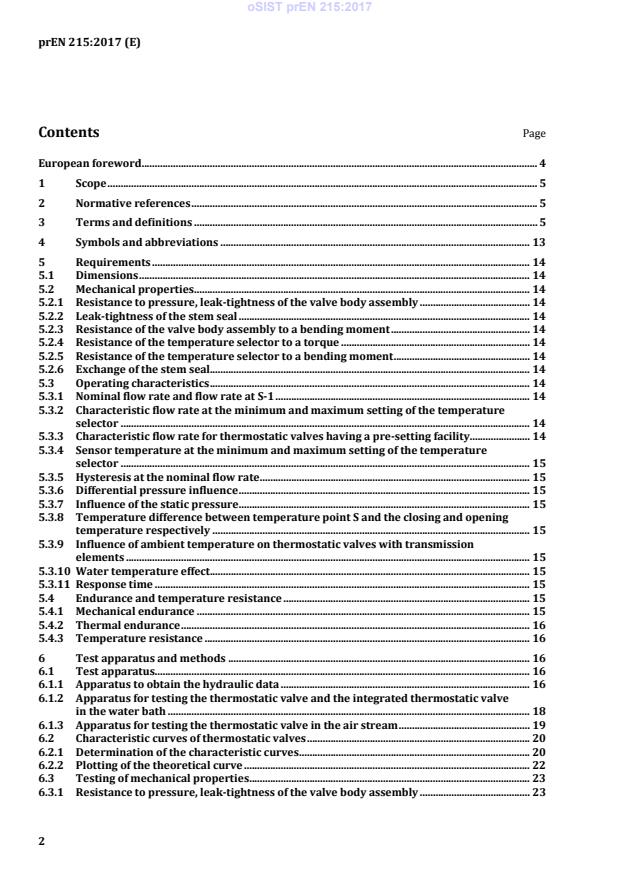
Contents Page
European foreword . 4
1 Scope . 5
2 Normative references . 5
3 Terms and definitions . 5
4 Symbols and abbreviations . 13
5 Requirements . 14
5.1 Dimensions . 14
5.2 Mechanical properties . 14
5.2.1 Resistance to pressure, leak-tightness of the valve body assembly . 14
5.2.2 Leak-tightness of the stem seal . 14
5.2.3 Resistance of the valve body assembly to a bending moment . 14
5.2.4 Resistance of the temperature selector to a torque . 14
5.2.5 Resistance of the temperature selector to a bending moment . 14
5.2.6 Exchange of the stem seal. 14
5.3 Operating characteristics . 14
5.3.1 Nominal flow rate and flow rate at S-1 . 14
5.3.2 Characteristic flow rate at the minimum and maximum setting of the temperature
selector . 14
5.3.3 Characteristic flow rate for thermostatic valves having a pre-setting facility. 14
5.3.4 Sensor temperature at the minimum and maximum setting of the temperature
selector . 15
5.3.5 Hysteresis at the nominal flow rate . 15
5.3.6 Differential pressure influence . 15
5.3.7 Influence of the static pressure . 15
5.3.8 Temperature difference between temperature point S and the closing and opening
temperature respectively . 15
5.3.9 Influence of ambient temperature on thermostatic valves with transmission
elements . 15
5.3.10 Water temperature effect. 15
5.3.11 Response time . 15
5.4 Endurance and temperature resistance . 15
5.4.1 Mechanical endurance . 15
5.4.2 Thermal endurance . 16
5.4.3 Temperature resistance . 16
6 Test apparatus and methods . 16
6.1 Test apparatus. 16
6.1.1 Apparatus to obtain the hydraulic data . 16
6.1.2 Apparatus for testing the thermostatic valve and the integrated thermostatic valve
in the water bath . 18
6.1.3 Apparatus for testing the thermostatic valve in the air stream . 19
6.2 Characteristic curves of thermostatic valves . 20
6.2.1 Determination of the characteristic curves . 20
6.2.2 Plotting of the theoretical curve . 22
6.3 Testing of mechanical properties . 23
6.3.1 Resistance to pressure, leak-tightness of the valve body assembly . 23
6.3.2 Leak-tightness of the valve closed mechanically by means of the protection cap. . 24
6.3.3 Leak-tightness of the stem seal . 24
6.3.4 Resistance of the valve body assembly to a bending moment . 25
6.3.5 Resistance of the temperature selector to a torque . 26
6.3.6 Resistance of the temperature selector to a bending moment . 27
6.4 Testing of operating characteristics . 27
6.4.1 Characteristic data . 27
6.4.2 Endurance tests and temperature resistance test . 30
6.5 Test schedule . 31
7 Technical information to be published by the manufacturer . 33
Annex A (normative) Thermostatic Radiator Valves - Dimensions and details on connection . 35
A.1 General . 35
A.2 Dimensions . 35
A.3 Connection details . 37
A.4 Materials for body, tailpiece and nut . 37
A.5 Designation . 38
A.6 Marking (This marking does not cover possible certification marking) . 38
A.7 CA Value Calculation . 38
Annex B (informative) Degree of turbulence of the air current in a room . 39
Annex C (informative) Test block for thermostatic integrated valves . 40
Bibliography . 41
European foreword
This document (prEN 215:2017) has been prepared by Technical Committee CEN/TC 130 “Space
heating appliances without integral heat sources”, the secretariat of which is held by UNI.
This document is currently submitted to the CEN Enquiry.
This document will supersede EN 215:2004.
This European Standard can be used as a reference for a CEN/CENELEC Certification Mark System on
radiator valves.
1 Scope
This European Standard specifies definitions, requirements and test methods for thermostatic radiator
valves (referred to hereafter as thermostatic valves).
This standard applies to two port thermostatic valves with or without pre-setting facility and
thermostatic integrated valves with or without pre-setting facility for fitting to radiators in wet central
heating installations up to a water temperature of 120 °C and a nominal pressure of PN 10.
This standard further specifies the dimensions, the materials and the connection details of four series of
straight and angle pattern thermostatic radiator valves of nominal pressure ≤ PN 10.
This standard can be used as reference in a CEN/CENELEC Certification Mark System on thermostatic
radiator valves.
2 Normative references
The following documents, in whole or in part, are normatively referenced in this document and are
indispensable for its application. For dated references, only the edition cited applies. For undated
references, the latest edition of the referenced document (including any amendments) applies.
EN 1982, Copper and copper alloys - Ingots and castings
EN 12164, Copper and copper alloys - Rod for free machining purposes
EN 12168, Copper and copper alloys - Hollow rod for free machining purposes
EN 12420, Copper and copper alloys - Forgings
EN 12449, Copper and copper alloys - Seamless, round tubes for general purposes
prEN 15316-2, Heating systems and water based cooling systems in buildings - Method for calculation of
system energy requirements and system efficiencies - Part 2: Space emission systems (heating and cooling)
EN ISO 228-1, Pipe threads where pressure-tight joints are not made on the threads - Part 1: Dimensions,
tolerances and designation (ISO 228-1)
ISO 7-1, Pipe threads where pressure-tight joints are made on the threads - Part 1: Dimensions, tolerances
and designation
ISO 965-1, ISO general purpose metric screw threads - Tolerances - Part 1: Principles and basic data.
ISO 7268, Pipe components - Definition of nominal pressure.
3 Terms and definitions
For the purposes of this document, the following terms and definitions apply.
3.1
thermostatic radiator valve
thermostatic head assembly and thermostatic valve assembly or the thermostatic integrated valve
assembly
Note 1 to entry: See Figure 1 for components of the thermostatic radiator valve.
Key
A thermostatic head assembly 5 valve seat
B valve body assembly 6 union nut
1 sensor 7 tailpiece
2 temperature selector 8 valve stem
3 temperature selector scale 9 stem seal
4 valve disc 10 flow direction arrow
Figure 1 — Schematic drawing of the assembly of a thermostatic valve with integral sensor
3.1.1
sensor
part of the thermostatic valve that senses the temperature (controlled value)
Note 1 to entry: See Figure 2.
3.1.2
transmission unit
part of the thermostatic valve that converts a change of temperature or pressure of the sensor into a
linear movement of the valve stem
Note 1 to entry: See Figure 2.
3.1.3
transmission element
part of the thermostatic valve (e.g. capillary) that transmits the volume or pressure changes from the
sensor or temperature selector to the transmission unit
Note 1 to entry: See Figure 2.
3.1.4
thermostatic element
section containing all parts that are filled with the expansion medium
EXAMPLE Sensor, transmission element and transmission unit, shown as cross hatched parts in Figure 2.
Key
1 sensor
2 transmission element
3 transmission unit
Figure 2 — Thermostatic element
3.1.5
protection cap
device that protects the valve stem and thread before the initial fitting of the thermostatic head
assembly
3.2
types of thermostatic head assembly
3.2.1
thermostatic valve with integral sensor
valve where the sensor, transmission unit and temperature selector constitute an assembly which is
incorporated with the valve body assembly
Note 1 to entry: See Figure 3.
Figure 3 — Thermostatic valve with integral sensor
3.2.2
thermostatic valve with integral temperature selector and with remote sensor
valve where the temperature selector is incorporated within the valve but the sensor is separated from
the transmission unit, and there is a transmission element between the sensor and the transmission
unit
Note 1 to entry: See Figure 4.
Figure 4 — Thermostatic valve with integral temperature selector with remote sensor
3.2.3
thermostatic valve with the remote sensor incorporating the selector
valve where the sensor and temperature selector assembly is mounted remotely from the valve body
assembly and from the transmission unit, and there is a transmission element between the sensor and
the transmission unit
Note 1 to entry: See Figure 5.
Figure 5 — Thermostatic valve with the remote sensor incorporating the selector
3.2.4
thermostatic valve with remote sensor and remote selector
valve where both the sensor and the temperature selector are separate from each other and from the
valve body assembly with transmission unit, and there is a transmission element between the sensor
and the transmission unit and between the temperature selector and the transmission unit
Note 1 to entry: See Figure 6.
Figure 6 — Thermostatic valve with remote sensor and remote selector
3.2.5
thermostatic valve with pre-setting
valve where a reduced flow rate can be obtained by means of mechanical pre-adjustment incorporated
in the valve body assembly
3.2.6
type of thermostatic integrated valve
embedded valve including valve seat
Note 1 to entry: See Figure 7.
Key
1 garniture
2 integrated valve assembly
3 packing seal
Figure 7 — Example of valve integrated in a radiator
3.3
types of connections
examples of connections used to fit the valve to the radiator and to the pipe work
Note 1 to entry: See Figure 8.
Key
a) internal pipe thread and cone seated union
b) compression fitting and cone seated union
c) washered union connections
d) compression fittings
e) integrated valve
Figure 8 — Types of radiator valve connections
3.4
operating characteristics
3.4.1
characteristic flow rate
q
m, s
water flow rate that is obtained at a temperature of point S-2K, and at a differential pressure of 10 kPa
(0,1 bar), at any desired setting
3.4.2
nominal flow rate
q
m, N
characteristic flow rate for an intermediate setting of the temperature selector according to 6.2.1.3.
Note 1 to entry: The nominal flow rate for thermostatic valves having a pre-setting facility is that obtained
when the pre-setting facility is inoperative.
3.4.3
maximum flow rate
q
m, max
maximum water flow rate that can be obtained at a differential pressure of 10 kPa (0,1 bar)
3.4.4
hysteresis
temperature difference between the opening and closing curves obtained at the same flow rate
Note 1 to entry: See Figure 9.
Note 2 to entry: If the opening and the closing curves cross each other the value of the hysteresis will be
measured at 1 K P-deviation.
Key
q flow rate a opening curve S temperature point S
m
°C water bath temperature b closing curve
c theoretical curve
d hysteresis
e closing temperature
f opening temperature
Figure 9 — Explanatory graph of characteristic curves
3.4.5
differential pressure influence
difference between the temperature points S on the theoretical closing curves obtained at different
differential pressures
Note 1 to entry: See Figure 9.
3.4.6
influence of static pressure
temperature difference between two closing curves plotted at different static pressures at the same
flow rate
3.4.7
water temperature effect
difference in sensor temperatures which is equivalent to the flow rate deviation caused by a change of
temperature of the water flowing through the valve
3.4.8
influence of ambient temperature on thermostatic valves with transmission elements
temperature difference obtained at the same flow rate between two opening curves, one recorded with
and one without temperature difference between sensor and transmission unit
Note 1 to entry: Valves according to 3.2.2 to 3.2.4.
3.4.9
response time
time taken for a change of flow rate after a step-change of air temperature
Note 1 to entry: This change of flow rate corresponds to a pre-determined temperature difference in accordance
with 6.4.1.13.
3.5
technical definitions
3.5.1
sensor temperature
measured temperature of the sensor
Note 1 to entry: In the test it is the same as the temperature of the water bath.
3.5.2
differential pressure
Δp
difference of pressure between valve inlet and valve outlet
3.5.3
closing curve and opening curve
curves showing the functions of the water flow versus sensor temperature at constant differential
pressure when the valve is closing and opening respectively and at the same temperature selector
setting
Note to entry: See Figure 9.
3.5.4
closing temperature and opening temperature
sensor temperatures obtained from the closing and opening curves respectively for zero flow
Note 1 to entry: See Figure 9.
3.5.5
theoretical curve
straight line which passes through the points 0,5 q and 0,25 q on the characteristic curve
m s m s
Note 1 to entry: Construction shall be according to 6.2.2.
Note 2 to entry: See Figure 9.
3.5.6
temperature point S
point of intersection of the theoretical curve with the abscissa q = 0
m
Note 1 to entry: According to 6.2.2.
Note 2 to entry: See Figure 9.
4 Symbols and abbreviations
Table 1 — Symbols and abbreviations
Symbol Explanation Unit
q
Flow rate kg/h
m
qm,N Nominal flow rate kg/h
qm,s Characteristic flow rate kg/h
qm,max Maximum flow rate kg/h
q at maximum setting of the
m s
qm,s,max kg/h
temperature selector
q at minimum setting of the
m s
qm,s,min kg/h
temperature selector
q
m,x1 Auxiliary flow rates for measuring the
kg/h
response time
qm,x2
Sensor temperature which corresponds
t
°C
s
to the characteristic flow rate
t at maximum setting of the
s
ts,max °C
temperature selector
t at minimum setting of the
s
ts,min °C
temperature selector
S Temperature point °C
Δp Differential pressure Pa
K Temperature difference Kelvin
5 Requirements
5.1 Dimensions
Dimensions and connection details for some types of radiator valves are given in Annex A.
5.2 Mechanical properties
5.2.1 Resistance to pressure, leak-tightness of the valve body assembly
During the test according to 6.3.1, there shall be no leak from the connections nor through the wall of
the body.
5.2.2 Leak-tightness of the stem seal
The stem seal shall show no leakage of air during the test according to 6.3.3.
5.2.3 Resistance of the valve body assembly to a bending moment
The valve shall withstand the load according to 6.3.4 without permanent functional impairment, and
shall fulfil the requirements of the subsequent tests.
Permanent deformation shall not be taken into account.
5.2.4 Resistance of the temperature selector to a torque
No damage or permanent deformation shall be visible after the test according to 6.3.5.
5.2.5 Resistance of the temperature selector to a bending moment
No damage or permanent deformation shall be visible after the test according to 6.3.6.
5.2.6 Exchange of the stem seal
It shall be possible to exchange the stem seal and/or the insert without draining the heating installation
in which the valve is mounted.
5.3 Operating characteristics
5.3.1 Nominal flow rate and flow rate at S-1
The nominal flow rate declared by the manufacturer shall not vary by more than 10 % for flow rates
> 33 kg/h and by more than 3 kg/h for flow rates ≤ 33 kg/h from the value determined in the test
specified in 6.4.1.1.
The plotted flow rate S -1 K shall not be more than 70 % of the nominal flow rate. For presettable
valves, the 70 % are only valid for the maximum pre-setting position.
5.3.2 Characteristic flow rate at the minimum and maximum setting of the temperature selector
This flow rate qm,s determined according to 6.4.1.5 shall be within the following ranges:
• at maximum setting: q ≥ 0,8q
m,s,max m,N;
• at minimum setting: 1,2q ≥ q ≥ 0,5q
m,N m,s,min m,N.
5.3.3 Characteristic flow rate for thermostatic valves having a pre-setting facility
For thermostatic valves having a pre-setting facility, the characteristic flow rate declared by the
manufacturer for an intermediate setting of the temperature selector according to 6.2.1.3 and for each
specified pre-setting position shall not vary by more than the tolerance declared by the manufacturer
from the values determined in the test specified in 6.4.1.3.
5.3.4 Sensor temperature at the minimum and maximum setting of the temperature selector
This sensor temperature ts determined according to 6.4.1.6 shall be within the following range:
• 5 °C ≤ t ≤ 32 °C.
s
5.3.5 Hysteresis at the nominal flow rate
The hysteresis determined according to 6.4.1.7 shall not be greater than 1 K and not exceed the value
declared by the manufacturer by more than 0,2 K.
5.3.6 Differential pressure influence
The differential pressure influence determined according to 6.4.1.8 shall not be greater than 1 K and not
exceed the value declared by the manufacturer by more than 0,3 K.
If the measured value is negative (e.g. in case of opposite flow direction) it shall be documented as
absolute value.
5.3.7 Influence of the static pressure
The influence of the static pressure determined according to 6.4.1.9 shall not be greater than 1 K.
5.3.8 Temperature difference between temperature point S and the closing and opening
temperature respectively
The temperature difference between temperature point S and the closing and opening temperature
respectively determined according to 6.4.1.10 shall not be greater than 0,8 K.
5.3.9 Influence of ambient temperature on thermostatic valves with transmission elements
The influence of the ambient temperature determined according to 6.4.1.11 shall not be greater than
1,5 K.
5.3.10 Water temperature effect
The effect that is caused by a change of the temperature of the water flowing through the valve of 30 K
and which is determined according to 6.4.1.12 shall not be greater than:
• 1,5 K for thermostatic valves with the sensor incorporated according to 3.2.1;
• 0,75 K for thermostatic valves with the transmission elements according to 3.2.2 to 3.2.4
and not exceed the value declared by the manufacturer by more than 0,3 K.
5.3.11 Response time
The response time determined according to 6.4.1.13 shall not exceed 40 min and the value declared by
the manufacturer by more than 7 min.
5.4 Endurance and temperature resistance
5.4.1 Mechanical endurance
The values of the sensor temperatures at the nominal flow rate before and after the mechanical
endurance test according to 6.4.2.1 shall not vary by more than 2 K.
The nominal flow rate determined after the mechanical endurance test shall not vary by more than
± 20 % from that determined before the endurance test.
5.4.2 Thermal endurance
The values of the sensor temperatures at nominal flow rate before and after the thermal endurance test
according to 6.4.2.2 shall not vary by more than 2 K.
The nominal flow rate determined after the thermal endurance test shall not vary by more than ± 20 %
from that determined before the endurance test.
5.4.3 Temperature resistance
The values of the sensor temperatures at nominal flow rate before and after the temperature resistance
test according to 6.4.2.3 shall not vary by more than 1,5 K.
The nominal flow rate determined after the temperature resistance test shall not vary by more than
± 20 % from that determined before the temperature resistance test.
6 Test apparatus and methods
6.1 Test apparatus
6.1.1 Apparatus to obtain the hydraulic data
Use a test circuit with the functions shown in Figure 10 to obtain the hydraulic data of the valve.
Key
1 test sample 8 differential pressure controller
2 flow meter F 9 differential pressure meter
3 xy recorder R 10 measuring points for differential pressure
(x = temperature, y = flow rate)
4 heater 11 temperature sensor
5 temperature controller 12 temperature meter
6 temperature sensor 13 device for maintaining the pressure in the system by means of
an expansion vessel
7 circulating pump 14 test block for thermostatic integrated valve (Examples for
dimension see Annex C)
Figure 10 — Schematic layout of the test circuit to obtain the hydraulic data of the thermostatic
valve and the thermostatic integrated valve
Table 2 — Dimensional pipe characteristics
Nominal size Pipe thread Internal diameter d
a
DN mm
8 1/4 10
10 3/8 10
15 1/2 13
20 3/4 20
25 1 25
a
See EN ISO 6708.
The flow measurement accuracy shall be at least:
— ± 3 % of the measured value for flow rates > 33 kg/h;
— ± 1 kg/h for flow rates ≤ 33 kg/h.
The pressure differential measurement accuracy shall be at least:
— ± 1 % of the measured value.
By means of a controller it shall be possible to maintain a differential pressure, when measured across
the inlet and outlet pressure tappings of the test sample, at a value between 10 and 60 kPa (0,1 and
0,6 bar) and constant within ± 2 %. Furthermore, it shall be possible to apply a constant inlet pressure
of 100 kPa (1 bar) ± 2 % or of 1 000 kPa (10 bar) ± 2 % at the inlet pressure tapping of the sample.
At the inlet of the test circuit there is a water temperature measuring point.
It shall be possible to keep the water temperature constant within ± 0,2 K at a chosen temperature
between 50 °C and 80 °C.
6.1.2 Apparatus for testing the thermostatic valve and the integrated thermostatic valve in the
water bath
Use a circuit functionally as shown in Figure 11 for testing the thermostatic valve and the thermostatic
integrated valve in the water bath. Totally immerse the thermostatic element in the water bath, e. g. at
the level which is specified by the manufacturer, ensuring that the water is continuously mixed and
circulated around the thermostatic element.
It shall be possible to change the temperature smoothly by means of a control device. The rate of change
shall be 3 K/h. The temperature of the water bath shall be measured and recorded with an accuracy of
± 0,2 K and the temperature change in the bath with an accuracy of ± 0,03 K.
For the test according to 6.2.1.5, two water baths shall be used.
Key
1 water bath 8 temperature controller
2 stirrer 9 temperature sensor
3 temperature sensor 10 thermostatic head assembly
4 temperature meter 11 thermostatic element
5 xy recorder 12 test circuit according to Figure 10
(x = temperature, y = flow rate)
6 water bath heater 13 testblock for thermostatic integrated
valve (Dimensions see Annex C)
7 water bath cooler
Figure 11 — Schematic layout of the test apparatus for the water bath
6.1.3 Apparatus for testing the thermostatic valve in the air stream
Use a testing equipment consisting of two air ducts, each having a symmetrical cross sectional area of at
least 0,36 m (Figure 12). The thermostatic valve shall be placed in the centre of one duct with the axis
of the thermostatic head with integral sensor mounted in a horizontal position, unless otherwise
specified by the manufacturer. Thermostatic valves with transmission elements in accordance with
3.2.2 to 3.2.4 shall be mounted in a position as declared by the manufacturer.
Air shall pass across the thermostatic valve in an upward direction. A device shall effect rapid transfer
of the thermostatic valve from one duct to the other.
The inside wall of the measuring duct shall be protected against radiated heat. The temperature and
velocity profiles in the duct at test level shall be uniform over at least 80 % of the cross section. During
the test, the air stream shall be controlled by a measuring device having an adequate measuring
accuracy. The air temperature shall be maintained constant to ± 0,1 K.
The connection pipes shall not be in the air stream in front of the test sample. They shall be thermally
insulated.
The air temperature change shall be measured with a maximum uncertainty of measurement of
± 0,03 K. The temperature sensor shall be insulated against radiation.
The airflow shall be turbulent. The air velocity, shall be adjusted to obtain a mean velocity of
+0,05
0,1 m/s m/s.
The standard deviation, calculated from velocity variations, by statistical methods and compared to the
mean value, or the degree of turbulence, shall be within 30 % to 50 % (see Annex B).
Key
1 test sample
2 fan
3 duct installations for obtaining a smooth flow profile and for generating turbulence
4 calibrated venturi
5 differential pressure gauge F
6 heat exchanger
7 temperature controlled water circuit
8 temperature meter
Figure 12 — Schematic layout of the air test apparatus
6.2 Characteristic curves of thermostatic valves
6.2.1 Determination of the characteristic curves
6.2.1.1 General
Use the curves 1 to 7 according to Figure 13 for the assessment of the performance of thermostatic
valves.
These curves are plotted using the test apparatus as described in 6.1.1 and 6.1.2.
Unless specified differently in the following clauses, the measurements shall be carried out with a static
pressure at the inlet of the valve of 100 kPa (1 bar) ± 10 % and with a differential pressure of
10 kPa (0,1 bar) ± 2 %. The temperature of the water flowing through the thermostatic valve shall be
maintained at 50 °C ± 2 °C. The water bath temperature shall not vary by more than 3 K/h.
For all the characteristic curves which are measured at an intermediate setting of the temperature
selector, this intermediate setting shall be obtained in the closing direction.
6.2.1.2 Opening curve at minimum setting of the temperature selector (curve no. 1) and at
maximum setting (curve no. 2)
Adjust to the minimum setting. Starting with a temperature of at least 2 K above the opening
temperature, decrease the sensor temperature to 3 K below the opening temperature and plot the
opening curve. Now adjust to the maximum setting and repeat the procedure given for the minimum
setting above.
6.2.1.3 Opening curve at an intermediate setting of the temperature selector (curve no. 3)
Choose a mean setting of the temperature selector for which the opening temperature on the opening
curve is between 20 °C and 24 °C. Start with a temperature of at least 2 K above the opening
temperature. Decrease the sensor temperature to 6 K below the opening temperature and plot the
opening curve.
6.2.1.4 Closing curve at an intermediate setting of the temperature selector (curve no. 4)
The setting of the temperature selector remaining unchanged, start from a temperature of at least 4 K
below the opening temperature. Increase the sensor temperature up to 1 K above the closing
temperature and plot the closing curve.
6.2.1.5 Opening curve for thermostatic valves with transmission elements in accordance with
3.2.2 to 3.2.4 at an intermediate setting of the temperature selector (curve no. 5)
The setting of the temperature selector remaining unchanged, immerse the transmission unit with 1 m
of its transmission element in a second water bath. This shall be at a constant temperature of
10 K ± 0,1 K above that sensor temperature, at which the nominal flow rate is obtained. The remainder
of the transmission element, the sensor, and for thermostatic valves according to 3.2.4 the remote
temperature selector as well shall be immersed in the first water bath.
Starting with the temperature of at least 2 K above the opening temperature, decrease the sensor
temperature to 3 K below the opening temperature and plot the opening curve.
6.2.1.6 Closing curve at an intermediate setting of the temperature selector and at a differential
pressure greater than 10 kPa (0,1 bar) (curve no. 6)
For thermostatic valves with integral sensor, plot the closing curve at a differential pressure of 60 kPa
(0,6 bar) ± 2 % immediately after the measurement as described in 6.2.1.4 and in the same way.
For thermostatic valves with transmission elements according to 3.2.2 to 3.2.4, plot the same curve
after the measurement as described in 6.2.1.5.
If the maximum permissible differential pressure declared by the manufacturer is less than
60 kPa (0,6 bar), the test shall be carried out at that differential pressure.
6.2.1.7 Closing curve at an intermediate setting of the temperature selector and at a static
pressure of 1000 kPa (10 bar) (curve no. 7)
In the same way as described in 6.2.1.4 and immediately after the measurement described in 6.2.1.6,
plot the closing curve at a static pressure of 1 000 kPa (10 bar) ± 2 %.
Key
A flow rate, q
m
B water bath temperature, °C
C hysteresis
D differential pressure effect
E effect of the static pressure
F difference of sensor temperatures at minimum and maximum setting
G influence of ambient temperature on thermostatic valves with transmission elements
Figure 13 — Characteristic curves of thermostatic valves
6.2.2 Plotting of the theoretical curve
This procedure is used for any plotted opening and closing curve. It is effected by the following iterative
steps (see Figure 14):
1) The linear part of the curve is extended to meet the abscissa q = 0 (point 1 ) or the tangent is
m 1
drawn through the point of inflexion;
2) At a temperature of 2 K below the intersection (point 1 ) point 2 is obtained and the corresponding
1 1
water flow rate (point 3 ) is determined;
3) Point 4 is obtained at 50 % and point 5 at 25 % of the water flow rate at point 3 ;
1 1 1
4) Join point 4 and 5 and continue to cut the abscissa (q = 0) at point 6 ;
1 1 m 1
5) Repeat the process starting from point 6 until further repetition does not result in a shift in point 6;
this final point is designated by S;
6) The water flow rate at a temperature 2 K lower is q ;
m,s
7) The line through the final points of 50 % and of 25 % of q on the characteristic curve and S on the
m,s
abscissa is the theoretical curve.
Key
q flow rate
m
°C water bath temperature
Figure 14 — Plotting of the theoretical curve and of point S
6.3 Testing of mechanical properties
6.3.1 Resistance to pressure, leak-tightness of the valve body assembly
The test shall be carried out as shown in Figure 15.
Tighten the union nut of the tailpiece piece for the connection to the radiator (cone seated union shown
in Figure 7) with a torque given in Table 3 and shut the valve on the radiator side. The tightening torque
for other connections shall be according to the manufacturer's instructions.
Subject the valve in the open position, to a static water pressure of the next higher nominal pressure
(see ISO 7268), compared to the nominal pressure of the valve body assembly. The temperature of the
water shall be 20 °C ± 10 °C. Check after 1 min whether water leaks from the connections or through the
wall of the body.
Figure 15 — Testing of pressure resistance of the valve body
Table 3 — Tightening torques for the tailpiece nut
a
Nominal size Size of thread Tightening torque
Nm
15 mm copper tube fitting 1/4 40
DN 8 3/8 40
DN 10 1/2 40
DN 15 3/4 60
DN 20 1 80
DN 25 100
a
See EN ISO 6708.
6.3.2 Leak-tightness of the valve closed mechanically by means of the protection cap.
This test shall be carried out only if the manufacturer declares that the valve can be shut-off by means
of the protection cap against a pressure, which he declares.
Mount the valve body assembly in the test apparatus shown in Figure 15 so that it remains open on the
radiator side. Shut the valve by means of the protection cap. Apply a static water pressure equal to the
pressure declared by the manufacturer. The temperature of the water shall be 20 °C ± 10 °C. Check after
1 min whether water has escaped past the valve disc.
6.3.3 Leak-tightness of the stem seal
The test shall be carried out as shown in Figure 16. The valve shall be blanked off on the radiator side
and immersed in water. Apply an air pressure of 20 kPa (0,2 bar) ± 10 %. After 1 min, operate the stem
5 times. Check the leak-tightness of the stem seal.
Figure 16 — Testing of leak-tightness of the stem seal
6.3.4 Resistance of the valve body assembly to a bending moment
The test shall be carried out as shown in Figure 17. Tighten the union nut of the tailpiece piece
according to Table 3. Apply a force F at the end of the pipe and perpendicular to its axis for 30 s. F shall
result in a bending moment as specified in Table 4.
After this test, check the leak tightness by the method specified in 6.3.1.
Permanent deformation shall not be taken into account.
Key
1 straight-through valves
2 right-angle valves
Figure 17 — Testing of bending strength of the valve body assembly
Table 4 — Bending moments for testing thermostatic valves
a
Nominal size Size of thread Bending moment in Nm
15 mm copper tube fitting 1/4 20
DN 8 3/8 80
DN 10 1/2 100
DN 15 3/4 120
DN 20 1 180
DN 25 220
a
See EN ISO 6708.
6.3.5 Resistance of the temperature selector to a torque
The test shall be carried out as shown in Figure 18 with water at a temperature of 90 °C ± 2 °C and a
static pressure of 100 kPa (1 bar) flowing through the valve body assembly. After a period of at least
20 min for thermal equilibrium to be reached, set the temperature selector at the minimum stop
position. Apply for 30 s a force that results in a torque of 7 Nm without any transverse force in the
direction of the stop.
Finally, the temperature selector is set to the maximum stop position and the test is carried out
accordi
...