

SIST EN 13794:2003
(Main)Respiratory protective devices - Self-contained closed-circuit breathing apparatus for escape - Requirements, testing, marking
- Abstract
This EN specifies minimum requirements for self-contained closed-circuit breathing apparatus, chemical oxygen (KO2, NaCIO3) type and compressed oxygen type, for escape (short: oxygen escape apparatus OEA). This EN does not apply to apparatus for work and rescue and to diving apparatus. Laboratory and practical performance tests are included for the assessment of compliance with the requirements.
- Status
- Published
- Publication Date
- 31-Mar-2003
- Technical Committee
- OVP - Personal protecting equipment
- Current Stage
- 6060 - National Implementation/Publication (Adopted Project)
- Start Date
- 01-Apr-2003
- Due Date
- 01-Apr-2003
- Completion Date
- 01-Apr-2003
2016/425 - Regulation (EU) 2016/425 of the European Parliament and of the Council of 9 March 2016 on personal protective equipment and repealing Council Directive 89/686/EECOJ Ref: C 113 OJ Date: 27-Mar-2018
89/686/EEC - Personal protective equipment (PPE)OJ Ref: C 203 OJ Date: 28-Aug-2003 Conflicting Date: 28-Aug-2003

SIST EN 13794:2003 is the Slovenian adoption of EN 13794:2002 from SIST, covering respiratory protective devices for escape. It specifies minimum requirements, test methods and marking for self-contained closed-circuit breathing apparatus for escape, including chemical oxygen and compressed oxygen types, for manufacturers, test houses and buyers who need to verify escape capability.
What does SIST EN 13794:2003 specify?
SIST EN 13794:2003 specifies oxygen escape apparatus (OEA) that are intended for escape only. It covers chemical oxygen apparatus with KO2 or NaClO3 and compressed oxygen apparatus, and it combines product requirements with laboratory and practical performance tests so compliance can be assessed on the complete apparatus.
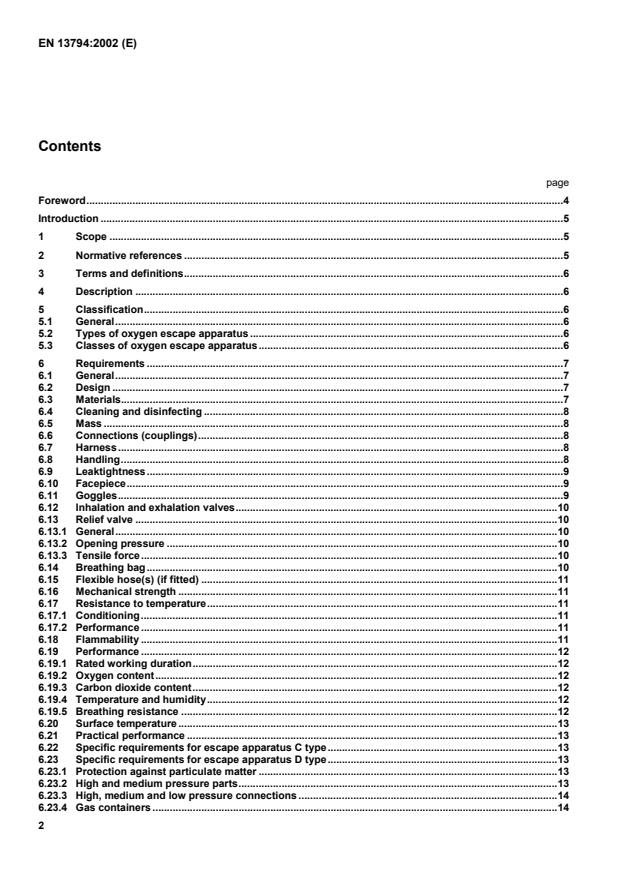
The document is organized into scope, normative references, terms and definitions, description, classification, requirements, testing, marking, and information supplied by the manufacturer.
| Annex | What it covers |
|---|---|
| Annex A | Additional requirements for apparatus designed for underground use |
| Annex B | Methods for measuring insulation resistance of the carrying container |
| Annex C | Training apparatus |
| Annex D | Marking guidance for components and sub-assemblies |
| Annex ZA | Clauses addressing EU Directive 89/686/EEC |
What are the key requirements of SIST EN 13794:2003?
SIST EN 13794:2003 focuses on safe construction, dependable breathing performance and clear user information. The most important requirements are the ones that affect how the apparatus is worn, how long it works, and whether it still protects the wearer under heat, shock and realistic escape conditions.
Design, materials and handling
Clause 6 requires reliable, compact construction with no sharp edges or protruding parts likely to catch in narrow passages. In practice, this matters because escape equipment must be easy to carry and should not snag when the wearer is moving through restricted spaces.
Materials, carrying containers and locking devices must withstand corrosion, temperature and mechanical stress. Exposed parts must not be made of aluminium, magnesium or titanium where friction sparks could ignite flammable gas mixtures, and non-metallic carrying containers must be antistatic. This matters where ignition risk or rough handling is a concern.
The apparatus must be easy to don and put into operation, including in the dark and in restricted spaces. It must also remain leaktight in ready-for-use condition, so the wearer can trust the breathing circuit before starting an escape.
Facepiece, harness and bag
Clause 6 requires either a mouthpiece assembly or a full face mask, with special rules for Type D apparatus using a lung governed demand valve. The harness or other support must leave the hands free and allow quick donning without assistance.
The breathing bag must withstand foreseeable use and have a volume of at least 6 l. Flexible hoses, if fitted, must not kink or block the gas supply under load. These points matter because comfort, fit and gas delivery directly affect whether the wearer can complete an escape.
Performance under test
Clause 6 sets the core performance checks: oxygen content, carbon dioxide content, breathing resistance, temperature and humidity of inhaled gas, surface temperature and practical performance. The apparatus is tested at a minute volume of 35 l/min, and some types are also checked at 70 l/min.
For readers, this means the document does not stop at design claims - it verifies actual breathing performance over the rated working duration and under heat, cold and realistic user movement.
Type-specific requirements
Type C apparatus must deliver at least 4.0 l/min of oxygen and include a pressure safety device for the chlorate candle. Type D apparatus has extra requirements for pressure parts, gas container connections, pressure indicator and oxygen supply control. Type K apparatus must keep the carrying container leaktight over time and deliver adequate oxygen flow into the breathing circuit.
Marking and manufacturer information
Clauses 8 and 9 require marking for the manufacturer, model, type C/D/K, rated working duration, serial number, year of manufacture or shelf life, and the standard number. The manufacturer’s instructions must explain type classification, limitations, checks before use, donning, maintenance, storage, shelf life and leaktightness testing. This is important because escape apparatus depends on correct use and inspection.
What terms does SIST EN 13794:2003 define?
- oxygen escape apparatus (OEA) - A self-contained closed-circuit breathing apparatus for escape, not for work or rescue.
- quick start system - A mechanism that activates oxygen generation or flow when the storage container is opened or the facepiece is pulled.
- rated working duration - The classified duration established by breathing machine testing at 35 l/min.
- Type C - Escape apparatus using NaClO3.
- Type D - Compressed oxygen apparatus.
- Type K - Escape apparatus using KO2.
- training apparatus - Apparatus that simulates carrying, donning and breathing of the working apparatus.
Who uses SIST EN 13794:2003?
Manufacturers use SIST EN 13794:2003 to design and mark escape breathing apparatus and to prepare technical files and user instructions. Test houses and certification bodies use it for laboratory tests, practical performance trials and inspection of markings and documentation.
It is also relevant to buyers, safety managers and operators in underground and other escape-critical workplaces, because it defines what to check when selecting, receiving and maintaining oxygen escape apparatus.
What changed in SIST EN 13794:2003 from the previous edition?
SIST EN 13794:2003 supersedes EN 400:1993, EN 401:1993 and EN 1061:1996.
Which standards are used with SIST EN 13794:2003?
- EN 132 - provides terms and pictograms for respiratory protective devices.
- EN 134 - gives nomenclature of components.
- EN 136:1998 - supplies requirements and tests for full face masks used with this apparatus.
- EN 166:1995 and EN 168:1995 - support the requirements and test methods for goggles.
- EN 13274-1 - inward leakage and total inward leakage tests.
- EN 13274-2 - practical performance tests.
- EN 13274-3 - breathing resistance tests.
- EN 13274-4 - flame tests.
- EN 13274-5 - climatic conditioning.
What does the SIST EN 13794:2003 document contain?
SIST EN 13794:2003 contains a full requirement-and-test framework, not just a product description. Clause 7 gives the test programme, including visual inspection, leak tests, shock and vibration, temperature conditioning, breathing machine tests, surface temperature measurement and practical escape trials. It also includes figure-based test set-ups, such as the breathing machine arrangement, the Sheffield head and the mouthpiece connector.
Annex B provides alternative measurement methods for insulation resistance, while Annex C defines a training apparatus and its acceptance rules. Annex D gives marking guidance for safety-related parts and sub-assemblies, which helps manufacturers decide what to identify on the product and what to explain in the instructions.
Relations
- Effective Date
- 01-Apr-2003
- Effective Date
- 01-Apr-2003
- Effective Date
- 01-Apr-2003
- Effective Date
- 28-Jan-2026
- Effective Date
- 28-Jan-2026
- Effective Date
- 28-Jan-2026
- Refers
SIST EN 136:1998 - Respiratory protective devices - Full face masks - Requirements, testing, marking - Effective Date
- 28-Jan-2026
- Effective Date
- 28-Jan-2026
- Effective Date
- 28-Jan-2026
- Effective Date
- 28-Jan-2026
- Effective Date
- 28-Jan-2026
- Effective Date
- 28-Jan-2026
- Effective Date
- 28-Jan-2026
- Effective Date
- 28-Jan-2026
- Effective Date
- 28-Jan-2026
Get Certified
Connect with accredited certification bodies for this standard

CIS Institut d.o.o.
Personal Protective Equipment (PPE) certification body. Notified Body NB-2890 for EU Regulation 2016/425 PPE.

Kiwa BDA Testing
Building and construction product certification.
Kmetijski inštitut Slovenije
Agricultural Institute of Slovenia. Soil testing, plant health, agricultural product analysis.
Sponsored listings
Frequently Asked Questions
SIST EN 13794:2003 is a standard published by the Slovenian Institute for Standardization (SIST). Its full title is "Respiratory protective devices - Self-contained closed-circuit breathing apparatus for escape - Requirements, testing, marking". This standard covers: This EN specifies minimum requirements for self-contained closed-circuit breathing apparatus, chemical oxygen (KO2, NaCIO3) type and compressed oxygen type, for escape (short: oxygen escape apparatus OEA). This EN does not apply to apparatus for work and rescue and to diving apparatus. Laboratory and practical performance tests are included for the assessment of compliance with the requirements.
This EN specifies minimum requirements for self-contained closed-circuit breathing apparatus, chemical oxygen (KO2, NaCIO3) type and compressed oxygen type, for escape (short: oxygen escape apparatus OEA). This EN does not apply to apparatus for work and rescue and to diving apparatus. Laboratory and practical performance tests are included for the assessment of compliance with the requirements.
SIST EN 13794:2003 is classified under the following ICS (International Classification for Standards) categories: 13.340.30 - Respiratory protective devices. The ICS classification helps identify the subject area and facilitates finding related standards.
SIST EN 13794:2003 has the following relationships with other standards: It is inter standard links to SIST EN 401:1996, SIST EN 400:1996, SIST EN 1061:1998, SIST EN 13274-3:2002, SIST EN 13274-5:2001, SIST EN ISO 16972:2020, SIST EN 136:1998, SIST EN 168:1996, SIST EN 13274-1:2001, SIST EN 166:1996, SIST EN 13274-2:2019, SIST EN 13274-4:2020, SIST EN 134:2024, SIST EN 134:1998, SIST EN 133:2002. Understanding these relationships helps ensure you are using the most current and applicable version of the standard.
SIST EN 13794:2003 is associated with the following European legislation: EU Directives/Regulations: 2008/68/EC, 2016/425, 2016/797/EU, 89/686/EEC, 93/68/EEC, 93/95/EEC, 96/58/EC; Standardization Mandates: M/031. When a standard is cited in the Official Journal of the European Union, products manufactured in conformity with it benefit from a presumption of conformity with the essential requirements of the corresponding EU directive or regulation.
SIST EN 13794:2003 is available in PDF format for immediate download after purchase. The document can be added to your cart and obtained through the secure checkout process. Digital delivery ensures instant access to the complete standard document.
Standards Content (Sample)
2003-01.Slovenski inštitut za standardizacijo. Razmnoževanje celote ali delov tega standarda ni dovoljeno.Respiratory protective devices - Self-contained closed-circuit breathing apparatus for escape - Requirements, testing, markingAppareils de protection respiratoire - Appareils de protection respiratoire isolants autonomes a circuit fermé pour l'évacuation - Exigences, essais, marquageAtemschutzgeräte - Isoliergeräte für Selbstrettung - Anforderungen, Prüfung, Kennzeichnung13.340.30Varovalne dihalne napraveRespiratory protective devicesICS:SIST EN 13794:2003enTa slovenski standard je istoveten z:EN 13794:200201-april-2003SIST EN 13794:2003SLOVENSKI
STANDARDSIST EN 401:1996SIST EN 400:1996SIST EN 1061:19981DGRPHãþD
EUROPEAN STANDARDNORME EUROPÉENNEEUROPÄISCHE NORMEN 13794November 2002ICS 13.340.30Supersedes EN 400:1993, EN 401:1993 andEN 1061:1996English versionRespiratory protective devices - Self-contained closed-circuitbreathing apparatus for escape - Requirements, testing,markingAppareils de protection respiratoire - Appareils deprotection respiratoire isolants autonomes à circuit fermépour l'évacuation - Exigences, essais, marquageAtemschutzgeräte - Isoliergeräte für Selbstrettung -Anforderungen, Prüfung, KennzeichnungThis European Standard was approved by CEN on 9 September 2002.CEN members are bound to comply with the CEN/CENELEC Internal Regulations which stipulate the conditions for giving this EuropeanStandard the status of a national standard without any alteration. Up-to-date lists and bibliographical references concerning such nationalstandards may be obtained on application to the Management Centre or to any CEN member.This European Standard exists in three official versions (English, French, German). A version in any other language made by translationunder the responsibility of a CEN member into its own language and notified to the Management Centre has the same status as the officialversions.CEN members are the national standards bodies of Austria, Belgium, Czech Republic, Denmark, Finland, France, Germany, Greece,Iceland, Ireland, Italy, Luxembourg, Malta, Netherlands, Norway, Portugal, Spain, Sweden, Switzerland and United Kingdom.EUROPEAN COMMITTEE FOR STANDARDIZATIONCOMITÉ EUROPÉEN DE NORMALISATIONEUROPÄISCHES KOMITEE FÜR NORMUNGManagement Centre: rue de Stassart, 36
B-1050 Brussels© 2002 CENAll rights of exploitation in any form and by any means reservedworldwide for CEN national Members.Ref. No. EN 13794:2002 E
(normative)
Additional requirements for apparatus designed for underground use.29Annex B
(normative)
Methods of measurement of the insulation resistance of the carrying container.30Annex C
(normative)
Training apparatus.32Annex D
(informative)
Marking.34Annex ZA
(informative)
Clauses of this European Standard addressing essential requirements orother provisions of EU Directives.35
apparatus;¾ Type DCompressed oxygen apparatus;¾ Type KKO2 apparatus.5.3 Classes of oxygen escape apparatusOxygen escape apparatus are classified according to the rated working duration (see 6.19.1) which is defined byperforming a breathing machine test in accordance with 7.10.1 with a minute volume of 35 l/min(20 cycles/min; 1,75 l/stroke).Rated working duration will be defined in increments of 5 min up to and including a duration of 30 min andthereafter in steps of 10 min.
...