

SIST EN IEC 62962:2020
(Main)Particular requirements for load-shedding equipment (LSE) (IEC 62962:2019)
General Information
- Abstract
IEC 62962:2019 The purpose of this document is to provide requirements for equipment to be used in energy efficiency systems. This document covers load-shedding equipment (LSE).
Guidelines relating to safety for LSE as given in IEC Guide 110 have been followed.
This document applies to load-shedding equipment for household and similar uses. The load-shedding function is used in energy management systems to optimize the overall use of electrical energy including production and storage. Load-shedding can be used for example for energy efficiency purposes as per IEC 60364-8-1:2019.
- Status
- Published
- Publication Date
- 26-Feb-2020
- Technical Committee
- EPR - Electrical accessories
- Current Stage
- 6060 - National Implementation/Publication (Adopted Project)
- Start Date
- 07-Nov-2019
- Due Date
- 12-Jan-2020
- Completion Date
- 27-Feb-2020

Overview
EN IEC 62962:2019 (CLC adoption of IEC 62962:2019) specifies particular requirements for load‑shedding equipment (LSE) used in energy efficiency systems for household and similar applications. The standard sets safety, performance and testing requirements for devices that carry out controlled disconnection (shedding) of loads to optimize electrical energy use, including coordination with production and storage. It follows IEC Guide 110 safety principles and aligns with energy management guidance such as IEC 60364-8-1:2019.
Key topics and technical requirements
The standard addresses the full lifecycle and technical characteristics of LSEs, including:
- Scope and definitions: Terms, functional descriptions and per‑application boundaries for LSE in residential and similar settings.
- Architecture and general requirements: Device architecture, operational modes and standard conditions for service (temperature, humidity, altitude).
- Ratings and electrical characteristics: Rated operational/insulation voltages, rated current, impulse voltages, frequency, conditional short‑circuit current and preferred rated values.
- Time–current and time–power characteristics: Requirements for current‑monitoring LSEs, limits, minimum OFF time, reclosing conditions and shedding sequences.
- Classification: Functional categories, switching means, adjustability of shedding current/power, design types (stand‑alone, combined, external sensors) and mounting.
- Protection and safety: Protection against electric shock, terminal design and testing, mechanical strength, corrosion resistance and clamping reliability for conductor connections.
- Markings, information and documentation: Required labels, user information and test verification for markings.
- Environmental and EMC testing: Test procedures for environmental conditions and electromagnetic compatibility referencing IEC 61000 series and other normative documents.
Applications
EN IEC 62962 is directly applicable to devices that implement load‑shedding for:
- Residential and multi‑dwelling energy management systems (smart homes).
- Local demand response functions that balance consumption with on‑site production and storage (PV, batteries).
- Energy efficiency installations where prioritized shedding reduces peak demand or optimizes storage usage.
Using LSEs compliant with EN IEC 62962 helps integrate load control into smart meters, home energy controllers, distribution panels and building management systems.
Who should use this standard
- Manufacturers and designers of load‑shedding equipment and intelligent switches.
- Test laboratories and conformity assessment bodies performing safety and performance testing.
- Specifiers, installers, utilities and energy service companies developing residential energy management and demand response solutions.
- Regulators and product safety authorities referencing harmonized requirements.
Related standards
Normative references include IEC 60364 series (HD 60364), IEC 60730, IEC 61000 EMC series, IEC 60664‑1, IEC 60529 and others cited in the EN IEC 62962 annex. These provide complementary requirements for low‑voltage installations, automatic controls, EMC and enclosure protection.
Keywords: EN IEC 62962:2019, IEC 62962, load‑shedding equipment, LSE, energy efficiency, energy management systems, household load shedding.
Relations
- Effective Date
- 22-Sep-2026
- Effective Date
- 25-Aug-2026
- Effective Date
- 09-Feb-2026
- Effective Date
- 09-Feb-2026
- Effective Date
- 03-Feb-2026
- Effective Date
- 03-Feb-2026
- Refers
SIST EN 61032:2001 - Protection of persons and equipment by enclosures - Probes for verification - Effective Date
- 03-Feb-2026
- Effective Date
- 03-Feb-2026
- Effective Date
- 03-Feb-2026
- Effective Date
- 03-Feb-2026
- Effective Date
- 03-Feb-2026
- Effective Date
- 03-Feb-2026
- Effective Date
- 03-Feb-2026
- Effective Date
- 03-Feb-2026
- Effective Date
- 03-Feb-2026
Get Certified
Connect with accredited certification bodies for this standard

DNV
DNV is an independent assurance and risk management provider.

Lloyd's Register
Lloyd's Register is a global professional services organisation specialising in engineering and technology.
DNV Energy Systems
Energy and renewable energy certification.
Sponsored listings
Frequently Asked Questions
SIST EN IEC 62962:2020 is a standard published by the Slovenian Institute for Standardization (SIST). Its full title is "Particular requirements for load-shedding equipment (LSE) (IEC 62962:2019)". This standard covers: IEC 62962:2019 The purpose of this document is to provide requirements for equipment to be used in energy efficiency systems. This document covers load-shedding equipment (LSE). Guidelines relating to safety for LSE as given in IEC Guide 110 have been followed. This document applies to load-shedding equipment for household and similar uses. The load-shedding function is used in energy management systems to optimize the overall use of electrical energy including production and storage. Load-shedding can be used for example for energy efficiency purposes as per IEC 60364-8-1:2019.
IEC 62962:2019 The purpose of this document is to provide requirements for equipment to be used in energy efficiency systems. This document covers load-shedding equipment (LSE). Guidelines relating to safety for LSE as given in IEC Guide 110 have been followed. This document applies to load-shedding equipment for household and similar uses. The load-shedding function is used in energy management systems to optimize the overall use of electrical energy including production and storage. Load-shedding can be used for example for energy efficiency purposes as per IEC 60364-8-1:2019.
SIST EN IEC 62962:2020 is classified under the following ICS (International Classification for Standards) categories: 27.015 - Energy efficiency. Energy conservation in general; 29.120.99 - Other electrical accessories. The ICS classification helps identify the subject area and facilitates finding related standards.
SIST EN IEC 62962:2020 has the following relationships with other standards: It is inter standard links to kSIST FprEN IEC 60127-4:2025, SIST EN IEC 60127-7:2026, SIST EN 13479:2005, SIST EN ISO 306:2023, SIST EN IEC 61000-4-2:2025, SIST EN 60317-0-1:2001, SIST EN 61032:2001, SIST HD 60364-1:2008, SIST EN 61000-4-4:2013, SIST HD 60364-1:2008/A11:2017, SIST EN IEC 55015:2019, SIST EN 60065:2003, SIST EN 61000-2-2:2003, SIST EN 60212:2011, SIST EN IEC 61000-4-6:2023. Understanding these relationships helps ensure you are using the most current and applicable version of the standard.
SIST EN IEC 62962:2020 is available in PDF format for immediate download after purchase. The document can be added to your cart and obtained through the secure checkout process. Digital delivery ensures instant access to the complete standard document.
Standards Content (Sample)
SLOVENSKI STANDARD
01-april-2020
Posebne zahteve za opremo za odlaganje tovora (IEC 62962:2019)
Particular requirements for load-shedding equipment (LSE) (IEC 62962:2019)
Besondere Anforderungen für Lastabwurfeinrichtungen (LSE) (IEC 62962:2019)
Exigences spécifiques pour les délesteurs (LSE) (IEC 62962:2019)
Ta slovenski standard je istoveten z: EN IEC 62962:2019
ICS:
27.015 Energijska učinkovitost. Energy efficiency. Energy
Ohranjanje energije na conservation in general
splošno
29.120.99 Druga električna dodatna Other electrical accessories
oprema
2003-01.Slovenski inštitut za standardizacijo. Razmnoževanje celote ali delov tega standarda ni dovoljeno.
EUROPEAN STANDARD EN IEC 62962
NORME EUROPÉENNE
EUROPÄISCHE NORM
November 2019
ICS 27.015; 29.020
English Version
Particular requirements for load-shedding equipment (LSE)
(IEC 62962:2019)
Exigences spécifiques pour les délesteurs (LSE) Besondere Anforderungen für Lastabwurfeinrichtungen
(IEC 62962:2019) (LSE)
(IEC 62962:2019)
This European Standard was approved by CENELEC on 2019-10-18. CENELEC members are bound to comply with the CEN/CENELEC
Internal Regulations which stipulate the conditions for giving this European Standard the status of a national standard without any alteration.
Up-to-date lists and bibliographical references concerning such national standards may be obtained on application to the CEN-CENELEC
Management Centre or to any CENELEC member.
This European Standard exists in three official versions (English, French, German). A version in any other language made by translation
under the responsibility of a CENELEC member into its own language and notified to the CEN-CENELEC Management Centre has the
same status as the official versions.
CENELEC members are the national electrotechnical committees of Austria, Belgium, Bulgaria, Croatia, Cyprus, the Czech Republic,
Denmark, Estonia, Finland, France, Germany, Greece, Hungary, Iceland, Ireland, Italy, Latvia, Lithuania, Luxembourg, Malta, the
Netherlands, Norway, Poland, Portugal, Republic of North Macedonia, Romania, Serbia, Slovakia, Slovenia, Spain, Sweden, Switzerland,
Turkey and the United Kingdom.
European Committee for Electrotechnical Standardization
Comité Européen de Normalisation Electrotechnique
Europäisches Komitee für Elektrotechnische Normung
CEN-CENELEC Management Centre: Rue de la Science 23, B-1040 Brussels
© 2019 CENELEC All rights of exploitation in any form and by any means reserved worldwide for CENELEC Members.
Ref. No. EN IEC 62962:2019 E
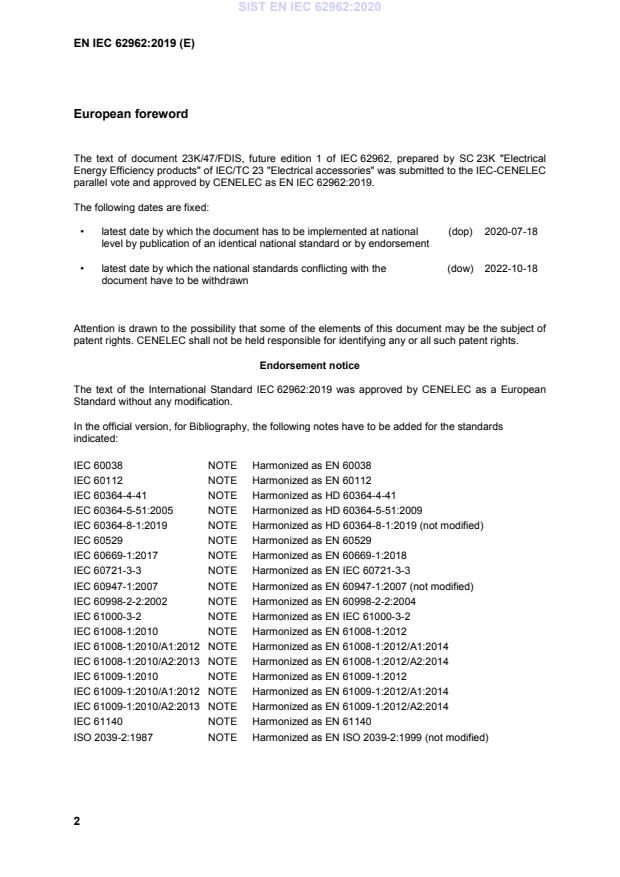
European foreword
The text of document 23K/47/FDIS, future edition 1 of IEC 62962, prepared by SC 23K "Electrical
Energy Efficiency products" of IEC/TC 23 "Electrical accessories" was submitted to the IEC-CENELEC
parallel vote and approved by CENELEC as EN IEC 62962:2019.
The following dates are fixed:
• latest date by which the document has to be implemented at national (dop) 2020-07-18
level by publication of an identical national standard or by endorsement
• latest date by which the national standards conflicting with the (dow) 2022-10-18
document have to be withdrawn
Attention is drawn to the possibility that some of the elements of this document may be the subject of
patent rights. CENELEC shall not be held responsible for identifying any or all such patent rights.
Endorsement notice
The text of the International Standard IEC 62962:2019 was approved by CENELEC as a European
Standard without any modification.
In the official version, for Bibliography, the following notes have to be added for the standards
indicated:
IEC 60038 NOTE Harmonized as EN 60038
IEC 60112 NOTE Harmonized as EN 60112
IEC 60364-4-41 NOTE Harmonized as HD 60364-4-41
IEC 60364-5-51:2005 NOTE Harmonized as HD 60364-5-51:2009
IEC 60364-8-1:2019 NOTE Harmonized as HD 60364-8-1:2019 (not modified)
IEC 60529 NOTE Harmonized as EN 60529
IEC 60669-1:2017 NOTE Harmonized as EN 60669-1:2018
IEC 60721-3-3 NOTE Harmonized as EN IEC 60721-3-3
IEC 60947-1:2007 NOTE Harmonized as EN 60947-1:2007 (not modified)
IEC 60998-2-2:2002 NOTE Harmonized as EN 60998-2-2:2004
IEC 61000-3-2 NOTE Harmonized as EN IEC 61000-3-2
IEC 61008-1:2010 NOTE Harmonized as EN 61008-1:2012
IEC 61008-1:2010/A1:2012 NOTE Harmonized as EN 61008-1:2012/A1:2014
IEC 61008-1:2010/A2:2013 NOTE Harmonized as EN 61008-1:2012/A2:2014
IEC 61009-1:2010 NOTE Harmonized as EN 61009-1:2012
IEC 61009-1:2010/A1:2012 NOTE Harmonized as EN 61009-1:2012/A1:2014
IEC 61009-1:2010/A2:2013 NOTE Harmonized as EN 61009-1:2012/A2:2014
IEC 61140 NOTE Harmonized as EN 61140
ISO 2039-2:1987 NOTE Harmonized as EN ISO 2039-2:1999 (not modified)
Annex ZA
(normative)
Normative references to international publications
with their corresponding European publications
The following documents are referred to in the text in such a way that some or all of their content
constitutes requirements of this document. For dated references, only the edition cited applies. For
undated references, the latest edition of the referenced document (including any amendments)
applies.
NOTE 1 Where an International Publication has been modified by common modifications, indicated by (mod), the relevant
EN/HD applies.
NOTE 2 Up-to-date information on the latest versions of the European Standards listed in this annex is available here:
www.cenelec.eu.
Publication Year Title EN/HD Year
IEC 60065 2001 Audio, video and similar electronic - -
apparatus - Safety requirements
IEC 60085 - Electrical insulation - Thermal evaluation EN 60085 -
and designation
IEC 60127 series Miniature fuses EN 60127 series
IEC 60212 - Standard conditions for use prior to and EN 60212 -
during the testing of solid electrical
insulating materials
IEC 60317-0-1 1997 Specifications for particular types of - -
winding wires -- Part 0-1: General
requirements - Enamelled round copper
wire
IEC 60364 series Low-voltage electrical installations HD 60364 series
IEC 60384-14 1993 Fixed capacitors for use in electronic - -
equipment -- Part 14: Sectional
specification: Fixed capacitors for
electromagnetic interference suppression
and connection to the supply mains
IEC 60417 - Graphical symbols for use on equipment. - -
Index, survey and compilation of the single
sheets.
IEC 60664-1 2007 Insulation coordination for equipment EN 60664-1 2007
within low-voltage systems - Part 1:
Principles, requirements and tests
IEC 60695-2-10 2000 Fire hazard testing -- Part 2-10: - -
Glowing/hot-wire based test methods -
Glow-wire apparatus and common test
procedure
IEC 60695-2-11 2000 Fire hazard testing -- Part 2-11: - -
Glowing/hot-wire based test methods -
Glow-wire flammability test method for
end-products
Publication Year Title EN/HD Year
IEC 60730 series Automatic electrical controls EN 60730 series
IEC 61000-2-2 - Electromagnetic compatibility (EMC) - Part EN 61000-2-2 -
2-2: Environment - Compatibility levels for
low-frequency conducted disturbances and
signalling in public low-voltage power
supply systems
IEC 61000-4-2 - Electromagnetic compatibility (EMC) - Part EN 61000-4-2 -
4-2: Testing and measurement techniques
- Electrostatic discharge immunity test
IEC 61000-4-3 - Electromagnetic compatibility (EMC) - Part - -
4-3: Testing and measurement techniques
- Radiated, radio-frequency,
electromagnetic field immunity test
IEC 61000-4-4 - Electromagnetic compatibility (EMC) - Part EN 61000-4-4 -
4-4: Testing and measurement techniques
- Electrical fast transient/burst immunity
test
IEC 61000-4-5 - Electromagnetic compatibility (EMC) - Part EN 61000-4-5 -
4-5: Testing and measurement techniques
- Surge immunity test
IEC 61000-4-6 - Electromagnetic compatibility (EMC) - Part EN 61000-4-6 -
4-6: Testing and measurement techniques
- Immunity to conducted disturbances,
induced by radio-frequency fields
IEC 61000-4-8 - Electromagnetic compatibility (EMC) - Part EN 61000-4-8 -
4-8: Testing and measurement techniques
- Power frequency magnetic field immunity
test
IEC 61000-4-11 - Electromagnetic compatibility (EMC) - Part EN 61000-4-11 -
4-11: Testing and measurement
techniques - Voltage dips, short
interruptions and voltage variations
immunity tests
IEC 61032 1997 Protection of persons and equipment by EN 61032 1998
enclosures - Probes for verification
IEC 61558-2-6 - Safety of transformers, reactors, power EN 61558-2-6 -
supply units and similar products for supply
voltages up to 1 100 V - Part 2-6: Particular
requirements and tests for safety isolating
transformers and power supply units
incorporating safety isolating transformers
ISO 306 - Plastics - Thermoplastic materials - EN ISO 306 -
Determination of Vicat softening
temperature (VST)
CISPR 15 - Limits and methods of measurement of EN IEC 55015 -
radio disturbance characteristics of
electrical lighting and similar equipment
IEC 62962 ®
Edition 1.0 2019-09
INTERNATIONAL
STANDARD
NORME
INTERNATIONALE
colour
inside
Particular requirements for load-shedding equipment (LSE)
Exigences spécifiques pour les délesteurs (LSE)
INTERNATIONAL
ELECTROTECHNICAL
COMMISSION
COMMISSION
ELECTROTECHNIQUE
INTERNATIONALE
ICS 27.015; 29.020 ISBN 978-2-8322-7385-2
– 2 – IEC 62962:2019 IEC 2019
CONTENTS
FOREWORD . 9
INTRODUCTION . 11
1 Scope . 12
2 Normative references . 13
3 Terms and definitions . 14
4 General requirements . 22
4.1 General . 22
4.2 Architecture . 23
4.3 Standard conditions for operation in service . 24
5 General remarks on tests . 25
5.1 Environmental conditions . 25
5.1.1 General . 25
5.1.2 Ambient temperature range in normal use. 25
5.1.3 Relative humidity . 25
5.1.4 Altitude . 25
5.2 General testing procedure and samples . 26
6 Ratings . 27
6.1 Rated values . 27
6.1.1 Rated operational voltages . 27
6.1.2 Rated insulation voltage . 27
6.1.3 Rated impulse voltage . 27
6.1.4 Maximum value of rated current . 27
6.1.5 Preferred rated current values (I ) . 27
n
6.1.6 Minimum value of rated making and breaking capacity (I ) . 28
RMS
6.1.7 Rated frequency . 28
6.1.8 Rated conditional short-circuit current . 28
6.1.9 Preferred rated load-shedding current (power) values (I L , P L ) . 28
n s n s
6.2 Time-current characteristic for LSEs monitoring the current . 28
6.2.1 LSE operating principle . 28
6.2.2 Current limits (I L ) . 30
n s
6.2.3 Minimum switch OFF-time . 30
6.2.4 Reclosing conditions . 31
6.3 Time-power characteristic . 32
6.4 LSE shedding sequence . 32
7 Classification . 33
7.1 General . 33
7.2 According to the LSE functional category . 33
7.3 According to the switching means . 34
7.4 According to the possibility of adjusting the rated load-shedding current(s)
(or power) . 34
7.5 According to the shedding sequence . 34
7.6 According to the design . 34
7.6.1 Stand-alone LSE with internal or external sensors or measuring units . 34
7.6.2 LSE with external sensor . 34
7.6.3 Combined LSE (or assembled LSE) . 34
7.7 According to the method of mounting . 34
IEC 62962:2019 IEC 2019 – 3 –
7.8 According to the type of terminals . 34
7.9 According to the contact openings . 34
7.10 According to the protection against external influences . 35
7.11 According to the number of poles . 35
7.12 According to the type of monitored parameters . 35
8 Markings and information . 35
8.1 General . 35
8.2 Test of markings . 36
9 Protection against electric shock . 36
9.1 General . 36
9.2 Test for protection against electric shock . 37
10 Terminals for external copper conductors . 40
10.1 General . 40
10.2 Terminals with screw clamping for external copper conductors . 40
10.2.1 General . 40
10.2.2 Conductor fitting . 46
10.2.3 Mechanical strength of terminals . 46
10.2.4 Resistance to corrosion of terminals . 46
10.2.5 Clamping effects on conductors . 46
10.2.6 Clamping reliability of terminals . 47
10.2.7 Clamping length of terminals . 48
10.2.8 Reliability of terminals . 49
10.2.9 Accidental loosening of earthing terminals . 49
10.2.10 Resistance to corrosion of earthing terminals . 49
10.2.11 Additional requirements for the design of pillar terminals . 50
10.2.12 Additional requirements for the design of lug terminals . 50
10.2.13 Additional requirements for terminals for the connection of external
conductors . 50
10.3 Screwless terminals for external copper conductors . 50
10.3.1 General . 50
10.3.2 Conductor fittings . 50
10.3.3 Connection of conductors . 51
10.3.4 Type of material . 51
10.3.5 Conductors clamping . 51
10.3.6 Operation of terminals . 51
10.3.7 Multi conductor terminals . 52
10.3.8 Introduction of conductors . 52
10.3.9 Fixing of terminals . 52
10.3.10 Mechanical strength. 52
10.3.11 Electrical and thermal stress resistance . 54
10.3.12 Mechanical reliability . 56
11 Constructional requirements . 59
11.1 General . 59
11.2 Mechanical requirements for insulating means . 59
11.3 Installation requirements . 59
11.4 Fixing of covers, cover plates and actuating members . 62
11.4.1 General . 62
11.4.2 Fixings based on screws or rivets . 63
– 4 – IEC 62962:2019 IEC 2019
11.4.3 Fixings which may be removed by applying a force perpendicular to the
surfaces . 63
11.4.4 Fixings which may be removed using a tool . 63
11.5 Attachment of knobs . 64
11.6 Mounting means . 64
11.7 Accessories . 64
12 Mechanism and operating means . 64
12.1 General . 64
12.2 Indication of the position . 65
12.3 Rest position . 65
12.4 Making and breaking . 65
12.5 Action of the mechanism without cover or cover plate . 65
12.6 Fixings and removal of operating means . 65
12.7 Locking . 66
12.8 Status indicators . 66
13 Resistance to ageing and humidity . 66
13.1 Resistance to ageing . 66
13.2 Resistance to humidity . 67
14 Insulation resistance and dielectric strength . 67
14.1 General . 67
14.2 Insulation resistance of the main circuit . 67
14.3 Dielectric strength of main circuits . 68
14.4 Insulation resistance and dielectric strength of other circuits . 70
14.5 Verification of impulse withstand voltages (across clearances and through
solid insulations) . 71
14.5.1 General testing procedure . 71
14.5.2 Verification of clearances with the impulse withstand voltage tests . 72
15 Temperature rise . 72
15.1 General . 72
15.2 Test setup . 73
15.3 Test procedure . 74
16 Making and breaking capacity . 76
17 Normal operation . 76
17.1 Functional tests: disconnection and reclosing . 76
17.1.1 General . 76
17.1.2 Disconnection tests . 77
17.1.3 Reclosing tests . 78
17.1.4 Load-shedding sequence(s) tests . 79
17.1.5 Remotely controlled LSE and LSE with connection to other external
equipment. 79
17.2 Endurance test . 79
18 Mechanical strength . 80
18.1 General . 80
18.2 Pendulum hammer test . 81
18.3 Covers, cover plates or actuating members – Accessibility to live parts . 89
18.3.1 General . 89
18.3.2 Verification of the non-removal of covers, cover plates or actuating
members . 89
18.3.3 Verification of the removal of covers, cover plates or actuating members. 89
IEC 62962:2019 IEC 2019 – 5 –
18.4 Covers, cover plates or actuating members – Accessibility to non-earthed
metal parts separated from live parts . 90
18.5 Covers, cover plates or actuating members – Accessibility to insulating
parts, earthed metal parts, the live parts of SELV ≤ 25 V AC or metal parts
separated from live parts . 90
18.6 Covers, cover plates or actuating members – Application of gauges . 90
18.7 Grooves, holes and reverse tapers . 92
18.8 Rail mounted LSEs . 93
19 Resistance to heat . 94
19.1 General . 94
19.2 Basic heating test . 94
19.3 Ball-pressure test on parts of insulating material necessary to retain current-
carrying parts and parts of the earthing circuit in position . 95
19.4 Ball-pressure test on parts of insulating material not necessary to retain
current-carrying parts and parts of the earthing circuit in position. 95
20 Screws, current carrying capacity and connections . 95
20.1 General . 95
20.2 Correct insertion of screws . 96
20.3 Contact pressure of electrical connections . 97
20.4 Screws and rivets used both as electrical and mechanical connections . 97
20.5 Material of current-carrying parts . 97
20.6 Thread-forming and thread-cutting screws . 98
21 Creepage distances, clearances and distances through sealing compound . 98
21.1 General . 98
21.2 Measurements . 98
21.3 Insulating compound . 99
22 Resistance of insulating material to abnormal heat and fire . 101
22.1 General . 101
22.2 Glow-wire test . 101
23 Resistance to rusting . 103
24 EMC requirements . 104
24.1 General . 104
24.2 Immunity . 104
24.2.1 General . 104
24.2.2 Voltage dips and short interruptions . 105
24.2.3 Surge immunity test for 1,2/50 wave impulses . 105
24.2.4 Electrical fast transient/burst test . 106
24.2.5 Electrostatic discharge test . 106
24.2.6 Radiated electromagnetic field test . 107
24.2.7 Radio-frequency voltage test . 107
24.2.8 Power-frequency magnetic field test . 108
24.3 Emission . 108
24.3.1 General . 108
24.3.2 Low-frequency emission . 108
24.3.3 Radio-frequency emission . 108
25 Coordination with short-circuit devices . 108
25.1 General requirements for coordination . 108
25.2 Testing conditions . 108
25.2.1 Test circuit . 108
– 6 – IEC 62962:2019 IEC 2019
25.2.2 Tolerances on test quantities . 112
25.2.3 Power factor of the test circuit . 112
25.2.4 Power frequency recovery voltage . 113
25.2.5 Calibration of the test circuit . 113
25.2.6 Sequence of operations . 113
25.3 Tests of coordination between the LSE and the SCPD . 113
25.3.1 General . 113
25.3.2 Verification of the coordination at the rated conditional short-circuit
current (I ). 114
nc
25.3.3 Verification at the instantaneous tripping of the SCPD . 114
25.3.4 Condition of the LSE during and after tests . 114
26 Tests under abnormal conditions . 114
26.1 General . 114
26.2 Tests under fault conditions . 115
26.3 Overload tests . 116
27 Components . 116
27.1 Fuses. 117
27.2 Capacitors . 117
27.3 Resistors . 118
27.4 Automatic protective devices (other than fuses) . 118
27.4.1 General . 118
27.4.2 Cut-outs . 118
27.4.3 Automatic protective devices . 120
27.5 Transformers . 120
Annex A (normative) Test sequences and number of specimens . 121
Annex B (informative) Correspondence between ISO and AWG copper conductors . 123
Annex C (normative) Determination of clearances and creepage distances . 124
C.1 General . 124
C.2 Orientation and location of a creepage distance . 124
C.3 Creepage distances where more than one material is used . 124
C.4 Creepage distances split by floating conductive part . 124
C.5 Measurement of creepage distances and clearances . 124
Annex D (normative) Arrangement for the detection of the emission of ionized gases
during short-circuit tests . 128
Bibliography . 131
Figure 1 – Energy efficiency management system . 11
Figure 2 – LSE general architecture . 24
Figure 3 – Time-current characteristic of a Class A LSE . 29
Figure 4 – Joined test finger (test probe B according to IEC 61032:1997) . 38
Figure 5 – Test pin for checking the protection against electric shock . 40
Figure 6 – Terminals with stirrup . 41
Figure 7 – Pillar terminals . 41
Figure 8 – Screw terminals and stud terminals . 43
Figure 9 – Saddle terminals . 44
Figure 10 – Lug terminals . 45
Figure 11 – Test apparatus for checking damage to conductors . 54
IEC 62962:2019 IEC 2019 – 7 –
Figure 12 – Information for deflection test . 57
Figure 13 – Determination of the direction of the forces to be applied . 61
Figure 14 – Direction for the conductor pull of 30 N for 1 min . 62
Figure 15 – Pendulum impact test apparatus . 82
Figure 16 – Pendulum impact test apparatus (striking element) . 83
Figure 17 – Mounting support of specimens . 84
Figure 18 – Mounting block for a flush type LSE . 85
Figure 19 – Example of mounting support of a panel board type LSE . 86
Figure 20 – Example of mounting support for a rear fixed LSE . 87
Figure 21 – Gauge (thickness: about 2 mm) for the verification of the outline of covers,
cover-plates or actuating members . 90
Figure 22 – Example of application of the gauge of Figure 21 on covers fixed without
screws on a mounting surface or supporting surface . 91
Figure 23 – Examples of applications of the gauge of Figure 21 . 92
Figure 24 – Gauge for verification of grooves, holes and reverse tapers . 93
Figure 25 – Sketch showing the direction of application of the gauge of Figure 24 . 93
Figure 26 – Application of forces on a rail-mounted LSE . 94
Figure 27 – Ball-pressure test apparatus. 95
Figure 28 – Thread-cutting screw . 96
Figure 29 – Thread-forming screw . 96
Figure 30 – Diagrammatic representation . 102
Figure 31 – Typical diagram for all coordination tests . 110
Figure 32 – Detail of impedances Z and Z . 110
Figure C.1 – Example 1 . 125
Figure C.2 – Example 2 . 125
Figure C.3 – Example 3 . 125
Figure C.4 – Example 4 . 126
Figure C.5 – Example 5 . 126
Figure C.6 – Example 6 . 126
Figure C.7 – Example 7 . 127
Figure D.1 – Test arrangement . 129
Figure D.2 – Grid . 130
Figure D.3 – Grid circuit . 130
Table 1 – Cross-sectional areas (S) of test copper conductors corresponding to the
rated currents . 26
Table 2 – Rated impulse voltage as a function of the nominal voltage of the installation . 27
Table 3 – Load-shedding classes . 30
Table 4 – Disconnecting time . 31
Table 5 – Load-shedding classes . 32
Table 6 – Disconnecting time . 32
Table 7 – Load-shedding functional categories . 33
Table 8 – Marking and position of marking . 35
– 8 – IEC 62962:2019 IEC 2019
Table 9 – Relationship between rated currents and connectable cross-sectional areas
of copper conductors . 39
Table 10 – Dimensions and tightening torque of pillar terminals . 42
Table 11 – Dimensions and tightening torque for screw and stud terminals . 44
Table 12 – Dimensions and tightening torque for saddle terminals . 45
Table 13 – Dimensions and tightening torque for lug terminals. 45
Table 14 – Tightening torque for the verification of the mechanical strength of screw-
type terminals . 47
Table 15 – Test values for pulling out test . 48
Table 16 – Relat
...