

SIST EN 18065:2025
(Main)Plastics - Recycled plastics - Classification of recycled plastics based on Data Quality Levels for use and (digital) trading
General Information
- Abstract
This document defines a system for the classification of recycled plastics based on the available data depth (Data Quality Levels, DQL) and provides guidelines for the labelling of the recyclate type and recycled content in compounds.
It is intended to support parties involved in the use and trading of recycled plastics, explicitly including digital trading platforms.
- Status
- Published
- Public Enquiry End Date
- 28-May-2024
- Publication Date
- 30-Sep-2025
- Technical Committee
- IPMA - Polimer materials and products
- Current Stage
- 6060 - National Implementation/Publication (Adopted Project)
- Start Date
- 29-Sep-2025
- Due Date
- 04-Dec-2025
- Completion Date
- 01-Oct-2025

Overview
EN 18065:2025 - published by CEN - establishes a harmonized system to classify recycled plastics based on the depth and quality of available data, called Data Quality Levels (DQL). The standard provides guidance for labelling recyclate types and calculating/declaring recycled content in compounds. It is explicitly designed to support manufacturers, recyclers, traders and digital trading platforms, and to enable interoperable Digital Product Passports and traceability across the plastics value chain.
Key topics and technical requirements
- Data Quality Levels (DQL): A framework that defines specific combinations of material characteristics (data depth) required to reach each DQL. Includes application-specific DQL variants (DQL‑A).
- Material characteristics covered: Type of filler, additives, recycling process details, traceability, contaminants/non-target materials, and greenhouse gas emissions reported in CO2-equivalents.
- Sampling and homogenization: Requirements and best practice references for representative sampling and sample preparation (see CEN/TS 16010 and CEN/TS 16011).
- Recycled content determination: Methods and worked examples for calculating recycled fraction for mechanically- and chemically-recycled materials (Annex B).
- Labelling: Guidelines for consistent labelling of recyclate type and declared recycled content to enable clear communication along the supply chain.
- Digital Product Passport (DPP): Requirements for data capture, validation, amendment/supersedence, transfer and preservation to support digital trading, traceability and verification.
- Normative and informative annexes: Annex A defines specific DQL requirements; Annex B contains recycled content calculation examples; Annex C covers sampling guidance.
Practical applications and who uses it
- Recyclers and processors: Classify outputs, document data quality, and prepare compliant labels and DPP entries.
- Product manufacturers and compounders: Select appropriate recyclates based on DQL and calculate declared recycled content for formulations.
- Supply chain and procurement teams: Verify recyclate quality, traceability and environmental data (e.g., GHG values) for sourcing decisions.
- Digital trading platforms and marketplaces: Standardize data fields, validation rules and traceability flows for buying/selling recyclates online.
- Regulators and conformity assessors: Use DQL classifications to support reporting, claims verification and circular economy policies.
Related standards
EN 18065:2025 is an umbrella standard aligned with existing CEN publications on recycled plastics, including: EN 15342, EN 15343, EN 15344, EN 15345, EN 15346, EN 15348, EN 18064, EN 18067, CEN/TR 15353 and CEN/TR 18160 - providing a coherent framework for recyclate classification, testing, traceability and recycled-content calculation.
Keywords: EN 18065:2025, recycled plastics, Data Quality Levels, recyclate classification, recycled content, digital trading, Digital Product Passport, CEN.
Relations
- Effective Date
- 28-Jan-2026
- Effective Date
- 28-Jan-2026
- Effective Date
- 28-Jan-2026
- Effective Date
- 28-Jan-2026
- Effective Date
- 28-Jan-2026
- Effective Date
- 28-Jan-2026
- Effective Date
- 28-Jan-2026
Get Certified
Connect with accredited certification bodies for this standard

BSI Group
BSI (British Standards Institution) is the business standards company that helps organizations make excellence a habit.

DIN CERTCO
DIN Group product certification.
CIS Institut d.o.o.
Personal Protective Equipment (PPE) certification body. Notified Body NB-2890 for EU Regulation 2016/425 PPE.
Sponsored listings
Frequently Asked Questions
SIST EN 18065:2025 is a standard published by the Slovenian Institute for Standardization (SIST). Its full title is "Plastics - Recycled plastics - Classification of recycled plastics based on Data Quality Levels for use and (digital) trading". This standard covers: This document defines a system for the classification of recycled plastics based on the available data depth (Data Quality Levels, DQL) and provides guidelines for the labelling of the recyclate type and recycled content in compounds. It is intended to support parties involved in the use and trading of recycled plastics, explicitly including digital trading platforms.
This document defines a system for the classification of recycled plastics based on the available data depth (Data Quality Levels, DQL) and provides guidelines for the labelling of the recyclate type and recycled content in compounds. It is intended to support parties involved in the use and trading of recycled plastics, explicitly including digital trading platforms.
SIST EN 18065:2025 is classified under the following ICS (International Classification for Standards) categories: 13.030.50 - Recycling; 35.240.63 - IT applications in trade; 83.080.01 - Plastics in general. The ICS classification helps identify the subject area and facilitates finding related standards.
SIST EN 18065:2025 has the following relationships with other standards: It is inter standard links to SIST-TS CEN/TS 16011:2014, SIST EN ISO 1043-1:2012, SIST-TS CEN/TS 16010:2021, SIST-TP CEN/TR 15353:2007, SIST EN ISO 472:2014, SIST EN 17615:2022, SIST EN 18064-6:2025. Understanding these relationships helps ensure you are using the most current and applicable version of the standard.
SIST EN 18065:2025 is associated with the following European legislation: Standardization Mandates: M/584. When a standard is cited in the Official Journal of the European Union, products manufactured in conformity with it benefit from a presumption of conformity with the essential requirements of the corresponding EU directive or regulation.
SIST EN 18065:2025 is available in PDF format for immediate download after purchase. The document can be added to your cart and obtained through the secure checkout process. Digital delivery ensures instant access to the complete standard document.
Standards Content (Sample)
SLOVENSKI STANDARD
01-november-2025
Polimerni materiali - Reciklirani polimerni materiali - Razvrstitev recikliranih
polimernih materialov na osnovi ravni kakovosti podatkov za uporabo in
(digitalno) trgovanje
Plastics - Recycled plastics - Classification of recycled plastics based on Data Quality
Levels for use and (digital) trading
Kunststoffe - Kunststoff-Rezyklate - Klassifizierung von Kunststoff-Rezyklate durch
Datenqualitätslevels für die Verwendung und den (internetbasierten) Handel
Plastiques - Plastiques recyclés - Classification des plastiques recyclés sur la base des
niveaux de qualité des données pour l’utilisation et le commerce (numérique)
Ta slovenski standard je istoveten z: EN 18065:2025
ICS:
13.030.50 Recikliranje Recycling
35.240.63 Uporabniške rešitve IT v IT applications in trade
trgovini
83.080.01 Polimerni materiali na Plastics in general
splošno
2003-01.Slovenski inštitut za standardizacijo. Razmnoževanje celote ali delov tega standarda ni dovoljeno.
EN 18065
EUROPEAN STANDARD
NORME EUROPÉENNE
August 2025
EUROPÄISCHE NORM
ICS 13.030.50; 35.240.63; 83.080.01
English Version
Plastics - Recycled plastics - Classification of recycled
plastics based on Data Quality Levels for use and (digital)
trading
Plastiques - Plastiques recyclés - Classification des Kunststoffe - Kunststoff-Rezyklate - Klassifizierung von
plastiques recyclés sur la base des niveaux de qualité Kunststoff-Rezyklate durch Datenqualitätslevels für die
des données pour l'utilisation et le commerce Verwendung und den (internetbasierten) Handel
(numérique)
This European Standard was approved by CEN on 4 May 2025.
CEN members are bound to comply with the CEN/CENELEC Internal Regulations which stipulate the conditions for giving this
European Standard the status of a national standard without any alteration. Up-to-date lists and bibliographical references
concerning such national standards may be obtained on application to the CEN-CENELEC Management Centre or to any CEN
member.
This European Standard exists in three official versions (English, French, German). A version in any other language made by
translation under the responsibility of a CEN member into its own language and notified to the CEN-CENELEC Management
Centre has the same status as the official versions.
CEN members are the national standards bodies of Austria, Belgium, Bulgaria, Croatia, Cyprus, Czech Republic, Denmark, Estonia,
Finland, France, Germany, Greece, Hungary, Iceland, Ireland, Italy, Latvia, Lithuania, Luxembourg, Malta, Netherlands, Norway,
Poland, Portugal, Republic of North Macedonia, Romania, Serbia, Slovakia, Slovenia, Spain, Sweden, Switzerland, Türkiye and
United Kingdom.
EUROPEAN COMMITTEE FOR STANDARDIZATION
COMITÉ EUROPÉEN DE NORMALISATION
EUROPÄISCHES KOMITEE FÜR NORMUNG
CEN-CENELEC Management Centre: Rue de la Science 23, B-1040 Brussels
© 2025 CEN All rights of exploitation in any form and by any means reserved Ref. No. EN 18065:2025 E
worldwide for CEN national Members.
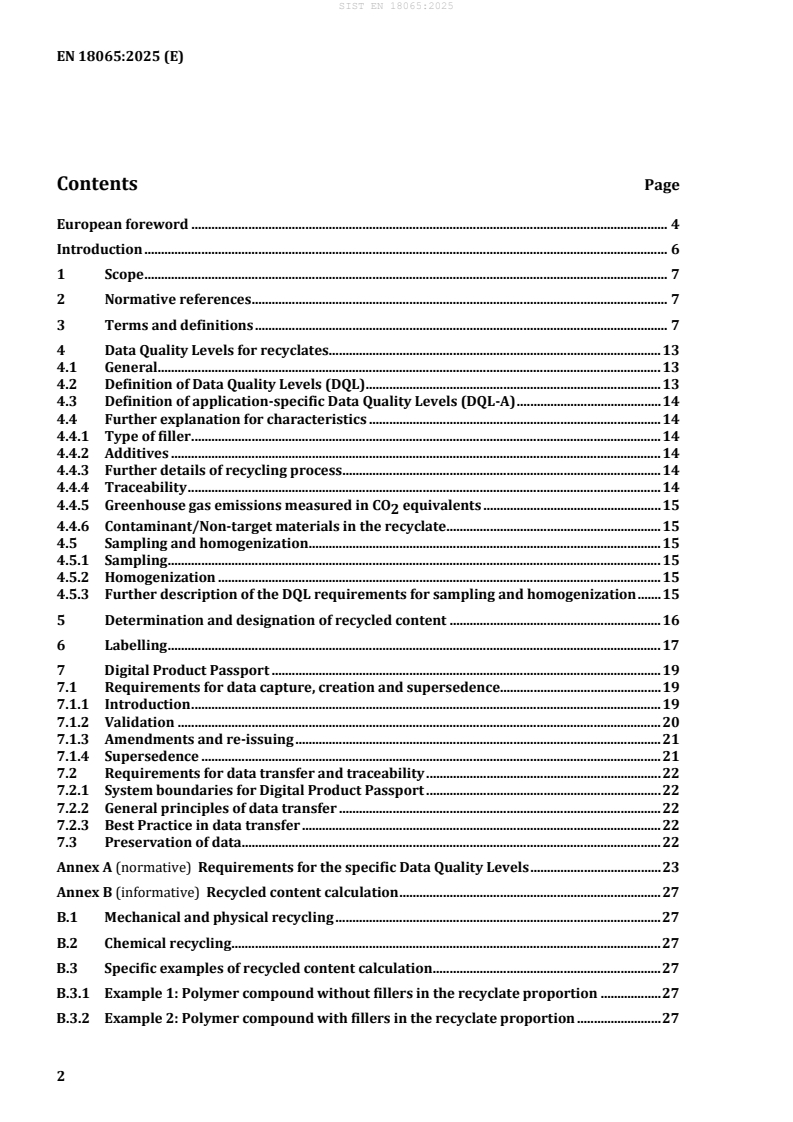
Contents Page
European foreword . 4
Introduction . 6
1 Scope . 7
2 Normative references . 7
3 Terms and definitions . 7
4 Data Quality Levels for recyclates . 13
4.1 General. 13
4.2 Definition of Data Quality Levels (DQL) . 13
4.3 Definition of application-specific Data Quality Levels (DQL-A) . 14
4.4 Further explanation for characteristics . 14
4.4.1 Type of filler . 14
4.4.2 Additives . 14
4.4.3 Further details of recycling process . 14
4.4.4 Traceability . 14
4.4.5 Greenhouse gas emissions measured in CO equivalents . 15
4.4.6 Contaminant/Non-target materials in the recyclate . 15
4.5 Sampling and homogenization . 15
4.5.1 Sampling . 15
4.5.2 Homogenization . 15
4.5.3 Further description of the DQL requirements for sampling and homogenization . 15
5 Determination and designation of recycled content . 16
6 Labelling . 17
7 Digital Product Passport . 19
7.1 Requirements for data capture, creation and supersedence. 19
7.1.1 Introduction . 19
7.1.2 Validation . 20
7.1.3 Amendments and re-issuing . 21
7.1.4 Supersedence . 21
7.2 Requirements for data transfer and traceability . 22
7.2.1 System boundaries for Digital Product Passport . 22
7.2.2 General principles of data transfer . 22
7.2.3 Best Practice in data transfer . 22
7.3 Preservation of data. 22
Annex A (normative) Requirements for the specific Data Quality Levels . 23
Annex B (informative) Recycled content calculation . 27
B.1 Mechanical and physical recycling . 27
B.2 Chemical recycling . 27
B.3 Specific examples of recycled content calculation . 27
B.3.1 Example 1: Polymer compound without fillers in the recyclate proportion . 27
B.3.2 Example 2: Polymer compound with fillers in the recyclate proportion . 27
B.3.3 Example 3: Polymer compound without fillers in the recyclate proportion, and a
recycled plastic as carrier for pigments in the masterbatch . 28
B.3.4 Example 4: Polymer compound with glass fibres in the recyclate proportion, virgin
glass fibres and a recyclate based masterbatch . 29
B.3.5 Example 5: Polymer compound with different sources (PIR and PCR) recycled plastic,
inorganic virgin fillers and virgin masterbatch . 29
Annex C (informative) Sampling . 31
Bibliography . 34
European foreword
This document (EN 18065:2025) has been prepared by Technical Committee CEN/TC 249 “Plastics”, the
secretariat of which is held by SIS.
This European Standard shall be given the status of a national standard, either by publication of an
identical text or by endorsement, at the latest by February 2026, and conflicting national standards shall
be withdrawn at the latest by February 2026.
Attention is drawn to the possibility that some of the elements of this document may be the subject of
patent rights. CEN shall not be held responsible for identifying any or all such patent rights.
This document is part of CEN publications on plastics recycling, listed as follows:
— EN 15342, Plastics — Recycled plastics — Characterization of polystyrene (PS) recyclates
— EN 15343, Plastics — Recycled Plastics — Plastics recycling traceability and assessment of conformity
and recycled content
— EN 15344, Plastics — Recycled plastics — Characterization of Polyethylene (PE) recyclates
— EN 15345, Plastics — Recycled plastics — Characterization of Polypropylene (PP) recyclates
— EN 15346, Plastics — Recycled plastics — Characterization of poly(vinyl chloride) (PVC) recyclates
— EN 15347 (all parts), Plastics — Sorted plastics wastes
— EN 15348, Plastics — Recycled plastics — Characterization of poly(ethylene terephthalate) (PET)
recyclates
— EN 18064 (all parts), Plastics — Quality recommendations and basis for specifications for application
of plastic recyclates in products
— EN 18065, Plastics —Recycled plastics — Classification of recycled plastics based on Data Quality
Levels for use and (digital) trading
— EN 18067, Plastics — Recycled plastics — Characterization of Acrylonitrile-Butadiene-Styrene (ABS)
recyclates
— CEN/TR 15353, Plastics — Recycled plastics — Guidelines for the development of standards for
recycled plastics
— CEN/TR 18160, Plastics recycling — Classification of plastic recyclates as postconsumer recyclates
(PCR) and postindustrial recyclates (PIR)
This document has been prepared under a standardization request addressed to CEN and CENELEC by
the European Commission. The Standing Committee of the EFTA States subsequently approves these
requests for its Member States.
Any feedback and questions on this document should be directed to the users’ national standards body.
A complete listing of these bodies can be found on the CEN website.
According to the CEN-CENELEC Internal Regulations, the national standards organisations of the
following countries are bound to implement this European Standard: Austria, Belgium, Bulgaria, Croatia,
Cyprus, Czech Republic, Denmark, Estonia, Finland, France, Germany, Greece, Hungary, Iceland, Ireland,
Italy, Latvia, Lithuania, Luxembourg, Malta, Netherlands, Norway, Poland, Portugal, Republic of North
Macedonia, Romania, Serbia, Slovakia, Slovenia, Spain, Sweden, Switzerland, Türkiye and the United
Kingdom.
Introduction
This document was drafted as an umbrella standard for a group of standards for the classification of
recycled plastics, pursuant to the Standardization Request of the European Commission (SReq M/584),
annexed to the Commission Implementing Decision C(2022) 5372 as regards plastics recycling and
recycled plastics in support of the European Strategy for Plastics in a Circular Economy. With decision
from August 10, 2022, CEN and CENELEC Technical Boards have accepted the Standardization Request.
It aims to establish a coherent classification and designation system for recycled plastics, irrespective of
polymer and application type, and provides a unified framework with existing and future standards in
the field of recycled plastics. It further addresses the need of creating digital product passports for
recyclates in order to ensure a unified transfer of data as the material passes through the value chain and
thus enable a more holistic circular economy for plastics.
This document has been developed with a view towards creating synergies between the digital and green
transition from today’s linear towards a truly circular plastics economy. By measuring and controlling
inputs and outputs of the recycling process using standardized sets of data, digital technologies will
enable the reintroduction of materials that have reached their end-of-life back into the orderly fashion of
global supply chains at scale. Such technologies could also support monitoring, reporting and verification
of greenhouse gas emissions for carbon pricing. Digital product passports enable enhanced material,
component and end-to-end traceability and make data more accessible, which is essential for viable
circular business models.
European Commission (2022), 2022 Strategic Foresight Report. Twinning the green and digital transitions in the
new geopolitical context, COM (2022), 289 final, p. 2.
1 Scope
This document defines a system for the classification of recycled plastics based on the available data
depth (Data Quality Levels, DQL) and provides guidelines for the labelling of the recyclate type and
recycled content in compounds.
It is intended to support parties involved in the use and trading of recycled plastics, explicitly including
digital trading platforms.
2 Normative references
The following documents are referred to in the text in such a way that some or all of their content
constitutes requirements of this document. For dated references, only the edition cited applies. For
undated references, the latest edition of the referenced document (including any amendments) applies.
CEN/TR 15353 Plastics — Recycled plastics— Guidelines for the development of standards for recycled
plastics
CEN/TS 16010, Plastics — Recycled plastics — Sampling procedures for testing plastics waste and
recyclates
CEN/TS 16011, Plastics —Recycled plastics — Sample preparation
EN 17615:2022, Plastics — Environmental Aspects — Vocabulary
EN ISO 472:2013, Plastics — Vocabulary (ISO 472:2013)
EN ISO 1043-1, Plastics — Symbols and abbreviated terms — Part 1: Basic polymers and their special
characteristics (ISO 1043-1)
3 Terms and definitions
For the purposes of this document, the terms and definitions given in EN ISO 472, EN 17615 and
CEN/TR 15353, the abbreviated terms related to recyclates given in EN ISO 1043-1, and the following
apply.
ISO and IEC maintain terminology databases for use in standardization at the following addresses:
— ISO Online browsing platform: available at https://www.iso.org/obp
— IEC Electropedia: available at https://www.electropedia.org/
NOTE 1 Regranulates are not recyclates if made from by-products.
NOTE 2 Regenerates/recompounds can contain virgin material in the form of polymers, fillers, additives.
Figure 1 — Illustration of terms
3.1
additive
substance which is used to process or to modify end use properties of plastics
Note 1 to entry: Mentioned substances are normally included in carrier matrix.
Note 2 to entry: Mentioned final use properties are e.g. rigidity, flexibility, colour etc.
[SOURCE: EN 17615:2022, 3.4, modified — Term was changed to singular, and definition was adapted
accordingly; in Note 1 to entry, “mentioned” was added; Notes 2 to 4 to entry were removed and new
Note 2 to entry was added.]
3.2
agglomerate
compactate
larger particles formed by joining or binding together of smaller particles whose original identity can still
be visible in the final form
Note 1 to entry: See also Figure 1.
[SOURCE: EN 17615:2022, 3.6, modified — “compactate” was added as alternative term, Note 1 to entry
was replaced by a new Note 1 to entry.]
3.3
characteristic
information (3.9) about or property (3.19) of a material
3.4
compound
intimate mixture of a polymer in melt with other ingredients such as fillers, plasticizers, polymers,
catalysts, colourants or other additives
[SOURCE: EN ISO 472:2013, 2.184, modified — “polymer or polymers” was changed to read “polymer”,
“in melt” was added; “polymers” and “other additives” were added in iterative list; “and” was replaced
with “or”.]
3.5
contaminant
non-target materials
DEPRECATED: impurity
undesired substance or material
[SOURCE: EN 17615:2022, 3.68, modified — “non-target materials” added as synonym term]
3.6
Data Quality Level
DQL
specific combination of characteristics (3.3) about the material
Note 1 to entry: Every DQL is defined by the amount of minimum material characteristics given (3.3) (e.g.
information and/or properties, application-specific characteristics) as specified in Annex A.
Note 2 to entry: DQLs are documented in form of a technical documentation. For examples of technical
documentation, see below.
Note 3 to entry: Claiming ignorance of a characteristic does not meet the reporting requirement on any specific
DQL.
3.7
filler
relatively inert solid material added to a plastic to modify its strength, permanence, working properties
or other qualities, or to lower costs
Note 1 to entry: Fillers are for example glass fibres, carbon fibres, natural fibres, talcum, and other minerals.
[SOURCE: EN ISO 472:2013, 2.369, modified — Note 1 and Note 2 to entry were removed and a new
Note 1 to entry was added. The words “or to an adhesive” were removed as adhesives are not within the
scope of this standard.]
3.8
flake
plate-like regrind
Note 1 to entry: The shape of regrind depends both on the plastics being processed and the manner of processing.
Note 2 to entry: See also Figure 1.
[SOURCE: ISO 15270:2008, 3.15, modified — Note 2 to entry was added.]
3.9
information
material characteristic that has not been established by using a scientific measurement method
Note 1 to entry: For the purpose of this document, a characteristic (3.3) of the material that has been established
by a scientific measurement method is considered as a property (3.19).
3.10
lot
definite quantity of some commodity manufactured or produced under conditions that are presumed
uniform
Note 1 to entry: The term “batch” is sometimes used synonymously.
[SOURCE: EN ISO 472:2013, 2.560, modified — Note 1 to entry was added.]
3.11
machine-readable
set of data or information that can be read, processed or altered by a computer without human
intervention
Note 1 to entry: For the purpose of this document, a PDF-format is not considered “machine-readable”.
Note 2 to entry: Such data will generally be stored in a format that it can be read and processed by software and
hardware, often using standardized formats such as XML, JSON, CSV or RDF.
3.12
mass balance
method to trace output, products with recycled content, with input, quantity of recycled feedstock, within
a predefined boundary and within a given production batch or booking period
Note 1 to entry: Mass balance is not synonymous to material balance (see EN 16785-2).
[SOURCE: EN 17615:2022, 3.147, modified — Note 1 to entry was deleted, Note 2 to entry is now Note 1
to entry.]
3.13
post-consumer plastic waste
plastic waste, generated by the end-users of products, that has fulfilled its intended purpose and can no
longer be used for its intended purpose
Note 1 to entry: The term “post-use” is sometimes used synonymously.
[SOURCE: EN 17615:2022, 3.192]
3.14
post-industrial plastic waste
pre-consumer plastic waste
plastic material or product which the holder discards or intends or is required to discard before it has
been put in use
Note 1 to entry: This term excludes in-house-scrap.
Note 2 to entry: Discarded material can still be recycled in-house.
[SOURCE: EN 17615:2022, 3.194, modified — “post-industrial plastic waste” is named as first term here.]
3.15
post-consumer recyclate
PCR
recyclate generated from post-consumer plastic waste
3.16
post-industrial recyclate
PIR
recyclate generated from post-industrial plastic waste
3.17
product
resins, material or objects/articles resulting from a production process
Note 1 to entry: The product can be a material, semi-finished or final product, for example polyethylene resin
derived from petroleum or biomass, bioPE film, PET resins, PET bottles, monomers, plasticizers.
[SOURCE: ISO 16620-1:2015, 3.1.8]
3.18
Product Data Sheet
PDS
overview that provides information about the material, the source and the recycling process as well as,
in addition, properties as guide values that are based on a certain number of single measurements
Note 1 to entry: Due to the fundamentally different content, it is no Material Safety Data Sheet (MSDS), e.g. based
on EC1907/2006 or any other legal requirement.
3.19
property
material characteristic that has been established by using a scientific measurement method
Note 1 to entry: For the purpose of this document, a characteristic (3.3) of the material that has not been
established by a scientific measurement method is considered as information (3.9).
3.20
recyclate
recycled plastic
secondary raw material
plastics material resulting from recycling of plastic waste, that ceased to be waste and can be used for the
manufacturing of new articles or products
Note 1 to entry: Recyclates may be reformulated using additives.
Note 2 to entry: Throughout the document, the term recyclate is used as an abbreviated term for plastic recyclate.
Note 3 to entry: Common physical forms of recyclates are regrind, flakes, powder and pellets.
[SOURCE: EN 17615:2022, 3.209, modified — Notes 2 and 3 to entry were added]
3.21
recycled content
percentage by weight of recycled plastic in a product
Note 1 to entry: Recycled content can be attributed through various chain of custody models as referenced in an
international or European standard or applicable legislation.
Note 2 to entry: Only recycled post-industrial plastic waste and recycled post-consumer plastic waste shall be
considered as recycled content
[SOURCE: EN 17615:2022, 3.210, modified — Note 1 and 2 to entry were added.]
3.22
regenerate
recompound
plastic recyclate obtained by restoring the characteristics of a plastics material during reprocessing to
the level of the original material
Note 1 to entry: See also Figure 1.
[SOURCE: EN 17615:2022, 3.213, modified — the term “regeneration” was replaced by “regenerate” and
“recompound” added as synonymous definition. The wording was adapted from describing a verb to
describing a noun; Note 1 to entry was added.]
3.23
regranulate
plastic granules made from remelted plastic waste or by-products by granulation
Note 1 to entry: Should not be confused with recyclates, which is the umbrella term for all plastics material derived
from processing plastic waste. A regranulate from plastic waste is a sub-category of a recyclate. See also Figure 1.
Note 2 to entry: Regranulates derived from by-products shall not be considered as “recyclates”.
[SOURCE: EN 17615:2022, 3.215, modified — Note 1 to entry was modified to reflect the term “recyclate”
as umbrella term. Note 2 to entry was added.]
3.24
regrind
shredded and/or grinded recovered plastics material in the form of free-flowing material recovered from
plastics that were produced during a previous manufacturing process
Note 1 to entry: Regrind only includes shredded material and does not include regranulated material.
Note 2 to entry: See also Figure 1.
[SOURCE: EN 17615:2022, 3.214, modified — “and/or grinded recovered” and “that were” was added,
Note 2 to entry was added.]
4 Data Quality Levels for recyclates
4.1 General
In order to better match supply with demand, increase uptake of recyclates within all applications and
increase demand, this clause defines a system for classifying recycled plastics based on the available data
depth. This data depth system consists of information (I), properties (P) and optional characteristics (O).
The quantity of characteristics available for the recyclate determines a specific Data Quality Level (DQL)
of such recyclate. The DQLs are not defined by rigid values or tolerances for each characteristic.
4.2 Definition of Data Quality Levels (DQL)
To reach a specific DQL, several characteristics [Information (I) and Properties (P)] of the recyclate shall
be provided in a Product Data Sheet (PDS), the number of which increases with each level, according to
Table 1.
Table 1 — Required characteristics as per Data Quality Level (overview)
Characteristics DQL 1 DQL 2 DQL 3 DQL 4
Information 6 12 15 18
Properties 1 4 5 8
Optional characteristics 21 (non-exhaustive)
A detailed list of the required characteristics is given in Annex A, Table A.1 and Table A.2. In addition,
optional characteristics can be provided (see Table A.3).
Information (I) designate characteristics, which are taken from the documentation of the collection,
handling and/or recycling process.
Properties (P) designate characteristics, which are obtained by a test that was performed according to a
publicly available and established standard. Company internal methods may also be used, if they are
publicly available, for example on their website. Due to the large number of standards for
different materials, applications and testing methods, this document does not define which standard
method shall be used, but gives examples or recommendations for standards and publicly available
specifications in Annex A. The used standard shall be listed in the Product Data Sheet. If multiple
measurements are performed, it is recommended to add the standard deviation to the Product Data
Sheet. If the test was performed in a laboratory that is accredited to EN ISO/IEC 17025, such accreditation
information may also be included in the PDS.
Optional characteristics (O) are relevant for many materials and applications, but not for all. Thus, it is
recommended to include them together with the mandatory information and properties in the Product
Data Sheet. These optional characteristics are not necessary to reach a DQL. It is possible to add more
than the listed optional characteristics to the Product Data Sheet, which may comprise both
characteristics from higher DQLs and characteristics not listed in this document.
NOTE Attention is drawn to possible national/international legislation that might impact the obligations of the
material owner/producer (for example, REACH, RoHS).
4.3 Definition of application-specific Data Quality Levels (DQL-A)
As there are various material requirements for different applications, this document does not cover all
these requirements. If a material complies with an application-specific standard (e.g. ISO, EN) or a
publicly available third-party specification for a specified application, an “A” may be added to the DQL.
This “A” can be reached for DQL 1, 2, 3 and 4. A non-exhaustive list of optional characteristics that are
relevant for many applications can be found in Annex A, Table A.3.
EXAMPLE 1 DQL4-A designates a material that fulfils DQL 4 as well as an application-specific standard.
Information about fulfilment of additional application-specific requirements shall be listed in the
technical documentation.
EXAMPLE 2 Applications are for example:
Packaging: Food contact approval (EFSA), Biodegradability (e.g. as defined – inter alia – in EN 13432)
Automotive: VDA 284, PV, DBL, GS, FTLM, TSM, etc. specifications
IEEE: EN IEC 63000, UL 94
Medicine: VDI 2017
4.4 Further explanation for characteristics
4.4.1 Type of filler
Type of fillers that are added during the recompounding process of the recyclate or that are known from
the plastic waste feedstock for recycling (the content is determined by the property “ash content” and
additional analytical techniques (e.g. XRF).
4.4.2 Additives
Information about the function of all known modifying additives such as UV stabilizers, impact modifiers,
flame retardants should (for DQL 1-3) or shall (DQL 4) be added to the Product Data Sheet and the Digital
Product Passport (DPP) respectively. To the extent that such data is required (as of DQL4), additive
details such as CAS-Numbers and trade name of additives shall be added to the DPP only .
4.4.3 Further details of recycling process
Information from the recycling process from sorting to compounding that can be relevant to comprehend
the quality of the recyclate.
4.4.4 Traceability
This characteristic should include data that is relevant for further uses of the recyclate. If the traceability
of the recyclate complies with a standard or publicly available third-party specification, the result and
the used standard or specification shall be listed in the Product Data Sheet and the Digital Product
Passport.
For general principles of data transfer, see 7.2.2.
4.4.5 Greenhouse gas emissions measured in CO equivalents
If CO equivalents are disclosed, they shall be specified according to a current version of an
ISO/CEN/IEC/CENELEC standard (e.g. EN ISO 14040, EN ISO 14044 and EN ISO 14067), publicly
available industrial standard (based on ISO/CEN/IEC/CENELEC standards), a national standard, legal
requirement or GHG Protocol Product Standard (2011) according to WRI and WBCSD. The result and the
standard or legal requirement shall be listed in the information part of the technical documentation. If
third party assessment is available, its details shall be added.
4.4.6 Contaminant/Non-target materials in the recyclate
Information about other materials than the main material type in the recyclate that are relevant for the
processability of the recyclate or product quality. Typical non-target materials can be other plastics, solid
metal particles, paper or minerals. The type(s) and/or the content(s) can be added to the PDS.
4.5 Sampling and homogenization
4.5.1 Sampling
The quantity of samples taken shall be representative for that lot. Further information, how to take
samples in different packaging are given in Annex C.
4.5.2 Homogenization
The recyclate shall be homogeneous or made of homogeneous batches and its specification shall be
adjusted to the typology and/or application required. The homogenization of the recycled material shall
be carried out to ensure the quality of the recycled material regardless of the type of recycled material
required. However, in those cases where a uniform behaviour of the recycled material can be ensured
without the need for homogenization, it need not be carried out. If a production batch has undergone
homogenization prior to dispatch, such information shall be included in the PDS.
For the homogenization of test samples, the procedure of CEN/TS 16011 shall be used.
4.5.3 Further description of the DQL requirements for sampling and homogenization
There are different requirements for the data about sampling and homogenization to fulfil the different
DQL. The process of sampling, homogenization and the calculation of the confidence of the value and the
coefficient of the variation shall be performed according to CEN/TS 16010 and CEN/TS 16011. If required
(as of DQL 3, see Table 2), the calculation of the confidence in % and the coefficient of variation shall be
done for all properties that are mandatory in DQL 2. For any other properties required as of DQL 3, and
optional characteristics, it is recommended to also calculate these values. The values shall be given in the
Product Data Sheet.
Table 2 — Sampling data requirements as per DQL
DQL 1 DQL 2 DQL 3 DQL 4
Product Data Sheet X X X X
Certificate of Analysis X X X
% confidence of the Certificate of Analysis
X
X
(for all properties which are mandatory in
(minimum 90 %)
DQL 2)
Coefficient of the variation with respect to
a
the Certificate of Analyses
X
X
(for all properties which are mandatory in
(max. 20 %)
DQL 2)
a
The coefficient of variation form the Certificate of Analysis shall be max. 20 % for all mandatory properties of
DQL 1 and 2.
The coefficient of variation is obtained by dividing the standard deviation by the absolute value of the
mean of the set and is usually expressed as percentage for better understanding. The coefficient of the
variation may be expressed by the letter CV or r, depending on the manual or source used. Its formula is
as follows:
S
x
CV=
x
where
S is the standard deviation of a data set;
x
x≠ 0
x is the absolute value of the mean of a data set (x , x , . x ) and .
1 2 n
5 Determination and designation of recycled content
A manufacturer of material shall indicate which method has been used to determine the recycled content
contained in a recyclate or attributed to a recyclate and which type of recycling process has been applied.
Informative examples of how to calculate recycled content have been added in Annex B.
DESIGNATION:
r NNN (M/P/C)
In this designation, the elements have the following meaning:
r indicator for recycled content
NNN recycled content in % (mass fraction) in the material or attributed to a material (1 to 100)
M/P/C indicator for which type of recycling method has been used (M = mechanical; P = physical; C =
chemical)
EXAMPLE A polymer that contains at least 60 % (mass fraction) of recyclate in the material derived from a
mechanical recycling process is labelled as r60 (M).
The polymer contained in a colour masterbatch may only be added to the recycled content if the batch of
the colour masterbatch also contains a recyclate as a polymeric carrier. In all other cases, the carrier
polymer is not assigned as part of the recycled content. If data is available on PIR/PCR content of
masterbatch carrier, it should be listed in the PDS, for DQL 2, 3 and 4, information on the source is
mandatory (see Annex A).
Fillers in the recycled material used for the compound are respected in the proportion of the entire
recycled material if they were not removed during recycling; for the fillers that were not removed during
recycling, no production, mining, or processing is necessary. Therefore, they are a sustainable part of the
compound. Virgin fillers and pigments added to the recyclate shall be considered in the calculation of
recycled content as non-recycled content, unless it is stated otherwise.
6 Labelling
To visualize the compliance of a recyclate with this standard, a label should be used to provide the most
important characteristics directly on its packaging. It shall complement the Product Data Sheet of the
recyclate.
If used, the label shall have a readable size in relation to the size of the used packaging. See Figure 2 as an
example. It shall contain all the information as stipulated in Table 3.
Figure 2 — Label
Table 3 — Label description
Field Description
Field A1 Company logo of the material producer/owner
Field B1 Lettering “Material according to EN 18065”
Data Quality Level according to Clause 4 and Annex A shall be marked by a blue circle
Field B2 under the respective level. The letter “A” may be added inside of the circle if the material
is used for specific applications as specified in 4.3.
Field C1 Trade name of the product if available
Field C2 Colour of the recyclate by visual inspection
Field D1 Material classification (EN ISO 1043-1, EN ISO 1043-2)
Field D2 Recycled content calculated according to 5.1.
Field D3 Recycling method used indicated by M, P, or C
Field E1 Mass fraction of post-consumer recyclate (PCR)
Field E2 Mass fraction of post-industrial recyclate (PIR)
Field F Voluntary producer information, e.g. Lot-No, barcode, QR-code or others
7 Digital Product Passport
7.1 Requirements for data capture, creation and supersedence
7.1.1 Introduction
7.1.1.1 General
When commissioning materials for shipping, the delivery papers are mostly compiled digitally. This
means that part of the data for compiling a Digital Product Passport (DPP) are already available but only
printed copies were produced up to now.
Based on the data, the DPP shall be generated by the manufacturer or supplier of the material in machine-
readable format as part of the commissioning and shipping process according to the following section.
Parallel to this, a label (see for reference Clause 6) can be created for the physical marking of the material,
which gives a unique reference to the DPP. The DPP shall contain the following information:
— general company and material identification;
— characteristics of material composition (Data Quality Levels).
The system of DPPs for plastic recyclates and plastic waste is visualized in Figure 3.
7.1.1.2 General company and material identification
Unless indicated otherwise, all of the following data shall be an obligatory part of a DPP:
For reference and legal definition, see EU Regulation 2024/1781, Ecodesign for Sustainable Products Regulation
(18.07.2024), Article 2 (28).
— manufacturer name (optional);
— street address (optional);
— City and Postcode (optional);
— corporate identification number (optional);
— country of manufacturer;
— country of production site;
— material name (if applicable);
— brand trade name;
— Chemical Abstract Service (CAS)-No of main components (optional for additives for DQL1-3,
mandatory for DQL4);
— material ID code/unique material identifier code (”unique ID”) (if applicable);
— lot number;
— Product Data Sheet;
— substances of concern
— Material Safety Data Sheet;
— DPP version number;
— DPP issuer name;
— Date of DPP issuance;
— identification of person responsible for DPP issuance;
— contact information of entity issuing the DPP.
7.1.1.3 Characteristics of material composition (Data Quality Levels)
The required characteristics on the material composition are defined in the respective Data Quality
Levels as in Clause 4 and Annex A below.
7.1.2 Validation
DPPs shall be validated contingent upon the required Data Quality Level according to the following
Table 4 (see for reference EN 10204).
Table 4 — Validation of DPP per Data Quality Level
Data Quality Level Validation by
DQL1 The material producer/data generator
DQL2 Independent data validator/Quality Assurance Manager of the producer or
data generator of the material
DQL3 Independent data validator/Quality Assurance Manager of the producer or
independent data validator of the data generator
DQL4 Independent data validator/Quality Assurance Manager of the producer or
independent data validator of the data generator
7.1.3 Amendments and re-issuing
Only the original issuer of a DPP is entitled to amend an existing DPP; the issuer shall make a reference
to a specific version of such DPP and inform all receiving parties of such changes.
Any material changes to a manufactured material requires the amending party to issue a new DPP. The
data contained in the original DPP shall be preserved in the new DPP to the extent possible.
7.1.4 Supersedence
A DPP shall be superseded the moment the material changes its physical shape or composition. A new
DPP shall then be issued. The characteristics contained in the superseded DPP shall be transferred to a
newly issued DPP at the respective processing step of the value chain. The superseded DPP shall no longer
be used as a commercially valid document. It may serve a supplementary function.
Figure 3 — System of Digital Product Passport for recyclates and plastic waste
7.2 Requirements for data transfer and traceability
7.2.1 System boundaries for Digital Product Passport
The following section stipulates the requirements for data transfer and traceability for Digital Product
Passports along the value chain from feedstock to recyclates. It defines minimum requirements and shall
be open for any technological approach regarding data infrastructure.
7.2.2 General principles of data transfer
The transfer of data shall be secure. The integrity and authenticity of machine-readable data as well as its
interlinkage shall be proven by using cryptographic evidence. The data shall be captured in the form of a
DPP that enables the interoperability of data transfer regardless of which technology provider is being
used. A producer or data collector shall pass on all of the data along the value chain in the form of a DPP
that are necessary to achieve utmost circularity of plastics. Producers of data collectors shall make use of
such technological solution providers, that can ensure the secure transfer of data without compromising
the legitimate concerns for trade secrets. To the extent that characteristics are mandatory to be provided
as per DQL and representing a trade secret, such data shall only be included in the Digital Product
Passport and accessible only according to the ”need-to-know”-principle (i.e. not publicly available). As a
minimum, such data shall be transferred that are relevant for the specific processing step in recycling, in
accordance with the agree
...