

SIST EN 14654-3:2021
(Main)Drain and sewer systems outside buildings - Management and control of activities - Part 3: Drain and sewer cleaning
General Information
- Abstract
This document establishes requirements for the management and control of activities in drain and sewer systems outside buildings and specifies requirements for development and implementation of work programmes, and the selection of techniques.
This document covers the management and control of drain and sewer cleaning.
It is applicable to drain and sewer systems from the point where wastewater leaves a building, roof drainage system, or paved area, to the point where it is discharged into a wastewater treatment plant or receiving water body.
Drains and sewers below buildings are included provided that they do not form part of the drainage system of the building.
- Status
- Published
- Public Enquiry End Date
- 04-Jul-2019
- Publication Date
- 09-Feb-2021
- Technical Committee
- IOVO - Water supply and waste water engineering
- Current Stage
- 6060 - National Implementation/Publication (Adopted Project)
- Start Date
- 03-Feb-2021
- Due Date
- 10-Apr-2021
- Completion Date
- 10-Feb-2021

Overview
EN 14654-3:2021 - published by CEN - sets out requirements for the management and control of drain and sewer cleaning activities outside buildings. The standard applies from the point wastewater leaves a building, roof drainage or paved area up to discharge into a wastewater treatment plant or receiving water body. Drains and sewers below buildings are included provided they are not part of the building’s internal drainage. EN 14654-3:2021 focuses on developing and implementing cleaning work programmes, selecting appropriate cleaning techniques, and measuring conformity with project specifications.
Key topics and requirements
- Scope and applicability: Defines the extent of the network covered and the link with integrated sewer system management.
- Planning and programmes: Requirements for preparing cleaning programmes as part of an integrated sewer system management plan, including proactive and reactive cleaning strategies.
- Investigation and assessment: Guidance on data collection, system characterisation, performance analysis and frequency determination for cleaning tasks.
- Project specification: How to draft project objectives, investigations, performance indicators and deliverables for cleaning projects.
- Cleaning techniques: Descriptions and selection guidance for common methods such as jetting, flushing, rodding, combined jetting (jetting + suction), cleaning balls, scouring plates, and winching.
- Implementation requirements: Selection of cleaning methods, health & safety considerations, environmental impact mitigation, and the need for cleaning reports.
- Measurement of conformity: Procedures for verifying compliance with project specifications and handling non-conformities.
- Documentation & review: Use of cleaning reports, performance indicators and periodic review of plans and programmes.
Practical applications and users
EN 14654-3:2021 is intended for professionals responsible for sewer system performance and asset management, including:
- Municipal utilities and water companies (operations and maintenance teams)
- Asset managers and planners integrating cleaning into maintenance plans
- Engineering consultants and designers preparing project specifications
- Contractors and cleaning crews selecting and applying cleaning techniques
- Health, safety and environmental officers ensuring compliant implementation
Practical benefits include improved system performance, prolonged asset life, reduced odour and septicity, minimized pollution to receiving waters, and better preparation for inspection and rehabilitation works.
Related standards
- EN 14654-1:2021 - Management and control of activities - Part 1: General
- EN 752 - Drain and sewer systems outside buildings - Sewer system management
- EN 13508 - Investigation and assessment of drain and sewer systems outside buildings
- EN 16323 - Glossary of wastewater engineering terms
- EN 1829 (parts 1 & 2) - Safety requirements for high-pressure water jet machines
Keywords: EN 14654-3:2021, drain and sewer cleaning, sewer system management, cleaning techniques, maintenance plan, CEN.
Relations
- Effective Date
- 01-Mar-2021
- Refers
SIST EN 1829-1:2021 - High-pressure water jet machines - Safety requirements - Part 1: Machines - Effective Date
- 28-Jan-2026
- Effective Date
- 28-Jan-2026
- Effective Date
- 28-Jan-2026
- Effective Date
- 28-Jan-2026
- Effective Date
- 28-Jan-2026
- Effective Date
- 28-Jan-2026
- Effective Date
- 28-Jan-2026
- Effective Date
- 28-Jan-2026
Get Certified
Connect with accredited certification bodies for this standard

Zavod za gradbeništvo Slovenije (ZAG) - Inšpekcija
ZAG inspection body for construction products, structures, and materials.
Sponsored listings
Frequently Asked Questions
SIST EN 14654-3:2021 is a standard published by the Slovenian Institute for Standardization (SIST). Its full title is "Drain and sewer systems outside buildings - Management and control of activities - Part 3: Drain and sewer cleaning". This standard covers: This document establishes requirements for the management and control of activities in drain and sewer systems outside buildings and specifies requirements for development and implementation of work programmes, and the selection of techniques. This document covers the management and control of drain and sewer cleaning. It is applicable to drain and sewer systems from the point where wastewater leaves a building, roof drainage system, or paved area, to the point where it is discharged into a wastewater treatment plant or receiving water body. Drains and sewers below buildings are included provided that they do not form part of the drainage system of the building.
This document establishes requirements for the management and control of activities in drain and sewer systems outside buildings and specifies requirements for development and implementation of work programmes, and the selection of techniques. This document covers the management and control of drain and sewer cleaning. It is applicable to drain and sewer systems from the point where wastewater leaves a building, roof drainage system, or paved area, to the point where it is discharged into a wastewater treatment plant or receiving water body. Drains and sewers below buildings are included provided that they do not form part of the drainage system of the building.
SIST EN 14654-3:2021 is classified under the following ICS (International Classification for Standards) categories: 93.030 - External sewage systems. The ICS classification helps identify the subject area and facilitates finding related standards.
SIST EN 14654-3:2021 has the following relationships with other standards: It is inter standard links to SIST EN 14654-1:2014, SIST EN 1829-1:2021, SIST EN 752:2017, SIST EN 14654-1:2021, SIST EN 13508-1:2013, SIST EN 1829-2:2008, SIST EN 16323:2014, SIST EN 16933-1:2022, SIST EN 16506:2015. Understanding these relationships helps ensure you are using the most current and applicable version of the standard.
SIST EN 14654-3:2021 is available in PDF format for immediate download after purchase. The document can be added to your cart and obtained through the secure checkout process. Digital delivery ensures instant access to the complete standard document.
Standards Content (Sample)
SLOVENSKI STANDARD
01-marec-2021
Nadomešča:
SIST EN 14654-1:2014
Sistemi za odvod odpadne vode in kanalizacijo zunaj stavb - Upravljanje in nadzor
aktivnosti - 3. del: Čiščenje odpadne vode in kanalizacije
Drain and sewer systems outside buildings - Management and control of activities - Part
3: Drain and sewer cleaning
Entwässerungssysteme außerhalb von Gebäuden - Management und Überwachung von
Maßnahmen - Teil 3: Kanalreinigung
Réseaux d'évacuation et d'assainissement à l'extérieur des bâtiments - Gestion et
contrôle des activités opérationnelles - Partie 3: Curage des branchements et des
collecteurs
Ta slovenski standard je istoveten z: EN 14654-3:2021
ICS:
93.030 Zunanji sistemi za odpadno External sewage systems
vodo
2003-01.Slovenski inštitut za standardizacijo. Razmnoževanje celote ali delov tega standarda ni dovoljeno.
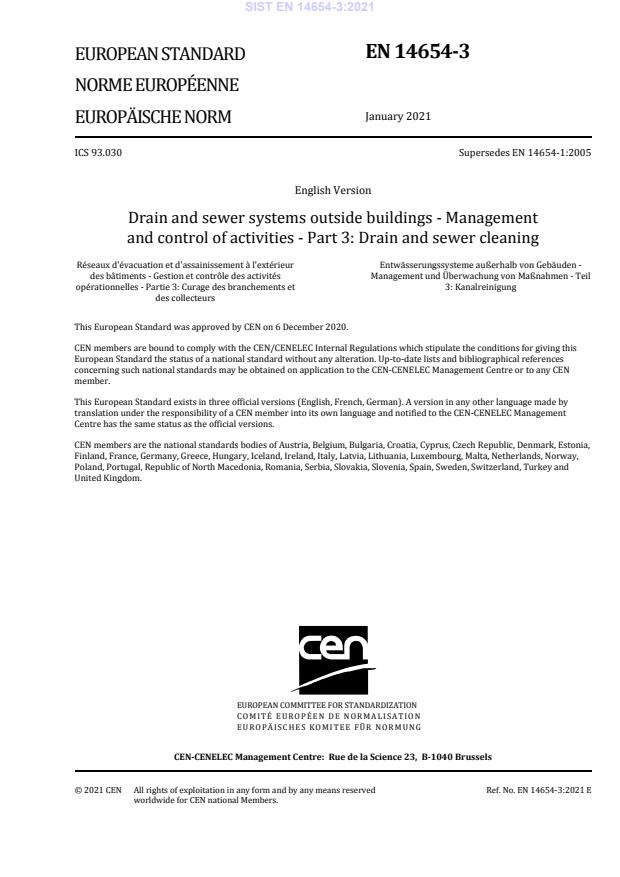
EN 14654-3
EUROPEAN STANDARD
NORME EUROPÉENNE
January 2021
EUROPÄISCHE NORM
ICS 93.030 Supersedes EN 14654-1:2005
English Version
Drain and sewer systems outside buildings - Management
and control of activities - Part 3: Drain and sewer cleaning
Réseaux d'évacuation et d'assainissement à l'extérieur Entwässerungssysteme außerhalb von Gebäuden -
des bâtiments - Gestion et contrôle des activités Management und Überwachung von Maßnahmen - Teil
opérationnelles - Partie 3: Curage des branchements et 3: Kanalreinigung
des collecteurs
This European Standard was approved by CEN on 6 December 2020.
CEN members are bound to comply with the CEN/CENELEC Internal Regulations which stipulate the conditions for giving this
European Standard the status of a national standard without any alteration. Up-to-date lists and bibliographical references
concerning such national standards may be obtained on application to the CEN-CENELEC Management Centre or to any CEN
member.
This European Standard exists in three official versions (English, French, German). A version in any other language made by
translation under the responsibility of a CEN member into its own language and notified to the CEN-CENELEC Management
Centre has the same status as the official versions.
CEN members are the national standards bodies of Austria, Belgium, Bulgaria, Croatia, Cyprus, Czech Republic, Denmark, Estonia,
Finland, France, Germany, Greece, Hungary, Iceland, Ireland, Italy, Latvia, Lithuania, Luxembourg, Malta, Netherlands, Norway,
Poland, Portugal, Republic of North Macedonia, Romania, Serbia, Slovakia, Slovenia, Spain, Sweden, Switzerland, Turkey and
United Kingdom.
EUROPEAN COMMITTEE FOR STANDARDIZATION
COMITÉ EUROPÉEN DE NORMALISATION
EUROPÄISCHES KOMITEE FÜR NORMUNG
CEN-CENELEC Management Centre: Rue de la Science 23, B-1040 Brussels
© 2021 CEN All rights of exploitation in any form and by any means reserved Ref. No. EN 14654-3:2021 E
worldwide for CEN national Members.
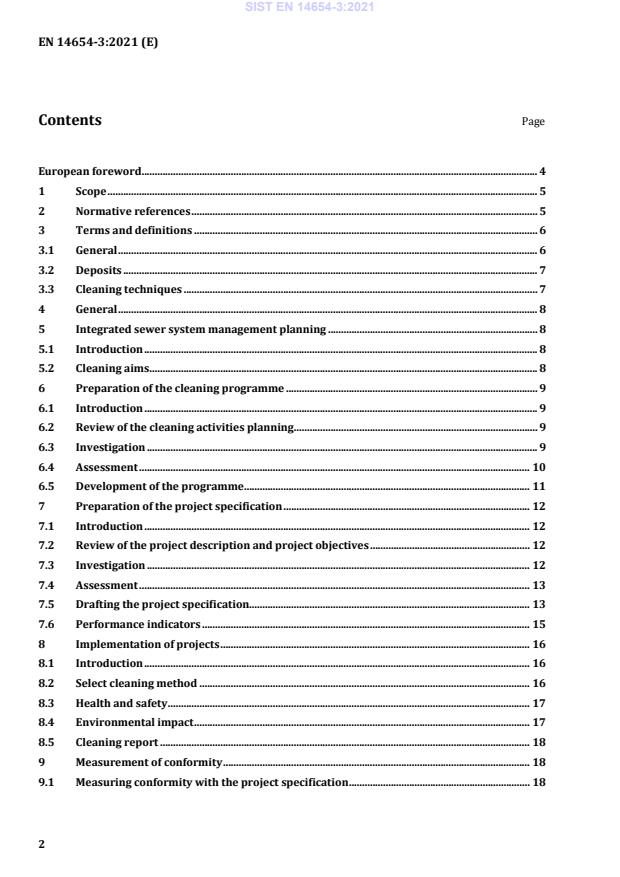
Contents Page
European foreword . 4
1 Scope . 5
2 Normative references . 5
3 Terms and definitions . 6
3.1 General . 6
3.2 Deposits . 7
3.3 Cleaning techniques . 7
4 General . 8
5 Integrated sewer system management planning . 8
5.1 Introduction . 8
5.2 Cleaning aims . 8
6 Preparation of the cleaning programme . 9
6.1 Introduction . 9
6.2 Review of the cleaning activities planning . 9
6.3 Investigation . 9
6.4 Assessment . 10
6.5 Development of the programme . 11
7 Preparation of the project specification . 12
7.1 Introduction . 12
7.2 Review of the project description and project objectives . 12
7.3 Investigation . 12
7.4 Assessment . 13
7.5 Drafting the project specification. 13
7.6 Performance indicators . 15
8 Implementation of projects . 16
8.1 Introduction . 16
8.2 Select cleaning method . 16
8.3 Health and safety . 17
8.4 Environmental impact . 17
8.5 Cleaning report . 18
9 Measurement of conformity . 18
9.1 Measuring conformity with the project specification . 18
9.2 Non-conformities . 18
10 Review of plan and programme . 19
Annex A (informative) Example of cleaning report form . 20
Annex B (informative) Drain and sewer cleaning techniques . 21
Bibliography . 24
European foreword
This document (EN 14654-3:2021) has been prepared by Technical Committee CEN/TC 165
“Wastewater Engineering”, the secretariat of which is held by DIN.
This European Standard shall be given the status of a national standard, either by publication of an
identical text or by endorsement, at the latest by July 2021, and conflicting national standards shall be
withdrawn at the latest by July 2021.
Attention is drawn to the possibility that some of the elements of this document may be the subject of
patent rights. CEN shall not be held responsible for identifying any or all such patent rights.
This document, together with EN 14654-1:2021 supersedes EN 14654-1:2014.
The changes to the text in this document are largely editorial and relate to the separation of the
duplicated text.
EN 14654 consists of the following parts, under the general title Drain and sewer systems outside
buildings — Management and control of activities:
— Part 1: General
— Part 2: Rehabilitation
— Part 3: Drain and sewer cleaning (the present document)
— Part 4: Control of inputs from users
Other parts, dealing with other activities, may be added later.
In drafting this part of EN 14654, account has been taken of other available standards, in particular
EN 752, Drain and sewer systems outside building and EN 13508 Investigation and assessment of drain
and sewer systems outside buildings.
According to the CEN-CENELEC Internal Regulations, the national standards organisations of the
following countries are bound to implement this European Standard: Austria, Belgium, Bulgaria,
Croatia, Cyprus, Czech Republic, Denmark, Estonia, Finland, France, Germany, Greece, Hungary, Iceland,
Ireland, Italy, Latvia, Lithuania, Luxembourg, Malta, Netherlands, Norway, Poland, Portugal, Republic of
North Macedonia, Romania, Serbia, Slovakia, Slovenia, Spain, Sweden, Switzerland, Turkey and the
United Kingdom.
1 Scope
This document establishes requirements for the management and control of activities in drain and
sewer systems outside buildings and specifies requirements for development and implementation of
work programmes, and the selection of techniques.
This document covers the management and control of drain and sewer cleaning.
It is applicable to drain and sewer systems from the point where wastewater leaves a building, roof
drainage system, or paved area, to the point where it is discharged into a wastewater treatment plant or
receiving water body.
Drains and sewers below buildings are included provided that they do not form part of the drainage
system of the building.
2 Normative references
The following documents are referred to in the text in such a way that some or all of their content
constitutes requirements of this document. For dated references, only the edition cited applies. For
undated references, the latest edition of the referenced document (including any amendments) applies.
EN 752, Drain and sewer systems outside buildings - Sewer system management
EN 1829-1, High pressure water jet machines - Safety requirements - Part 1: Machines
EN 1829-2, High-pressure water jet machines - Safety requirements - Part 2: Hoses, hose lines and
connectors
EN 13508-1:2012, Investigation and assessment of drain and sewer systems outside buildings - Part 1:
General Requirements
EN 14654-1:2021 Drain and sewer systems outside buildings - Management and control of activities -
Part 1: General
EN 16323:2014, Glossary of wastewater engineering terms
3 Terms and definitions
For the purposes of this document, the terms and definitions given in EN
16323:2014, EN 14654-1:2021 and the following apply.
ISO and IEC maintain terminological databases for use in standardization at the following addresses:
— IEC Electropedia available at http://www.electropedia.org/
— ISO Online browsing platform: available at https://www.iso.org/obp
NOTE Certain key definitions from EN 16323:2014 have been repeated below for clarity. The following
additional terms used in this document are defined in EN 16323:2014.
— drain
— foul wastewater
— sewer
— sewer system
— receiving water body
— surface receiving water body
— wastewater treatment plant
3.1 General
3.1.1
cleaning activities
removal or partial removal of settled deposits, attached deposits, roots and other obstacles from a drain
or sewer system
3.1.2
degree of cleaning
extent to which complete removal of deposits is achieved
3.1.3
removal
extraction of deposits after collecting at the working area or the intentional use of the flow in the drain
or sewer to carry the re-entrained solids to a specified point of extraction
3.1.4
self-cleansing
ability of the flow in a drain or sewer to carry away solid particles which would otherwise be deposited
in the pipe
[SOURCE: EN 16323:2014, 2.2.1.13]
3.1.5
supernatant liquor
liquor in a tank lying above the deposited solids
[SOURCE: EN 16323:2014, 2.1.2.16]
3.1.6
wastewater
water composed of any combination of water discharged from domestic, industrial or commercial
premises, surface run-off and accidentally any sewer infiltration water
[SOURCE: EN 16323:2014, 2.3.10.65]
3.2 Deposits
3.2.1
attached deposits
material attached to the wall of elements of the drain or sewer system by physical or chemical bonding
3.2.2
settled deposits
material deposited by gravity in the invert or benching of elements of the drain or sewer system
3.3 Cleaning techniques
3.3.1
cleaning ball
spherical device, having an indented surface, designed to be carried through a drain or sewer by the
flow to facilitate removal of sediments
3.3.2
combined jetting
simultaneous use of high-pressure water jetting equipment together with a suction action, to remove
obstructions or sediments from drains or sewers
[SOURCE: EN 16323:2014, 2.2.1.10]
3.3.3
flushing
use of a temporary and substantially increased flow to facilitate the removal of obstructions or
sediments from drains or sewers
[SOURCE: EN 16323:2014, 2.2.1.16]
3.3.4
jetting
use of water under defined conditions of pressure, through a nozzle
[SOURCE: EN 16323:2014, 2.2.1.18]
3.3.5
rodding
use of appropriate device on the end of flexible rods to facilitate the removal of obstructions (or
sediments) from drains or sewers
[SOURCE: EN 16323:2014, 2.2.1.11]
3.3.6
scouring plate
device used to clean a drain or sewer by concentrating the flow into a small cross section thereby
increasing the flow velocity
3.3.7
winching
use of a device pulled through a drain or sewer to facilitate removal of sediments (or obstructions)
[SOURCE: EN 16323:2014, 2.2.1.12]
4 General
Cleaning activities in drains and sewers can be carried out pro-actively, to prevent problems occurring
or to clean a drain or sewer before particular operations (e.g. an inspection or renovation work) or
reactively in response to problems that have occurred.
The requirements for pro-active cleaning can be identified through a rehabilitation plan, a maintenance
plan involving periodic monitoring or as part of an integrated sewer system management plan in
accordance with EN 752. Consideration shall also be given to the feasibility of preventing deposition of
sediments for example by rehabilitation of the sewer.
This document applies the process described in EN 14654-1 for implementing cleaning activities in the
integrated drain and sewer system management plan. This document shall be used in conjunction with
EN 14654-1.
5 Integrated sewer system management planning
5.1 Introduction
Cleaning activities are one aspect of the maintenance plan, as part of an integrated sewer system
management plan. A maintenance plan dealing with cleaning activities should be in place for the drain
and sewer system prior to carrying out major programmes of sewer cleaning. However, this is not
always possible if works are required urgently (e.g. in response to a sewer failure).
5.2 Cleaning aims
The principal aims of carrying out cleaning work can include:
a) Pro-active cleaning
1) to ensure that the performance of the drain or sewer system is acceptable;
2) to prolong the operational life and maintain the value of the asset;
3) to control septicity to reduce associated odour, health and potential corrosion problems;
4) to limit polluting discharges into receiving water bodies;
5) to enable inspection or renovation of the drain or sewer system;
6) to optimize the effectiveness of key components of the system at critical times (e.g. prior to
heavy rain seasons, busy periods in tourist sites);
7) to facilitate inspection.
b) Reactive cleaning
1) to restore the flow (e.g. by removing a blockage);
2) to restore the function of the drain or sewer system;
3) to reduce septicity and odour problems (e.g. by removing sediments).
The nature of the aim can determine the degree of cleaning necessary.
6 Preparation of the cleaning programme
6.1 Introduction
The cleaning programme defines the approach to be taken to cleaning in each drain or sewer, either
specifically or as part of a group of drains or sewers. The cleaning programme defines a series of
projects, in line with the integrated sewer system management plan, to ensure that the drain and sewer
system meets the performance requirements.
6.2 Review of the cleaning activities planning
A review should be undertaken of the cleaning aspects of the operations and maintenance plan within
the integrated sewer system management plan.
6.3 Investigation
6.3.1 Introduction
The location of the sections of drains and sewers where proactive cleaning is to be carried out and the
assessment of the cleaning frequencies shall be based on:
a) an understanding of the characteristics and structural condition of the drain and sewer system;
b) an analysis of its performance;
c) a review of the available information which may include the performance of similar systems
elsewhere.
The different sections of the sewer shall be described according to the information collected in order to
optimize the cleaning programme.
The scope of the investigations necessary to produce the cleaning programme will depend on the extent
of the investigations carried out during the preparation of the integrated sewer system management
plan and on the characteristics of the individual systems.
6.3.2 Review of previous investigations
A review should be undertaken of the information available. The review should include:
a) inventory data
1) type of effluent (foul wastewater, surface water, combined sewage or specific effluents);
2) sewer characteristics (shape, size, slope, depth, material, etc.), presence and characteristics of
combined sewer overflows and other ancillaries;
3) characteristics of the location of the sewer (e.g. aquifer protection zones, ground water level,
trees, proximity of receiving water bodies);
b) condition information from inspection reports (e.g. visual inspection reports, CCTV reports,
sediment measurements);
c) data on flows from measurements or the results of hydraulic models;
d) records of past cleaning (e.g. location of areas of persistent operational problems, working space
and access constraints, effectiveness of previous techniques, personnel input and costs); and
e) performance data (e.g. sewer flooding, sewer blockages, collapses, odours, septicity problems,
premature operation of combined sewer overflows, etc.).
6.3.3 Further investigations
Where there is insufficient information available to plan the cleaning programme, a programme of
investigations shall be carried out to obtain the necessary information.
An example report form is given in Annex A.
Examples of investigations can include:
a) further inspection in parts of the system where the original assessment was based only on sample
inspections;
b) use of an appropriate sewer flow simulation model;
c) more detailed studies of the impact of any discharges on receiving water bodies.
Details of investigation techniques for drains and sewers are described in EN 13508-1:2012.
6.4 Assessment
The assessment should identify the location of those components of the drains and sewer system where
proactive or reactive cleaning is to be carried out. This shall be based on:
a) effects of the deposits on the performance of the system;
b) sources of such deposits;
c) typology of the drain or sewer;
d) nature of the effluent.
The performance of the drain or sewer systems shall be assessed in accordance with EN 13508-1:2012,
Clause 6, using the results of the investigation (see 6.3). The assessments carried out during the
preparation of the integrated sewer system management plan should be reviewed and updated in the
light of any new information identified during the investigations. The performance at each planning
horizon shall be compared to the performance requirements to identify the need for cleaning.
Where inspection is used to determine the current levels of sediment, the effect of the movement of
sediment in dunes, leaving some parts of the pipe clear while other localized parts of the sewer have
significant deposits, should be considered. However, localized sediments may also indicate the presence
of an obstacle.
The typology of drains and sewers can be identified as:
— type 1: drains and sewers which are self-cleansing, where proactive cleaning is exceptional;
— type 2: drains and sewers which are not completely self-cleansing, where proactive cleaning could
be beneficial, the cleaning frequencies depending on the rate of sediment accumulation;
— type 3: drains and sewers with localized problems, which require frequent cleaning.
The typology can change over time.
Other elements of the sewer system, for example sewer connections, gullies, silt traps, inverted siphons,
pumping stations, rising mains and vacuum systems also require cleaning.
NOTE: Information on pumping stations, rising mains and vacuum systems are given in EN 16932 parts
1 to 3.
6.5 Development of the programme
6.5.1 Introduction
A cleaning programme shall:
a) identify optimum frequencies for pro-active cleaning operations;
b) maintain or reduce the number of reactive cleaning operations to an acceptable level.
6.5.2 Specification of objectives
The cleaning objectives should be established in accordance with the cleaning aim. These should be
expressed as a performance requirement, for example:
a) to remove settled and/or attached deposits to a prescribed amount (for example remove
completely or to a maximum depth);
b) to restore the flow capacity in a pipe to the design capacity;
c) to limit the build-up of sediments to a prescribed level;
d) to limit the deposits to existing levels (maintaining a balance in the sediment movement);
e) to limit the build-up of deposits so that sewer flooding is limited to prescribed frequencies;
f) to remove sufficient deposits to avoid blockages;
g) to remove sufficient sediments to allow an inspection to take
...