

SIST EN 14623:2005
(Main)Devices to prevent pollution by backflow of potable water - Air gaps with minimum circular overflow (verified by test or measurement) - Family A, type G
General Information
- Abstract
This European Standard specifies the characteristics and the requirements of air gaps with overflow, family A, type G for nominal flow velocity not exceeding 3 m/s. Air gaps are devices for protection of potable water in water installations from pollution. This European Standard applies to air gaps in factory assembled products and to constructed air gaps in situ, and defines the physicochemical characteristics of materials of construction used for the purpose and application to ensure compliance with this document during normal working use.
- Status
- Published
- Publication Date
- 31-Aug-2005
- Technical Committee
- IOVO - Water supply and waste water engineering
- Current Stage
- 6060 - National Implementation/Publication (Adopted Project)
- Start Date
- 01-Sep-2005
- Due Date
- 01-Sep-2005
- Completion Date
- 01-Sep-2005


Overview
SIST EN 14623:2005 is a European standard that specifies the requirements for devices designed to prevent pollution of potable water by backflow, specifically focusing on air gaps with a minimum circular overflow (Family A, Type G). These air gap devices play a critical role in water supply systems by ensuring that contaminated fluids cannot re-enter and pollute drinking water supplies. The standard applies to both factory-assembled products and in situ-constructed air gaps for nominal flow velocities not exceeding 3 m/s.
Proper implementation of air gaps according to this standard is essential for maintaining the safety and quality of drinking water in residential, commercial, and industrial water installations.
Key Topics
- Air Gaps with Overflow: Defines the minimum dimensions and physical configuration of air gaps with circular overflow to effectively prevent backflow into potable water systems.
- Material Requirements: Specifies the physicochemical characteristics for materials used in contact with drinking water to ensure compatibility and compliance with national and European regulations.
- Flow Velocity Limitation: Applicability limited to systems with nominal flow velocities up to 3 m/s.
- Factory Assembled and Site-Constructed Units: Covers both pre-assembled and on-site constructed air gap configurations.
- Verification Methods: Details procedures for verifying air gap dimensions by test or measurement to ensure compliance.
- Marking and Documentation: Requirements for clear marking of devices and provision of technical documentation for proper installation and maintenance.
Applications
Air gaps conforming to SIST EN 14623:2005 are widely used in water supply systems to protect potable water sources from contamination by ensuring a physical separation between the water outlet and the potential source of pollution. Typical applications include:
- Domestic Plumbing Installations: Preventing backflow in household water systems, especially at transitional points such as storage tanks and water softeners.
- Commercial and Industrial Facilities: Ensuring safe separation in complex installations where cross-connections with non-potable water are possible.
- Water Treatment and Storage: Maintaining the integrity of water quality in plants and reservoirs by preventing indirect connections and siphoning contamination.
- Healthcare and Laboratory Environments: Protecting sensitive users from potential exposure to contaminants by using certified air gap devices.
By using devices compliant with this standard, water suppliers, installers, and facility managers can significantly reduce the risk of waterborne contamination and adhere to critical public health and safety regulations.
Related Standards
For comprehensive backflow protection and water quality assurance, the following standards are relevant and often referenced alongside SIST EN 14623:2005:
- EN 1717:2000 - Protection against pollution of potable water in water installations and general requirements of devices to prevent pollution by backflow.
- ICS 13.060.20 - Standards related to drinking water.
- ICS 91.140.60 - Standards addressing water supply systems.
Implementing SIST EN 14623:2005 together with EN 1717 ensures a robust defense against water pollution risks within European and international water supply frameworks.
By adhering to SIST EN 14623:2005, stakeholders ensure compliance with essential best practices in potable water safety, supporting efficient operation, regulatory fulfillment, and public health protection.
Relations
- Effective Date
- 01-Apr-2026
- Effective Date
- 28-Jan-2026
- Effective Date
- 28-Jan-2026
- Effective Date
- 28-Jan-2026
Get Certified
Connect with accredited certification bodies for this standard

DIBt (Deutsches Institut für Bautechnik)
German Institute for Building Technology.
DIN CERTCO
DIN Group product certification.

Kiwa BDA Testing
Building and construction product certification.
Sponsored listings
Frequently Asked Questions
SIST EN 14623:2005 is a standard published by the Slovenian Institute for Standardization (SIST). Its full title is "Devices to prevent pollution by backflow of potable water - Air gaps with minimum circular overflow (verified by test or measurement) - Family A, type G". This standard covers: This European Standard specifies the characteristics and the requirements of air gaps with overflow, family A, type G for nominal flow velocity not exceeding 3 m/s. Air gaps are devices for protection of potable water in water installations from pollution. This European Standard applies to air gaps in factory assembled products and to constructed air gaps in situ, and defines the physicochemical characteristics of materials of construction used for the purpose and application to ensure compliance with this document during normal working use.
This European Standard specifies the characteristics and the requirements of air gaps with overflow, family A, type G for nominal flow velocity not exceeding 3 m/s. Air gaps are devices for protection of potable water in water installations from pollution. This European Standard applies to air gaps in factory assembled products and to constructed air gaps in situ, and defines the physicochemical characteristics of materials of construction used for the purpose and application to ensure compliance with this document during normal working use.
SIST EN 14623:2005 is classified under the following ICS (International Classification for Standards) categories: 13.060.20 - Drinking water; 91.140.60 - Water supply systems. The ICS classification helps identify the subject area and facilitates finding related standards.
SIST EN 14623:2005 has the following relationships with other standards: It is inter standard links to SIST EN 1717:2025+A1:2026, SIST EN 1717:2025, SIST EN 17962:2025, SIST EN 806-5:2012. Understanding these relationships helps ensure you are using the most current and applicable version of the standard.
SIST EN 14623:2005 is available in PDF format for immediate download after purchase. The document can be added to your cart and obtained through the secure checkout process. Digital delivery ensures instant access to the complete standard document.
Standards Content (Sample)
SLOVENSKI STANDARD
01-september-2005
Naprave za varovanje pred onesnaženjem pitne vode zaradi povratnega toka -
Prosti iztok z najmanjšim prelivom krožne oblike (preverjeno s preskusom ali
meritvijo) – Družina A, tip G
Devices to prevent pollution by backflow of potable water - Air gaps with minimum
circular overflow (verified by test or measurement) - Family A, type G
Sicherungseinrichtungen zum Schutz des Trinkwassers gegen Verschmutzung durch
Rückfließen - Freier Auslauf mit kreisförmigem Überlauf mit Mindestdurchmesser
(Nachweis durch Prüfung oder Messung) - Familie A, Typ G
Dispositifs de protection contre la pollution de l'eau potable par retour - Surverse avec
trop-plein (définie par essai de dépression) - Famille A, type G
Ta slovenski standard je istoveten z: EN 14623:2005
ICS:
13.060.20 Pitna voda Drinking water
91.140.60 Sistemi za oskrbo z vodo Water supply systems
2003-01.Slovenski inštitut za standardizacijo. Razmnoževanje celote ali delov tega standarda ni dovoljeno.
EUROPEAN STANDARD
EN 14623
NORME EUROPÉENNE
EUROPÄISCHE NORM
May 2005
ICS 13.060.20; 91.140.60
English version
Devices to prevent pollution by backflow of potable water - Air
gaps with minimum circular overflow (verified by test or
measurement) - Family A, type G
Dispositifs de protection contre la pollution de l'eau potable Sicherungseinrichtungen zum Schutz des Trinkwassers
par retour - Surverse avec trop plein (définie par essai de gegen Verschmutzung durch Rückfließen - Freier Auslauf
dépression) - Famille A, type G mit kreisförmigem Überlauf mit Mindestdurchmesser
(Nachweis durch Prüfung oder Messung) - Familie A, Typ
G
This European Standard was approved by CEN on 25 March 2005.
CEN members are bound to comply with the CEN/CENELEC Internal Regulations which stipulate the conditions for giving this European
Standard the status of a national standard without any alteration. Up-to-date lists and bibliographical references concerning such national
standards may be obtained on application to the Central Secretariat or to any CEN member.
This European Standard exists in three official versions (English, French, German). A version in any other language made by translation
under the responsibility of a CEN member into its own language and notified to the Central Secretariat has the same status as the official
versions.
CEN members are the national standards bodies of Austria, Belgium, Cyprus, Czech Republic, Denmark, Estonia, Finland, France,
Germany, Greece, Hungary, Iceland, Ireland, Italy, Latvia, Lithuania, Luxembourg, Malta, Netherlands, Norway, Poland, Portugal, Slovakia,
Slovenia, Spain, Sweden, Switzerland and United Kingdom.
EUROPEAN COMMITTEE FOR STANDARDIZATION
COMITÉ EUROPÉEN DE NORMALISATION
EUROPÄISCHES KOMITEE FÜR NORMUNG
Management Centre: rue de Stassart, 36 B-1050 Brussels
© 2005 CEN All rights of exploitation in any form and by any means reserved Ref. No. EN 14623:2005: E
worldwide for CEN national Members.
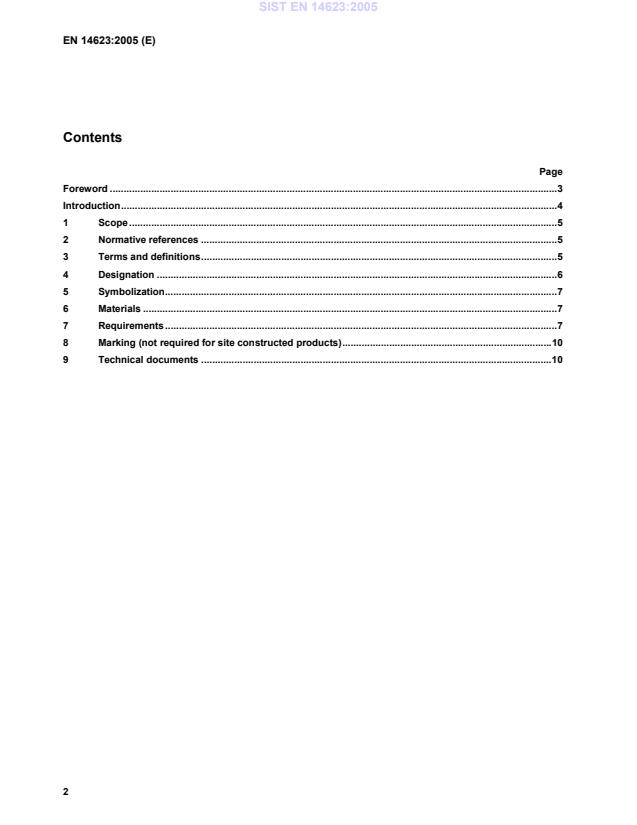
Contents
Page
Foreword .3
Introduction.4
1 Scope .5
2 Normative references .5
3 Terms and definitions.5
4 Designation .6
5 Symbolization.7
6 Materials .7
7 Requirements .7
8 Marking (not required for site constructed products).10
9 Technical documents .10
Foreword
This European Standard (EN 14623:2005) has been prepared by Technical Committee CEN/TC 164 "Water
supply", the secretariat of which is held by AFNOR.
This European Standard shall be given the status of a national standard, either by publication of an identical text or
by endorsement, at the latest by November 2005, and conflicting national standards shall be withdrawn at the latest
by November 2005.
According to the CEN/CENELEC Internal Regulations, the national standards organizations of the following
countries are bound to implement this European Standard: Austria, Belgium, Cyprus, Czech Republic, Denmark,
Estonia, Finland, France, Germany, Greece, Hungary, Iceland, Ireland, Italy, Latvia, Lithuania, Luxembourg, Malta,
Netherlands, Norway, Poland, Portugal, Slovakia, Slovenia, Spain, Sweden, Switzerland and United Kingdom.
Introduction
In respect of potential adverse effects on the quality of water intended for human consumption, caused by the
product covered by this European Standard:
a) this European Standard provides no information as to whether the produce may be used without restriction in
any of the Member state of the EU or EFTA;
b) it should be noted that, while awaiting the adoption of verifiable European criteria, existing national regulations
concerning the use and/or the characteristics of this product remain in force.
1 Scope
This European Standard specifies the characteristics and the requirements of air gaps with overflow, family A,
type G for nominal flow velocity not exceeding 3 m/s. Air gaps are devices for protection of potable water in water
installations from pollution. This European Standard applies to air gaps in factory assembled products and to
constructed air gaps in situ, and defines the physicochemical characteristics of materials of construction used for
the purpose and application to ensure compliance with this document during normal working use.
2 Normative references
The following referenced documents are indispensable for the application of this document. For dated references,
only the edition cited applies. For undated references, the latest edition of the referenced document (including any
amendments) applies.
EN 1717:2000, Protection against pollution of potable water in water installations and general requirements of
devices to prevent pollution by backflow.
3 Terms and definitions
For the purposes of this European Standard, the terms and definitions of EN 1717:2000 and the following apply.
3.1
air gap with overflow family A, type G
permanent and vertical distance between the lowest point of the feed orifice and the critical water level having an
overflow capable of draining the maximum inflow of water under fault condition
NOTE See Figure 1 for the design principle.
Figure 1 — Design principle
3.2
spillover level
leve
...