


SIST EN 1492-2:2001
(Main)Textile slings - Safety - Part 2: Roundslings, made of man-made fibres, for general purpose use
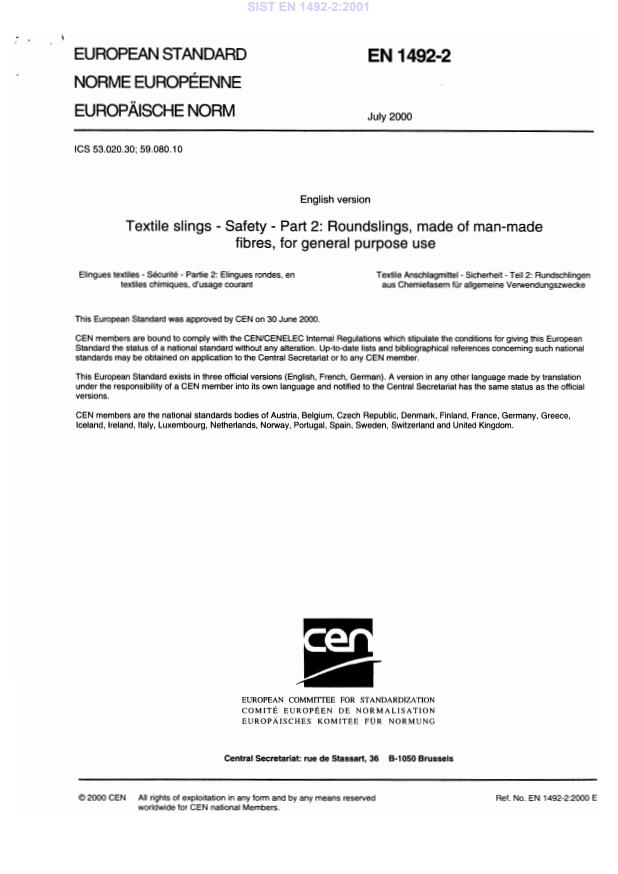
Textile slings - Safety - Part 2: Roundslings, made of man-made fibres, for general purpose use
This European Standard specifies the requirements related to safety, including methods of rating and testing roundslings up to 40 tonnes working load limit (in straight lift) and two-, three-, and four-leg roundsling assemblies, with or without fittings, made of polyamide, polyester and polypropylene. The roundslings covered by this Part of EN 1492 are intended for general purpose lifting operations, i.e. when used for lifting objects, materials or goods which require no deviations from the requirements, safety factors or WLL¿s specified. Lifting operations not covered by this standard include the lifting of persons, potentially dangerous materials such as molten metal and acids, glass sheets, fissile materials, nuclear reactors and where special conditions apply. Roundslings conforming to this European Standard are suitable for use and storage in the following temperature ranges: a) polyester and polyamide: -40°C to 100°C, b) polypropylene: -40°C to 80°C This European Standard does not apply to the types of roundsling indicated below: a) roundslings designed for securing or lashing of cargoes to each other on pallets and platforms or in vehicles; b) slings of tubular webbing without filling. This European Standard deals with the technical requirements to minimize the hazards listed in clause 4 which can arise during the use of roundslings when carried out in accordance with the instructions and specifications given by the manufacturer or authorized representative.
Textile Anschlagmittel - Sicherheit - Teil 2: Rundschlingen aus Chemiefasern für allgemeine Verwendungszwecke
Diese Europäische Norm legt Anforderungen an die Sicherheit sowie Verfahren zur Bewertung und Prüfung von Rundschlingen mit einer Tragfähigkeit bis 40 t (in der Anschlagart direkt) sowie von ein-, zwei-, drei- und vier-strängigen Rundschling-Einheiten, mit oder ohne Beschlagteilen, aus Polyamid, Polyester und Polypropylen fest. Die in diesem Teil von EN 1492 erfaßten Rundschlingen sind für allgemeine Hebevorgänge vorgesehen, d. h. für Anwendungen zum Anheben von Gegenständen, Materialien oder Lasten, die keine Abweichungen von den festgelegten Anforderungen, Sicherheitsfaktoren oder Tragfähigkeiten erfordern. In dieser Norm nicht festgelegt
werden das Anheben von Personen, von möglicherweise gefährlichen Materialien, z. B. geschmolzenem Metall und Säuren, Glasplatten, spaltbaren Materialien, Teilen von Kernreaktoren und alle Hebevorgänge, für die Sonderbedingungen gelten. Rundschlingen, die dieser Europäischen Norm entsprechen, sind für eine Benutzung und Lagerung bei Temperaturen in folgenden Bereichen geeignet: a) Polyester und Polyamid: -40 °C bis 100 °C; b) Polypropylen: -40 °C bis 80 °C. Diese Europäische Norm gilt nicht für die nachfolgend angegebenen Typen von Rundschlingen: a) Rundschlingen, die zum Sichern oder Verzurren von Lasten miteinander auf Paletten und Ladeflächen oder in Fahrzeugen vorgesehen sind; b) Rundschlingen aus schlauchförmigem Gurtbandgewebe ohne Füllfasern. Diese Europäische Norm legt die zu beachtenden technischen Anforderungen zur Verringerung der im Abschnitt 4 aufgeführten Gefahren fest, die bei Anwendung von Rundschlingen auftreten können, wenn sie nach den vom Hersteller oder seinem bevollmächtigten Vertreter erteilten Anweisungen und Anforderungen entsprechend angewendet werden.
Elingues textiles - Sécurité - Partie 2: Elingues rondes, en textiles chimiques, d'usage courant
La présente norme spécifie les prescriptions relatives à la sécurité, y compris les méthodes de classification et d'essais des élingues rondes de charge maximale d'utilisation jusqu'à 40 tonnes (en levage direct) et les assemblage d'élingues rondes à deux, trois et quatre brins, avec ou sans accessoires, en polyamide, polyester et polypropylène. Les élingues rondes couvertes par la présente partie de l'EN 1492 sont prévues pour des applications de levage générales, c'est-à-dire le levage d'objet, de matériels ou de marchandises qui ne nécessitent aucun écart par rapport aux prescriptions, coefficients de sécurité ou charge maximale d'utilisation spécifiés. Les opérations de levage non couvertes par la présente norme sont le levage de personnes, de matériaux potentiellement dangereux tels que le métal fondu, les acides, les vitres, les matériaux fissiles, les réacteurs nucléaires ou lorsque des conditions spéciales s'appliquent. Les élingues rondes conformes à la présente norme européenne sont adaptées pour l'utilisation et le stockage dans les plages de températures suivantes : a) Polyester et polyamide: -40°C à 100°C ; b) Polypropylène: -40°C à 80°C. La présente norme européenne ne s'appliquent pas aux types d'élingues rondes suivantes : a) Elingues rondes conçues pour la fixation ou l'arrimage des charges entre elles sur des palettes et plateaux ou dans des véhicules; b) Elingues constituées de sangles tubulaires sans liage. La présente norme européenne traite des prescriptions techniques pour minimiser les phénomènes dangereux listés dans l'article 4 qui peuvent survenir lorsque les élingues rondes sont utilisées conformément aux instructions et aux spécifications données par le fabricant ou son représentant autorisé.
Tekstilne obese - Varnost - 2. del: Obese z okroglim presekom iz umetnih vlaken za splošno uporabo
General Information
- Status
- Withdrawn
- Publication Date
- 30-Apr-2001
- Withdrawal Date
- 18-Aug-2010
- Technical Committee
- DTN - Lift and transport appliances
- Current Stage
- 9900 - Withdrawal (Adopted Project)
- Start Date
- 17-Aug-2010
- Due Date
- 09-Sep-2010
- Completion Date
- 19-Aug-2010
- Directive
- 98/37/EC - Machinery
Relations
- Effective Date
- 01-Sep-2010
- Consolidated By
SIST EN 1492-2:2001+A1:2009 - Textile slings - Safety - Part 2: Roundslings made of man-made fibres for general purpose use - Effective Date
- 18-Jan-2023
- Effective Date
- 01-Oct-2006

Frequently Asked Questions
SIST EN 1492-2:2001 is a standard published by the Slovenian Institute for Standardization (SIST). Its full title is "Textile slings - Safety - Part 2: Roundslings, made of man-made fibres, for general purpose use". This standard covers: This European Standard specifies the requirements related to safety, including methods of rating and testing roundslings up to 40 tonnes working load limit (in straight lift) and two-, three-, and four-leg roundsling assemblies, with or without fittings, made of polyamide, polyester and polypropylene. The roundslings covered by this Part of EN 1492 are intended for general purpose lifting operations, i.e. when used for lifting objects, materials or goods which require no deviations from the requirements, safety factors or WLL¿s specified. Lifting operations not covered by this standard include the lifting of persons, potentially dangerous materials such as molten metal and acids, glass sheets, fissile materials, nuclear reactors and where special conditions apply. Roundslings conforming to this European Standard are suitable for use and storage in the following temperature ranges: a) polyester and polyamide: -40°C to 100°C, b) polypropylene: -40°C to 80°C This European Standard does not apply to the types of roundsling indicated below: a) roundslings designed for securing or lashing of cargoes to each other on pallets and platforms or in vehicles; b) slings of tubular webbing without filling. This European Standard deals with the technical requirements to minimize the hazards listed in clause 4 which can arise during the use of roundslings when carried out in accordance with the instructions and specifications given by the manufacturer or authorized representative.
This European Standard specifies the requirements related to safety, including methods of rating and testing roundslings up to 40 tonnes working load limit (in straight lift) and two-, three-, and four-leg roundsling assemblies, with or without fittings, made of polyamide, polyester and polypropylene. The roundslings covered by this Part of EN 1492 are intended for general purpose lifting operations, i.e. when used for lifting objects, materials or goods which require no deviations from the requirements, safety factors or WLL¿s specified. Lifting operations not covered by this standard include the lifting of persons, potentially dangerous materials such as molten metal and acids, glass sheets, fissile materials, nuclear reactors and where special conditions apply. Roundslings conforming to this European Standard are suitable for use and storage in the following temperature ranges: a) polyester and polyamide: -40°C to 100°C, b) polypropylene: -40°C to 80°C This European Standard does not apply to the types of roundsling indicated below: a) roundslings designed for securing or lashing of cargoes to each other on pallets and platforms or in vehicles; b) slings of tubular webbing without filling. This European Standard deals with the technical requirements to minimize the hazards listed in clause 4 which can arise during the use of roundslings when carried out in accordance with the instructions and specifications given by the manufacturer or authorized representative.
SIST EN 1492-2:2001 is classified under the following ICS (International Classification for Standards) categories: 53.020.30 - Accessories for lifting equipment. The ICS classification helps identify the subject area and facilitates finding related standards.
SIST EN 1492-2:2001 has the following relationships with other standards: It is inter standard links to SIST EN 1492-2:2001+A1:2009, SIST EN 1492-2:2001+A1:2009, SIST EN 1492-2:2001/AC:2006. Understanding these relationships helps ensure you are using the most current and applicable version of the standard.
SIST EN 1492-2:2001 is associated with the following European legislation: EU Directives/Regulations: 98/37/EC; Standardization Mandates: M/BC/CEN/91/1. When a standard is cited in the Official Journal of the European Union, products manufactured in conformity with it benefit from a presumption of conformity with the essential requirements of the corresponding EU directive or regulation.
SIST EN 1492-2:2001 is available in PDF format for immediate download after purchase. The document can be added to your cart and obtained through the secure checkout process. Digital delivery ensures instant access to the complete standard document.
Standards Content (Sample)
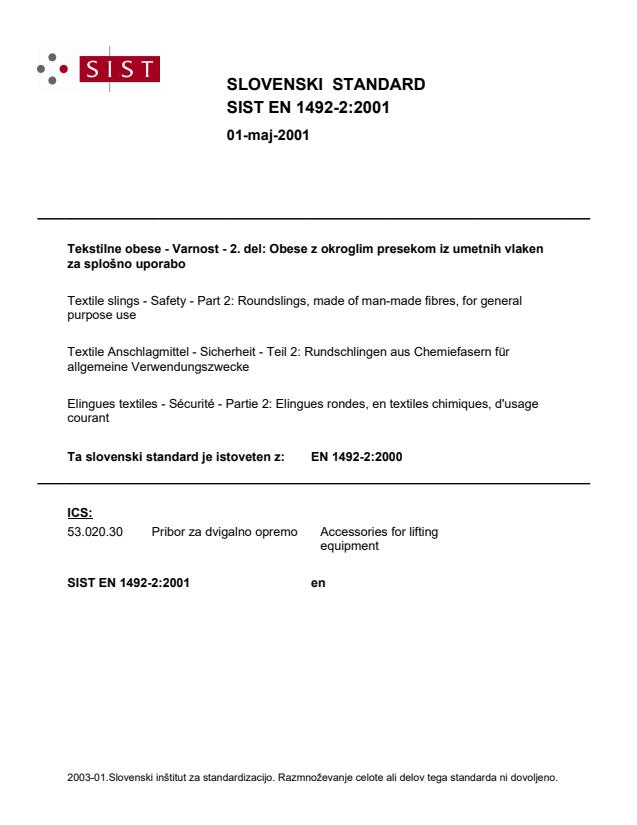
2003-01.Slovenski inštitut za standardizacijo. Razmnoževanje celote ali delov tega standarda ni dovoljeno.Tekstilne obese - Varnost - 2. del: Obese z okroglim presekom iz umetnih vlaken za splošno uporaboTextile Anschlagmittel - Sicherheit - Teil 2: Rundschlingen aus Chemiefasern für allgemeine VerwendungszweckeElingues textiles - Sécurité - Partie 2: Elingues rondes, en textiles chimiques, d'usage courantTextile slings - Safety - Part 2: Roundslings, made of man-made fibres, for general purpose use53.020.30Pribor za dvigalno opremoAccessories for lifting equipmentICS:Ta slovenski standard je istoveten z:EN 1492-2:2000SIST EN 1492-2:2001en01-maj-2001SIST EN 14
...
Questions, Comments and Discussion
Ask us and Technical Secretary will try to provide an answer. You can facilitate discussion about the standard in here.
Loading comments...