

SIST EN 15461:2008+A1:2010
(Main)Railway applications - Noise emission - Characterisation of the dynamic properties of track sections for pass by noise measurements
General Information
- Abstract
This European Standard specifies a method for characterizing the dynamic behaviour of the structure of a track relative to its contribution to the sound radiation associated with the rolling noise.
This European Standard describes a method for:
a) acquiring data on mechanical frequency response functions on a track;
b) processing measurement data in order to calculate an estimate of the vibration decay rates along the rails in an audible frequency range associated with the rolling noise;
c) presenting this estimate for comparison with the lower limits of the decay rates.
It is applicable for evaluating the performance of sections of reference tracks for measuring railway vehicle noise within the framework of official approval tests.
The method is not applicable for characterizing the vibration behaviour of tracks on loadbearing structures such as bridges or embankments.
- Status
- Published
- Publication Date
- 15-Nov-2010
- Technical Committee
- IŽNP - Reilway applications
- Current Stage
- 6060 - National Implementation/Publication (Adopted Project)
- Start Date
- 04-Nov-2010
- Due Date
- 09-Jan-2011
- Completion Date
- 16-Nov-2010
- Directive
- 2008/57/EC - DIRECTIVE 2008/57/EC OF THE EUROPEAN PARLIAMENT AND OF THE COUNCIL of 17 June 2008 on the interoperability of the rail system within the Community (Recast)OJ Ref: C 214 OJ Date: 20-Jul-2011
2016/797/EU - Directive (EU) 2016/797 of the European Parliament and of the Council of 11 May 2016 on the interoperability of the rail system within the European Union (Text with EEA relevance)OJ Ref: Izvedbeni sklep Komisije 2023/2584 OJ Date: 21-Nov-2023

Overview
EN 15461:2008+A1:2010 is a CEN European standard for railway noise emission that defines a measurement method to characterise the dynamic behaviour of a track section and its contribution to rolling (pass-by) noise. The standard describes how to obtain mechanical frequency-response functions (FRFs) on rails, process those measurements to estimate track vibration decay rates in the audible frequency range, and present the results for comparison with acceptance limits. It is intended for use when evaluating reference track sections used in official railway vehicle noise approval tests. The method excludes tracks on load‑bearing structures such as bridges or embankments.
Key topics and technical requirements
- Purpose: Quantify the track’s dynamic contribution to rolling noise via decay rates (expressed in dB/m) in one‑third‑octave bands.
- Measurement principle: Use an instrumented hammer to excite the rail and a fixed accelerometer to record responses; compute direct and transfer FRFs and derive decay rates from spatial FRF sets.
- Test section selection: Track must be homogeneous (constant rail profile, pad stiffness, sleeper spacing, long welded rail, no expansion joints) over the measurement area.
- Accelerometer placement: Fixed on rail (preferably rail head) at median point between sleepers; locations must avoid nearby defects, welds, pumping sleepers and be a minimum distance from expansion joints as specified.
- Data acquisition: Multiple measuring positions along the rail, FRFs in vertical and transverse directions, and acquisition system compliant with experimental vibration practices.
- Data processing: Convert FRFs to one‑third‑octave spectra, calculate decay-rate spectra (vertical and transverse bending waves), and present results for comparison against lower limit criteria.
- Reporting: Includes test report content and presentation of decay rates for reproducibility of pass‑by noise measurements.
Applications and users
Who uses EN 15461:2008+A1:2010:
- Railway vehicle manufacturers and type‑approval laboratories for pass‑by noise certification
- National approval authorities and conformity assessment bodies
- Infrastructure managers and track engineers establishing or verifying reference track sections
- Acoustic consultants performing rolling noise assessments and laboratory validation
Typical applications:
- Qualification of reference track sections for vehicle noise testing
- Determination of track influence in rolling noise studies
- Ensuring repeatability and comparability of pass‑by noise measurements
Related standards
Normative references included in EN 15461:
- EN 61260 (octave/fractional-octave filters)
- EN ISO 266 (normal frequencies)
- EN ISO/IEC 17025 (laboratory competence)
- ISO 2041 (vibration vocabulary)
- ISO 7626-1 and ISO 7626-5 (mechanical mobility and impact measurements)
Keywords: EN 15461:2008+A1:2010, railway noise, pass-by noise measurements, track decay rates, frequency-response function, instrumented hammer, accelerometer, rolling noise, reference track.
Relations
- Effective Date
- 09-Feb-2026
- Effective Date
- 09-Feb-2026
- Effective Date
- 09-Feb-2026
- Effective Date
- 28-Jan-2026
- Effective Date
- 28-Jan-2026
- Effective Date
- 28-Jan-2026
- Effective Date
- 28-Jan-2026
- Effective Date
- 01-Dec-2010
- Effective Date
- 01-Dec-2010
Get Certified
Connect with accredited certification bodies for this standard

IRIS Certification (UNIFE)
International Railway Industry Standard certification.

TÜV SÜD Rail GmbH
TÜV SÜD railway certification services.
BSMI (Bureau of Standards, Metrology and Inspection)
Taiwan's standards and inspection authority.
Sponsored listings
Frequently Asked Questions
SIST EN 15461:2008+A1:2010 is a standard published by the Slovenian Institute for Standardization (SIST). Its full title is "Railway applications - Noise emission - Characterisation of the dynamic properties of track sections for pass by noise measurements". This standard covers: This European Standard specifies a method for characterizing the dynamic behaviour of the structure of a track relative to its contribution to the sound radiation associated with the rolling noise. This European Standard describes a method for: a) acquiring data on mechanical frequency response functions on a track; b) processing measurement data in order to calculate an estimate of the vibration decay rates along the rails in an audible frequency range associated with the rolling noise; c) presenting this estimate for comparison with the lower limits of the decay rates. It is applicable for evaluating the performance of sections of reference tracks for measuring railway vehicle noise within the framework of official approval tests. The method is not applicable for characterizing the vibration behaviour of tracks on loadbearing structures such as bridges or embankments.
This European Standard specifies a method for characterizing the dynamic behaviour of the structure of a track relative to its contribution to the sound radiation associated with the rolling noise. This European Standard describes a method for: a) acquiring data on mechanical frequency response functions on a track; b) processing measurement data in order to calculate an estimate of the vibration decay rates along the rails in an audible frequency range associated with the rolling noise; c) presenting this estimate for comparison with the lower limits of the decay rates. It is applicable for evaluating the performance of sections of reference tracks for measuring railway vehicle noise within the framework of official approval tests. The method is not applicable for characterizing the vibration behaviour of tracks on loadbearing structures such as bridges or embankments.
SIST EN 15461:2008+A1:2010 is classified under the following ICS (International Classification for Standards) categories: 17.140.30 - Noise emitted by means of transport; 45.060.01 - Railway rolling stock in general. The ICS classification helps identify the subject area and facilitates finding related standards.
SIST EN 15461:2008+A1:2010 has the following relationships with other standards: It is inter standard links to SIST EN 61260-1:2014, SIST EN 61260-3:2016, SIST EN 61260-2:2016, SIST EN ISO 266:1998, SIST-TP CEN/TR 16891:2016, SIST EN ISO 3095:2025, SIST EN ISO 3381:2021, SIST EN 15461:2008/kFprA1:2010, SIST EN 15461:2008. Understanding these relationships helps ensure you are using the most current and applicable version of the standard.
SIST EN 15461:2008+A1:2010 is associated with the following European legislation: EU Directives/Regulations: 2008/57/EC, 2016/797/EU; Standardization Mandates: M/334, M/483. When a standard is cited in the Official Journal of the European Union, products manufactured in conformity with it benefit from a presumption of conformity with the essential requirements of the corresponding EU directive or regulation.
SIST EN 15461:2008+A1:2010 is available in PDF format for immediate download after purchase. The document can be added to your cart and obtained through the secure checkout process. Digital delivery ensures instant access to the complete standard document.
Standards Content (Sample)
2003-01.Slovenski inštitut za standardizacijo. Razmnoževanje celote ali delov tega standarda ni dovoljeno.Bahnanwendungen - Schallemission - Charakterisierung der dynamischen Eigenschaften von Gleisabschnitten für VorbeifahrtgeräuschmessungenApplications ferroviaires - Emission sonore - Caractérisation des propriétés dynamiques de sections de voie pour le mesurage du bruit au passageRailway applications - Noise emission - Characterisation of the dynamic properties of track sections for pass by noise measurements45.060.01Železniška vozila na splošnoRailway rolling stock in general17.140.30Emisija hrupa transportnih sredstevNoise emitted by means of transportICS:Ta slovenski standard je istoveten z:EN 15461:2008+A1:2010SIST EN 15461:2008+A1:2010en,fr,de01-december-2010SIST EN 15461:2008+A1:2010SLOVENSKI
STANDARD
EUROPEAN STANDARD NORME EUROPÉENNE EUROPÄISCHE NORM
EN 15461:2008+A1
November 2010 ICS 17.140.30; 93.100 Supersedes EN 15461:2008English Version
Railway applications - Noise emission - Characterisation of the dynamic properties of track sections for pass by noise measurements
Applications ferroviaires - Emission sonore - Caractérisation des propriétés dynamiques de sections de voie pour le mesurage du bruit au passage
Bahnanwendungen - Schallemission - Charakterisierung der dynamischen Eigenschaften von Gleisabschnitten für Vorbeifahrtgeräuschmessungen This European Standard was approved by CEN on 28 December 2007 and includes Amendment 1 approved by CEN on 28 September 2010.
CEN members are bound to comply with the CEN/CENELEC Internal Regulations which stipulate the conditions for giving this European Standard the status of a national standard without any alteration. Up-to-date lists and bibliographical references concerning such national standards may be obtained on application to the CEN Management Centre or to any CEN member.
This European Standard exists in three official versions (English, French, German). A version in any other language made by translation under the responsibility of a CEN member into its own language and notified to the CEN Management Centre has the same status as the official versions.
CEN members are the national standards bodies of Austria, Belgium, Bulgaria, Croatia, Cyprus, Czech Republic, Denmark, Estonia, Finland, France, Germany, Greece, Hungary, Iceland, Ireland, Italy, Latvia, Lithuania, Luxembourg, Malta, Netherlands, Norway, Poland, Portugal, Romania, Slovakia, Slovenia, Spain, Sweden, Switzerland and United Kingdom.
EUROPEAN COMMITTEE FOR STANDARDIZATION
COMITÉ EUROPÉEN DE NORMALISATION EUROPÄISCHES KOMITEE FÜR NORMUNG
Management Centre:
Avenue Marnix 17,
B-1000 Brussels © 2010 CEN All rights of exploitation in any form and by any means reserved worldwide for CEN national Members. Ref. No. EN 15461:2008+A1:2010: ESIST EN 15461:2008+A1:2010
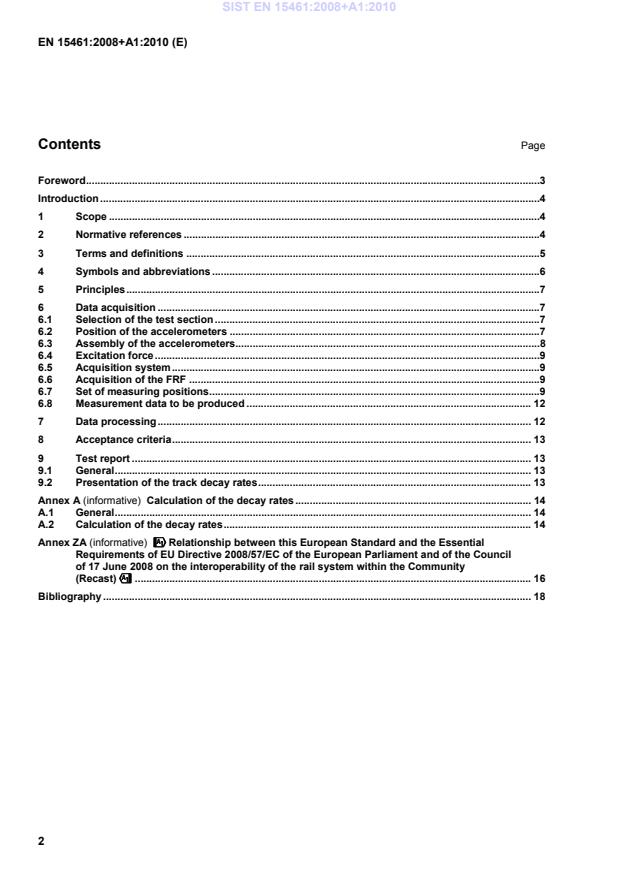
Calculation of the decay rates . 14A.1General . 14A.2Calculation of the decay rates . 14Annex ZA (informative)
!!!!Relationship between this European Standard and the Essential Requirements of EU Directive 2008/57/EC of the European Parliament and of the Council of 17 June 2008 on the interoperability of the rail system within the Community (Recast)"""" . 16Bibliography . 18 SIST EN 15461:2008+A1:2010
The vibration response of the track structure determines the level of its sound contribution to this noise. The method assumes that the vibration waves in the rail can be regarded as the superposition of two bending waves, one vertical and the other transverse, of the rail represented as a simple beam.
Although the track rail does not behave in this way over all the frequencies covered by the measurement, this simplification permits the "decay rates" to be measured for an estimation of the dynamic behaviour of the track which is one of the basic parameters influencing the generation of rolling noise. 1 Scope This European Standard specifies a method for characterizing the dynamic behaviour of the structure of a track relative to its contribution to the sound radiation associated with the rolling noise. This European Standard describes a method for: a) acquiring data on mechanical frequency response functions on a track; b) processing measurement data in order to calculate an estimate of the vibration decay rates along the rails in an audible frequency range associated with the rolling noise; c) presenting this estimate for comparison with the lower limits of the decay rates. It is applicable for evaluating the performance of sections of reference tracks for measuring railway vehicle noise within the framework of official approval tests. The method is not applicable for characterizing the vibration behaviour of tracks on loadbearing structures such as bridges or embankments. 2 Normative references The following referenced documents are indispensable for the application of this document. For dated references, only the edition cited applies. For undated references, the latest edition of the referenced document (including any amendments) applies EN 61260, Electroacoustics — Octave-band and fractional-octave-band filters (IEC 61260:1995) EN ISO 266, Acoustics — Normal frequencies (ISO 266:1997) EN ISO/IEC 17025, General requirements for the competence of testing and calibration laboratories (ISO/IEC 17025:2005) ISO 2041, Vibration and shock — Vocabulary ISO 7626-1, Vibration and shock — Experimental determination of mechanical mobility — Part 1: Basic definitions and transducers
ISO 7626-1)
NOTE 1
In this document, the term also refers to the mean spectral amplitude of the FRF in the form of a one-third octave spectrum. NOTE 2
In this standard, the term frequency-response function (FRF) is used to refer generically either to accelerance (accelerometric response/excitation force) or to mobility (speed response/excitation force). The term is not used to refer to receptance (dynamic compliance).
NOTE 3 The FRF is generally calculated as the interspectrum ratio between the response and the force with the autospectrum.
This estimate of the FRF is called estimate H1. NOTE 4 A set of FRF between a single excitation point and multiple response points or even between a single response point and multiple excitation points may be used.
In this standard, the case of a fixed accelerometer and a mobile instrumented excitation hammer is the easiest to implement.
3.2 accelerance complex ratio of the acceleration at one point in a mechanical system to the force at the same point or at a different point during a single harmonic motion (see also ISO 7626-1 and ISO 2041)
NOTE
Accelerance is an FRF currently expressed as a narrow-band complex spectrum.
It is also used in this standard to express a one-third octave spectrum.
3.3 mobility complex ratio of the speed at one point in a mechanical system to the force at the same point or at a different point during a single harmonic motion (see also ISO 7626-1 and ISO 2041)
NOTE
Mobility is an FRF currently expressed as a narrow-band complex spectrum.
It is also used in this standard to express a one-third octave spectrum.
3.4 direct FRF, FRF at the point of application FRF for which the response is measured at the same position (as close as possible physically with an impact hammer and an accelerometer) and the same direction (see also ISO 7626-1)
NOTE
In this standard, the term refers both to force and response FRF in the vertical and transverse directions. 3.5 transfer FRF FRF for which the response amplitude is measured at a different position to the force application point
NOTE In order to define the FRF, the direction and position of the application force and the response should be mentioned.
section of track specifically associated with a particular set of measurement data
3.8 accelerometer position fixed position of the accelerometer(s) for which a complete set of FRF measurements is taken
3.9 structural wave
vibration wave that is propagated along the rail resulting in a deformation of the whole rail section
NOTE For example, vertical and transverse bending waves of the rail behaving like a beam or waves that involve deformation modes in the cross-section of the rail propagating along the rail.
The vibration waves with wavelengths that are smaller than the rail cross-section dimensions, such as the Rayleigh ultrasonic waves or the shear or compression waves in the material are not covered in the definition associated with the subject of this standard. 3.10 one third-octave band spectrum spectrum of the added squared values or the root mean squares of the FRF in each of the normal frequencies one-third octave band (see EN ISO 266).
NOTE In this document, also refers to the speed and acceleration vibration spectrum, to the excitation effort spectrum, to the mobility and accelerance FRF spectrum and to the resulting decay rate 3.11 reference track section portion of track used to characterize the rail system noise emission performances that meet the requirements of the interoperability technical specifications from the railway interoperability directives
NOTE These requirements cover the track vibration response via the track decay rate and the acoustic roughness level of the rail.
They are intended to ensure the reproducibility of the measurements 3.12 instrumented hammer instrument with an integrated force transducer for applying an excitation force to the structure
4 Symbols and abbreviations x
position along the track. The reference position x0 = 0 is situated at the measuring point of the direct
FRF,
dx
differential operator over x, n
number of measuring positions, ∆xn
nth interval, xmax
position of the maximum distance considered along the track, SIST EN 15461:2008+A1:2010
response amplitude decay constant, DR
decay rate, FRF
frequency-response function, FFT
fast Fourier transform 5
Principles The decay rates are determined on the basis of an FRF at the application point and a certain number of frequency-response function measurements relative to the position on the rail of the excitation force application point (transfer function). An instrumented hammer shall be used to excite the rail. For the purpose of this standard, an accelerometer shall be fixed to the rail and the measurements shall be taken for various distances from the force application point in relation to it. The full set of FRF shall be measured in the vertical and transverse directions.
The decay rates of the vertical and transverse bending waves as a function of the distance shall be calculated on the basis of this set of FRF measurements. The stages of the test method are specified in the following subclauses. 6 Data acquisition 6.1 Selection of the test section The test section shall meet the following conditions: a) the constitution of the track shall be constant over the whole test section for all the parameters that could affect the decay rates. These parameters include the rail cross-sections, the stiffness of the pad beneath the rail, the cant of the rails and the space between the sleepers; b) the test section shall be fitted with long welded rails. Specifically, it shall not have any rail expansion joints. 6.2 Position of the accelerometers Within the test section, each position to which the accelerometer is fixed to the rail shall satisfy the following conditions: a) it shall be located inside the test section, at least 20 m from the centre of the test section; b) it shall be located at the median point of a space between the sleepers; c) the accelerometer shall not be located close to rail supports in an unusual condition; in particular:
1) there shall be no pumping sleeper less than 3 metres from the accelerometer position; 2) there shall be no missing or damaged fastening clip (or fastening of any other type, if necessary) on the supports directly adjacent to the measuring accelerometer position; 3) the accelerometer shall not be located less than 5 m from a rail weld;
If this is not possible, it (they) should be fixed on the flange of the rail; b) in the transverse directi
...