

SIST EN 15522-2:2023/kFprA1:2024
(Amendment)Oil spill identification - Petroleum and petroleum related products - Part 2: Analytical method and interpretation of results based on GC-FID and GC-low resolution-MS analyses
General Information
- Abstract
This document specifies a method to identify and compare the compositional characteristics of oil samples. Specifically, it describes the detailed analytical and data processing methods for identifying the characteristics of spill samples and establishing their correlation to suspected source oils. Even when samples or data from suspected sources are not available for comparison, establishing the specific nature (e.g. refined petroleum, crude oil, waste oil, etc.) of the spilled oil still helps to constrain the possible source(s).
This methodology is restricted to petroleum related products containing a significant proportion of hydrocarbon-components with a boiling point above 150 °C. Examples are: crude oils, higher boiling condensates, diesel oils, residual bunker or heavy fuel oils, lubricants, and mixtures of bilge and sludge samples, as well as distillate fuels and blends. While the specific analytical methods are perhaps not appropriate for lower boiling oils (e.g. kerosene, jet fuel, or gasoline), the general concepts described in this methodology, i.e. statistical comparison of weathering-resistant diagnostic ratios, are applicable in spills involving these kinds of oils.
Paraffin based products (e.g. waxes, etc.) are outside the scope of this method because too many compounds are removed during the production process [37]. However, the method can be used to identify the type of product involved.
Although not directly intended for identifying oil recovered from groundwater, vegetation, wildlife/tissues, soil, or sediment matrices, they are not precluded. However, caution is needed as extractable compounds can be present in these matrices that alter and/or contribute additional compounds compared to the source sample. If unrecognized, the contribution from the matrix can lead to false “non-matches”. It is therefore advisable to analyse background sample(s) of the matrix that appear unoiled.
When analysing “non-oil” matrices additional sample preparation (e.g. clean-up) is often required prior to analysis and the extent to which the matrix affects the correlation achieved is to be considered. Whether the method is applicable for a specific matrix depends upon the oil concentration compared to the “matrix concentration”. In matrices containing high concentrations of oil, a positive match can still be concluded. In matrices containing lower concentrations of oil, a false “non-match” or an “inconclusive match” can result from matrix effects. Evaluation of possible matrix effects is beyond the scope of this document.
- Status
- Not Published
- Public Enquiry End Date
- 31-Mar-2024
- Technical Committee
- NAD - Petroleum products, lubricants and related products
- Current Stage
- 5020 - Formal vote (FV) (Adopted Project)
- Start Date
- 18-Dec-2024
- Due Date
- 05-Feb-2025
- Completion Date
- 15-Jan-2025

Overview
SIST EN 15522-2:2023/kFprA1:2024 is a European standard developed by CEN that specifies an analytical method for the identification and characterization of petroleum and petroleum-related products in the context of oil spill investigations. The procedure centers on the use of gas chromatography with flame ionization detection (GC-FID) and gas chromatography coupled with low-resolution mass spectrometry (GC-MS) for determining the compositional characteristics of oil samples. This standard provides a systematic approach for correlating oil spill samples with potential source oils, improving the accuracy and reliability of spill identification and enabling better environmental response and legal accountability.
This methodology primarily applies to petroleum products with hydrocarbon components boiling above 150 °C, including crude oils, diesel oils, lubricants, residual bunker fuels, and sludge samples. The method excludes paraffin-based products such as waxes but remains applicable to a variety of hydrocarbon mixtures. While optimized for heavier oils, the conceptual framework extends to lower boiling petroleum products like kerosene and gasoline through statistical comparison of diagnostic chemical ratios, aiding comprehensive oil spill forensic analysis.
Key Topics
- Analytical Techniques: Utilization of GC-FID and GC-low resolution MS to analyze and compare hydrocarbon profiles in spill samples.
- Sample Types: Geared towards heavier hydrocarbons including crude oils, condensates, diesel, lubricants, and mixtures of bilge and sludge.
- Data Interpretation: Emphasizes statistical correlation techniques for matching spill samples to suspected sources or classifying unknown spills.
- Weathering and Matrix Effects: Addresses compositional changes post-spill, such as evaporation and biodegradation, and the impact of environmental matrices (like soil, vegetation, and wildlife tissue) on analysis accuracy.
- Sample Preparation: Highlights the importance of sample clean-up, especially for non-oil matrices, and recommends background matrix analysis to prevent false mismatches.
- Definitions and Abbreviations: Clarifies terminology related to contamination, weathering, bilge, sludge, and tank washings to standardize communication.
Applications
- Oil Spill Response and Forensics: SIST EN 15522-2:2023/kFprA1:2024 supports environmental agencies, laboratories, and forensic experts in accurately identifying the type and origin of petroleum spills to facilitate efficient remediation and liability resolution.
- Environmental Monitoring and Pollution Control: Enables routine monitoring of water bodies and coastal areas for petroleum contamination, ensuring compliance with environmental standards and policies.
- Legal and Regulatory Frameworks: Provides scientifically robust evidence used in litigation or enforcement actions related to oil pollution incidents.
- Research and Development: Serves as a reference for developing improved analytical protocols and environmental impact assessments concerning petroleum products.
- Quality Control: Assists the petroleum industry in monitoring product contamination and spill risk management throughout logistics and storage operations.
Related Standards
- EN 15522-1: Covers general guidelines and definitions for petroleum spill identification.
- ISO 1998-1: Provides terms and definitions relevant to petroleum products and oil spill analysis.
- CEN/TC 19 Standards: Addresses gaseous and liquid fuels, lubricants, and related petroleum products, offering broader frameworks for fuel quality and testing.
- Environmental Quality Standards for Water (ISO 13.060.99): Covers water quality benchmarks assisting in evaluating contamination levels.
- Oil Weathering and Environmental Impact Standards: Standards addressing natural and artificial processes affecting spilled oil composition are complementary for understanding sample alteration during field investigation.
Keywords: oil spill identification, petroleum analysis, GC-FID, GC-MS, hydrocarbon characterization, oil spill forensics, petroleum products, environmental monitoring, oil weathering, CEN standard, sludge analysis, bilge water, oil sample correlation, spill response techniques, hydrocarbon ratio statistics.
Relations
- Effective Date
- 01-Jun-2025
- Effective Date
- 01-Mar-2024
Get Certified
Connect with accredited certification bodies for this standard

BSI Group
BSI (British Standards Institution) is the business standards company that helps organizations make excellence a habit.

Bureau Veritas
Bureau Veritas is a world leader in laboratory testing, inspection and certification services.

DNV
DNV is an independent assurance and risk management provider.
Sponsored listings
Frequently Asked Questions
SIST EN 15522-2:2023/kFprA1:2024 is a draft published by the Slovenian Institute for Standardization (SIST). Its full title is "Oil spill identification - Petroleum and petroleum related products - Part 2: Analytical method and interpretation of results based on GC-FID and GC-low resolution-MS analyses". This standard covers: This document specifies a method to identify and compare the compositional characteristics of oil samples. Specifically, it describes the detailed analytical and data processing methods for identifying the characteristics of spill samples and establishing their correlation to suspected source oils. Even when samples or data from suspected sources are not available for comparison, establishing the specific nature (e.g. refined petroleum, crude oil, waste oil, etc.) of the spilled oil still helps to constrain the possible source(s). This methodology is restricted to petroleum related products containing a significant proportion of hydrocarbon-components with a boiling point above 150 °C. Examples are: crude oils, higher boiling condensates, diesel oils, residual bunker or heavy fuel oils, lubricants, and mixtures of bilge and sludge samples, as well as distillate fuels and blends. While the specific analytical methods are perhaps not appropriate for lower boiling oils (e.g. kerosene, jet fuel, or gasoline), the general concepts described in this methodology, i.e. statistical comparison of weathering-resistant diagnostic ratios, are applicable in spills involving these kinds of oils. Paraffin based products (e.g. waxes, etc.) are outside the scope of this method because too many compounds are removed during the production process [37]. However, the method can be used to identify the type of product involved. Although not directly intended for identifying oil recovered from groundwater, vegetation, wildlife/tissues, soil, or sediment matrices, they are not precluded. However, caution is needed as extractable compounds can be present in these matrices that alter and/or contribute additional compounds compared to the source sample. If unrecognized, the contribution from the matrix can lead to false “non-matches”. It is therefore advisable to analyse background sample(s) of the matrix that appear unoiled. When analysing “non-oil” matrices additional sample preparation (e.g. clean-up) is often required prior to analysis and the extent to which the matrix affects the correlation achieved is to be considered. Whether the method is applicable for a specific matrix depends upon the oil concentration compared to the “matrix concentration”. In matrices containing high concentrations of oil, a positive match can still be concluded. In matrices containing lower concentrations of oil, a false “non-match” or an “inconclusive match” can result from matrix effects. Evaluation of possible matrix effects is beyond the scope of this document.
This document specifies a method to identify and compare the compositional characteristics of oil samples. Specifically, it describes the detailed analytical and data processing methods for identifying the characteristics of spill samples and establishing their correlation to suspected source oils. Even when samples or data from suspected sources are not available for comparison, establishing the specific nature (e.g. refined petroleum, crude oil, waste oil, etc.) of the spilled oil still helps to constrain the possible source(s). This methodology is restricted to petroleum related products containing a significant proportion of hydrocarbon-components with a boiling point above 150 °C. Examples are: crude oils, higher boiling condensates, diesel oils, residual bunker or heavy fuel oils, lubricants, and mixtures of bilge and sludge samples, as well as distillate fuels and blends. While the specific analytical methods are perhaps not appropriate for lower boiling oils (e.g. kerosene, jet fuel, or gasoline), the general concepts described in this methodology, i.e. statistical comparison of weathering-resistant diagnostic ratios, are applicable in spills involving these kinds of oils. Paraffin based products (e.g. waxes, etc.) are outside the scope of this method because too many compounds are removed during the production process [37]. However, the method can be used to identify the type of product involved. Although not directly intended for identifying oil recovered from groundwater, vegetation, wildlife/tissues, soil, or sediment matrices, they are not precluded. However, caution is needed as extractable compounds can be present in these matrices that alter and/or contribute additional compounds compared to the source sample. If unrecognized, the contribution from the matrix can lead to false “non-matches”. It is therefore advisable to analyse background sample(s) of the matrix that appear unoiled. When analysing “non-oil” matrices additional sample preparation (e.g. clean-up) is often required prior to analysis and the extent to which the matrix affects the correlation achieved is to be considered. Whether the method is applicable for a specific matrix depends upon the oil concentration compared to the “matrix concentration”. In matrices containing high concentrations of oil, a positive match can still be concluded. In matrices containing lower concentrations of oil, a false “non-match” or an “inconclusive match” can result from matrix effects. Evaluation of possible matrix effects is beyond the scope of this document.
SIST EN 15522-2:2023/kFprA1:2024 is classified under the following ICS (International Classification for Standards) categories: 13.020.40 - Pollution, pollution control and conservation; 13.060.99 - Other standards related to water quality; 75.080 - Petroleum products in general. The ICS classification helps identify the subject area and facilitates finding related standards.
SIST EN 15522-2:2023/kFprA1:2024 has the following relationships with other standards: It is inter standard links to SIST EN 15522-2:2023+A1:2025, SIST EN 15522-2:2023. Understanding these relationships helps ensure you are using the most current and applicable version of the standard.
SIST EN 15522-2:2023/kFprA1:2024 is available in PDF format for immediate download after purchase. The document can be added to your cart and obtained through the secure checkout process. Digital delivery ensures instant access to the complete standard document.
Standards Content (Sample)
SLOVENSKI STANDARD
SIST EN 15522-2:2023/oprA1:2024
01-marec-2024
Prepoznavanje razlitij olj - Nafta in sorodni naftni proizvodi - 2. del: Analizne
metode in podajanje rezultatov, izhajajočih iz GC-FID in GC-MS nizke ločljivosti
Oil spill identification - Petroleum and petroleum related products - Part 2: Analytical
method and interpretation of results based on GC-FID and GC-low resolution-MS
analyses
Identifizierung von Ölverschmutzungen - Rohöl und Mineralölerzeugnisse - Teil 2:
Analytische Methodik und Interpretation der Ergebnisse, basierend auf GC-FID- und GC-
MS-Analysen bei niedriger Auflösung
Identification des pollutions pétrolières - Pétrole et produits pétroliers - Partie 2 :
Méthode d'analyse et interprétation des résultats sur la base des analyses par CPG DIF
et CPG-SM faible résolution
Ta slovenski standard je istoveten z: EN 15522-2:2023/prA1
ICS:
13.020.40 Onesnaževanje, nadzor nad Pollution, pollution control
onesnaževanjem in and conservation
ohranjanje
13.060.99 Drugi standardi v zvezi s Other standards related to
kakovostjo vode water quality
75.080 Naftni proizvodi na splošno Petroleum products in
general
SIST EN 15522-2:2023/oprA1:2024 en
2003-01.Slovenski inštitut za standardizacijo. Razmnoževanje celote ali delov tega standarda ni dovoljeno.
SIST EN 15522-2:2023/oprA1:2024
SIST EN 15522-2:2023/oprA1:2024
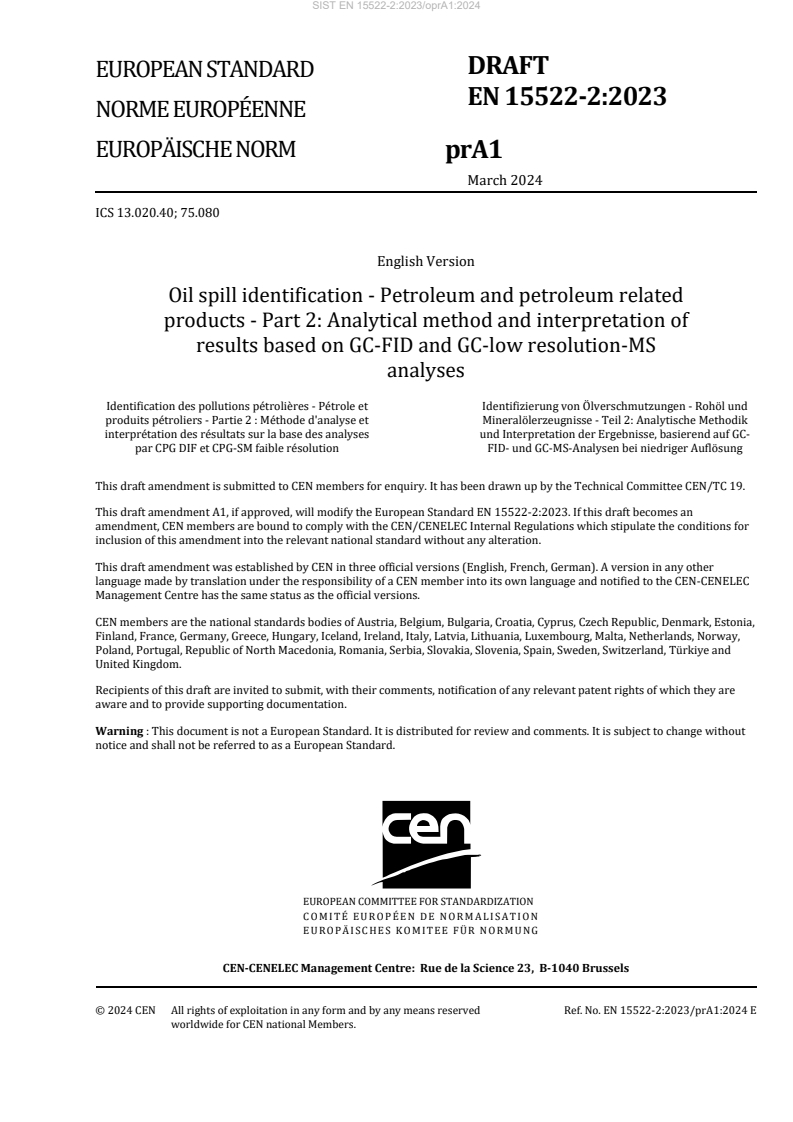
DRAFT
EUROPEAN STANDARD
EN 15522-2:2023
NORME EUROPÉENNE
EUROPÄISCHE NORM
prA1
March 2024
ICS 13.020.40; 75.080
English Version
Oil spill identification - Petroleum and petroleum related
products - Part 2: Analytical method and interpretation of
results based on GC-FID and GC-low resolution-MS
analyses
Identification des pollutions pétrolières - Pétrole et Identifizierung von Ölverschmutzungen - Rohöl und
produits pétroliers - Partie 2 : Méthode d'analyse et Mineralölerzeugnisse - Teil 2: Analytische Methodik
interprétation des résultats sur la base des analyses und Interpretation der Ergebnisse, basierend auf GC-
par CPG DIF et CPG-SM faible résolution FID- und GC-MS-Analysen bei niedriger Auflösung
This draft amendment is submitted to CEN members for enquiry. It has been drawn up by the Technical Committee CEN/TC 19.
This draft amendment A1, if approved, will modify the European Standard EN 15522-2:2023. If this draft becomes an
amendment, CEN members are bound to comply with the CEN/CENELEC Internal Regulations which stipulate the conditions for
inclusion of this amendment into the relevant national standard without any alteration.
This draft amendment was established by CEN in three official versions (English, French, German). A version in any other
language made by translation under the responsibility of a CEN member into its own language and notified to the CEN-CENELEC
Management Centre has the same status as the official versions.
CEN members are the national standards bodies of Austria, Belgium, Bulgaria, Croatia, Cyprus, Czech Republic, Denmark, Estonia,
Finland, France, Germany, Greece, Hungary, Iceland, Ireland, Italy, Latvia, Lithuania, Luxembourg, Malta, Netherlands, Norway,
Poland, Portugal, Republic of North Macedonia, Romania, Serbia, Slovakia, Slovenia, Spain, Sweden, Switzerland, Türkiye and
United Kingdom.
Recipients of this draft are invited to submit, with their comments, notification of any relevant patent rights of which they are
aware and to provide supporting documentation.
Warning : This document is not a European Standard. It is distributed for review and comments. It is subject to change without
notice and shall not be referred to as a European Standard.
EUROPEAN COMMITTEE FOR STANDARDIZATION
COMITÉ EUROPÉEN DE NORMALISATION
EUROPÄISCHES KOMITEE FÜR NORMUNG
CEN-CENELEC Management Centre: Rue de la Science 23, B-1040 Brussels
© 2024 CEN All rights of exploitation in any form and by any means reserved Ref. No. EN 15522-2:2023/prA1:2024 E
worldwide for CEN national Members.
SIST EN 15522-2:2023/oprA1:2024
EN 15522-2:2023/prA1:2024 (E)
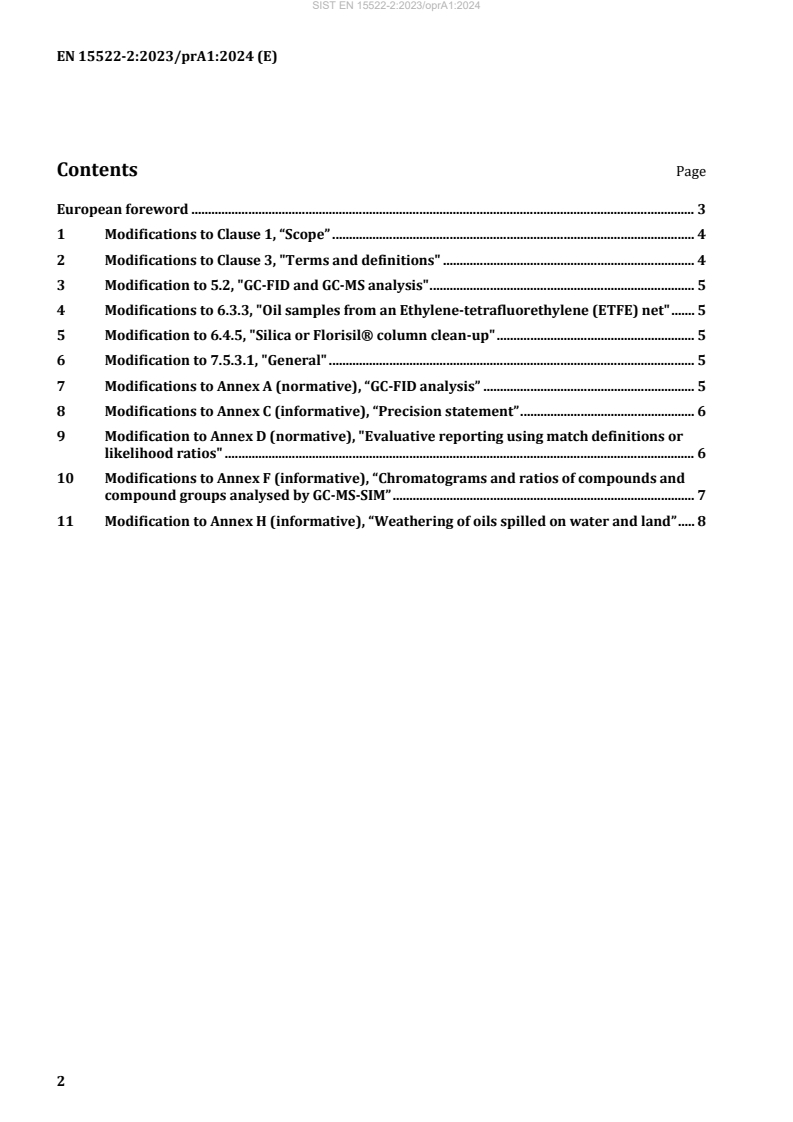
Contents Page
European foreword . 3
1 Modifications to Clause 1, “Scope” . 4
2 Modifications to Clause 3, "Terms and definitions" . 4
3 Modification to 5.2, "GC-FID and GC-MS analysis" . 5
4 Modifications to 6.3.3, "Oil samples from an Ethylene-tetrafluorethylene (ETFE) net" . 5
5 Modification to 6.4.5, "Silica or Florisil® column clean-up" . 5
6 Modification to 7.5.3.1, "General" . 5
7 Modifications to Annex A (normative), “GC-FID analysis” . 5
8 Modifications to Annex C (informative), “Precision statement” . 6
9 Modification to Annex D (normative), "Evaluative reporting using match definitions or
likelihood ratios" . 6
10 Modifications to Annex F (informative), “Chromatograms and ratios of compounds and
compound groups analysed by GC-MS-SIM” . 7
11 Modification to Annex H (informative), “Weathering of oils spilled on water and land” . 8
SIST EN 15522-2:2023/oprA1:2024
EN 15522-2:2023/prA1:2024 (E)
European foreword
This document (EN 15522-2:2023/prA1:2024) has been prepared by Technical Committee CEN/TC 19
“Gaseous and liquid fuels, lubricants and related products of petroleum, synthetic and biological origin”,
the secretariat of which is held by NEN.
This document is currently submitted to the CEN Enquiry.
SIST EN 15522-2:2023/oprA1:2024
EN 15522-2:2023/prA1:2024 (E)
1 Modifications to Clause 1, “Scope”
nd nd
In the 2 paragraph, 2 sentence, replace “, and mixtures of bilge and sludge samples” with “, sludge
samples, and mixtures of bilge” to read:
“‘Examples are: crude oils, higher boiling condensates, diesel oils, residual bunker or heavy fuel oils,
lubricants, sludge samples, and mixtures of bilge, as well as distillate fuels and blends”.
st
In the 1 sentence of the last paragraph, after “matrices”, add “(e.g. contaminated feathers, plants, rocks,
sand)” to read:
“When analysing “non-oil” matrices (e.g. contaminated feathers, plants, rocks, sand) additional sample
preparation (e.g. clean-up) is often required prior to analysis and the extent to which the matrix affects
the correlation achieved is to be considered”.
2 Modifications to Clause 3, "Terms and definitions"
Replace the current title of Clause 3 with: “Terms, definitions and abbreviations”.
Replace the current introductory paragraph with the following:
“For the purposes of this document, the terms and definitions given in ISO 1998-1:1198 and the following
terms, definitions and abbreviations apply.”
Under term 3.1.3 contamination, delete the phrases “(e.g. fat from feathers)” and “(e.g. compounds from
plastics)”
...