

SIST EN 1759-3:2004
(Main)Flanges and their joints - Circular flanges for pipes, valves, fittings and accessories, Class designated - Part 3: Copper alloy flanges
General Information
- Abstract
This European Standard specifies requirements for circular copper alloy flanges and copper alloy collars combined with loose steel plate flanges in Class designations Class 150 and Class 300 and nominal sizes from DN 10 to DN 900 (NPS ½ to NPS 36) in the types shown in Table 1.
This standard also specifies dimensions and tolerances, materials and their associated pressure/temperature (p/T) ratings, flange facings and related surface finish, weld repairs and marking together with information on bolting, gaskets, application and installation and approximate flange masses.
The flanges specified, with the exception of integral (type 21) flanges, are for attachment to copper or copper alloy tubes in accordance with EN 12449.
NOTE 1 The size of copper and copper alloy tubes is designated by reference to the outside diameter in millimetres.
NOTE 2 See also annex B.
NOTE 3 Non-gasketed pipe joints are outside the scope of this standard.
- Status
- Published
- Publication Date
- 31-May-2004
- Technical Committee
- TLP - Pressure vessels
- Current Stage
- 6060 - National Implementation/Publication (Adopted Project)
- Start Date
- 01-Jun-2004
- Due Date
- 01-Jun-2004
- Completion Date
- 01-Jun-2004
- Directive
- 2014/68/EU - Directive 2014/68/EU of the European Parliament and of the Council of 15 May 2014 on the harmonisation of the laws of the Member States relating to the making available on the market of pressure equipmentOJ Ref: C 293/01 OJ Date: 12-Aug-2016
97/23/EC - Pressure equipmentOJ Ref: C 118 OJ Date: 15-Apr-2011

Overview
EN 1759-3:2003 - Flanges and their joints, Part 3: Copper alloy flanges - is a CEN European Standard that sets requirements for circular copper alloy flanges and copper-alloy collars used with loose steel plate flanges in Class 150 and Class 300. It covers nominal sizes DN 10 to DN 900 (NPS ½ to NPS 36) and the flange types defined in the standard (e.g., plate flanges, weld-neck collars, slip-on collars, blank flanges and integral flanges). The standard specifies dimensions and tolerances, materials and associated pressure/temperature (p/T) ratings, flange facings and surface finish, weld repairs, marking, bolting, gaskets, application/installation guidance and approximate flange masses.
Key Topics
- Scope and applicability: Copper and copper-alloy flanges for pipes, valves, fittings and accessories; flanges (except integral type 21) intended for attachment to copper tubes per EN 12449. Non-gasketed joints are excluded.
- Classes and sizes: Defines Class 150 and Class 300 mating dimensions for DN/NPS sizes from DN 10 to DN 900 (NPS ½–36).
- Flange types: Types include plate flanges (type 01), loose steel plate with copper alloy collars (types 04/07/34/37), blank/clad flanges (05/05C), weld-neck and slip-on types (11, 12, 14), and integral flanges (21).
- Materials and identification: Permitted copper alloy materials and means of material identification; certificates per EN 10204 can be supplied.
- p/T ratings & surface finish: Material-specific pressure/temperature ratings and flange facing requirements (surface texture and finish).
- Bolting and gaskets: Guidance on bolt sizes/counts and material selection. Copper-alloy bolting (e.g., EN 12420 alloys CW306G/CW307G) is recommended for certain flange types up to 120 °C; steel bolting for others with references to EN 1515 and Annex C.
- Weld repairs & marking: Welding permitted with approved procedures and appropriate post-weld heat treatment where required; marking and traceability requirements detailed.
- Informative annexes: Annex A (manufacturer information), B (application/installation), C (metric vs imperial bolting), D (approximate masses), ZA (relation to PED).
Applications / Who uses this standard
- Flange and collar manufacturers producing copper-alloy components
- Plant designers, piping engineers and equipment manufacturers specifying flanged connections for copper piping systems
- Procurement/specification writers ensuring mating compatibility (DN/NPS, Class)
- Inspectors and installers following guidance on bolting, gaskets, welding and installation
Practical uses include corrosion-resistant copper-alloy piping in plumbing, heating, cooling, marine and industrial process systems where Class-designated flanges are required.
Related Standards
- EN 12449 (copper alloy tubes)
- EN 1515-1 / EN 1515-2 (bolting)
- EN 10204 (inspection certificates)
- ISO/ANSI references: compatibility notes with ISO 7005-3 and ANSI B16.24 (mating dimensions)
Keywords: EN 1759-3:2003, copper alloy flanges, Class 150, Class 300, DN 10–DN 900, NPS ½–36, p/T ratings, flange facings, bolting, gaskets, EN 12449.
Relations
- Effective Date
- 28-Jan-2026
- Effective Date
- 28-Jan-2026
- Refers
SIST EN 1652:2000 - Copper and copper alloys - Plate, sheet, strip and circles for general purposes - Effective Date
- 28-Jan-2026
- Effective Date
- 28-Jan-2026
- Effective Date
- 28-Jan-2026
- Effective Date
- 28-Jan-2026
- Effective Date
- 28-Jan-2026
- Effective Date
- 28-Jan-2026
- Effective Date
- 28-Jan-2026
- Effective Date
- 28-Jan-2026
- Effective Date
- 28-Jan-2026
- Effective Date
- 28-Jan-2026
- Effective Date
- 28-Jan-2026
- Effective Date
- 28-Jan-2026
- Effective Date
- 28-Jan-2026
Get Certified
Connect with accredited certification bodies for this standard

Institut za varilstvo d.o.o. (Welding Institute)
Slovenia's leading welding institute since 1952. ISO 3834, EN 1090, pressure equipment certification, NDT personnel, welder qualification. Only IIW Au
Sponsored listings
Frequently Asked Questions
SIST EN 1759-3:2004 is a standard published by the Slovenian Institute for Standardization (SIST). Its full title is "Flanges and their joints - Circular flanges for pipes, valves, fittings and accessories, Class designated - Part 3: Copper alloy flanges". This standard covers: This European Standard specifies requirements for circular copper alloy flanges and copper alloy collars combined with loose steel plate flanges in Class designations Class 150 and Class 300 and nominal sizes from DN 10 to DN 900 (NPS ½ to NPS 36) in the types shown in Table 1. This standard also specifies dimensions and tolerances, materials and their associated pressure/temperature (p/T) ratings, flange facings and related surface finish, weld repairs and marking together with information on bolting, gaskets, application and installation and approximate flange masses. The flanges specified, with the exception of integral (type 21) flanges, are for attachment to copper or copper alloy tubes in accordance with EN 12449. NOTE 1 The size of copper and copper alloy tubes is designated by reference to the outside diameter in millimetres. NOTE 2 See also annex B. NOTE 3 Non-gasketed pipe joints are outside the scope of this standard.
This European Standard specifies requirements for circular copper alloy flanges and copper alloy collars combined with loose steel plate flanges in Class designations Class 150 and Class 300 and nominal sizes from DN 10 to DN 900 (NPS ½ to NPS 36) in the types shown in Table 1. This standard also specifies dimensions and tolerances, materials and their associated pressure/temperature (p/T) ratings, flange facings and related surface finish, weld repairs and marking together with information on bolting, gaskets, application and installation and approximate flange masses. The flanges specified, with the exception of integral (type 21) flanges, are for attachment to copper or copper alloy tubes in accordance with EN 12449. NOTE 1 The size of copper and copper alloy tubes is designated by reference to the outside diameter in millimetres. NOTE 2 See also annex B. NOTE 3 Non-gasketed pipe joints are outside the scope of this standard.
SIST EN 1759-3:2004 is classified under the following ICS (International Classification for Standards) categories: 23.040.60 - Flanges, couplings and joints. The ICS classification helps identify the subject area and facilitates finding related standards.
SIST EN 1759-3:2004 has the following relationships with other standards: It is inter standard links to SIST EN 1982:2024, SIST EN 12420:2024, SIST EN 1652:2000, SIST EN ISO 6708:1998, SIST EN 10028-2:2017, SIST EN ISO 21920-2:2022, SIST EN 12449:2023, SIST EN 10222-2:2017+A1:2021, SIST EN ISO 887:2002, SIST EN 593:2009+A1:2014, SIST EN 12516-4:2008, SIST EN 736-3:2008, SIST EN 12261:2024, SIST EN 12288:2011, SIST EN 16678:2022. Understanding these relationships helps ensure you are using the most current and applicable version of the standard.
SIST EN 1759-3:2004 is associated with the following European legislation: EU Directives/Regulations: 2014/68/EU, 97/23/EC; Standardization Mandates: M/071. When a standard is cited in the Official Journal of the European Union, products manufactured in conformity with it benefit from a presumption of conformity with the essential requirements of the corresponding EU directive or regulation.
SIST EN 1759-3:2004 is available in PDF format for immediate download after purchase. The document can be added to your cart and obtained through the secure checkout process. Digital delivery ensures instant access to the complete standard document.
Standards Content (Sample)
SLOVENSKI STANDARD
01-junij-2004
Prirobnice in prirobnični spoji - Okrogle prirobnice za cevi, ventile, fitinge in pribor
z oznako Class - 3. del: Prirobnice iz bakrovih zlitin
Flanges and their joints - Circular flanges for pipes, valves, fittings and accessories,
Class designated - Part 3: Copper alloy flanges
Flansche und ihre Verbindungen - Runde Flansche für Rohre, Armaturen, Formstücke
und Zubehörteile, nach Class bezeichnet - Teil 3: Flansche aus Kupferlegierungen
Brides et leurs assemblages - Brides circulaires pour tubes, appareils de robinetterie,
raccords et accessoires, désignées Class - Partie 3: Brides en alliages de cuivre
Ta slovenski standard je istoveten z: EN 1759-3:2003
ICS:
23.040.60 Prirobnice, oglavki in spojni Flanges, couplings and joints
elementi
2003-01.Slovenski inštitut za standardizacijo. Razmnoževanje celote ali delov tega standarda ni dovoljeno.
EUROPEAN STANDARD
EN 1759-3
NORME EUROPÉENNE
EUROPÄISCHE NORM
September 2003
ICS 23.040.60
English version
Flanges and their joints - Circular flanges for pipes, valves,
fittings and accessories, Class designated - Part 3: Copper alloy
flanges
Brides et leurs assemblages - Brides circulaires pour tubes, Flansche und ihre Verbindungen - Runde Flansche für
appareils de robinetterie, raccords et accessoires, Rohre, Armaturen, Formstücke und Zubehörteile, nach
désignées Class - Partie 3: Brides en alliages de cuivre Class bezeichnet - Teil 3: Flansche aus Kupferlegierungen
This European Standard was approved by CEN on 27 June 2003.
CEN members are bound to comply with the CEN/CENELEC Internal Regulations which stipulate the conditions for giving this European
Standard the status of a national standard without any alteration. Up-to-date lists and bibliographical references concerning such national
standards may be obtained on application to the Management Centre or to any CEN member.
This European Standard exists in three official versions (English, French, German). A version in any other language made by translation
under the responsibility of a CEN member into its own language and notified to the Management Centre has the same status as the official
versions.
CEN members are the national standards bodies of Austria, Belgium, Czech Republic, Denmark, Finland, France, Germany, Greece,
Hungary, Iceland, Ireland, Italy, Luxembourg, Malta, Netherlands, Norway, Portugal, Slovakia, Spain, Sweden, Switzerland and United
Kingdom.
EUROPEAN COMMITTEE FOR STANDARDIZATION
COMITÉ EUROPÉEN DE NORMALISATION
EUROPÄISCHES KOMITEE FÜR NORMUNG
Management Centre: rue de Stassart, 36 B-1050 Brussels
© 2003 CEN All rights of exploitation in any form and by any means reserved Ref. No. EN 1759-3:2003 E
worldwide for CEN national Members.
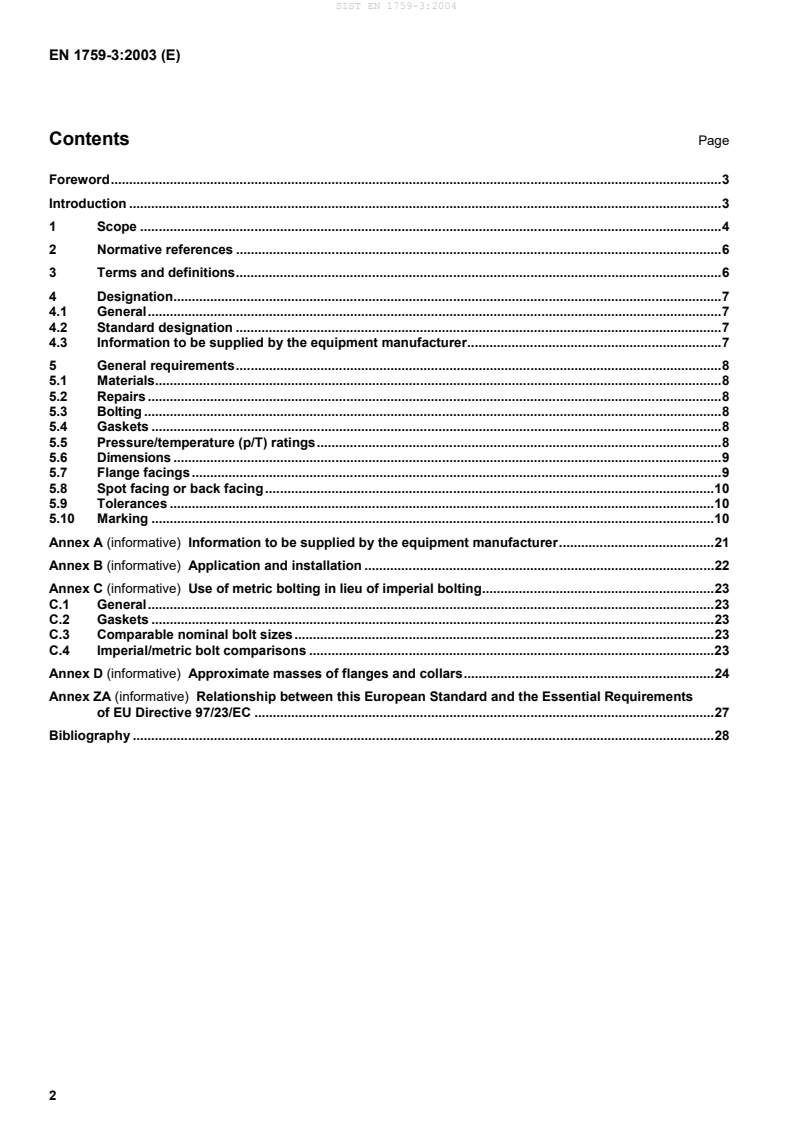
Contents Page
Foreword.3
Introduction .3
1 Scope .4
2 Normative references .6
3 Terms and definitions.6
4 Designation.7
4.1 General.7
4.2 Standard designation .7
4.3 Information to be supplied by the equipment manufacturer.7
5 General requirements.8
5.1 Materials.8
5.2 Repairs.8
5.3 Bolting .8
5.4 Gaskets .8
5.5 Pressure/temperature (p/T) ratings.8
5.6 Dimensions .9
5.7 Flange facings.9
5.8 Spot facing or back facing.10
5.9 Tolerances .10
5.10 Marking .10
Annex A (informative) Information to be supplied by the equipment manufacturer.21
Annex B (informative) Application and installation .22
Annex C (informative) Use of metric bolting in lieu of imperial bolting.23
C.1 General.23
C.2 Gaskets .23
C.3 Comparable nominal bolt sizes.23
C.4 Imperial/metric bolt comparisons .23
Annex D (informative) Approximate masses of flanges and collars.24
Annex ZA (informative) Relationship between this European Standard and the Essential Requirements
of EU Directive 97/23/EC .27
Bibliography .28
Foreword
This document (EN 1759-3:2003) has been prepared by Technical Committee CEN /TC 74, "Flanges and their
joints" the secretariat of which is held by DIN.
This European Standard shall be given the status of a national standard, either by publication of an identical text or
by endorsement, at the latest by March 2004, and conflicting national standards shall be withdrawn at the latest by
March 2004.
This document has been prepared under a mandate given to CEN by the European Commission and the European
1)
Free Trade Association, and supports essential requirements of the Pressure Equipment Directive (PED) . For
relationship with EU Directive(s), see informative annex ZA, which is an integral part of this standard.
EN 1759 consists of the following parts:
� Part 1: Steel flanges (draft stage);
� Part 3: Copper alloy flanges (draft stage);
� Part 4: Aluminium alloy flanges (draft stage).
The annexes A, B, C, D and ZA are informative.
According to the CEN/CENELEC Internal Regulations, the national standards organizations of the following
countries are bound to implement this European Standard: Austria, Belgium, Czech Republic, Denmark, Finland,
France, Germany, Greece, Hungary, Iceland, Ireland, Italy, Luxembourg, Malta, Netherlands, Norway, Portugal,
Slovakia, Spain, Sweden, Switzerland and the United Kingdom.
Introduction
This standard is related, but not identical, to IS0 7005-3 in respect of flanges having designations Class 150 and
Class 300. Outside diameters and mating dimensions are in accordance with ANSI B16.24.
Information on the use of metric bolting in lieu of imperial bolting which can be used with these flanges is given in
an informative annex.
The mating dimensions of the flanges of this standard are compatible with Class designated flanges of other
materials in accordance with the other parts of EN 1759.
1)
Directive 97/23 EC of the European Parliament and of the Council of 29 May 1997 on the approximation of the
Laws of the Member States concerning pressure equipment; OIEC L 181.
1 Scope
This European Standard specifies requirements for circular copper alloy flanges and copper alloy collars combined with
loose steel plate flanges in Class designations Class 150 and Class 300 and nominal sizes from DN 10 to DN 900
(NPS ½ to NPS 36) in the types shown in Table 1.
This standard also specifies dimensions and tolerances, materials and their associated pressure/temperature (p/T)
ratings, flange facings and related surface finish, weld repairs and marking together with information on bolting,
gaskets, application and installation and approximate flange masses.
The flanges specified, with the exception of integral (type 21) flanges, are for attachment to copper or copper alloy
tubes in accordance with EN 12449.
NOTE 1 The size of copper and copper alloy tubes is designated by reference to the outside diameter in millimetres.
NOTE 2 See also annex B.
NOTE 3 Non-gasketed pipe joints are outside the scope of this standard.
Table 1 — Types of flanges and collars
Type
Description
No.
01 Plate flange in copper alloy for brazing or welding
04 Loose plate flange in steel with a weld-neck collar (type 34) in copper alloy, for welding
05 Blank flange in copper alloy
05C Blank flange in steel clad with a copper alloy jointing face
Loose plate flange in steel with a slip-on collar (type 37) in copper alloy, for soft soldering,
brazing or welding
11 Weld-neck flange in copper alloy for welding
12 Hubbed slip-on flange in copper alloy, for soft soldering, brazing or welding
Hubbed slip-on flange in copper alloy supplied with tube stops, for soft soldering, brazing or
welding
21 Integral flange in copper alloy as part of some other equipment or component
34 Weld-neck collar in copper alloy
37 Slip-on collar in copper alloy
Type 01 Type 04, 34 Type 05, 05C
Plate flange in copper alloy Loose plate flange in steel with a 05 Blank flange in copper alloy
for brazing or welding weld-neck collar(type 34) in copper 05C Blank flange in steel clad with a
alloy, for welding copper alloy jointing face
Type 07, 37 Type 11 Type 12
Loose plate flange in steel with a Weld-neck flange in copper alloy for Hubbed slip- on flange in copper
slip-on collar (type 37) in copper welding alloy, for soft soldering, brazing or
alloy, for soft soldering, brazing or welding
welding
Steel component
Type 14 Type 21 Copper alloy component
Hubbed slip-on flange in copper Integral flange in copper alloy as
alloy supplied with tube stops, for part of some other equipment or
soft soldering, brazing or welding component
Figure 1 — Types of flanges and collars
2 Normative references
This European Standard incorporates by dated or undated references, provisions from other publications. These
normative references are cited at the appropriate places in the text and the publications are listed hereafter. For dated
references, subsequent amendments to or revisions of any of these publications apply to this European Standard only
when incorporated in it by amendment or revision. For undated references the latest edition of the publication referred
to applies (including amendments).
EN 1652, Copper and copper alloys — Plate, sheet, strip and circles for general purposes.
EN 1982, Copper and copper alloys — Ingots and castings.
EN 10028-2, Flat products made of steels for pressure purposes — Part 2: Non-alloy and alloy steels with specified
elevated temperature properties.
EN 10222-2, Steel forgings for pressure purposes — Part 2: Ferritic and martensitic steels with specified elevated
temperature properties.
EN 12420, Copper and copper alloys — Forgings.
EN 12449, Copper and copper alloys — Seamless round tubes for general purposes.
EN ISO 887, Plain washers for metric bolts, screws and nuts for general purposes — General plan (ISO 887:2000).
EN ISO 4287, Geometrical Product Specification (GPS) — Surface texture: Profile method — Terms, definitions
and surface texture parameters (ISO 4287:1997).
EN ISO 6708:1995, Pipework components — Definition and selection of DN (nominal size) (ISO 6708:1995).
3 Terms and definitions
For the purposes of this standard the following terms and definitions apply.
3.1
Class
alphanumeric designation used for reference purposes related to a combination of mechanical and
dimensional characteristics of a component of a pipework system. It comprises the word Class followed by a
dimensionless whole number
NOTE 1 The number following the word Class does not represent a measurable value and should not be used for calculation
purposes except where specified in the relevant standard.
NOTE 2 The designation Class is not meaningful unless it is related to the relevant component standard number.
NOTE 3 It is intended that all components with the same Class and NPS (see below) designations have the same mating
dimensions for compatible flange types.
3.2
DN
see EN ISO 6708:1995
3.3
NPS
alphanumeric designation of size for components of a pipework system, which is used for reference purposes. It
comprises, for the purpose of Class designated flanges according to this standard, the letters NPS followed by a
dimensionless number which is indirectly related to the physical size of the bore or outside diameter of the end
connections
NOTE The number following the letters NPS does not represent a measurable value and should not be used for calculation
purposes except where specified in the relevant standard. See EN ISO 6708.
4 Designation
4.1 General
The types of flanges and their reference numbers are given in Table 1 and the range of DN applicable to each flange
type and to each Class shall be as given in Table 3.
NOTE 1 Flanges, which are identified and/or marked by NPS additionally or alternatively to DN, are deemed to comply with
this standard.
NOTE 2 The relationship between DN and NPS is given for reference purposes in Tables 3, 4, 5 and 6.
4.2 Standard designation
Flanges and collars in accordance with this standard shall be designated by the following:
a) Designation, e.g. flange or collar;
b) Number of this standard, EN 1759-3;
c) Number of flange type in accordance with Figure 1;
d) Class designation, Class . (the word Class may be omitted);
e) Nominal size, DN . (and/or NPS .);
f) Material number or symbol (see Tables 7 and 8) (for type 05C flanges it is necessary to specify both the
material of the flange and the material of the cladding).
EXAMPLE 1 Designation of a plate flange type 01 in Class 150 and DN 600 (NPS 24) and in material symbol CuAl8Fe3:
Flange EN 1759-3/01/Class 150/DN 600/CW303G
or
Flange EN 1759-3/01/150/NPS 24/CW303G
EXAMPLE 2 Designation of a loose flange type 07 in Class 150 and DN 50 (NPS 2) and in material symbol S235JR:
Flange EN 1759-3/07/Class 150/DN 50/S235JR
or
Flange EN 1759-3/07/150/NPS 6/S235JR
EXAMPLE 3 Designation of a slip-on collar type 37 in Class 150 and DN 50 (NPS 2) and in material symbol CuZn20Al2As:
Collar EN 1759-3/37/Class 150/DN 50/CW702R
or
Collar EN 1759-3/37/150/NPS 2/CW702R
EXAMPLE 4 Designation of a blank flange type 05C with clad jointing face, in Class 300 and DN 150 (NPS 6) and in
materials symbols, S235JR (for blank flange) and CuNi30Mn1Fe (for cladding):
Flange EN 1759-3/05C/Class 300/DN 150/S235JR-CW354H
or
Flange EN 1759-3/05C/300/NPS 6/S235JR-CW354H
4.3 Information to be supplied by the equipment manufacturer
For information to be supplied by the equipment manufacturer see annex A.
5 General requirements
5.1 Materials
Flanges and collars shall be manufactured from the materials specified in Tables 7 and 8 except for type 21 flanges
where the flange manufacturer may use other materials by agreement with the equipment manufacturer.
The flange manufacturer shall provide means of identifying the material of the flange. An equipment manufacturer
may require a certificate in accordance with EN 10204 which is suitable for the category of the equipment to which
the flange is fitted.
NOTE If a protective coating such as zinc coating or painting is required on steel components, the equipment manufacturer
should state this on the enquiry and/or order.
5.2 Repairs
5.2.1 Repairs by welding are permitted when there is a proven method and where not otherwise prohibited by
the applicable material standard. All welding shall be carried out in accordance with a written procedure.
NOTE For approval of welding procedures, see EN 288-1. For approval of welders, see EN 287-1.
5.2.2 Any filler rod used for weld repairs shall be such as to produce a weld having characteristics at least equal
to the parent metal. Flanges shall be heat treated after repair welding when the material standard requires such
treatment.
5.3 Bolting
Flanges shall be suitable for use with the nominal size and number of bolts specified in Tables 4 and 5 as appropriate.
The bolting material shall be chosen by the equipment manufacturer according to the pressure, temperature, flange
material and the selected gasket so that the flanged joint remains tight under the expected operating conditions.
NOTE 1 For information on bolting, see EN 1515-1 and EN 1515-2 and annexes B and C.
NOTE 2 For flange types 01, 05, 11, 12, 14 and 21, where copper alloy bolting is used, the recommended bolting materials
are EN 12420 Alloy Nos. CW306G or CW307G for temperatures up to and including 120°C.
For flange types 04, 05C and 07, steel bolting should be used and reference should be made to EN 1515-1, EN 1515-2
and annex C.
5.4 Gaskets
The various gasket types, dimensions, design characteristics and material used are not within the scope of this
standard. Dimensions of gaskets are given in the relevant parts of prEN 12560.
5.5 Pressure/temperature (p/T) ratings
5.5.1 General
The p/T ratings of the flanges manufactured from the materials specified in Tables 7 and 8 are given in Tables 9, 10
and 11.
The p/T ratings indicate the relationship between the maximum allowable pressure, PS and the maximum allowable
temperature, TS.
Linear interpolation is permitted for intermediate temperatures.
NOTE 1 See EN 764 for terminology.
NOTE 2 When type 21 flanges are supplied as part of another component (for example, a valve or pump) in a material other
than those listed in Table 7, reference should be made to the relevant product or application standard for the appropriate p/T
ratings.
NOTE 3 The p/T rating of a flange is not necessarily the p/T rating of the whole pipework system. Gasket materials can also
impose a limitation of the p/T rating of a flanged joint and the gasket manufacturer should be consulted when selecting the
material of the gasket.
5.5.2 p/T ratings of flanged joints
When two flanges in a flanged joint do not have the same p/T rating at any temperature, then the lower of the two
flange p/T ratings at that temperature shall apply.
NOTE 1 For any p/T rating, the temperature shown is considered to be the same as that of the contained fluid. Use at a
pressure corresponding to a temperature other than that of the contained fluid is the responsibility of the user.
NOTE 2 Application of the p/T ratings given in this standard to flange joints should take into consideration the risks of
leakage due to forces and moments developed in the connecting pipework, see annex B.
NOTE 3 These notes on service considerations are not intended to be exhaustive.
5.6 Dimensions
5.6.1 Flanges
Dimensions of flanges shall be in accordance with the following tables and figures as appropriate:
� Class 150 flanges: Table 4 and Figure 2;
� Class 300 flanges: Table 5 and Figure 3.
NOTE 1 The bore sizes of type 21 flanges are usually equal to the nominal size of the pipe, valve or fitting of which they form a
part and the actual bore sizes are usually given in the appropriate standard(s) for the pipe, valve or fitting.
NOTE 2 When type 07, 12 and 14 flanges are for use with soft soldering techniques only, then reference should be made to
EN 1254-1 for socket depths.
NOTE 3 For type 34 collars and type 11 flanges the recommended weld preparation angle is 37,5 ± 2,5° when butt welding to
pipe with thickness of 3 mm and greater.
5.6.2 Bolt holes
Bolt holes shall be equally spaced on the pitch circle diameter. In the case of type 21 flanges, the bolt holes shall be
positioned such that they are symmetrical to the principle axes and such that no holes fall on these axes, i.e. positioned
"off-centre", see Figures 2 and 3.
5.7 Flange facings
5.7.1 Types of facings
Types 01, 05, 11, 12, 14 and 21 flanges in copper alloy shall be provided with flat face.
NOTE 1 Flanges with flat face facings are suitable for bolting to flat face mating flanges using a full face gasket.
Types 04, 05C and 07 flanges have a raised face formed by the face of the collar or the cladding, for bolting to raised
face mating flanges using an inside bolt circle gasket.
NOTE 2 The bolting of these flanges to a flat face iron or steel mating flange using full face or inside bolt circle gaskets is not
precluded.
5.7.2 Jointing face finish
All flange jointing faces shall be machine finished and when compared by visual or tactile means with reference
specimens, shall be in accordance with Table 2.
NOTE 1 It is not intended that instrument measurements are taken on the flange faces, and the R and R values as defined
a
z
in EN ISO 4287 relate to the reference specimens.
NOTE 2 Other finishes may be agreed between the flange manufacturer and equipment manufacturer.
Table 2 — Surface finish of jointing faces
a a
R R
a z
Method of machining
�m �m
min. max. min. max.
b
Turning 3,2 12,5 12,5 50
a
R and R are defined in EN ISO 4287
a
z
b
Turning covers any method of machining operation producing either serrated concentric or serrated spiral
grooves.
Machining processes other than turning are permissible provided that they give a surface finish in
accordance with the R and R values specified.
a z
5.7.3 Rims
Rims of flanges and collars may be machined or un-machined.
5.7.4 Collars and loose flanges
Collars and loose flanges shall be machine finished, or have a surface equivalent to that obtained by machining on all
locating diameters, bores and abutment faces. The abutment faces shall be flat and square to the bore axis.
5.8 Spot facing or back facing
Any spot facing or back facing required shall not reduce the flange thickness to less than the minimum specified.
When spot facing is used, the diameter shall be large enough to accommodate the outside diameter of the equivalent
normal series of washers complying with EN ISO 887 for the bolt size being fitted.
When a flange is back faced, it is permissible for the fillet radius to be reduced but it shall not be eliminated entirely.
The bearing surfaces for the bolting shall be parallel to the flange jointing face within the limits given in Table 6.
5.9 Tolerances
Tolerances on dimensions shall be as specified in Table 6.
5.10 Marking
5.10.1 Other than type 21 flanges
All flanges and collars shall be marked as follows:
a) Number of this standard , i.e. EN 1759-3;
b) Flange type number, e.g. 05;
c) Class designation, e.g. Class 150 or 150;
d) DN and/or NPS, e.g. DN 100 and/or NPS 4;
e) Material designation. The alloy designation number given in Tables 7 and 8 shall be used, as appropriate;
f) Flange manufacturer's name or trademark.
EXAMPLE 1 Copper alloy flanges:
EN 1759-3 — 12 — 150 — DN 300 (and/or NPS 12) — CW352H — XYZ.
EXAMPLE 2 Copper alloy collars:
EN 1759-3 — 37 — 300 — DN 50 (and/or NPS 2) — CC491K — XYZ.
EXAMPLE 3 Steel components:
EN 1759-3 — 07 — 300 — DN 50 (and/or NPS 2) — A105 — XYZ.
5.10.2 Method of marking
Copper alloy flanges shall be clearly and permanently marked by a method other than stamping with steel stamps.
NOTE 1 The flange manufacturer's name or trademark together with other relevant marking may be produced during casting
or forging for both copper alloy and steel components.
NOTE 2 Steel flanges may be marked round the rim of the flange with round nosed steel stamps.
5.10.3 Omission of markings
If a flange is too small to enable all the markings required in 5.10.1 to be marked on the flange, then some of the
markings are permitted to be omitted. The order in which the markings are omitted shall be as follows:
a) Flange type number;
b) DN (and/or NPS).
5.10.4 Declaration of compliance
The marking EN 1759-3, together with the flange manufacturer's name or trademark on or in relation to a product,
represents a manufacturer's declaration of compliance, i.e. a claim by or on behalf of the manufacturer that the product
meets the requirements of this standard.
Table 3 — Synoptic table for flange
Nominal size
Type Table
Class
(½) (¾) (1) (1¼) (1½) (2) (2½) (3) (4) (5) (6) (8) (10) (12) (14) (16) (18) (20) (24) (28) (32) (36)
number number
10 20 25 32 40 50 65 80 100 125 150 200 250 300 350 400 450 500 600 700 800 900
11 4 150 � ���������� �� ———————— —
4150 � ���������� �����������
04, 34
5300 � ���������� �������� —— —
4150 � ���������� �����������
05, 05C
5300 � ���������� �������� —— —
4150 � ������ ———— —————————— —
07, 37
5300 � ������ ———— —————————— —
4150 � ���������� �����������
5300 � ���������� �������� —— —
4150 � ���������� �����������
5300 � ���������� �������� —— —
4150 � ���������� �����������
5300 � ���������� �������� —— —
4150 � ���������� ��� ——————— —
5300 � ���������� � ————————— —
NOTE The nominal sizes in which a flange of a particular type and Class may be ordered to this standard, are denoted by a dot.
EN 1759-3:20
...