

SIST EN 330:2015
(Main)Wood preservatives - Determination of the relative protective effectiveness of a wood preservative for use under a coating and exposed out-of-ground contact - Field test: L-joint method
General Information
- Abstract
This European Standard specifies a method for determining the relative protective effectiveness against fungal decay of a wood preservative applied to wood in combination with a subsequent surface coating, exposed to the weather and out of contact with the ground. The effectiveness is evaluated relative to a reference wood preservative.
The method is applicable to the testing of commercial or experimental preservatives applied to non-durable timbers by methods appropriate to commercial practice and subsequently coated with a specified coating system. The method is applicable to products and processes used individually or in combination to prevent the development of decay in the wood.
The method is also appropriate for factory finishing systems which include wood protection and wood preservation claims.
- Status
- Published
- Public Enquiry End Date
- 29-Apr-2012
- Publication Date
- 03-Dec-2014
- Technical Committee
- LLZ - Les, lesni izdelki in zaščita lesa
- Current Stage
- 6060 - National Implementation/Publication (Adopted Project)
- Start Date
- 18-Nov-2014
- Due Date
- 23-Jan-2015
- Completion Date
- 04-Dec-2014
- Directive
- 89/106/EEC - Construction products

Overview
EN 330:2014 (CEN) specifies a standardized field test (L‑joint method) to determine the relative protective effectiveness of a wood preservative when applied beneath a surface coating and exposed outdoors out-of-ground contact (Use Class 3). The method evaluates test preservatives relative to a reference preservative using jointed test assemblies (L‑joints) that are treated, coated and exposed to natural weathering and microbial succession (moulds, blue stain, soft rot and basidiomycetes). Results are compared with reference-treated and untreated control specimens to assess performance.
Key topics and requirements
- Test principle: Treated L‑joint assemblies are coated, exposed outdoors and inspected periodically (visual non‑destructive and destructive sawn section inspections) to detect internal and surface decay. Comparison is made against a reference preservative and untreated controls.
- Reference preservative: Specified composition includes hexabutyldistannoxane (with minimum active fraction noted), hydrocarbon resin and solvent (document gives exact mass‑fraction guidance). Alternatives require evidence of equivalent performance.
- Reference coating: Solvent‑borne alkyd (opaque high gloss/gloss/semi‑gloss) applied to a dry film build of 50 ± 5 µm (2–3 coats) or water‑borne acrylic with 110–120 µm (1–2 coats) measured per ISO 2808 method 4A. Supplier‑specified coating systems may be used when integral to the protection system.
- Wood specimens: Primarily sapwood of Pinus sylvestris (Scots pine) is required; quality limits are specified (e.g., 2.5–8 growth rings per 10 mm; latewood ≤ 30% for Scots pine). Heartwood restrictions apply in joint areas.
- Materials & preparation: End‑seal compounds, treatment processes, conditioning, labeling, weathering racks and exposure site details are specified to ensure reproducible exposure.
- Duration & evaluation: Inspections at least annually; a minimum 5‑year exposure is indicated for many replicates, with recommendation to continue replicates until failure for fuller assessment. Test validity requires inclusion of reference and control L‑joints.
Applications and who uses it
- Wood preservative manufacturers for product development and comparative performance data.
- Coating and factory finishing suppliers when making combined protection/preservation claims.
- Independent test laboratories and certification bodies conducting durability testing to support compliance and marketing claims.
- Specifiers, architects and timber product manufacturers evaluating long‑term performance for exterior joinery and cladding.
- Regulatory and procurement teams requiring standardized comparative data for tendering or registration.
Related standards
- EN 335 (Use classes: definitions) - links performance to intended service class (Use Class 3).
- EN 1001‑2 (Durability terminology) - referenced for terms and definitions.
- Published by CEN; full procedural details, reporting requirements and safety advice are included within EN 330:2014.
Relations
- Effective Date
- 01-Jan-2015
- Refers
SIST EN 1001-2:2006 - Durability of wood and wood based products - Terminology - Part 2: Vocabulary - Effective Date
- 28-Jan-2026
- Effective Date
- 28-Jan-2026
- Effective Date
- 28-Jan-2026
- Effective Date
- 28-Jan-2026
Get Certified
Connect with accredited certification bodies for this standard

ECOCERT
Organic and sustainability certification.

Eurofins Food Testing Global
Global leader in food, environment, and pharmaceutical product testing.

Intertek Bangladesh
Intertek certification and testing services in Bangladesh.
Sponsored listings
Frequently Asked Questions
SIST EN 330:2015 is a standard published by the Slovenian Institute for Standardization (SIST). Its full title is "Wood preservatives - Determination of the relative protective effectiveness of a wood preservative for use under a coating and exposed out-of-ground contact - Field test: L-joint method". This standard covers: This European Standard specifies a method for determining the relative protective effectiveness against fungal decay of a wood preservative applied to wood in combination with a subsequent surface coating, exposed to the weather and out of contact with the ground. The effectiveness is evaluated relative to a reference wood preservative. The method is applicable to the testing of commercial or experimental preservatives applied to non-durable timbers by methods appropriate to commercial practice and subsequently coated with a specified coating system. The method is applicable to products and processes used individually or in combination to prevent the development of decay in the wood. The method is also appropriate for factory finishing systems which include wood protection and wood preservation claims.
This European Standard specifies a method for determining the relative protective effectiveness against fungal decay of a wood preservative applied to wood in combination with a subsequent surface coating, exposed to the weather and out of contact with the ground. The effectiveness is evaluated relative to a reference wood preservative. The method is applicable to the testing of commercial or experimental preservatives applied to non-durable timbers by methods appropriate to commercial practice and subsequently coated with a specified coating system. The method is applicable to products and processes used individually or in combination to prevent the development of decay in the wood. The method is also appropriate for factory finishing systems which include wood protection and wood preservation claims.
SIST EN 330:2015 is classified under the following ICS (International Classification for Standards) categories: 71.100.50 - Wood-protecting chemicals. The ICS classification helps identify the subject area and facilitates finding related standards.
SIST EN 330:2015 has the following relationships with other standards: It is inter standard links to SIST EN 330:2004, SIST EN 1001-2:2006, SIST EN 335:2013, SIST EN 599-1:2009+A1:2014, SIST EN 599-1:2009. Understanding these relationships helps ensure you are using the most current and applicable version of the standard.
SIST EN 330:2015 is associated with the following European legislation: EU Directives/Regulations: 89/106/EEC. When a standard is cited in the Official Journal of the European Union, products manufactured in conformity with it benefit from a presumption of conformity with the essential requirements of the corresponding EU directive or regulation.
SIST EN 330:2015 is available in PDF format for immediate download after purchase. The document can be added to your cart and obtained through the secure checkout process. Digital delivery ensures instant access to the complete standard document.
Standards Content (Sample)
2003-01.Slovenski inštitut za standardizacijo. Razmnoževanje celote ali delov tega standarda ni dovoljeno.Holzschutzmittel - Bestimmung der relativen Wirksamkeit eines Holzschutzmittels zur Anwendung unter einem Anstrich und ohne Erdkontakt - Freilandprüfung: L-VerbindungsmethodeProduits de préservation du bois - Détermination de l’efficacité protectrice d’un produit de préservation du bois pour employ un revetment et hors de contact avec le sol - Essais de champ: méthode avec un esemblage en LWood preservatives - Determination of the relative protective effectiveness of a wood preservative for use under a coating and exposed out-of-ground contact - Field test: L-joint method71.100.50Wood-protecting chemicalsICS:Ta slovenski standard je istoveten z:EN 330:2014SIST EN 330:2015en,fr,de01-januar-2015SIST EN 330:2015SLOVENSKI
STANDARDSIST EN 330:20041DGRPHãþD
EUROPEAN STANDARD NORME EUROPÉENNE EUROPÄISCHE NORM
EN 330
November 2014 ICS 71.100.50 Supersedes EN 330:1993English Version
Wood preservatives - Determination of the relative protective effectiveness of a wood preservative for use under a coating and exposed out-of-ground contact - Field test: L-joint method
Produits de préservation du bois - Détermination de l'efficacité protectrice d'un produit de préservation du bois pour emploi sous un revêtement et hors de contact avec le sol - Essai de champ: méthode avec un assemblage en L
Holzschutzmittel - Bestimmung der relativen Wirksamkeit eines Holzschutzmittels zur Anwendung unter einem Anstrich und ohne Erdkontakt - Freilandprüfung: L-Verbindungsmethode This European Standard was approved by CEN on 30 August 2014.
CEN members are bound to comply with the CEN/CENELEC Internal Regulations which stipulate the conditions for giving this European Standard the status of a national standard without any alteration. Up-to-date lists and bibliographical references concerning such national standards may be obtained on application to the CEN-CENELEC Management Centre or to any CEN member.
This European Standard exists in three official versions (English, French, German). A version in any other language made by translation under the responsibility of a CEN member into its own language and notified to the CEN-CENELEC Management Centre has the same status as the official versions.
CEN members are the national standards bodies of Austria, Belgium, Bulgaria, Croatia, Cyprus, Czech Republic, Denmark, Estonia, Finland, Former Yugoslav Republic of Macedonia, France, Germany, Greece, Hungary, Iceland, Ireland, Italy, Latvia, Lithuania, Luxembourg, Malta, Netherlands, Norway, Poland, Portugal, Romania, Slovakia, Slovenia, Spain, Sweden, Switzerland, Turkey and United Kingdom.
EUROPEAN COMMITTEE FOR STANDARDIZATION
COMITÉ EUROPÉEN DE NORMALISATION EUROPÄISCHES KOMITEE FÜR NORMUNG
CEN-CENELEC Management Centre:
Avenue Marnix 17,
B-1000 Brussels © 2014 CEN All rights of exploitation in any form and by any means reserved worldwide for CEN national Members. Ref. No. EN 330:2014 ESIST EN 330:2015
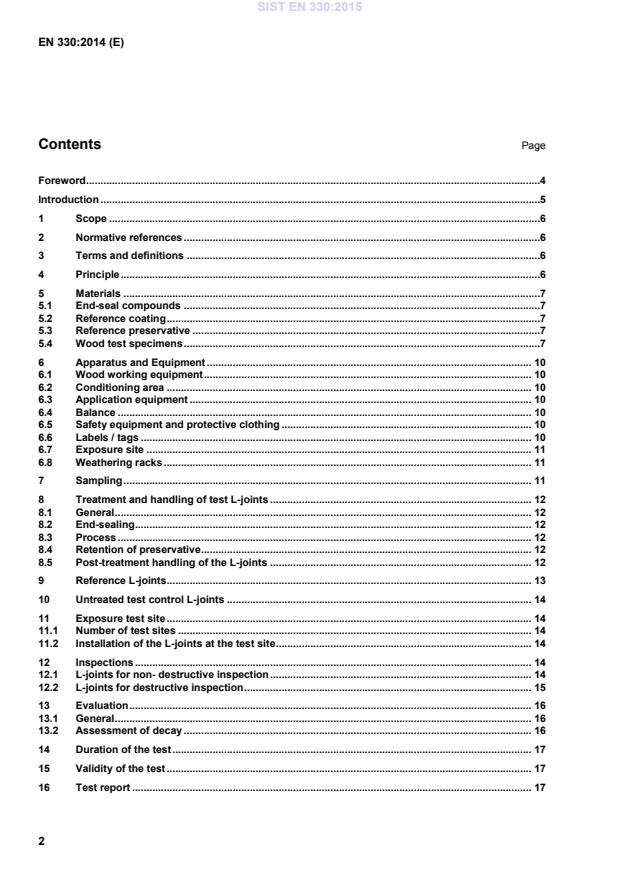
Flow chart for the preparation and exposure of L-joints for test . 19 Annex B (informative)
Information on treatment processes, reference and alternative preservatives and materials . 20 Annex C (informative)
Example of a Test Report. 22 Annex D (informative)
Environmental, health and safety precautions within chemical / biological laboratory . 24 Bibliography . 25
minimum mass fraction of 1 % (mass fraction 95 % active ingredient); — Aliphatic neutral hydrocarbon resin mass fraction of 5 %; — Hydrocarbon solvent mass fraction of 94 %, (distillation range 160 °C to 215 °C; aromatic content mass fraction < 17 %). If an alternative wood preservative product is used the concentration of the product used should provide a performance equivalent to the specified concentration of the reference wood preservatives referred to in this standard. Evidence of equivalence shall be recorded in the test report. NOTE See informative Annex B on alternative reference preservatives. 5.4 Wood test specimens 5.4.1 Wood species Sapwood of Pinus sylvestris (Scots Pine, redwood) shall be used. Some heartwood is permitted in the mortise member but none in the joint area (5.4.3). SIST EN 330:2015
Key 1 heartwood permitted 2 label position 3 mortise member 4 tenon member (note rounding of the longitudinal edges) Tolerances in the joint: a)
c) 13 ± 1 d) f)
b) 12 ± 1 e) The two members shall provide a firm but not tight push-fit. Figure 1 — The L-joint SIST EN 330:2015
...