


SIST EN 16931-1:2017+A1:2020/AC:2020
(Corrigendum)Electronic invoicing - Part 1: Semantic data model of the core elements of an electronic invoice
Electronic invoicing - Part 1: Semantic data model of the core elements of an electronic invoice
This European Standard establishes a semantic data model of the core elements of an electronic invoice. The semantic model includes only the essential information elements that an electronic invoice needs to ensure legal (including fiscal) compliance and to enable interoperability for cross-border, cross sector and for domestic trade. The semantic model may be used by organizations in the private and the public sector for public procurement invoicing. It may also be used for invoicing between private sector enterprises. It has not been specifically designed for invoicing consumers.
This European Standard complies at least with the following criteria:
- it is technologically neutral;
- it is compatible with relevant international standards on electronic invoicing;
- the application of this standard should comply with the requirements for the protection of personal data of Directive 95/46/EC, having due regard to the principles of privacy and data protection by-design, data minimization, purpose limitation, necessity and proportionality;
- it is consistent with the relevant provisions of Directive 2006/112/EC [2];
- it allows for the establishment of practical, user-friendly, flexible and cost-efficient electronic invoicing systems;
- it takes into account the special needs of small and medium-sized enterprises as well as of sub-central contracting authorities and contracting entities;
- it is suitable for use in commercial transactions between enterprises.
Elektronische Rechnungsstellung - Teil 1: Semantisches Datenmodell der Kernelemente einer elektronischen Rechnung
Diese Europäische Norm führt ein semantisches Datenmodell der Kernelemente einer elektronischen Rechnung ein. Das semantische Modell umfasst nur die wesentlichen Informationselemente, die eine elektronische Rechnung enthalten muss, um die rechtliche (einschließlich steuerrechtliche) Richtigkeit sicherzustellen und die Interoperabilität für den grenzüberschreitenden Handel, den branchenüber-greifenden Handel und den Binnenhandel zu ermöglichen. Das semantische Modell darf von Organisationen des privaten und öffentlichen Sektors bei der Rechnungsstellung für öffentliche Aufträge angewendet werden. Es darf auch bei der Rechnungsstellung zwischen Unternehmen des Privatsektors angewendet werden. Es ist nicht speziell für die Rechnungsstellung an Konsumenten ausgelegt.
Diese Europäische Norm erfüllt mindestens die folgenden Kriterien:
— sie ist technologieneutral;
— sie ist mit den einschlägigen internationalen Normen für die elektronische Rechnungsstellung vereinbar;
— die Anwendung dieser Norm sollte die Anforderungen an den Schutz von personenbezogenen Daten nach Richtlinie 95/46/EG erfüllen, unter Berücksichtigung der Grundsätze für Privatsphäre und Daten¬schutz durch Technik („data protection by design“), Zweckbegrenzung, Notwendigkeit und Verhältnis¬mäßigkeit;
— sie steht mit den einschlägigen Bestimmungen der Richtlinie 2006/112/EG [2] in Einklang;
— sie ermöglicht die Einrichtung zweckmäßiger, benutzerfreundlicher, flexibler und kosteneffizienter Systeme zur elektronischen Rechnungs¬stellung;
— sie berücksichtigt die speziellen Bedürfnisse von kleinen und mittleren Unternehmen sowie von subzentralen öffentlichen Auftraggebern und anderen Auftraggebern;
— sie eignet sich für die Verwendung bei kaufmännischen Transaktionen zwischen Unternehmen.
Facturation électronique - Partie 1 : Modèle sémantique de données des éléments essentiels d'une facture électronique
La présente Norme européenne définit un modèle sémantique de données pour les éléments essentiels d'une facture électronique. Ce modèle sémantique comporte uniquement les éléments d'information essentiels qu'une facture électronique doit contenir pour assurer le respect de la législation (y compris fiscale) et permettre l'interopérabilité du commerce transfrontalier, intersectoriel et national. Le modèle sémantique peut être utilisé par des organisations des secteurs public et privé pour la facturation des marchés publics. Il peut également être utilisé pour la facturation entre entreprises du secteur privé. Il n'a pas été spécifiquement conçu pour la facturation des consommateurs.
La présente Norme européenne remplit au moins les critères suivants :
— elle est technologiquement neutre ;
— elle est compatible avec les normes internationales applicables en matière de facturation électronique ;
— il convient que l'application de la présente norme soit conforme aux exigences de protection des données personnelles de la Directive 95/46/CE, dans le respect des principes de confidentialité et de protection des données dès la conception, par la minimisation des données, la limitation de l'objet du traitement, le caractère nécessaire et proportionné du traitement des données ;
— elle est compatible avec les dispositions pertinentes de la Directive 2006/112/CE [2] ;
— elle permet l'établissement de systèmes de facturation électronique pratiques, conviviaux, flexibles et efficaces en termes de coûts ;
— elle tient compte des besoins particuliers des petites et moyennes entreprises ainsi que des pouvoirs adjudicateurs sous-centraux et des entités contractantes ;
— elle peut être appliquée dans le cadre de transactions commerciales entre entreprises.
Elektronsko izdajanje računov - 1. del: Semantični podatkovni model osrednjih elementov za elektronski račun
General Information
- Status
- Withdrawn
- Publication Date
- 31-Aug-2020
- Withdrawal Date
- 11-May-2026
- Technical Committee
- ITC - Information technology
- Current Stage
- 9900 - Withdrawal (Adopted Project)
- Start Date
- 03-Apr-2026
- Due Date
- 26-Apr-2026
- Completion Date
- 12-May-2026
Relations
- Effective Date
- 01-Jun-2026
- Effective Date
- 01-Oct-2020
Buy Documents

Get Certified
Connect with accredited certification bodies for this standard

BSI Group
BSI (British Standards Institution) is the business standards company that helps organizations make excellence a habit.

Bureau Veritas
Bureau Veritas is a world leader in laboratory testing, inspection and certification services.

DNV
DNV is an independent assurance and risk management provider.
Sponsored listings
Frequently Asked Questions
SIST EN 16931-1:2017+A1:2020/AC:2020 is a corrigendum published by the Slovenian Institute for Standardization (SIST). Its full title is "Electronic invoicing - Part 1: Semantic data model of the core elements of an electronic invoice". This standard covers: This European Standard establishes a semantic data model of the core elements of an electronic invoice. The semantic model includes only the essential information elements that an electronic invoice needs to ensure legal (including fiscal) compliance and to enable interoperability for cross-border, cross sector and for domestic trade. The semantic model may be used by organizations in the private and the public sector for public procurement invoicing. It may also be used for invoicing between private sector enterprises. It has not been specifically designed for invoicing consumers. This European Standard complies at least with the following criteria: - it is technologically neutral; - it is compatible with relevant international standards on electronic invoicing; - the application of this standard should comply with the requirements for the protection of personal data of Directive 95/46/EC, having due regard to the principles of privacy and data protection by-design, data minimization, purpose limitation, necessity and proportionality; - it is consistent with the relevant provisions of Directive 2006/112/EC [2]; - it allows for the establishment of practical, user-friendly, flexible and cost-efficient electronic invoicing systems; - it takes into account the special needs of small and medium-sized enterprises as well as of sub-central contracting authorities and contracting entities; - it is suitable for use in commercial transactions between enterprises.
This European Standard establishes a semantic data model of the core elements of an electronic invoice. The semantic model includes only the essential information elements that an electronic invoice needs to ensure legal (including fiscal) compliance and to enable interoperability for cross-border, cross sector and for domestic trade. The semantic model may be used by organizations in the private and the public sector for public procurement invoicing. It may also be used for invoicing between private sector enterprises. It has not been specifically designed for invoicing consumers. This European Standard complies at least with the following criteria: - it is technologically neutral; - it is compatible with relevant international standards on electronic invoicing; - the application of this standard should comply with the requirements for the protection of personal data of Directive 95/46/EC, having due regard to the principles of privacy and data protection by-design, data minimization, purpose limitation, necessity and proportionality; - it is consistent with the relevant provisions of Directive 2006/112/EC [2]; - it allows for the establishment of practical, user-friendly, flexible and cost-efficient electronic invoicing systems; - it takes into account the special needs of small and medium-sized enterprises as well as of sub-central contracting authorities and contracting entities; - it is suitable for use in commercial transactions between enterprises.
SIST EN 16931-1:2017+A1:2020/AC:2020 is classified under the following ICS (International Classification for Standards) categories: 03.100.20 - Trade. Commercial function. Marketing; 03.120.20 - Product and company certification. Conformity assessment; 35.240.20 - IT applications in office work; 35.240.63 - IT applications in trade. The ICS classification helps identify the subject area and facilitates finding related standards.
SIST EN 16931-1:2017+A1:2020/AC:2020 has the following relationships with other standards: It is inter standard links to SIST EN 16931-1:2026, SIST EN 16931-1:2017+A1:2020. Understanding these relationships helps ensure you are using the most current and applicable version of the standard.
SIST EN 16931-1:2017+A1:2020/AC:2020 is associated with the following European legislation: EU Directives/Regulations: 2014/55/EU; Standardization Mandates: M/528. When a standard is cited in the Official Journal of the European Union, products manufactured in conformity with it benefit from a presumption of conformity with the essential requirements of the corresponding EU directive or regulation.
SIST EN 16931-1:2017+A1:2020/AC:2020 is available in PDF format for immediate download after purchase. The document can be added to your cart and obtained through the secure checkout process. Digital delivery ensures instant access to the complete standard document.
Standards Content (Sample)
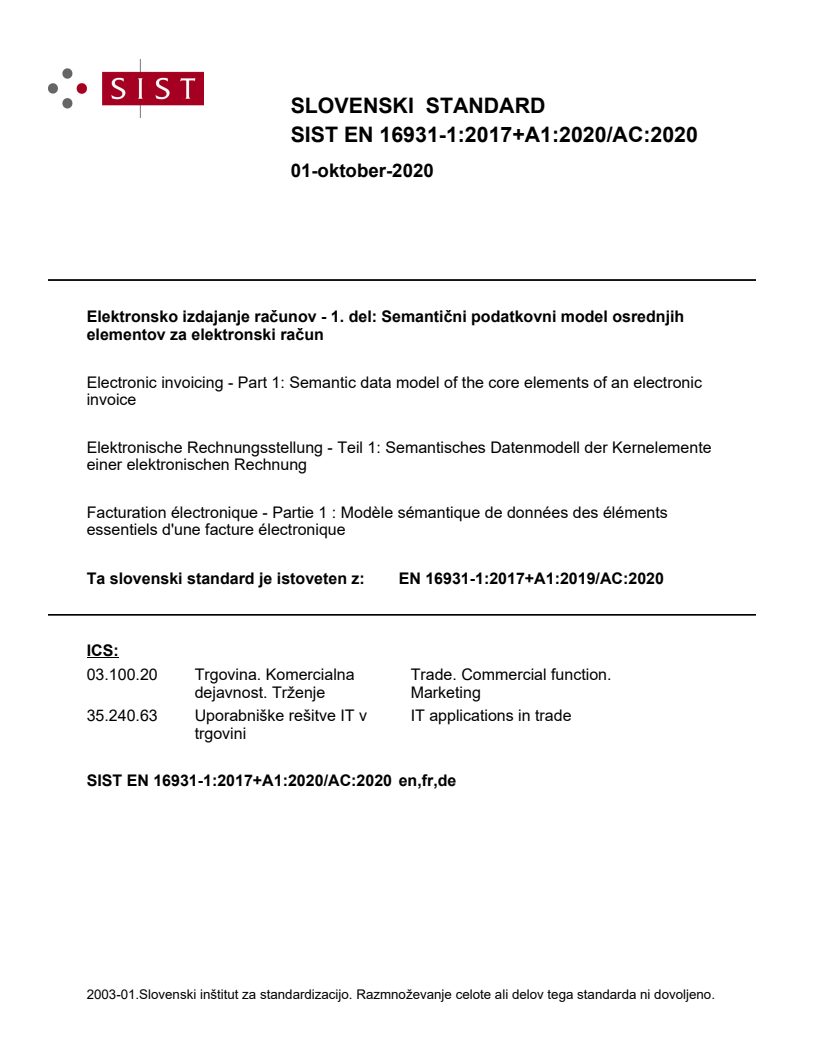
SLOVENSKI STANDARD
01-oktober-2020
Elektronsko izdajanje računov - 1. del: Semantični podatkovni model osrednjih
elementov za elektronski račun
Electronic invoicing - Part 1: Semantic data model of the core elements of an electronic
invoice
Elektronische Rechnungsstellung - Teil 1: Semantisches Datenmodell der Kernelemente
einer elektronischen Rechnung
Facturation électronique - Partie 1 : Modèle sémantique de données des éléments
essentiels d'une facture électronique
Ta slovenski standard je istoveten z: EN 16931-1:2017+A1:2019/AC:2020
ICS:
03.100.20 Trgovina. Komercialna Trade. Commercial function.
dejavnost. Trženje Marketing
35.240.63 Uporabniške rešitve IT v IT applications in trade
trgovini
2003-01.Slovenski inštitut za standardizacijo. Razmnoževanje celote ali delov tega standarda ni dovoljeno.
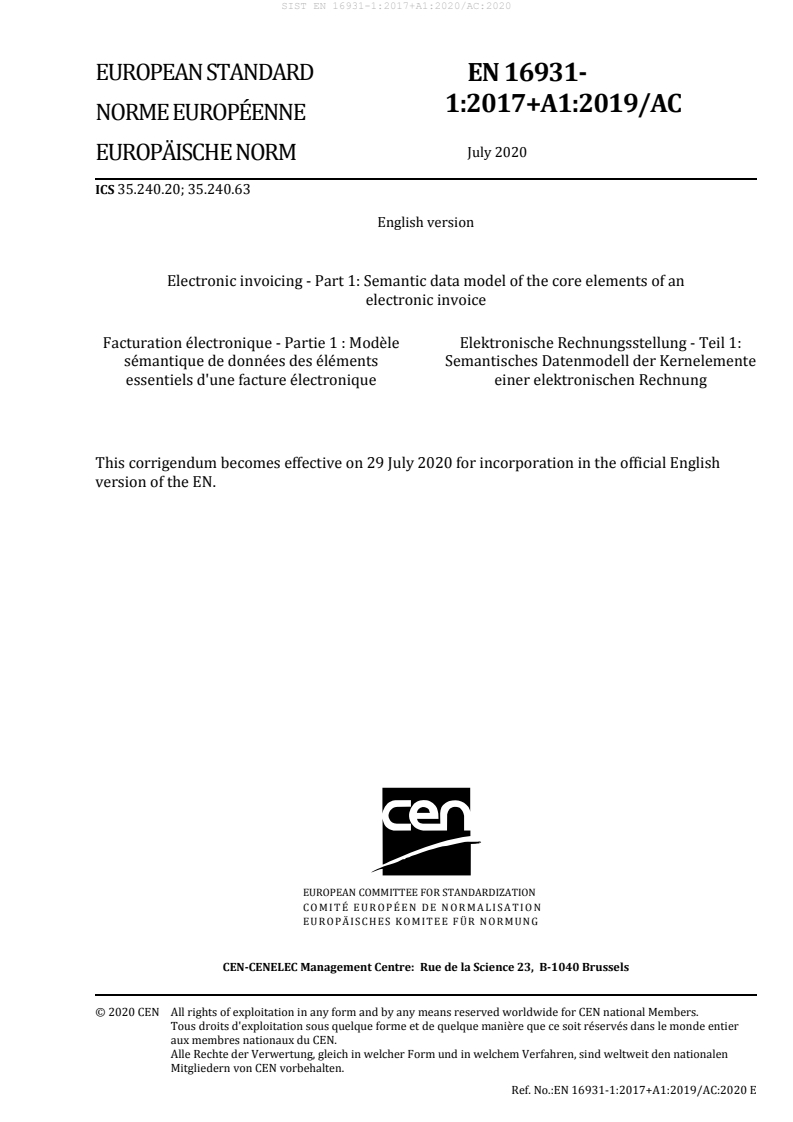
EUROPEAN STANDARD EN 16931-
1:2017+A1:2019/AC
NORME EUROPÉENNE
July 2020
EUROPÄISCHE NORM
ICS 35.240.20; 35.240.63
English version
Electronic invoicing - Part 1: Semantic data model of the core elements of an
electronic invoice
Facturation électronique - Partie 1 : Modèle Elektronische Rechnungsstellung - Teil 1:
sémantique de données des éléments Semantisches Datenmodell der Kernelemente
essentiels d'une facture électronique einer elektronischen Rechnung
This corrigendum becomes effective on 29 July 2020 for incorporation in the official English
version of the EN.
EUROPEAN COMMITTEE FOR STANDARDIZATION
COMITÉ EUROPÉEN DE NORMALISATIO N
EUROPÄISCHES KOMITEE FÜR NORMUN G
CEN-CENELEC Management Centre: Rue de la Science 23, B-1040 Brussels
© 2020 CEN All rights of exploitation in any form and by any means reserved worldwide for CEN national Members.
Tous droits d'exploitation sous quelque forme et de quelque manière que ce soit réservés dans le monde entier
aux membres nationaux du CEN.
Alle Rechte der Verwertung, gleich in welcher Form und in welchem Verfahren, sind weltweit den nationalen
Mitgliedern von CEN vorbehalten.
Ref. No.:EN 16931-1:2017+A1:2019/AC:2020 E
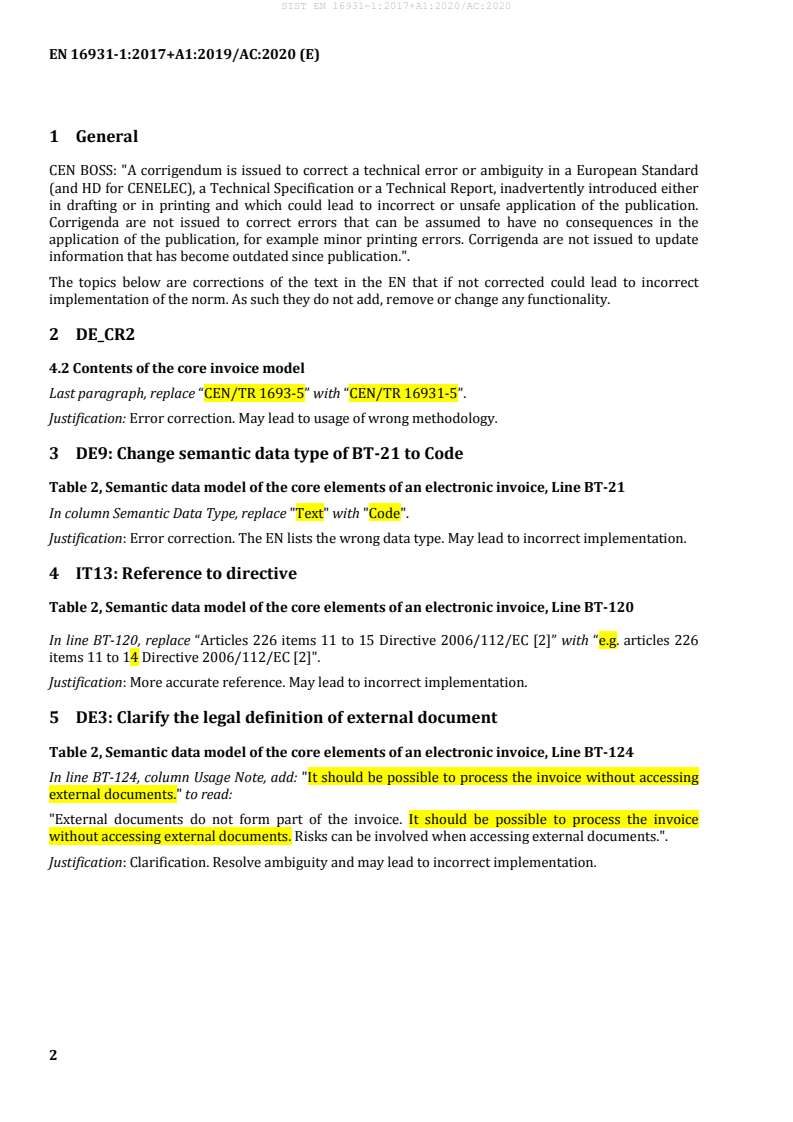
1 General
CEN BOSS: "A corrigendum is issued to correct a technical error or ambiguity in a European Standard
(and HD for CENELEC), a Technical Specification or a Technical Report, inadvertently introduced either
in drafting or in printing and which could lead to incorrect or unsafe application of the publication.
Corrigenda are not issued to correct errors that can be assumed to have no consequences in the
application of the publication, for example minor printing errors. Corrigenda are not issued to update
information that has become outdated since publication.".
The topics below are corrections of the text in the EN that if not corrected could lead to incorrect
implementation of the norm. As such they do not add, remove or change any functionality.
2 DE_CR2
4.2 Contents of the core invoice model
Last paragraph, replace “CEN/TR 1693-5” with “CEN/TR 16931-5”.
Justification: Error correction. May lead to usage of wrong methodology.
3 DE9: Change sema
...