

SIST EN 71-3:2019+A2:2025
(Main)Safety of toys - Part 3: Migration of certain elements
General Information
- Abstract
This document specifies requirements and test methods for the migration of aluminium, antimony, arsenic, barium, boron, cadmium, Chromium (III), Chromium (VI), cobalt, copper, lead, manganese, mercury, nickel, selenium, strontium, tin, organic tin and zinc from toy materials and from parts of toys.
Packaging materials are not considered to be part of the toy unless they have intended play value.
NOTE 1 See the European Commission guidance document no. 12 on the application of the Directive on the safety of toys - packaging [2].
The standard contains requirements for the migration of certain elements from the following categories of toy materials:
- Category I: Dry, brittle, powder like or pliable materials;
- Category II: Liquid or sticky materials;
- Category III: Scraped-off materials.
The requirements of this document do not apply to toys or parts of toys which, due to their accessibility, function, volume or mass, clearly exclude any hazard due to sucking, licking or swallowing or prolonged skin contact when the toy or part of toy is used as intended or in a foreseeable way, bearing in mind the behaviour of children.
NOTE 2 For the purposes of this document, for the following toys and parts of toys the likelihood of sucking, licking or swallowing toys is considered significant (see H.2 and H.3):
- All toys intended to be put in the mouth or to the mouth, cosmetics toys and writing instruments categorized as toys can be considered to be sucked, licked or swallowed;
- All the accessible parts and components of toys intended for children up to 6 years of age can be considered to come into contact with the mouth. The likelihood of mouth contact with parts of toys intended for older children is not considered significant in most cases (see H.2).
- Status
- Published
- Publication Date
- 09-Jun-2025
- Technical Committee
- OTR - Child use and care article
- Current Stage
- 6060 - National Implementation/Publication (Adopted Project)
- Start Date
- 16-Dec-2024
- Due Date
- 20-Feb-2025
- Completion Date
- 10-Jun-2025
- Directive
- 2009/48/EC - DIRECTIVE 2009/48/EC OF THE EUROPEAN PARLIAMENT AND OF THE COUNCIL of 18 June 2009 on the Safety of ToysOJ Ref: 16.12.2025, L OJ Date: 16-Dec-2025

Overview
SIST EN 71-3:2019+A2:2025 is a European and Slovenian standard that specifies the requirements and test methods for the migration of certain chemical elements from toys and toy materials. Developed by the Slovenian Institute for Standardization (SIST) and harmonized with European regulations, this standard is a critical part of ensuring toy safety throughout the European market.
The standard addresses the potential risks associated with children’s exposure to toxic elements that may migrate from toy materials during normal or foreseeable use, such as sucking, licking, swallowing, or extended skin contact. It forms part of the broader EN 71 series, which covers various aspects of toy safety in compliance with the EU Toy Safety Directive (2009/48/EC).
Key Topics
- Migration of Elements: Specifies test methods and migration limits for elements such as aluminium, antimony, arsenic, barium, boron, cadmium, chromium (III and VI), cobalt, copper, lead, manganese, mercury, nickel, selenium, strontium, tin, organic tin, and zinc.
- Toy Material Categories: Outlines requirements based on three specific types of toy materials:
- Category I: Dry, brittle, powder-like, or pliable materials
- Category II: Liquid or sticky materials
- Category III: Scraped-off materials (e.g., coatings, paints, and films)
- Exclusions: The standard does not apply to packaging materials unless they have intended play value. It also excludes toy parts that are not accessible or that, due to their design or use, do not present ingestion or prolonged skin contact hazards.
- Testing and Sampling: Provides detailed guidance on test portion selection, sample preparation, and analytical procedures, ensuring the reliability and repeatability of results.
- Regulatory Alignment: Designed to support compliance with EU legislation by referencing essential requirements of Directive 2009/48/EC and reflecting the latest amendments and limit values.
Applications
SIST EN 71-3:2019+A2:2025 is essential for a wide range of stakeholders in the toy industry:
- Manufacturers: Ensures compliance when designing and selecting materials for toys, particularly for products likely to be mouthed or handled by children under 6 years of age.
- Importers and Distributors: Provides a benchmark for due diligence in product selection, helping to meet both national and European Union safety requirements.
- Testing Laboratories: Standardizes test methods for migration analysis, supporting robust and comparable safety assessments.
- Regulators: Offers a framework for market surveillance, product recall decisions, and the enforcement of toy safety legislation.
- Designers and Product Developers: Helps guide material selection and design features, reducing the risk of toxic element migration and enhancing overall consumer confidence.
Specific toy categories affected include art and craft kits, modeling clays, crayons, paints, toy cosmetics, writing instruments classified as toys, and all items intended for young children or for oral use.
Related Standards
- EN 71-1: Safety of toys - Part 1: Mechanical and physical properties
- EN 71-2: Safety of toys - Part 2: Flammability
- EN 71-4: Experimental sets for chemistry and related activities
- EN 71-5: Chemical toys (sets) other than experimental sets
- CEN/TR 15071: National translations of warnings and instructions for use in EN 71 series
- CEN/TR 15371: Toy safety interpretations (Parts 1 and 2)
- CEN/TS 17973: Categorization of slime-type materials in toys
By adhering to SIST EN 71-3:2019+A2:2025, the toy industry contributes to the highest standards of chemical safety, protecting children’s health while enabling continued innovation and trade in the global toy market. Incorporation of these requirements is fundamental for legal market access in the European Economic Area and supports responsible business practices throughout the supply chain.
Relations
- Effective Date
- 01-Jul-2025
- Effective Date
- 23-Sep-2026
- Effective Date
- 08-Apr-2026
- Effective Date
- 10-Feb-2026
- Referred By
SIST EN 71-7:2014+A2:2018 - Safety of toys - Part 7: Finger paints - Requirements and test methods - Effective Date
- 28-Jan-2026
- Effective Date
- 28-Jan-2026
- Effective Date
- 28-Jan-2026
- Effective Date
- 28-Jan-2026
- Effective Date
- 28-Jan-2026
- Effective Date
- 28-Jan-2026
- Effective Date
- 28-Jan-2026
- Effective Date
- 28-Jan-2026
- Effective Date
- 28-Jan-2026
- Effective Date
- 28-Jan-2026
- Effective Date
- 28-Jan-2026
Frequently Asked Questions
SIST EN 71-3:2019+A2:2025 is a standard published by the Slovenian Institute for Standardization (SIST). Its full title is "Safety of toys - Part 3: Migration of certain elements". This standard covers: This document specifies requirements and test methods for the migration of aluminium, antimony, arsenic, barium, boron, cadmium, Chromium (III), Chromium (VI), cobalt, copper, lead, manganese, mercury, nickel, selenium, strontium, tin, organic tin and zinc from toy materials and from parts of toys. Packaging materials are not considered to be part of the toy unless they have intended play value. NOTE 1 See the European Commission guidance document no. 12 on the application of the Directive on the safety of toys - packaging [2]. The standard contains requirements for the migration of certain elements from the following categories of toy materials: - Category I: Dry, brittle, powder like or pliable materials; - Category II: Liquid or sticky materials; - Category III: Scraped-off materials. The requirements of this document do not apply to toys or parts of toys which, due to their accessibility, function, volume or mass, clearly exclude any hazard due to sucking, licking or swallowing or prolonged skin contact when the toy or part of toy is used as intended or in a foreseeable way, bearing in mind the behaviour of children. NOTE 2 For the purposes of this document, for the following toys and parts of toys the likelihood of sucking, licking or swallowing toys is considered significant (see H.2 and H.3): - All toys intended to be put in the mouth or to the mouth, cosmetics toys and writing instruments categorized as toys can be considered to be sucked, licked or swallowed; - All the accessible parts and components of toys intended for children up to 6 years of age can be considered to come into contact with the mouth. The likelihood of mouth contact with parts of toys intended for older children is not considered significant in most cases (see H.2).
This document specifies requirements and test methods for the migration of aluminium, antimony, arsenic, barium, boron, cadmium, Chromium (III), Chromium (VI), cobalt, copper, lead, manganese, mercury, nickel, selenium, strontium, tin, organic tin and zinc from toy materials and from parts of toys. Packaging materials are not considered to be part of the toy unless they have intended play value. NOTE 1 See the European Commission guidance document no. 12 on the application of the Directive on the safety of toys - packaging [2]. The standard contains requirements for the migration of certain elements from the following categories of toy materials: - Category I: Dry, brittle, powder like or pliable materials; - Category II: Liquid or sticky materials; - Category III: Scraped-off materials. The requirements of this document do not apply to toys or parts of toys which, due to their accessibility, function, volume or mass, clearly exclude any hazard due to sucking, licking or swallowing or prolonged skin contact when the toy or part of toy is used as intended or in a foreseeable way, bearing in mind the behaviour of children. NOTE 2 For the purposes of this document, for the following toys and parts of toys the likelihood of sucking, licking or swallowing toys is considered significant (see H.2 and H.3): - All toys intended to be put in the mouth or to the mouth, cosmetics toys and writing instruments categorized as toys can be considered to be sucked, licked or swallowed; - All the accessible parts and components of toys intended for children up to 6 years of age can be considered to come into contact with the mouth. The likelihood of mouth contact with parts of toys intended for older children is not considered significant in most cases (see H.2).
SIST EN 71-3:2019+A2:2025 is classified under the following ICS (International Classification for Standards) categories: 97.200.50 - Toys. The ICS classification helps identify the subject area and facilitates finding related standards.
SIST EN 71-3:2019+A2:2025 has the following relationships with other standards: It is inter standard links to SIST EN 71-3:2019+A1:2021, SIST EN 16781:2026, SIST EN 12221:2026, SIST-V CEN/CLC Guide 14:2009, SIST EN 71-7:2014+A2:2018, SIST EN 15918:2011, SIST EN 16232:2013+A1:2018, SIST EN 1466:2015, SIST EN 16120:2013+A2:2017, SIST EN 1130:2020, SIST EN 1930:2012, SIST EN 14960-2:2019, SIST EN 716-1:2017, SIST EN 13138-2:2007, SIST EN 12221-1:2008+A1:2013. Understanding these relationships helps ensure you are using the most current and applicable version of the standard.
SIST EN 71-3:2019+A2:2025 is associated with the following European legislation: EU Directives/Regulations: 2009/48/EC, EUR-PUB; Standardization Mandates: M/589. When a standard is cited in the Official Journal of the European Union, products manufactured in conformity with it benefit from a presumption of conformity with the essential requirements of the corresponding EU directive or regulation.
SIST EN 71-3:2019+A2:2025 is available in PDF format for immediate download after purchase. The document can be added to your cart and obtained through the secure checkout process. Digital delivery ensures instant access to the complete standard document.
Standards Content (Sample)
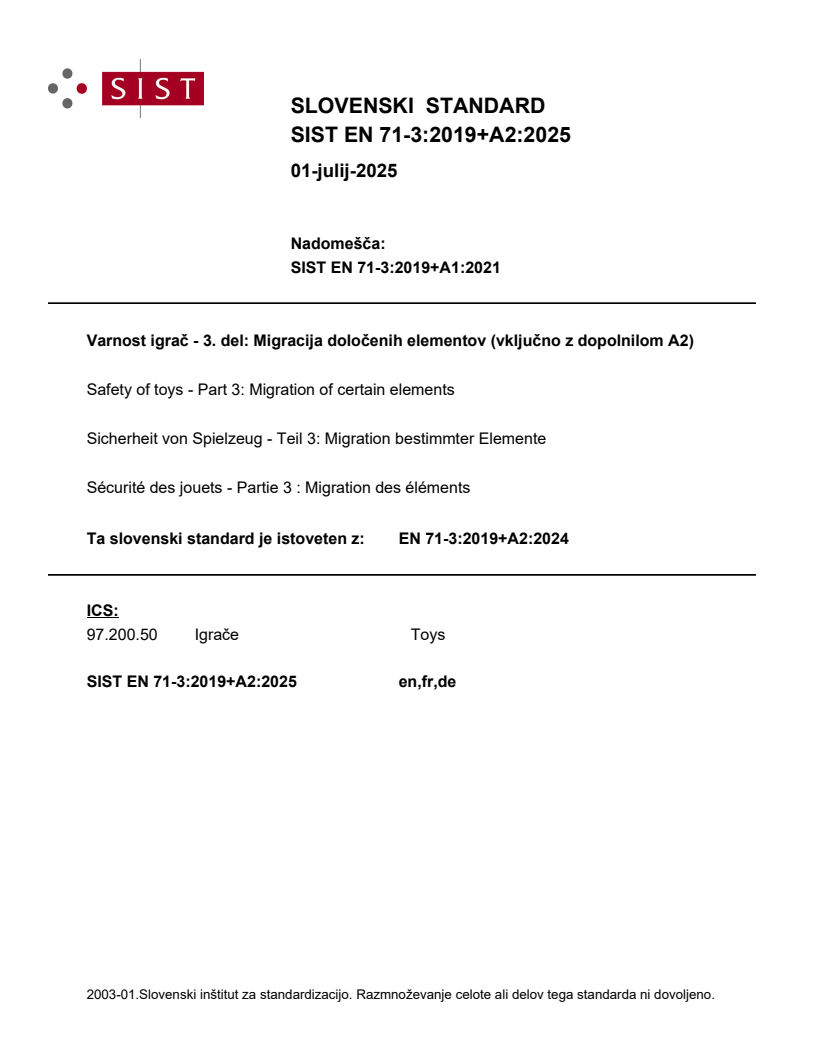
SLOVENSKI STANDARD
01-julij-2025
Nadomešča:
SIST EN 71-3:2019+A1:2021
Varnost igrač - 3. del: Migracija določenih elementov (vključno z dopolnilom A2)
Safety of toys - Part 3: Migration of certain elements
Sicherheit von Spielzeug - Teil 3: Migration bestimmter Elemente
Sécurité des jouets - Partie 3 : Migration des éléments
Ta slovenski standard je istoveten z: EN 71-3:2019+A2:2024
ICS:
97.200.50 Igrače Toys
2003-01.Slovenski inštitut za standardizacijo. Razmnoževanje celote ali delov tega standarda ni dovoljeno.
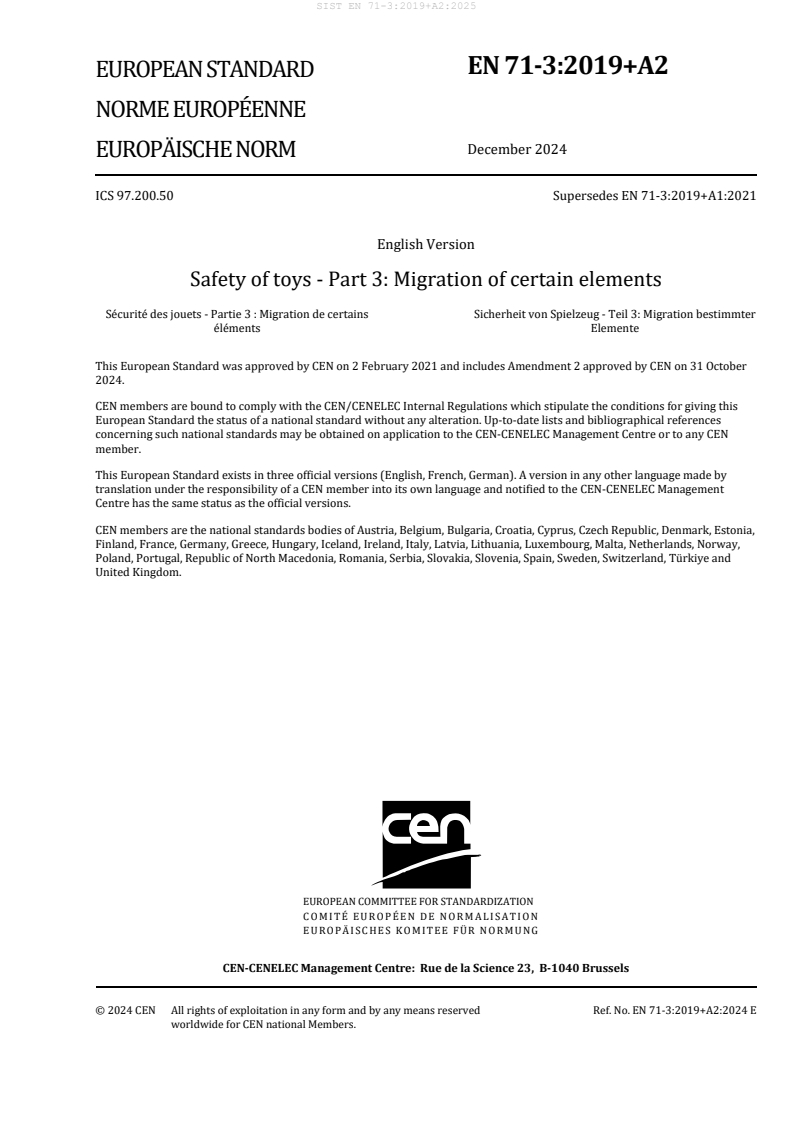
EN 71-3:2019+A2
EUROPEAN STANDARD
NORME EUROPÉENNE
December 2024
EUROPÄISCHE NORM
ICS 97.200.50 Supersedes EN 71-3:2019+A1:2021
English Version
Safety of toys - Part 3: Migration of certain elements
Sécurité des jouets - Partie 3 : Migration de certains Sicherheit von Spielzeug - Teil 3: Migration bestimmter
éléments Elemente
This European Standard was approved by CEN on 2 February 2021 and includes Amendment 2 approved by CEN on 31 October
2024.
CEN members are bound to comply with the CEN/CENELEC Internal Regulations which stipulate the conditions for giving this
European Standard the status of a national standard without any alteration. Up-to-date lists and bibliographical references
concerning such national standards may be obtained on application to the CEN-CENELEC Management Centre or to any CEN
member.
This European Standard exists in three official versions (English, French, German). A version in any other language made by
translation under the responsibility of a CEN member into its own language and notified to the CEN-CENELEC Management
Centre has the same status as the official versions.
CEN members are the national standards bodies of Austria, Belgium, Bulgaria, Croatia, Cyprus, Czech Republic, Denmark, Estonia,
Finland, France, Germany, Greece, Hungary, Iceland, Ireland, Italy, Latvia, Lithuania, Luxembourg, Malta, Netherlands, Norway,
Poland, Portugal, Republic of North Macedonia, Romania, Serbia, Slovakia, Slovenia, Spain, Sweden, Switzerland, Türkiye and
United Kingdom.
EUROPEAN COMMITTEE FOR STANDARDIZATION
COMITÉ EUROPÉEN DE NORMALISATION
EUROPÄISCHES KOMITEE FÜR NORMUNG
CEN-CENELEC Management Centre: Rue de la Science 23, B-1040 Brussels
© 2024 CEN All rights of exploitation in any form and by any means reserved Ref. No. EN 71-3:2019+A2:2024 E
worldwide for CEN national Members.
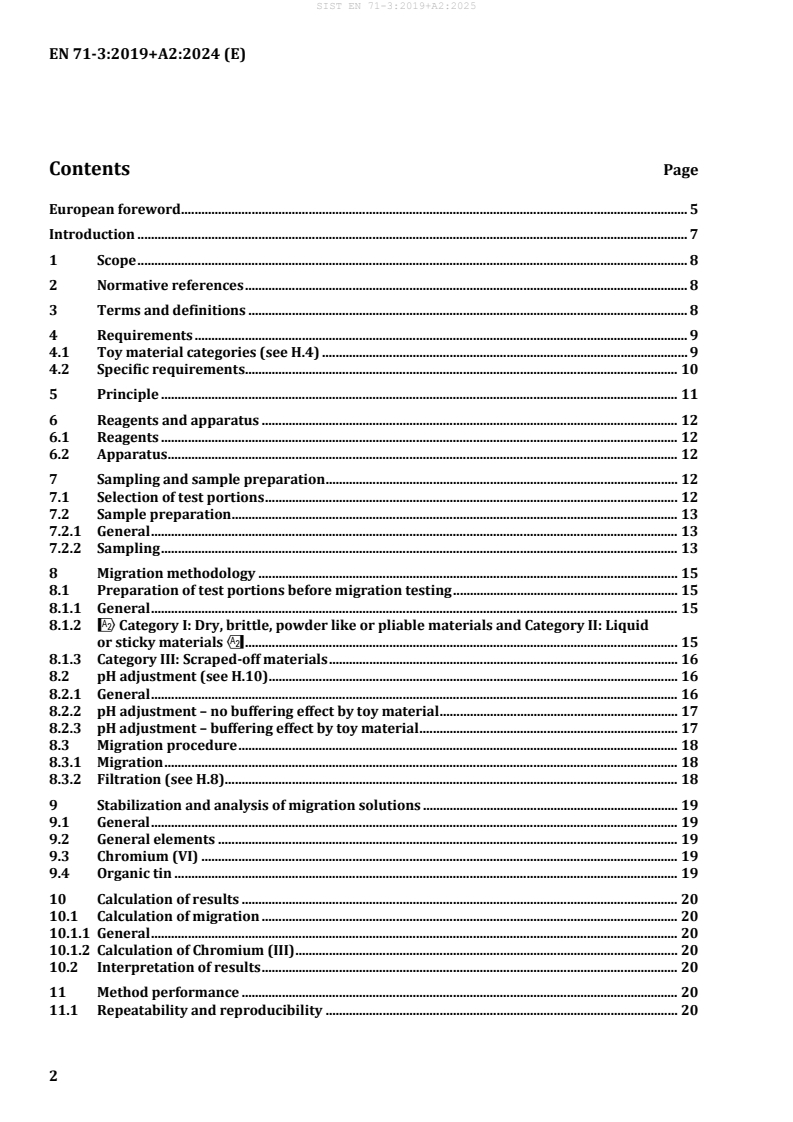
Contents Page
European foreword . 5
Introduction . 7
1 Scope . 8
2 Normative references . 8
3 Terms and definitions . 8
4 Requirements . 9
4.1 Toy material categories (see H.4) . 9
4.2 Specific requirements . 10
5 Principle . 11
6 Reagents and apparatus . 12
6.1 Reagents . 12
6.2 Apparatus . 12
7 Sampling and sample preparation . 12
7.1 Selection of test portions . 12
7.2 Sample preparation . 13
7.2.1 General . 13
7.2.2 Sampling . 13
8 Migration methodology . 15
8.1 Preparation of test portions before migration testing . 15
8.1.1 General . 15
8.1.2 #Category I: Dry, brittle, powder like or pliable materials and Category II: Liquid
or sticky materials$ . 15
8.1.3 Category III: Scraped-off materials . 16
8.2 pH adjustment (see H.10). 16
8.2.1 General . 16
8.2.2 pH adjustment – no buffering effect by toy material . 17
8.2.3 pH adjustment – buffering effect by toy material . 17
8.3 Migration procedure . 18
8.3.1 Migration . 18
8.3.2 Filtration (see H.8) . 18
9 Stabilization and analysis of migration solutions . 19
9.1 General . 19
9.2 General elements . 19
9.3 Chromium (VI) . 19
9.4 Organic tin . 19
10 Calculation of results . 20
10.1 Calculation of migration . 20
10.1.1 General . 20
10.1.2 Calculation of Chromium (III) . 20
10.2 Interpretation of results . 20
11 Method performance . 20
11.1 Repeatability and reproducibility . 20
11.2 Estimation of bias . 23
11.3 Limit of detection (LOD) and limit of quantification (LOQ) . 23
12 Test report . 23
Annex A (informative) Significant technical changes between this document and the
previous version . 25
Annex B (informative) Information on method validation. 27
B.1 General . 27
B.2 Samples of interlaboratory comparison . 27
B.3 Selection of material category/element combinations . 28
Annex C (informative) Estimation of reproducibility . 29
Annex D (informative) Toy material visual particle size comparison materials. 31
Annex E (normative) Method of analysis for general elements . 33
E.1 Principle . 33
E.2 Working solutions . 33
E.2.1 Stock solution (M ) . 33
E.2.2 Diluted stock solution (M ) . 34
E.2.3 Working solutions . 34
E.2.4 Internal standard stock solution . 34
E.3 Procedure . 34
E.4 Analysis . 34
E.5 Calculation. 35
E.5.1 Calibration curve . 35
E.5.2 Calculation of migration . 35
Annex F (normative) Method of analysis for Chromium (VI) . 36
F.1 Principle . 36
F.2 Reagents . 36
F.3 Apparatus . 37
F.4 Procedure . 38
F.5 Analysis . 38
F.5.1 General . 38
F.5.2 Chromatographic conditions . 38
F.5.3 Limit of detection and quantification . 39
F.6 Calculation. 39
F.6.1 Calibration curve . 39
F.6.2 Calculation of migration . 40
Annex G (normative) Method of analysis for organic tin (see H.9) . 41
G.1 Principle . 41
G.2 Reagents . 42
G.3 Apparatus . 45
G.4 Procedure. 45
G.4.1 Sample derivatisation . 45
G.4.2 Calibration standards . 47
G.5 Analysis . 47
G.5.1 General . 47
G.5.2 Example of GC conditions . 49
G.5.3 Example of MS conditions . 49
G.5.4 Limit of detection and quantification . 49
G.5.5 Example of a GC-MS chromatogram. 50
G.6 Calculation . 51
G.6.1 Calibration curve . 51
G.6.2 Standard addition . 51
G.6.3 Calculation of migration of organic tin . 51
Annex H (informative) Rationale . 53
H.1 General . 53
H.2 Mouthing behaviour of children (see Clause 1) . 53
H.3 Skin contact (see Clause 1) . 54
H.4 Toy categories (see 4.1) . 54
H.5 Test portions (see Clause 7) . 54
H.6 Size of test pieces (see 7.2) . 55
H.7 #Chromium (VI) (see 9.3 and Annex F)$. 55
H.8 Filtration of migration solutions (see 8.3.2) . 55
H.9 Organic tin (see Annex G) . 56
H.10 pH value (see 8.2 and 8.3.1.2) . 58
H.11 #Deletion of de-waxing procedure$ . 58
Annex ZA (informative) #Relationship between this European Standard and the essential
requirements of Directive 2009/48/EC aimed to be covered$ . 60
Bibliography . 61
European foreword
This document (EN 71-3:2019+A2:2024) has been prepared by Technical Committee CEN/TC 52 “Safety
of toys”, the secretariat of which is held by DS.
This European Standard shall be given the status of a national standard, either by publication of an
identical text or by endorsement, at the latest by June 2025, and conflicting national standards shall be
withdrawn at the latest by June 2025.
Attention is drawn to the possibility that some of the elements of this document may be the subject of
patent rights. CEN shall not be held responsible for identifying any or all such patent rights.
This document includes Amendment 1 approved by CEN on 2 February 2021 and Amendment 2 approved
by CEN on 31 October 2024.
This document supersedes #EN 71-3:2019+A1:2021$.
The start and finish of text introduced or altered by amendment is indicated in the text by tags !"
and #$.
This document has been prepared under a standardization request addressed to CEN by the European
Commission. The Standing Committee of the EFTA States subsequently approves these requests for its
Member States.
For the relationship with EU Legislation, see informative Annex ZA, which is an integral part of this
document.
The significant changes from the previous edition of this standard are detailed in Annex A.
!This document constitutes the third part of the EN 71 series of standards on safety of toys."
EN 71, Safety of toys, consists of the following parts:
— Part 1: Mechanical and physical properties;
— Part 2: Flammability;
— Part 3: Migration of certain elements (this document);
— Part 4: Experimental sets for chemistry and related activities;
— Part 5: Chemical toys (sets) other than experimental sets;
— Part 7: Finger paints — Requirements and test methods;
— Part 8: Activity toys for domestic use;
— #deleted text$
— Part 10: Organic chemical compounds — Sample preparation and extraction;
— Part 11: Organic chemical compounds — Methods of analysis;
— Part 12: N-Nitrosamines and N-nitrosatable substances;
— Part 13: Olfactory board games, cosmetic kits and gustative games;
— Part 14: Trampolines for domestic use;
— #Part 15: Formamide in foam toy materials (content);
— Part 16: Certain chlorinated phosphorus flame retardants (TCEP, TCPP, TDCP) in toy materials;
— Part 17: Certain isothiazolinones (MIT, CIT, BIT) in aqueous toy materials;
— Part 18: Phenol in aqueous (content) and polymeric (migration) toy materials;
— Part 19: Migration of bisphenol A from toy materials.$
!It is up to the user of the standard to determine whether or not a toy is included in the scope of several
of the above parts of the EN 71-series, and to apply each applicable standard accordingly. Normative
references from one part of the EN 71-series to another, are therefore normally not provided in the
individual parts."
!NOTE 1 In addition to the above parts of EN 71, the following #documents$ have been published:
— CEN/TR 15071, Safety of toys — National translations of warnings and instructions for use in EN 71 series;
— CEN/TR 15371 (parts 1 and 2), Safety of toys — Interpretations;
— CEN/TR 16918, Safety of toys — Children’s mouthing behaviour in contact with toys;
— #CEN/TR 17695, Safety of toys — Mechanical and physical properties — Guidance on categorisation of
projectile toys within EN 71-1;
— CEN/TS 17973, Safety of toys — Categorization of slime type materials;$
— CEN ISO/TR 8124-8, #Safety of toys — Part 8: Age determination — First age grade for the appropriate
play of toys (ISO/TR 8124-8)$."
NOTE 2 Words in italics are defined in Clause 3 (Terms and definitions).
Any feedback and questions on this document should be directed to the users’ national standards body.
A complete listing of these bodies can be found on the CEN website.
According to the CEN-CENELEC Internal Regulations, the national standards organisations of the
following countries are bound to implement this European Standard: Austria, Belgium, Bulgaria, Croatia,
Cyprus, Czech Republic, Denmark, Estonia, Finland, France, Germany, Greece, Hungary, Iceland, Ireland,
Italy, Latvia, Lithuania, Luxembourg, Malta, Netherlands, Norway, Poland, Portugal, Republic of North
Macedonia, Romania, Serbia, Slovakia, Slovenia, Spain, Sweden, Switzerland, Türkiye and the United
Kingdom.
Introduction
The Toy Safety Directive (2009/48/EC) [1] specifies maximum migration limits for three categories of
toy materials. Certain limit values have been amended (see [4, 5, 6, 7]). The limits for the migration of
certain elements are expressed in milligram per kilogram toy material and are detailed in Table 2. The
purpose of the limits is to minimize children’s exposure to certain potentially toxic elements.
1 Scope
This document specifies requirements and test methods for the migration of aluminium, antimony,
arsenic, barium, boron, cadmium, Chromium (III), Chromium (VI), cobalt, copper, lead, manganese,
mercury, nickel, selenium, strontium, tin, organic tin and zinc from toy materials and from parts of toys.
Packaging materials are not considered to be part of the toy unless they have intended play value.
NOTE 1 See the European Commission guidance document no. 12 on the application of the Directive on the safety
of toys – packaging [2].
The standard contains requirements for the migration of certain elements from the following categories
of toy materials:
— Category I: Dry, brittle, powder like or pliable materials;
— Category II: Liquid or sticky materials;
— Category III: Scraped-off materials.
The requirements of this document do not apply to toys or parts of toys which, due to their accessibility,
function, volume or mass, clearly exclude any hazard due to sucking, licking or swallowing or prolonged
skin contact when the toy or part of toy is used as intended or in a foreseeable way, bearing in mind the
behaviour of children.
NOTE 2 For the purposes of this document, for the following toys and parts of toys the likelihood of sucking,
licking or swallowing toys is considered significant (see H.2 and H.3):
— All toys intended to be put in the mouth or to the mouth, cosmetics toys and writing instruments categorized
as toys can be considered to be sucked, licked or swallowed;
— All the accessible parts and components of toys intended for children up to 6 years of age can be considered
to come into contact with the mouth. The likelihood of mouth contact with parts of toys intended for older
children is not considered significant in most cases (see H.2).
2 Normative references
The following documents are referred to in the text in such a way that some or all of their content
constitutes requirements of this document. For dated references, only the edition cited applies. For
undated references, the latest edition of the referenced document (including any amendments) applies.
EN 71-1:2014+A1:2018, Safety of toys — Part 1: Mechanical and physical properties
3 Terms and definitions
For the purposes of this document, the following terms and definitions apply.
ISO and IEC maintain terminology databases for use in standardization at the following addresses:
• ISO Online browsing platform: available at https://www.iso.org/ob
• IEC Electropedia: available at https://www.electropedia.org/
3.1
base material
material upon which coatings can be formed or deposited
3.2
coating
layer of material formed or deposited on a base material which can be removed by scraping
Note 1 to entry: Coatings can include paints, varnishes, lacquers, inks, polymeric coatings or other substances of
a similar nature, whether they contain metallic particles or not, and irrespective of the manner of application.
3.3
paper
sheet formed by irregularly intervened fibres with a mass per unit area of 400 g/m or less
3.4
paper board
sheet formed by irregularly intervened fibres with a mass per unit area over 400 g/m
Note 1 to entry: The term paper board also includes materials commonly referred to as card or cardboard with a
mass per unit area over 400 g/m .
3.5
scraping
mechanical removal of coatings down to but not including the base material
3.6
toy material
material present in toys and accessible as determined in accordance with EN 71-1:2014+A1:2018, 8.10
3.7
sample
toy or material subject to testing
3.8
laboratory sample
material taken from a sample
4 Requirements
4.1 Toy material categories (see H.4)
Table 1 contains a list of common toy materials and their respective categories. Toy materials not
specifically listed in Table 1 shall be assigned to one of the categories.
#NOTE CEN/TS 17973:2023, Safety of toys — Categorization of slime type materials, specifies a method for
categorization of slime-type products to support users of EN 71-3 in the categorization of products with slime-like
behaviour into material categories 1 (dry, brittle, powder-like or pliable toy material) or 2 (liquid or sticky toy
material).$
Table 1 — Cross-reference table for determining category
Toy Material Category I Category II Category III
Coatings of paints, varnishes, lacquers, printing inks,
X
polymers, foams and similar coatings
Polymeric and similar materials, including laminates,
X
whether textile reinforced or not, but excluding other textiles
Paper and paper board X
Textiles, whether natural or synthetic X
Glass, ceramic, metallic materials X
Wood, fibre board, hard board, bone, leather and other solid
X
materials
Compressed paint tablets, materials intended to leave a trace
or similar materials in solid form appearing as such in the toy X
(e.g. the cores of colouring pencils, chalk, crayons)
Pliable modelling materials, including modelling clays and
X
plaster
Liquid paints, including finger paints, varnishes, lacquers,
liquid ink in pens and similar materials in liquid form
X
appearing as such in the toy (e.g. #deleted text$ bubble
solution)
Glue sticks X
4.2 Specific requirements
The migration of elements from toy materials categorized in accordance with 4.1 shall not exceed the
migration limits given in Table 2 when tested in accordance with Clause 7 (sampling and sample
preparation), Clause 8 (migration procedure) and Clause 9 (stabilization and analysis of migration
solutions).
!Table 2 — Migration limits from toy materials
Migration limit
Element
Category I Category II Category III
mg/kg mg/kg mg/kg
a a a
Aluminium
5 625 / 2 250 1 406 / 560 70 000 / 28 130
Antimony 45 11,3 560
Arsenic 3,8 0,9 47
Barium 1 500 375 18 750
Boron 1 200 300 15 000
Cadmium 1,3 0,3 17
Chromium (III) 37,5 9,4 460
Chromium (VI) 0,02 0,005 0,053
Cobalt 10,5 2,6 130
Copper 622,5 156 7 700
Lead 2,0 0,5 23
Manganese 1 200 300 15 000
Mercury 7,5 1,9 94
Nickel 75 18,8 930
Selenium 37,5 9,4 460
Strontium 4 500 1 125 56 000
Tin 15 000 3 750 180 000
Organic tin 0,9 0,2 12
Zinc 3 750 938 46 000
a
The migration limits for Aluminium have been amended by Commission Directive (EU) 2019/1922 [19]. The
new limit values (2 250 mg/kg, 560 mg/kg and 28 130 mg/kg, respectively) apply from 2021-05–20. Before this
date the limit values 5 625 mg/kg, 1 406 mg/kg and 70 000 mg/kg, respectively, apply.
"
5 Principle
Soluble elements are extracted from toy materials using conditions which simulate the material
remaining in contact with gastric juices for a period of time after swallowing. The concentrations of the
soluble elements are determined quantitatively by three different methods:
— method for determining general elements: Aluminium, Antimony, Arsenic, Barium, Boron, Cadmium,
Chromium, Cobalt, Copper, Lead, Manganese, Mercury, Nickel, Selenium, Strontium, Tin and Zinc;
— method for determining Chromium (VI);
— method for determining organic tin.
6 Reagents and apparatus
6.1 Reagents
All reagents, including water, used for analysis shall be of analytical grade or, if unavailable, technical
grade reagents which have been determined to have acceptably low levels of impurity to allow the
analysis to be performed.
6.1.1 Hydrochloric acid solution, c(HCl) = (0,07 ± 0,005) mol/l.
6.1.2 Hydrochloric acid solution, c(HCl) = (0,14 ± 0,010) mol/l.
6.1.3 Hydrochloric acid solution, c(HCl) = approximately 1 mol/l.
6.1.4 Hydrochloric acid solution, c(HCl) = approximately 2 mol/l.
6.1.5 Hydrochloric acid solution, c(HCl) = approximately 6 mol/l.
6.1.6 Isooctane, (C H ), 99 %.
8 18
6.2 Apparatus
Standard laboratory equipment and the following shall be used.
6.2.1 Equipment for measuring pH, calibrated and sufficiently accurate for the purposes of this
European Standard.
NOTE H.10 contains additional information on equipment for measuring pH.
6.2.2 Centrifuge, capable of centrifuging at high speed to separate the solids (see H.8).
6.2.3 A means to agitate the mixture, at a temperature of (37 ± 2) °C.
An orbital or linear shaker or shaking water bath capable of maintaining the migration solution in
constant motion relative to the sample.
6.2.4 Plastic containers of gross volume, between 1,6 times and 5,0 times the volume of
#hydrochloric acid migration solution$.
6.2.5 High retention filter-paper, ashless filter paper, particle retention in liquids 2,5 µm.
6.2.6 Membrane filters with pore sizes of 0,45 µm and 0,02 µm.
Syringe filters made with a cellulose acetate membrane are recommended for the 0,45 µm filter.
7 Sampling and sample preparation
7.1 Selection of test portions
A sample for testing shall consist of one toy in the form in which it will be marketed. Test portions shall
be taken from toy materials of the single toy sample. Identical materials in the toy may be combined and
treated as a single test portion but additional toy samples shall not be used to prepare larger test portions.
Test portions are taken from each colour of each toy material. #Test portions shall not be composed of
more than one toy material unless discrete specimens cannot be separated physically, e. g. dot printing,
patterned textiles, multi-coloured printed surfaces etc. Such test portions made of more than one toy
material shall be representative of the whole material.
NOTE 1 Although this document requires test portions are made up of one material, test portions made up of
multiple materials can be a useful means of verification testing, provided care is taken with sample selection and
analysis. See H.5 for further information.$
#NOTE 2$ This requirement does not preclude the preparation of test portions which represent the
material and any base material upon which it is deposited.
Analysis of toy materials present in amounts less than 0,010 g is not required (see H.5).
The above does not preclude the testing of toy materials before they are used to manufacture a toy (raw
materials). In these cases, the manufacturing process shall be assessed in order to ensure that it does not
influence the migration of elements from the toy materials.
7.2 Sample preparation
7.2.1 General
Appropriate blank solutions shall be analysed so that appropriate corrections can be made when
necessary (e.g. contamination of reagents and materials). If the blank result exceeds half of the lowest
value the laboratory intends to report (laboratory’s reporting limit) at least two blank solutions shall be
analysed and the analytical result shall be corrected by the average value of the blank solutions.
7.2.2 Sampling
Whenever possible obtain a test portion of not less than 0,100 g of each toy material of the laboratory
sample using the appropriate sampling method specified in Table 3.
Table 3 — Sampling methods
Toy material Category Sampling method
(Table 1)
Liquid paints, including finger paints, II Mix the laboratory sample. Ink in pens should
varnishes, lacquers, liquid ink in pens be removed from the pen’s refill before
and similar materials in liquid form mixing.
appearing as such in the toy (e.g.
#deleted text$ bubble solutions)
Coatings of paints, varnishes, lacquers, III NOTE 1 Paper or paper board samples with
printing ink, polymers, foams and similar paint, varnish, lacquer, printing ink, adhesive
coatings or similar material applied to their surfaces
are not subjected to this sampling method but
are treated according to the sampling method
for paper or paper board.
Remove the coating from the laboratory
sample by scraping at room temperature,
taking care to avoid the inclusion of the base
material. Obtain particles of approximately
0,5 mm. The use of pre-prepared materials for
visual size comparison is recommended (see
Annex D).
In case of a thick layer or one which is difficult
to remove (e.g. pliable or plasticised layers),
the coating can be cut off and tested as
polymeric material.
Toy material Category Sampling method
(Table 1)
For coatings deposited on a non-polymeric
base material, it is permissible to add a few
drops of solvent, such as acetone/ethanol
(1:1) mixture, methylene chloride or
tetrahydrofuran to soften the coating and
assist in its removal from the base material. If
a solvent is used, remove the traces of solvent
only by evaporation prior to migration. This
procedure shall not be used if there are
indications that the use of solvents can affect
the migration of an element from the coating.
NOTE 2 The use of scraping tools made of
plastic materials helps to prevent the removal
of base material after applying the solvent.
This solvent assisted procedure may be used
r verifying previous high results which
fo
might have been caused by the release of
elements from scraped off base materials
underlying the coating, e.g. high release of zinc
from a coating scraped off from a base
material containing zinc.
Paper and paper board III Prepare a test portion by cutting the
laboratory sample using suitable tools. Take
care to produce clean cut edges. Each
dimension of the test pieces shall be as near to
6 mm as possible (see H.6). The use of pre-
prepared materials for visual size comparison
is recommended (see Annex D).
If a paper or paper board sample has paint,
varnish, lacquer, printing ink, adhesive or
similar material applied to its surface, test
portions of the coating shall not be taken
separately. In such cases test portions shall be
taken from the toy material so that they also
include representative parts of the coated
area.
Toys and removable components which III Apply the migration procedure to the whole
fit entirely within the small parts cylinder component including any coatings.
(see EN 71-1:2014+A1:2018, 8.2) Components, the coatings of which have been
containing accessible glass, ceramic, removed for analysis, shall not be used. A
metallic materials separate unchanged component shall be used.
Compressed paint tablets, materials I
Prepare a test portion by cutting the
intended to leave a trace or similar
laboratory sample using suitable tools. Take
materials in solid form appearing as such
care to produce clean cut edges. Each
in the toy (e.g. the cores of colouring
dimension of the test pieces shall be as near to
pencils, chalk, crayons)
6 mm as possible (see H.6). The use of pre-
Toy material Category Sampling method
(Table 1)
prepared materials for visual size comparison
Pliable modelling materials, including I
is recommended (see Annex D).
modelling clays and plaster
Glue sticks II
Polymeric and similar materials,
including laminates, whether textile
III
reinforced or not, but excluding other
textiles
Textiles, whether natural or synthetic,
III
including textile threads
Wood, fibre board, hard board, bone,
III
leather and other solid materials
NOTE No sampling procedure for inaccessible toy materials or glass, ceramic and metallic toy components
which do not fit within the small parts cylinder is specified as they are not within the scope of this European
Standard. The exposure to certain elements from inaccessible materials and larger hard components, which cannot
be swallowed, is not considered significant.
If a test portion of 0,1 g or more cannot be obtained, a test portion shall be obtained from each toy material
present in the sample in a mass greater than 0,010 g. If the weight of the test portion obtained is between
0,010 g and 0,100 g, this shall be indicated in the report (see Clause 12 h)). In this case the analytical
results shall be calculated as though 0,100 g of the test portion had been used (Wtp = 0,100 g, see H.5).
#deleted text$
8 Migration methodology
8.1 Preparation of test portions before migration testing
8.1.1 General
For the purposes of the following subclauses the density of the water and hydrochloric acid solution can
be assumed to be 1,0 g/ml and the solutions can be added volumetrically using suitable dispensers
accurate to the nearest 0,05 ml.
The volume of simulant (V) added shall be recorded for the purpose of calculation of results.
8.1.2 #Category I: Dry, brittle, powder like or pliable materials and Category II: Liquid or
sticky materials
Weigh the test portion to the nearest 0,001 g (Wtp) into the appropriately sized container (see 6.2.4).
Add 50 × Wtp (to the nearest 0,05 g) of an aqueous solution of 0,07 mol/l HCl (see 6.1.1) at (22 ± 3) °C.
For test portions of mass between 0,010 g and 0,100 g, add 5,0 ml of 0,07 mol/l HCl (see 6.1.1) at
(22 ± 3) °C.
Proceed without any delay with the appropriate pH adjustment procedure specified in 8.2 (pH
adjustment).$
8.1.3 Category III: Scraped-off materials
8.1.3.1 Glass, ceramic and metallic materials
Weigh the toy or component to the nearest 0,001 g (Wtp) into a 50 ml container with nominal height
60 mm and nominal diameter 40 mm.
Add sufficient amount of an aqueous solution of 0,07 mol/l HCl (see 6.1.1) at (22 ± 3) °C to just cover the
toy or component.
NOTE This size of container can contain components/toys that fit inside the small parts cylinder.
Proceed without any delay with the appropriate pH adjustment procedure specified in 8.2 (pH
adjustment).
8.1.3.2 Paper and paper board
Weigh the test portion to the nearest 0,001 g (Wtp) into the appropriately sized container (see 6.2.4).
#Add 25 × Wtp (to the nearest 0,05 g) of water at (22 ± 3) °C.$
Using a suitable mechanical means (e.g. a glass rod, a pestle or similar implement) homogenize the test
portion in the water.
#Add 25 × Wtp (to the nearest 0,05 g) of 0,14 mol/l hydrochloric acid solution (see 6.1.2) at (22 ± 3) °C
and mix.$
Proceed without any delay with the appropriate pH adjustment procedure specified in 8.2 (pH
adjustment).
8.1.3.3 Other materials
Weigh the test portion to the nearest 0,001 g (Wtp) into the appropriately sized container (see 6.2.4).
#Add 50 × Wtp (to the nearest 0,05 g) of an aqueous solution of 0,07 mol/l HCl (see 6.1.1) at (22 ± 3)
°C.$
For test portions of mass between 0,010 g and 0,100 g, add 5,0 ml of 0,07 mol/l HCl (see 6.1.1) at
(22 ± 3) °C.
Proceed without any delay with the appropriate pH adjustment procedure specified in 8.2 (pH
adjustment).
8.2 pH adjustment (see H.10)
8.2.1 General
Before starting the migration procedure adjust pH as specified in:
— 8.2.2 (pH adjustment – no buffering effect by toy material) if the test portion is not expected to
contain a significant quantity of alkaline/buffering materials; or
— 8.2.3 (pH adjustment – buffering effect by toy material) if the test portion is expected to contain a
significant quantity of alkaline/buffering material
...